Career Development Report: Comparing CIP and CASVE Cycle Models
VerifiedAdded on 2022/10/06
|20
|5039
|143
Report
AI Summary
This report delves into the realm of career counseling and decision-making, exploring two prominent models: the Cognitive Information Processing (CIP) model and the CASVE cycle. The report begins by comparing and contrasting these two frameworks, highlighting their strengths and weaknesses in guiding individuals through career-related challenges. The CIP model, developed at Florida State University, is presented as a structured approach that emphasizes self-knowledge, occupational knowledge, and effective decision-making skills. The CASVE cycle, on the other hand, is introduced as a practical, five-phase process designed to equip individuals with the tools to become independent decision-makers. The report then transitions to a self-reflective analysis, utilizing the CASVE cycle to address the author's personal career concerns. The author systematically applies each phase of the CASVE cycle to their own situation, addressing issues such as job dissatisfaction and the desire for career advancement. The analysis is supported by four relevant articles on career decision-making, which provide further insights into the factors influencing career choices and the importance of employee satisfaction. The report concludes by summarizing the key differences between the CIP model and the CASVE cycle and reinforcing the value of the CASVE cycle for practical career problem-solving.
Career Decision making 0
Masters of Counseling: Career Development
Student’s Name
10/10/2019
Masters of Counseling: Career Development
Student’s Name
10/10/2019

Paraphrase This Document
Need a fresh take? Get an instant paraphrase of this document with our AI Paraphraser
Career Decision making 1
Contents
Comparison between cognitive information processing model and CASVE cycle...................2
Cognitive information processing model...............................................................................2
Self-reflection based on CASVE Cycle.....................................................................................7
Phase 1: Communication........................................................................................................7
Phase 2: Analysis....................................................................................................................8
Phase 3: Synthesis..................................................................................................................9
Phase 4: Valuing...................................................................................................................10
Phase 5: Execution...............................................................................................................11
Implementation plan.........................................................................................................12
References................................................................................................................................14
Contents
Comparison between cognitive information processing model and CASVE cycle...................2
Cognitive information processing model...............................................................................2
Self-reflection based on CASVE Cycle.....................................................................................7
Phase 1: Communication........................................................................................................7
Phase 2: Analysis....................................................................................................................8
Phase 3: Synthesis..................................................................................................................9
Phase 4: Valuing...................................................................................................................10
Phase 5: Execution...............................................................................................................11
Implementation plan.........................................................................................................12
References................................................................................................................................14
Career Decision making 2
Introduction
Career counseling is considered as a process that provides insight about yourself and
the world of work to make the career, educational and life decisions. It helps the individual in
solving the issues and developing the personality through the application of various
counseling theories (Arthur, 2018). The additional paragraphs of the report will reflect upon
the comparison between the cognitive information processing model and CASVE cycle and
will also include the self-reflection on career decision making through the application of the
CASVE cycle.
Comparison between the cognitive information processing model and
CASVE cycle
Cognitive information processing model
In order to solve the problems related to career and decision-making, the model of
cognitive information processing was developed through the joint efforts of researchers at
Florida State University. The practical application of the model was done in the year 1971.
The main components of the model include the content and the process for making the
decisions related to the career. The content includes the knowledge about one own-self i.e.
employment preferences, skills, interests, and values. It also involves the knowledge about
emotions, thoughts and metacognitions and the knowledge about the options available (Gati,
& Levin, 2015).
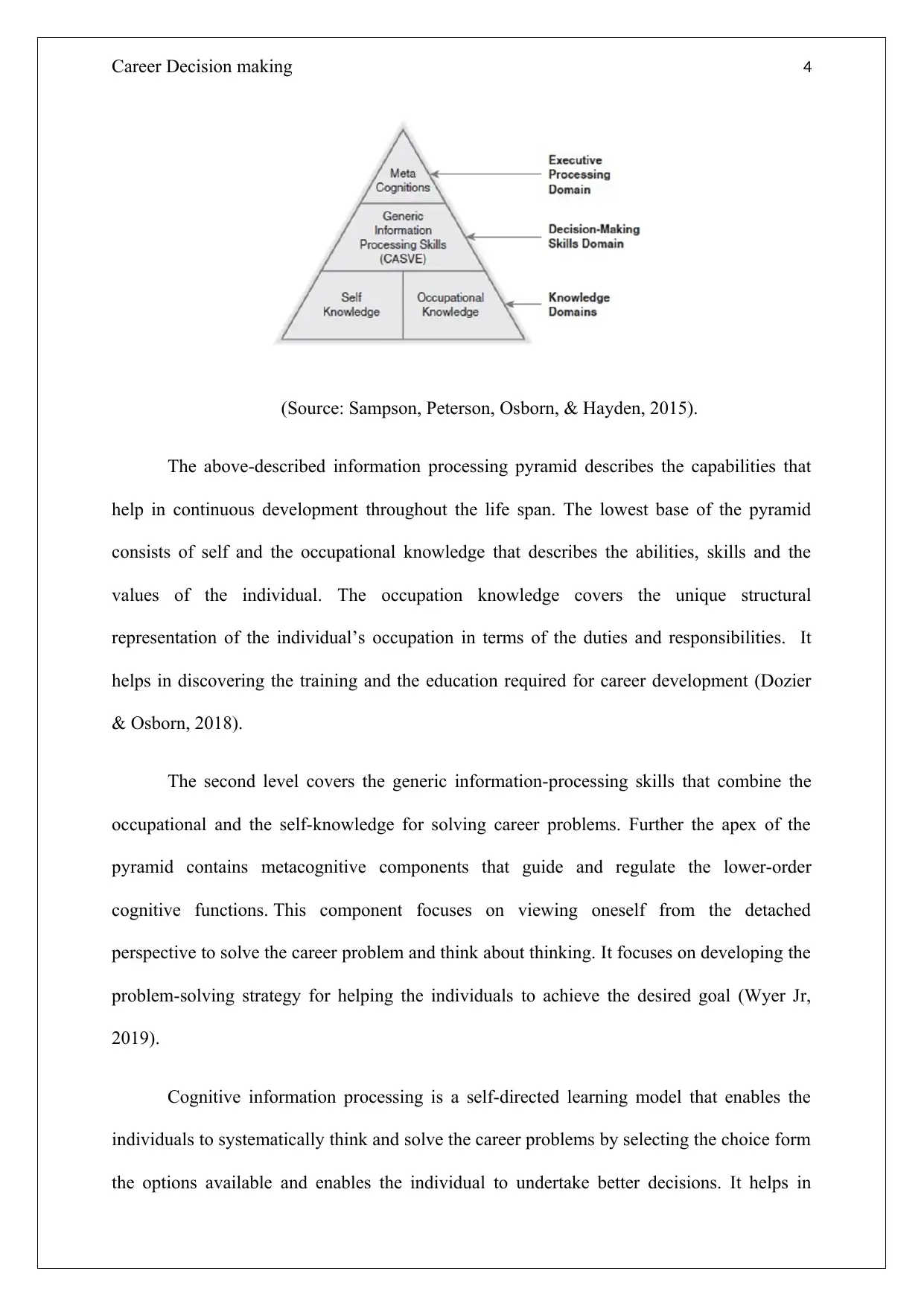
The above-stated components are categorized into the domain of information
processing which includes knowledge domain, decision-making skills domain and executive
Introduction
Career counseling is considered as a process that provides insight about yourself and
the world of work to make the career, educational and life decisions. It helps the individual in
solving the issues and developing the personality through the application of various
counseling theories (Arthur, 2018). The additional paragraphs of the report will reflect upon
the comparison between the cognitive information processing model and CASVE cycle and
will also include the self-reflection on career decision making through the application of the
CASVE cycle.
Comparison between the cognitive information processing model and
CASVE cycle
Cognitive information processing model
In order to solve the problems related to career and decision-making, the model of
cognitive information processing was developed through the joint efforts of researchers at
Florida State University. The practical application of the model was done in the year 1971.
The main components of the model include the content and the process for making the
decisions related to the career. The content includes the knowledge about one own-self i.e.
employment preferences, skills, interests, and values. It also involves the knowledge about
emotions, thoughts and metacognitions and the knowledge about the options available (Gati,
& Levin, 2015).
The above-stated components are categorized into the domain of information
processing which includes knowledge domain, decision-making skills domain and executive
⊘ This is a preview!⊘
Do you want full access?
Subscribe today to unlock all pages.

Trusted by 1+ million students worldwide
Career Decision making 3
processing domain. The process of the cognitive information processing model focuses on
making effective decisions. It considers the gap under which it determines where the
individual is and where it wants to become. This model aids in providing a deeper
understanding of one own self and the options available. This model expands and narrows the
available options by selecting the choice and valuing some options by selecting them.
Furthermore, it focuses on developing the implementation plan for the choice made and also
reflects upon the chosen option (Dozier, Lenz & Freeman, 2016).
This model aims at developing the skills among the individual to focus on the
problems related to career and also develops the skills for effective decision making and
making the appropriate career choices in the future. It provides the direction to the
individuals to solve the career-related problems and advance their career (Neubert, Mainert,
Kretzschmar & Greiff, 2015).
This model focuses on the gap between an existing state of career indecision and a
more desirable state of decidedness. The gap analyzed through this model becomes the
primary driving motivational force to search for the problem solving process because the gap
leads to the state of cognitive dissonance. The cognitive information processing consists of
problem space that entails the career problems at hand and also considers the emotional state
of the individuals (Sampson Jr, 2017).
Another component in the CIP model is career problem solving under which it
focuses on analyzing the causes, acknowledging the gap and formulates the courses of actions
in order to reduce the gap. The aim is to reduce the career problem through selection from the
alternatives available. Another component is career decision making under which it carries
out the actions for the implementation of the choice selected (Sampson, Peterson, Osborn, &
Hayden, 2015).
processing domain. The process of the cognitive information processing model focuses on
making effective decisions. It considers the gap under which it determines where the
individual is and where it wants to become. This model aids in providing a deeper
understanding of one own self and the options available. This model expands and narrows the
available options by selecting the choice and valuing some options by selecting them.
Furthermore, it focuses on developing the implementation plan for the choice made and also
reflects upon the chosen option (Dozier, Lenz & Freeman, 2016).
This model aims at developing the skills among the individual to focus on the
problems related to career and also develops the skills for effective decision making and
making the appropriate career choices in the future. It provides the direction to the
individuals to solve the career-related problems and advance their career (Neubert, Mainert,
Kretzschmar & Greiff, 2015).
This model focuses on the gap between an existing state of career indecision and a
more desirable state of decidedness. The gap analyzed through this model becomes the
primary driving motivational force to search for the problem solving process because the gap
leads to the state of cognitive dissonance. The cognitive information processing consists of
problem space that entails the career problems at hand and also considers the emotional state
of the individuals (Sampson Jr, 2017).
Another component in the CIP model is career problem solving under which it
focuses on analyzing the causes, acknowledging the gap and formulates the courses of actions
in order to reduce the gap. The aim is to reduce the career problem through selection from the
alternatives available. Another component is career decision making under which it carries
out the actions for the implementation of the choice selected (Sampson, Peterson, Osborn, &
Hayden, 2015).
Paraphrase This Document
Need a fresh take? Get an instant paraphrase of this document with our AI Paraphraser
Career Decision making 4
(Source: Sampson, Peterson, Osborn, & Hayden, 2015).
The above-described information processing pyramid describes the capabilities that
help in continuous development throughout the life span. The lowest base of the pyramid
consists of self and the occupational knowledge that describes the abilities, skills and the
values of the individual. The occupation knowledge covers the unique structural
representation of the individual’s occupation in terms of the duties and responsibilities. It
helps in discovering the training and the education required for career development (Dozier
& Osborn, 2018).
The second level covers the generic information-processing skills that combine the
occupational and the self-knowledge for solving career problems. Further the apex of the
pyramid contains metacognitive components that guide and regulate the lower-order
cognitive functions. This component focuses on viewing oneself from the detached
perspective to solve the career problem and think about thinking. It focuses on developing the
problem-solving strategy for helping the individuals to achieve the desired goal (Wyer Jr,
2019).
Cognitive information processing is a self-directed learning model that enables the
individuals to systematically think and solve the career problems by selecting the choice form
the options available and enables the individual to undertake better decisions. It helps in
(Source: Sampson, Peterson, Osborn, & Hayden, 2015).
The above-described information processing pyramid describes the capabilities that
help in continuous development throughout the life span. The lowest base of the pyramid
consists of self and the occupational knowledge that describes the abilities, skills and the
values of the individual. The occupation knowledge covers the unique structural
representation of the individual’s occupation in terms of the duties and responsibilities. It
helps in discovering the training and the education required for career development (Dozier
& Osborn, 2018).
The second level covers the generic information-processing skills that combine the
occupational and the self-knowledge for solving career problems. Further the apex of the
pyramid contains metacognitive components that guide and regulate the lower-order
cognitive functions. This component focuses on viewing oneself from the detached
perspective to solve the career problem and think about thinking. It focuses on developing the
problem-solving strategy for helping the individuals to achieve the desired goal (Wyer Jr,
2019).
Cognitive information processing is a self-directed learning model that enables the
individuals to systematically think and solve the career problems by selecting the choice form
the options available and enables the individual to undertake better decisions. It helps in
Career Decision making 5
acquiring the self and the occupational knowledge and combining them to take the decision
(Savickas, 2015).
In contrast to the above model, the CASVE cycle model focuses on plays the key role
in equipping individuals with the knowledge to become independent decision-makers and
provides the framework for future career decision making. It also helps in developing the
critical thinking skills that will aid in making future career decisions. It acts as a guide for
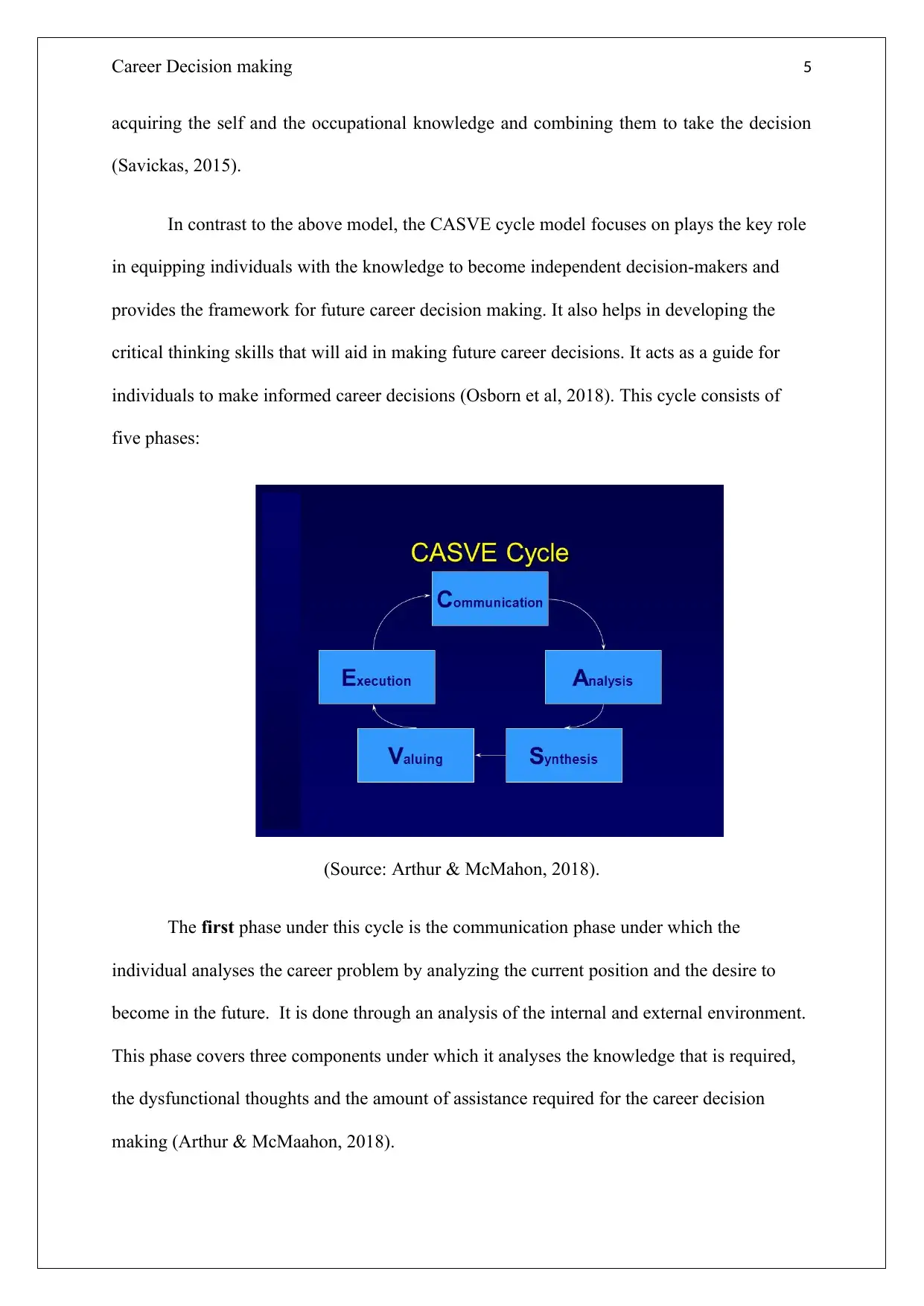
individuals to make informed career decisions (Osborn et al, 2018). This cycle consists of
five phases:
(Source: Arthur & McMahon, 2018).
The first phase under this cycle is the communication phase under which the
individual analyses the career problem by analyzing the current position and the desire to
become in the future. It is done through an analysis of the internal and external environment.
This phase covers three components under which it analyses the knowledge that is required,
the dysfunctional thoughts and the amount of assistance required for the career decision
making (Arthur & McMaahon, 2018).
acquiring the self and the occupational knowledge and combining them to take the decision
(Savickas, 2015).
In contrast to the above model, the CASVE cycle model focuses on plays the key role
in equipping individuals with the knowledge to become independent decision-makers and
provides the framework for future career decision making. It also helps in developing the
critical thinking skills that will aid in making future career decisions. It acts as a guide for
individuals to make informed career decisions (Osborn et al, 2018). This cycle consists of
five phases:
(Source: Arthur & McMahon, 2018).
The first phase under this cycle is the communication phase under which the
individual analyses the career problem by analyzing the current position and the desire to
become in the future. It is done through an analysis of the internal and external environment.
This phase covers three components under which it analyses the knowledge that is required,
the dysfunctional thoughts and the amount of assistance required for the career decision
making (Arthur & McMaahon, 2018).
⊘ This is a preview!⊘
Do you want full access?
Subscribe today to unlock all pages.
Trusted by 1+ million students worldwide
Career Decision making 6
In this phase, the discomfort becomes greater than the fear of change and the internal
conditions that bring the discomfort include the emotions, avoidance behavior and the
psychological state of the individuals. The external that creates the career problem includes
the outside events and the significance of the other career decisions (Sharf, 2016).
The second phase under this cycle is the analysis phase under which the individual
gains the self-knowledge and the occupational knowledge. The self-knowledge covers the
values, skills, and interests of oneself and gaining insight into what the individual desires.
Under this stage, the individual gains self-knowledge about the gap and also clarifies the
knowledge related gap in order to solve the career-related problems and undertake
appropriate decisions (Lustig, Xu & Strauser, 2017).
This phase also provides insight into the occupation knowledge required to overcome
the career problem. It allows the individual to make the analysis of occupation required and
also provides an understanding of the world of work. It also helps in analyzing how much
negative and positive thinking influences the behavior of the individual. At this phase, the
company gains the self and the occupation knowledge and relates it with the existing
knowledge to make informed career decisions (Vondracek, F. W., Lerner, R. M., &
Schulenberg, 2019).
The third phase of the cycle is synthesis under which the individual engages in
elaboration by creating the list of options and narrowing the list of options through the
process of crystallization. It covers the exercise of brainstorming to expand the lists of
possible options and derive the solution for reducing the gap in career problems. It also
includes synthesis crystallization to reduce the list of available options. This phase allows the
individual to reach three to five possible options that will help the individual in solving career
problems and will promote the growth of the individual (Arthur, 2018).
In this phase, the discomfort becomes greater than the fear of change and the internal
conditions that bring the discomfort include the emotions, avoidance behavior and the
psychological state of the individuals. The external that creates the career problem includes
the outside events and the significance of the other career decisions (Sharf, 2016).
The second phase under this cycle is the analysis phase under which the individual
gains the self-knowledge and the occupational knowledge. The self-knowledge covers the
values, skills, and interests of oneself and gaining insight into what the individual desires.
Under this stage, the individual gains self-knowledge about the gap and also clarifies the
knowledge related gap in order to solve the career-related problems and undertake
appropriate decisions (Lustig, Xu & Strauser, 2017).
This phase also provides insight into the occupation knowledge required to overcome
the career problem. It allows the individual to make the analysis of occupation required and
also provides an understanding of the world of work. It also helps in analyzing how much
negative and positive thinking influences the behavior of the individual. At this phase, the
company gains the self and the occupation knowledge and relates it with the existing
knowledge to make informed career decisions (Vondracek, F. W., Lerner, R. M., &
Schulenberg, 2019).
The third phase of the cycle is synthesis under which the individual engages in
elaboration by creating the list of options and narrowing the list of options through the
process of crystallization. It covers the exercise of brainstorming to expand the lists of
possible options and derive the solution for reducing the gap in career problems. It also
includes synthesis crystallization to reduce the list of available options. This phase allows the
individual to reach three to five possible options that will help the individual in solving career
problems and will promote the growth of the individual (Arthur, 2018).
Paraphrase This Document
Need a fresh take? Get an instant paraphrase of this document with our AI Paraphraser
Career Decision making 7
It is also analyzed that the individuals consider the various significant factors and
their families in taking the decisions. Such factors help the Individual in narrowing its
options and reducing the gap through the appropriate decision making. The aim of this phase
to avoid the alternatives that do match with the personal values of the individual and also
helps in narrowing the options through the process of crystallization (Blustein et al, 2018).
The fourth phase of the cycle is the valuing phase under which the individual
focuses on analyzing the cost and the benefits associated with the option derived at the above
stage. It concentrates on analyzing the cost and the benefits for own self, for the family,
cultural group and the community. In this phase, the individual makes a detailed analysis of
the option and focuses on selecting the best choice. It will focus on integrating the
occupational knowledge and the personal values with the options for selecting the best choice
and considers the cots and benefits of a selection of the option (Greco & Kraimer, 2019).
The last phase of the cycle is execution under which the individual focuses on
converting the thoughts into action. Under this phase, the individual formulates the goal and
executes the plan for implementing the choice selected at the above stage. It involves
planning the activities, testing the choice and finally implementing it to achieve the desired
state and accomplish the choice. At this phase the individual pays attention to the realistic
constraints creates the action plan for closing the gap between the current position and the
desired position of the individual (Leuty et al, 2015).
Considering the above information it is evaluated that the cognitive information
processing model provides the self-knowledge and the occupational knowledge to analyze the
gap between the current and the desired state. In contrast to the above, the CASVE cycle
focuses on the practical implementation of the choice considering the factors and the personal
It is also analyzed that the individuals consider the various significant factors and
their families in taking the decisions. Such factors help the Individual in narrowing its
options and reducing the gap through the appropriate decision making. The aim of this phase
to avoid the alternatives that do match with the personal values of the individual and also
helps in narrowing the options through the process of crystallization (Blustein et al, 2018).
The fourth phase of the cycle is the valuing phase under which the individual
focuses on analyzing the cost and the benefits associated with the option derived at the above
stage. It concentrates on analyzing the cost and the benefits for own self, for the family,
cultural group and the community. In this phase, the individual makes a detailed analysis of
the option and focuses on selecting the best choice. It will focus on integrating the
occupational knowledge and the personal values with the options for selecting the best choice
and considers the cots and benefits of a selection of the option (Greco & Kraimer, 2019).
The last phase of the cycle is execution under which the individual focuses on
converting the thoughts into action. Under this phase, the individual formulates the goal and
executes the plan for implementing the choice selected at the above stage. It involves
planning the activities, testing the choice and finally implementing it to achieve the desired
state and accomplish the choice. At this phase the individual pays attention to the realistic
constraints creates the action plan for closing the gap between the current position and the
desired position of the individual (Leuty et al, 2015).
Considering the above information it is evaluated that the cognitive information
processing model provides the self-knowledge and the occupational knowledge to analyze the
gap between the current and the desired state. In contrast to the above, the CASVE cycle
focuses on the practical implementation of the choice considering the factors and the personal
Career Decision making 8
values of the individual. It also helps in valuing the options derived through the process of
crystallization to select the best choice and reduce the communication gap.
It is recorded that under the CASVE cycle the individual can revisit to the
communication phase to analyze that the gap is reduced but it is not applicable in case of the
cognitive information processing model.
Self-reflection based on CASVE Cycle
Considering the above discussed CASVE cycle, I will focus on implementing the
phases of this cycle in my personal life to solve my career problem and chose the career
decision. It includes the following phases.
Phase 1: Communication
Under this phase I have analyzed I am suffering from various psychological tensions
because I am not able to handle the avoidance behavior of the employees at my current
workplace and feel the high pressure of work which in turn disturbs my psychological states
and creates the desire to shift to another job. I feel that I possess the skills and the knowledge
to perform higher job roles and also face the external pressures from my family friends to
shift to a job that provides me greater incentives and higher responsibility.
Considering the above issue of career exploitation, the article “Career Exploration and
Career Decision-Making Difficulties: The Moderating Role of Creative Self-Efficacy”
reflects that career exploitation helps the individual in analyzing the job characteristics and
gets positive associated with career decision making difficulties. It allows the individual to
analyze the expectation of the organization (Storme & Celik, 2017).
values of the individual. It also helps in valuing the options derived through the process of
crystallization to select the best choice and reduce the communication gap.
It is recorded that under the CASVE cycle the individual can revisit to the
communication phase to analyze that the gap is reduced but it is not applicable in case of the
cognitive information processing model.
Self-reflection based on CASVE Cycle
Considering the above discussed CASVE cycle, I will focus on implementing the
phases of this cycle in my personal life to solve my career problem and chose the career
decision. It includes the following phases.
Phase 1: Communication
Under this phase I have analyzed I am suffering from various psychological tensions
because I am not able to handle the avoidance behavior of the employees at my current
workplace and feel the high pressure of work which in turn disturbs my psychological states
and creates the desire to shift to another job. I feel that I possess the skills and the knowledge
to perform higher job roles and also face the external pressures from my family friends to
shift to a job that provides me greater incentives and higher responsibility.
Considering the above issue of career exploitation, the article “Career Exploration and
Career Decision-Making Difficulties: The Moderating Role of Creative Self-Efficacy”
reflects that career exploitation helps the individual in analyzing the job characteristics and
gets positive associated with career decision making difficulties. It allows the individual to
analyze the expectation of the organization (Storme & Celik, 2017).
⊘ This is a preview!⊘
Do you want full access?
Subscribe today to unlock all pages.
Trusted by 1+ million students worldwide
Career Decision making 9
I have realized that I possess the analytical and technical skills which will help me in
performing higher job roles with full efficiency. I am not satisfied with my current job profile
because I am not getting the opportunity to directly communicate the customers and influence
them. I have been given the responsibility to work from the back end. I feel bored in
performing the monotonous work and realized that I am not able to get the exposure that is
becoming the hindrance in my growth (Ibrahim, Arip & Bistaman, 2017).
In respect to the above issue, the article “How to attract and retain Generation Y
employees? An exploration of career choice and the meaning of work” reflects that employee
satisfaction is important for the retention of employees. It allows the employees to make
career decisions and bridges the gap between employee motivation and job choices. It states
that dissatisfaction at the workplace reduces employee retention and helps the employees to
make career choices(Wong, Wan, & Gao, 2017).
I realized that I am capable of performing higher job roles because I have knowledge
about the industry and also possess the financial acumen that will help my company to make
better decisions and develop the growth of the business. Apart from the internal state, there
are various external factors that drive me to leave my current job. On the competition of my
post-graduation degree, my family is expecting me to be at a higher position that will enable
me to maintain my status quo and earn a respectable position in society.
In context to the above-discussed issue, the article, “the Impact of Intrinsic and
Extrinsic Motivators on Employee Engagement in Information Organizations” reflects that
the intrinsic and the extrinsic factors play the major role in employee satisfaction and drives
the career choices. It states that professional development, job security, financial stability and
culture of respect, recognition plays the role in employee motivation and responding to the
issues at the workplace (Singh, 2016).
I have realized that I possess the analytical and technical skills which will help me in
performing higher job roles with full efficiency. I am not satisfied with my current job profile
because I am not getting the opportunity to directly communicate the customers and influence
them. I have been given the responsibility to work from the back end. I feel bored in
performing the monotonous work and realized that I am not able to get the exposure that is
becoming the hindrance in my growth (Ibrahim, Arip & Bistaman, 2017).
In respect to the above issue, the article “How to attract and retain Generation Y
employees? An exploration of career choice and the meaning of work” reflects that employee
satisfaction is important for the retention of employees. It allows the employees to make
career decisions and bridges the gap between employee motivation and job choices. It states
that dissatisfaction at the workplace reduces employee retention and helps the employees to
make career choices(Wong, Wan, & Gao, 2017).
I realized that I am capable of performing higher job roles because I have knowledge
about the industry and also possess the financial acumen that will help my company to make
better decisions and develop the growth of the business. Apart from the internal state, there
are various external factors that drive me to leave my current job. On the competition of my
post-graduation degree, my family is expecting me to be at a higher position that will enable
me to maintain my status quo and earn a respectable position in society.
In context to the above-discussed issue, the article, “the Impact of Intrinsic and
Extrinsic Motivators on Employee Engagement in Information Organizations” reflects that
the intrinsic and the extrinsic factors play the major role in employee satisfaction and drives
the career choices. It states that professional development, job security, financial stability and
culture of respect, recognition plays the role in employee motivation and responding to the
issues at the workplace (Singh, 2016).
Paraphrase This Document
Need a fresh take? Get an instant paraphrase of this document with our AI Paraphraser
Career Decision making 10
Through the self-analysis, the communication gap has been identified which specifies
that I am not satisfied with the current job of business managers and want to attain higher
positions. Such higher expectation creates a career problem and a sense of dissatisfaction
from the current of position.
Considering the above issues at the workplace the article “Self-employment and
work-related stress: The mediating role of job control and job demand” states that the
increasing job demand creates work stress and however affects the health of the individual.
The articles also state that increased job control reduces the stress level of employees which
in turn develops the need to make the individual self-employed (Hessels, Rietveld & Van Der
Zwan, 2017).
Phase 2: Analysis
This phase will reflect upon my skills, interest, and values and will provide insight
into my educational qualification and job title. In order to fill the communicating gap, I have
realized that I am good at numbers and also have the financial acumen to carry out the
business operations and maintain the interest of the stakeholders. I possess the technical,
negotiating and communication skills to deliver maximum satisfaction to the customers and
manage the function of the organization. I have the ability to handle the stress of complex job
roles and also possess the knowledge about the market and industry to control the credit risk
and evaluate the opportunities for the business.
I value honesty and performs the work will full commitment. In order to perform the
job roles, I expect higher income that will act as a motivational source and will drive my
energy to put more effort into the company. Through the internal and the external factors, I
am able to make a proper self-analysis and have realized that I have the interest of performing
the job roles that will provide the opportunity to apply my analytical and communication
Through the self-analysis, the communication gap has been identified which specifies
that I am not satisfied with the current job of business managers and want to attain higher
positions. Such higher expectation creates a career problem and a sense of dissatisfaction
from the current of position.
Considering the above issues at the workplace the article “Self-employment and
work-related stress: The mediating role of job control and job demand” states that the
increasing job demand creates work stress and however affects the health of the individual.
The articles also state that increased job control reduces the stress level of employees which
in turn develops the need to make the individual self-employed (Hessels, Rietveld & Van Der
Zwan, 2017).
Phase 2: Analysis
This phase will reflect upon my skills, interest, and values and will provide insight
into my educational qualification and job title. In order to fill the communicating gap, I have
realized that I am good at numbers and also have the financial acumen to carry out the
business operations and maintain the interest of the stakeholders. I possess the technical,
negotiating and communication skills to deliver maximum satisfaction to the customers and
manage the function of the organization. I have the ability to handle the stress of complex job
roles and also possess the knowledge about the market and industry to control the credit risk
and evaluate the opportunities for the business.
I value honesty and performs the work will full commitment. In order to perform the
job roles, I expect higher income that will act as a motivational source and will drive my
energy to put more effort into the company. Through the internal and the external factors, I
am able to make a proper self-analysis and have realized that I have the interest of performing
the job roles that will provide the opportunity to apply my analytical and communication
Career Decision making 11
skills to directly communicate with the ultimate users and will also aid in my personality
development. I have an interest in becoming a risk officer because I have the capability to
develop networks and also possess the capabilities to take the strategic decisions that will aid
in the growth of the company and will promote a positive working environment.
In performing the higher job roles, I have done my graduation in business
administration and I have also completed my post-graduation in business administration with
a specialisation in human resources. In order to fulfill the above-discussed gap, I will be
requiring more training to get expertise in the technical and negotiating skills because my
specialization in human resources can become a barrier in achieving my desired goal due to
lack of required efficiency (Coetzee, Ferreira & Potgieter, 2015).
Phase 3: Synthesis
This phase will reflect upon the options for solving career problems. My current job
profile as a business manager has helped me in developing my financial acumen and gaining
knowledge about the market. I have realized that I am a quick learner and possess the ability
to make decisions for the company. Such analysis will help me in reducing the gap and
attaining my desired goal
In order to attain the higher positions of operational risk officer, I will be requiring
enrolling in courses such as Chartered Enterprise Risk Analyst and attaining the Certified
Risk manager certificate for becoming the qualified personnel that fits the desired job
position. I can also attain the certificate of PRM i.e. professional risk manager. Such courses
will allow me to become the preferred choice of the company and will increase my eligibility
to become the operational risk manager.
skills to directly communicate with the ultimate users and will also aid in my personality
development. I have an interest in becoming a risk officer because I have the capability to
develop networks and also possess the capabilities to take the strategic decisions that will aid
in the growth of the company and will promote a positive working environment.
In performing the higher job roles, I have done my graduation in business
administration and I have also completed my post-graduation in business administration with
a specialisation in human resources. In order to fulfill the above-discussed gap, I will be
requiring more training to get expertise in the technical and negotiating skills because my
specialization in human resources can become a barrier in achieving my desired goal due to
lack of required efficiency (Coetzee, Ferreira & Potgieter, 2015).
Phase 3: Synthesis
This phase will reflect upon the options for solving career problems. My current job
profile as a business manager has helped me in developing my financial acumen and gaining
knowledge about the market. I have realized that I am a quick learner and possess the ability
to make decisions for the company. Such analysis will help me in reducing the gap and
attaining my desired goal
In order to attain the higher positions of operational risk officer, I will be requiring
enrolling in courses such as Chartered Enterprise Risk Analyst and attaining the Certified
Risk manager certificate for becoming the qualified personnel that fits the desired job
position. I can also attain the certificate of PRM i.e. professional risk manager. Such courses
will allow me to become the preferred choice of the company and will increase my eligibility
to become the operational risk manager.
⊘ This is a preview!⊘
Do you want full access?
Subscribe today to unlock all pages.
Trusted by 1+ million students worldwide

1 out of 20


Related Documents


Your All-in-One AI-Powered Toolkit for Academic Success.
+13062052269
info@desklib.com
Available 24*7 on WhatsApp / Email
![[object Object]](/_next/static/media/star-bottom.7253800d.svg)
Unlock your academic potential
Copyright © 2020–2025 A2Z Services. All Rights Reserved. Developed and managed by ZUCOL.