Career Management Report: Career Construction Theories and Skills

Verified

Added on  2021/04/17

|7
|965
|28
Report
AI Summary
This report provides an overview of career management, exploring various theories related to career construction. It begins by discussing three key theories: social learning theory, social cognitive career theory, and career construction theory, outlining their significance in shaping occupational choices and career development. The report further examines the crucial roles of resilience, identity, adaptability, and learning in achieving career success, emphasizing how these elements contribute to navigating challenges and fostering growth. The report concludes by synthesizing the discussed theories and highlighting the importance of these factors in effective career management, offering insights into how individuals can strategically approach their professional journeys. The report is a valuable resource for students seeking to understand the dynamics of career development and planning.
Document Page
Running head: CAREER MANAGEMENT
Career Management
Name of the Student:
Name of the University:
Author Note:
tabler-icon-diamond-filled.svg

Paraphrase This Document

Need a fresh take? Get an instant paraphrase of this document with our AI Paraphraser
Document Page
1CAREER MANAGEMENT
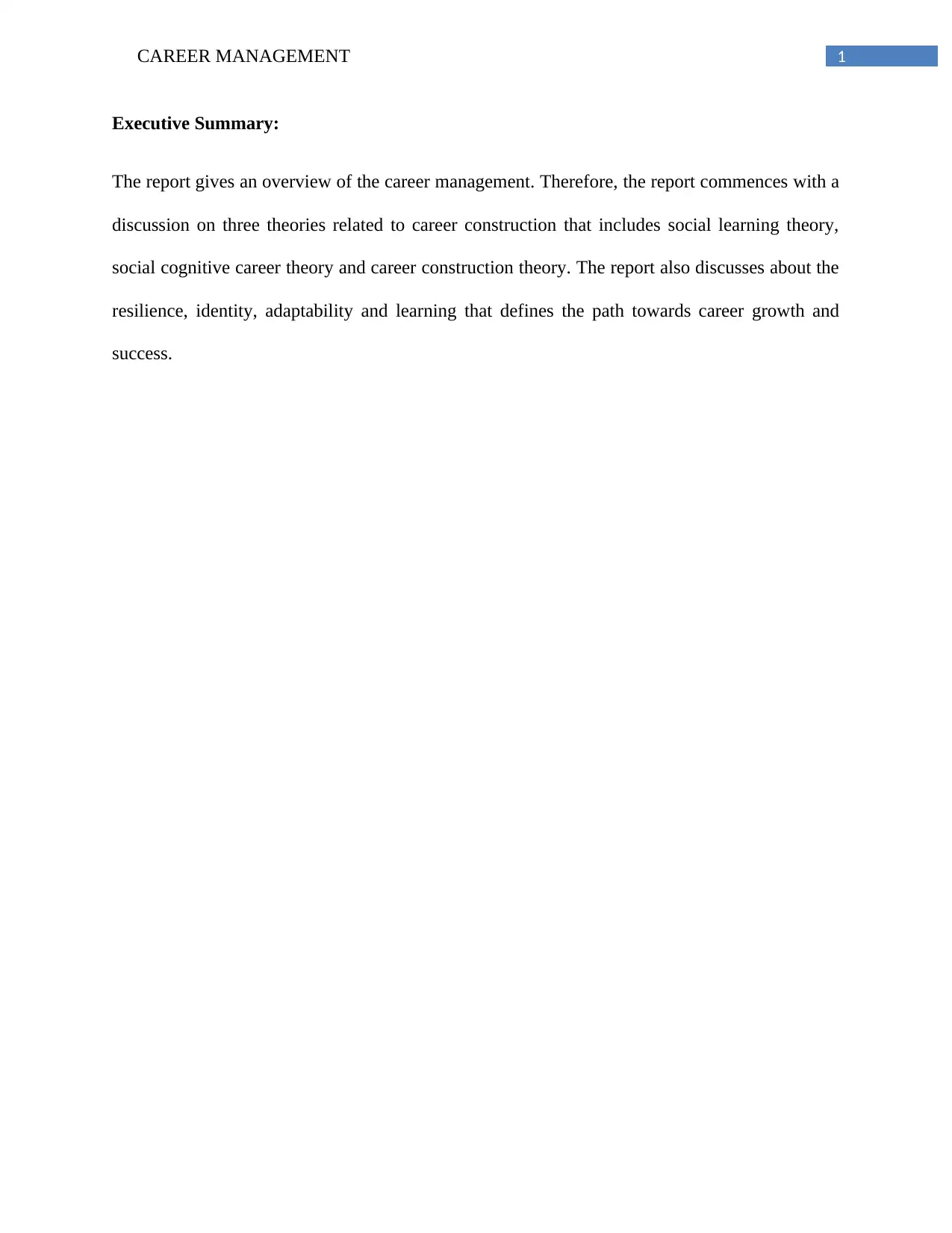
Executive Summary:
The report gives an overview of the career management. Therefore, the report commences with a
discussion on three theories related to career construction that includes social learning theory,
social cognitive career theory and career construction theory. The report also discusses about the
resilience, identity, adaptability and learning that defines the path towards career growth and
success.
Document Page
2CAREER MANAGEMENT
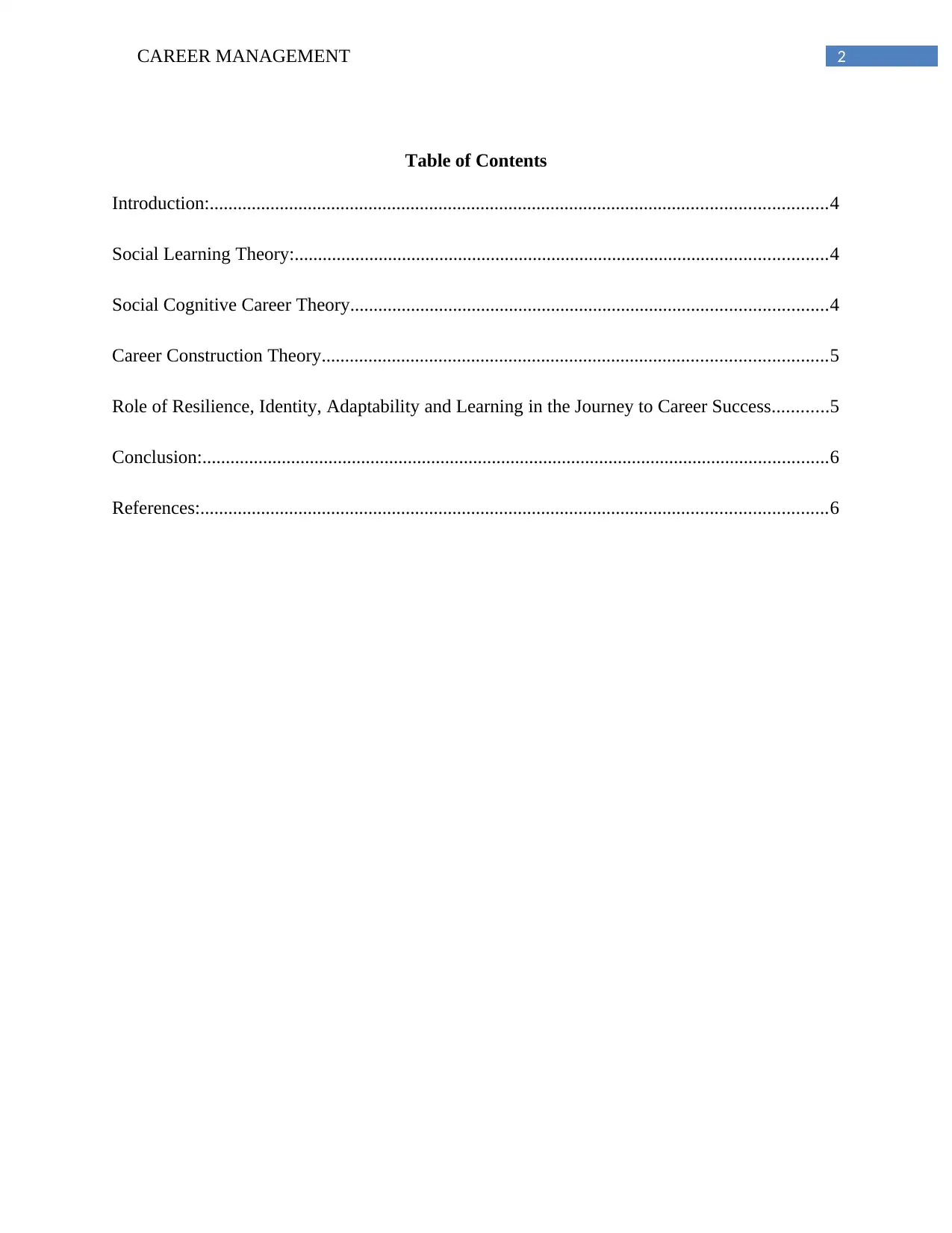
Table of Contents
Introduction:....................................................................................................................................4
Social Learning Theory:..................................................................................................................4
Social Cognitive Career Theory......................................................................................................4
Career Construction Theory............................................................................................................5
Role of Resilience, Identity, Adaptability and Learning in the Journey to Career Success............5
Conclusion:......................................................................................................................................6
References:......................................................................................................................................6
Document Page
3CAREER MANAGEMENT
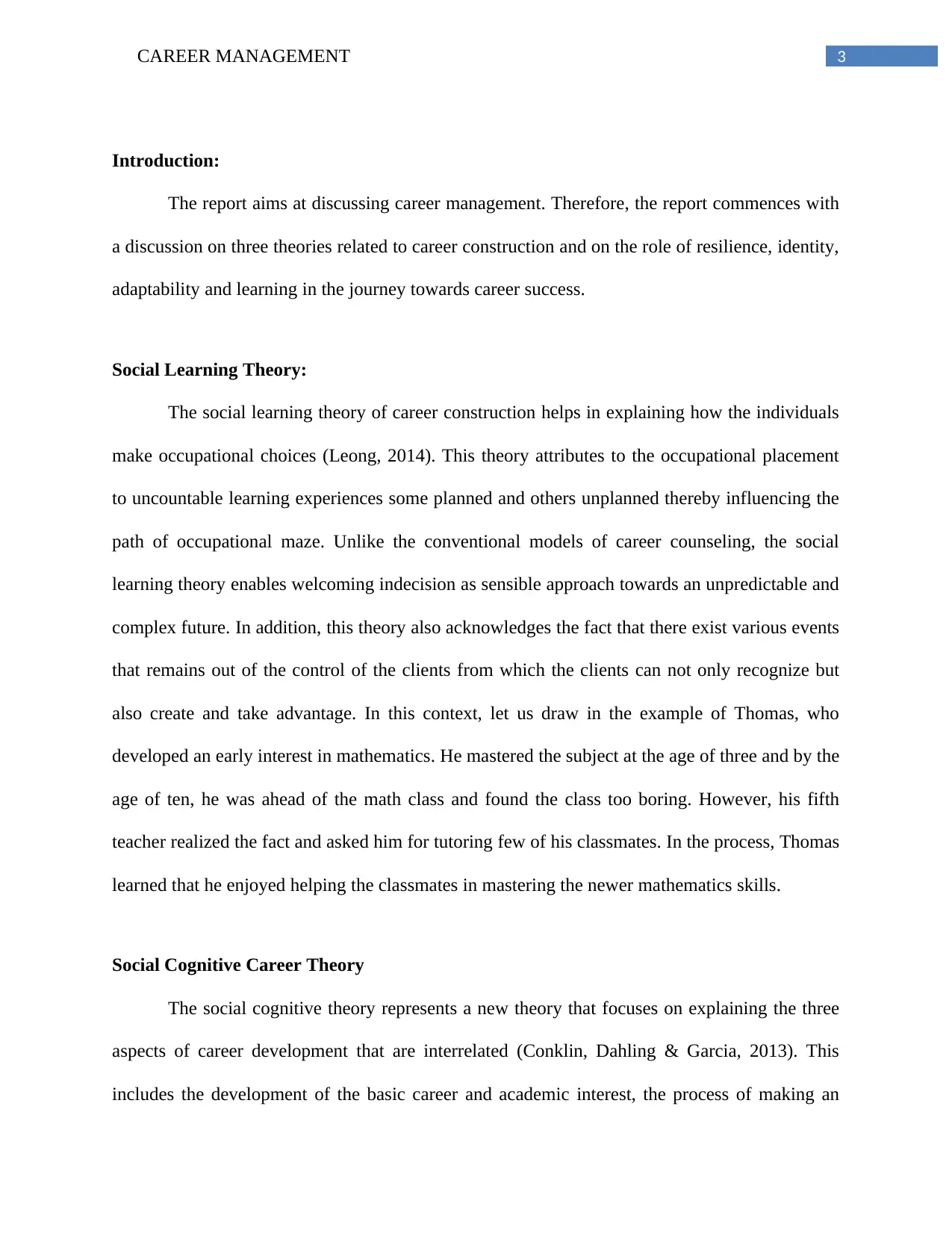
Introduction:
The report aims at discussing career management. Therefore, the report commences with
a discussion on three theories related to career construction and on the role of resilience, identity,
adaptability and learning in the journey towards career success.
Social Learning Theory:
The social learning theory of career construction helps in explaining how the individuals
make occupational choices (Leong, 2014). This theory attributes to the occupational placement
to uncountable learning experiences some planned and others unplanned thereby influencing the
path of occupational maze. Unlike the conventional models of career counseling, the social
learning theory enables welcoming indecision as sensible approach towards an unpredictable and
complex future. In addition, this theory also acknowledges the fact that there exist various events
that remains out of the control of the clients from which the clients can not only recognize but
also create and take advantage. In this context, let us draw in the example of Thomas, who
developed an early interest in mathematics. He mastered the subject at the age of three and by the
age of ten, he was ahead of the math class and found the class too boring. However, his fifth
teacher realized the fact and asked him for tutoring few of his classmates. In the process, Thomas
learned that he enjoyed helping the classmates in mastering the newer mathematics skills.
Social Cognitive Career Theory
The social cognitive theory represents a new theory that focuses on explaining the three
aspects of career development that are interrelated (Conklin, Dahling & Garcia, 2013). This
includes the development of the basic career and academic interest, the process of making an
tabler-icon-diamond-filled.svg

Paraphrase This Document

Need a fresh take? Get an instant paraphrase of this document with our AI Paraphraser
Document Page
4CAREER MANAGEMENT
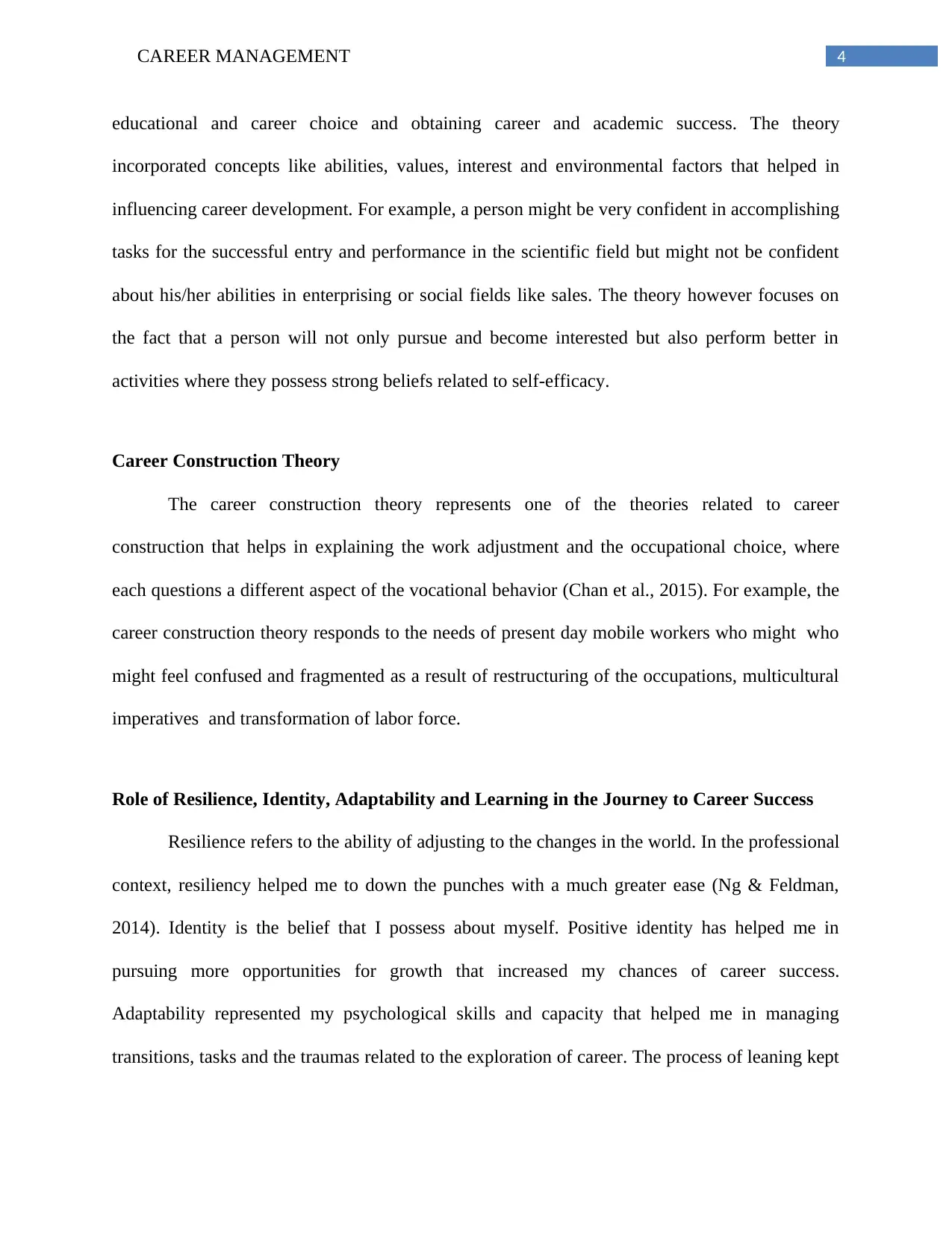
educational and career choice and obtaining career and academic success. The theory
incorporated concepts like abilities, values, interest and environmental factors that helped in
influencing career development. For example, a person might be very confident in accomplishing
tasks for the successful entry and performance in the scientific field but might not be confident
about his/her abilities in enterprising or social fields like sales. The theory however focuses on
the fact that a person will not only pursue and become interested but also perform better in
activities where they possess strong beliefs related to self-efficacy.
Career Construction Theory
The career construction theory represents one of the theories related to career
construction that helps in explaining the work adjustment and the occupational choice, where
each questions a different aspect of the vocational behavior (Chan et al., 2015). For example, the
career construction theory responds to the needs of present day mobile workers who might who
might feel confused and fragmented as a result of restructuring of the occupations, multicultural
imperatives and transformation of labor force.
Role of Resilience, Identity, Adaptability and Learning in the Journey to Career Success
Resilience refers to the ability of adjusting to the changes in the world. In the professional
context, resiliency helped me to down the punches with a much greater ease (Ng & Feldman,
2014). Identity is the belief that I possess about myself. Positive identity has helped me in
pursuing more opportunities for growth that increased my chances of career success.
Adaptability represented my psychological skills and capacity that helped me in managing
transitions, tasks and the traumas related to the exploration of career. The process of leaning kept
Document Page
5CAREER MANAGEMENT
me up to date, enabled development of natural abilities and relationships, be productive and
thereby achieve fulfillment.
Conclusion:
The report ends by giving an insight into how the different career construction theories
help in career management. One is also able to see how resilience, identity, adaptability and
learning help in path towards success.
Document Page
6CAREER MANAGEMENT
References:
Chan, K. Y., Uy, M. A., Moon-ho, R. H., Sam, Y. L., Chernyshenko, O. S., & Yu, K. Y. T.
(2015). Comparing two career adaptability measures for career construction theory:
Relations with boundaryless mindset and protean career attitudes. Journal of Vocational
Behavior, 87, 22-31.
Conklin, A. M., Dahling, J. J., & Garcia, P. A. (2013). Linking affective commitment, career
self-efficacy, and outcome expectations: A test of social cognitive career theory. Journal
of Career Development, 40(1), 68-83.
Leong, F. (Ed.). (2014). Career development and vocational behavior of racial and ethnic
minorities. Routledge.
Ng, T. W., & Feldman, D. C. (2014). Subjective career success: A meta-analytic review. Journal
of Vocational Behavior, 85(2), 169-179.
chevron_up_icon
1 out of 7
circle_padding
hide_on_mobile
zoom_out_icon
[object Object]