Caring for Dementia/Delirium Patients: Exploring Nurse's Self Conflict
VerifiedAdded on 2023/06/10
|4
|931
|53
Essay
AI Summary
This essay delves into the intricate conflict between a nurse's public and private self when providing care for individuals with dementia or delirium. It highlights the challenges nurses face in balancing their personal emotions (private self) with the professional demeanor they must maintain (public self). The essay explores how cultural, familial, and spiritual values influence these conflicting perspectives. It further discusses the impact of these internal conflicts on the quality of patient care and emphasizes the importance of nurses continually examining their own values and beliefs to provide effective and compassionate care. The essay also touches upon the emotional and physical toll that caring for patients with dementia or delirium can take on nurses, including feelings of helplessness, stress, and burnout. Desklib provides this paper as a resource for students.
Running head: CARING FOR PEOPLE WITH DEMENTIA OR DELIRIUM
CARING FOR PEOPLE WITH DEMENTIA OR DELIRIUM
Name of the Student
Name of the University
Author note
CARING FOR PEOPLE WITH DEMENTIA OR DELIRIUM
Name of the Student
Name of the University
Author note
Paraphrase This Document
Need a fresh take? Get an instant paraphrase of this document with our AI Paraphraser

1CARING FOR PEOPLE WITH DEMENTIA OR DELIRIUM
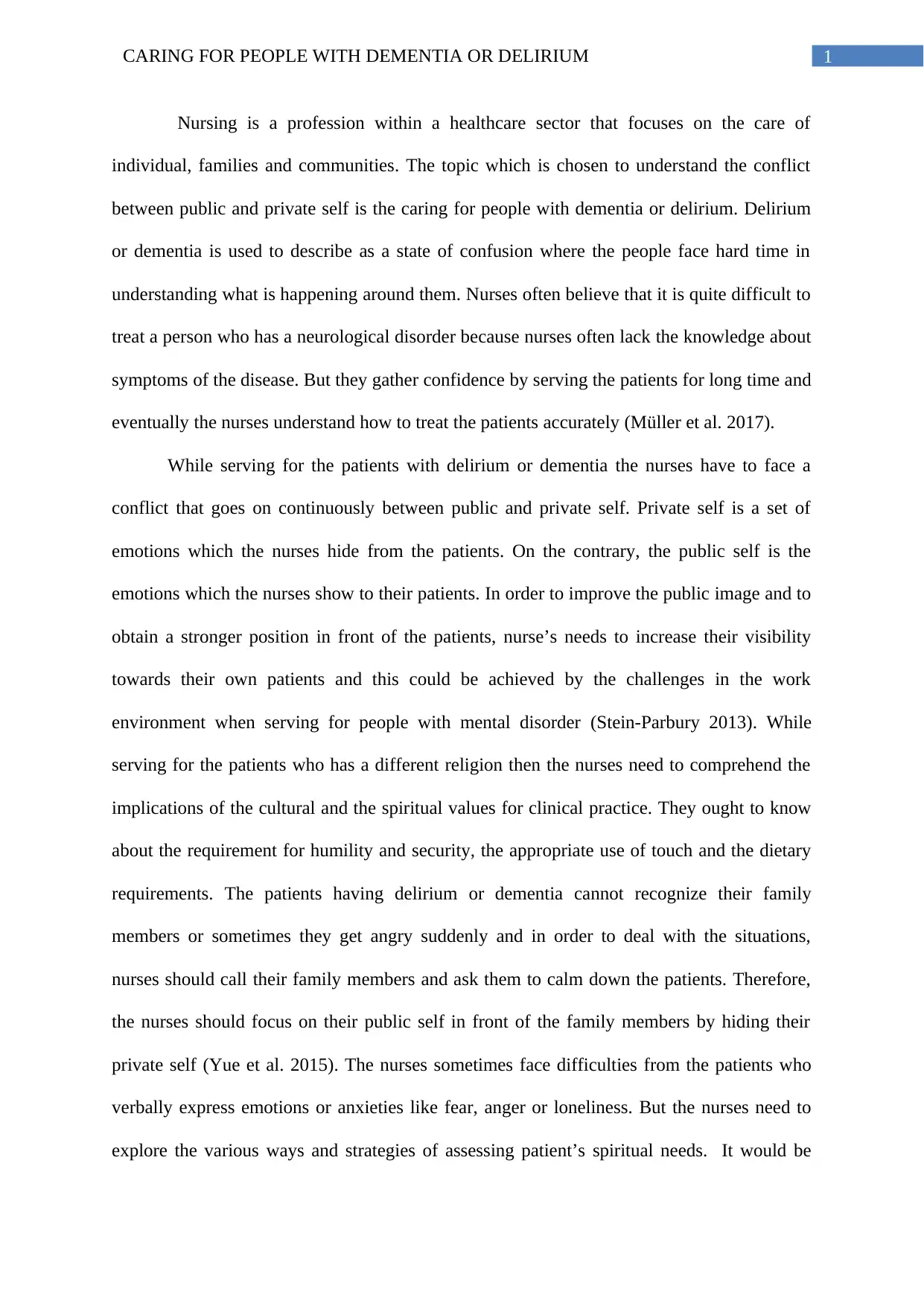
Nursing is a profession within a healthcare sector that focuses on the care of
individual, families and communities. The topic which is chosen to understand the conflict
between public and private self is the caring for people with dementia or delirium. Delirium
or dementia is used to describe as a state of confusion where the people face hard time in
understanding what is happening around them. Nurses often believe that it is quite difficult to
treat a person who has a neurological disorder because nurses often lack the knowledge about
symptoms of the disease. But they gather confidence by serving the patients for long time and
eventually the nurses understand how to treat the patients accurately (Müller et al. 2017).
While serving for the patients with delirium or dementia the nurses have to face a
conflict that goes on continuously between public and private self. Private self is a set of
emotions which the nurses hide from the patients. On the contrary, the public self is the
emotions which the nurses show to their patients. In order to improve the public image and to
obtain a stronger position in front of the patients, nurse’s needs to increase their visibility
towards their own patients and this could be achieved by the challenges in the work
environment when serving for people with mental disorder (Stein-Parbury 2013). While
serving for the patients who has a different religion then the nurses need to comprehend the
implications of the cultural and the spiritual values for clinical practice. They ought to know
about the requirement for humility and security, the appropriate use of touch and the dietary
requirements. The patients having delirium or dementia cannot recognize their family
members or sometimes they get angry suddenly and in order to deal with the situations,
nurses should call their family members and ask them to calm down the patients. Therefore,
the nurses should focus on their public self in front of the family members by hiding their
private self (Yue et al. 2015). The nurses sometimes face difficulties from the patients who
verbally express emotions or anxieties like fear, anger or loneliness. But the nurses need to
explore the various ways and strategies of assessing patient’s spiritual needs. It would be
Nursing is a profession within a healthcare sector that focuses on the care of
individual, families and communities. The topic which is chosen to understand the conflict
between public and private self is the caring for people with dementia or delirium. Delirium
or dementia is used to describe as a state of confusion where the people face hard time in
understanding what is happening around them. Nurses often believe that it is quite difficult to
treat a person who has a neurological disorder because nurses often lack the knowledge about
symptoms of the disease. But they gather confidence by serving the patients for long time and
eventually the nurses understand how to treat the patients accurately (Müller et al. 2017).
While serving for the patients with delirium or dementia the nurses have to face a
conflict that goes on continuously between public and private self. Private self is a set of
emotions which the nurses hide from the patients. On the contrary, the public self is the
emotions which the nurses show to their patients. In order to improve the public image and to
obtain a stronger position in front of the patients, nurse’s needs to increase their visibility
towards their own patients and this could be achieved by the challenges in the work
environment when serving for people with mental disorder (Stein-Parbury 2013). While
serving for the patients who has a different religion then the nurses need to comprehend the
implications of the cultural and the spiritual values for clinical practice. They ought to know
about the requirement for humility and security, the appropriate use of touch and the dietary
requirements. The patients having delirium or dementia cannot recognize their family
members or sometimes they get angry suddenly and in order to deal with the situations,
nurses should call their family members and ask them to calm down the patients. Therefore,
the nurses should focus on their public self in front of the family members by hiding their
private self (Yue et al. 2015). The nurses sometimes face difficulties from the patients who
verbally express emotions or anxieties like fear, anger or loneliness. But the nurses need to
explore the various ways and strategies of assessing patient’s spiritual needs. It would be

2CARING FOR PEOPLE WITH DEMENTIA OR DELIRIUM
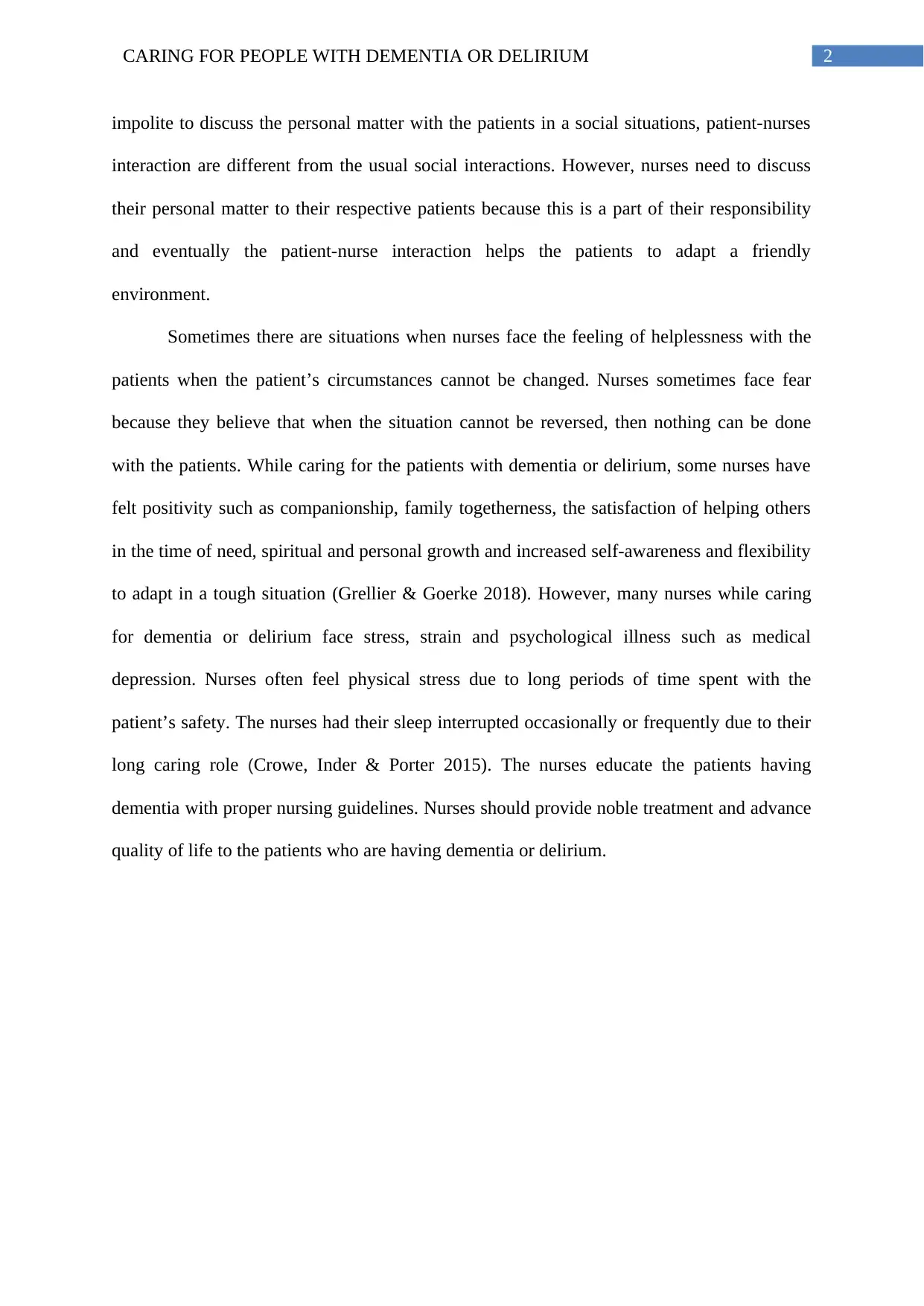
impolite to discuss the personal matter with the patients in a social situations, patient-nurses
interaction are different from the usual social interactions. However, nurses need to discuss
their personal matter to their respective patients because this is a part of their responsibility
and eventually the patient-nurse interaction helps the patients to adapt a friendly
environment.
Sometimes there are situations when nurses face the feeling of helplessness with the
patients when the patient’s circumstances cannot be changed. Nurses sometimes face fear
because they believe that when the situation cannot be reversed, then nothing can be done
with the patients. While caring for the patients with dementia or delirium, some nurses have
felt positivity such as companionship, family togetherness, the satisfaction of helping others
in the time of need, spiritual and personal growth and increased self-awareness and flexibility
to adapt in a tough situation (Grellier & Goerke 2018). However, many nurses while caring
for dementia or delirium face stress, strain and psychological illness such as medical
depression. Nurses often feel physical stress due to long periods of time spent with the
patient’s safety. The nurses had their sleep interrupted occasionally or frequently due to their
long caring role (Crowe, Inder & Porter 2015). The nurses educate the patients having
dementia with proper nursing guidelines. Nurses should provide noble treatment and advance
quality of life to the patients who are having dementia or delirium.
impolite to discuss the personal matter with the patients in a social situations, patient-nurses
interaction are different from the usual social interactions. However, nurses need to discuss
their personal matter to their respective patients because this is a part of their responsibility
and eventually the patient-nurse interaction helps the patients to adapt a friendly
environment.
Sometimes there are situations when nurses face the feeling of helplessness with the
patients when the patient’s circumstances cannot be changed. Nurses sometimes face fear
because they believe that when the situation cannot be reversed, then nothing can be done
with the patients. While caring for the patients with dementia or delirium, some nurses have
felt positivity such as companionship, family togetherness, the satisfaction of helping others
in the time of need, spiritual and personal growth and increased self-awareness and flexibility
to adapt in a tough situation (Grellier & Goerke 2018). However, many nurses while caring
for dementia or delirium face stress, strain and psychological illness such as medical
depression. Nurses often feel physical stress due to long periods of time spent with the
patient’s safety. The nurses had their sleep interrupted occasionally or frequently due to their
long caring role (Crowe, Inder & Porter 2015). The nurses educate the patients having
dementia with proper nursing guidelines. Nurses should provide noble treatment and advance
quality of life to the patients who are having dementia or delirium.
⊘ This is a preview!⊘
Do you want full access?
Subscribe today to unlock all pages.

Trusted by 1+ million students worldwide

3CARING FOR PEOPLE WITH DEMENTIA OR DELIRIUM
References
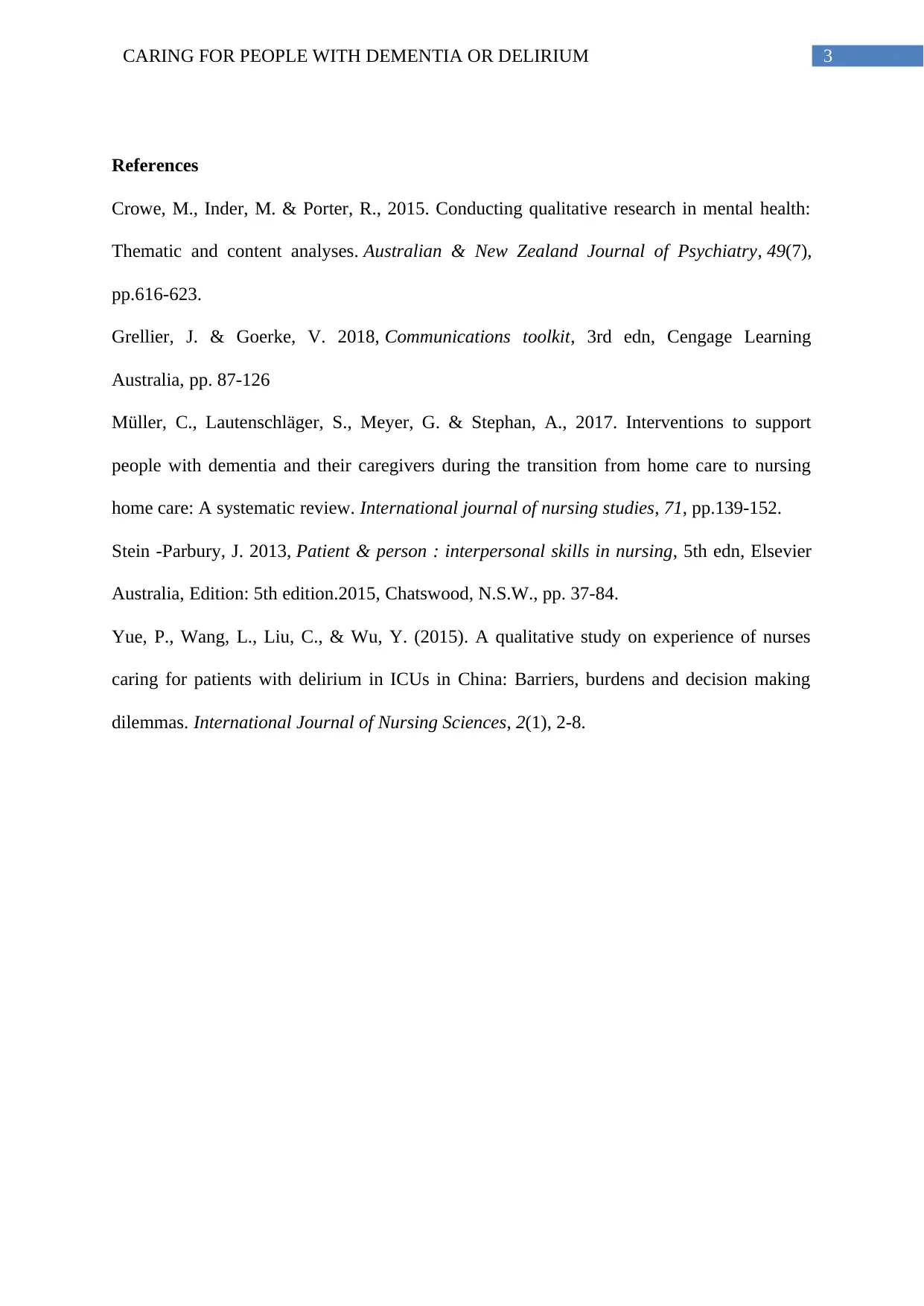
Crowe, M., Inder, M. & Porter, R., 2015. Conducting qualitative research in mental health:
Thematic and content analyses. Australian & New Zealand Journal of Psychiatry, 49(7),
pp.616-623.
Grellier, J. & Goerke, V. 2018, Communications toolkit, 3rd edn, Cengage Learning
Australia, pp. 87-126
Müller, C., Lautenschläger, S., Meyer, G. & Stephan, A., 2017. Interventions to support
people with dementia and their caregivers during the transition from home care to nursing
home care: A systematic review. International journal of nursing studies, 71, pp.139-152.
Stein -Parbury, J. 2013, Patient & person : interpersonal skills in nursing, 5th edn, Elsevier
Australia, Edition: 5th edition.2015, Chatswood, N.S.W., pp. 37-84.
Yue, P., Wang, L., Liu, C., & Wu, Y. (2015). A qualitative study on experience of nurses
caring for patients with delirium in ICUs in China: Barriers, burdens and decision making
dilemmas. International Journal of Nursing Sciences, 2(1), 2-8.
References
Crowe, M., Inder, M. & Porter, R., 2015. Conducting qualitative research in mental health:
Thematic and content analyses. Australian & New Zealand Journal of Psychiatry, 49(7),
pp.616-623.
Grellier, J. & Goerke, V. 2018, Communications toolkit, 3rd edn, Cengage Learning
Australia, pp. 87-126
Müller, C., Lautenschläger, S., Meyer, G. & Stephan, A., 2017. Interventions to support
people with dementia and their caregivers during the transition from home care to nursing
home care: A systematic review. International journal of nursing studies, 71, pp.139-152.
Stein -Parbury, J. 2013, Patient & person : interpersonal skills in nursing, 5th edn, Elsevier
Australia, Edition: 5th edition.2015, Chatswood, N.S.W., pp. 37-84.
Yue, P., Wang, L., Liu, C., & Wu, Y. (2015). A qualitative study on experience of nurses
caring for patients with delirium in ICUs in China: Barriers, burdens and decision making
dilemmas. International Journal of Nursing Sciences, 2(1), 2-8.
1 out of 4
Related Documents
Your All-in-One AI-Powered Toolkit for Academic Success.
+13062052269
info@desklib.com
Available 24*7 on WhatsApp / Email
Unlock your academic potential
Copyright © 2020–2026 A2Z Services. All Rights Reserved. Developed and managed by ZUCOL.