Leadership Management Case Study: Analyzing Carla's Situation
VerifiedAdded on 2022/08/11
|5
|1124
|22
Case Study
AI Summary
This case study analyzes the challenges faced by Carla, a clerk in a clinic, focusing on her unmet needs, including lack of self-confidence, insufficient support from colleagues and her mentor, and inadequate training. The analysis explores how these unmet needs impact Carla's wellbeing, leading to stress and reliance on alcohol, and identifies coping techniques to manage workplace stress. The study also examines time management issues within the scenario, suggesting improvements that can be implemented by Daniel, Carla, and other staff members to enhance Carla's performance and overall work environment. The solution references relevant academic sources to support its findings and recommendations.
Running head: CASE STUDY
Case Study
Name of the student
Name of the university
Author’s name
Case Study
Name of the student
Name of the university
Author’s name
Paraphrase This Document
Need a fresh take? Get an instant paraphrase of this document with our AI Paraphraser

1CASE STUDY
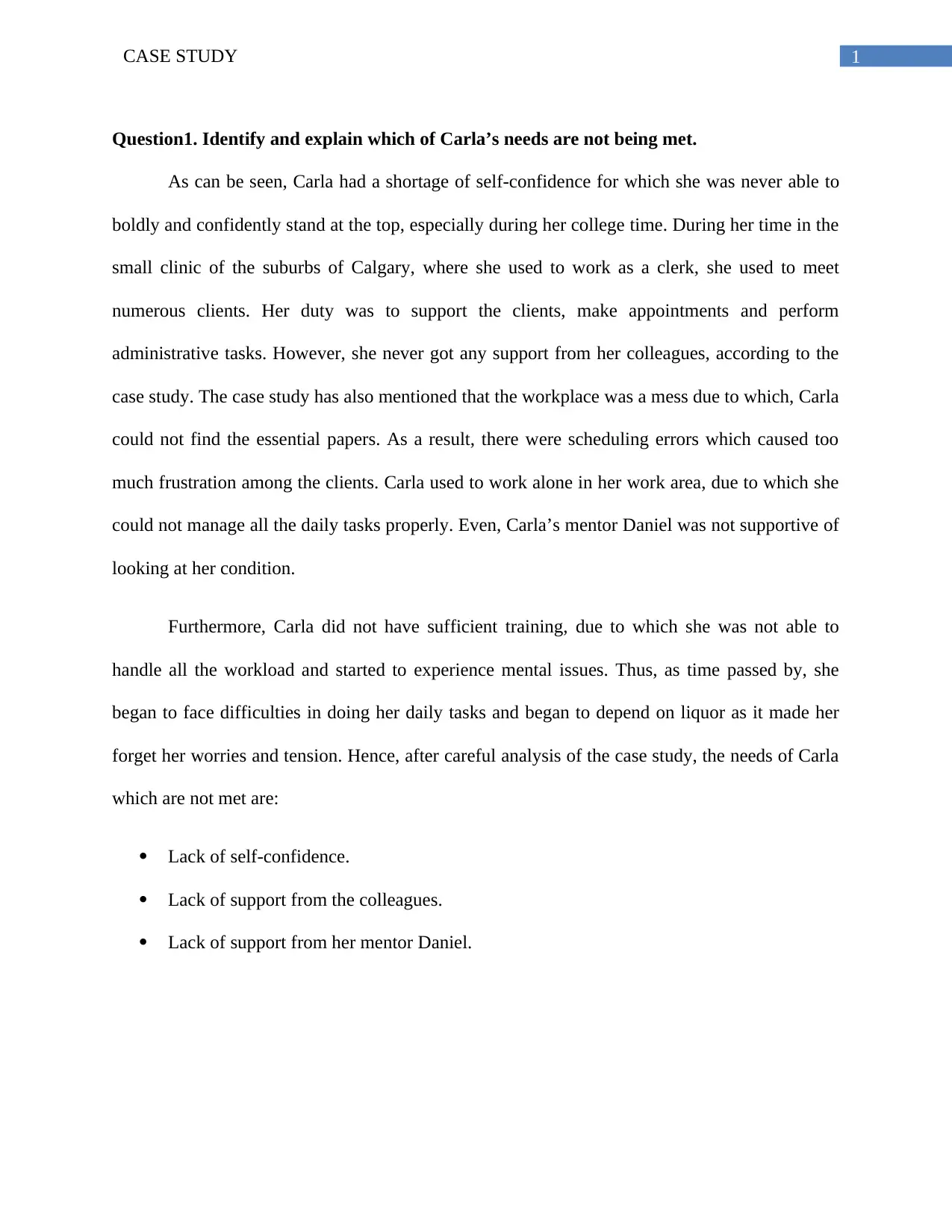
Question1. Identify and explain which of Carla’s needs are not being met.
As can be seen, Carla had a shortage of self-confidence for which she was never able to
boldly and confidently stand at the top, especially during her college time. During her time in the
small clinic of the suburbs of Calgary, where she used to work as a clerk, she used to meet
numerous clients. Her duty was to support the clients, make appointments and perform
administrative tasks. However, she never got any support from her colleagues, according to the
case study. The case study has also mentioned that the workplace was a mess due to which, Carla
could not find the essential papers. As a result, there were scheduling errors which caused too
much frustration among the clients. Carla used to work alone in her work area, due to which she
could not manage all the daily tasks properly. Even, Carla’s mentor Daniel was not supportive of
looking at her condition.
Furthermore, Carla did not have sufficient training, due to which she was not able to
handle all the workload and started to experience mental issues. Thus, as time passed by, she
began to face difficulties in doing her daily tasks and began to depend on liquor as it made her
forget her worries and tension. Hence, after careful analysis of the case study, the needs of Carla
which are not met are:
Lack of self-confidence.
Lack of support from the colleagues.
Lack of support from her mentor Daniel.
Question1. Identify and explain which of Carla’s needs are not being met.
As can be seen, Carla had a shortage of self-confidence for which she was never able to
boldly and confidently stand at the top, especially during her college time. During her time in the
small clinic of the suburbs of Calgary, where she used to work as a clerk, she used to meet
numerous clients. Her duty was to support the clients, make appointments and perform
administrative tasks. However, she never got any support from her colleagues, according to the
case study. The case study has also mentioned that the workplace was a mess due to which, Carla
could not find the essential papers. As a result, there were scheduling errors which caused too
much frustration among the clients. Carla used to work alone in her work area, due to which she
could not manage all the daily tasks properly. Even, Carla’s mentor Daniel was not supportive of
looking at her condition.
Furthermore, Carla did not have sufficient training, due to which she was not able to
handle all the workload and started to experience mental issues. Thus, as time passed by, she
began to face difficulties in doing her daily tasks and began to depend on liquor as it made her
forget her worries and tension. Hence, after careful analysis of the case study, the needs of Carla
which are not met are:
Lack of self-confidence.
Lack of support from the colleagues.
Lack of support from her mentor Daniel.

2CASE STUDY
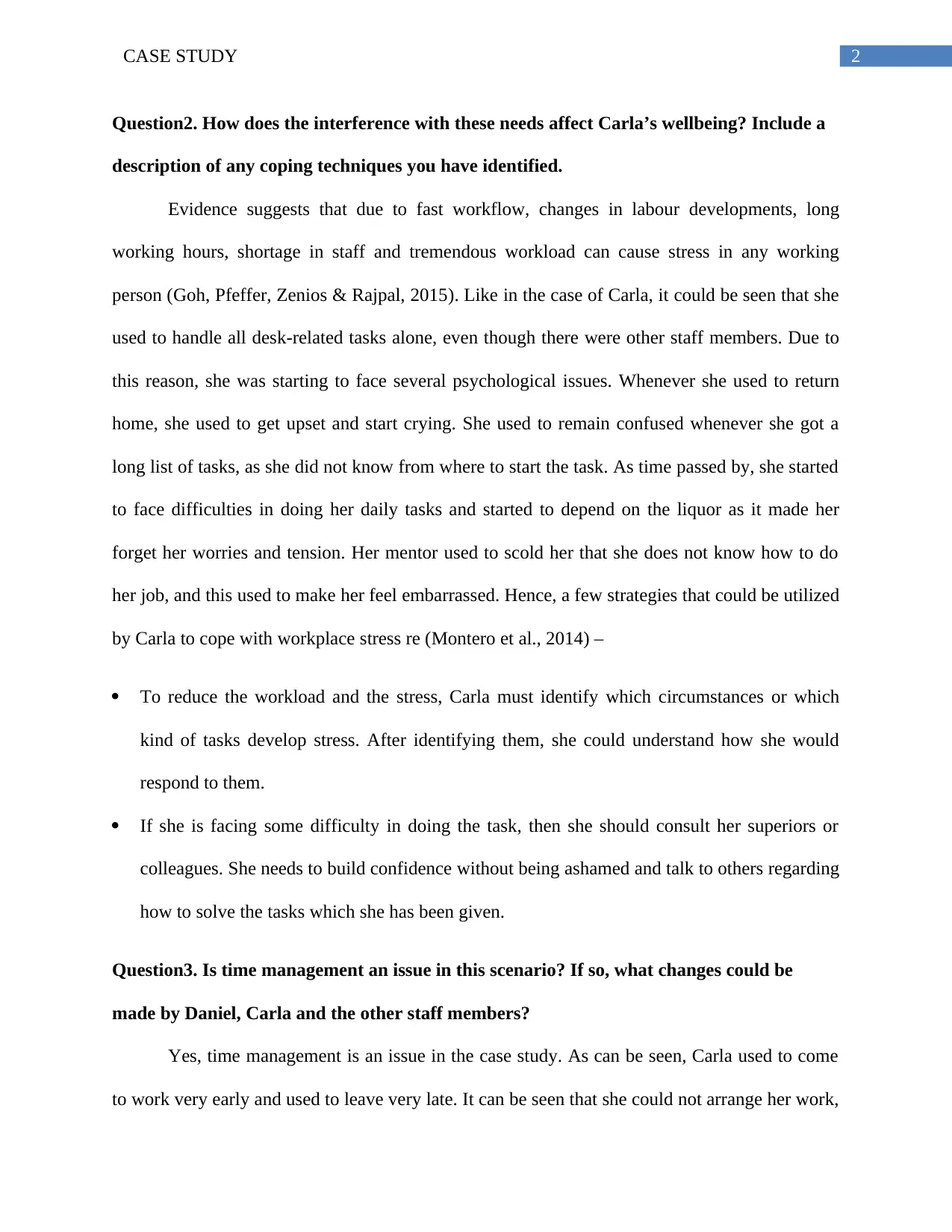
Question2. How does the interference with these needs affect Carla’s wellbeing? Include a
description of any coping techniques you have identified.
Evidence suggests that due to fast workflow, changes in labour developments, long
working hours, shortage in staff and tremendous workload can cause stress in any working
person (Goh, Pfeffer, Zenios & Rajpal, 2015). Like in the case of Carla, it could be seen that she
used to handle all desk-related tasks alone, even though there were other staff members. Due to
this reason, she was starting to face several psychological issues. Whenever she used to return
home, she used to get upset and start crying. She used to remain confused whenever she got a
long list of tasks, as she did not know from where to start the task. As time passed by, she started
to face difficulties in doing her daily tasks and started to depend on the liquor as it made her
forget her worries and tension. Her mentor used to scold her that she does not know how to do
her job, and this used to make her feel embarrassed. Hence, a few strategies that could be utilized
by Carla to cope with workplace stress re (Montero et al., 2014) –
To reduce the workload and the stress, Carla must identify which circumstances or which
kind of tasks develop stress. After identifying them, she could understand how she would
respond to them.
If she is facing some difficulty in doing the task, then she should consult her superiors or
colleagues. She needs to build confidence without being ashamed and talk to others regarding
how to solve the tasks which she has been given.
Question3. Is time management an issue in this scenario? If so, what changes could be
made by Daniel, Carla and the other staff members?
Yes, time management is an issue in the case study. As can be seen, Carla used to come
to work very early and used to leave very late. It can be seen that she could not arrange her work,
Question2. How does the interference with these needs affect Carla’s wellbeing? Include a
description of any coping techniques you have identified.
Evidence suggests that due to fast workflow, changes in labour developments, long
working hours, shortage in staff and tremendous workload can cause stress in any working
person (Goh, Pfeffer, Zenios & Rajpal, 2015). Like in the case of Carla, it could be seen that she
used to handle all desk-related tasks alone, even though there were other staff members. Due to
this reason, she was starting to face several psychological issues. Whenever she used to return
home, she used to get upset and start crying. She used to remain confused whenever she got a
long list of tasks, as she did not know from where to start the task. As time passed by, she started
to face difficulties in doing her daily tasks and started to depend on the liquor as it made her
forget her worries and tension. Her mentor used to scold her that she does not know how to do
her job, and this used to make her feel embarrassed. Hence, a few strategies that could be utilized
by Carla to cope with workplace stress re (Montero et al., 2014) –
To reduce the workload and the stress, Carla must identify which circumstances or which
kind of tasks develop stress. After identifying them, she could understand how she would
respond to them.
If she is facing some difficulty in doing the task, then she should consult her superiors or
colleagues. She needs to build confidence without being ashamed and talk to others regarding
how to solve the tasks which she has been given.
Question3. Is time management an issue in this scenario? If so, what changes could be
made by Daniel, Carla and the other staff members?
Yes, time management is an issue in the case study. As can be seen, Carla used to come
to work very early and used to leave very late. It can be seen that she could not arrange her work,
⊘ This is a preview!⊘
Do you want full access?
Subscribe today to unlock all pages.

Trusted by 1+ million students worldwide

3CASE STUDY
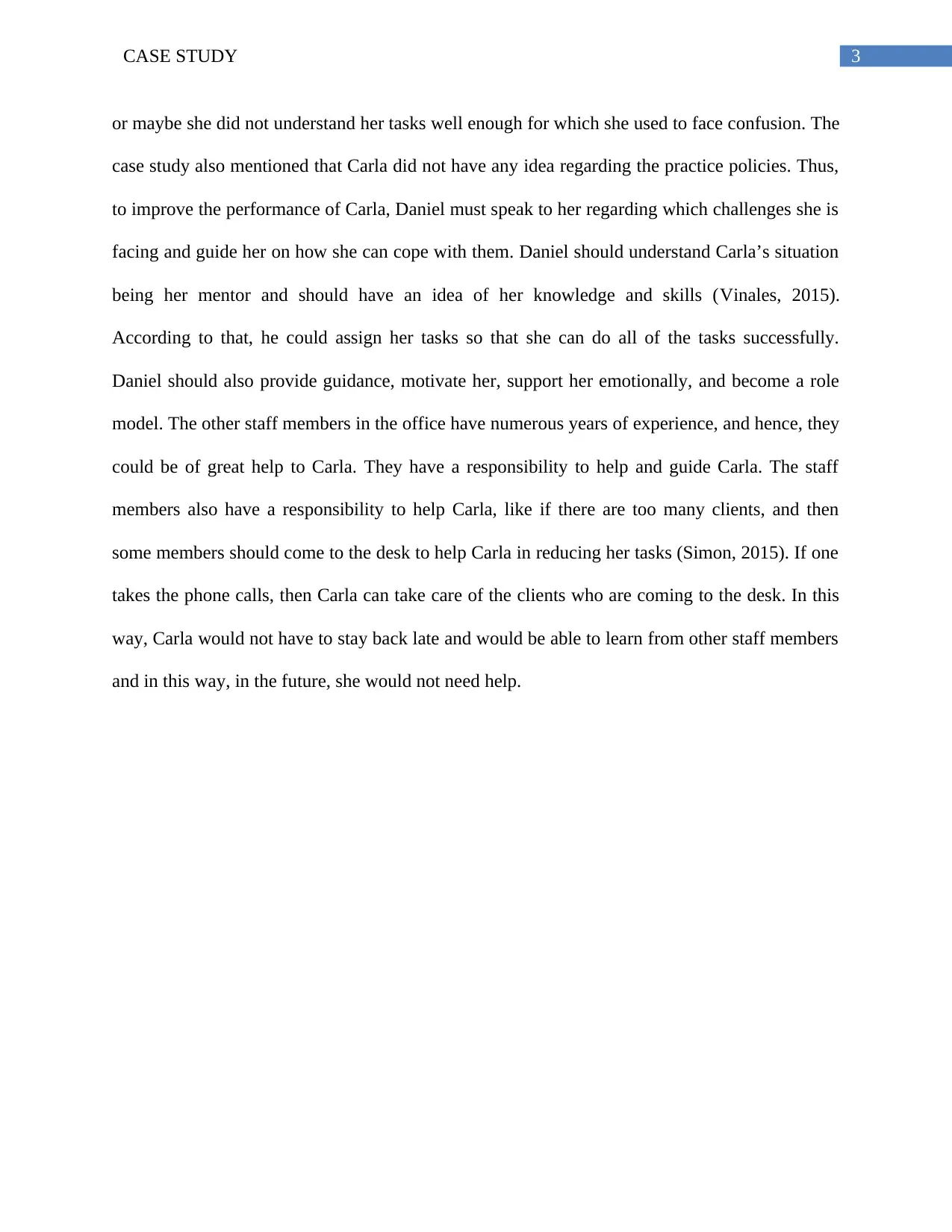
or maybe she did not understand her tasks well enough for which she used to face confusion. The
case study also mentioned that Carla did not have any idea regarding the practice policies. Thus,
to improve the performance of Carla, Daniel must speak to her regarding which challenges she is
facing and guide her on how she can cope with them. Daniel should understand Carla’s situation
being her mentor and should have an idea of her knowledge and skills (Vinales, 2015).
According to that, he could assign her tasks so that she can do all of the tasks successfully.
Daniel should also provide guidance, motivate her, support her emotionally, and become a role
model. The other staff members in the office have numerous years of experience, and hence, they
could be of great help to Carla. They have a responsibility to help and guide Carla. The staff
members also have a responsibility to help Carla, like if there are too many clients, and then
some members should come to the desk to help Carla in reducing her tasks (Simon, 2015). If one
takes the phone calls, then Carla can take care of the clients who are coming to the desk. In this
way, Carla would not have to stay back late and would be able to learn from other staff members
and in this way, in the future, she would not need help.
or maybe she did not understand her tasks well enough for which she used to face confusion. The
case study also mentioned that Carla did not have any idea regarding the practice policies. Thus,
to improve the performance of Carla, Daniel must speak to her regarding which challenges she is
facing and guide her on how she can cope with them. Daniel should understand Carla’s situation
being her mentor and should have an idea of her knowledge and skills (Vinales, 2015).
According to that, he could assign her tasks so that she can do all of the tasks successfully.
Daniel should also provide guidance, motivate her, support her emotionally, and become a role
model. The other staff members in the office have numerous years of experience, and hence, they
could be of great help to Carla. They have a responsibility to help and guide Carla. The staff
members also have a responsibility to help Carla, like if there are too many clients, and then
some members should come to the desk to help Carla in reducing her tasks (Simon, 2015). If one
takes the phone calls, then Carla can take care of the clients who are coming to the desk. In this
way, Carla would not have to stay back late and would be able to learn from other staff members
and in this way, in the future, she would not need help.
Paraphrase This Document
Need a fresh take? Get an instant paraphrase of this document with our AI Paraphraser

4CASE STUDY
References
Goh, J., Pfeffer, J., Zenios, S. A., & Rajpal, S. (2015). Workplace stressors & health outcomes:
Health policy for the workplace. Behavioral Science & Policy, 1(1), 43-52.
Montero-Marin, J., Prado-Abril, J., Demarzo, M. M. P., Gascon, S., & García-Campayo, J.
(2014). Coping with stress and types of burnout: explanatory power of different coping
strategies. PloS one, 9(2).
Simon, R. (2015). Monroe Freedman: Friend, Role Models, and Colleague. Hofstra L. Rev., 44,
275.
Vinales, J. J. (2015). The mentor as a role model and the importance of belongingness. British
Journal of Nursing, 24(10), 532-535.
References
Goh, J., Pfeffer, J., Zenios, S. A., & Rajpal, S. (2015). Workplace stressors & health outcomes:
Health policy for the workplace. Behavioral Science & Policy, 1(1), 43-52.
Montero-Marin, J., Prado-Abril, J., Demarzo, M. M. P., Gascon, S., & García-Campayo, J.
(2014). Coping with stress and types of burnout: explanatory power of different coping
strategies. PloS one, 9(2).
Simon, R. (2015). Monroe Freedman: Friend, Role Models, and Colleague. Hofstra L. Rev., 44,
275.
Vinales, J. J. (2015). The mentor as a role model and the importance of belongingness. British
Journal of Nursing, 24(10), 532-535.
1 out of 5
Related Documents
Your All-in-One AI-Powered Toolkit for Academic Success.
+13062052269
info@desklib.com
Available 24*7 on WhatsApp / Email
Unlock your academic potential
Copyright © 2020–2025 A2Z Services. All Rights Reserved. Developed and managed by ZUCOL.