ECON2020C Assignment 1: Intermediate Microeconomics Problems

Verified

Added on  2022/09/28

|8
|712
|20
Homework Assignment
AI Summary
This document presents a complete solution to Assignment 1 for ECON2020C, Intermediate Microeconomics I, at Carlton University. The assignment covers several key microeconomic concepts, including production functions, marginal and average product of labor, and elasticity of output. It explores short-run and long-run production scenarios, analyzing returns to scale and cost minimization using Lagrange multipliers. The solution also addresses the opportunity cost of decisions and the irrelevance of sunk costs. Furthermore, the assignment analyzes the production functions of individuals and their marginal rates of technical substitution. The document provides step-by-step solutions to all questions, demonstrating the application of microeconomic principles to various scenarios. The solution also includes the impact of subsidies on the long-run cost function and the derivation of cost functions given production constraints.

Document Page
ECON2020C
[DATE]
Grizli777
tabler-icon-diamond-filled.svg

Paraphrase This Document

Need a fresh take? Get an instant paraphrase of this document with our AI Paraphraser
Document Page
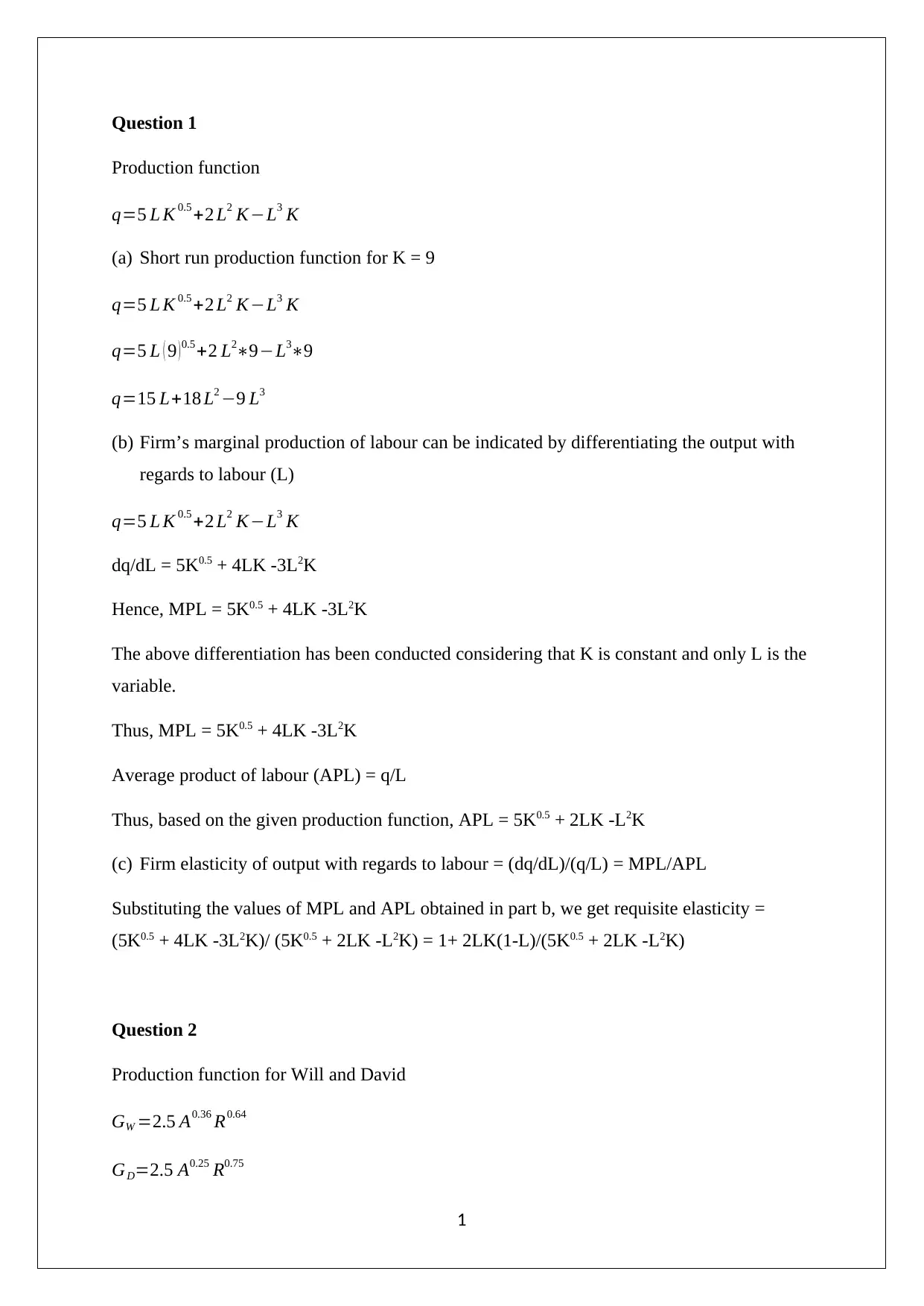
Question 1
Production function
q=5 L K 0.5 +2 L2 KL3 K
(a) Short run production function for K = 9
q=5 L K 0.5 +2 L2 KL3 K
q=5 L ( 9 ) 0.5 +2 L29L39
q=15 L+18 L2 9 L3
(b) Firm’s marginal production of labour can be indicated by differentiating the output with
regards to labour (L)
q=5 L K 0.5 +2 L2 KL3 K
dq/dL = 5K0.5 + 4LK -3L2K
Hence, MPL = 5K0.5 + 4LK -3L2K
The above differentiation has been conducted considering that K is constant and only L is the
variable.
Thus, MPL = 5K0.5 + 4LK -3L2K
Average product of labour (APL) = q/L
Thus, based on the given production function, APL = 5K0.5 + 2LK -L2K
(c) Firm elasticity of output with regards to labour = (dq/dL)/(q/L) = MPL/APL
Substituting the values of MPL and APL obtained in part b, we get requisite elasticity =
(5K0.5 + 4LK -3L2K)/ (5K0.5 + 2LK -L2K) = 1+ 2LK(1-L)/(5K0.5 + 2LK -L2K)
Question 2
Production function for Will and David
GW =2.5 A0.36 R0.64
GD=2.5 A0.25 R0.75
1
Document Page
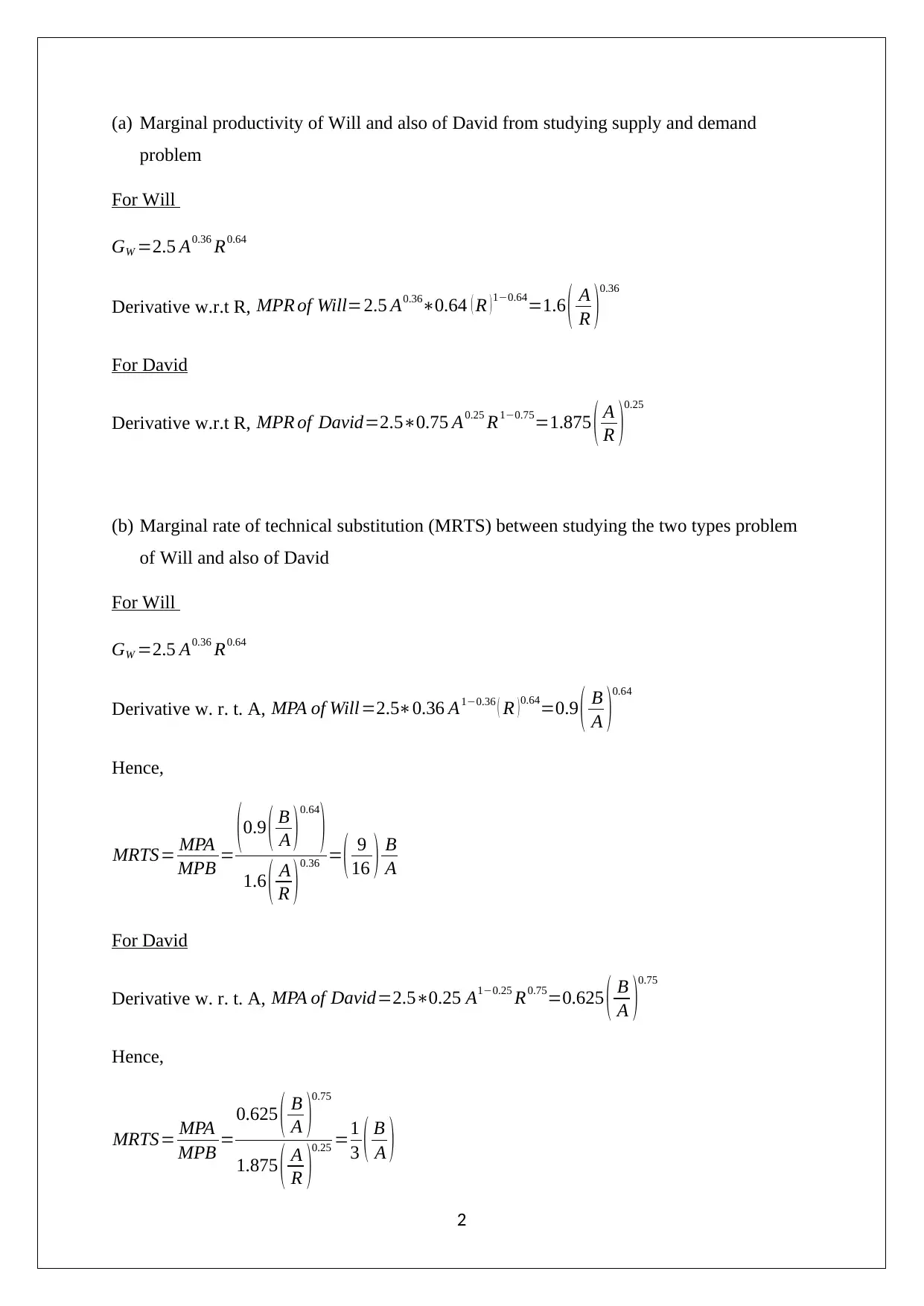
(a) Marginal productivity of Will and also of David from studying supply and demand
problem
For Will
GW =2.5 A0.36 R0.64
Derivative w.r.t R, MPR of Will=2.5 A0.360.64 ( R )10.64=1.6 ( A
R )0.36
For David
Derivative w.r.t R, MPR of David=2.50.75 A0.25 R10.75=1.875 ( A
R )
0.25
(b) Marginal rate of technical substitution (MRTS) between studying the two types problem
of Will and also of David
For Will
GW =2.5 A0.36 R0.64
Derivative w. r. t. A, MPA of Will=2.50.36 A10.36 ( R ) 0.64=0.9 ( B
A )
0.64
Hence,
MRTS= MPA
MPB =
(0.9 ( B
A )0.64
)
1.6 ( A
R )0.36 = ( 9
16 ) B
A
For David
Derivative w. r. t. A, MPA of David=2.50.25 A10.25 R0.75=0.625 ( B
A )
0.75
Hence,
MRTS= MPA
MPB =
0.625 ( B
A )
0.75
1.875 ( A
R )
0.25 =1
3 ( B
A )
2
Document Page
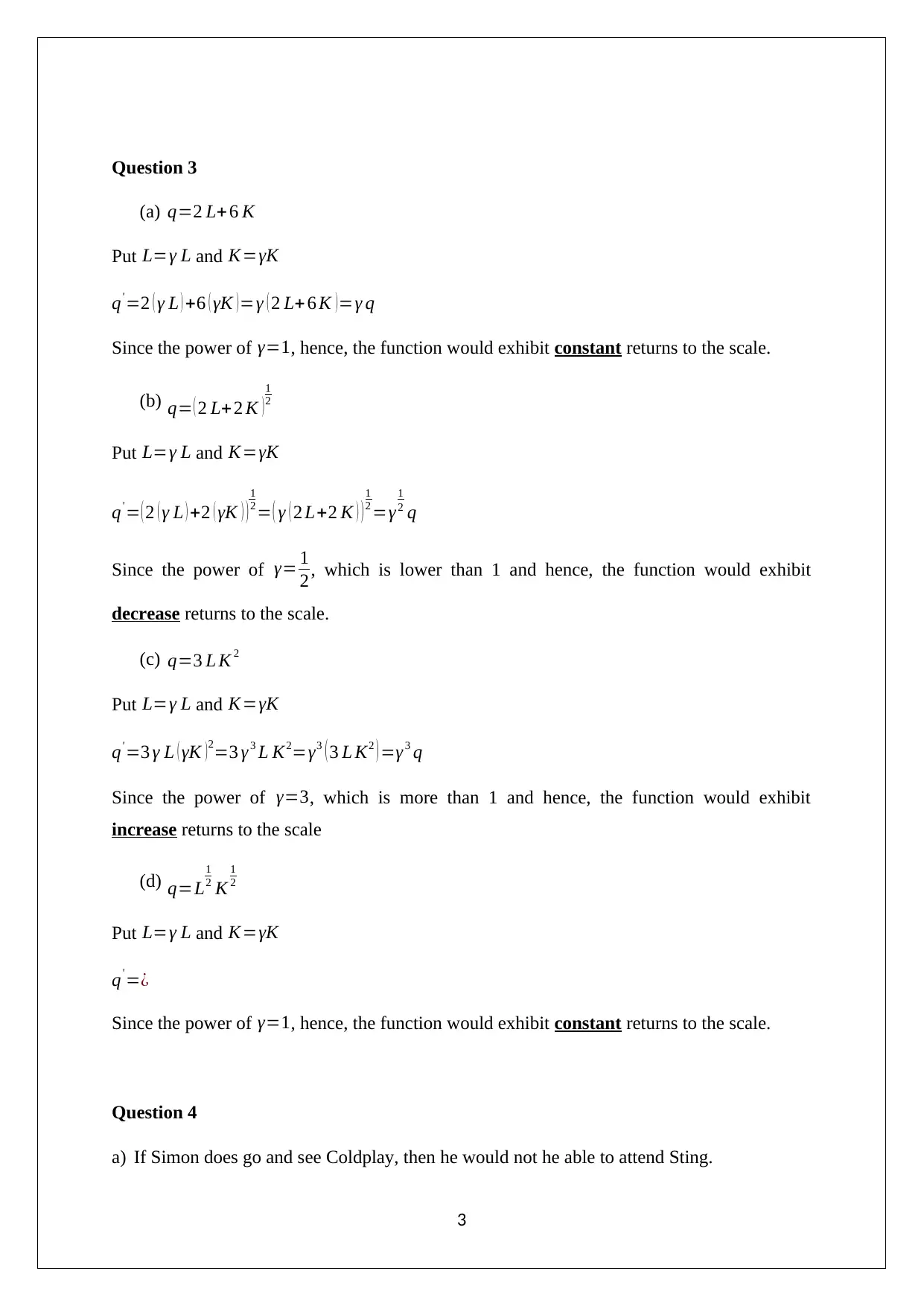
Question 3
(a) q=2 L+ 6 K
Put L=γ L and K=γK
q' =2 ( γ L ) +6 ( γK )=γ ( 2 L+6 K )=γ q
Since the power of γ=1, hence, the function would exhibit constant returns to the scale.
(b) q= ( 2 L+2 K )
1
2
Put L=γ L and K=γK
q' = ( 2 ( γ L ) +2 ( γK ) )
1
2 = ( γ ( 2 L+2 K ) )
1
2 =γ
1
2 q
Since the power of γ= 1
2 , which is lower than 1 and hence, the function would exhibit
decrease returns to the scale.
(c) q=3 L K 2
Put L=γ L and K=γK
q' =3 γ L ( γK )2=3 γ 3 L K2=γ3 ( 3 L K2 ) =γ 3 q
Since the power of γ=3, which is more than 1 and hence, the function would exhibit
increase returns to the scale
(d) q=L
1
2 K
1
2
Put L=γ L and K=γK
q' =¿
Since the power of γ=1, hence, the function would exhibit constant returns to the scale.
Question 4
a) If Simon does go and see Coldplay, then he would not he able to attend Sting.
3
tabler-icon-diamond-filled.svg

Paraphrase This Document

Need a fresh take? Get an instant paraphrase of this document with our AI Paraphraser
Document Page
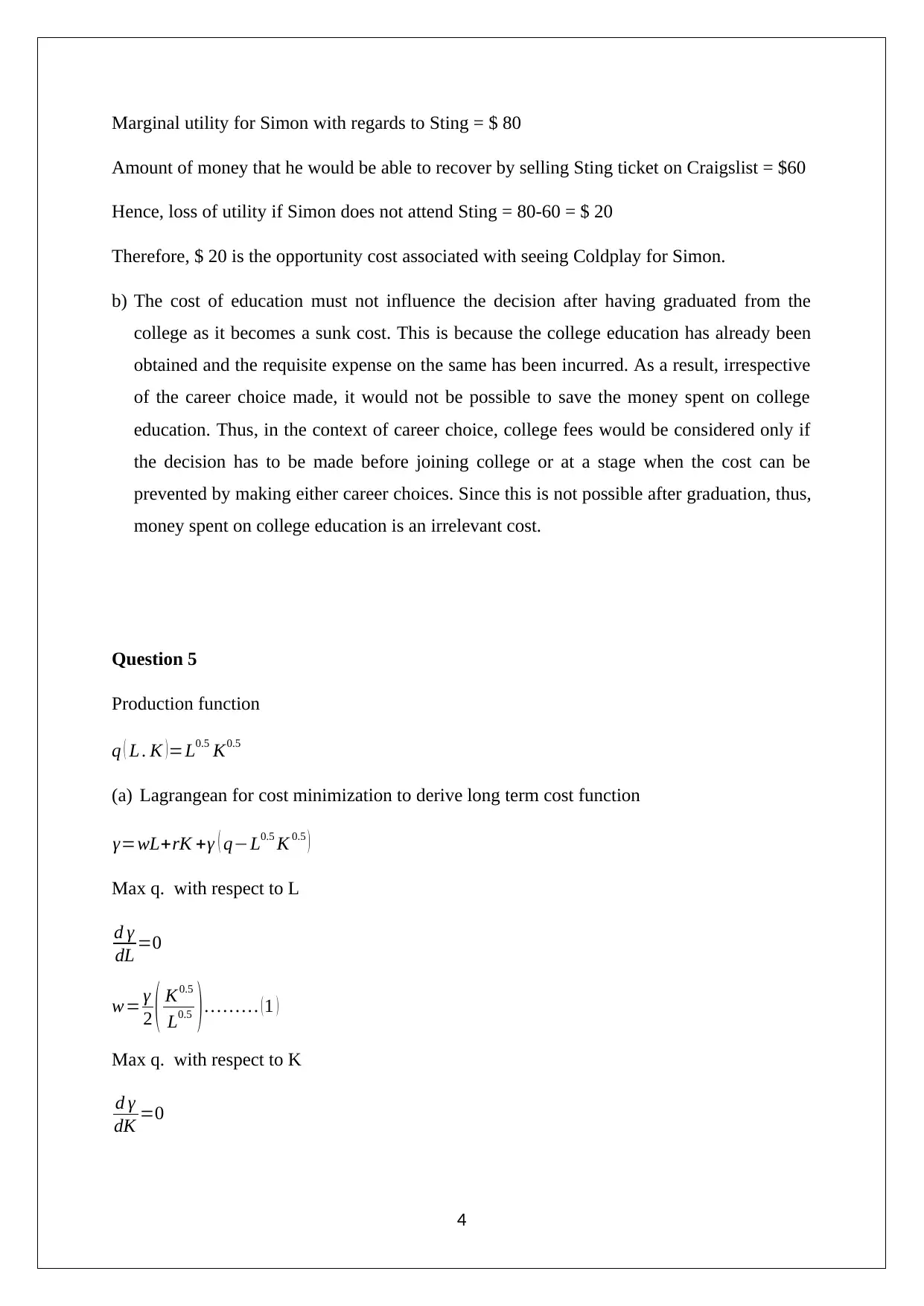
Marginal utility for Simon with regards to Sting = $ 80
Amount of money that he would be able to recover by selling Sting ticket on Craigslist = $60
Hence, loss of utility if Simon does not attend Sting = 80-60 = $ 20
Therefore, $ 20 is the opportunity cost associated with seeing Coldplay for Simon.
b) The cost of education must not influence the decision after having graduated from the
college as it becomes a sunk cost. This is because the college education has already been
obtained and the requisite expense on the same has been incurred. As a result, irrespective
of the career choice made, it would not be possible to save the money spent on college
education. Thus, in the context of career choice, college fees would be considered only if
the decision has to be made before joining college or at a stage when the cost can be
prevented by making either career choices. Since this is not possible after graduation, thus,
money spent on college education is an irrelevant cost.
Question 5
Production function
q ( L . K )=L0.5 K0.5
(a) Lagrangean for cost minimization to derive long term cost function
γ=wL+rK +γ ( qL0.5 K 0.5 )
Max q. with respect to L
d γ
dL =0
w= γ
2 ( K0.5
L0.5 ) ( 1 )
Max q. with respect to K
d γ
dK =0
4
Document Page
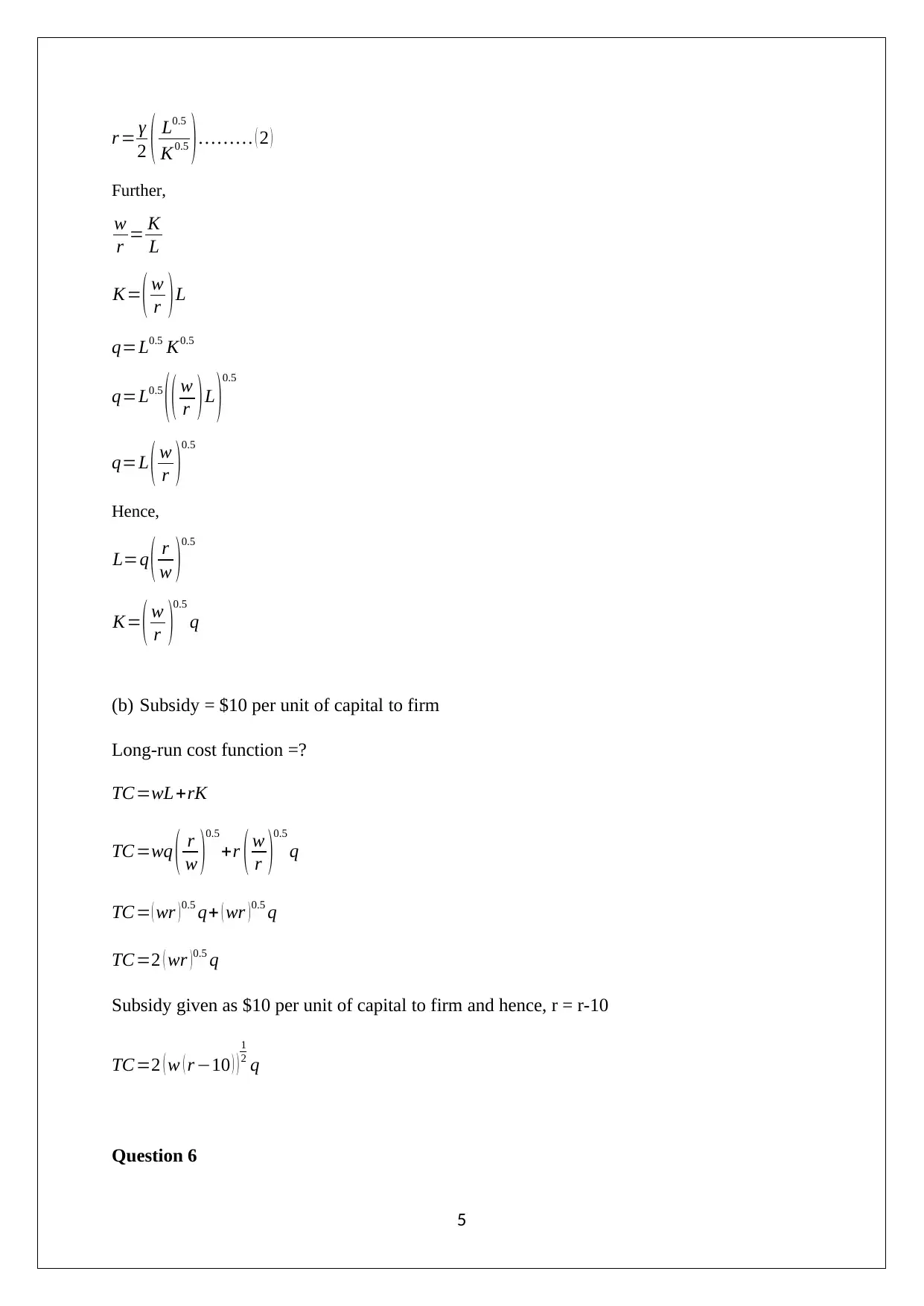
r = γ
2 ( L0.5
K0.5 ) ( 2 )
Further,
w
r = K
L
K= ( w
r )L
q=L0.5 K0.5
q=L0.5
( ( w
r ) L )
0.5
q=L ( w
r )0.5
Hence,
L=q ( r
w )
0.5
K= ( w
r )
0.5
q
(b) Subsidy = $10 per unit of capital to firm
Long-run cost function =?
TC=wL+rK
TC =wq ( r
w )
0.5
+r ( w
r )
0.5
q
TC= ( wr )0.5 q+ ( wr )0.5 q
TC=2 ( wr ) 0.5 q
Subsidy given as $10 per unit of capital to firm and hence, r = r-10
TC =2 ( w ( r 10 ) )
1
2 q
Question 6
5
Document Page
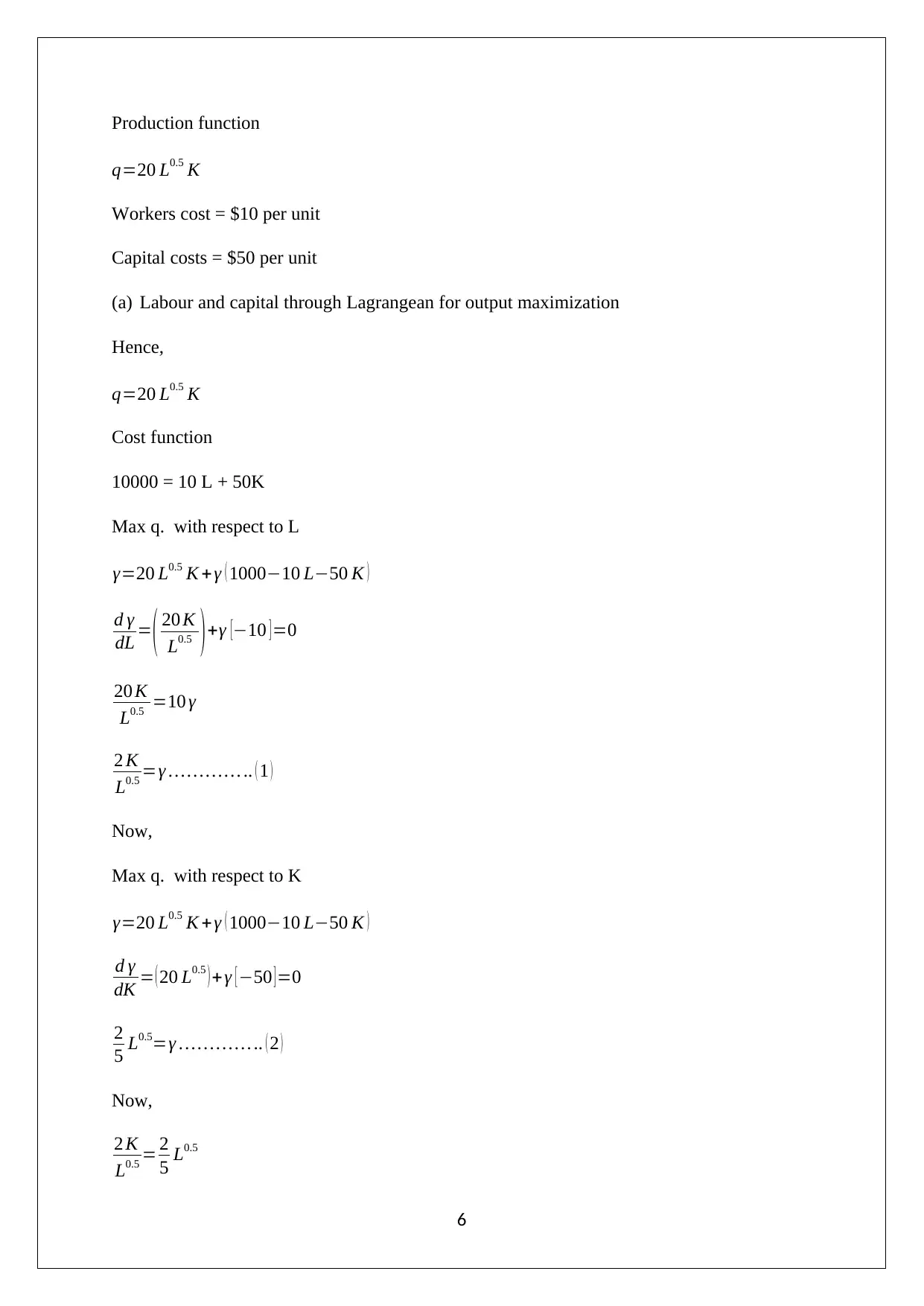
Production function
q=20 L0.5 K
Workers cost = $10 per unit
Capital costs = $50 per unit
(a) Labour and capital through Lagrangean for output maximization
Hence,
q=20 L0.5 K
Cost function
10000 = 10 L + 50K
Max q. with respect to L
γ=20 L0.5 K +γ ( 100010 L50 K )
d γ
dL = ( 20 K
L0.5 ) +γ [10 ] =0
20 K
L0.5 =10 γ
2 K
L0.5 =γ .. ( 1 )
Now,
Max q. with respect to K
γ=20 L0.5 K +γ ( 100010 L50 K )
d γ
dK = ( 20 L0.5 ) + γ [ 50 ]=0
2
5 L0.5=γ .. ( 2 )
Now,
2 K
L0.5 = 2
5 L0.5
6
tabler-icon-diamond-filled.svg

Paraphrase This Document

Need a fresh take? Get an instant paraphrase of this document with our AI Paraphraser
Document Page
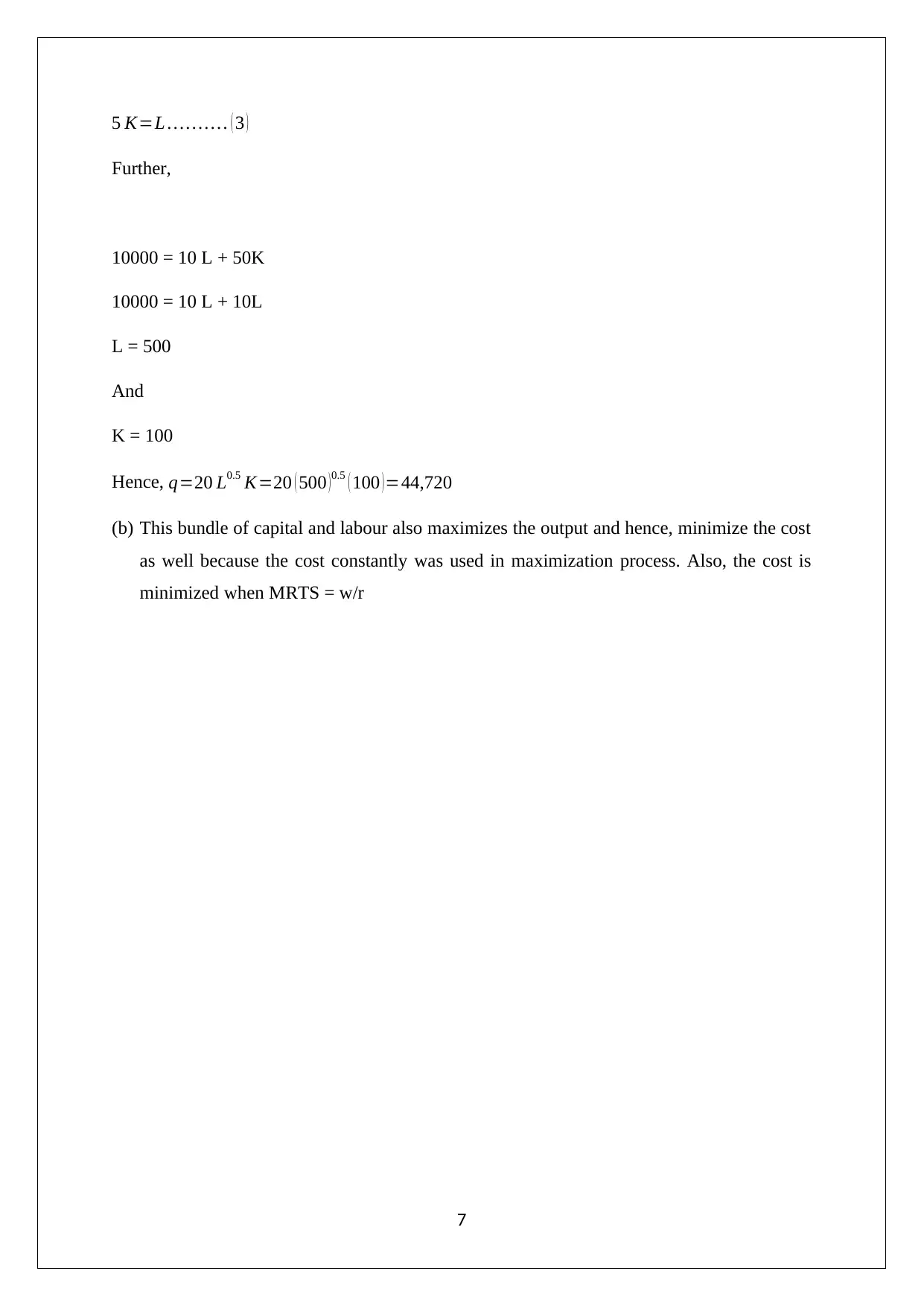
5 K=L . ( 3 )
Further,
10000 = 10 L + 50K
10000 = 10 L + 10L
L = 500
And
K = 100
Hence, q=20 L0.5 K=20 ( 500 ) 0.5 ( 100 ) =44,720
(b) This bundle of capital and labour also maximizes the output and hence, minimize the cost
as well because the cost constantly was used in maximization process. Also, the cost is
minimized when MRTS = w/r
7
chevron_up_icon
1 out of 8
circle_padding
hide_on_mobile
zoom_out_icon
[object Object]