Case Analysis: Moral Standards and Queen's Company Business Ethics
VerifiedAdded on 2023/05/28
|11
|2608
|466
Case Study
AI Summary
This case analysis examines the ethical considerations for Queen's Company, focusing on whether the company should be allowed to increase its consumer electronics production and independently research cancer threats. The analysis employs six moral standards: utilitarianism, the principle of care, virtue ethics, the principle of justice, moral rights, and Kantianism. The author supports Queen's Company's actions, aligning with Milton Friedman's perspective on market self-regulation. The case study also explores the relationship between ethics and law, the impact of government oversight, and the importance of corporate social responsibility, particularly in the context of CSR sustainability. The analysis concludes by suggesting that the Canadian government should not overly regulate Queen's Company's operations, but should encourage competition to maintain product quality.
CASE ANALYSIS 1
Case analysis
By ()
The name of the course
Instructor’s name
The name of the University
The country and city where it belongs
Date
Case analysis
By ()
The name of the course
Instructor’s name
The name of the University
The country and city where it belongs
Date

Paraphrase This Document
Need a fresh take? Get an instant paraphrase of this document with our AI Paraphraser
CASE ANALYSIS 2
Introduction
The policymakers of an organization have a duty to take actions that protect the interest of the
community (Carroll and Buchholtz, 2014). This can be easier if these business organizations are
given the freedom to conduct activities that increase their income (Freeman, 2015). In this case,
analysis, I will be using the six moral standards to support the increase of the consumers'
electronics and perusing the research into the cancer threats independently for Queen's company.
The moral standards
The validity of ethical standards is determined from the line of making decisions which can take
back or amended by certain authorities (Murphy and Callaghan, 2011). No need for close
monitoring for any organization that applies these moral standards.
The first moral standard to be applied in this case is the utilitarianism. Utilitarianism requires
business organizations like Queens to promote the general welfare of other individuals (Fassin,
2012). The utilitarianism is one of the doctrines worth of the actions used in determining the fate
of the extreme to which a business organization maximizes its happiness and pleasures of other
people. The concept suggests that the competitive business organization are the right in
maximizing the happiness and facilitate protection of the rights of the individuals and same time
encourage the competition (Jamali, 2008). Many market researchers have proposed that the
public policymakers or the government should implement policies that protect the well-being of
individuals. This is because companies like Queen has developed its own and qualified
researchers who will be able to identify the link between their devices and the censer then they
can take various measures (Harrison and Wicks, 2013).
Introduction
The policymakers of an organization have a duty to take actions that protect the interest of the
community (Carroll and Buchholtz, 2014). This can be easier if these business organizations are
given the freedom to conduct activities that increase their income (Freeman, 2015). In this case,
analysis, I will be using the six moral standards to support the increase of the consumers'
electronics and perusing the research into the cancer threats independently for Queen's company.
The moral standards
The validity of ethical standards is determined from the line of making decisions which can take
back or amended by certain authorities (Murphy and Callaghan, 2011). No need for close
monitoring for any organization that applies these moral standards.
The first moral standard to be applied in this case is the utilitarianism. Utilitarianism requires
business organizations like Queens to promote the general welfare of other individuals (Fassin,
2012). The utilitarianism is one of the doctrines worth of the actions used in determining the fate
of the extreme to which a business organization maximizes its happiness and pleasures of other
people. The concept suggests that the competitive business organization are the right in
maximizing the happiness and facilitate protection of the rights of the individuals and same time
encourage the competition (Jamali, 2008). Many market researchers have proposed that the
public policymakers or the government should implement policies that protect the well-being of
individuals. This is because companies like Queen has developed its own and qualified
researchers who will be able to identify the link between their devices and the censer then they
can take various measures (Harrison and Wicks, 2013).
CASE ANALYSIS 3
The principle of care is the next moral standard and can be applied to allow the Queens
organization to increase its products and research on the dangers of cancer to individuals
independently (Miller, Mcadam and Mcadam, 2014). It focuses on improving the rights of other
individuals and not individual self like other traditional ethical theories. Any organization that
uses this principle will focus on the people other than profits, quality and undertakes the ventures
with a lot of care. Restricting the operations that apply this virtue might cause them to withdraw
their benefits from the communities around them in order to maximize their income (Greenwood
and Van Buren, 2010). Queen organization has spent a considerable amount of dollars in raising
the standards of the community. For example, the company has highly contributed to developing
the infrastructure and urban planning of the Rhabingtom. The company has also offered funds to
the city that has been used in forming the international roadway used in transiting systems. This
support has made the Rhabingtom one of the most significant technological and manufacturing
towns in Canada today. In the past few years, some technology companies in Canada have
relocated to Rhabingtom to tap from the headquarters of Queens. Lastly, the Company has also
established advanced hospitals, schools, and research institutions and due to this Queens should
be given the freedom to increase the electrons to meet all these demands.
The third principle is the virtue of ethics which has been designed in guiding the decisions or
actions (Stieb, 2009). Virtue of ethics is based on the choices from the individuals and in this
case is centered in the hearts of individuals. The principle focuses on following certain excellent
morals which can be transformed into flourishing human happiness. Its fundamental aspect is
concentrated on the significances of accepting certain characters which by perfecting them a
company becomes explicitly ethical (Bevan and Werhane, 2011). The critical emphasis is put on
the active society which is used as a ground of nurturing these virtues of ethics. Thus, this
The principle of care is the next moral standard and can be applied to allow the Queens
organization to increase its products and research on the dangers of cancer to individuals
independently (Miller, Mcadam and Mcadam, 2014). It focuses on improving the rights of other
individuals and not individual self like other traditional ethical theories. Any organization that
uses this principle will focus on the people other than profits, quality and undertakes the ventures
with a lot of care. Restricting the operations that apply this virtue might cause them to withdraw
their benefits from the communities around them in order to maximize their income (Greenwood
and Van Buren, 2010). Queen organization has spent a considerable amount of dollars in raising
the standards of the community. For example, the company has highly contributed to developing
the infrastructure and urban planning of the Rhabingtom. The company has also offered funds to
the city that has been used in forming the international roadway used in transiting systems. This
support has made the Rhabingtom one of the most significant technological and manufacturing
towns in Canada today. In the past few years, some technology companies in Canada have
relocated to Rhabingtom to tap from the headquarters of Queens. Lastly, the Company has also
established advanced hospitals, schools, and research institutions and due to this Queens should
be given the freedom to increase the electrons to meet all these demands.
The third principle is the virtue of ethics which has been designed in guiding the decisions or
actions (Stieb, 2009). Virtue of ethics is based on the choices from the individuals and in this
case is centered in the hearts of individuals. The principle focuses on following certain excellent
morals which can be transformed into flourishing human happiness. Its fundamental aspect is
concentrated on the significances of accepting certain characters which by perfecting them a
company becomes explicitly ethical (Bevan and Werhane, 2011). The critical emphasis is put on
the active society which is used as a ground of nurturing these virtues of ethics. Thus, this
⊘ This is a preview!⊘
Do you want full access?
Subscribe today to unlock all pages.

Trusted by 1+ million students worldwide
CASE ANALYSIS 4
principle proposes that the moral of any individual or business organization does not rely on the
guidelines or rules in exercising their moral judgment. That means the Queen's company must
not be monitored by the government in making its decision in increasing its consumer
electronics. The company has clearly shown it royalty in the fact that it has privately begun its
interest on researching about the production of MB-DP, a chemical used in treating the screens
on the queen's touchscreens. This is a self-decision and has signed an agreement not to release
the information about the organization that is producing the chemical to avoid any confusion.
The successful emulation and identification of such moral roles are critical in disseminating the
morality.
The fourth moral standard is the principle of justice which require an organization or an
individual to operate in a manner that treats individuals fairly and equitably. The law governing
employment equity in an organization was passed in the year 1984, and the same was repeated in
the year 1996. The law does not restrict the operation of the organization but provides the
guidelines on various decisions should be made to safeguard the rights of the consumers. For
instance, the section 15 charter of the constitution in Canada recognizes that equity needs the
disadvantage conditions within an organization to be addressed.The government of Canada has
granted the Queen's company an autonomy and the independent in issues dealing with the IT
(Information Technology) with the aim that it will benefit everybody and make Canada the
leading state regarding technology. Although, most individuals who have highly benefited from
this technology are the children in other part of the world. The primary advantage of the
principles of justice is that it allows everyone to share the resources equally. On the other hand, it
might become a challenge if perceived as a must for every individual to have an equal share.
principle proposes that the moral of any individual or business organization does not rely on the
guidelines or rules in exercising their moral judgment. That means the Queen's company must
not be monitored by the government in making its decision in increasing its consumer
electronics. The company has clearly shown it royalty in the fact that it has privately begun its
interest on researching about the production of MB-DP, a chemical used in treating the screens
on the queen's touchscreens. This is a self-decision and has signed an agreement not to release
the information about the organization that is producing the chemical to avoid any confusion.
The successful emulation and identification of such moral roles are critical in disseminating the
morality.
The fourth moral standard is the principle of justice which require an organization or an
individual to operate in a manner that treats individuals fairly and equitably. The law governing
employment equity in an organization was passed in the year 1984, and the same was repeated in
the year 1996. The law does not restrict the operation of the organization but provides the
guidelines on various decisions should be made to safeguard the rights of the consumers. For
instance, the section 15 charter of the constitution in Canada recognizes that equity needs the
disadvantage conditions within an organization to be addressed.The government of Canada has
granted the Queen's company an autonomy and the independent in issues dealing with the IT
(Information Technology) with the aim that it will benefit everybody and make Canada the
leading state regarding technology. Although, most individuals who have highly benefited from
this technology are the children in other part of the world. The primary advantage of the
principles of justice is that it allows everyone to share the resources equally. On the other hand, it
might become a challenge if perceived as a must for every individual to have an equal share.
Paraphrase This Document
Need a fresh take? Get an instant paraphrase of this document with our AI Paraphraser
CASE ANALYSIS 5
The fifth moral standard is the moral rights. The rights of the workers are the moral rights which
can be justified by consideration of the good morals (Cosans, 2009). Moral rights allow the
employees to enjoy the rights of protection from certain risks at the workplace. Based on this
moral standard, Queen should be given an opportunity to continue producing more electronics,
and they do their research independently. This is because in one of the occasions they have
shown interest in safeguarding their workers and the community by hiring the environmental
researchers to identify the traces of MB-DP which could result in health threat. The chemical and
the cancer agent has never been detected, and due to this, it will continue flooding the market
with more electronics. The Queen company, however, must make sure the workplace is safe and
should train the workers when dealing with possible hazards through supplying equipment that
protects them.
The last moral standard or principle of ethics in this case analysis is the Kantianism or
deontology. Kantianism acknowledges goodwill as the only thing that can be called good with no
qualifications in the world (Au and Kauffman, 2008). Thus, bringing back the case in which
Queen should be responsible for the unemployment cases which might result due to the high
level of their technology as the result of increasing the consumer electronics. This is because
their technology is expanding at a high rate across all sectors and in different parts of the world.
For instance, philanthropic initiatives have focused on assisting the education sector through then
education. The organization has also provided some sub-Saharan African communities with
access to computers and the internet. This will result in the reduction of many employees since
many tasks that were manual can be done by technology or electronic devices like computers.
The Milton Friedman
The fifth moral standard is the moral rights. The rights of the workers are the moral rights which
can be justified by consideration of the good morals (Cosans, 2009). Moral rights allow the
employees to enjoy the rights of protection from certain risks at the workplace. Based on this
moral standard, Queen should be given an opportunity to continue producing more electronics,
and they do their research independently. This is because in one of the occasions they have
shown interest in safeguarding their workers and the community by hiring the environmental
researchers to identify the traces of MB-DP which could result in health threat. The chemical and
the cancer agent has never been detected, and due to this, it will continue flooding the market
with more electronics. The Queen company, however, must make sure the workplace is safe and
should train the workers when dealing with possible hazards through supplying equipment that
protects them.
The last moral standard or principle of ethics in this case analysis is the Kantianism or
deontology. Kantianism acknowledges goodwill as the only thing that can be called good with no
qualifications in the world (Au and Kauffman, 2008). Thus, bringing back the case in which
Queen should be responsible for the unemployment cases which might result due to the high
level of their technology as the result of increasing the consumer electronics. This is because
their technology is expanding at a high rate across all sectors and in different parts of the world.
For instance, philanthropic initiatives have focused on assisting the education sector through then
education. The organization has also provided some sub-Saharan African communities with
access to computers and the internet. This will result in the reduction of many employees since
many tasks that were manual can be done by technology or electronic devices like computers.
The Milton Friedman
CASE ANALYSIS 6
My position in this case analysis has been supporting the Queen company in the production of
consumer electronics and research on the threats of cancer independently. This position agrees
with Milton Friedman since he proposes that the safety standard for the commodities are not
necessary as long as the market will always correct itself (Nelson and Schwartz, 2008). In a
competitive market environment, producers will always focus on the quality of their products to
increase more customers to counter the hypercompetitive business world. That means, there is no
need of government to regulate their operations since it's a responsibility of the business
organization to produce safe products at a specific price (Shleifer, 2009). For example, the
Queen organization has started to recognize that they must disclose some of the issues and create
awareness to their customers. These issues are like replacing the cellphone calls with the text
messages and researching on the glioma which is their primary concern unveil the truth
information concerning cancer and electromagnetic radiations. The acknowledgment of the
safety was initiated to safeguard their trust with their customers and put off their market
competitors. However, some researchers argue that specific products suspected to be unsafe
should never be released in the market.
Theoretical concepts
Some individuals do not understand or belief on regulations and legal laws in doing what is
wrong or right while others think that business must concentrate on the legal compliances for it
to be ethical (Bagley, 2015). This is because the ethics and the laws are very different techniques
in such that, on the one hand, going against the law might not always be considered immoral
(Ardichvili, Cardozo and Ray, 2003). In some cases, breaking the rules could be defensible like
the case where the Queen organization is not ready to disclose the information of the company
that produces MB-DP or then effect of the chemical to it employees to safeguard the trust of their
My position in this case analysis has been supporting the Queen company in the production of
consumer electronics and research on the threats of cancer independently. This position agrees
with Milton Friedman since he proposes that the safety standard for the commodities are not
necessary as long as the market will always correct itself (Nelson and Schwartz, 2008). In a
competitive market environment, producers will always focus on the quality of their products to
increase more customers to counter the hypercompetitive business world. That means, there is no
need of government to regulate their operations since it's a responsibility of the business
organization to produce safe products at a specific price (Shleifer, 2009). For example, the
Queen organization has started to recognize that they must disclose some of the issues and create
awareness to their customers. These issues are like replacing the cellphone calls with the text
messages and researching on the glioma which is their primary concern unveil the truth
information concerning cancer and electromagnetic radiations. The acknowledgment of the
safety was initiated to safeguard their trust with their customers and put off their market
competitors. However, some researchers argue that specific products suspected to be unsafe
should never be released in the market.
Theoretical concepts
Some individuals do not understand or belief on regulations and legal laws in doing what is
wrong or right while others think that business must concentrate on the legal compliances for it
to be ethical (Bagley, 2015). This is because the ethics and the laws are very different techniques
in such that, on the one hand, going against the law might not always be considered immoral
(Ardichvili, Cardozo and Ray, 2003). In some cases, breaking the rules could be defensible like
the case where the Queen organization is not ready to disclose the information of the company
that produces MB-DP or then effect of the chemical to it employees to safeguard the trust of their
⊘ This is a preview!⊘
Do you want full access?
Subscribe today to unlock all pages.
Trusted by 1+ million students worldwide
CASE ANALYSIS 7
customers. Thus, the law could be immoral as well as the case of United States patriot act on
slavery as an institution. The next thing to consider when the government oversight the operation
of the Queens is the self-determination. Countries that enforce some policies might lender private
sectors fundamental vectors of the economic development undermines their democracy and self-
determination. The reason being, the individuals who make these policies are mostly unelected
bureaucrats like the economists, corporate officials and the bankers mainly motivated by their
self-interests and not the interest of the community.
However, concerning the first minimum, the pursuit of the profits is constrained by the role of
ethics not to harm. The individuals or business organization should cause no damage but their
prima facie part is preventing danger and doing the right thing is supererogatory. The CSR
sustainability model does not agree with the idea of having the tension between making the
profits and social responsibilities. Social responsibility should form the guideline as they act as
the strategic vision of the business organization. The CSR sustainability model, in this case, does
not allow government regulations and public criticism for the investors. It's right in addressing
the social challenges which can be an excellent opportunity for finances and in providing the
competitive benefits. Thus, no need of restricting Queen organization from conducting the
research independently because the central role of their managers is to balance the competing
ethical issues. By adjusting the ethical concerns or other interests, the company will be able to
offer good values for all its stakeholders.
Conclusion
The Canadian government should not oversight the operations of the Queen's company.
Concerning how they manage their services, I support they continue increasing the productions
to meet the demands of their clients and other charity projects. However, the government should
customers. Thus, the law could be immoral as well as the case of United States patriot act on
slavery as an institution. The next thing to consider when the government oversight the operation
of the Queens is the self-determination. Countries that enforce some policies might lender private
sectors fundamental vectors of the economic development undermines their democracy and self-
determination. The reason being, the individuals who make these policies are mostly unelected
bureaucrats like the economists, corporate officials and the bankers mainly motivated by their
self-interests and not the interest of the community.
However, concerning the first minimum, the pursuit of the profits is constrained by the role of
ethics not to harm. The individuals or business organization should cause no damage but their
prima facie part is preventing danger and doing the right thing is supererogatory. The CSR
sustainability model does not agree with the idea of having the tension between making the
profits and social responsibilities. Social responsibility should form the guideline as they act as
the strategic vision of the business organization. The CSR sustainability model, in this case, does
not allow government regulations and public criticism for the investors. It's right in addressing
the social challenges which can be an excellent opportunity for finances and in providing the
competitive benefits. Thus, no need of restricting Queen organization from conducting the
research independently because the central role of their managers is to balance the competing
ethical issues. By adjusting the ethical concerns or other interests, the company will be able to
offer good values for all its stakeholders.
Conclusion
The Canadian government should not oversight the operations of the Queen's company.
Concerning how they manage their services, I support they continue increasing the productions
to meet the demands of their clients and other charity projects. However, the government should
Paraphrase This Document
Need a fresh take? Get an instant paraphrase of this document with our AI Paraphraser
CASE ANALYSIS 8
encourage the development of other technology companies so as that the company producers will
always focus on improving the quality of their products.
encourage the development of other technology companies so as that the company producers will
always focus on improving the quality of their products.
CASE ANALYSIS 9
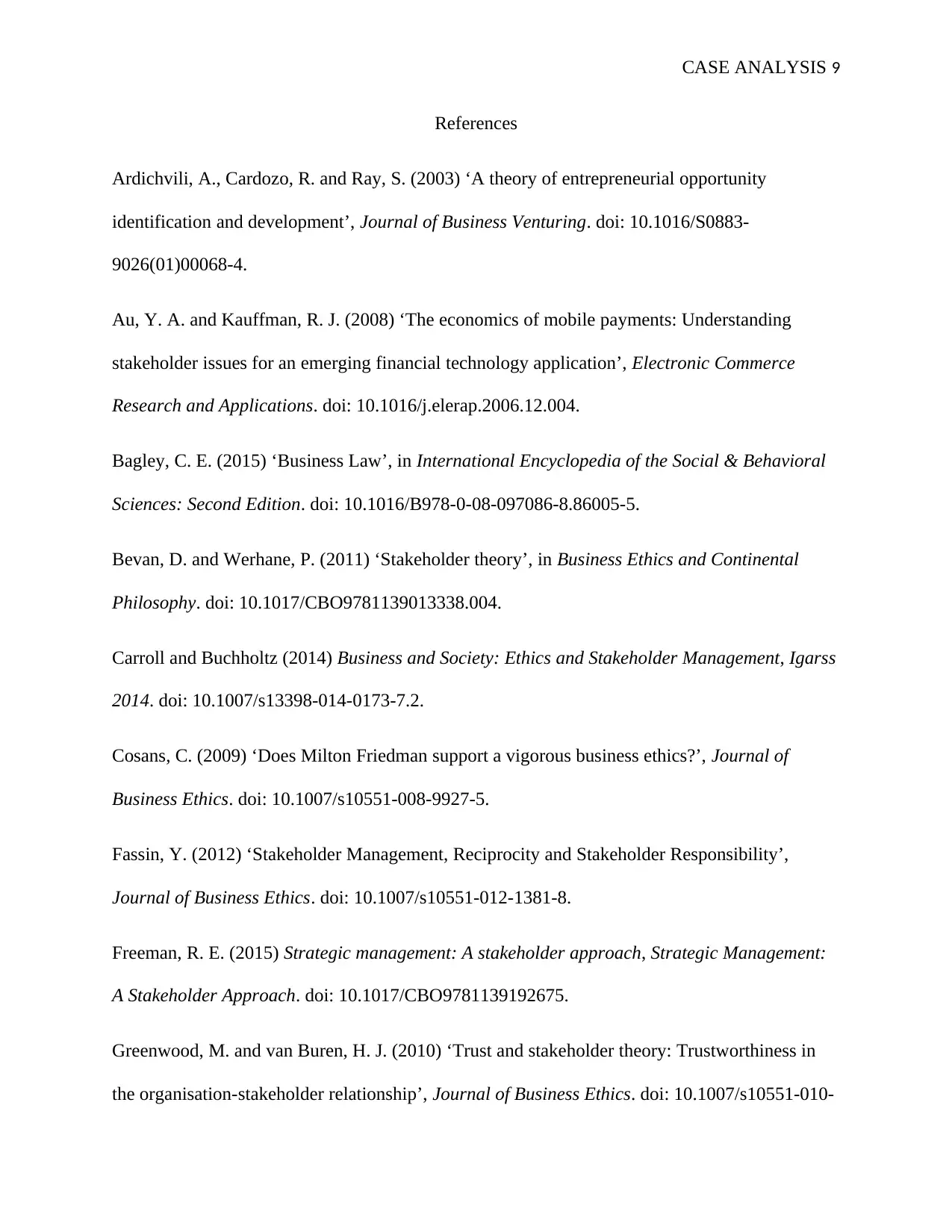
References
Ardichvili, A., Cardozo, R. and Ray, S. (2003) ‘A theory of entrepreneurial opportunity
identification and development’, Journal of Business Venturing. doi: 10.1016/S0883-
9026(01)00068-4.
Au, Y. A. and Kauffman, R. J. (2008) ‘The economics of mobile payments: Understanding
stakeholder issues for an emerging financial technology application’, Electronic Commerce
Research and Applications. doi: 10.1016/j.elerap.2006.12.004.
Bagley, C. E. (2015) ‘Business Law’, in International Encyclopedia of the Social & Behavioral
Sciences: Second Edition. doi: 10.1016/B978-0-08-097086-8.86005-5.
Bevan, D. and Werhane, P. (2011) ‘Stakeholder theory’, in Business Ethics and Continental
Philosophy. doi: 10.1017/CBO9781139013338.004.
Carroll and Buchholtz (2014) Business and Society: Ethics and Stakeholder Management, Igarss
2014. doi: 10.1007/s13398-014-0173-7.2.
Cosans, C. (2009) ‘Does Milton Friedman support a vigorous business ethics?’, Journal of
Business Ethics. doi: 10.1007/s10551-008-9927-5.
Fassin, Y. (2012) ‘Stakeholder Management, Reciprocity and Stakeholder Responsibility’,
Journal of Business Ethics. doi: 10.1007/s10551-012-1381-8.
Freeman, R. E. (2015) Strategic management: A stakeholder approach, Strategic Management:
A Stakeholder Approach. doi: 10.1017/CBO9781139192675.
Greenwood, M. and van Buren, H. J. (2010) ‘Trust and stakeholder theory: Trustworthiness in
the organisation-stakeholder relationship’, Journal of Business Ethics. doi: 10.1007/s10551-010-
References
Ardichvili, A., Cardozo, R. and Ray, S. (2003) ‘A theory of entrepreneurial opportunity
identification and development’, Journal of Business Venturing. doi: 10.1016/S0883-
9026(01)00068-4.
Au, Y. A. and Kauffman, R. J. (2008) ‘The economics of mobile payments: Understanding
stakeholder issues for an emerging financial technology application’, Electronic Commerce
Research and Applications. doi: 10.1016/j.elerap.2006.12.004.
Bagley, C. E. (2015) ‘Business Law’, in International Encyclopedia of the Social & Behavioral
Sciences: Second Edition. doi: 10.1016/B978-0-08-097086-8.86005-5.
Bevan, D. and Werhane, P. (2011) ‘Stakeholder theory’, in Business Ethics and Continental
Philosophy. doi: 10.1017/CBO9781139013338.004.
Carroll and Buchholtz (2014) Business and Society: Ethics and Stakeholder Management, Igarss
2014. doi: 10.1007/s13398-014-0173-7.2.
Cosans, C. (2009) ‘Does Milton Friedman support a vigorous business ethics?’, Journal of
Business Ethics. doi: 10.1007/s10551-008-9927-5.
Fassin, Y. (2012) ‘Stakeholder Management, Reciprocity and Stakeholder Responsibility’,
Journal of Business Ethics. doi: 10.1007/s10551-012-1381-8.
Freeman, R. E. (2015) Strategic management: A stakeholder approach, Strategic Management:
A Stakeholder Approach. doi: 10.1017/CBO9781139192675.
Greenwood, M. and van Buren, H. J. (2010) ‘Trust and stakeholder theory: Trustworthiness in
the organisation-stakeholder relationship’, Journal of Business Ethics. doi: 10.1007/s10551-010-
⊘ This is a preview!⊘
Do you want full access?
Subscribe today to unlock all pages.
Trusted by 1+ million students worldwide
CASE ANALYSIS 10
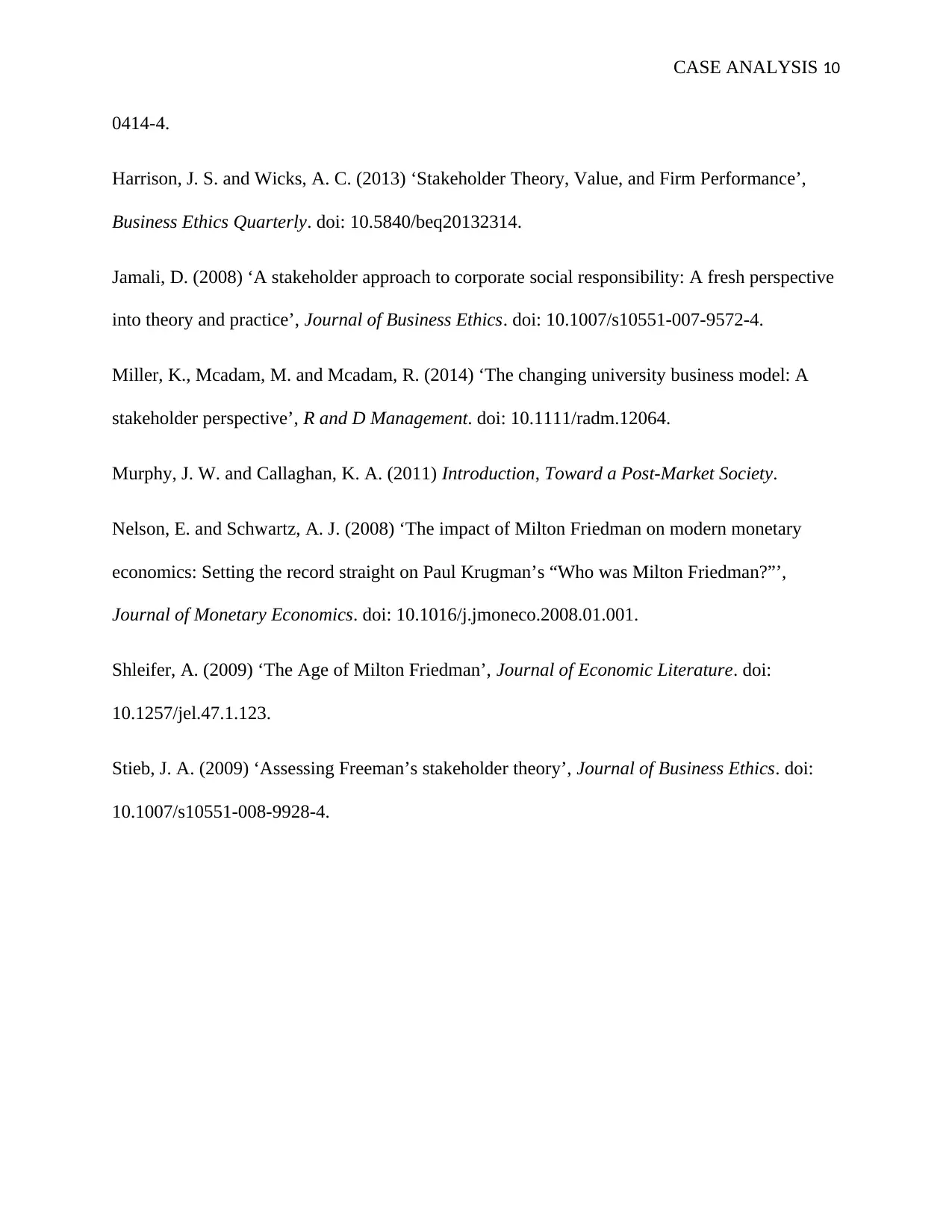
0414-4.
Harrison, J. S. and Wicks, A. C. (2013) ‘Stakeholder Theory, Value, and Firm Performance’,
Business Ethics Quarterly. doi: 10.5840/beq20132314.
Jamali, D. (2008) ‘A stakeholder approach to corporate social responsibility: A fresh perspective
into theory and practice’, Journal of Business Ethics. doi: 10.1007/s10551-007-9572-4.
Miller, K., Mcadam, M. and Mcadam, R. (2014) ‘The changing university business model: A
stakeholder perspective’, R and D Management. doi: 10.1111/radm.12064.
Murphy, J. W. and Callaghan, K. A. (2011) Introduction, Toward a Post-Market Society.
Nelson, E. and Schwartz, A. J. (2008) ‘The impact of Milton Friedman on modern monetary
economics: Setting the record straight on Paul Krugman’s “Who was Milton Friedman?”’,
Journal of Monetary Economics. doi: 10.1016/j.jmoneco.2008.01.001.
Shleifer, A. (2009) ‘The Age of Milton Friedman’, Journal of Economic Literature. doi:
10.1257/jel.47.1.123.
Stieb, J. A. (2009) ‘Assessing Freeman’s stakeholder theory’, Journal of Business Ethics. doi:
10.1007/s10551-008-9928-4.
0414-4.
Harrison, J. S. and Wicks, A. C. (2013) ‘Stakeholder Theory, Value, and Firm Performance’,
Business Ethics Quarterly. doi: 10.5840/beq20132314.
Jamali, D. (2008) ‘A stakeholder approach to corporate social responsibility: A fresh perspective
into theory and practice’, Journal of Business Ethics. doi: 10.1007/s10551-007-9572-4.
Miller, K., Mcadam, M. and Mcadam, R. (2014) ‘The changing university business model: A
stakeholder perspective’, R and D Management. doi: 10.1111/radm.12064.
Murphy, J. W. and Callaghan, K. A. (2011) Introduction, Toward a Post-Market Society.
Nelson, E. and Schwartz, A. J. (2008) ‘The impact of Milton Friedman on modern monetary
economics: Setting the record straight on Paul Krugman’s “Who was Milton Friedman?”’,
Journal of Monetary Economics. doi: 10.1016/j.jmoneco.2008.01.001.
Shleifer, A. (2009) ‘The Age of Milton Friedman’, Journal of Economic Literature. doi:
10.1257/jel.47.1.123.
Stieb, J. A. (2009) ‘Assessing Freeman’s stakeholder theory’, Journal of Business Ethics. doi:
10.1007/s10551-008-9928-4.
Paraphrase This Document
Need a fresh take? Get an instant paraphrase of this document with our AI Paraphraser

CASE ANALYSIS 11
.
.

1 out of 11


Related Documents


Your All-in-One AI-Powered Toolkit for Academic Success.
+13062052269
info@desklib.com
Available 24*7 on WhatsApp / Email
![[object Object]](/_next/static/media/star-bottom.7253800d.svg)
Unlock your academic potential
Copyright © 2020–2026 A2Z Services. All Rights Reserved. Developed and managed by ZUCOL.