Assessment on Coordinating Complex Case Requirements: CHCCSM004

Verified

Added on  2023/01/10

|8
|1625
|82
Homework Assignment
AI Summary
This assignment solution addresses the core principles of case management, focusing on coordinating complex case requirements. It explores person-centered approaches, emphasizing active listening and individualized care plans. The solution delves into essential aspects such as referral options, the role's requirements and boundaries, and the impact of mandatory reporting laws. It also examines strategies for establishing effective communication, preventing service duplication, and monitoring client progress. The assignment further analyzes collaborative working arrangements, outlining the benefits for all parties involved and addressing coordination requirements across different organizations. It also discusses the barriers presented by welfare dependency and highlights the importance of prioritizing client needs through a person-centered approach. Finally, the solution outlines potential issues faced by clients and their families when accessing multiple services and describes various case management models.
Document Page
Coordinate Complex Case
Requirements
tabler-icon-diamond-filled.svg

Paraphrase This Document

Need a fresh take? Get an instant paraphrase of this document with our AI Paraphraser
Document Page
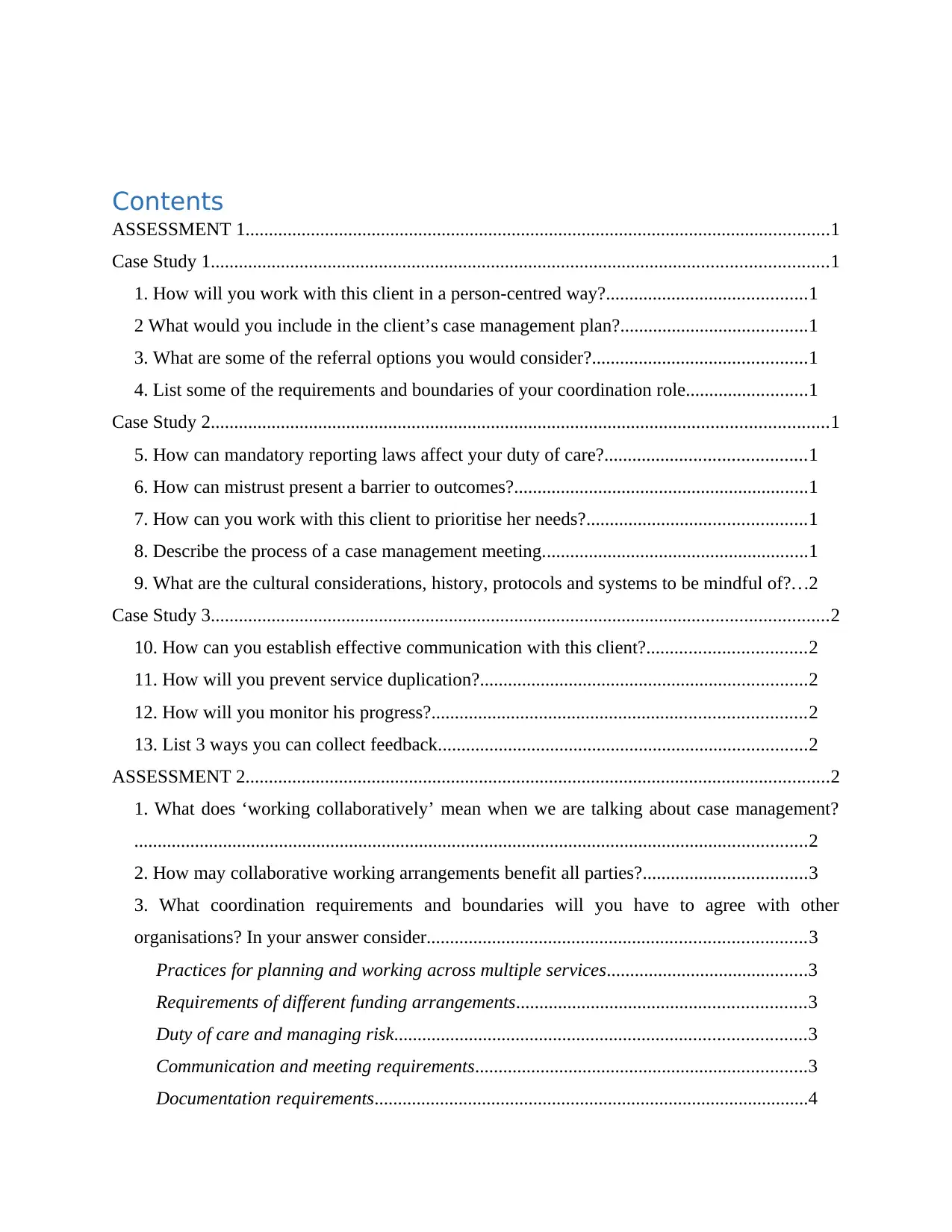
Contents
ASSESSMENT 1.............................................................................................................................1
Case Study 1....................................................................................................................................1
1. How will you work with this client in a person-centred way?...........................................1
2 What would you include in the client’s case management plan?........................................1
3. What are some of the referral options you would consider?..............................................1
4. List some of the requirements and boundaries of your coordination role..........................1
Case Study 2....................................................................................................................................1
5. How can mandatory reporting laws affect your duty of care?...........................................1
6. How can mistrust present a barrier to outcomes?...............................................................1
7. How can you work with this client to prioritise her needs?...............................................1
8. Describe the process of a case management meeting.........................................................1
9. What are the cultural considerations, history, protocols and systems to be mindful of?...2
Case Study 3....................................................................................................................................2
10. How can you establish effective communication with this client?..................................2
11. How will you prevent service duplication?......................................................................2
12. How will you monitor his progress?................................................................................2
13. List 3 ways you can collect feedback...............................................................................2
ASSESSMENT 2.............................................................................................................................2
1. What does ‘working collaboratively’ mean when we are talking about case management?
................................................................................................................................................2
2. How may collaborative working arrangements benefit all parties?...................................3
3. What coordination requirements and boundaries will you have to agree with other
organisations? In your answer consider.................................................................................3
Practices for planning and working across multiple services...........................................3
Requirements of different funding arrangements..............................................................3
Duty of care and managing risk........................................................................................3
Communication and meeting requirements.......................................................................3
Documentation requirements.............................................................................................4
Document Page
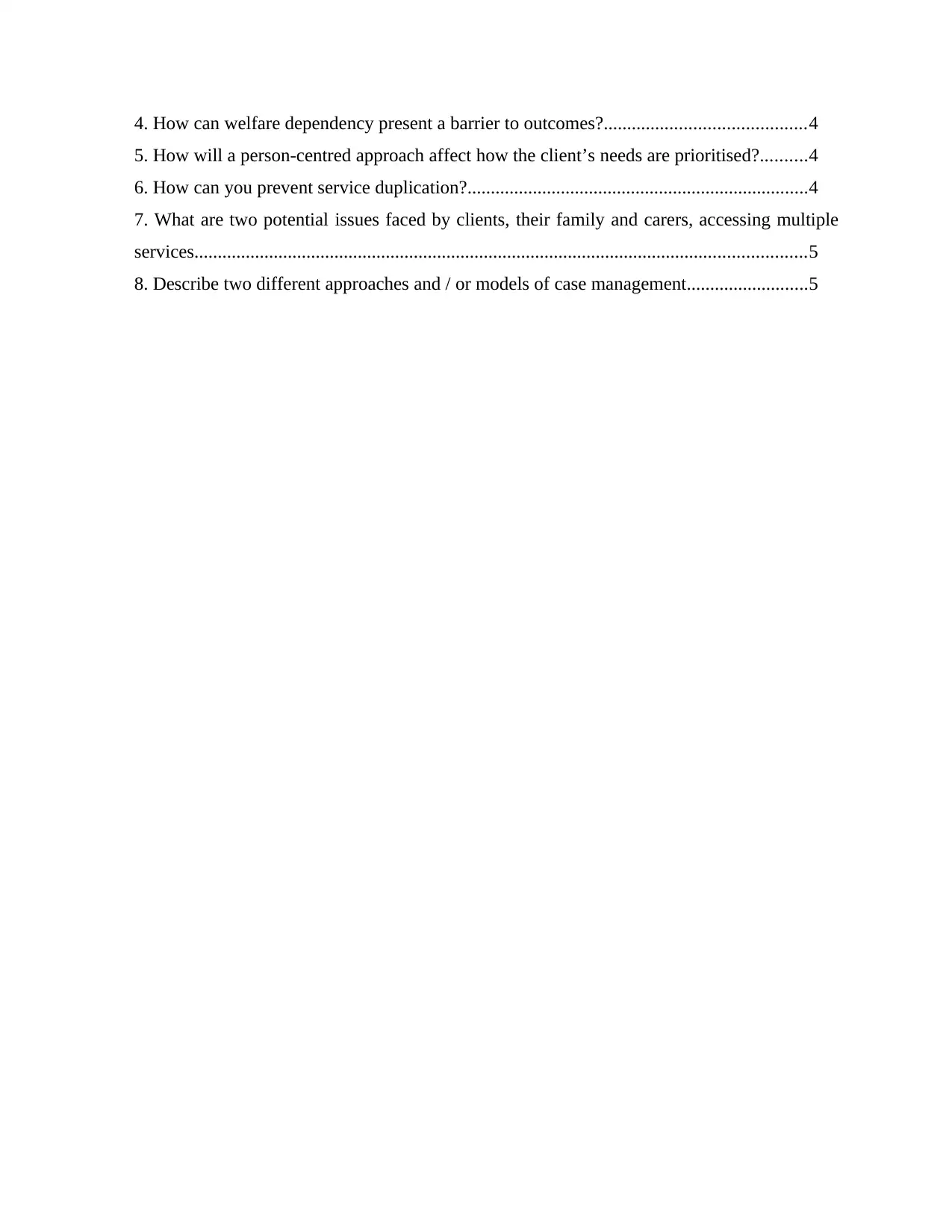
4. How can welfare dependency present a barrier to outcomes?...........................................4
5. How will a person-centred approach affect how the client’s needs are prioritised?..........4
6. How can you prevent service duplication?.........................................................................4
7. What are two potential issues faced by clients, their family and carers, accessing multiple
services...................................................................................................................................5
8. Describe two different approaches and / or models of case management..........................5
Document Page
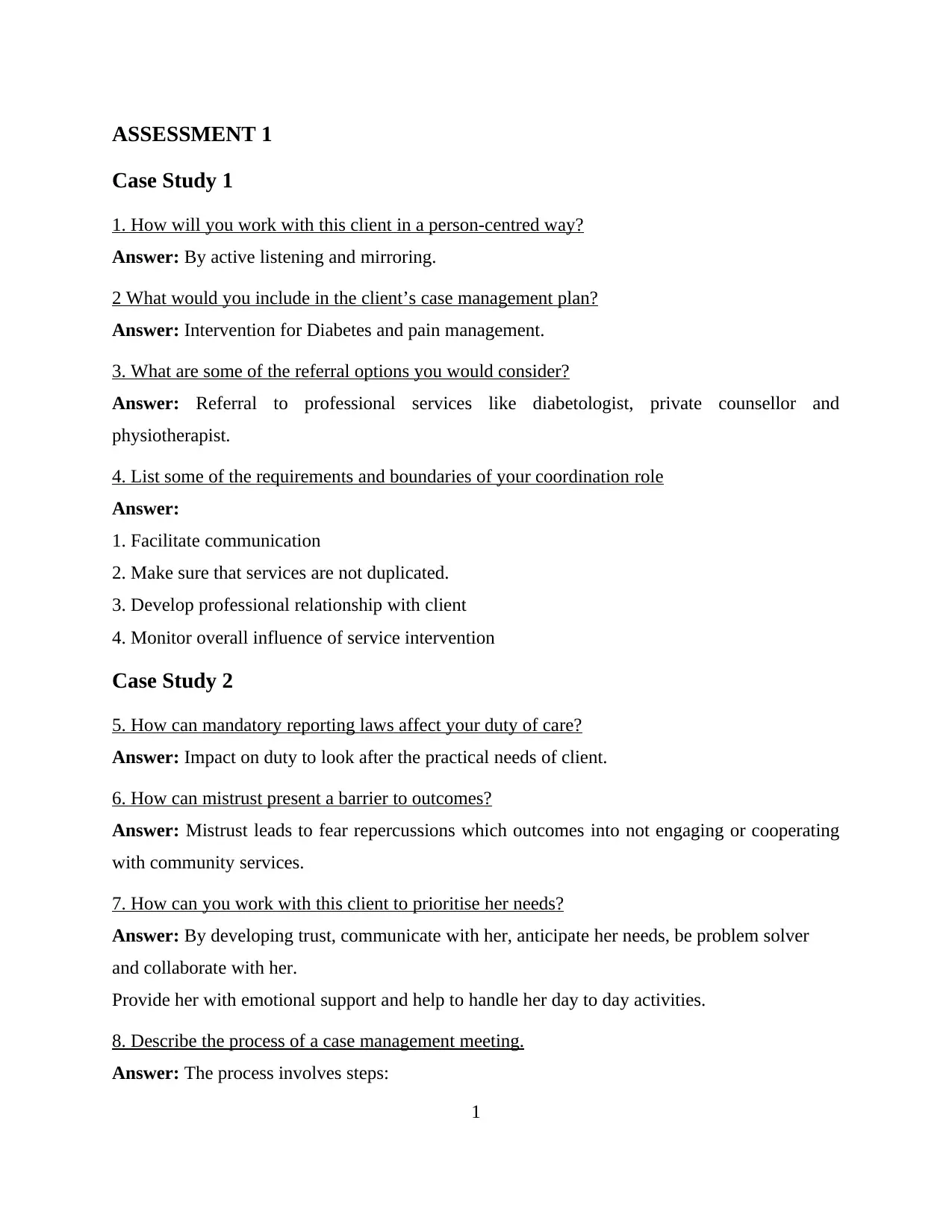
ASSESSMENT 1
Case Study 1
1. How will you work with this client in a person-centred way?
Answer: By active listening and mirroring.
2 What would you include in the client’s case management plan?
Answer: Intervention for Diabetes and pain management.
3. What are some of the referral options you would consider?
Answer: Referral to professional services like diabetologist, private counsellor and
physiotherapist.
4. List some of the requirements and boundaries of your coordination role
Answer:
1. Facilitate communication
2. Make sure that services are not duplicated.
3. Develop professional relationship with client
4. Monitor overall influence of service intervention
Case Study 2
5. How can mandatory reporting laws affect your duty of care?
Answer: Impact on duty to look after the practical needs of client.
6. How can mistrust present a barrier to outcomes?
Answer: Mistrust leads to fear repercussions which outcomes into not engaging or cooperating
with community services.
7. How can you work with this client to prioritise her needs?
Answer: By developing trust, communicate with her, anticipate her needs, be problem solver
and collaborate with her.
Provide her with emotional support and help to handle her day to day activities.
8. Describe the process of a case management meeting.
Answer: The process involves steps:
1
tabler-icon-diamond-filled.svg

Paraphrase This Document

Need a fresh take? Get an instant paraphrase of this document with our AI Paraphraser
Document Page
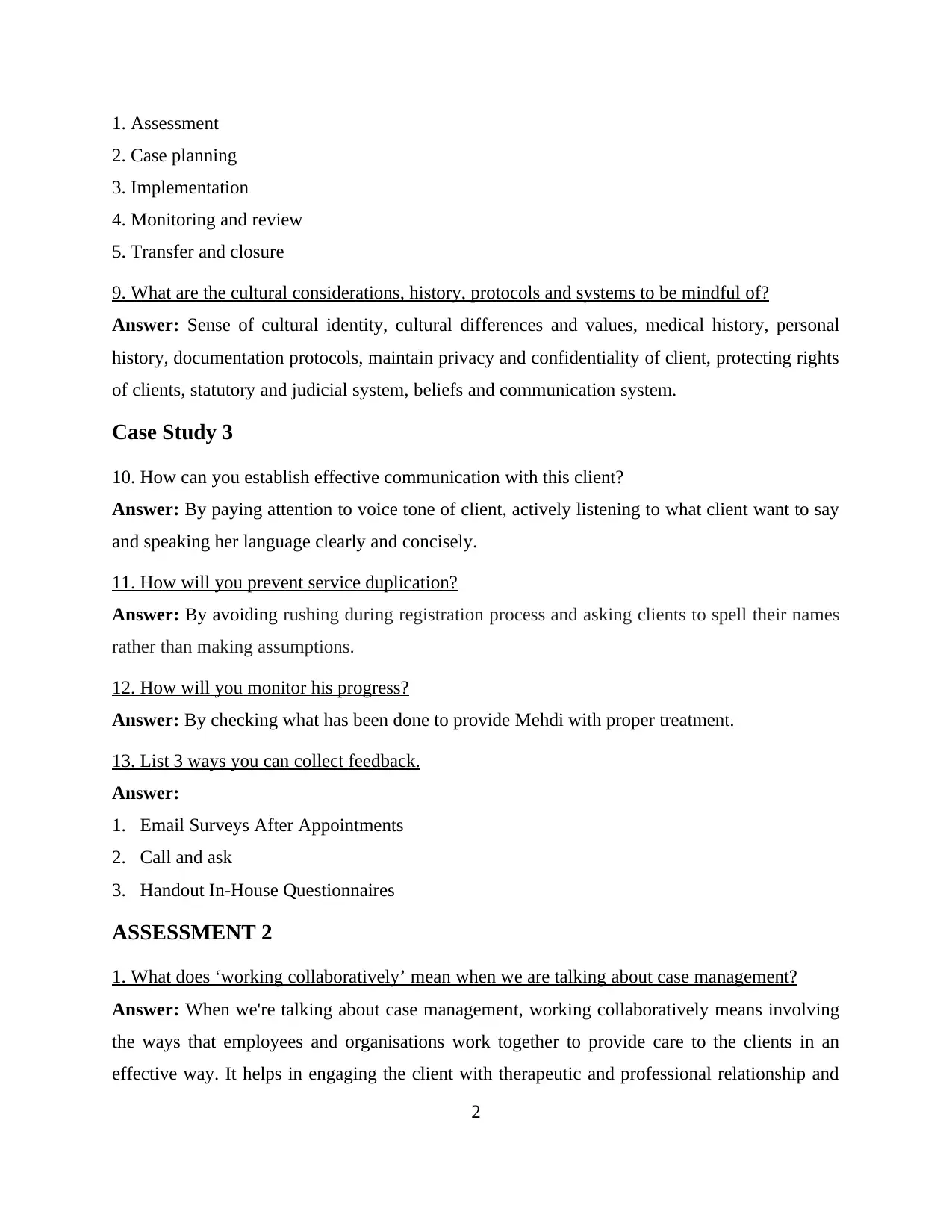
1. Assessment
2. Case planning
3. Implementation
4. Monitoring and review
5. Transfer and closure
9. What are the cultural considerations, history, protocols and systems to be mindful of?
Answer: Sense of cultural identity, cultural differences and values, medical history, personal
history, documentation protocols, maintain privacy and confidentiality of client, protecting rights
of clients, statutory and judicial system, beliefs and communication system.
Case Study 3
10. How can you establish effective communication with this client?
Answer: By paying attention to voice tone of client, actively listening to what client want to say
and speaking her language clearly and concisely.
11. How will you prevent service duplication?
Answer: By avoiding rushing during registration process and asking clients to spell their names
rather than making assumptions.
12. How will you monitor his progress?
Answer: By checking what has been done to provide Mehdi with proper treatment.
13. List 3 ways you can collect feedback.
Answer:
1. Email Surveys After Appointments
2. Call and ask
3. Handout In-House Questionnaires
ASSESSMENT 2
1. What does ‘working collaboratively’ mean when we are talking about case management?
Answer: When we're talking about case management, working collaboratively means involving
the ways that employees and organisations work together to provide care to the clients in an
effective way. It helps in engaging the client with therapeutic and professional relationship and
2
Document Page
monitoring and reviewing to make sure that services are effectively delivered and recognise the
needs of individuals and families.
2. How may collaborative working arrangements benefit all parties?
Answer: Collaborative working arrangements have several benefits for all the parties. It makes
the meetings more productive and helps in finding out innovative ideas which assist in bringing
improvements in the services. Apart from this, it increases the engagement between health care
professionals, clients, stakeholders and other healthcare staff which assist in ensuring delivery of
high quality services to the patients and fulfilling their care needs.
3. What coordination requirements and boundaries will you have to agree with other
organisations? In your answer consider
Answer:
Practices for planning and working across multiple services
Providing a central point of contact for client
Ensure that services are not duplicated
Monitor client concerns, confusion, and barriers
Determine the services available within the community
Requirements of different funding arrangements
Consult with relevant parties
Facilitate case management meetings
Duty of care and managing risk
Listen to concerns of patient and provide them with better quality care.
Monitor overall influence of service interventions
Ensure services are clear regarding what needs to be accomplished
Communication and meeting requirements
Facilitate communication
Participate in a network
3
Document Page
Documentation requirements
Record information accurately and carefully
Secure all records properly
Maintain privacy and confidentiality
4. How can welfare dependency present a barrier to outcomes?
Answer: Welfare dependency can be stated as a state in which an individual is reliant on welfare
benefits of government for their income for longer period and without it, they will be unable to
mitigate the expenses of their daily life. It can present barriers to outcomes as it reduces the work
effort as well as remote poverty prone single parent families and illegitimacy. It may cause
decrease in incomes of family and replacing self-sufficiency with reliance and limit employment
opportunities. It has potential to direct people to poor decision making.
5. How will a person-centred approach affect how the client’s needs are prioritised?
Answer: Person centred care assist healthcare professionals in finding out appropriate way to
communicate and improve quality of care. It enhances their independence and is beneficial for
patient and personal level and encourage them to take participation in decisions. Apart from this,
the person centred approach put values of people at centre of care and considers their preferences
and needs which ensures delivery of high quality care services to patient. When providing
support and care to a person, it is important to prioritise their needs. For prioritising, proper
determination of need is very much essential. Support and care may be needed for short time
period like as part of planned respite and in response to crisis. An ongoing care is needed to
support day to day activities like recreation, employment or personal care requirements.
Developing how urgent the requirements are recognising the priority of mitigating needs of
person. Needs can be prioritizing as follows: crisis support, intermittent care, transition care and
ongoing support.
6. How can you prevent service duplication?
Answer: In order to prevent the service duplication, it is necessary to educate all the care
provider and define the differences discipline involved. Apart from this, it is necessary to ensure
that all the goals are stated before treating functional deficit. Moreover, proper understanding of
4
tabler-icon-diamond-filled.svg

Paraphrase This Document

Need a fresh take? Get an instant paraphrase of this document with our AI Paraphraser
Document Page
medical rules is also very necessary for avoiding service duplication. Ensuring effective
communication is the another way that also helps in preventing service duplication.
7. What are two potential issues faced by clients, their family and carers, accessing multiple
services.
Answer:
Potential issues faced by clients:
Poor accommodation of needs of patients
Getting ineffective care
Potential issues faced by family and carers:
Behavioural issues
Communication
8. Describe two different approaches and / or models of case management
Answer:
The Brokerage Case Management Model
The Clinical Case Management Model
5
chevron_up_icon
1 out of 8
circle_padding
hide_on_mobile
zoom_out_icon
[object Object]