Case Management Principles Applied: Jennifer's Case Study Report
VerifiedAdded on 2022/08/22
|9
|2063
|28
Case Study
AI Summary
This case study examines the application of case management principles in Jennifer's situation, a 16-year-old girl facing multiple challenges. The assignment details the collaborative process, including engagement, assessment, planning, implementation, and termination phases. It highlights key principles such as informed consent, confidentiality, and respect for cultural diversity. The study also addresses ethical concerns faced by case managers, emphasizing patient autonomy, beneficence, and non-maleficence. Jennifer's case demonstrates how a structured approach, involving various agencies and services like counseling, rehabilitation, and employment support, can lead to successful outcomes, improving her quality of life and resilience. The report concludes with a discussion of the ethical considerations and the importance of a client-centered approach in social work practice.
Running Head: Principles of Case Management 1
A Case Study on Case Management Principles
Name
Course
Institution
Date
A Case Study on Case Management Principles
Name
Course
Institution
Date

Paraphrase This Document
Need a fresh take? Get an instant paraphrase of this document with our AI Paraphraser
Principles of Case Management 2
Table of Contents
Table of Contents
Abstract.....................................................................................................................................2
Introduction..............................................................................................................................2
Principles of Case Management..............................................................................................3
Professional and Ethical Concerns in Case Management....................................................4
Jennifer’s Case Management Procedure...............................................................................5
Engagement...........................................................................................................................6
Assessment.............................................................................................................................6
Planning.................................................................................................................................7
Implementation....................................................................................................................7
Termination...........................................................................................................................7
Conclusion.................................................................................................................................8
Abstract
The case management process is a vital tool in health and social care. This process
helps social workers to support people with complex health requirements. Case management
varies according to the clients in the setting. This paper reports how the case management
process was used to overcome the challenges faced by Jennifer in a case study context.
Jennifer was successfully enrolled in the process and her life changed from being a drug
addict to completing school.
Table of Contents
Table of Contents
Abstract.....................................................................................................................................2
Introduction..............................................................................................................................2
Principles of Case Management..............................................................................................3
Professional and Ethical Concerns in Case Management....................................................4
Jennifer’s Case Management Procedure...............................................................................5
Engagement...........................................................................................................................6
Assessment.............................................................................................................................6
Planning.................................................................................................................................7
Implementation....................................................................................................................7
Termination...........................................................................................................................7
Conclusion.................................................................................................................................8
Abstract
The case management process is a vital tool in health and social care. This process
helps social workers to support people with complex health requirements. Case management
varies according to the clients in the setting. This paper reports how the case management
process was used to overcome the challenges faced by Jennifer in a case study context.
Jennifer was successfully enrolled in the process and her life changed from being a drug
addict to completing school.
Principles of Case Management 3
Introduction
Case Management process is a collaborative process that aims at solving a patient’s
needs through various interventions (Frankel et al., 2018). Achieving the needs is facilitated
through effective communication and the use of resources at hand to promote high-quality
care, patient safety, and cost-effective treatment. The case management process is governed
by a set of principles that ensure everything stays in order until the results are achieved. Case
management is driven by the fact that all parties involved will benefit when the patient
reaches optimum functional capabilities and wellness. The following report encompasses the
process and principles of case management that were followed in resolving the needs of a 16-
year-old girl named Jennifer.
Principles of Case Management.
Case management is undertaken according to a set of principles (Dieterich et al.,
2017). Principles of case management include consent to take part in the case, confidentiality,
and respect for the culture, diversity, and traditions of the client. Other principles include
enhancing the quality of life and patient resiliency, partnership, and respect. We applied all of
these principles while determining Jennifer’s case management.
Informed consent is an ethical and legal principle that is used widely in care
transactions (Grady, 2015). As a group, we obtained written consent from Jessica through
her parents. To obtain the consent we explained to both Jessica and her parents the case
management process and the responsibilities of all the parties that were involved. The next
principle that we put into use was confidentiality. The principle of confidentiality prevents
social workers from sharing information with third party members without the authority of
the client (Reamer, 2013). Jennifer had to sign an agreement form that approved us to share
her information with the necessary parties.
Introduction
Case Management process is a collaborative process that aims at solving a patient’s
needs through various interventions (Frankel et al., 2018). Achieving the needs is facilitated
through effective communication and the use of resources at hand to promote high-quality
care, patient safety, and cost-effective treatment. The case management process is governed
by a set of principles that ensure everything stays in order until the results are achieved. Case
management is driven by the fact that all parties involved will benefit when the patient
reaches optimum functional capabilities and wellness. The following report encompasses the
process and principles of case management that were followed in resolving the needs of a 16-
year-old girl named Jennifer.
Principles of Case Management.
Case management is undertaken according to a set of principles (Dieterich et al.,
2017). Principles of case management include consent to take part in the case, confidentiality,
and respect for the culture, diversity, and traditions of the client. Other principles include
enhancing the quality of life and patient resiliency, partnership, and respect. We applied all of
these principles while determining Jennifer’s case management.
Informed consent is an ethical and legal principle that is used widely in care
transactions (Grady, 2015). As a group, we obtained written consent from Jessica through
her parents. To obtain the consent we explained to both Jessica and her parents the case
management process and the responsibilities of all the parties that were involved. The next
principle that we put into use was confidentiality. The principle of confidentiality prevents
social workers from sharing information with third party members without the authority of
the client (Reamer, 2013). Jennifer had to sign an agreement form that approved us to share
her information with the necessary parties.
⊘ This is a preview!⊘
Do you want full access?
Subscribe today to unlock all pages.

Trusted by 1+ million students worldwide
Principles of Case Management 4
Collaboration with the client is an important principle that enables the free flow of
information and service delivery (Reeves et al., 2011). In Jennifer's case, we collaborated
with several agencies that offered counseling services, behavior support, the network of
alcohol and drug agencies (NADA) and youth employment. These agencies worked together
with each other and Jennifer. Due to this partnership, Jennifer was able to receive information
regarding her services in a timely fashion. We also adhered to the principle of promoting and
respecting Jennifer’s strengths. We worked closely with Jennifer and her parents which
enable us to build on her existing strengths and resources. This approach enabled us to
understand how Jennifer could contribute to her own wellbeing. Our strategy contrasts with a
pathology-based approach that focuses only on the problems faced by the client (Summers,
2015).
Respecting a client's traditions and culture as well as diversity is an important case
management principle that ensures the services provided are consistent with the patients'
needs. In this regard, we studied Jennifer's background in detail. We were, therefore, able to
make decisions based on Jennifer's cultural background. This principle enabled Jennifer to
integrate smoothly into the community after the completion of case management. The
principle of improving increasing a client’s resiliency and enhancement of the quality of life
ensured that we met our goal of saving Jennifer from her situation.
Professional and Ethical Concerns in Case Management
Professionals for example case managers should act as the advocate to the patient and
their family. More often they are faced with conflicting choices. In this instance, the case
manager uses the principle of beneficence whereby the best interests of the clients are put
first. Patients must be allowed to make decisions regarding their wellbeing and case managers
must respect them. We advocated the rights of Jennifer to secure her freedom after she had
been charged with shoplifting.
Collaboration with the client is an important principle that enables the free flow of
information and service delivery (Reeves et al., 2011). In Jennifer's case, we collaborated
with several agencies that offered counseling services, behavior support, the network of
alcohol and drug agencies (NADA) and youth employment. These agencies worked together
with each other and Jennifer. Due to this partnership, Jennifer was able to receive information
regarding her services in a timely fashion. We also adhered to the principle of promoting and
respecting Jennifer’s strengths. We worked closely with Jennifer and her parents which
enable us to build on her existing strengths and resources. This approach enabled us to
understand how Jennifer could contribute to her own wellbeing. Our strategy contrasts with a
pathology-based approach that focuses only on the problems faced by the client (Summers,
2015).
Respecting a client's traditions and culture as well as diversity is an important case
management principle that ensures the services provided are consistent with the patients'
needs. In this regard, we studied Jennifer's background in detail. We were, therefore, able to
make decisions based on Jennifer's cultural background. This principle enabled Jennifer to
integrate smoothly into the community after the completion of case management. The
principle of improving increasing a client’s resiliency and enhancement of the quality of life
ensured that we met our goal of saving Jennifer from her situation.
Professional and Ethical Concerns in Case Management
Professionals for example case managers should act as the advocate to the patient and
their family. More often they are faced with conflicting choices. In this instance, the case
manager uses the principle of beneficence whereby the best interests of the clients are put
first. Patients must be allowed to make decisions regarding their wellbeing and case managers
must respect them. We advocated the rights of Jennifer to secure her freedom after she had
been charged with shoplifting.
Paraphrase This Document
Need a fresh take? Get an instant paraphrase of this document with our AI Paraphraser
Principles of Case Management 5
In the case of management, a patient has the right to initiate and determine their
treatment course. This form of liberty is called autonomy. Autonomy fosters a patient's self-
determination and independence. Justice enables the parties to maintain what right while
making relevant decisions for the client. Non-maleficence protects patients from harm. These
ethical principles guide the social workers on what to do when faced with ethical dilemmas
(Caras and Sandu, 2013).
Ethical concerns in social care include; confidentiality of information retrieved from
minors. Relationships between the social worker and the clients that are outside the scope of
professionalism. The differences in personal views and values may be a source of ethical
concern in case management. Receiving gifts from clients may breach the integrity of
professionals (Dolgoff et al., 2012).
Jennifer’s Case Management Procedure
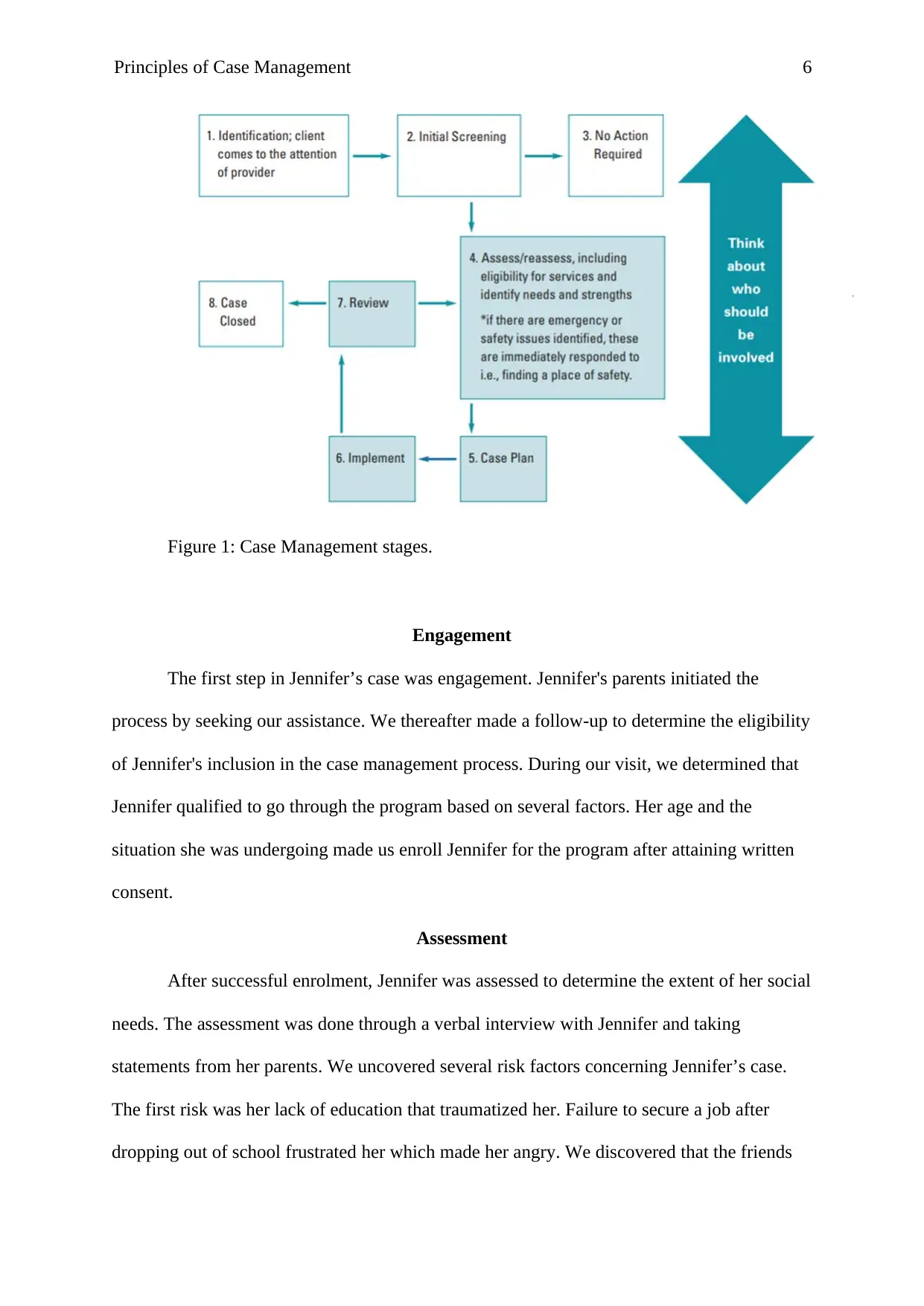
The case management process consists of several stages. The first stage is the
identification of the patient whereby the client gets the service provider's attention. The
second stage is the initial screening which determines whether any action is required or not. If
action is required, then the client is thoroughly assessed. Thereafter a case is planned and
then implemented in the sixth stage. After implementation, the case is reviewed and then
closed. If the results are unsatisfactory, after the review stage, the client is reassessed and the
process repeats itself from that point (Thota et al., 2012). These stages were effectively
applied to determine Jennifer’s case.
In the case of management, a patient has the right to initiate and determine their
treatment course. This form of liberty is called autonomy. Autonomy fosters a patient's self-
determination and independence. Justice enables the parties to maintain what right while
making relevant decisions for the client. Non-maleficence protects patients from harm. These
ethical principles guide the social workers on what to do when faced with ethical dilemmas
(Caras and Sandu, 2013).
Ethical concerns in social care include; confidentiality of information retrieved from
minors. Relationships between the social worker and the clients that are outside the scope of
professionalism. The differences in personal views and values may be a source of ethical
concern in case management. Receiving gifts from clients may breach the integrity of
professionals (Dolgoff et al., 2012).
Jennifer’s Case Management Procedure
The case management process consists of several stages. The first stage is the
identification of the patient whereby the client gets the service provider's attention. The
second stage is the initial screening which determines whether any action is required or not. If
action is required, then the client is thoroughly assessed. Thereafter a case is planned and
then implemented in the sixth stage. After implementation, the case is reviewed and then
closed. If the results are unsatisfactory, after the review stage, the client is reassessed and the
process repeats itself from that point (Thota et al., 2012). These stages were effectively
applied to determine Jennifer’s case.
Principles of Case Management 6
Figure 1: Case Management stages.
Engagement
The first step in Jennifer’s case was engagement. Jennifer's parents initiated the
process by seeking our assistance. We thereafter made a follow-up to determine the eligibility
of Jennifer's inclusion in the case management process. During our visit, we determined that
Jennifer qualified to go through the program based on several factors. Her age and the
situation she was undergoing made us enroll Jennifer for the program after attaining written
consent.
Assessment
After successful enrolment, Jennifer was assessed to determine the extent of her social
needs. The assessment was done through a verbal interview with Jennifer and taking
statements from her parents. We uncovered several risk factors concerning Jennifer’s case.
The first risk was her lack of education that traumatized her. Failure to secure a job after
dropping out of school frustrated her which made her angry. We discovered that the friends
Figure 1: Case Management stages.
Engagement
The first step in Jennifer’s case was engagement. Jennifer's parents initiated the
process by seeking our assistance. We thereafter made a follow-up to determine the eligibility
of Jennifer's inclusion in the case management process. During our visit, we determined that
Jennifer qualified to go through the program based on several factors. Her age and the
situation she was undergoing made us enroll Jennifer for the program after attaining written
consent.
Assessment
After successful enrolment, Jennifer was assessed to determine the extent of her social
needs. The assessment was done through a verbal interview with Jennifer and taking
statements from her parents. We uncovered several risk factors concerning Jennifer’s case.
The first risk was her lack of education that traumatized her. Failure to secure a job after
dropping out of school frustrated her which made her angry. We discovered that the friends
⊘ This is a preview!⊘
Do you want full access?
Subscribe today to unlock all pages.
Trusted by 1+ million students worldwide
Principles of Case Management 7
she had in the bad company, made her a drug addict. Failure to raise the required amount to
buy drugs made her shoplift stuff and start selling drugs. While undertaking the illegal acts
she was often involved in fights thus disrupting other people's peace. Discussions with
Jennifer showed her willingness to reform. Our agency had the capacity to deal with the issue
through collaboration with different service providers.
Planning
In planning and implementing Jennifer's case, some resolutions were made. First, we
collaboratively came up with goals to ensure that Jennifer's quality of life would improve in
the end. The goals we made included getting Jennifer back to finish school. The second goal
was to provide the necessary assistance to treat mental issues. Our third goal was ensuring
that she had good company, and avoid using alcohol. The last goal was to get away that
would cater to her financial needs.
Implementation
To implement the goals, we collaborated with different agencies that provided
Jennifer with rehabilitation services including guidance and counseling. We also took the
necessary steps to make sure that she attended classes until completion. We also partnered
with a youth employment agency that helped Jennifer secure a job finishing school. We
integrated Jennifer in the Salvation Army youth services to make sure that she spent her free
time wisely. NADA helped with giving Jennifer advice on how to stop using drugs and made
efforts to keep her away from the bad company.
Several challenges were encountered while implementing the case management
process. For instance, we had a difficult time persuading Jennifer to attend counseling
programs. Other instances like blocking her access to alcohol and re-schooling proved to be
an uphill task.
she had in the bad company, made her a drug addict. Failure to raise the required amount to
buy drugs made her shoplift stuff and start selling drugs. While undertaking the illegal acts
she was often involved in fights thus disrupting other people's peace. Discussions with
Jennifer showed her willingness to reform. Our agency had the capacity to deal with the issue
through collaboration with different service providers.
Planning
In planning and implementing Jennifer's case, some resolutions were made. First, we
collaboratively came up with goals to ensure that Jennifer's quality of life would improve in
the end. The goals we made included getting Jennifer back to finish school. The second goal
was to provide the necessary assistance to treat mental issues. Our third goal was ensuring
that she had good company, and avoid using alcohol. The last goal was to get away that
would cater to her financial needs.
Implementation
To implement the goals, we collaborated with different agencies that provided
Jennifer with rehabilitation services including guidance and counseling. We also took the
necessary steps to make sure that she attended classes until completion. We also partnered
with a youth employment agency that helped Jennifer secure a job finishing school. We
integrated Jennifer in the Salvation Army youth services to make sure that she spent her free
time wisely. NADA helped with giving Jennifer advice on how to stop using drugs and made
efforts to keep her away from the bad company.
Several challenges were encountered while implementing the case management
process. For instance, we had a difficult time persuading Jennifer to attend counseling
programs. Other instances like blocking her access to alcohol and re-schooling proved to be
an uphill task.
Paraphrase This Document
Need a fresh take? Get an instant paraphrase of this document with our AI Paraphraser
Principles of Case Management 8
Termination
After the successful completion of rehabilitation and studies, the case management
process was terminated. An exit interview was performed which showed that Jennifer was
ready to exit the program. Follow up program was conceived in which we obtained consent
on checking out her progress on a monthly basis. and Jennifer secured a job through the
youth employment agency as she awaited to get into college.
Conclusion
The case management process is based on a set of principles that ensure the process is
undertaken morally. The process systematically integrates the aspects of social and health
care in different contexts with excellent outcomes. After a client has finished the process,
they emerge as changed individuals of good health that are ready to take up meaningful
responsibilities in their lives.
Termination
After the successful completion of rehabilitation and studies, the case management
process was terminated. An exit interview was performed which showed that Jennifer was
ready to exit the program. Follow up program was conceived in which we obtained consent
on checking out her progress on a monthly basis. and Jennifer secured a job through the
youth employment agency as she awaited to get into college.
Conclusion
The case management process is based on a set of principles that ensure the process is
undertaken morally. The process systematically integrates the aspects of social and health
care in different contexts with excellent outcomes. After a client has finished the process,
they emerge as changed individuals of good health that are ready to take up meaningful
responsibilities in their lives.
Principles of Case Management 9
References
Caras, A., & Sandu, A. (2013). Ethical evaluation of social services and the need for ethics
committees. Procedia-Social and Behavioral Sciences, 92, 142-149.
Dieterich, M., Irving, C. B., Bergman, H., Khokhar, M. A., Park, B., & Marshall, M. (2017).
Intensive case management for severe mental illness. Cochrane database of
systematic reviews, (1).
Dolgoff, R., Harrington, D., & Loewenberg, F. M. (2012). Brooks/Cole empowerment series:
Ethical decisions for social work practice. Cengage Learning.
Frankel, A. J., Gelman, S. R., & Pastor, D. K. (2018). Case management: An introduction to
concepts and skills. Oxford University Press.
Grady, C. (2015). Enduring and emerging challenges of informed consent. New England
Journal of Medicine, 372(9), 855-862.
Reamer, F. G. (2013). Social work in a digital age: Ethical and risk management challenges.
Social work, 58(2), 163-172.
Reeves, S., Lewin, S., Espin, S., & Zwarenstein, M. (2011). Interprofessional teamwork for
health and social care (Vol. 8). John Wiley & Sons.
Summers, N. (2015). Fundamentals of case management practice: Skills for human services.
Nelson Education.
Thota, A. B., Sipe, T. A., Byard, G. J., Zometa, C. S., Hahn, R. A., McKnight-Eily, L. R., ...
& Gelenberg, A. J. (2012). Collaborative care to improve the management of
depressive disorders: a community guide systematic review and meta-analysis.
American journal of preventive medicine, 42(5), 525-538.
References
Caras, A., & Sandu, A. (2013). Ethical evaluation of social services and the need for ethics
committees. Procedia-Social and Behavioral Sciences, 92, 142-149.
Dieterich, M., Irving, C. B., Bergman, H., Khokhar, M. A., Park, B., & Marshall, M. (2017).
Intensive case management for severe mental illness. Cochrane database of
systematic reviews, (1).
Dolgoff, R., Harrington, D., & Loewenberg, F. M. (2012). Brooks/Cole empowerment series:
Ethical decisions for social work practice. Cengage Learning.
Frankel, A. J., Gelman, S. R., & Pastor, D. K. (2018). Case management: An introduction to
concepts and skills. Oxford University Press.
Grady, C. (2015). Enduring and emerging challenges of informed consent. New England
Journal of Medicine, 372(9), 855-862.
Reamer, F. G. (2013). Social work in a digital age: Ethical and risk management challenges.
Social work, 58(2), 163-172.
Reeves, S., Lewin, S., Espin, S., & Zwarenstein, M. (2011). Interprofessional teamwork for
health and social care (Vol. 8). John Wiley & Sons.
Summers, N. (2015). Fundamentals of case management practice: Skills for human services.
Nelson Education.
Thota, A. B., Sipe, T. A., Byard, G. J., Zometa, C. S., Hahn, R. A., McKnight-Eily, L. R., ...
& Gelenberg, A. J. (2012). Collaborative care to improve the management of
depressive disorders: a community guide systematic review and meta-analysis.
American journal of preventive medicine, 42(5), 525-538.
⊘ This is a preview!⊘
Do you want full access?
Subscribe today to unlock all pages.
Trusted by 1+ million students worldwide

1 out of 9


Related Documents


Your All-in-One AI-Powered Toolkit for Academic Success.
+13062052269
info@desklib.com
Available 24*7 on WhatsApp / Email
![[object Object]](/_next/static/media/star-bottom.7253800d.svg)
Unlock your academic potential
Copyright © 2020–2026 A2Z Services. All Rights Reserved. Developed and managed by ZUCOL.