CHSUG2004: Research Report and Case Management Portfolio Analysis
VerifiedAdded on 2022/11/23
|3
|1852
|1
Case Study
AI Summary
This assignment presents four case studies designed for a CHSUG2004 Research Report and Case Management Portfolio. The first case, Dale, focuses on a 45-year-old man with depression, alcohol abuse, and caregiving responsibilities for his elderly father, highlighting issues of unemployment and strained family relationships. Jenny, the second case, involves a 68-year-old woman facing eviction, financial distress, and social isolation due to past traumas and broken family ties. Jamilah, the third case, is a 34-year-old refugee struggling with postpartum depression, cultural adjustment, and marital conflicts. The final case, Josh, centers on a 13-year-old involved in the youth justice system, dealing with family issues, school disengagement, and the incarceration of his older brother. Students are tasked with choosing one case study to analyze and develop a comprehensive research report and case management portfolio, addressing the complex challenges faced by each individual.
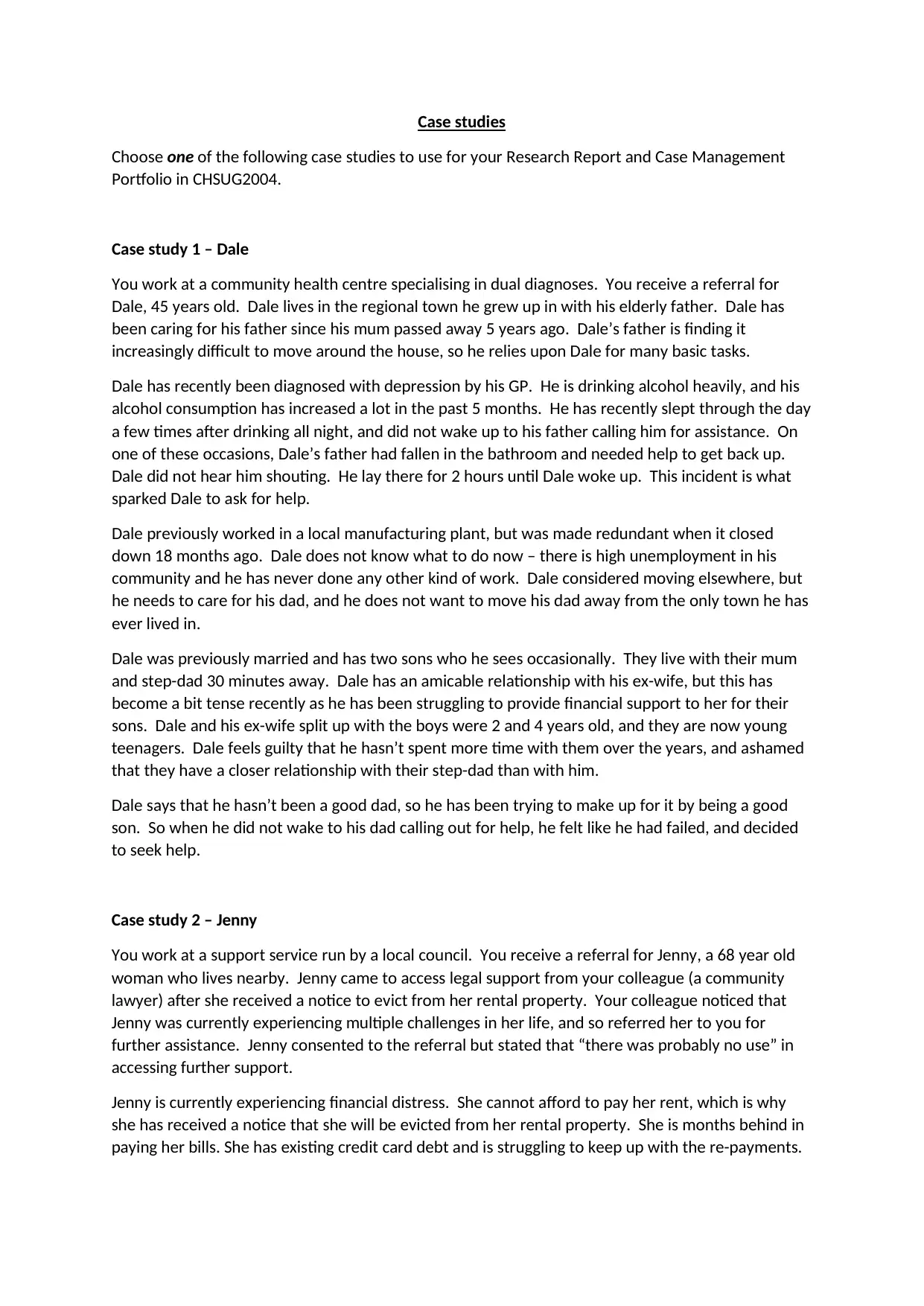
Case studies
Choose one of the following case studies to use for your Research Report and Case Management
Portfolio in CHSUG2004.
Case study 1 – Dale
You work at a community health centre specialising in dual diagnoses. You receive a referral for
Dale, 45 years old. Dale lives in the regional town he grew up in with his elderly father. Dale has
been caring for his father since his mum passed away 5 years ago. Dale’s father is finding it
increasingly difficult to move around the house, so he relies upon Dale for many basic tasks.
Dale has recently been diagnosed with depression by his GP. He is drinking alcohol heavily, and his
alcohol consumption has increased a lot in the past 5 months. He has recently slept through the day
a few times after drinking all night, and did not wake up to his father calling him for assistance. On
one of these occasions, Dale’s father had fallen in the bathroom and needed help to get back up.
Dale did not hear him shouting. He lay there for 2 hours until Dale woke up. This incident is what
sparked Dale to ask for help.
Dale previously worked in a local manufacturing plant, but was made redundant when it closed
down 18 months ago. Dale does not know what to do now – there is high unemployment in his
community and he has never done any other kind of work. Dale considered moving elsewhere, but
he needs to care for his dad, and he does not want to move his dad away from the only town he has
ever lived in.
Dale was previously married and has two sons who he sees occasionally. They live with their mum
and step-dad 30 minutes away. Dale has an amicable relationship with his ex-wife, but this has
become a bit tense recently as he has been struggling to provide financial support to her for their
sons. Dale and his ex-wife split up with the boys were 2 and 4 years old, and they are now young
teenagers. Dale feels guilty that he hasn’t spent more time with them over the years, and ashamed
that they have a closer relationship with their step-dad than with him.
Dale says that he hasn’t been a good dad, so he has been trying to make up for it by being a good
son. So when he did not wake to his dad calling out for help, he felt like he had failed, and decided
to seek help.
Case study 2 – Jenny
You work at a support service run by a local council. You receive a referral for Jenny, a 68 year old
woman who lives nearby. Jenny came to access legal support from your colleague (a community
lawyer) after she received a notice to evict from her rental property. Your colleague noticed that
Jenny was currently experiencing multiple challenges in her life, and so referred her to you for
further assistance. Jenny consented to the referral but stated that “there was probably no use” in
accessing further support.
Jenny is currently experiencing financial distress. She cannot afford to pay her rent, which is why
she has received a notice that she will be evicted from her rental property. She is months behind in
paying her bills. She has existing credit card debt and is struggling to keep up with the re-payments.
Choose one of the following case studies to use for your Research Report and Case Management
Portfolio in CHSUG2004.
Case study 1 – Dale
You work at a community health centre specialising in dual diagnoses. You receive a referral for
Dale, 45 years old. Dale lives in the regional town he grew up in with his elderly father. Dale has
been caring for his father since his mum passed away 5 years ago. Dale’s father is finding it
increasingly difficult to move around the house, so he relies upon Dale for many basic tasks.
Dale has recently been diagnosed with depression by his GP. He is drinking alcohol heavily, and his
alcohol consumption has increased a lot in the past 5 months. He has recently slept through the day
a few times after drinking all night, and did not wake up to his father calling him for assistance. On
one of these occasions, Dale’s father had fallen in the bathroom and needed help to get back up.
Dale did not hear him shouting. He lay there for 2 hours until Dale woke up. This incident is what
sparked Dale to ask for help.
Dale previously worked in a local manufacturing plant, but was made redundant when it closed
down 18 months ago. Dale does not know what to do now – there is high unemployment in his
community and he has never done any other kind of work. Dale considered moving elsewhere, but
he needs to care for his dad, and he does not want to move his dad away from the only town he has
ever lived in.
Dale was previously married and has two sons who he sees occasionally. They live with their mum
and step-dad 30 minutes away. Dale has an amicable relationship with his ex-wife, but this has
become a bit tense recently as he has been struggling to provide financial support to her for their
sons. Dale and his ex-wife split up with the boys were 2 and 4 years old, and they are now young
teenagers. Dale feels guilty that he hasn’t spent more time with them over the years, and ashamed
that they have a closer relationship with their step-dad than with him.
Dale says that he hasn’t been a good dad, so he has been trying to make up for it by being a good
son. So when he did not wake to his dad calling out for help, he felt like he had failed, and decided
to seek help.
Case study 2 – Jenny
You work at a support service run by a local council. You receive a referral for Jenny, a 68 year old
woman who lives nearby. Jenny came to access legal support from your colleague (a community
lawyer) after she received a notice to evict from her rental property. Your colleague noticed that
Jenny was currently experiencing multiple challenges in her life, and so referred her to you for
further assistance. Jenny consented to the referral but stated that “there was probably no use” in
accessing further support.
Jenny is currently experiencing financial distress. She cannot afford to pay her rent, which is why
she has received a notice that she will be evicted from her rental property. She is months behind in
paying her bills. She has existing credit card debt and is struggling to keep up with the re-payments.
Paraphrase This Document
Need a fresh take? Get an instant paraphrase of this document with our AI Paraphraser

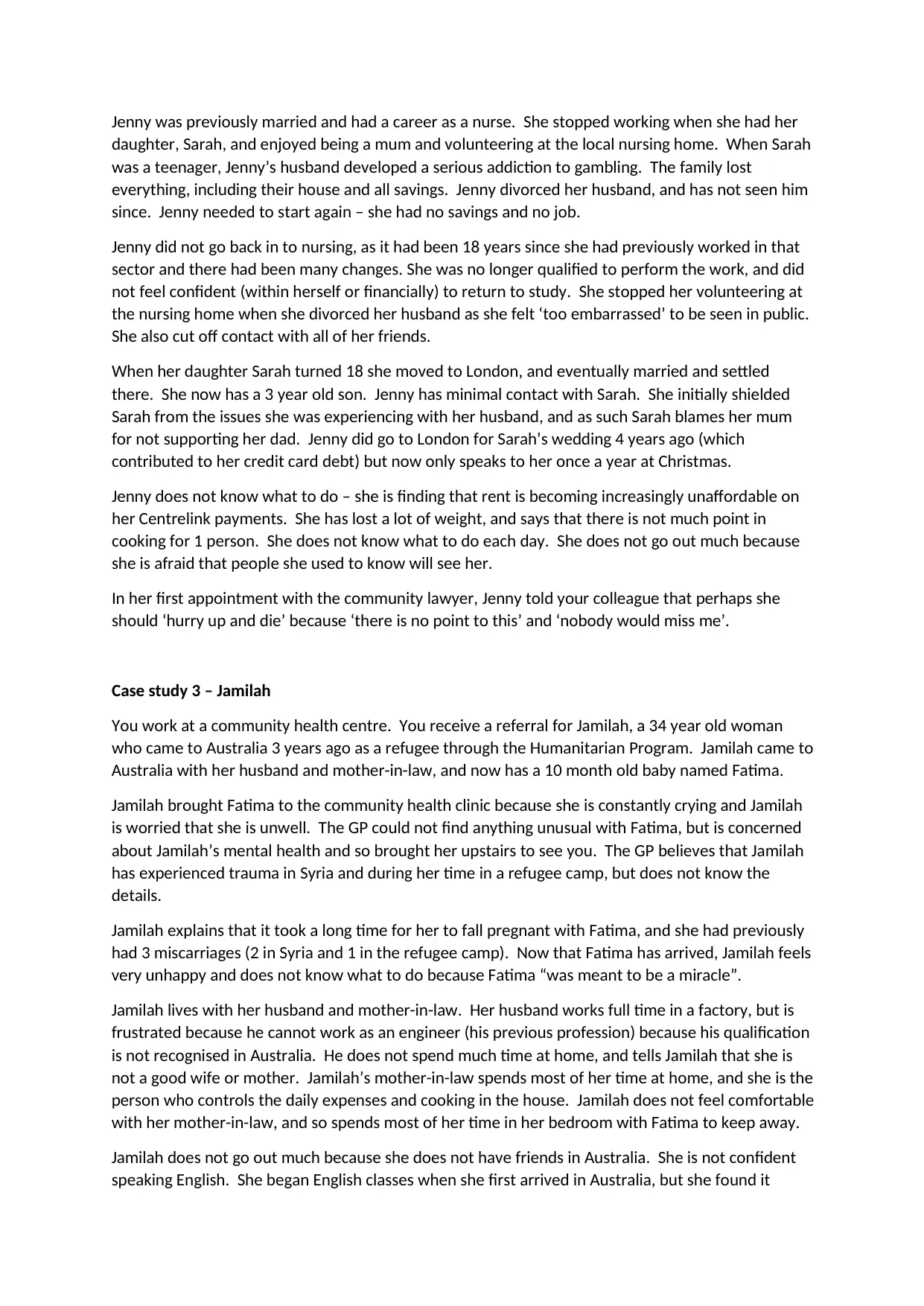
Jenny was previously married and had a career as a nurse. She stopped working when she had her
daughter, Sarah, and enjoyed being a mum and volunteering at the local nursing home. When Sarah
was a teenager, Jenny’s husband developed a serious addiction to gambling. The family lost
everything, including their house and all savings. Jenny divorced her husband, and has not seen him
since. Jenny needed to start again – she had no savings and no job.
Jenny did not go back in to nursing, as it had been 18 years since she had previously worked in that
sector and there had been many changes. She was no longer qualified to perform the work, and did
not feel confident (within herself or financially) to return to study. She stopped her volunteering at
the nursing home when she divorced her husband as she felt ‘too embarrassed’ to be seen in public.
She also cut off contact with all of her friends.
When her daughter Sarah turned 18 she moved to London, and eventually married and settled
there. She now has a 3 year old son. Jenny has minimal contact with Sarah. She initially shielded
Sarah from the issues she was experiencing with her husband, and as such Sarah blames her mum
for not supporting her dad. Jenny did go to London for Sarah’s wedding 4 years ago (which
contributed to her credit card debt) but now only speaks to her once a year at Christmas.
Jenny does not know what to do – she is finding that rent is becoming increasingly unaffordable on
her Centrelink payments. She has lost a lot of weight, and says that there is not much point in
cooking for 1 person. She does not know what to do each day. She does not go out much because
she is afraid that people she used to know will see her.
In her first appointment with the community lawyer, Jenny told your colleague that perhaps she
should ‘hurry up and die’ because ‘there is no point to this’ and ‘nobody would miss me’.
Case study 3 – Jamilah
You work at a community health centre. You receive a referral for Jamilah, a 34 year old woman
who came to Australia 3 years ago as a refugee through the Humanitarian Program. Jamilah came to
Australia with her husband and mother-in-law, and now has a 10 month old baby named Fatima.
Jamilah brought Fatima to the community health clinic because she is constantly crying and Jamilah
is worried that she is unwell. The GP could not find anything unusual with Fatima, but is concerned
about Jamilah’s mental health and so brought her upstairs to see you. The GP believes that Jamilah
has experienced trauma in Syria and during her time in a refugee camp, but does not know the
details.
Jamilah explains that it took a long time for her to fall pregnant with Fatima, and she had previously
had 3 miscarriages (2 in Syria and 1 in the refugee camp). Now that Fatima has arrived, Jamilah feels
very unhappy and does not know what to do because Fatima “was meant to be a miracle”.
Jamilah lives with her husband and mother-in-law. Her husband works full time in a factory, but is
frustrated because he cannot work as an engineer (his previous profession) because his qualification
is not recognised in Australia. He does not spend much time at home, and tells Jamilah that she is
not a good wife or mother. Jamilah’s mother-in-law spends most of her time at home, and she is the
person who controls the daily expenses and cooking in the house. Jamilah does not feel comfortable
with her mother-in-law, and so spends most of her time in her bedroom with Fatima to keep away.
Jamilah does not go out much because she does not have friends in Australia. She is not confident
speaking English. She began English classes when she first arrived in Australia, but she found it
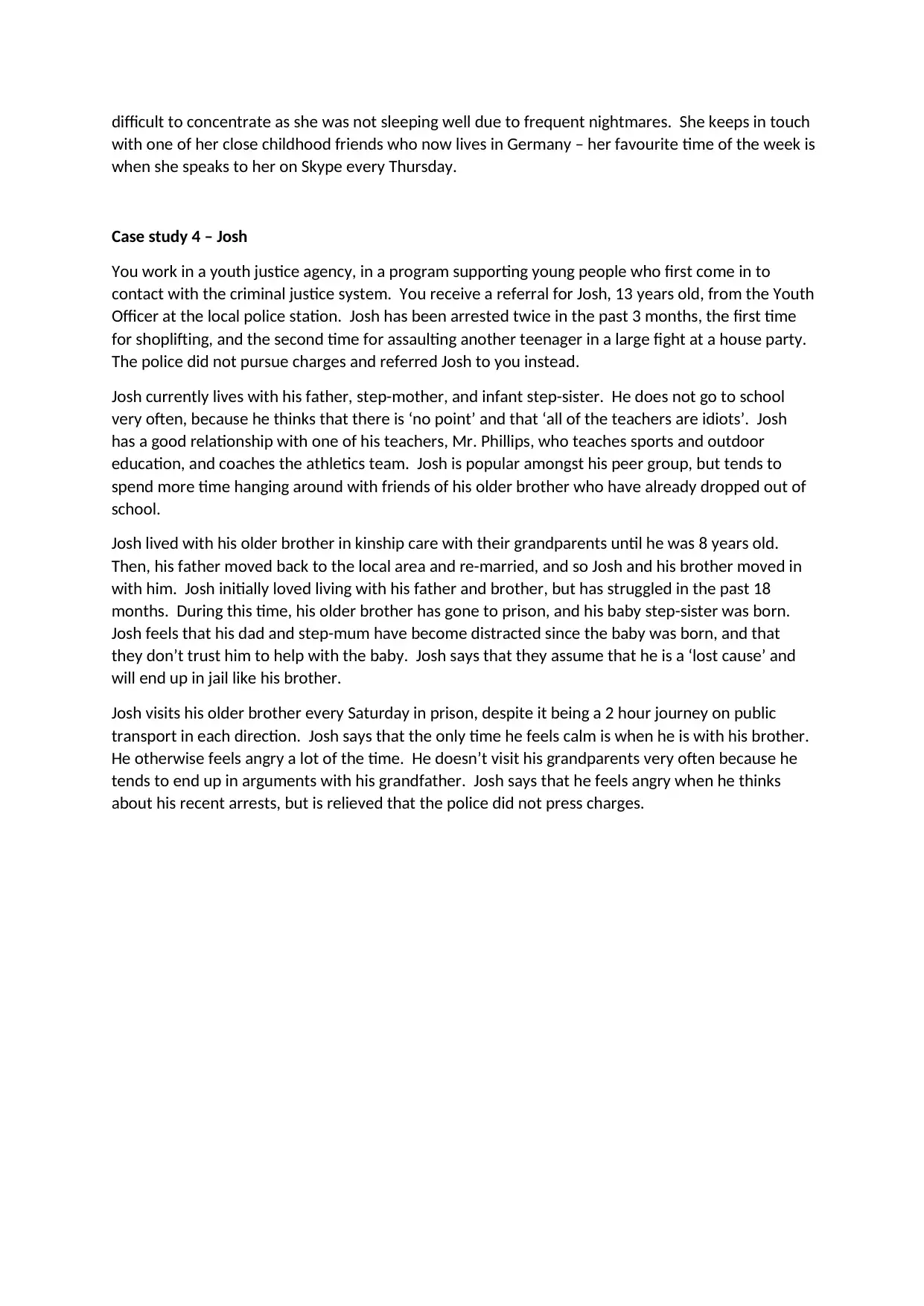
daughter, Sarah, and enjoyed being a mum and volunteering at the local nursing home. When Sarah
was a teenager, Jenny’s husband developed a serious addiction to gambling. The family lost
everything, including their house and all savings. Jenny divorced her husband, and has not seen him
since. Jenny needed to start again – she had no savings and no job.
Jenny did not go back in to nursing, as it had been 18 years since she had previously worked in that
sector and there had been many changes. She was no longer qualified to perform the work, and did
not feel confident (within herself or financially) to return to study. She stopped her volunteering at
the nursing home when she divorced her husband as she felt ‘too embarrassed’ to be seen in public.
She also cut off contact with all of her friends.
When her daughter Sarah turned 18 she moved to London, and eventually married and settled
there. She now has a 3 year old son. Jenny has minimal contact with Sarah. She initially shielded
Sarah from the issues she was experiencing with her husband, and as such Sarah blames her mum
for not supporting her dad. Jenny did go to London for Sarah’s wedding 4 years ago (which
contributed to her credit card debt) but now only speaks to her once a year at Christmas.
Jenny does not know what to do – she is finding that rent is becoming increasingly unaffordable on
her Centrelink payments. She has lost a lot of weight, and says that there is not much point in
cooking for 1 person. She does not know what to do each day. She does not go out much because
she is afraid that people she used to know will see her.
In her first appointment with the community lawyer, Jenny told your colleague that perhaps she
should ‘hurry up and die’ because ‘there is no point to this’ and ‘nobody would miss me’.
Case study 3 – Jamilah
You work at a community health centre. You receive a referral for Jamilah, a 34 year old woman
who came to Australia 3 years ago as a refugee through the Humanitarian Program. Jamilah came to
Australia with her husband and mother-in-law, and now has a 10 month old baby named Fatima.
Jamilah brought Fatima to the community health clinic because she is constantly crying and Jamilah
is worried that she is unwell. The GP could not find anything unusual with Fatima, but is concerned
about Jamilah’s mental health and so brought her upstairs to see you. The GP believes that Jamilah
has experienced trauma in Syria and during her time in a refugee camp, but does not know the
details.
Jamilah explains that it took a long time for her to fall pregnant with Fatima, and she had previously
had 3 miscarriages (2 in Syria and 1 in the refugee camp). Now that Fatima has arrived, Jamilah feels
very unhappy and does not know what to do because Fatima “was meant to be a miracle”.
Jamilah lives with her husband and mother-in-law. Her husband works full time in a factory, but is
frustrated because he cannot work as an engineer (his previous profession) because his qualification
is not recognised in Australia. He does not spend much time at home, and tells Jamilah that she is
not a good wife or mother. Jamilah’s mother-in-law spends most of her time at home, and she is the
person who controls the daily expenses and cooking in the house. Jamilah does not feel comfortable
with her mother-in-law, and so spends most of her time in her bedroom with Fatima to keep away.
Jamilah does not go out much because she does not have friends in Australia. She is not confident
speaking English. She began English classes when she first arrived in Australia, but she found it

difficult to concentrate as she was not sleeping well due to frequent nightmares. She keeps in touch
with one of her close childhood friends who now lives in Germany – her favourite time of the week is
when she speaks to her on Skype every Thursday.
Case study 4 – Josh
You work in a youth justice agency, in a program supporting young people who first come in to
contact with the criminal justice system. You receive a referral for Josh, 13 years old, from the Youth
Officer at the local police station. Josh has been arrested twice in the past 3 months, the first time
for shoplifting, and the second time for assaulting another teenager in a large fight at a house party.
The police did not pursue charges and referred Josh to you instead.
Josh currently lives with his father, step-mother, and infant step-sister. He does not go to school
very often, because he thinks that there is ‘no point’ and that ‘all of the teachers are idiots’. Josh
has a good relationship with one of his teachers, Mr. Phillips, who teaches sports and outdoor
education, and coaches the athletics team. Josh is popular amongst his peer group, but tends to
spend more time hanging around with friends of his older brother who have already dropped out of
school.
Josh lived with his older brother in kinship care with their grandparents until he was 8 years old.
Then, his father moved back to the local area and re-married, and so Josh and his brother moved in
with him. Josh initially loved living with his father and brother, but has struggled in the past 18
months. During this time, his older brother has gone to prison, and his baby step-sister was born.
Josh feels that his dad and step-mum have become distracted since the baby was born, and that
they don’t trust him to help with the baby. Josh says that they assume that he is a ‘lost cause’ and
will end up in jail like his brother.
Josh visits his older brother every Saturday in prison, despite it being a 2 hour journey on public
transport in each direction. Josh says that the only time he feels calm is when he is with his brother.
He otherwise feels angry a lot of the time. He doesn’t visit his grandparents very often because he
tends to end up in arguments with his grandfather. Josh says that he feels angry when he thinks
about his recent arrests, but is relieved that the police did not press charges.
with one of her close childhood friends who now lives in Germany – her favourite time of the week is
when she speaks to her on Skype every Thursday.
Case study 4 – Josh
You work in a youth justice agency, in a program supporting young people who first come in to
contact with the criminal justice system. You receive a referral for Josh, 13 years old, from the Youth
Officer at the local police station. Josh has been arrested twice in the past 3 months, the first time
for shoplifting, and the second time for assaulting another teenager in a large fight at a house party.
The police did not pursue charges and referred Josh to you instead.
Josh currently lives with his father, step-mother, and infant step-sister. He does not go to school
very often, because he thinks that there is ‘no point’ and that ‘all of the teachers are idiots’. Josh
has a good relationship with one of his teachers, Mr. Phillips, who teaches sports and outdoor
education, and coaches the athletics team. Josh is popular amongst his peer group, but tends to
spend more time hanging around with friends of his older brother who have already dropped out of
school.
Josh lived with his older brother in kinship care with their grandparents until he was 8 years old.
Then, his father moved back to the local area and re-married, and so Josh and his brother moved in
with him. Josh initially loved living with his father and brother, but has struggled in the past 18
months. During this time, his older brother has gone to prison, and his baby step-sister was born.
Josh feels that his dad and step-mum have become distracted since the baby was born, and that
they don’t trust him to help with the baby. Josh says that they assume that he is a ‘lost cause’ and
will end up in jail like his brother.
Josh visits his older brother every Saturday in prison, despite it being a 2 hour journey on public
transport in each direction. Josh says that the only time he feels calm is when he is with his brother.
He otherwise feels angry a lot of the time. He doesn’t visit his grandparents very often because he
tends to end up in arguments with his grandfather. Josh says that he feels angry when he thinks
about his recent arrests, but is relieved that the police did not press charges.
⊘ This is a preview!⊘
Do you want full access?
Subscribe today to unlock all pages.

Trusted by 1+ million students worldwide
1 out of 3
Related Documents
Your All-in-One AI-Powered Toolkit for Academic Success.
+13062052269
info@desklib.com
Available 24*7 on WhatsApp / Email
Unlock your academic potential
Copyright © 2020–2025 A2Z Services. All Rights Reserved. Developed and managed by ZUCOL.