Case Management Report: Collaborative Working in Social Work

Verified

Added on  2022/08/15

|3
|432
|12
Report
AI Summary
This report delves into the critical aspects of case management within social work, specifically focusing on the negotiation of collaborative working arrangements. It explores how social workers can effectively manage client services by establishing informal networks to facilitate communication and coordination among caregivers, clients, and their families. The report highlights the significance of clearly defined roles and responsibilities, emphasizing the importance of planning and communication to avoid confusion and ensure the efficient delivery of services. It also discusses the establishment of boundaries to maintain client confidentiality and achieve desired outcomes. The report concludes by emphasizing the importance of these strategies in providing effective social work services.
Document Page
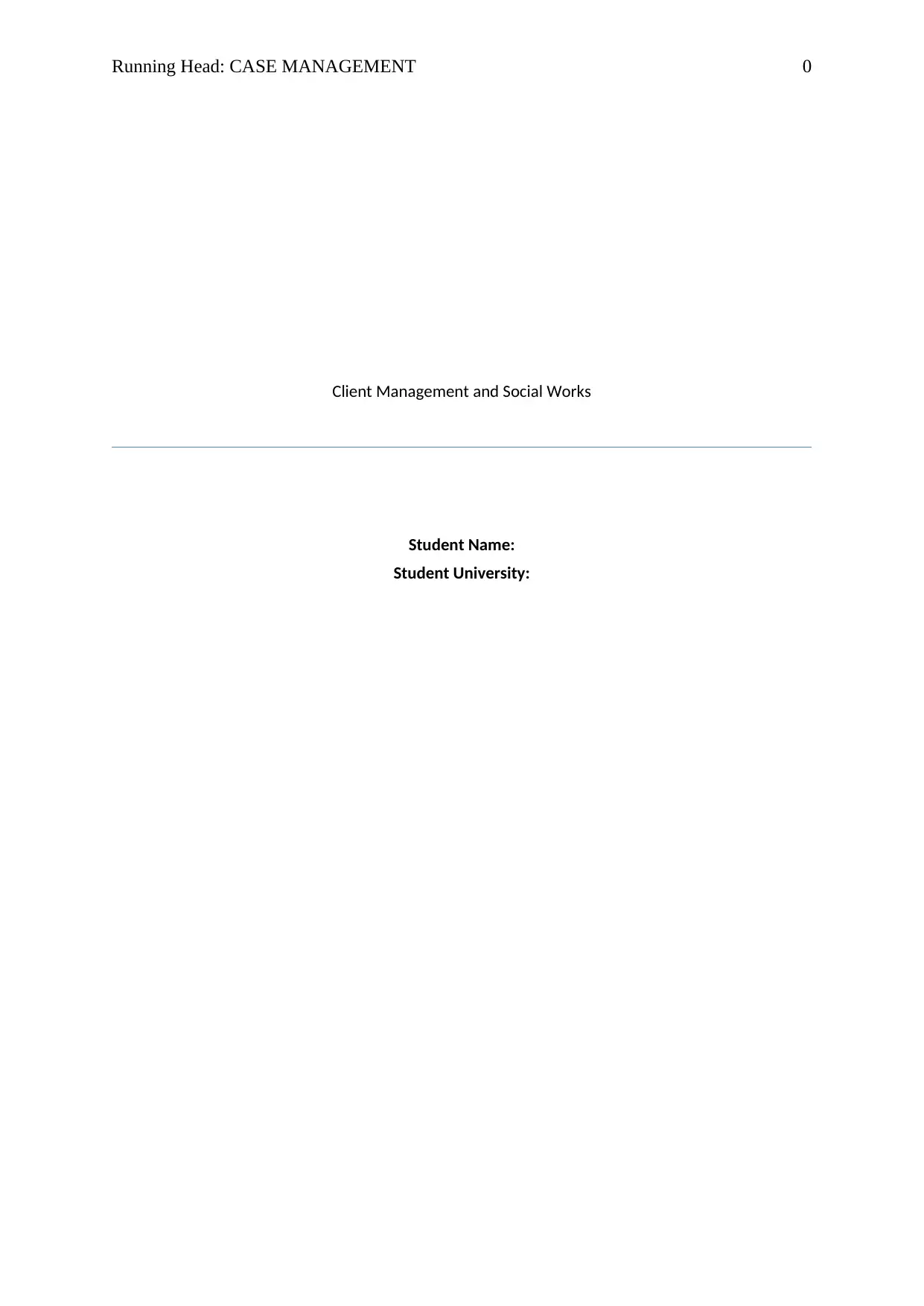
Running Head: CASE MANAGEMENT 0
Client Management and Social Works
Student Name:
Student University:
tabler-icon-diamond-filled.svg

Paraphrase This Document

Need a fresh take? Get an instant paraphrase of this document with our AI Paraphraser
Document Page
CASE MANAGEMENT 1
Effective negotiation is crucial when it comes to collaborative working arrangements since it
enables social workers in ensuring that they properly delivers all services to their clients who
have complex needs. There are different ways through which social workers can negotiate
collaborative working arrangements. They should focus on establishing informal network and
alliances to ensure delivery when it comes to all services of the client while making sure full
merger (Ciolfi & Lockley, 2018). These informal networks can facilitate effective
communication between carers, clients and their family members which allows social
workers in avoiding behavioural challenges and setting expected outcomes. Another key
factor is effective coordination which can be achieved through planning and communication
of roles and responsibilities of social workers. It shows that establishment of roles and
responsibilities are crucial for social workers when it comes to negotiate collaborative
working arrangements (Levenson, 2017).
In order to establish roles and boundaries, social workers should prepare thorough plans in
which they should include details regarding their responsibilities and how they will perform
specific tasks. Boundaries are important to make sure that privacy of clients and their family
members is maintained. Clearly defined roles avoid confusion and social workers are able to
efficiently deliver services to clients (De Corte, et al., 2017). To conclude, social workers can
negotiate collaborative working arrangements by creating informal networks, coordinating
with each other, planning and effectively communicating to avoid any confusion. They
should also establish roles and boundaries to make sure that services are delivered properly
and confidentiality is maintained which are relevant to achieve expected outcomes.
Document Page
CASE MANAGEMENT 2
References
Ciolfi, L. & Lockley, E., 2018. From Work to Life and back again: Examining the digitally-
mediated work/life practices of a group of knowledge workers.. Computer Supported
Cooperative Work (CSCW), 27(3-6), pp. 803-839.
De Corte, J., Verschuere, B., Roets, G. & De Bie, M., 2017. Uncovering the double-edged
sword of inter-organisational networks of welfare services: Tackling wicked issues in social
work.. The British Journal of Social Work, 47(2), pp. 524-541.
Levenson, J., 2017. Trauma-informed social work practice.. Social Work, 62(2), pp. 105-113.
chevron_up_icon
1 out of 3
circle_padding
hide_on_mobile
zoom_out_icon
[object Object]