Financial Accounting Statements: Case Study Analysis and Ratios
VerifiedAdded on 2023/01/13
|16
|2534
|26
Case Study
AI Summary
This case study analyzes financial accounting statements, focusing on the key concepts and terms, and how adjustments are applied. It examines the financial performance of River Island and Matalan Ltd. through ratio analysis, covering profitability, liquidity, solvency, and efficiency ratios. The study interprets the results of these ratios, identifies business performance strategies, and discusses the importance of year-end adjustments, their effects on financial statements, and the uses and limitations of ratio analysis. The case study also includes financial data, ratio calculations, and interpretations to assess the financial health and performance of the companies.
Case study on a set of
accounting statements
accounting statements

Paraphrase This Document
Need a fresh take? Get an instant paraphrase of this document with our AI Paraphraser
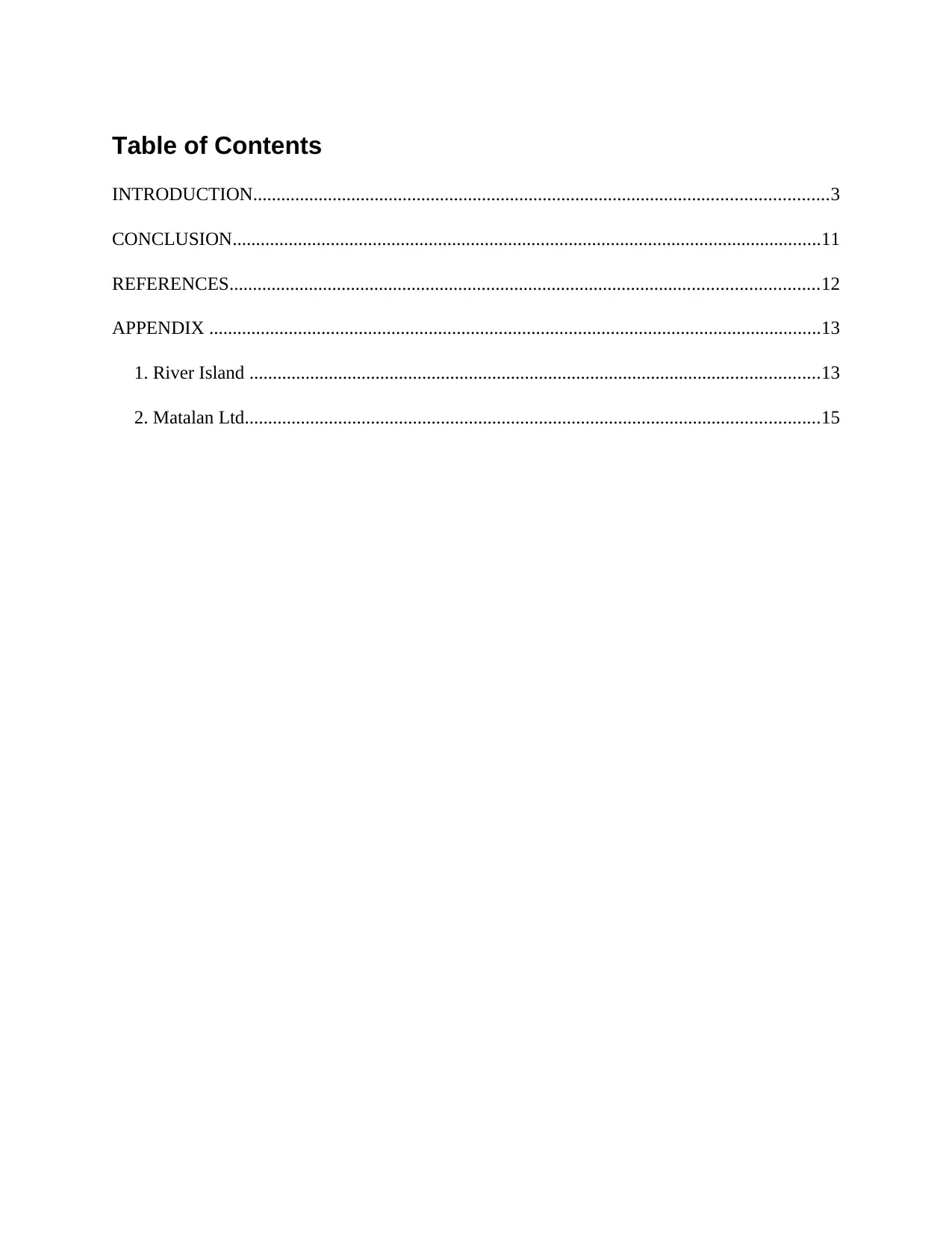
Table of Contents
INTRODUCTION...........................................................................................................................3
CONCLUSION..............................................................................................................................11
REFERENCES..............................................................................................................................12
APPENDIX ...................................................................................................................................13
1. River Island ..........................................................................................................................13
2. Matalan Ltd...........................................................................................................................15
INTRODUCTION...........................................................................................................................3
CONCLUSION..............................................................................................................................11
REFERENCES..............................................................................................................................12
APPENDIX ...................................................................................................................................13
1. River Island ..........................................................................................................................13
2. Matalan Ltd...........................................................................................................................15
INTRODUCTION
Financial accounting statement is considered to be as the summary of various
accounting transactions which in turn is occurred over the specific period of the time (Granof
and et.al., 2016). This study will highlight on understanding the various key terms and concepts
which in turn is considered to be very relevant for understanding financial accounting
statements. This study also effectively examines how the adjustments are applied within the
financial accounting statements. Furthermore, this study also understands the role and
limitations associated with the ratios in order to effectively analyse the business performance.
Lastly, this study determines the use of ratio analysis which in turn helps in analysing the
business performance.
Examining appropriate accounting concepts and terms.
Accounting terms
Accounting is an appropriate procedure to record various financial activities which is
useful in assessing the financial position of the business.
Accounting period is a span of time that tends to cover by various set of financial
statements.
Business entity is referred to as the legal structure of the business where all operations
will be carried out.
Financial statements are in turn referred to as reports which is prepared by the
management of the organisation in order to analyse the financial position of the company for a
given span of time (Jollands and Quinn, 2017).
Accounting concept
Accounting concepts is referred to as the basic assumption which in turn is based on
certain rules and principles which in turn tends to work on basis of recording various set of
financial business transactions.
Financial accounting statement is considered to be as the summary of various
accounting transactions which in turn is occurred over the specific period of the time (Granof
and et.al., 2016). This study will highlight on understanding the various key terms and concepts
which in turn is considered to be very relevant for understanding financial accounting
statements. This study also effectively examines how the adjustments are applied within the
financial accounting statements. Furthermore, this study also understands the role and
limitations associated with the ratios in order to effectively analyse the business performance.
Lastly, this study determines the use of ratio analysis which in turn helps in analysing the
business performance.
Examining appropriate accounting concepts and terms.
Accounting terms
Accounting is an appropriate procedure to record various financial activities which is
useful in assessing the financial position of the business.
Accounting period is a span of time that tends to cover by various set of financial
statements.
Business entity is referred to as the legal structure of the business where all operations
will be carried out.
Financial statements are in turn referred to as reports which is prepared by the
management of the organisation in order to analyse the financial position of the company for a
given span of time (Jollands and Quinn, 2017).
Accounting concept
Accounting concepts is referred to as the basic assumption which in turn is based on
certain rules and principles which in turn tends to work on basis of recording various set of
financial business transactions.
⊘ This is a preview!⊘
Do you want full access?
Subscribe today to unlock all pages.

Trusted by 1+ million students worldwide
Business entity concept: This means business and its owner tends to have separate legal
identity.
Money measurement concept: Only those financial transaction are recorder in
statements which can be valued and measured in monetary terms.
Going concern concept: This means business will carry out its operations for the
foreseeable future (Cannon, 2019).
Accounting period concept: This means accounting transactions are recorded for
ascertaining profit or loss for specific period of time.
Historical cost concept: It states all assets of the company are recorded at original
purchase price.
Dual aspect concept: Every financial transaction has affects on two accounts on
opposite side.
Realisation concept: The revenue generated from business transaction is recorded only
at the time of its realisation. Consistency concept: It states that, the accounting practices of the company must
remain consistent for several years.
Interpretation of financial accounting statements from provided data.
Financial accounting statements of River Island clothing company represents that it is
performing well in the market. Company is having a turnover of 877.7 million with the gross
profits of 107.1 million. The profits and turnover of the company has shown a decrease from
last year. The operating profit of company has declined to half from last year. The income
statements of company for year 2018 shows that profit for the financial year is only 37. The
cost of sales has increased of company where the revenues has declined. The balance sheet
presenting the position of company shows that net assets of company have decreased from last
year which were 581.6 to 341.5. The reserves and capital of company has also declined.
Financial statements of company are prepared using the accounting standards and complying
identity.
Money measurement concept: Only those financial transaction are recorder in
statements which can be valued and measured in monetary terms.
Going concern concept: This means business will carry out its operations for the
foreseeable future (Cannon, 2019).
Accounting period concept: This means accounting transactions are recorded for
ascertaining profit or loss for specific period of time.
Historical cost concept: It states all assets of the company are recorded at original
purchase price.
Dual aspect concept: Every financial transaction has affects on two accounts on
opposite side.
Realisation concept: The revenue generated from business transaction is recorded only
at the time of its realisation. Consistency concept: It states that, the accounting practices of the company must
remain consistent for several years.
Interpretation of financial accounting statements from provided data.
Financial accounting statements of River Island clothing company represents that it is
performing well in the market. Company is having a turnover of 877.7 million with the gross
profits of 107.1 million. The profits and turnover of the company has shown a decrease from
last year. The operating profit of company has declined to half from last year. The income
statements of company for year 2018 shows that profit for the financial year is only 37. The
cost of sales has increased of company where the revenues has declined. The balance sheet
presenting the position of company shows that net assets of company have decreased from last
year which were 581.6 to 341.5. The reserves and capital of company has also declined.
Financial statements of company are prepared using the accounting standards and complying
Paraphrase This Document
Need a fresh take? Get an instant paraphrase of this document with our AI Paraphraser
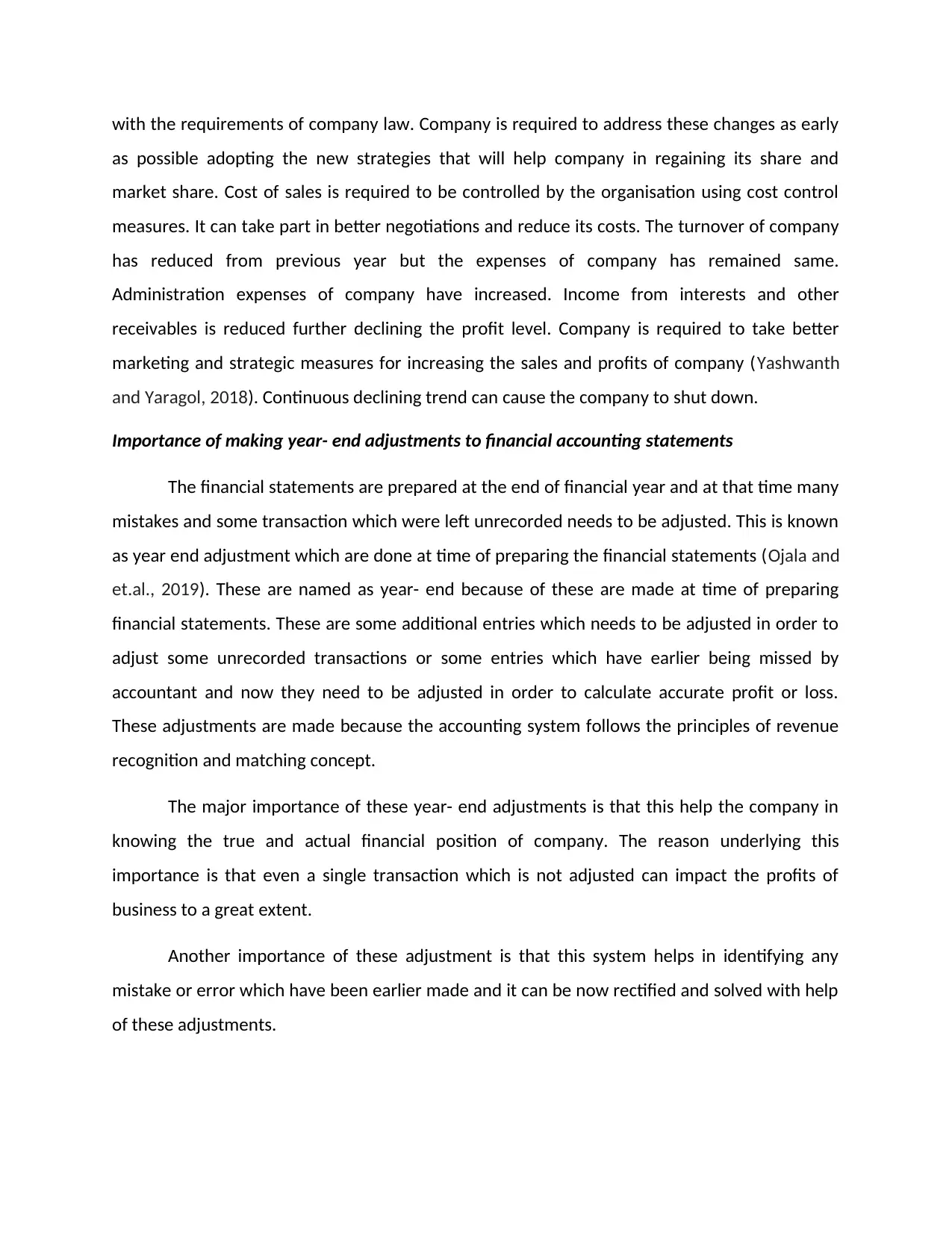
with the requirements of company law. Company is required to address these changes as early
as possible adopting the new strategies that will help company in regaining its share and
market share. Cost of sales is required to be controlled by the organisation using cost control
measures. It can take part in better negotiations and reduce its costs. The turnover of company
has reduced from previous year but the expenses of company has remained same.
Administration expenses of company have increased. Income from interests and other
receivables is reduced further declining the profit level. Company is required to take better
marketing and strategic measures for increasing the sales and profits of company (Yashwanth
and Yaragol, 2018). Continuous declining trend can cause the company to shut down.
Importance of making year- end adjustments to financial accounting statements
The financial statements are prepared at the end of financial year and at that time many
mistakes and some transaction which were left unrecorded needs to be adjusted. This is known
as year end adjustment which are done at time of preparing the financial statements (Ojala and
et.al., 2019). These are named as year- end because of these are made at time of preparing
financial statements. These are some additional entries which needs to be adjusted in order to
adjust some unrecorded transactions or some entries which have earlier being missed by
accountant and now they need to be adjusted in order to calculate accurate profit or loss.
These adjustments are made because the accounting system follows the principles of revenue
recognition and matching concept.
The major importance of these year- end adjustments is that this help the company in
knowing the true and actual financial position of company. The reason underlying this
importance is that even a single transaction which is not adjusted can impact the profits of
business to a great extent.
Another importance of these adjustment is that this system helps in identifying any
mistake or error which have been earlier made and it can be now rectified and solved with help
of these adjustments.
as possible adopting the new strategies that will help company in regaining its share and
market share. Cost of sales is required to be controlled by the organisation using cost control
measures. It can take part in better negotiations and reduce its costs. The turnover of company
has reduced from previous year but the expenses of company has remained same.
Administration expenses of company have increased. Income from interests and other
receivables is reduced further declining the profit level. Company is required to take better
marketing and strategic measures for increasing the sales and profits of company (Yashwanth
and Yaragol, 2018). Continuous declining trend can cause the company to shut down.
Importance of making year- end adjustments to financial accounting statements
The financial statements are prepared at the end of financial year and at that time many
mistakes and some transaction which were left unrecorded needs to be adjusted. This is known
as year end adjustment which are done at time of preparing the financial statements (Ojala and
et.al., 2019). These are named as year- end because of these are made at time of preparing
financial statements. These are some additional entries which needs to be adjusted in order to
adjust some unrecorded transactions or some entries which have earlier being missed by
accountant and now they need to be adjusted in order to calculate accurate profit or loss.
These adjustments are made because the accounting system follows the principles of revenue
recognition and matching concept.
The major importance of these year- end adjustments is that this help the company in
knowing the true and actual financial position of company. The reason underlying this
importance is that even a single transaction which is not adjusted can impact the profits of
business to a great extent.
Another importance of these adjustment is that this system helps in identifying any
mistake or error which have been earlier made and it can be now rectified and solved with help
of these adjustments.
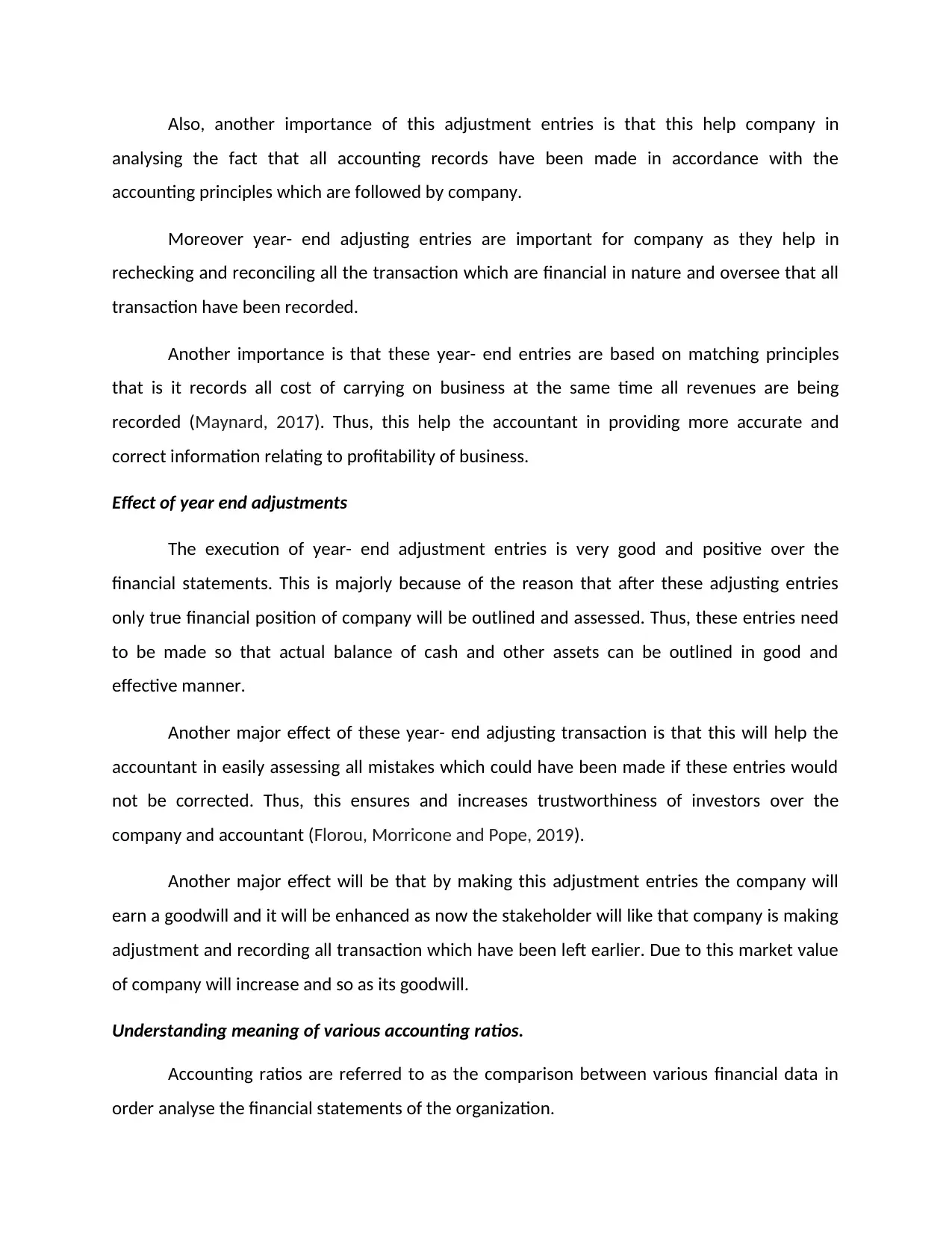
Also, another importance of this adjustment entries is that this help company in
analysing the fact that all accounting records have been made in accordance with the
accounting principles which are followed by company.
Moreover year- end adjusting entries are important for company as they help in
rechecking and reconciling all the transaction which are financial in nature and oversee that all
transaction have been recorded.
Another importance is that these year- end entries are based on matching principles
that is it records all cost of carrying on business at the same time all revenues are being
recorded (Maynard, 2017). Thus, this help the accountant in providing more accurate and
correct information relating to profitability of business.
Effect of year end adjustments
The execution of year- end adjustment entries is very good and positive over the
financial statements. This is majorly because of the reason that after these adjusting entries
only true financial position of company will be outlined and assessed. Thus, these entries need
to be made so that actual balance of cash and other assets can be outlined in good and
effective manner.
Another major effect of these year- end adjusting transaction is that this will help the
accountant in easily assessing all mistakes which could have been made if these entries would
not be corrected. Thus, this ensures and increases trustworthiness of investors over the
company and accountant (Florou, Morricone and Pope, 2019).
Another major effect will be that by making this adjustment entries the company will
earn a goodwill and it will be enhanced as now the stakeholder will like that company is making
adjustment and recording all transaction which have been left earlier. Due to this market value
of company will increase and so as its goodwill.
Understanding meaning of various accounting ratios.
Accounting ratios are referred to as the comparison between various financial data in
order analyse the financial statements of the organization.
analysing the fact that all accounting records have been made in accordance with the
accounting principles which are followed by company.
Moreover year- end adjusting entries are important for company as they help in
rechecking and reconciling all the transaction which are financial in nature and oversee that all
transaction have been recorded.
Another importance is that these year- end entries are based on matching principles
that is it records all cost of carrying on business at the same time all revenues are being
recorded (Maynard, 2017). Thus, this help the accountant in providing more accurate and
correct information relating to profitability of business.
Effect of year end adjustments
The execution of year- end adjustment entries is very good and positive over the
financial statements. This is majorly because of the reason that after these adjusting entries
only true financial position of company will be outlined and assessed. Thus, these entries need
to be made so that actual balance of cash and other assets can be outlined in good and
effective manner.
Another major effect of these year- end adjusting transaction is that this will help the
accountant in easily assessing all mistakes which could have been made if these entries would
not be corrected. Thus, this ensures and increases trustworthiness of investors over the
company and accountant (Florou, Morricone and Pope, 2019).
Another major effect will be that by making this adjustment entries the company will
earn a goodwill and it will be enhanced as now the stakeholder will like that company is making
adjustment and recording all transaction which have been left earlier. Due to this market value
of company will increase and so as its goodwill.
Understanding meaning of various accounting ratios.
Accounting ratios are referred to as the comparison between various financial data in
order analyse the financial statements of the organization.
⊘ This is a preview!⊘
Do you want full access?
Subscribe today to unlock all pages.
Trusted by 1+ million students worldwide
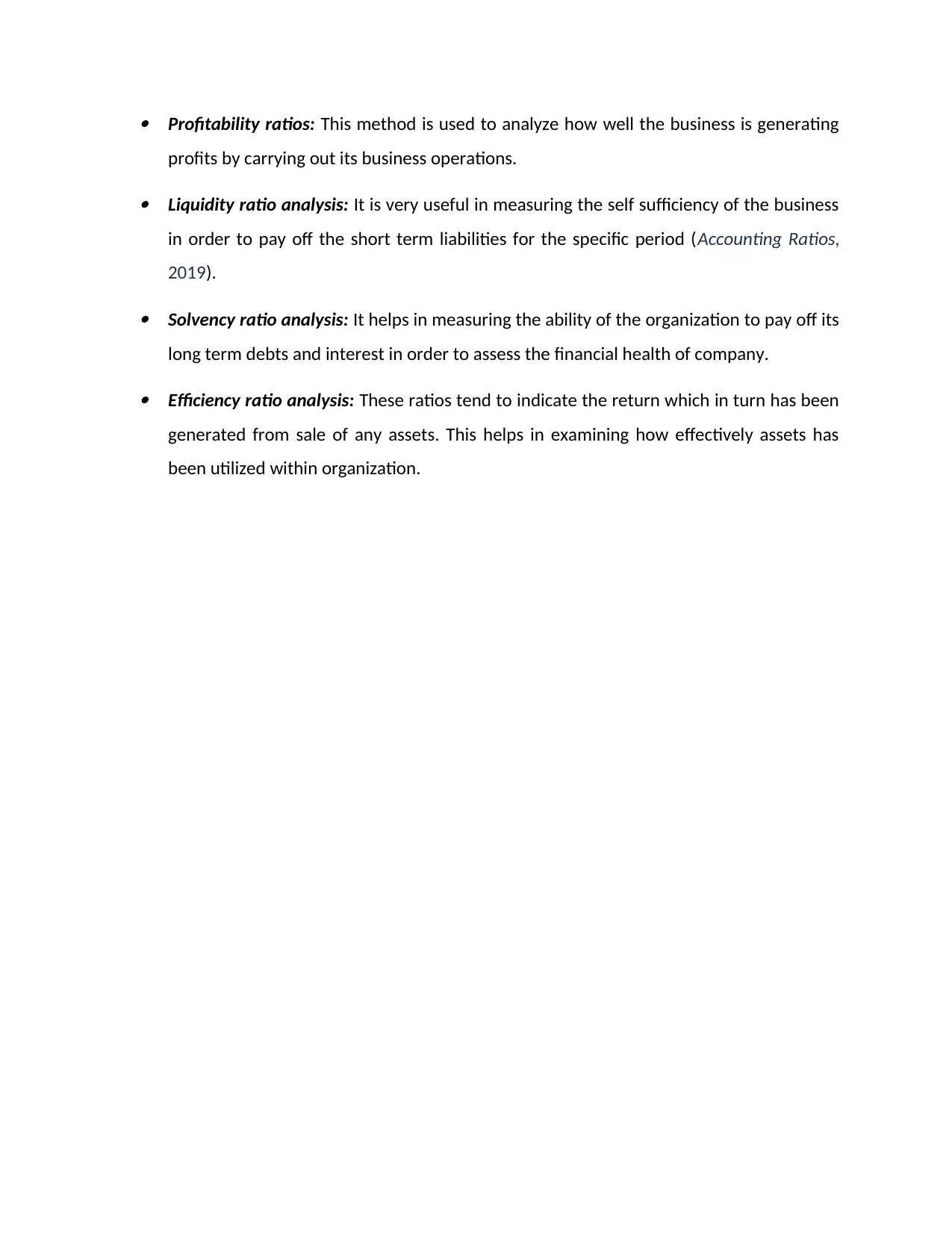
Profitability ratios: This method is used to analyze how well the business is generating
profits by carrying out its business operations. Liquidity ratio analysis: It is very useful in measuring the self sufficiency of the business
in order to pay off the short term liabilities for the specific period (Accounting Ratios,
2019). Solvency ratio analysis: It helps in measuring the ability of the organization to pay off its
long term debts and interest in order to assess the financial health of company. Efficiency ratio analysis: These ratios tend to indicate the return which in turn has been
generated from sale of any assets. This helps in examining how effectively assets has
been utilized within organization.
profits by carrying out its business operations. Liquidity ratio analysis: It is very useful in measuring the self sufficiency of the business
in order to pay off the short term liabilities for the specific period (Accounting Ratios,
2019). Solvency ratio analysis: It helps in measuring the ability of the organization to pay off its
long term debts and interest in order to assess the financial health of company. Efficiency ratio analysis: These ratios tend to indicate the return which in turn has been
generated from sale of any assets. This helps in examining how effectively assets has
been utilized within organization.
Paraphrase This Document
Need a fresh take? Get an instant paraphrase of this document with our AI Paraphraser
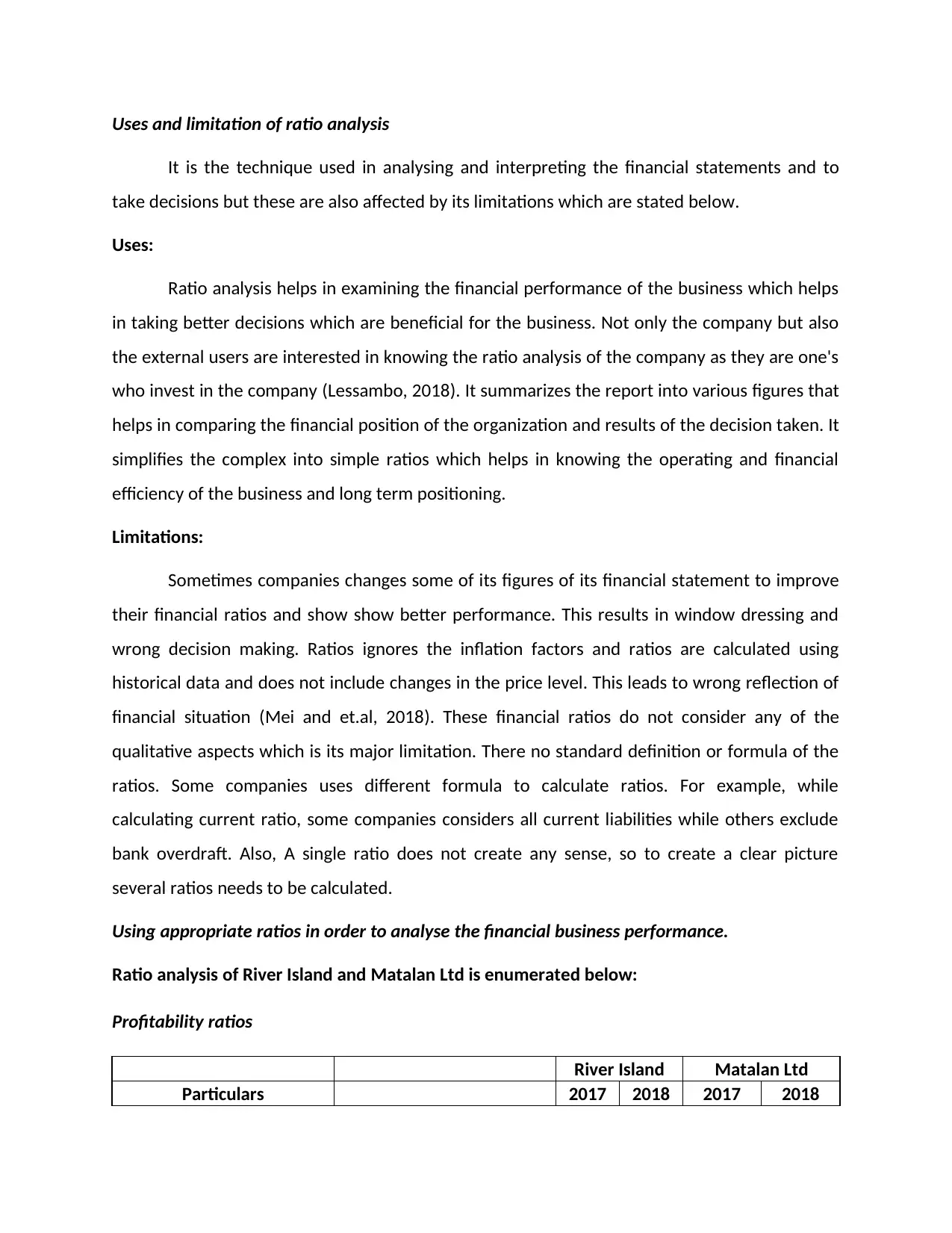
Uses and limitation of ratio analysis
It is the technique used in analysing and interpreting the financial statements and to
take decisions but these are also affected by its limitations which are stated below.
Uses:
Ratio analysis helps in examining the financial performance of the business which helps
in taking better decisions which are beneficial for the business. Not only the company but also
the external users are interested in knowing the ratio analysis of the company as they are one's
who invest in the company (Lessambo, 2018). It summarizes the report into various figures that
helps in comparing the financial position of the organization and results of the decision taken. It
simplifies the complex into simple ratios which helps in knowing the operating and financial
efficiency of the business and long term positioning.
Limitations:
Sometimes companies changes some of its figures of its financial statement to improve
their financial ratios and show show better performance. This results in window dressing and
wrong decision making. Ratios ignores the inflation factors and ratios are calculated using
historical data and does not include changes in the price level. This leads to wrong reflection of
financial situation (Mei and et.al, 2018). These financial ratios do not consider any of the
qualitative aspects which is its major limitation. There no standard definition or formula of the
ratios. Some companies uses different formula to calculate ratios. For example, while
calculating current ratio, some companies considers all current liabilities while others exclude
bank overdraft. Also, A single ratio does not create any sense, so to create a clear picture
several ratios needs to be calculated.
Using appropriate ratios in order to analyse the financial business performance.
Ratio analysis of River Island and Matalan Ltd is enumerated below:
Profitability ratios
River Island Matalan Ltd
Particulars 2017 2018 2017 2018
It is the technique used in analysing and interpreting the financial statements and to
take decisions but these are also affected by its limitations which are stated below.
Uses:
Ratio analysis helps in examining the financial performance of the business which helps
in taking better decisions which are beneficial for the business. Not only the company but also
the external users are interested in knowing the ratio analysis of the company as they are one's
who invest in the company (Lessambo, 2018). It summarizes the report into various figures that
helps in comparing the financial position of the organization and results of the decision taken. It
simplifies the complex into simple ratios which helps in knowing the operating and financial
efficiency of the business and long term positioning.
Limitations:
Sometimes companies changes some of its figures of its financial statement to improve
their financial ratios and show show better performance. This results in window dressing and
wrong decision making. Ratios ignores the inflation factors and ratios are calculated using
historical data and does not include changes in the price level. This leads to wrong reflection of
financial situation (Mei and et.al, 2018). These financial ratios do not consider any of the
qualitative aspects which is its major limitation. There no standard definition or formula of the
ratios. Some companies uses different formula to calculate ratios. For example, while
calculating current ratio, some companies considers all current liabilities while others exclude
bank overdraft. Also, A single ratio does not create any sense, so to create a clear picture
several ratios needs to be calculated.
Using appropriate ratios in order to analyse the financial business performance.
Ratio analysis of River Island and Matalan Ltd is enumerated below:
Profitability ratios
River Island Matalan Ltd
Particulars 2017 2018 2017 2018
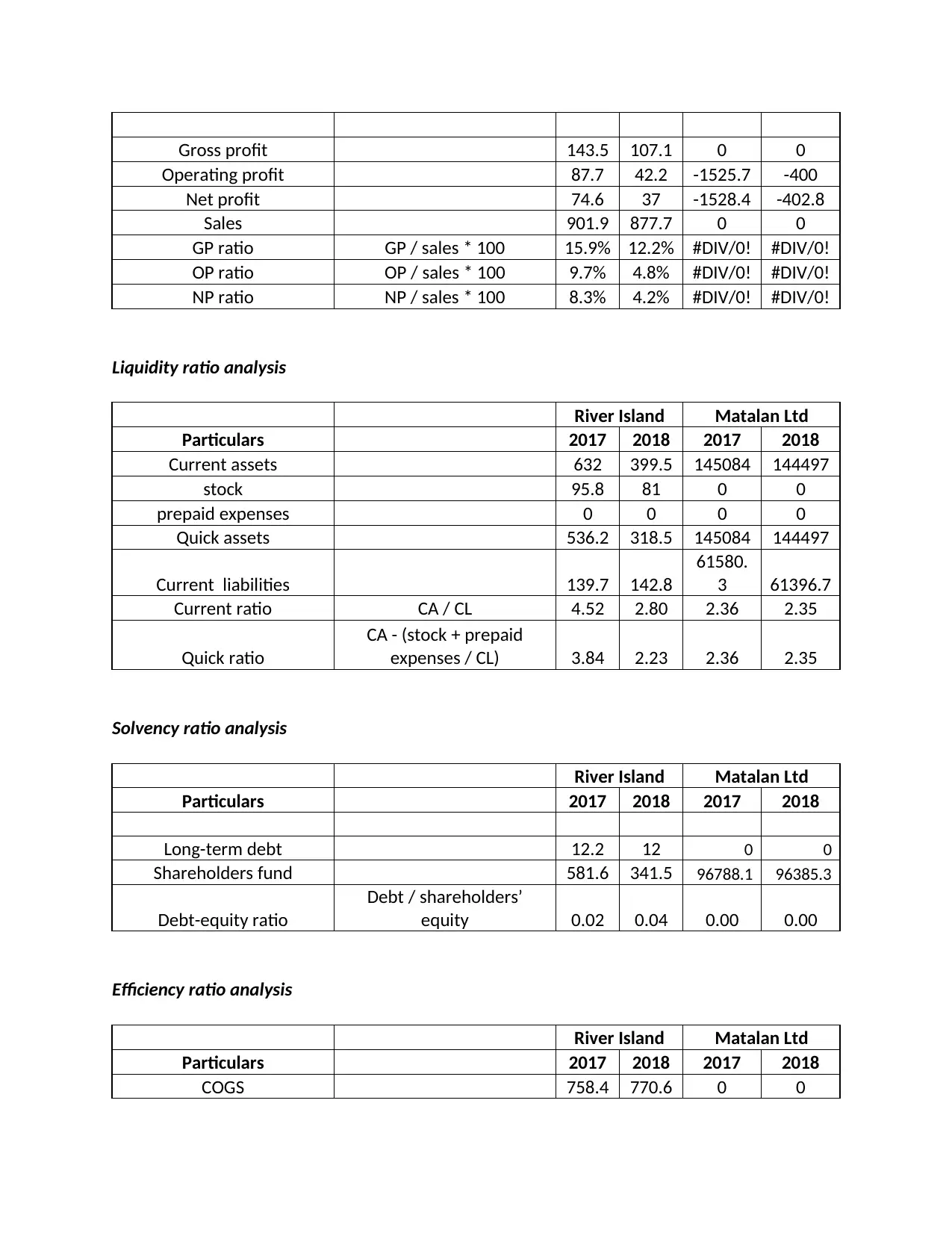
Gross profit 143.5 107.1 0 0
Operating profit 87.7 42.2 -1525.7 -400
Net profit 74.6 37 -1528.4 -402.8
Sales 901.9 877.7 0 0
GP ratio GP / sales * 100 15.9% 12.2% #DIV/0! #DIV/0!
OP ratio OP / sales * 100 9.7% 4.8% #DIV/0! #DIV/0!
NP ratio NP / sales * 100 8.3% 4.2% #DIV/0! #DIV/0!
Liquidity ratio analysis
River Island Matalan Ltd
Particulars 2017 2018 2017 2018
Current assets 632 399.5 145084 144497
stock 95.8 81 0 0
prepaid expenses 0 0 0 0
Quick assets 536.2 318.5 145084 144497
Current liabilities 139.7 142.8
61580.
3 61396.7
Current ratio CA / CL 4.52 2.80 2.36 2.35
Quick ratio
CA - (stock + prepaid
expenses / CL) 3.84 2.23 2.36 2.35
Solvency ratio analysis
River Island Matalan Ltd
Particulars 2017 2018 2017 2018
Long-term debt 12.2 12 0 0
Shareholders fund 581.6 341.5 96788.1 96385.3
Debt-equity ratio
Debt / shareholders’
equity 0.02 0.04 0.00 0.00
Efficiency ratio analysis
River Island Matalan Ltd
Particulars 2017 2018 2017 2018
COGS 758.4 770.6 0 0
Operating profit 87.7 42.2 -1525.7 -400
Net profit 74.6 37 -1528.4 -402.8
Sales 901.9 877.7 0 0
GP ratio GP / sales * 100 15.9% 12.2% #DIV/0! #DIV/0!
OP ratio OP / sales * 100 9.7% 4.8% #DIV/0! #DIV/0!
NP ratio NP / sales * 100 8.3% 4.2% #DIV/0! #DIV/0!
Liquidity ratio analysis
River Island Matalan Ltd
Particulars 2017 2018 2017 2018
Current assets 632 399.5 145084 144497
stock 95.8 81 0 0
prepaid expenses 0 0 0 0
Quick assets 536.2 318.5 145084 144497
Current liabilities 139.7 142.8
61580.
3 61396.7
Current ratio CA / CL 4.52 2.80 2.36 2.35
Quick ratio
CA - (stock + prepaid
expenses / CL) 3.84 2.23 2.36 2.35
Solvency ratio analysis
River Island Matalan Ltd
Particulars 2017 2018 2017 2018
Long-term debt 12.2 12 0 0
Shareholders fund 581.6 341.5 96788.1 96385.3
Debt-equity ratio
Debt / shareholders’
equity 0.02 0.04 0.00 0.00
Efficiency ratio analysis
River Island Matalan Ltd
Particulars 2017 2018 2017 2018
COGS 758.4 770.6 0 0
⊘ This is a preview!⊘
Do you want full access?
Subscribe today to unlock all pages.
Trusted by 1+ million students worldwide
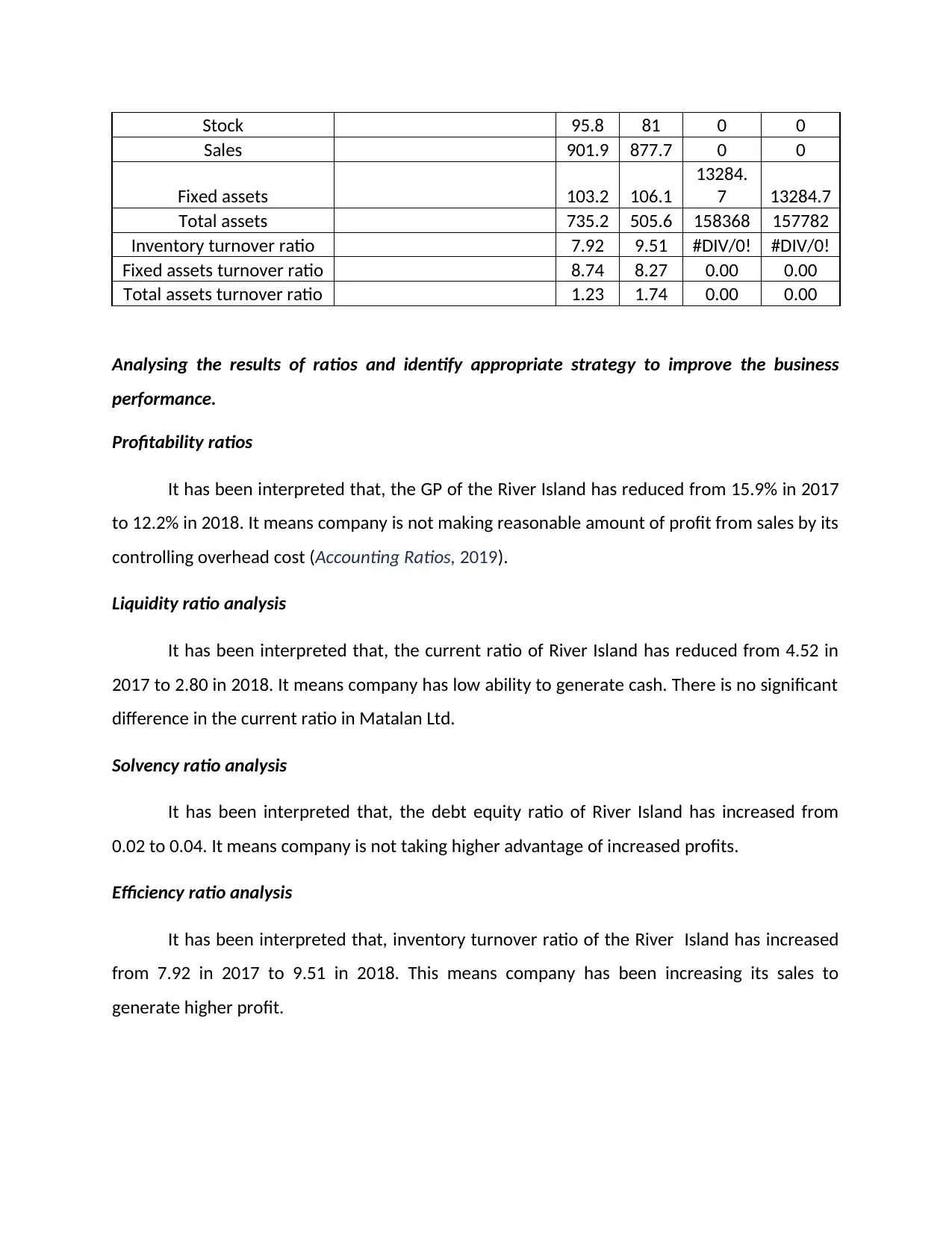
Stock 95.8 81 0 0
Sales 901.9 877.7 0 0
Fixed assets 103.2 106.1
13284.
7 13284.7
Total assets 735.2 505.6 158368 157782
Inventory turnover ratio 7.92 9.51 #DIV/0! #DIV/0!
Fixed assets turnover ratio 8.74 8.27 0.00 0.00
Total assets turnover ratio 1.23 1.74 0.00 0.00
Analysing the results of ratios and identify appropriate strategy to improve the business
performance.
Profitability ratios
It has been interpreted that, the GP of the River Island has reduced from 15.9% in 2017
to 12.2% in 2018. It means company is not making reasonable amount of profit from sales by its
controlling overhead cost (Accounting Ratios, 2019).
Liquidity ratio analysis
It has been interpreted that, the current ratio of River Island has reduced from 4.52 in
2017 to 2.80 in 2018. It means company has low ability to generate cash. There is no significant
difference in the current ratio in Matalan Ltd.
Solvency ratio analysis
It has been interpreted that, the debt equity ratio of River Island has increased from
0.02 to 0.04. It means company is not taking higher advantage of increased profits.
Efficiency ratio analysis
It has been interpreted that, inventory turnover ratio of the River Island has increased
from 7.92 in 2017 to 9.51 in 2018. This means company has been increasing its sales to
generate higher profit.
Sales 901.9 877.7 0 0
Fixed assets 103.2 106.1
13284.
7 13284.7
Total assets 735.2 505.6 158368 157782
Inventory turnover ratio 7.92 9.51 #DIV/0! #DIV/0!
Fixed assets turnover ratio 8.74 8.27 0.00 0.00
Total assets turnover ratio 1.23 1.74 0.00 0.00
Analysing the results of ratios and identify appropriate strategy to improve the business
performance.
Profitability ratios
It has been interpreted that, the GP of the River Island has reduced from 15.9% in 2017
to 12.2% in 2018. It means company is not making reasonable amount of profit from sales by its
controlling overhead cost (Accounting Ratios, 2019).
Liquidity ratio analysis
It has been interpreted that, the current ratio of River Island has reduced from 4.52 in
2017 to 2.80 in 2018. It means company has low ability to generate cash. There is no significant
difference in the current ratio in Matalan Ltd.
Solvency ratio analysis
It has been interpreted that, the debt equity ratio of River Island has increased from
0.02 to 0.04. It means company is not taking higher advantage of increased profits.
Efficiency ratio analysis
It has been interpreted that, inventory turnover ratio of the River Island has increased
from 7.92 in 2017 to 9.51 in 2018. This means company has been increasing its sales to
generate higher profit.
Paraphrase This Document
Need a fresh take? Get an instant paraphrase of this document with our AI Paraphraser
CONCLUSION
This study concludes that, ratios helps in analysing the financial position of the
company. Accounting is useful for summarizing the accounting information to ascertain better
decision making.
This study concludes that, ratios helps in analysing the financial position of the
company. Accounting is useful for summarizing the accounting information to ascertain better
decision making.
REFERENCES
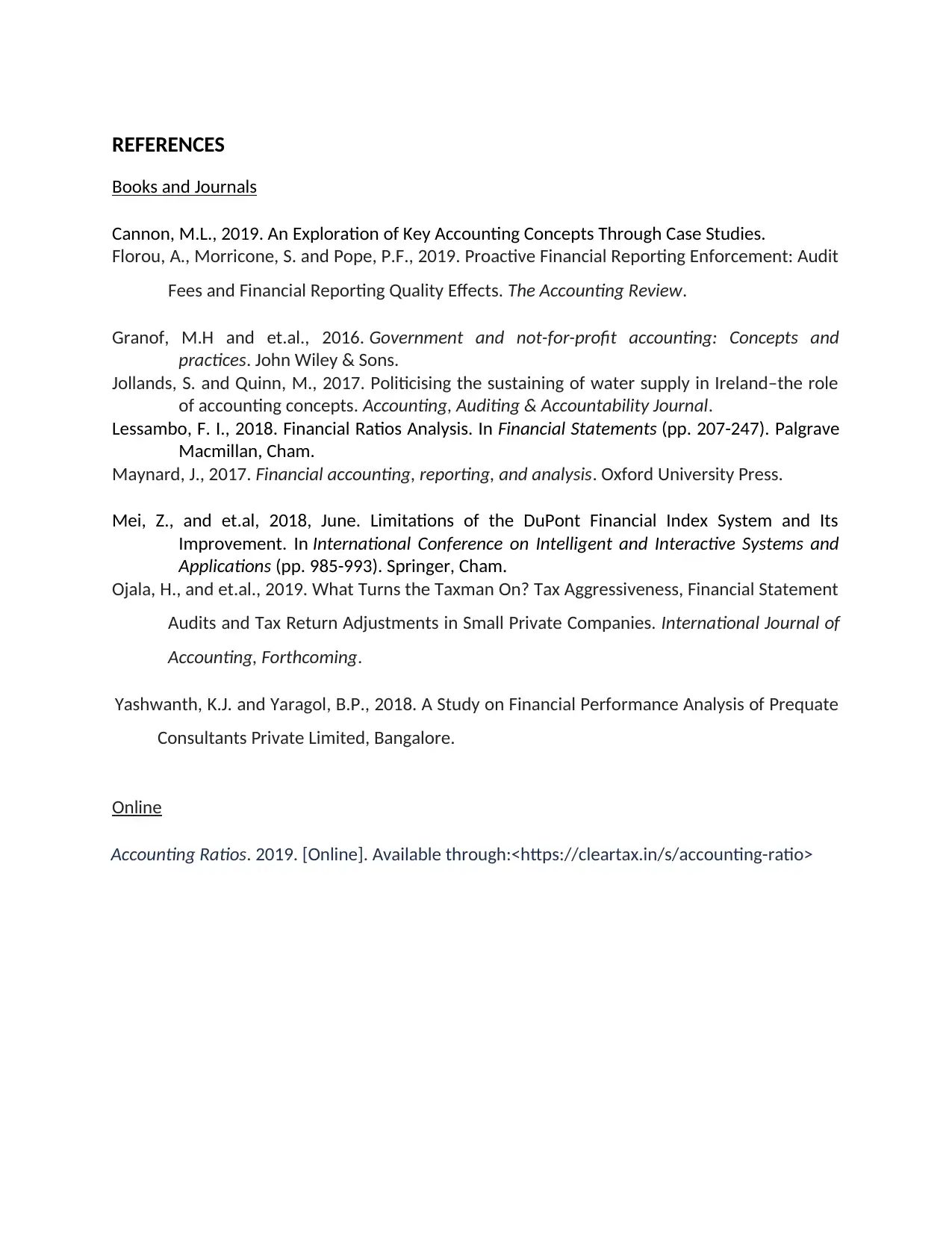
Books and Journals
Cannon, M.L., 2019. An Exploration of Key Accounting Concepts Through Case Studies.
Florou, A., Morricone, S. and Pope, P.F., 2019. Proactive Financial Reporting Enforcement: Audit
Fees and Financial Reporting Quality Effects. The Accounting Review.
Granof, M.H and et.al., 2016. Government and not-for-profit accounting: Concepts and
practices. John Wiley & Sons.
Jollands, S. and Quinn, M., 2017. Politicising the sustaining of water supply in Ireland–the role
of accounting concepts. Accounting, Auditing & Accountability Journal.
Lessambo, F. I., 2018. Financial Ratios Analysis. In Financial Statements (pp. 207-247). Palgrave
Macmillan, Cham.
Maynard, J., 2017. Financial accounting, reporting, and analysis. Oxford University Press.
Mei, Z., and et.al, 2018, June. Limitations of the DuPont Financial Index System and Its
Improvement. In International Conference on Intelligent and Interactive Systems and
Applications (pp. 985-993). Springer, Cham.
Ojala, H., and et.al., 2019. What Turns the Taxman On? Tax Aggressiveness, Financial Statement
Audits and Tax Return Adjustments in Small Private Companies. International Journal of
Accounting, Forthcoming.
Yashwanth, K.J. and Yaragol, B.P., 2018. A Study on Financial Performance Analysis of Prequate
Consultants Private Limited, Bangalore.
Online
Accounting Ratios. 2019. [Online]. Available through:<https://cleartax.in/s/accounting-ratio>
Books and Journals
Cannon, M.L., 2019. An Exploration of Key Accounting Concepts Through Case Studies.
Florou, A., Morricone, S. and Pope, P.F., 2019. Proactive Financial Reporting Enforcement: Audit
Fees and Financial Reporting Quality Effects. The Accounting Review.
Granof, M.H and et.al., 2016. Government and not-for-profit accounting: Concepts and
practices. John Wiley & Sons.
Jollands, S. and Quinn, M., 2017. Politicising the sustaining of water supply in Ireland–the role
of accounting concepts. Accounting, Auditing & Accountability Journal.
Lessambo, F. I., 2018. Financial Ratios Analysis. In Financial Statements (pp. 207-247). Palgrave
Macmillan, Cham.
Maynard, J., 2017. Financial accounting, reporting, and analysis. Oxford University Press.
Mei, Z., and et.al, 2018, June. Limitations of the DuPont Financial Index System and Its
Improvement. In International Conference on Intelligent and Interactive Systems and
Applications (pp. 985-993). Springer, Cham.
Ojala, H., and et.al., 2019. What Turns the Taxman On? Tax Aggressiveness, Financial Statement
Audits and Tax Return Adjustments in Small Private Companies. International Journal of
Accounting, Forthcoming.
Yashwanth, K.J. and Yaragol, B.P., 2018. A Study on Financial Performance Analysis of Prequate
Consultants Private Limited, Bangalore.
Online
Accounting Ratios. 2019. [Online]. Available through:<https://cleartax.in/s/accounting-ratio>
⊘ This is a preview!⊘
Do you want full access?
Subscribe today to unlock all pages.
Trusted by 1+ million students worldwide

1 out of 16


Related Documents


Your All-in-One AI-Powered Toolkit for Academic Success.
+13062052269
info@desklib.com
Available 24*7 on WhatsApp / Email
![[object Object]](/_next/static/media/star-bottom.7253800d.svg)
Unlock your academic potential
Copyright © 2020–2025 A2Z Services. All Rights Reserved. Developed and managed by ZUCOL.