Beating Automation: A Case Study on Strategies for Workplace Success

Verified

Added on  2023/04/10

|4
|449
|76
Case Study
AI Summary
This case study examines the impact of sudden job automation on employee morale and employment, drawing parallels with the Luddites' reaction to industrial machinery. It advocates for a constructive approach to dealing with job loss due to automation, suggesting counseling and legal action to ensure a gradual transition. The study emphasizes the importance of continuous education and skill development, particularly in communication, social, and management skills, to remain competitive in the workforce. It highlights that robots lack the ability to manage themselves, communicate effectively, or solve problems, making these skills crucial for job security. Embracing further education and training not only equips employees with management and operational skills related to new technologies but also provides a diverse skill set that helps them adapt to various employment levels and beat automation in any event. Desklib provides similar solved assignments for students.

Document Page
Running head: CASE STUDY 1
Case study
Student’s Name
Institutional Affiliation
tabler-icon-diamond-filled.svg

Paraphrase This Document

Need a fresh take? Get an instant paraphrase of this document with our AI Paraphraser
Document Page
Running head: CASE STUDY 2
Beating Automation
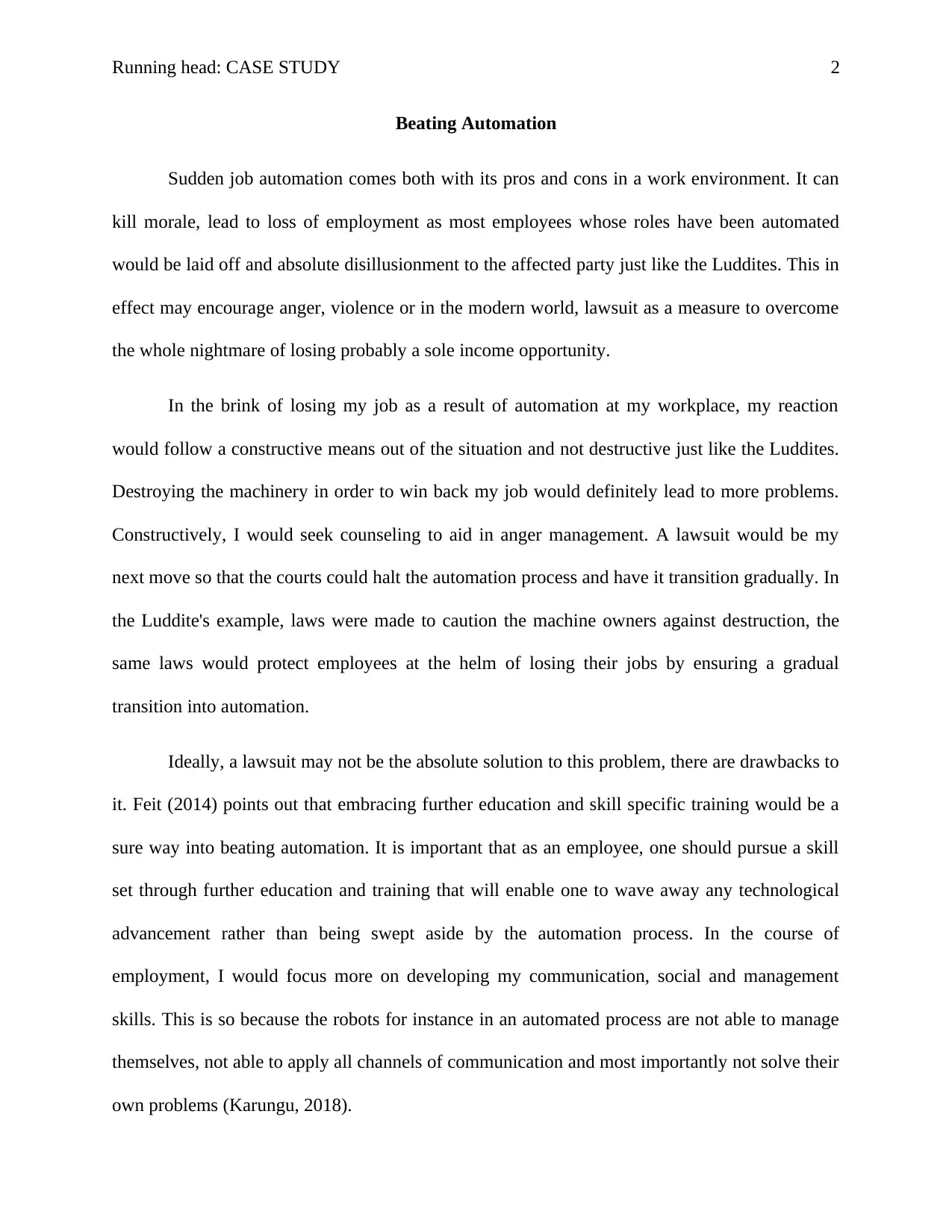
Sudden job automation comes both with its pros and cons in a work environment. It can
kill morale, lead to loss of employment as most employees whose roles have been automated
would be laid off and absolute disillusionment to the affected party just like the Luddites. This in
effect may encourage anger, violence or in the modern world, lawsuit as a measure to overcome
the whole nightmare of losing probably a sole income opportunity.
In the brink of losing my job as a result of automation at my workplace, my reaction
would follow a constructive means out of the situation and not destructive just like the Luddites.
Destroying the machinery in order to win back my job would definitely lead to more problems.
Constructively, I would seek counseling to aid in anger management. A lawsuit would be my
next move so that the courts could halt the automation process and have it transition gradually. In
the Luddite's example, laws were made to caution the machine owners against destruction, the
same laws would protect employees at the helm of losing their jobs by ensuring a gradual
transition into automation.
Ideally, a lawsuit may not be the absolute solution to this problem, there are drawbacks to
it. Feit (2014) points out that embracing further education and skill specific training would be a
sure way into beating automation. It is important that as an employee, one should pursue a skill
set through further education and training that will enable one to wave away any technological
advancement rather than being swept aside by the automation process. In the course of
employment, I would focus more on developing my communication, social and management
skills. This is so because the robots for instance in an automated process are not able to manage
themselves, not able to apply all channels of communication and most importantly not solve their
own problems (Karungu, 2018).
Document Page
Running head: CASE STUDY 3
Embracing further education and training would also teach one more on management and
operations of the machines hence ensuring security in the next level of employment. A variety of
skills will be adequate and a perfect mix in different levels of employment helping one to beat
automation in any event (Rainie & Anderson, 2017).
Document Page
Running head: CASE STUDY 4
References
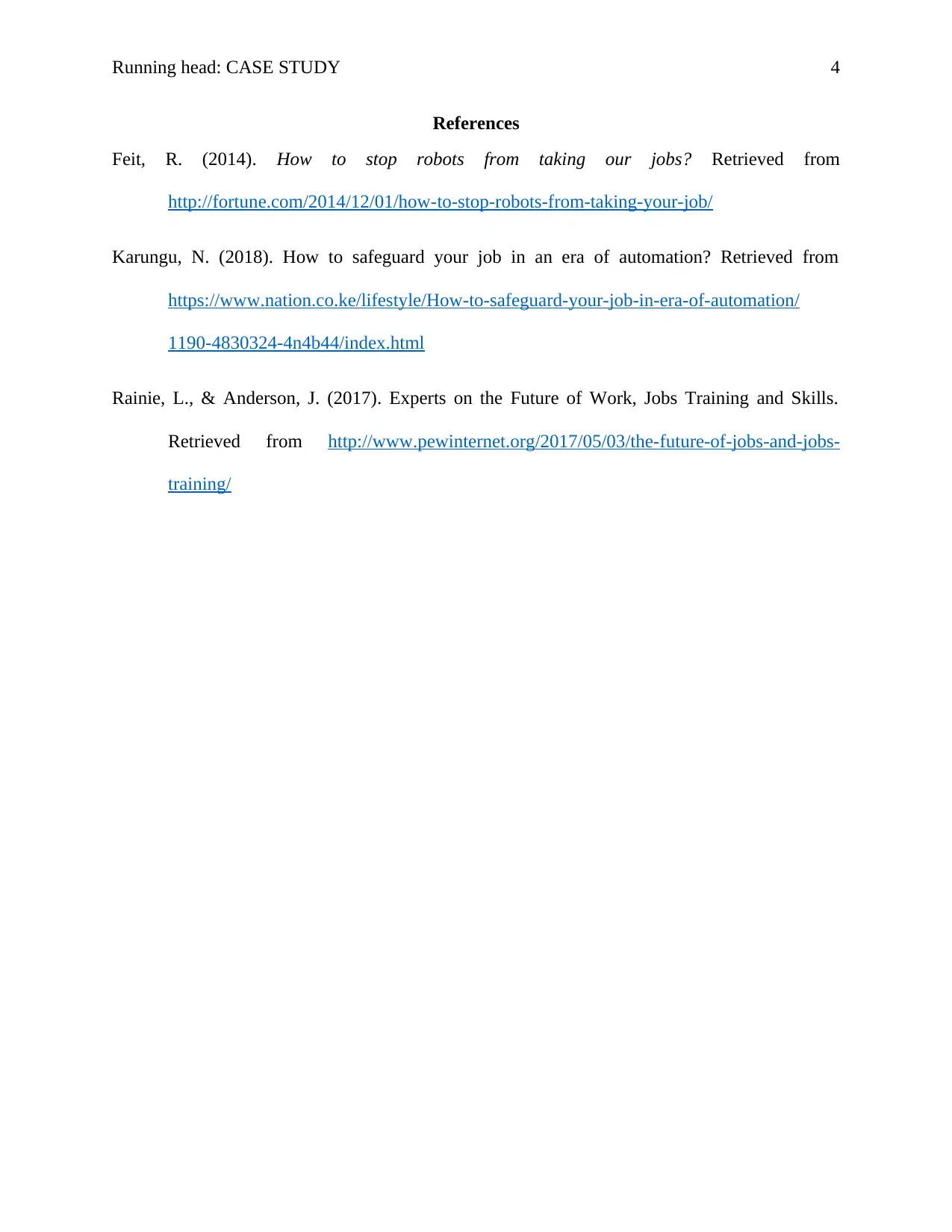
Feit, R. (2014). How to stop robots from taking our jobs? Retrieved from
http://fortune.com/2014/12/01/how-to-stop-robots-from-taking-your-job/
Karungu, N. (2018). How to safeguard your job in an era of automation? Retrieved from
https://www.nation.co.ke/lifestyle/How-to-safeguard-your-job-in-era-of-automation/
1190-4830324-4n4b44/index.html
Rainie, L., & Anderson, J. (2017). Experts on the Future of Work, Jobs Training and Skills.
Retrieved from http://www.pewinternet.org/2017/05/03/the-future-of-jobs-and-jobs-
training/
chevron_up_icon
1 out of 4
circle_padding
hide_on_mobile
zoom_out_icon
[object Object]