Analyzing Burberry's Marketing Problems: A Detailed Case Study

Verified

Added on  2023/04/23

|7
|1434
|422
Case Study
AI Summary
This case study examines Burberry's strategic shift to reposition itself in the fashion market, moving from an affordable brand to a luxury brand. The analysis covers the macro and micro environmental factors that influenced this decision, including economic conditions and competitive pressures. The study assesses the potential implications of a successful repositioning strategy, such as increased profitability and a shift in target market to premium customers. It also explores repositioning strategies, including the use of social media marketing and aligning brand experience with customer expectations. The case study references various academic sources to support its analysis of Burberry's marketing challenges and strategic responses.
Document Page
RUNNING HEAD: Marketing
Marketing
[Type the document subtitle]
Laptop04011
[Pick the date]
tabler-icon-diamond-filled.svg

Paraphrase This Document

Need a fresh take? Get an instant paraphrase of this document with our AI Paraphraser
Document Page
Marketing 1
Answer 1
The case study clearly explains that the company Burberry wants to change its business
strategies in order to grow in fashion and retail market. Earlier in the fashion and clothing
industry, the company was placed at a position where the customers believe that the brand is
economical, chic and affordable by them. However, the economic conditions of the country
along with industry reduced the profits of the business in the target market. Resulting in which,
the company was convinced to reposition the brand in the eyes of prospective customers and
maintain their position as well. An important fact should be noted that the repositioning strategy
of the company aimed to transfer the brand from affordable brand to a class and rich brand
present in the market (Phan, Thomas, and Heine 2011). The company believed that upgrading
the brand will successively increase the profits and help the business to attain competitive
advantage as well. Further, this business objective of the company would require various
changes in the business program and implementation of change management process as well. It
is important for the business to align the marketing plan with the brand objective of the company
so as to effectively complete aim as well. Thus, the facts should be noted that repositioning of
the brand is an important aspect that helps the business in growing and becoming profitable in
the target market (Wilson, and Robson 2019).
Furthermore, analysing the activities of the company Burberry along with its business objective
to reposition the brand, it should be noted that the macro environmental factors along with the
internal factors insisted the company to make such a move in the market. As it was believed that
repositioning with help the company to become stable and manage to create a dignified position
in the market due to which the company shifted their products in the premium segment. Further,
talking about the implication of business if such reposition strategy of the company is successful
then the company would earn growing profitability in the target market along with positive
customer feedback as well (Gaustad, et. al., 2019). The target market class of the company will
shift from middle and lower to premium range customers which will significantly provide more
profits to the business. With the help of this type of repositioning strategy, the company will be
able to eliminate the losses and adversities and grow as well. Thus, it can be clearly said that
using the repositioning strategy, the company can easily position themselves at the right position
in the target market (Robinson, and Hsieh 2016).
Document Page
Marketing 2
Document Page
Marketing 3
Answer 2
High
Low
Classic Fashionable
Source: By Author
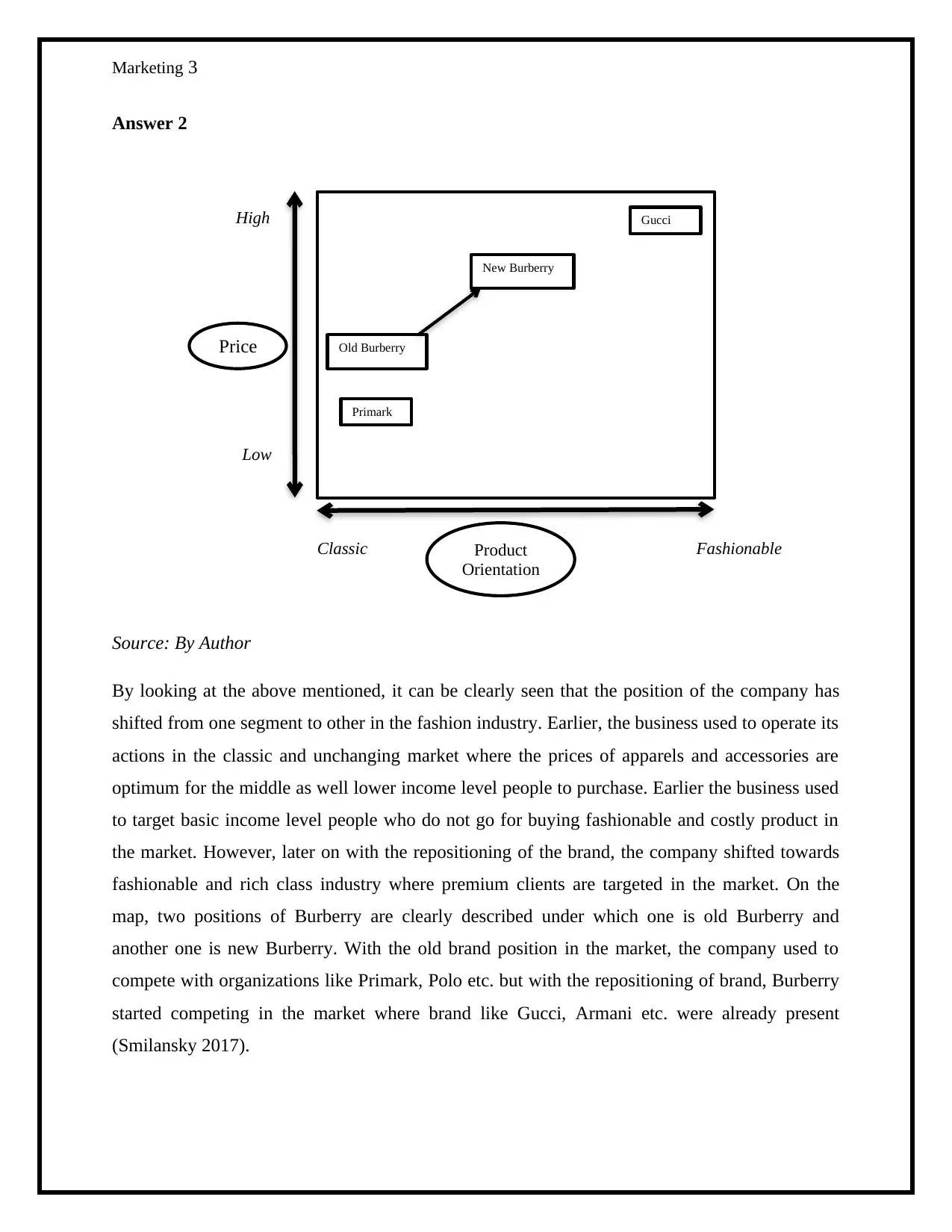
By looking at the above mentioned, it can be clearly seen that the position of the company has
shifted from one segment to other in the fashion industry. Earlier, the business used to operate its
actions in the classic and unchanging market where the prices of apparels and accessories are
optimum for the middle as well lower income level people to purchase. Earlier the business used
to target basic income level people who do not go for buying fashionable and costly product in
the market. However, later on with the repositioning of the brand, the company shifted towards
fashionable and rich class industry where premium clients are targeted in the market. On the
map, two positions of Burberry are clearly described under which one is old Burberry and
another one is new Burberry. With the old brand position in the market, the company used to
compete with organizations like Primark, Polo etc. but with the repositioning of brand, Burberry
started competing in the market where brand like Gucci, Armani etc. were already present
(Smilansky 2017).
Price
Product
Orientation
Primark
Old Burberry
New Burberry
Gucci
tabler-icon-diamond-filled.svg

Paraphrase This Document

Need a fresh take? Get an instant paraphrase of this document with our AI Paraphraser
Document Page
Marketing 4
Thus, it can be said that the position of Burberry changed in the market in terms of the price and
value addition in the product as the company started identifying the premium range customers
are their main focus. This aspect motivated the company to create more fashionable and unique
clothing and accessories so that people are attracted to buy them. This process also made the
organization lose their loyal customers who were attracted towards the company due to its classic
taste and price effectiveness as well. The positioning map clearly explain the before and after
position of the company Burberry (Coleman 2018).
Document Page
Marketing 5
Answer 3
Repositioning is an important phase for the companies like Burberry as it helps them to uplift
their position in the target market and differentiate themselves from the crowd as well. Further,
below-mentioned are the two repositioning strategies that the companies like Burberry can make
use of in order to grow and succeed in the target market:
Use of Social Media Marketing Tools: social media has become one of the most important
platforms to present a brand in the target market. It has become easy for the companies to
provide their brand impression to the customers using social media marketing tools. The
companies like Burberry can effectively make use of social media platforms like Facebook;
Twitter etc. promote the name of the company in the target market by repositioning the brand.
Through this type of promotional strategy, the companies can clearly circulate their brand
message to the customers in the target market. By using this platform, the company can target a
wide segment in one go. Thus, this type of strategy can help the business in enhancing their
repositioning strategy (Balapour, and Khanlari 2015).
Aligning Brand Experience with Customer Expectation: In the process of repositioning, it is
important for the business to maintain the satisfaction level of the customers by providing them
optimum services according to the industry requirement. While switching between the segments,
the companies might face difficulty to manage the quality standards of the products served in the
new environment that might create a problem for them. Like in the case of Burberry Company,
the company used to provide low quality product before and after repositioning they shifted in
the premium quality market. Difference in the expectation and product/ service delivery can
reduce the effectiveness of the repositioning process. Thus, the business should research and then
make changes in the product in such a way that optimum value is delivered to the customers in
respect to their expectation (Dimitrakopoulou 2015).
Document Page
Marketing 6
References
Balapour, A. and Khanlari, A., 2015. The Effects of Fan Personality on Participation in Social
Media Based Brand Community: Role of Personality on Participation in the Social Media.
In Strategic Customer Relationship Management in the Age of Social Media (pp. 155-177). IGI
Global.
Coleman, D., 2018. Building Brand Experiences: A Practical Guide to Retaining Brand
Relevance. UK: Kogan Page Publishers.
Dimitrakopoulou, P., 2015. The Development Of A Bussiness Strategy Model For A Luxury
Brand.
Gaustad, T., Samuelsen, B.M., Warlop, L. and Fitzsimons, G.J., 2019. Too much of a good
thing? Consumer response to strategic changes in brand image. International Journal of
Research in Marketing.
Phan, M., Thomas, R. and Heine, K., 2011. Social media and luxury brand management: The
case of Burberry. Journal of Global Fashion Marketing, 2(4), pp.213-222.
Robinson, P.K. and Hsieh, L., 2016. Reshoring: a strategic renewal of luxury clothing supply
chains. Operations Management Research, 9(3-4), pp.89-101.
Smilansky, S., 2017. Experiential Marketing: A practical guide to interactive brand experiences.
UK: Kogan Page Publishers.
Wilson, M. and Robson, K., 2019. Overexposure of a luxury brand: Coach Inc.’s distribution and
image problem.
chevron_up_icon
1 out of 7
circle_padding
hide_on_mobile
zoom_out_icon
[object Object]