Case Study: David Hennessy's Entrepreneurial Success with Job-Driven
VerifiedAdded on 2023/06/14
|12
|3206
|59
Case Study
AI Summary
This case study delves into David Hennessy's entrepreneurial journey with Motor Staff and his establishment of Job-Driven. The study identifies the opportunity as a 'Locus of Changes,' allowing Motor Staff to capture a broader market by offering a cheaper alternative through Job-Driven. David ensured Job-Driven's relevance by gathering market intelligence and securing team support. Key elements of Job-Driven's business plan included online marketing, social media engagement, and word-of-mouth promotion. David learned the importance of flexibility in business planning, resource allocation, and time management, as well as the necessity of a unique entrepreneurial mindset. He also recognized the value of dedicating time to strategic thinking and anticipating future business trends and challenges. The case study highlights the practical steps and lessons learned in launching a successful entrepreneurial venture.
Running head: ASSIGNMENT 1: CASE STUDY-ENTREPRENUER 1
Assignment 1: Case Study – Entrepreneur
Name
Institution
Assignment 1: Case Study – Entrepreneur
Name
Institution

Paraphrase This Document
Need a fresh take? Get an instant paraphrase of this document with our AI Paraphraser
ASSIGNMENT 1: CASE STUDY-ENTREPRENUER 2
Table of Contents
Executive Summary........................................................................................................................................3
Introduction.....................................................................................................................................................3
How was the opportunity identified?............................................................................................................4
What opportunity did David identify?...........................................................................................................5
How did David make Job-Driven happen?...................................................................................................6
What were the most critical elements of David’s business plan for Job-Driven?...................................6
What lessons did David learn in the entrepreneurship process?.............................................................6
Conclusion.......................................................................................................................................................7
References........................................................................................................................................................8
Table of Contents
Executive Summary........................................................................................................................................3
Introduction.....................................................................................................................................................3
How was the opportunity identified?............................................................................................................4
What opportunity did David identify?...........................................................................................................5
How did David make Job-Driven happen?...................................................................................................6
What were the most critical elements of David’s business plan for Job-Driven?...................................6
What lessons did David learn in the entrepreneurship process?.............................................................6
Conclusion.......................................................................................................................................................7
References........................................................................................................................................................8

ASSIGNMENT 1: CASE STUDY-ENTREPRENUER 3
Executive Summary
The primary focus of this paper was to document the desired process useful in pursuing an
identified opportunity by an entrepreneur. David Hennessy (Motor staff) was interviewed together with his
newly founded venture, Job-Driven to succeed. The essay is sectioned in the following manner: The first
Executive Summary
The primary focus of this paper was to document the desired process useful in pursuing an
identified opportunity by an entrepreneur. David Hennessy (Motor staff) was interviewed together with his
newly founded venture, Job-Driven to succeed. The essay is sectioned in the following manner: The first
⊘ This is a preview!⊘
Do you want full access?
Subscribe today to unlock all pages.

Trusted by 1+ million students worldwide
ASSIGNMENT 1: CASE STUDY-ENTREPRENUER 4
section presents a brief introduction; followed by an explanation of how the opportunity was identified in the
second section. The third section displays a summary of the particular opportunity identified by David.
The fourth section gives a brief description of how Job-Driven venture was made to happen by
David. The subsequent part highlights the most significant elements of David’s business plan for Job-
Driven followed by lessons learned by David in entrepreneurship process in the sixth section. Finally, a
brief conclusion. David identified an opportunity categorized as, “Locus of Changes” whereby staff would be
permitted to continue capturing the market through a new company (Job-Driven) establishment for people
who want a cheaper alternative.
It would help Motor Staff to offer premium services, build revenue or profit and capture extra
market share. David ensured the success of Job-Driven by first determining Job Driven’s relevance both in
the long-and short-term by gathering market intelligence and engaged his team to support the idea to avoid
any resistance. The most significant elements of Job Driven’s business plan included the marketing through
an online magazine, social media, and email companions; scrips for staff hence spreading the information
through word of mouth; and websites, cards, flyers, and stationeries.
David learned to be flexible with a business plan, time and resources. He also learned about the
importance of having different psychology to be a business owner. He also learned about the importance of
setting aside some time away from the business to think about what one’s future may look like in their
business, trends, and challenges to foresee the benefits of implementing a potential business opportunity.
section presents a brief introduction; followed by an explanation of how the opportunity was identified in the
second section. The third section displays a summary of the particular opportunity identified by David.
The fourth section gives a brief description of how Job-Driven venture was made to happen by
David. The subsequent part highlights the most significant elements of David’s business plan for Job-
Driven followed by lessons learned by David in entrepreneurship process in the sixth section. Finally, a
brief conclusion. David identified an opportunity categorized as, “Locus of Changes” whereby staff would be
permitted to continue capturing the market through a new company (Job-Driven) establishment for people
who want a cheaper alternative.
It would help Motor Staff to offer premium services, build revenue or profit and capture extra
market share. David ensured the success of Job-Driven by first determining Job Driven’s relevance both in
the long-and short-term by gathering market intelligence and engaged his team to support the idea to avoid
any resistance. The most significant elements of Job Driven’s business plan included the marketing through
an online magazine, social media, and email companions; scrips for staff hence spreading the information
through word of mouth; and websites, cards, flyers, and stationeries.
David learned to be flexible with a business plan, time and resources. He also learned about the
importance of having different psychology to be a business owner. He also learned about the importance of
setting aside some time away from the business to think about what one’s future may look like in their
business, trends, and challenges to foresee the benefits of implementing a potential business opportunity.
Paraphrase This Document
Need a fresh take? Get an instant paraphrase of this document with our AI Paraphraser
ASSIGNMENT 1: CASE STUDY-ENTREPRENUER 5
Introduction
The term entrepreneurship” was formulated by Professor Howard Stevenson. It is defined as “...the
pursuit of opportunity beyond resources controlled” (Sinoway and Meadow, 2012). Individuals who have
entrepreneurship competence possess sets of knowledge, attitudes, and skills for the recognition of
opportunity, exploitation, and value creation and action orientation. They are e likely to identify problems
and take action (Herrmann, Hannon, COS and Ternouth, 2008; Lillevali and Taks, 2017). To document an
existing example of the process an entrepreneur could take to pursue an opportunity they have identified,
we interviewed David Hennessy at Motor Staff and his newly founded venture, Job-Driven.
Since commencing its operations in 1995, Motor Staff specialize in recruiting for the automotive
sector. They support automotive companies that include dealerships, aftermarket automotive businesses
(including small or large workshops) and manufacturers who have their head offices based in Australia.
These are otherwise known as Original Equipment Manufacturer or OEM’s like Mazda, Mercedes-Benz,
Ford, Kia, etc. Like other recruitment agencies, Motor Staff is a firm who source candidates for employers
(Turkina & Thai, 2015). Once Motor Staff have received a recruitment brief, their recruitment methodology
includes advertising for the position on the relevant job boards and social media. They will also be
conducting extensive searches on several databases, emailing potential candidates in the database,
interviewing, reference checking, shortlisting, facilitating interviews, negotiating salary and condition of
employment and assisting with on-boarding once the campaign is successful (Davidsson, 2017).
With a career in owning and operating a café/restaurant and working in the corporate
entertainment industry, David Hennessy who is 42 years old, joined his father in 2012 with a goal of
expanding Motor Staff. Motor Staff currently has three primary office locations (Dutt, Grabe & Castro,
2016). The first office is located in Sydney, second in Melbourne and the third in Queensland as well as
having handled briefs in South Australia, Western Australia as well as two to three assignments both in
New Zealand and Singapore.
Introduction
The term entrepreneurship” was formulated by Professor Howard Stevenson. It is defined as “...the
pursuit of opportunity beyond resources controlled” (Sinoway and Meadow, 2012). Individuals who have
entrepreneurship competence possess sets of knowledge, attitudes, and skills for the recognition of
opportunity, exploitation, and value creation and action orientation. They are e likely to identify problems
and take action (Herrmann, Hannon, COS and Ternouth, 2008; Lillevali and Taks, 2017). To document an
existing example of the process an entrepreneur could take to pursue an opportunity they have identified,
we interviewed David Hennessy at Motor Staff and his newly founded venture, Job-Driven.
Since commencing its operations in 1995, Motor Staff specialize in recruiting for the automotive
sector. They support automotive companies that include dealerships, aftermarket automotive businesses
(including small or large workshops) and manufacturers who have their head offices based in Australia.
These are otherwise known as Original Equipment Manufacturer or OEM’s like Mazda, Mercedes-Benz,
Ford, Kia, etc. Like other recruitment agencies, Motor Staff is a firm who source candidates for employers
(Turkina & Thai, 2015). Once Motor Staff have received a recruitment brief, their recruitment methodology
includes advertising for the position on the relevant job boards and social media. They will also be
conducting extensive searches on several databases, emailing potential candidates in the database,
interviewing, reference checking, shortlisting, facilitating interviews, negotiating salary and condition of
employment and assisting with on-boarding once the campaign is successful (Davidsson, 2017).
With a career in owning and operating a café/restaurant and working in the corporate
entertainment industry, David Hennessy who is 42 years old, joined his father in 2012 with a goal of
expanding Motor Staff. Motor Staff currently has three primary office locations (Dutt, Grabe & Castro,
2016). The first office is located in Sydney, second in Melbourne and the third in Queensland as well as
having handled briefs in South Australia, Western Australia as well as two to three assignments both in
New Zealand and Singapore.
ASSIGNMENT 1: CASE STUDY-ENTREPRENUER 6
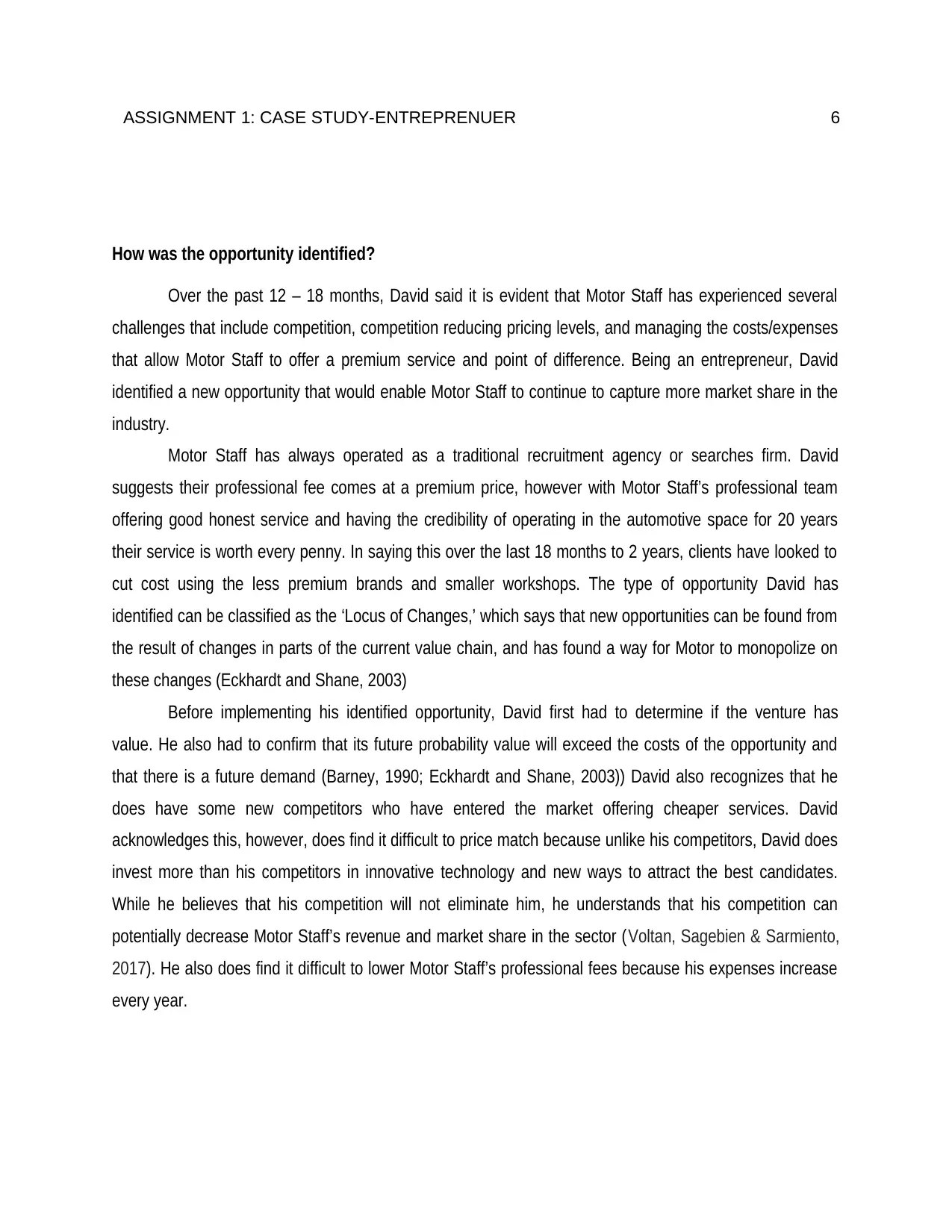
How was the opportunity identified?
Over the past 12 – 18 months, David said it is evident that Motor Staff has experienced several
challenges that include competition, competition reducing pricing levels, and managing the costs/expenses
that allow Motor Staff to offer a premium service and point of difference. Being an entrepreneur, David
identified a new opportunity that would enable Motor Staff to continue to capture more market share in the
industry.
Motor Staff has always operated as a traditional recruitment agency or searches firm. David
suggests their professional fee comes at a premium price, however with Motor Staff’s professional team
offering good honest service and having the credibility of operating in the automotive space for 20 years
their service is worth every penny. In saying this over the last 18 months to 2 years, clients have looked to
cut cost using the less premium brands and smaller workshops. The type of opportunity David has
identified can be classified as the ‘Locus of Changes,’ which says that new opportunities can be found from
the result of changes in parts of the current value chain, and has found a way for Motor to monopolize on
these changes (Eckhardt and Shane, 2003)
Before implementing his identified opportunity, David first had to determine if the venture has
value. He also had to confirm that its future probability value will exceed the costs of the opportunity and
that there is a future demand (Barney, 1990; Eckhardt and Shane, 2003)) David also recognizes that he
does have some new competitors who have entered the market offering cheaper services. David
acknowledges this, however, does find it difficult to price match because unlike his competitors, David does
invest more than his competitors in innovative technology and new ways to attract the best candidates.
While he believes that his competition will not eliminate him, he understands that his competition can
potentially decrease Motor Staff’s revenue and market share in the sector (Voltan, Sagebien & Sarmiento,
2017). He also does find it difficult to lower Motor Staff’s professional fees because his expenses increase
every year.
How was the opportunity identified?
Over the past 12 – 18 months, David said it is evident that Motor Staff has experienced several
challenges that include competition, competition reducing pricing levels, and managing the costs/expenses
that allow Motor Staff to offer a premium service and point of difference. Being an entrepreneur, David
identified a new opportunity that would enable Motor Staff to continue to capture more market share in the
industry.
Motor Staff has always operated as a traditional recruitment agency or searches firm. David
suggests their professional fee comes at a premium price, however with Motor Staff’s professional team
offering good honest service and having the credibility of operating in the automotive space for 20 years
their service is worth every penny. In saying this over the last 18 months to 2 years, clients have looked to
cut cost using the less premium brands and smaller workshops. The type of opportunity David has
identified can be classified as the ‘Locus of Changes,’ which says that new opportunities can be found from
the result of changes in parts of the current value chain, and has found a way for Motor to monopolize on
these changes (Eckhardt and Shane, 2003)
Before implementing his identified opportunity, David first had to determine if the venture has
value. He also had to confirm that its future probability value will exceed the costs of the opportunity and
that there is a future demand (Barney, 1990; Eckhardt and Shane, 2003)) David also recognizes that he
does have some new competitors who have entered the market offering cheaper services. David
acknowledges this, however, does find it difficult to price match because unlike his competitors, David does
invest more than his competitors in innovative technology and new ways to attract the best candidates.
While he believes that his competition will not eliminate him, he understands that his competition can
potentially decrease Motor Staff’s revenue and market share in the sector (Voltan, Sagebien & Sarmiento,
2017). He also does find it difficult to lower Motor Staff’s professional fees because his expenses increase
every year.
⊘ This is a preview!⊘
Do you want full access?
Subscribe today to unlock all pages.
Trusted by 1+ million students worldwide
ASSIGNMENT 1: CASE STUDY-ENTREPRENUER 7
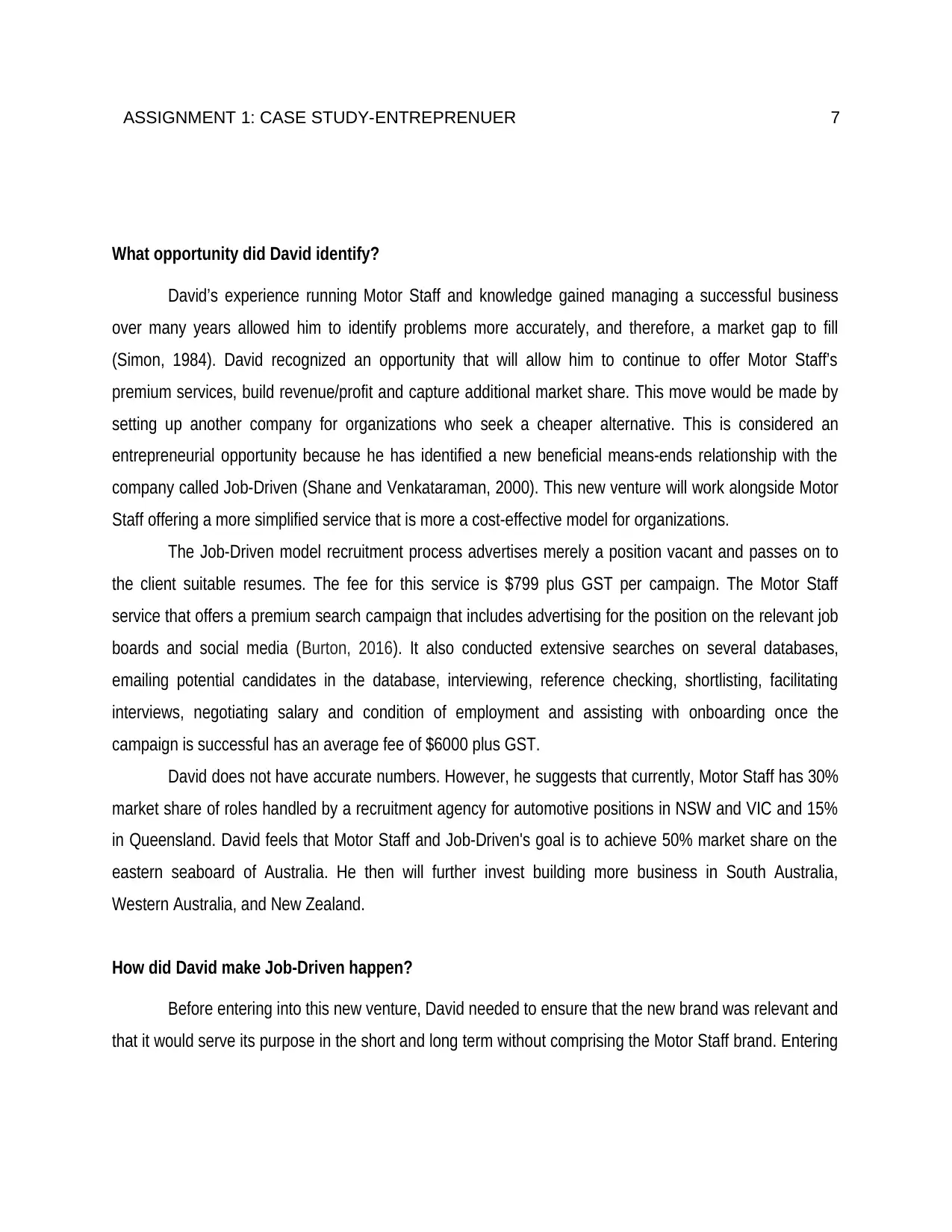
What opportunity did David identify?
David’s experience running Motor Staff and knowledge gained managing a successful business
over many years allowed him to identify problems more accurately, and therefore, a market gap to fill
(Simon, 1984). David recognized an opportunity that will allow him to continue to offer Motor Staff’s
premium services, build revenue/profit and capture additional market share. This move would be made by
setting up another company for organizations who seek a cheaper alternative. This is considered an
entrepreneurial opportunity because he has identified a new beneficial means-ends relationship with the
company called Job-Driven (Shane and Venkataraman, 2000). This new venture will work alongside Motor
Staff offering a more simplified service that is more a cost-effective model for organizations.
The Job-Driven model recruitment process advertises merely a position vacant and passes on to
the client suitable resumes. The fee for this service is $799 plus GST per campaign. The Motor Staff
service that offers a premium search campaign that includes advertising for the position on the relevant job
boards and social media (Burton, 2016). It also conducted extensive searches on several databases,
emailing potential candidates in the database, interviewing, reference checking, shortlisting, facilitating
interviews, negotiating salary and condition of employment and assisting with onboarding once the
campaign is successful has an average fee of $6000 plus GST.
David does not have accurate numbers. However, he suggests that currently, Motor Staff has 30%
market share of roles handled by a recruitment agency for automotive positions in NSW and VIC and 15%
in Queensland. David feels that Motor Staff and Job-Driven's goal is to achieve 50% market share on the
eastern seaboard of Australia. He then will further invest building more business in South Australia,
Western Australia, and New Zealand.
How did David make Job-Driven happen?
Before entering into this new venture, David needed to ensure that the new brand was relevant and
that it would serve its purpose in the short and long term without comprising the Motor Staff brand. Entering
What opportunity did David identify?
David’s experience running Motor Staff and knowledge gained managing a successful business
over many years allowed him to identify problems more accurately, and therefore, a market gap to fill
(Simon, 1984). David recognized an opportunity that will allow him to continue to offer Motor Staff’s
premium services, build revenue/profit and capture additional market share. This move would be made by
setting up another company for organizations who seek a cheaper alternative. This is considered an
entrepreneurial opportunity because he has identified a new beneficial means-ends relationship with the
company called Job-Driven (Shane and Venkataraman, 2000). This new venture will work alongside Motor
Staff offering a more simplified service that is more a cost-effective model for organizations.
The Job-Driven model recruitment process advertises merely a position vacant and passes on to
the client suitable resumes. The fee for this service is $799 plus GST per campaign. The Motor Staff
service that offers a premium search campaign that includes advertising for the position on the relevant job
boards and social media (Burton, 2016). It also conducted extensive searches on several databases,
emailing potential candidates in the database, interviewing, reference checking, shortlisting, facilitating
interviews, negotiating salary and condition of employment and assisting with onboarding once the
campaign is successful has an average fee of $6000 plus GST.
David does not have accurate numbers. However, he suggests that currently, Motor Staff has 30%
market share of roles handled by a recruitment agency for automotive positions in NSW and VIC and 15%
in Queensland. David feels that Motor Staff and Job-Driven's goal is to achieve 50% market share on the
eastern seaboard of Australia. He then will further invest building more business in South Australia,
Western Australia, and New Zealand.
How did David make Job-Driven happen?
Before entering into this new venture, David needed to ensure that the new brand was relevant and
that it would serve its purpose in the short and long term without comprising the Motor Staff brand. Entering
Paraphrase This Document
Need a fresh take? Get an instant paraphrase of this document with our AI Paraphraser
ASSIGNMENT 1: CASE STUDY-ENTREPRENUER 8
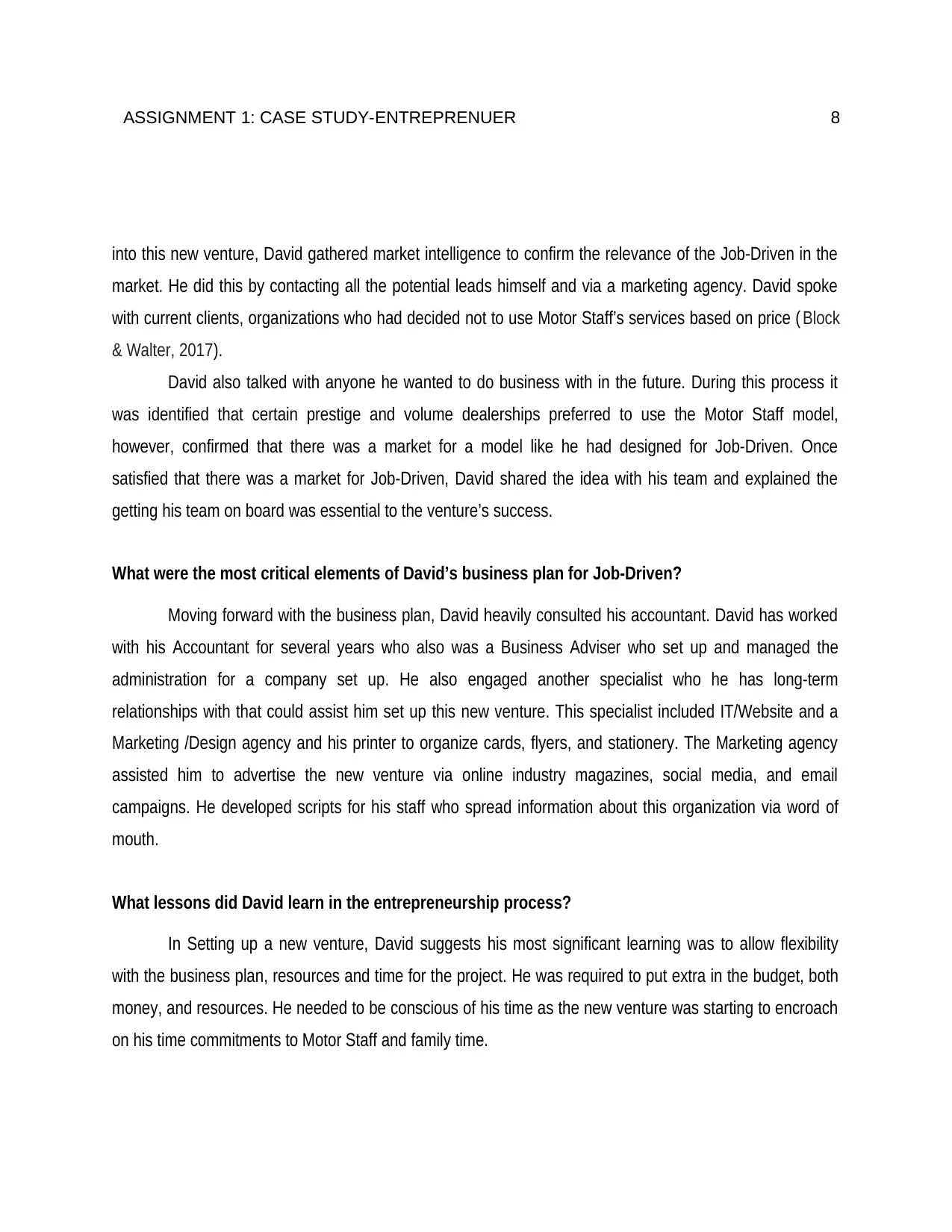
into this new venture, David gathered market intelligence to confirm the relevance of the Job-Driven in the
market. He did this by contacting all the potential leads himself and via a marketing agency. David spoke
with current clients, organizations who had decided not to use Motor Staff’s services based on price ( Block
& Walter, 2017).
David also talked with anyone he wanted to do business with in the future. During this process it
was identified that certain prestige and volume dealerships preferred to use the Motor Staff model,
however, confirmed that there was a market for a model like he had designed for Job-Driven. Once
satisfied that there was a market for Job-Driven, David shared the idea with his team and explained the
getting his team on board was essential to the venture’s success.
What were the most critical elements of David’s business plan for Job-Driven?
Moving forward with the business plan, David heavily consulted his accountant. David has worked
with his Accountant for several years who also was a Business Adviser who set up and managed the
administration for a company set up. He also engaged another specialist who he has long-term
relationships with that could assist him set up this new venture. This specialist included IT/Website and a
Marketing /Design agency and his printer to organize cards, flyers, and stationery. The Marketing agency
assisted him to advertise the new venture via online industry magazines, social media, and email
campaigns. He developed scripts for his staff who spread information about this organization via word of
mouth.
What lessons did David learn in the entrepreneurship process?
In Setting up a new venture, David suggests his most significant learning was to allow flexibility
with the business plan, resources and time for the project. He was required to put extra in the budget, both
money, and resources. He needed to be conscious of his time as the new venture was starting to encroach
on his time commitments to Motor Staff and family time.
into this new venture, David gathered market intelligence to confirm the relevance of the Job-Driven in the
market. He did this by contacting all the potential leads himself and via a marketing agency. David spoke
with current clients, organizations who had decided not to use Motor Staff’s services based on price ( Block
& Walter, 2017).
David also talked with anyone he wanted to do business with in the future. During this process it
was identified that certain prestige and volume dealerships preferred to use the Motor Staff model,
however, confirmed that there was a market for a model like he had designed for Job-Driven. Once
satisfied that there was a market for Job-Driven, David shared the idea with his team and explained the
getting his team on board was essential to the venture’s success.
What were the most critical elements of David’s business plan for Job-Driven?
Moving forward with the business plan, David heavily consulted his accountant. David has worked
with his Accountant for several years who also was a Business Adviser who set up and managed the
administration for a company set up. He also engaged another specialist who he has long-term
relationships with that could assist him set up this new venture. This specialist included IT/Website and a
Marketing /Design agency and his printer to organize cards, flyers, and stationery. The Marketing agency
assisted him to advertise the new venture via online industry magazines, social media, and email
campaigns. He developed scripts for his staff who spread information about this organization via word of
mouth.
What lessons did David learn in the entrepreneurship process?
In Setting up a new venture, David suggests his most significant learning was to allow flexibility
with the business plan, resources and time for the project. He was required to put extra in the budget, both
money, and resources. He needed to be conscious of his time as the new venture was starting to encroach
on his time commitments to Motor Staff and family time.
ASSIGNMENT 1: CASE STUDY-ENTREPRENUER 9
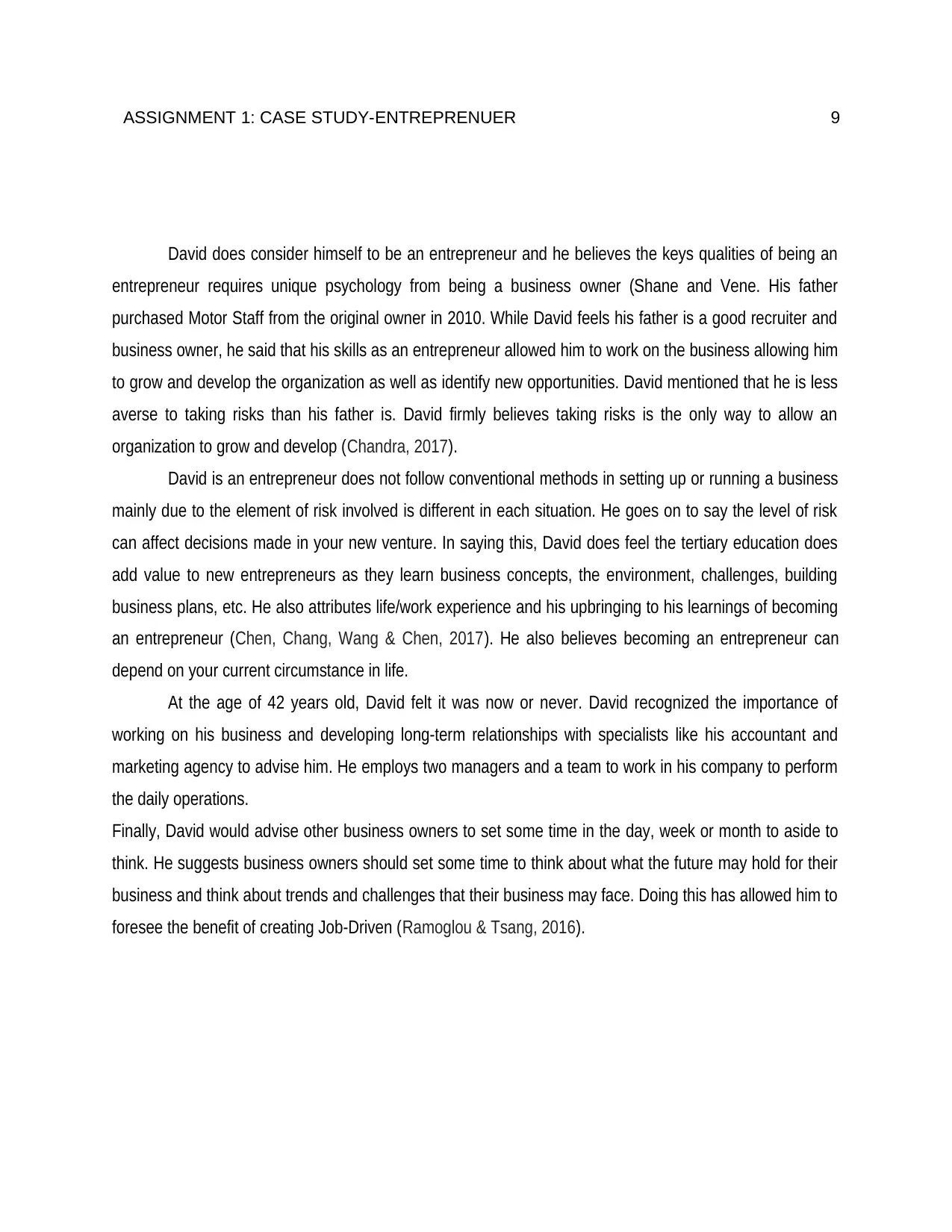
David does consider himself to be an entrepreneur and he believes the keys qualities of being an
entrepreneur requires unique psychology from being a business owner (Shane and Vene. His father
purchased Motor Staff from the original owner in 2010. While David feels his father is a good recruiter and
business owner, he said that his skills as an entrepreneur allowed him to work on the business allowing him
to grow and develop the organization as well as identify new opportunities. David mentioned that he is less
averse to taking risks than his father is. David firmly believes taking risks is the only way to allow an
organization to grow and develop (Chandra, 2017).
David is an entrepreneur does not follow conventional methods in setting up or running a business
mainly due to the element of risk involved is different in each situation. He goes on to say the level of risk
can affect decisions made in your new venture. In saying this, David does feel the tertiary education does
add value to new entrepreneurs as they learn business concepts, the environment, challenges, building
business plans, etc. He also attributes life/work experience and his upbringing to his learnings of becoming
an entrepreneur (Chen, Chang, Wang & Chen, 2017). He also believes becoming an entrepreneur can
depend on your current circumstance in life.
At the age of 42 years old, David felt it was now or never. David recognized the importance of
working on his business and developing long-term relationships with specialists like his accountant and
marketing agency to advise him. He employs two managers and a team to work in his company to perform
the daily operations.
Finally, David would advise other business owners to set some time in the day, week or month to aside to
think. He suggests business owners should set some time to think about what the future may hold for their
business and think about trends and challenges that their business may face. Doing this has allowed him to
foresee the benefit of creating Job-Driven (Ramoglou & Tsang, 2016).
David does consider himself to be an entrepreneur and he believes the keys qualities of being an
entrepreneur requires unique psychology from being a business owner (Shane and Vene. His father
purchased Motor Staff from the original owner in 2010. While David feels his father is a good recruiter and
business owner, he said that his skills as an entrepreneur allowed him to work on the business allowing him
to grow and develop the organization as well as identify new opportunities. David mentioned that he is less
averse to taking risks than his father is. David firmly believes taking risks is the only way to allow an
organization to grow and develop (Chandra, 2017).
David is an entrepreneur does not follow conventional methods in setting up or running a business
mainly due to the element of risk involved is different in each situation. He goes on to say the level of risk
can affect decisions made in your new venture. In saying this, David does feel the tertiary education does
add value to new entrepreneurs as they learn business concepts, the environment, challenges, building
business plans, etc. He also attributes life/work experience and his upbringing to his learnings of becoming
an entrepreneur (Chen, Chang, Wang & Chen, 2017). He also believes becoming an entrepreneur can
depend on your current circumstance in life.
At the age of 42 years old, David felt it was now or never. David recognized the importance of
working on his business and developing long-term relationships with specialists like his accountant and
marketing agency to advise him. He employs two managers and a team to work in his company to perform
the daily operations.
Finally, David would advise other business owners to set some time in the day, week or month to aside to
think. He suggests business owners should set some time to think about what the future may hold for their
business and think about trends and challenges that their business may face. Doing this has allowed him to
foresee the benefit of creating Job-Driven (Ramoglou & Tsang, 2016).
⊘ This is a preview!⊘
Do you want full access?
Subscribe today to unlock all pages.
Trusted by 1+ million students worldwide
ASSIGNMENT 1: CASE STUDY-ENTREPRENUER 10
Conclusion
The Job-Driven is a typical case of successful idea actualization. David’s case offers an ideal
entrepreneur who is ready to not only generate idea but also see it through successful implementation.
Through this case, it is worth noting that David presents the best opportunity for others to learn on how to
undertake a business process. David makes entrepreneurship to appreciate the need for gathering
business intelligence; consult a specialist, and engage the team in project management to become a
success.
It is through working closely with his employees, team, specialists, experts and most importantly
his potential customers that David got to understand that he was able to determine the relevance of the
new venture, Job-Driven. This made him set up a new company that apparently responded to the needs of
the customers who sought for cheaper alternatives without compromising his primary business. Therefore,
entrepreneurs are advised to borrow a leaf from David and take some to think about the future of their
business regarding both challenges and trends because in doing so, they will be able to foresee the
untapped benefits and implement their potential opportunities.
Conclusion
The Job-Driven is a typical case of successful idea actualization. David’s case offers an ideal
entrepreneur who is ready to not only generate idea but also see it through successful implementation.
Through this case, it is worth noting that David presents the best opportunity for others to learn on how to
undertake a business process. David makes entrepreneurship to appreciate the need for gathering
business intelligence; consult a specialist, and engage the team in project management to become a
success.
It is through working closely with his employees, team, specialists, experts and most importantly
his potential customers that David got to understand that he was able to determine the relevance of the
new venture, Job-Driven. This made him set up a new company that apparently responded to the needs of
the customers who sought for cheaper alternatives without compromising his primary business. Therefore,
entrepreneurs are advised to borrow a leaf from David and take some to think about the future of their
business regarding both challenges and trends because in doing so, they will be able to foresee the
untapped benefits and implement their potential opportunities.
Paraphrase This Document
Need a fresh take? Get an instant paraphrase of this document with our AI Paraphraser
ASSIGNMENT 1: CASE STUDY-ENTREPRENUER 11
References
Barney, J. 1991. Firm resources and sustained competitive advantage. Journal of Management, 17(1): 99–
120.
Block, J. H., & Walter, S. G. (2017). 2. Hofstede’s cultural dimensions and modes of entry into
entrepreneurship. Exploring the Entrepreneurial Society: Institutions, Behaviors and Outcomes, 22.
Burton, E. (2016). Business and Entrepreneurship in Saudi Arabia: Opportunities for Partnering and
Investing in Emerging Businesses. John Wiley & Sons.
Chandra, Y. (2017). A time-based process model of international entrepreneurial opportunity
evaluation. Journal of International Business Studies, 48(4), 423-451.
Chen, M. H., Chang, Y. Y., Wang, H. Y., & Chen, M. H. (2017). Understanding creative entrepreneurs’
intention to quit: The role of entrepreneurial motivation, creativity, and
opportunity. Entrepreneurship Research Journal, 7(3).
Davidsson, P. (2017). Entrepreneurial opportunities as propensities: Do Ramoglou & Tsang move the field
forward?. Journal of Business Venturing Insights, 7, 82-85.
Dutt, A., Grabe, S., & Castro, M. (2016). Exploring links between women's business ownership and
empowerment among Maasai women in Tanzania. Analyses of Social Issues and Public
Policy, 16(1), 363-386.
References
Barney, J. 1991. Firm resources and sustained competitive advantage. Journal of Management, 17(1): 99–
120.
Block, J. H., & Walter, S. G. (2017). 2. Hofstede’s cultural dimensions and modes of entry into
entrepreneurship. Exploring the Entrepreneurial Society: Institutions, Behaviors and Outcomes, 22.
Burton, E. (2016). Business and Entrepreneurship in Saudi Arabia: Opportunities for Partnering and
Investing in Emerging Businesses. John Wiley & Sons.
Chandra, Y. (2017). A time-based process model of international entrepreneurial opportunity
evaluation. Journal of International Business Studies, 48(4), 423-451.
Chen, M. H., Chang, Y. Y., Wang, H. Y., & Chen, M. H. (2017). Understanding creative entrepreneurs’
intention to quit: The role of entrepreneurial motivation, creativity, and
opportunity. Entrepreneurship Research Journal, 7(3).
Davidsson, P. (2017). Entrepreneurial opportunities as propensities: Do Ramoglou & Tsang move the field
forward?. Journal of Business Venturing Insights, 7, 82-85.
Dutt, A., Grabe, S., & Castro, M. (2016). Exploring links between women's business ownership and
empowerment among Maasai women in Tanzania. Analyses of Social Issues and Public
Policy, 16(1), 363-386.
ASSIGNMENT 1: CASE STUDY-ENTREPRENUER 12
Eckhardt, J.T. and Shane, S.A., 2003. Opportunities and entrepreneurship. Journal of management, 29(3),
pp.333-349.
Herrmann, K. Hannon, P. Cox, J. and Ternouth, P. 2008. Developing Entrepreneurial Graduates: Putting
Entrepreneurship at the Centre of Higher Education, NESTA.
Knight, R.M., 1996. The process of entrepreneurship. Journal of Small Business & Entrepreneurship, 13(2),
pp.3-13.
Lilleväli, U. and Täks, M., 2017. Competence Models as a Tool for Conceptualizing the Systematic Process
of Entrepreneurship Competence Development. Education Research International, 2017.
Nishimura, A. (2015). Comprehensive opportunity and lost opportunity control model and enterprise risk
management. International Journal of Business and Management, 10(8), 73.
Ramoglou, S., & Tsang, E. W. (2016). A realist perspective of entrepreneurship: Opportunities as
propensities. Academy of Management Review, 41(3), 410-434.
Simon, H. (1985). Frontiers in creative and innovative management. Cambridge, MA: Ballinger Publishing
Co., p.17.
Sinoway, E. and Meadow, M. (2012). Howard's gift. New York: St. Martin's Press, pp.7 - 11.
Turkina, E., & Thai, M. T. T. (2015). Socio-psychological determinants of opportunity
entrepreneurship. International Entrepreneurship and Management Journal, 11(1), 213-238.
Voltan, A., Sagebien, J., & Sarmiento, E. (2017). Beyond Revolution and Actualization: The Potential for
Social Innovation in Cuba’s Non-state Enterprise Sector. In Universities, Inclusive Development
and Social Innovation (pp. 147-177). Springer, Cham.
Eckhardt, J.T. and Shane, S.A., 2003. Opportunities and entrepreneurship. Journal of management, 29(3),
pp.333-349.
Herrmann, K. Hannon, P. Cox, J. and Ternouth, P. 2008. Developing Entrepreneurial Graduates: Putting
Entrepreneurship at the Centre of Higher Education, NESTA.
Knight, R.M., 1996. The process of entrepreneurship. Journal of Small Business & Entrepreneurship, 13(2),
pp.3-13.
Lilleväli, U. and Täks, M., 2017. Competence Models as a Tool for Conceptualizing the Systematic Process
of Entrepreneurship Competence Development. Education Research International, 2017.
Nishimura, A. (2015). Comprehensive opportunity and lost opportunity control model and enterprise risk
management. International Journal of Business and Management, 10(8), 73.
Ramoglou, S., & Tsang, E. W. (2016). A realist perspective of entrepreneurship: Opportunities as
propensities. Academy of Management Review, 41(3), 410-434.
Simon, H. (1985). Frontiers in creative and innovative management. Cambridge, MA: Ballinger Publishing
Co., p.17.
Sinoway, E. and Meadow, M. (2012). Howard's gift. New York: St. Martin's Press, pp.7 - 11.
Turkina, E., & Thai, M. T. T. (2015). Socio-psychological determinants of opportunity
entrepreneurship. International Entrepreneurship and Management Journal, 11(1), 213-238.
Voltan, A., Sagebien, J., & Sarmiento, E. (2017). Beyond Revolution and Actualization: The Potential for
Social Innovation in Cuba’s Non-state Enterprise Sector. In Universities, Inclusive Development
and Social Innovation (pp. 147-177). Springer, Cham.
⊘ This is a preview!⊘
Do you want full access?
Subscribe today to unlock all pages.
Trusted by 1+ million students worldwide

1 out of 12


Related Documents


Your All-in-One AI-Powered Toolkit for Academic Success.
+13062052269
info@desklib.com
Available 24*7 on WhatsApp / Email
![[object Object]](/_next/static/media/star-bottom.7253800d.svg)
Unlock your academic potential
Copyright © 2020–2025 A2Z Services. All Rights Reserved. Developed and managed by ZUCOL.