Case Study: Analyzing Canadian Economy and Liquor Demand Trends

Verified

Added on  2020/02/24

|10
|2203
|70
Case Study
AI Summary
This case study analyzes the Canadian economy and its impact on the demand for liquor. The analysis begins by examining the positive economic environment in Canada, including GDP growth, increasing employment rates, and expansionary fiscal policies, which contribute to increased purchasing power and a higher standard of living, subsequently boosting the demand for liquor. The study then delves into the Canadian government's monetary and fiscal policies, including inflation control and flexible exchange rate policies, and their effects on GDP growth and inflation rates. It further explores the implications of deflationary fiscal policies, such as increased taxes on liquor, and expansionary monetary policies, including changes in interest rates and exchange rates, on the demand and supply dynamics of liquor. The analysis utilizes graphical representations to illustrate the shifts in demand and supply curves, providing a comprehensive understanding of the economic factors influencing liquor consumption in Canada. Finally, it discusses the effects of these policies on exchange rates and the overall balance of trade.
Document Page
AD1
AD
Q Q1
P
P
Q
a
X-Axis= Quantity
demanded.
Y-Axis= Price ofoods.
P- price, Q- Quantity.
Quantity of liquor demanded and supplied
Price of liquor
AS
b
P
1
SID: #########
Case Analysis 1
Answer 1
Canadian economy is growing in a fast pace due to various reasons such as GDP,
increasing employment rate and expansionary fiscal policy. The economy of Canada
experienced a growth rate in its GDP by 3.7 percent, which in turn increased the household
expenditure by 1.1 percent. The county also experienced a growth in its exports by 0.2
percent in its fourth quarter. Other factors that is affects the growth rate of the Canada is its
increasing population. Canada experienced n increase in its population from 34.9 million to
36.5 billion. The country also experiences a high literacy rate of 97 percent. Thus, the country
experiences an increase in its growth rate by 2 percent. The overall positive environment of
the country puts a positive impact on the demand for liquor. This is because people of the
country are educated and has the purchasing power required to buy liquor. The high
purchasing power f the consumer also shows that they love to lead a high-class life (Hall,
Robert & Marc Lieberman, 2012).
1
tabler-icon-diamond-filled.svg

Paraphrase This Document

Need a fresh take? Get an instant paraphrase of this document with our AI Paraphraser
Document Page
SID: #########
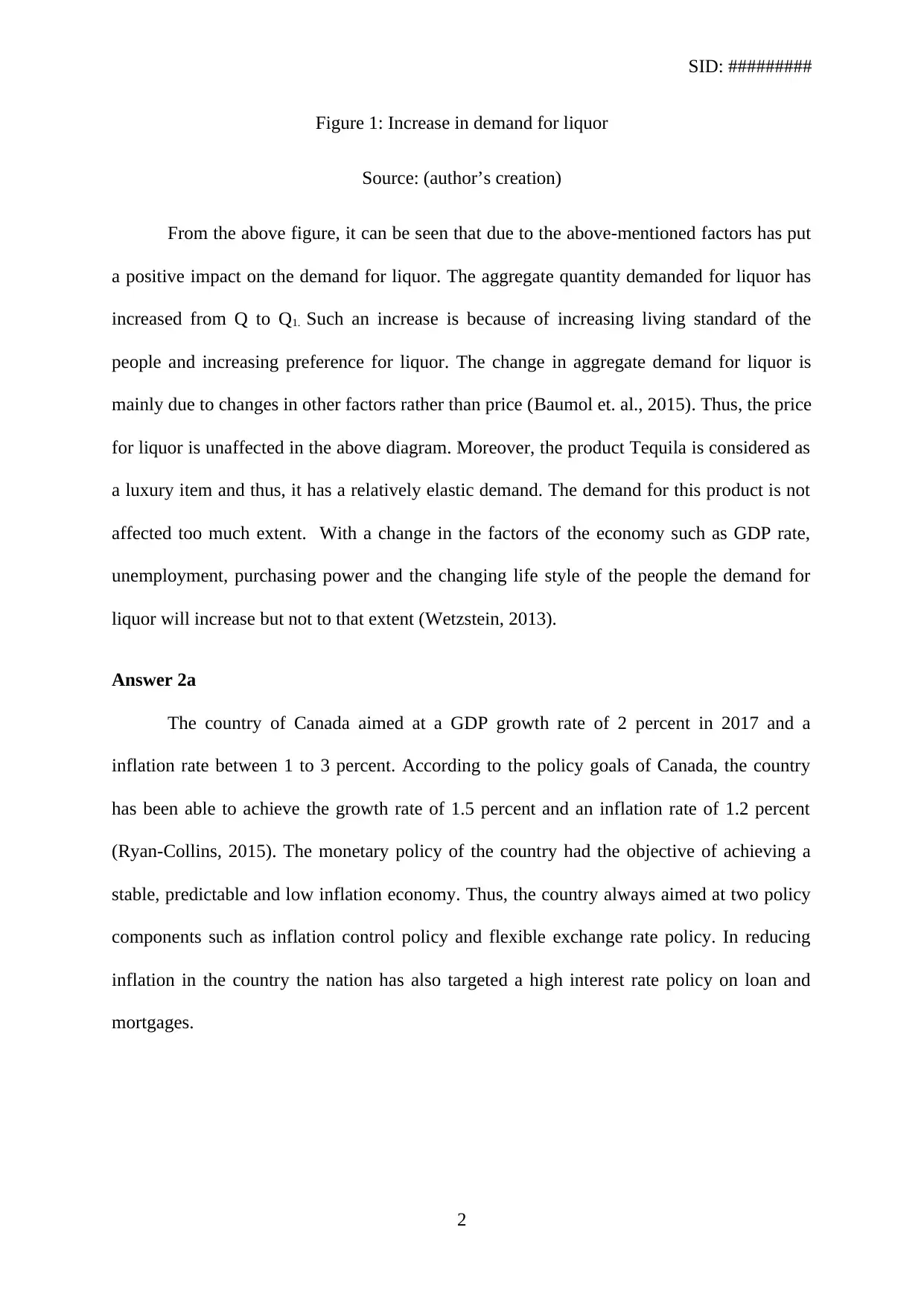
Figure 1: Increase in demand for liquor
Source: (author’s creation)
From the above figure, it can be seen that due to the above-mentioned factors has put
a positive impact on the demand for liquor. The aggregate quantity demanded for liquor has
increased from Q to Q1. Such an increase is because of increasing living standard of the
people and increasing preference for liquor. The change in aggregate demand for liquor is
mainly due to changes in other factors rather than price (Baumol et. al., 2015). Thus, the price
for liquor is unaffected in the above diagram. Moreover, the product Tequila is considered as
a luxury item and thus, it has a relatively elastic demand. The demand for this product is not
affected too much extent. With a change in the factors of the economy such as GDP rate,
unemployment, purchasing power and the changing life style of the people the demand for
liquor will increase but not to that extent (Wetzstein, 2013).
Answer 2a
The country of Canada aimed at a GDP growth rate of 2 percent in 2017 and a
inflation rate between 1 to 3 percent. According to the policy goals of Canada, the country
has been able to achieve the growth rate of 1.5 percent and an inflation rate of 1.2 percent
(Ryan-Collins, 2015). The monetary policy of the country had the objective of achieving a
stable, predictable and low inflation economy. Thus, the country always aimed at two policy
components such as inflation control policy and flexible exchange rate policy. In reducing
inflation in the country the nation has also targeted a high interest rate policy on loan and
mortgages.
2
Document Page
SID: #########
2015 2016 2017
0
0.5
1
1.5
2
2.5
3
3.5
4
gdp growth rate
gdp growth rate
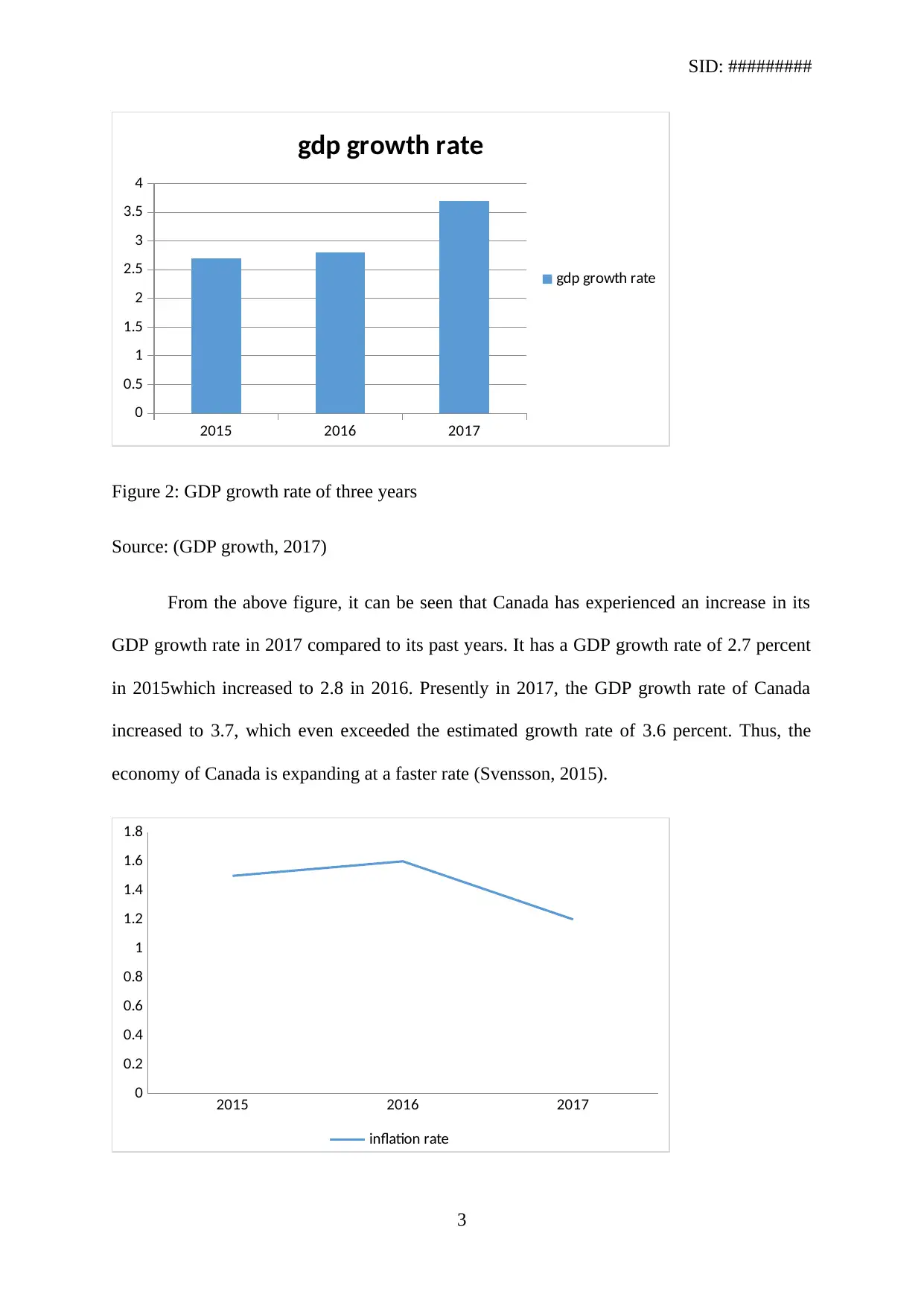
Figure 2: GDP growth rate of three years
Source: (GDP growth, 2017)
From the above figure, it can be seen that Canada has experienced an increase in its
GDP growth rate in 2017 compared to its past years. It has a GDP growth rate of 2.7 percent
in 2015which increased to 2.8 in 2016. Presently in 2017, the GDP growth rate of Canada
increased to 3.7, which even exceeded the estimated growth rate of 3.6 percent. Thus, the
economy of Canada is expanding at a faster rate (Svensson, 2015).
2015 2016 2017
0
0.2
0.4
0.6
0.8
1
1.2
1.4
1.6
1.8
inflation rate
3
Document Page
SID: #########
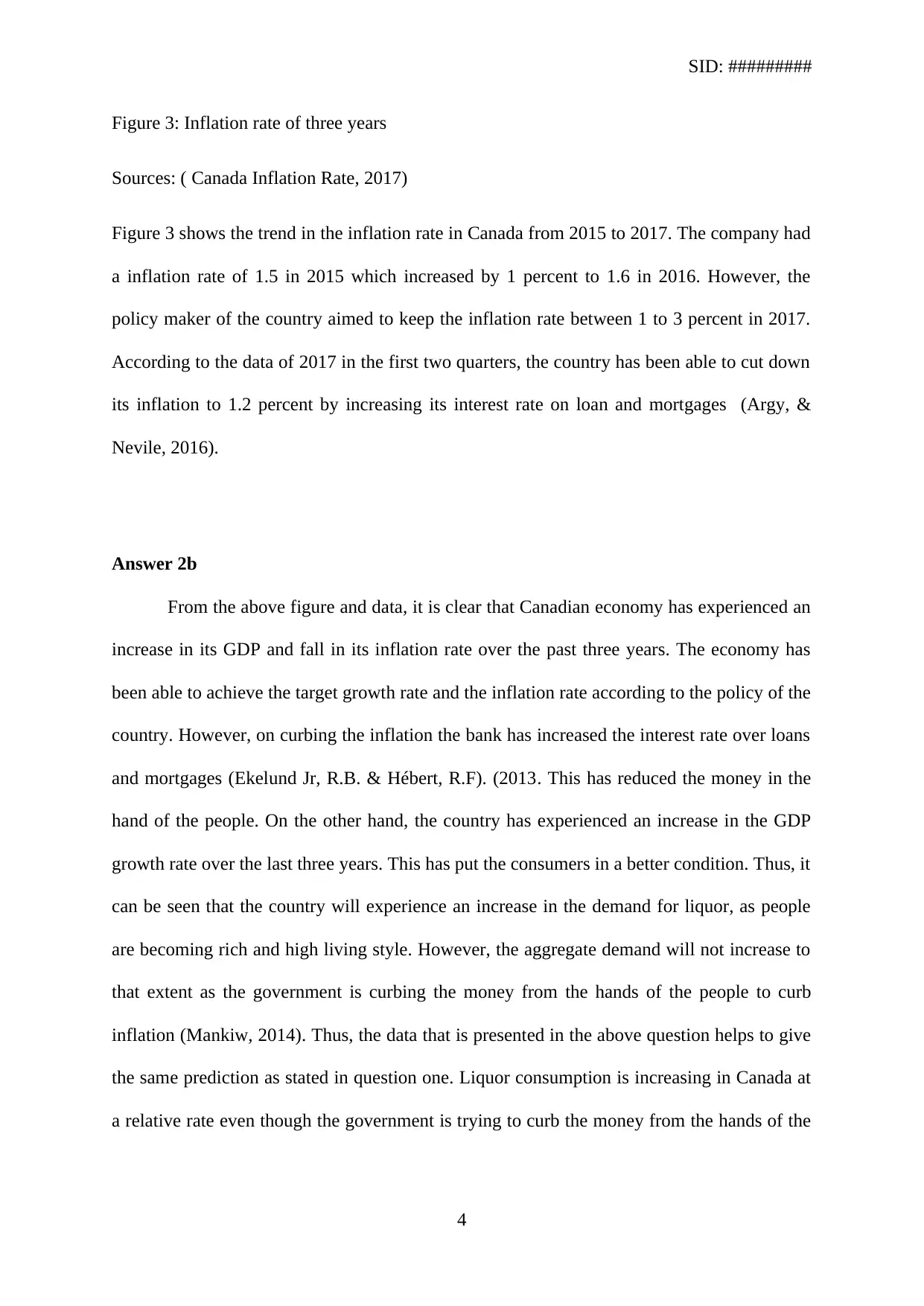
Figure 3: Inflation rate of three years
Sources: ( Canada Inflation Rate, 2017)
Figure 3 shows the trend in the inflation rate in Canada from 2015 to 2017. The company had
a inflation rate of 1.5 in 2015 which increased by 1 percent to 1.6 in 2016. However, the
policy maker of the country aimed to keep the inflation rate between 1 to 3 percent in 2017.
According to the data of 2017 in the first two quarters, the country has been able to cut down
its inflation to 1.2 percent by increasing its interest rate on loan and mortgages (Argy, &
Nevile, 2016).
Answer 2b
From the above figure and data, it is clear that Canadian economy has experienced an
increase in its GDP and fall in its inflation rate over the past three years. The economy has
been able to achieve the target growth rate and the inflation rate according to the policy of the
country. However, on curbing the inflation the bank has increased the interest rate over loans
and mortgages (Ekelund Jr, R.B. & Hébert, R.F). (2013. This has reduced the money in the
hand of the people. On the other hand, the country has experienced an increase in the GDP
growth rate over the last three years. This has put the consumers in a better condition. Thus, it
can be seen that the country will experience an increase in the demand for liquor, as people
are becoming rich and high living style. However, the aggregate demand will not increase to
that extent as the government is curbing the money from the hands of the people to curb
inflation (Mankiw, 2014). Thus, the data that is presented in the above question helps to give
the same prediction as stated in question one. Liquor consumption is increasing in Canada at
a relative rate even though the government is trying to curb the money from the hands of the
4
tabler-icon-diamond-filled.svg

Paraphrase This Document

Need a fresh take? Get an instant paraphrase of this document with our AI Paraphraser
Document Page
SID: #########
people. This is because people of Canada are fun loving and like to lead a good life even with
limited amount of money.
Answer 3a
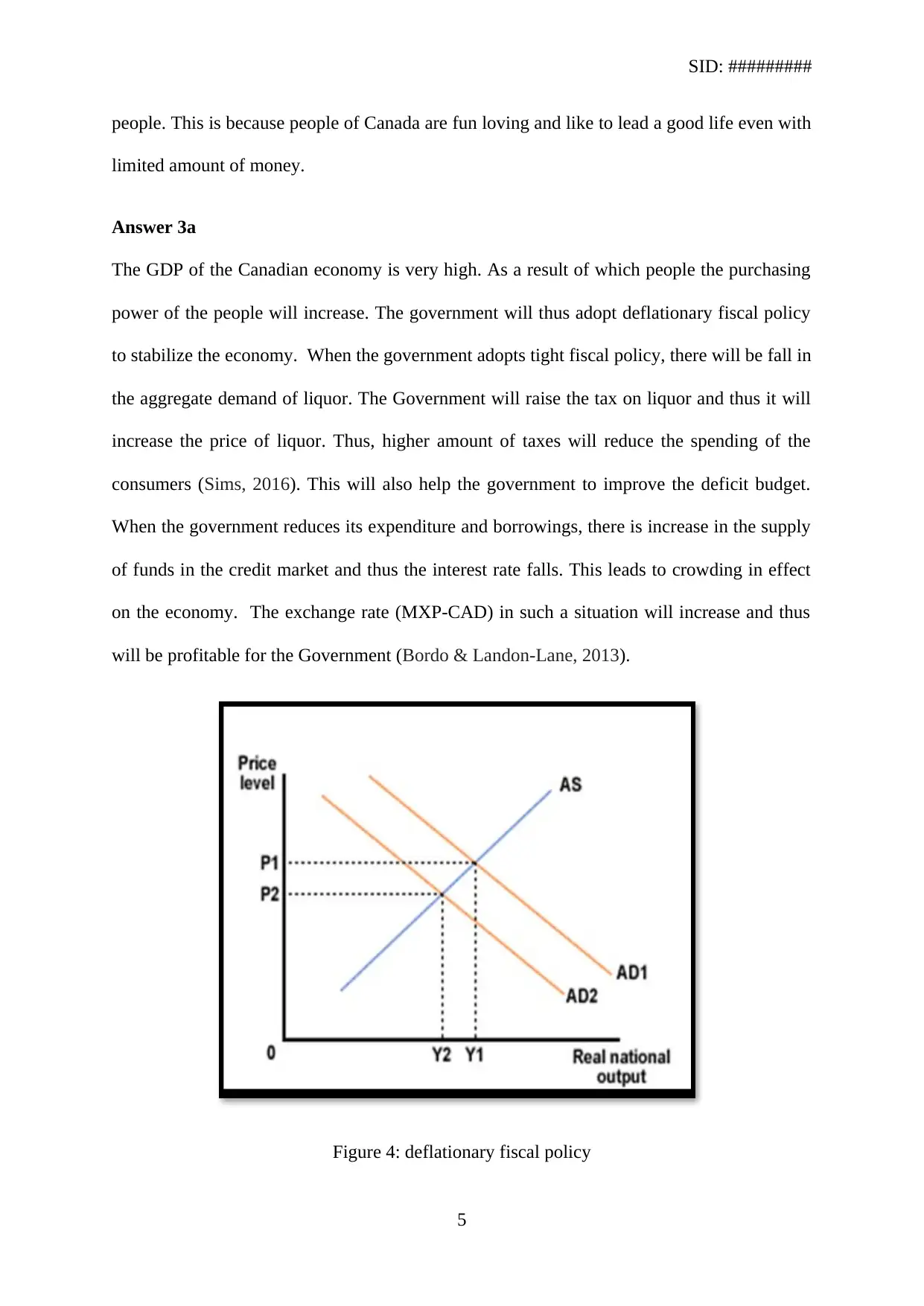
The GDP of the Canadian economy is very high. As a result of which people the purchasing
power of the people will increase. The government will thus adopt deflationary fiscal policy
to stabilize the economy. When the government adopts tight fiscal policy, there will be fall in
the aggregate demand of liquor. The Government will raise the tax on liquor and thus it will
increase the price of liquor. Thus, higher amount of taxes will reduce the spending of the
consumers (Sims, 2016). This will also help the government to improve the deficit budget.
When the government reduces its expenditure and borrowings, there is increase in the supply
of funds in the credit market and thus the interest rate falls. This leads to crowding in effect
on the economy. The exchange rate (MXP-CAD) in such a situation will increase and thus
will be profitable for the Government (Bordo & Landon-Lane, 2013).
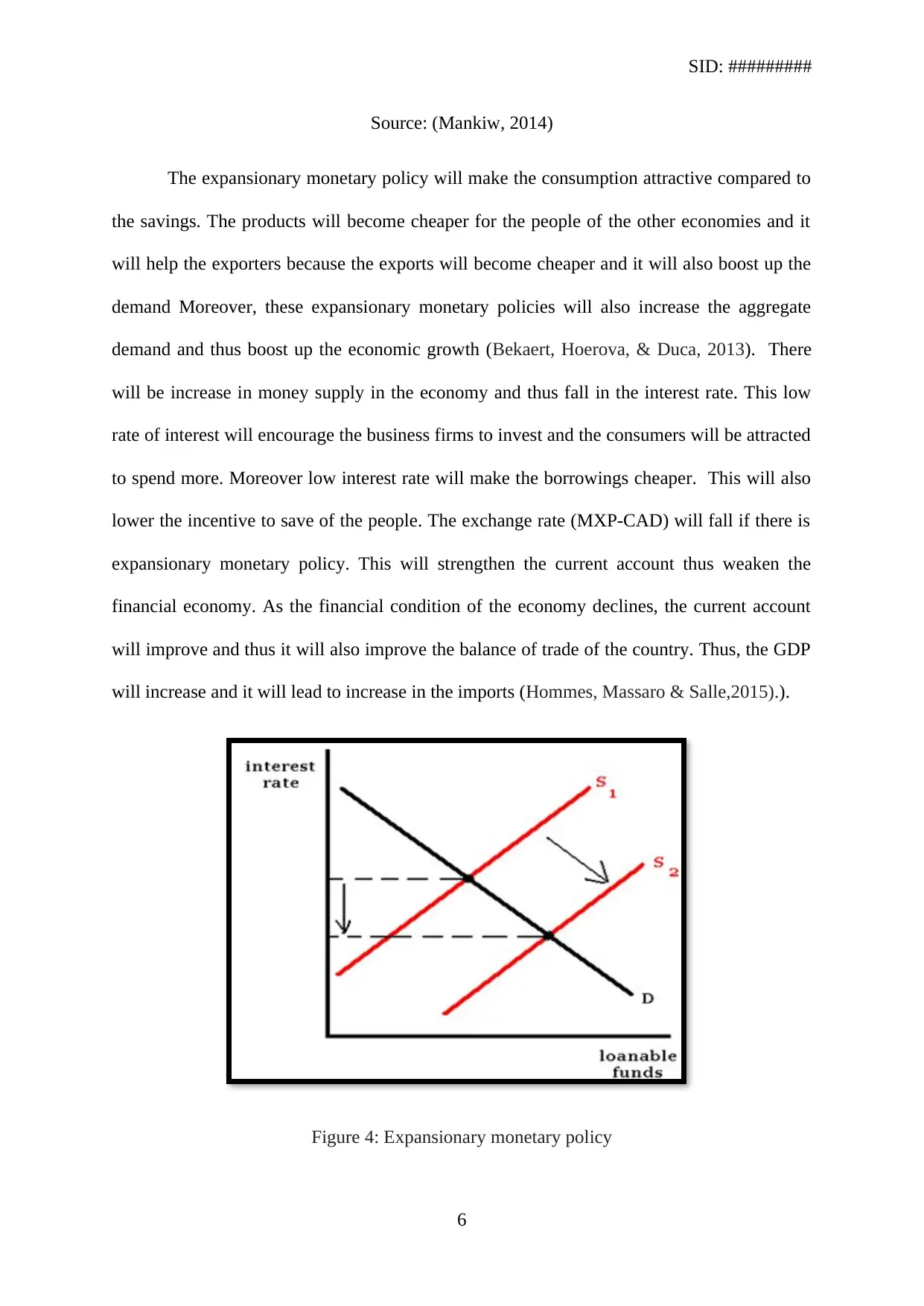
Figure 4: deflationary fiscal policy
5
Document Page
SID: #########
Source: (Mankiw, 2014)
The expansionary monetary policy will make the consumption attractive compared to
the savings. The products will become cheaper for the people of the other economies and it
will help the exporters because the exports will become cheaper and it will also boost up the
demand Moreover, these expansionary monetary policies will also increase the aggregate
demand and thus boost up the economic growth (Bekaert, Hoerova, & Duca, 2013). There
will be increase in money supply in the economy and thus fall in the interest rate. This low
rate of interest will encourage the business firms to invest and the consumers will be attracted
to spend more. Moreover low interest rate will make the borrowings cheaper. This will also
lower the incentive to save of the people. The exchange rate (MXP-CAD) will fall if there is
expansionary monetary policy. This will strengthen the current account thus weaken the
financial economy. As the financial condition of the economy declines, the current account
will improve and thus it will also improve the balance of trade of the country. Thus, the GDP
will increase and it will lead to increase in the imports (Hommes, Massaro & Salle,2015).).
Figure 4: Expansionary monetary policy
6
Document Page
Q2
S
CAD to MXP
Q of CADQ1
P2
P1
D2
D1
SID: #########
Source: (Mankiw, 2014)
Answer 3b
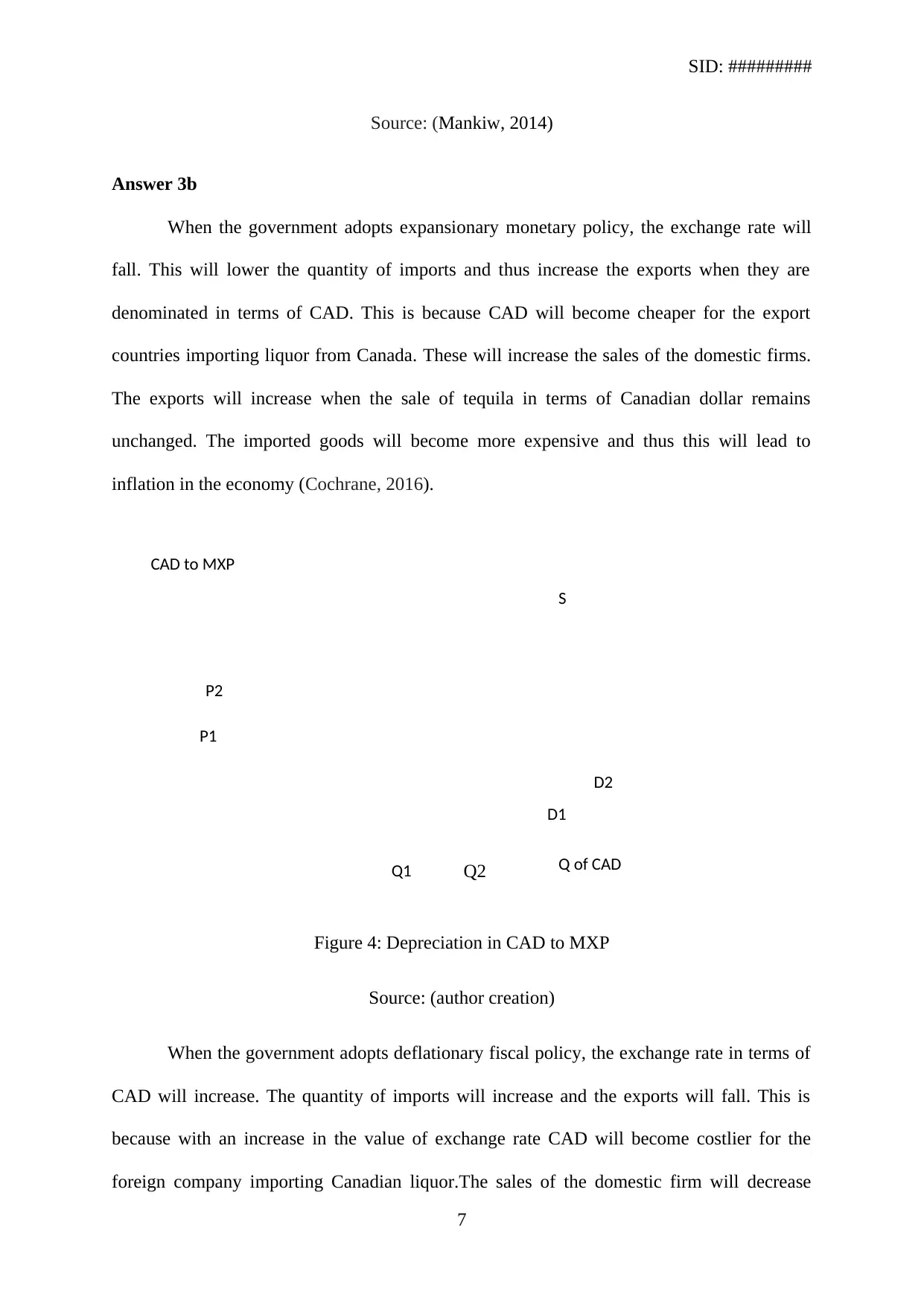
When the government adopts expansionary monetary policy, the exchange rate will
fall. This will lower the quantity of imports and thus increase the exports when they are
denominated in terms of CAD. This is because CAD will become cheaper for the export
countries importing liquor from Canada. These will increase the sales of the domestic firms.
The exports will increase when the sale of tequila in terms of Canadian dollar remains
unchanged. The imported goods will become more expensive and thus this will lead to
inflation in the economy (Cochrane, 2016).
Figure 4: Depreciation in CAD to MXP
Source: (author creation)
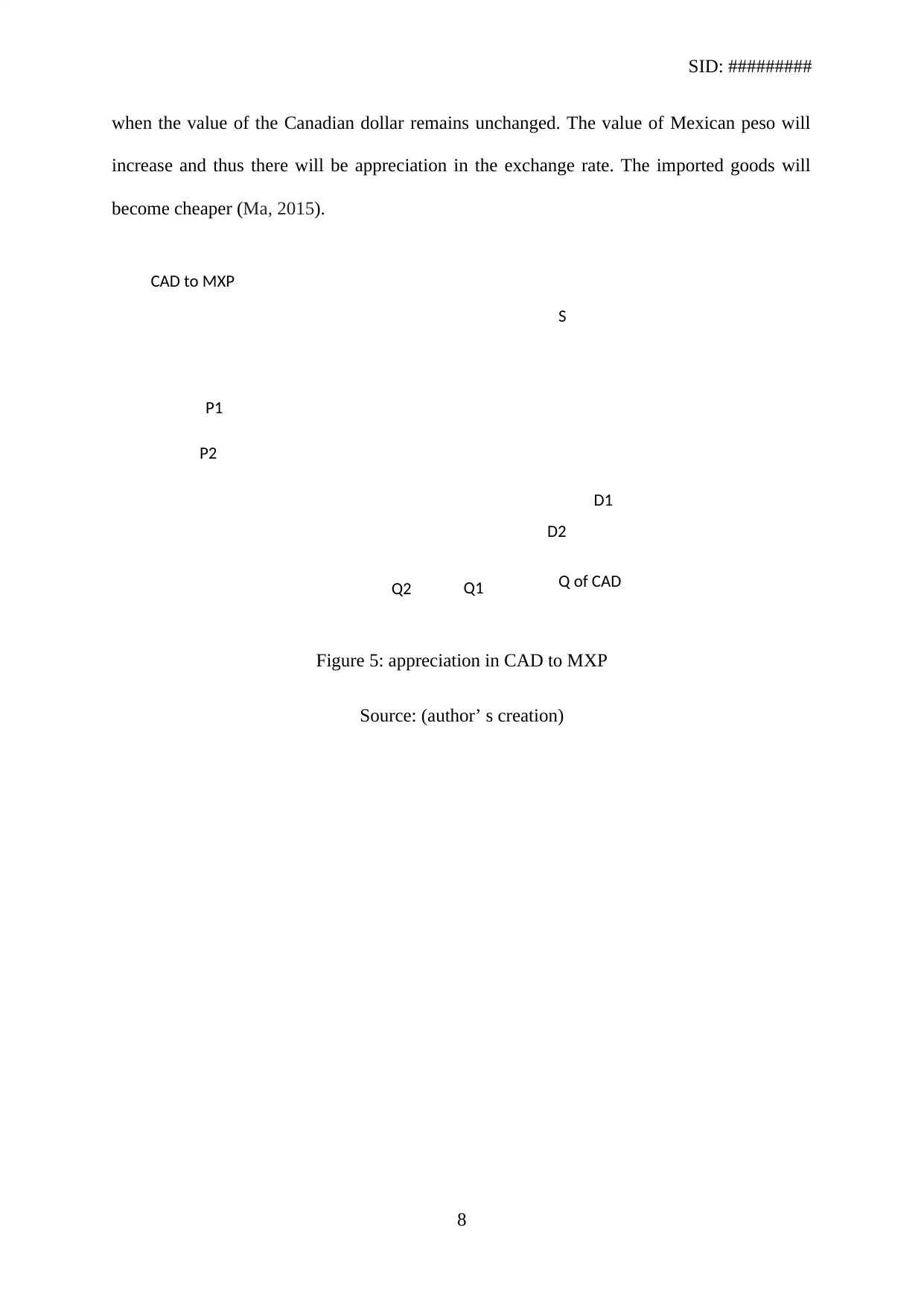
When the government adopts deflationary fiscal policy, the exchange rate in terms of
CAD will increase. The quantity of imports will increase and the exports will fall. This is
because with an increase in the value of exchange rate CAD will become costlier for the
foreign company importing Canadian liquor.The sales of the domestic firm will decrease
7
tabler-icon-diamond-filled.svg

Paraphrase This Document

Need a fresh take? Get an instant paraphrase of this document with our AI Paraphraser
Document Page
S
CAD to MXP
Q of CADQ2 Q1
P1
P2
D1
D2
SID: #########
when the value of the Canadian dollar remains unchanged. The value of Mexican peso will
increase and thus there will be appreciation in the exchange rate. The imported goods will
become cheaper (Ma, 2015).
Figure 5: appreciation in CAD to MXP
Source: (author’ s creation)
8
Document Page
SID: #########
Reference list
Argy, V. E., & Nevile, J. (Eds.). (2016). Inflation and Unemployment: Theory, Experience
and Policy Making. Routledge.
Baumol, William J., & Alan S. Blinder. Microeconomics: Principles and policy. Cengage
Learning, (2015).
Bekaert, G., Hoerova, M., & Duca, M. L. (2013). Risk, uncertainty and monetary
policy. Journal of Monetary Economics, 60(7), 771-788.
Bordo, M. D., & Landon-Lane, J. (2013). Does expansionary monetary policy cause asset
price booms; some historical and empirical evidence (No. w19585). National Bureau
of Economic Research.
Canada Inflation Rate | 1915-2017 | Data | Chart | Calendar | Forecast.
(2017). Tradingeconomics.com. Retrieved 29 August 2017, from
https://tradingeconomics.com/canada/inflation-cpi
Cochrane, J. H. (2016, April). The Fiscal Theory of the Price Level and its Implications for
Current Policy in the United States and Europe. In Next Steps for the Fiscal Theory of
the Price Level” conference at the Becker Friedman Institute for Research on
Economics at the University of Chicago (Vol. 1).
Ekelund Jr, R.B. & Hébert, R.F. (2013). A history of economic theory and method. Waveland
Press.
GDP growth (annual %) | Data. (2017). Data.worldbank.org. Retrieved 29 August 2017,
from http://data.worldbank.org/indicator/NY.GDP.MKTP.KD.ZG
Hall, Robert E., & Marc Lieberman. Microeconomics: Principles and applications. Cengage
Learning, (2012).
9
Document Page
SID: #########
Hommes, C., Massaro, D., & Salle, I. (2015). Monetary and Fiscal Policy Design at the Zero
Lower Bound: Evidence from the Lab. CeNDEF working paper, (15-11).
Ma, C. F. (2015). An Insight on the Rationale of Using Expansionary Monetary Policy during
the Great Recession. University of Toronto Economic Review, 58.
Mankiw, N. G. (2014). Essentials of economics. Cengage learning.
Ryan-Collins, J. (2015). Is monetary financing inflationary? A case study of the Canadian
economy, 1935-75.
Sims, C. A. (2016, August). Fiscal policy, monetary policy and central bank independence.
In Kansas Citi Fed Jackson Hole Conference.
Svensson, L. E. (2015). The possible unemployment cost of average inflation below a
credible target. American Economic Journal: Macroeconomics, 7(1), 258-296.
Wetzstein, M.E. (2013). Microeconomic theory: concepts and connections. Routledge.
10
chevron_up_icon
1 out of 10
circle_padding
hide_on_mobile
zoom_out_icon
[object Object]