Case Study Analysis: The Little Rock School District and Leadership
VerifiedAdded on 2023/05/28
|15
|3198
|458
Case Study
AI Summary
This case study examines the Little Rock School District, a large Arkansas school system grappling with racial conflict and leadership challenges. The analysis delves into the historical context, stakeholder perspectives, and situational dynamics, including the impact of desegregation policies, racial disparities, and the role of the superintendent. Utilizing tools like stakeholder maps, timelines, and the Dugan Nested Model, the study explores the "who, when, what, and where" of the conflict. The analysis highlights the tensions between African American and white communities, the impact of school closures, and the differing views on integration and quality education. The study concludes with recommendations for addressing the challenges and promoting effective leadership to create a more inclusive and equitable educational environment. The assignment uses diagrams and visual lenses to understand and communicate the analysis effectively.
Running Head: CASE STUDY ANALYSIS
Case Study Analysis
Name of the Student
Name of the University
Author’s Note
Case Study Analysis
Name of the Student
Name of the University
Author’s Note

Paraphrase This Document
Need a fresh take? Get an instant paraphrase of this document with our AI Paraphraser
2
CASE STUDY ANALYSIS
Table of Contents
Overview of the organization..........................................................................................................3
Situational Analysis.........................................................................................................................3
Theory Change...............................................................................................................................11
Recommendations..........................................................................................................................12
CASE STUDY ANALYSIS
Table of Contents
Overview of the organization..........................................................................................................3
Situational Analysis.........................................................................................................................3
Theory Change...............................................................................................................................11
Recommendations..........................................................................................................................12
3
CASE STUDY ANALYSIS
Overview of the organization
The Little Rock School District has been the largest school in Arkansas having 26,500
students and 3800 employees in the 2006-07 year. There have been various diversity in the
school including 69% of the district student have been African American, 24% are white and 5%
are Hispanic. The population of the city has 40% African American, 55% white and 3%
Hispanic. However, half of the white student in the Little Rock used to attend private School.
The mission of the Little Rock School District has been equipping all students with
proper knowledge and skills formalizing their aspirations, independently and think critically in
every situations in the future. This mission has been open for all diverse, innovation and
challenging curriculum in a secure environment with great teachers and staffs empowered to our
community.
The vision of the Little Rock School has been focused on creating excellence for
tomorrow. The school has been focused on the future of the students and enhancing their skills
and knowledge regarding every perspective of life.
However, the school have been facing racism discrimination among black and white
student in the school. Whites have been insisting that their test scores and enrollment have been
improved under Brooks. However, blacks have been furious for cutting numbers of office.
However, later in month, LRSD has been struggling with its performance with low income and
minority students.
Situational Analysis
WHO
CASE STUDY ANALYSIS
Overview of the organization
The Little Rock School District has been the largest school in Arkansas having 26,500
students and 3800 employees in the 2006-07 year. There have been various diversity in the
school including 69% of the district student have been African American, 24% are white and 5%
are Hispanic. The population of the city has 40% African American, 55% white and 3%
Hispanic. However, half of the white student in the Little Rock used to attend private School.
The mission of the Little Rock School District has been equipping all students with
proper knowledge and skills formalizing their aspirations, independently and think critically in
every situations in the future. This mission has been open for all diverse, innovation and
challenging curriculum in a secure environment with great teachers and staffs empowered to our
community.
The vision of the Little Rock School has been focused on creating excellence for
tomorrow. The school has been focused on the future of the students and enhancing their skills
and knowledge regarding every perspective of life.
However, the school have been facing racism discrimination among black and white
student in the school. Whites have been insisting that their test scores and enrollment have been
improved under Brooks. However, blacks have been furious for cutting numbers of office.
However, later in month, LRSD has been struggling with its performance with low income and
minority students.
Situational Analysis
WHO
⊘ This is a preview!⊘
Do you want full access?
Subscribe today to unlock all pages.

Trusted by 1+ million students worldwide
4
CASE STUDY ANALYSIS
African Community: There is an unexplained uniqueness of 1,213 between the detailed
populace of African-American youngsters and the genuine enlistment. Doubtlessly this came
about because of the by and large acknowledged under-tallying, especially of minority people, in
the 1990 statistics. At any rate, no doubt basically the majority of the qualified African-American
kids were going to the LRSD in 1990. Then again, the evaluation checks showed that there were
14,693 non-African-American youngsters living inside the LRSD limits in 1990, while just 9,193
were enlisted in 1990/91. This would propose that about 40 percent of the qualified non-African-
American kids were selected in tuition based schools as opposed to in the LRSD. The groups of
grade school understudies clearly were happy with the region in the mid 1980s and have been in
the years since, and minimal white flight has occurred. At the middle schools, be that as it may, a
comparable dimension of fulfillment was not apparent dependent on the enlistment designs.
Truth be told, all additions from the school locale limit changes in 1988 had been deleted by
1996. The secondary schools seem to introduce an exceptional case. Despite the fact that the
view of an issue with the racial parity was not obvious in the 1984-1987 period, there was a
stamped and prompt change following the limit changes in 1988.
LRSD: In evaluating enlistment designs in the LRSD, it is enlightening to endeavor to
appraise what number of white kids might be enlisted in private or parochial schools instead of in
the LRSD. Despite the fact that data on the correct number of understudies enlisted in non-public
schools is not at present accessible, an examination of the 1990 U.S. Enumeration Agency data
with real school enlistment gives an unpleasant gauge. The idea of the arrangement was to enable
understudies to settle on three selections of schools to go to with the LRSD pleasing decisions
inside the limitations of African-American/white proportions built up for that review level.
Tragically the arrangement was executed with the LRSD first settling on assignments and
CASE STUDY ANALYSIS
African Community: There is an unexplained uniqueness of 1,213 between the detailed
populace of African-American youngsters and the genuine enlistment. Doubtlessly this came
about because of the by and large acknowledged under-tallying, especially of minority people, in
the 1990 statistics. At any rate, no doubt basically the majority of the qualified African-American
kids were going to the LRSD in 1990. Then again, the evaluation checks showed that there were
14,693 non-African-American youngsters living inside the LRSD limits in 1990, while just 9,193
were enlisted in 1990/91. This would propose that about 40 percent of the qualified non-African-
American kids were selected in tuition based schools as opposed to in the LRSD. The groups of
grade school understudies clearly were happy with the region in the mid 1980s and have been in
the years since, and minimal white flight has occurred. At the middle schools, be that as it may, a
comparable dimension of fulfillment was not apparent dependent on the enlistment designs.
Truth be told, all additions from the school locale limit changes in 1988 had been deleted by
1996. The secondary schools seem to introduce an exceptional case. Despite the fact that the
view of an issue with the racial parity was not obvious in the 1984-1987 period, there was a
stamped and prompt change following the limit changes in 1988.
LRSD: In evaluating enlistment designs in the LRSD, it is enlightening to endeavor to
appraise what number of white kids might be enlisted in private or parochial schools instead of in
the LRSD. Despite the fact that data on the correct number of understudies enlisted in non-public
schools is not at present accessible, an examination of the 1990 U.S. Enumeration Agency data
with real school enlistment gives an unpleasant gauge. The idea of the arrangement was to enable
understudies to settle on three selections of schools to go to with the LRSD pleasing decisions
inside the limitations of African-American/white proportions built up for that review level.
Tragically the arrangement was executed with the LRSD first settling on assignments and
Paraphrase This Document
Need a fresh take? Get an instant paraphrase of this document with our AI Paraphraser
5
CASE STUDY ANALYSIS
enabling the decisions to come later. This system met with extensive analysis and may have been
a factor in some white guardians selecting to leave the LRSD. Additionally, from the get-go in
the school year in the fall of 1987, a quarrelsome, 10-day instructors strike, the first in the state's
history, had added to parental worries about dissension and insecurity in the Little Rock
government funded schools.
Government: The 1990 populace tally of kids between the ages of five and 17 living
inside the limits of the LRSD was 30,036. The genuine LRSD enlistment amid the 1990/91
school year was 25,749, recommending that 15 percent of qualified understudies might be
selected in non-public schools. The number of inhabitants in African-American kids in the
registration was 15,343 however the genuine enlistment was 16,556. The explanations behind the
takeoff of white understudies in the lesser and senior secondary schools are not absolutely clear.
It ought to be noticed that the limit changes for the 1988 school year were joined by the usage of
a "controlled decision" understudy task plan in the LRSD which was endorsed by the court in
1986.
Teachers: The planning process of this theory has been beneficial for the development of
anti-racial laws and change. Concerning guardian investment, African-American and white
educators see the LRSD as neglecting prevail self-teach connections. Half of each gathering, 49
percent, said that parent support in school exercises is declining.
Guardians of LRSD youngsters were worried about control wellbeing issue however at
lower reaction levels. In solid difference, making it impossible to their non-public school
partners, nonetheless, 66% of LRSD families concurred with an explanation that LRSD gives a
"sheltered, systematic condition." Doubtlessly this came about because of the by and large
acknowledged under-tallying, especially of minority people, in the 1990 statistics.
CASE STUDY ANALYSIS
enabling the decisions to come later. This system met with extensive analysis and may have been
a factor in some white guardians selecting to leave the LRSD. Additionally, from the get-go in
the school year in the fall of 1987, a quarrelsome, 10-day instructors strike, the first in the state's
history, had added to parental worries about dissension and insecurity in the Little Rock
government funded schools.
Government: The 1990 populace tally of kids between the ages of five and 17 living
inside the limits of the LRSD was 30,036. The genuine LRSD enlistment amid the 1990/91
school year was 25,749, recommending that 15 percent of qualified understudies might be
selected in non-public schools. The number of inhabitants in African-American kids in the
registration was 15,343 however the genuine enlistment was 16,556. The explanations behind the
takeoff of white understudies in the lesser and senior secondary schools are not absolutely clear.
It ought to be noticed that the limit changes for the 1988 school year were joined by the usage of
a "controlled decision" understudy task plan in the LRSD which was endorsed by the court in
1986.
Teachers: The planning process of this theory has been beneficial for the development of
anti-racial laws and change. Concerning guardian investment, African-American and white
educators see the LRSD as neglecting prevail self-teach connections. Half of each gathering, 49
percent, said that parent support in school exercises is declining.
Guardians of LRSD youngsters were worried about control wellbeing issue however at
lower reaction levels. In solid difference, making it impossible to their non-public school
partners, nonetheless, 66% of LRSD families concurred with an explanation that LRSD gives a
"sheltered, systematic condition." Doubtlessly this came about because of the by and large
acknowledged under-tallying, especially of minority people, in the 1990 statistics.
6
CASE STUDY ANALYSIS
Superintendent: In fact, despite being African American, Superintendent Brooks failed
to connect with the African American community in Little Rock. John Walker, the lead attorney
in Little Rock’s desegregation case, described Brooks as “a person who doesn’t identify with
black people at all. The only thing he stands for is putting black people down.” Former school
board president Skip Rutherford put it more diplomatically: Roy Brooks has done a credible job
reaching out to the grass tops, and a lousy job reaching out to the grass roots. Then again, the
evaluation checks showed that there were 14,693 non-African-American youngsters living inside
the LRSD limits in 1990, while just 9,193 were enlisted in 1990/91.
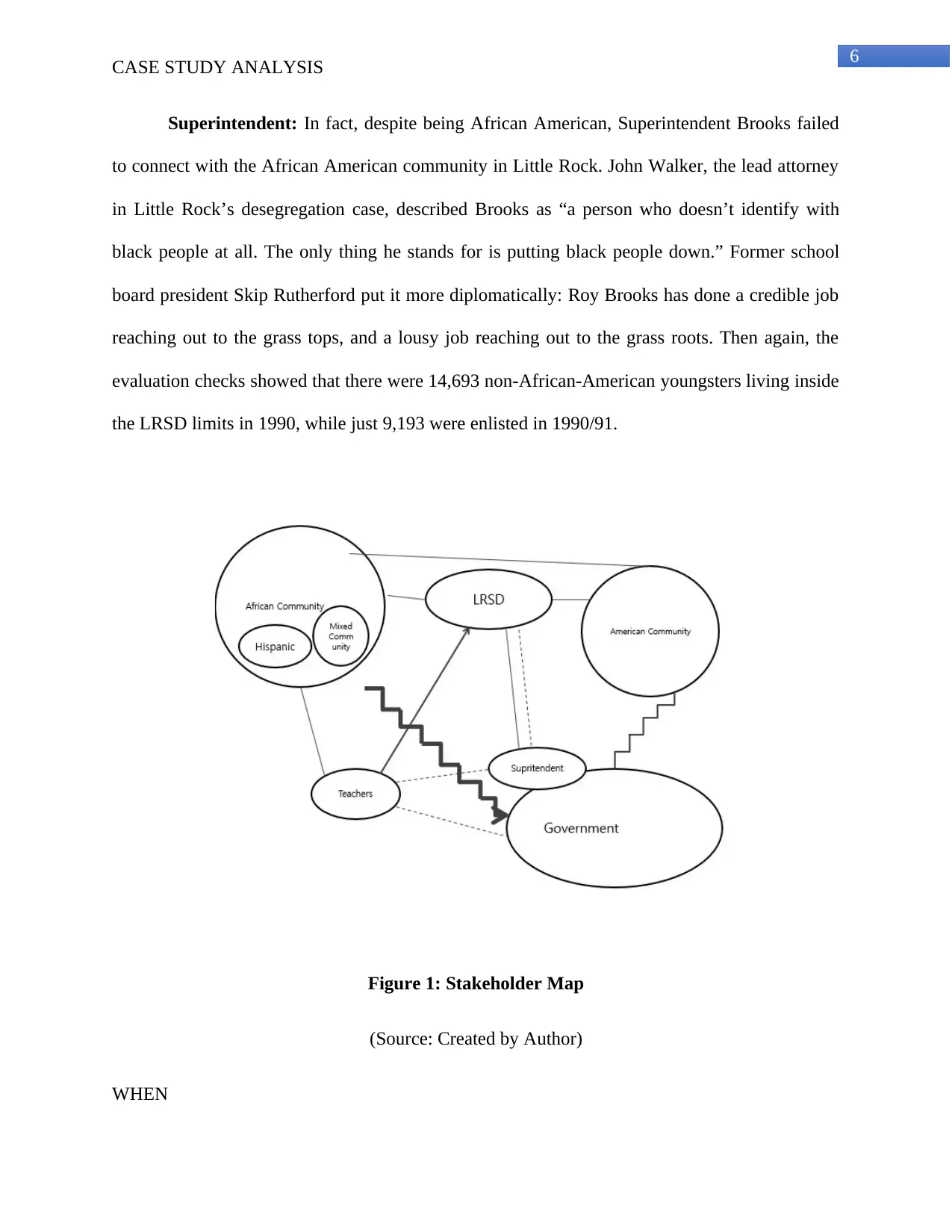
Figure 1: Stakeholder Map
(Source: Created by Author)
WHEN
CASE STUDY ANALYSIS
Superintendent: In fact, despite being African American, Superintendent Brooks failed
to connect with the African American community in Little Rock. John Walker, the lead attorney
in Little Rock’s desegregation case, described Brooks as “a person who doesn’t identify with
black people at all. The only thing he stands for is putting black people down.” Former school
board president Skip Rutherford put it more diplomatically: Roy Brooks has done a credible job
reaching out to the grass tops, and a lousy job reaching out to the grass roots. Then again, the
evaluation checks showed that there were 14,693 non-African-American youngsters living inside
the LRSD limits in 1990, while just 9,193 were enlisted in 1990/91.
Figure 1: Stakeholder Map
(Source: Created by Author)
WHEN
⊘ This is a preview!⊘
Do you want full access?
Subscribe today to unlock all pages.
Trusted by 1+ million students worldwide
7
CASE STUDY ANALYSIS
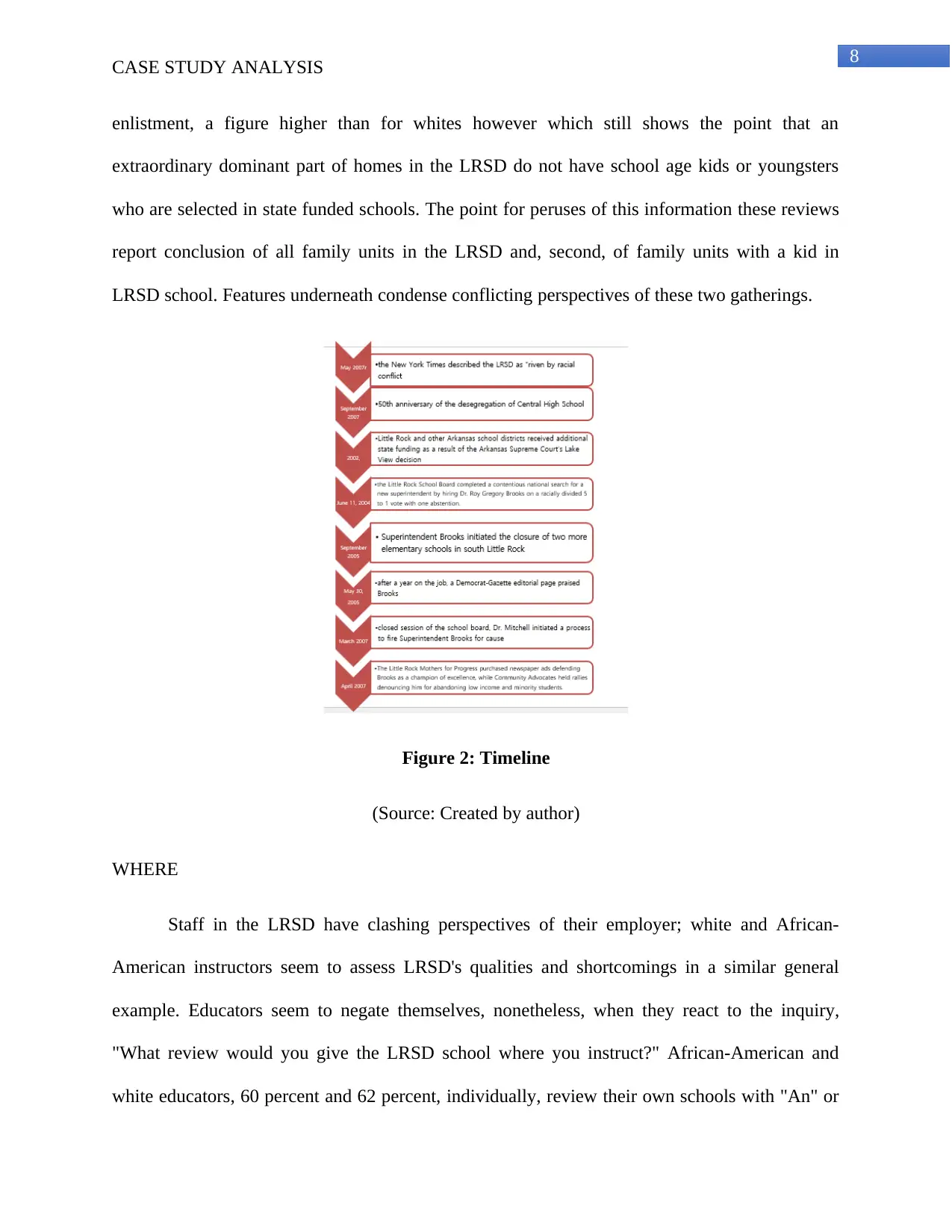
During 2002, Little Rock and other Arkansas school districts received additional state
funding as a result of the Arkansas Supreme Court’s Lake View decision. Sentiment studies led
in March and April of 1996 uncover synchronous help solid analysis of the Little Rock School
District. African-American and, especially, white family units show disappointment with the
general heading of the government funded schools. During June 11 2004, the Little Rock School
Board completed a contentious national search for a new superintendent by hiring Dr. Roy
Gregory Brooks on a racially divided 5 to 1 vote with one abstention. Nonetheless, while
reacting explicitly to inquiries concerning state funded schools gone to by their kids, guardians
were exceptionally positive about LRSD. In the year of 2005 September, Superintendent Brooks
initiated the closure of two more elementary schools in south Little Rock. On May 2007, the
New York Times described the LRSD as “riven by racial conflict. On April 2007, The Little
Rock Mothers for Progress purchased newspaper ads defending Brooks as a champion of
excellence, while Community Advocates held rallies denouncing him for abandoning low
income and minority students. The inquiry which quickly presents itself is, "By what method
would citizens be able to positive and negative convictions about the government funded schools
in the meantime?" One clarification is that review discoveries mirror assessments of two distinct
subgroups. This pattern holds broadly and is generated by "void home" family units (homes with
youngsters developed and gone), single-individual family units, rising enlistment in non-public
schools, or a mix of these factors.
Proof of youngster homes in LRSD is strengthened by arbitrary example in this study,
which recognized just 121 of 564 white families to be LRSD families. As it were, just 21.4
percent of white family units met any ongoing direct involvement (by means of their youngsters)
with LRSD. African-American families in examination recorded a 46 percent rate of LRSD
CASE STUDY ANALYSIS
During 2002, Little Rock and other Arkansas school districts received additional state
funding as a result of the Arkansas Supreme Court’s Lake View decision. Sentiment studies led
in March and April of 1996 uncover synchronous help solid analysis of the Little Rock School
District. African-American and, especially, white family units show disappointment with the
general heading of the government funded schools. During June 11 2004, the Little Rock School
Board completed a contentious national search for a new superintendent by hiring Dr. Roy
Gregory Brooks on a racially divided 5 to 1 vote with one abstention. Nonetheless, while
reacting explicitly to inquiries concerning state funded schools gone to by their kids, guardians
were exceptionally positive about LRSD. In the year of 2005 September, Superintendent Brooks
initiated the closure of two more elementary schools in south Little Rock. On May 2007, the
New York Times described the LRSD as “riven by racial conflict. On April 2007, The Little
Rock Mothers for Progress purchased newspaper ads defending Brooks as a champion of
excellence, while Community Advocates held rallies denouncing him for abandoning low
income and minority students. The inquiry which quickly presents itself is, "By what method
would citizens be able to positive and negative convictions about the government funded schools
in the meantime?" One clarification is that review discoveries mirror assessments of two distinct
subgroups. This pattern holds broadly and is generated by "void home" family units (homes with
youngsters developed and gone), single-individual family units, rising enlistment in non-public
schools, or a mix of these factors.
Proof of youngster homes in LRSD is strengthened by arbitrary example in this study,
which recognized just 121 of 564 white families to be LRSD families. As it were, just 21.4
percent of white family units met any ongoing direct involvement (by means of their youngsters)
with LRSD. African-American families in examination recorded a 46 percent rate of LRSD
Paraphrase This Document
Need a fresh take? Get an instant paraphrase of this document with our AI Paraphraser
8
CASE STUDY ANALYSIS
enlistment, a figure higher than for whites however which still shows the point that an
extraordinary dominant part of homes in the LRSD do not have school age kids or youngsters
who are selected in state funded schools. The point for peruses of this information these reviews
report conclusion of all family units in the LRSD and, second, of family units with a kid in
LRSD school. Features underneath condense conflicting perspectives of these two gatherings.
Figure 2: Timeline
(Source: Created by author)
WHERE
Staff in the LRSD have clashing perspectives of their employer; white and African-
American instructors seem to assess LRSD's qualities and shortcomings in a similar general
example. Educators seem to negate themselves, nonetheless, when they react to the inquiry,
"What review would you give the LRSD school where you instruct?" African-American and
white educators, 60 percent and 62 percent, individually, review their own schools with "An" or
CASE STUDY ANALYSIS
enlistment, a figure higher than for whites however which still shows the point that an
extraordinary dominant part of homes in the LRSD do not have school age kids or youngsters
who are selected in state funded schools. The point for peruses of this information these reviews
report conclusion of all family units in the LRSD and, second, of family units with a kid in
LRSD school. Features underneath condense conflicting perspectives of these two gatherings.
Figure 2: Timeline
(Source: Created by author)
WHERE
Staff in the LRSD have clashing perspectives of their employer; white and African-
American instructors seem to assess LRSD's qualities and shortcomings in a similar general
example. Educators seem to negate themselves, nonetheless, when they react to the inquiry,
"What review would you give the LRSD school where you instruct?" African-American and
white educators, 60 percent and 62 percent, individually, review their own schools with "An" or
9
CASE STUDY ANALYSIS
"B." There is no prepared clarification for this clear irregularity aside from that maybe rehashed
news accounts of court case and director what's more, school load up contradictions in the LRSD
have influenced educator conclusion similarly that it seems to have influenced popular
supposition by and large. The factors recognizing various factors in the theory of change has
been maintaining a keen approach in the development of strict laws reading the situation. This
theory helps in uncovering various opportunities in institution for minimizing racism in the
LRSD.
The unmistakable contrast of sentiment between gatherings with regards to seriousness of
the LRSD's control issues maybe is clarified by analyzing a vital contrast in LRSD and non-
public school homes. It also helps in challenging planners for providing equal attention in
cognitive sources of racial disparities. This theory has been focusing in what to change with
strategic planning and objectives. It also help planners in maintaining likelihood of
sociopolitical retrenchment into account as they design action strategies. At the point when
gotten some information about their essential wellspring of data used to shape decisions about
LRSD, 47 % of tuition based school depended on broad communication while 21% of LRSD
guardians did as such. The essential wellspring of government funded school data for 69 percent
of LRSD families was close to home understanding and contact with LRSD understudies and
guardians of other LRSD understudies. The order issue particularly seems to give the LRSD a
open relations challenge while in the meantime bringing up issues about the news announcing
designs by neighborhood paper, TV and radio outlets.
CASE STUDY ANALYSIS
"B." There is no prepared clarification for this clear irregularity aside from that maybe rehashed
news accounts of court case and director what's more, school load up contradictions in the LRSD
have influenced educator conclusion similarly that it seems to have influenced popular
supposition by and large. The factors recognizing various factors in the theory of change has
been maintaining a keen approach in the development of strict laws reading the situation. This
theory helps in uncovering various opportunities in institution for minimizing racism in the
LRSD.
The unmistakable contrast of sentiment between gatherings with regards to seriousness of
the LRSD's control issues maybe is clarified by analyzing a vital contrast in LRSD and non-
public school homes. It also helps in challenging planners for providing equal attention in
cognitive sources of racial disparities. This theory has been focusing in what to change with
strategic planning and objectives. It also help planners in maintaining likelihood of
sociopolitical retrenchment into account as they design action strategies. At the point when
gotten some information about their essential wellspring of data used to shape decisions about
LRSD, 47 % of tuition based school depended on broad communication while 21% of LRSD
guardians did as such. The essential wellspring of government funded school data for 69 percent
of LRSD families was close to home understanding and contact with LRSD understudies and
guardians of other LRSD understudies. The order issue particularly seems to give the LRSD a
open relations challenge while in the meantime bringing up issues about the news announcing
designs by neighborhood paper, TV and radio outlets.
⊘ This is a preview!⊘
Do you want full access?
Subscribe today to unlock all pages.
Trusted by 1+ million students worldwide
10
CASE STUDY ANALYSIS
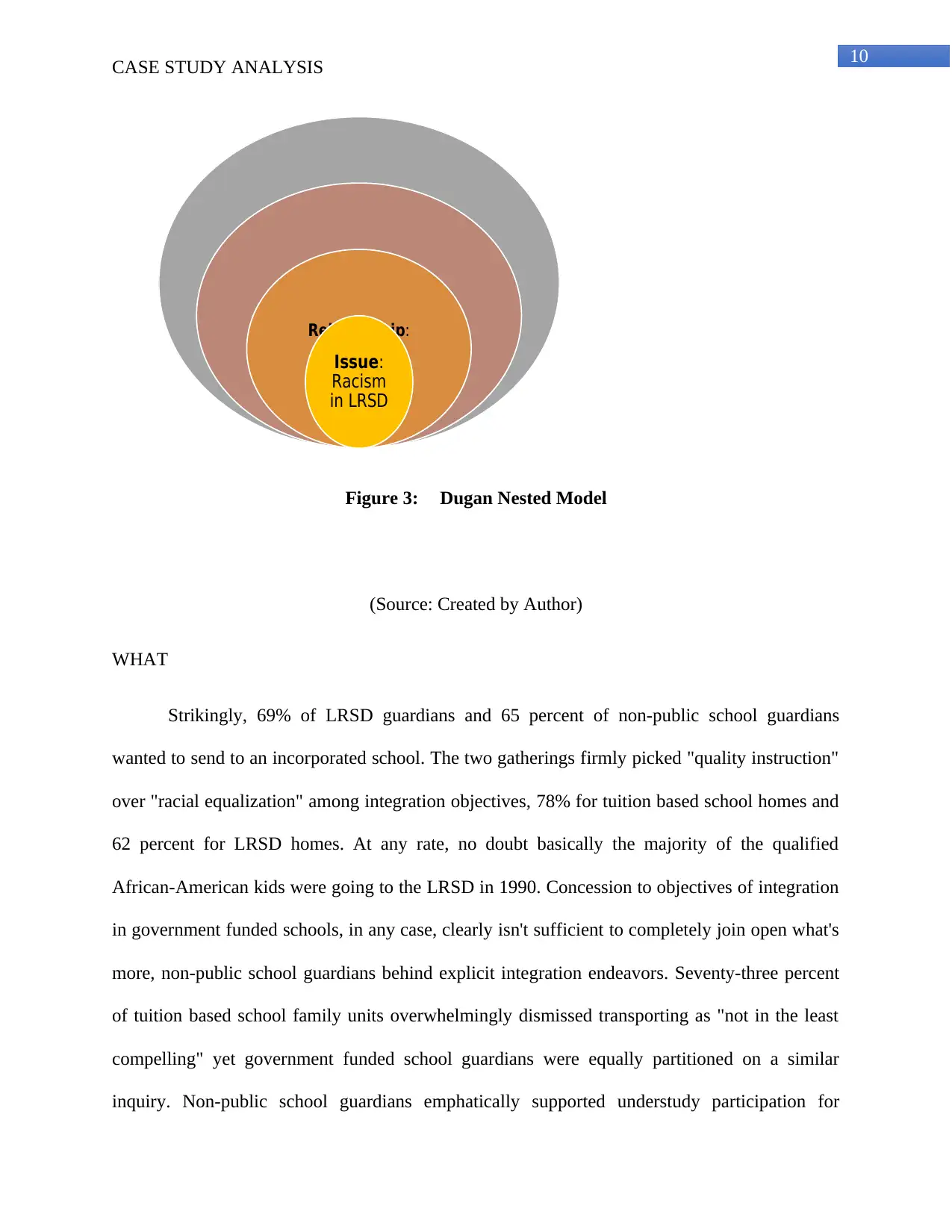
Figure 3: Dugan Nested Model
(Source: Created by Author)
WHAT
Strikingly, 69% of LRSD guardians and 65 percent of non-public school guardians
wanted to send to an incorporated school. The two gatherings firmly picked "quality instruction"
over "racial equalization" among integration objectives, 78% for tuition based school homes and
62 percent for LRSD homes. At any rate, no doubt basically the majority of the qualified
African-American kids were going to the LRSD in 1990. Concession to objectives of integration
in government funded schools, in any case, clearly isn't sufficient to completely join open what's
more, non-public school guardians behind explicit integration endeavors. Seventy-three percent
of tuition based school family units overwhelmingly dismissed transporting as "not in the least
compelling" yet government funded school guardians were equally partitioned on a similar
inquiry. Non-public school guardians emphatically supported understudy participation for
System: World racism among blacks
and white
Subsystem: Racism in LRSD
Relationship:
African and
AmericanIssue:
Racism
in LRSD
CASE STUDY ANALYSIS
Figure 3: Dugan Nested Model
(Source: Created by Author)
WHAT
Strikingly, 69% of LRSD guardians and 65 percent of non-public school guardians
wanted to send to an incorporated school. The two gatherings firmly picked "quality instruction"
over "racial equalization" among integration objectives, 78% for tuition based school homes and
62 percent for LRSD homes. At any rate, no doubt basically the majority of the qualified
African-American kids were going to the LRSD in 1990. Concession to objectives of integration
in government funded schools, in any case, clearly isn't sufficient to completely join open what's
more, non-public school guardians behind explicit integration endeavors. Seventy-three percent
of tuition based school family units overwhelmingly dismissed transporting as "not in the least
compelling" yet government funded school guardians were equally partitioned on a similar
inquiry. Non-public school guardians emphatically supported understudy participation for
System: World racism among blacks
and white
Subsystem: Racism in LRSD
Relationship:
African and
AmericanIssue:
Racism
in LRSD
Paraphrase This Document
Need a fresh take? Get an instant paraphrase of this document with our AI Paraphraser
11
CASE STUDY ANALYSIS
rudimentary, middle school, and senior secondary schools dependent on neighborhoods by solid
greater parts of 81 percent, 74 percent, and 66 percent, individually.
Government funded guardians additionally embraced neighborhood school rudimentary
and junior, be that as it may, were partitioned on the issue for senior secondary schools.
Regardless, right around 33% of government funded school guardians contradicted
neighborhood schools for review level. Tuition based guardians did grasp, and rather
unequivocally, one integration method: magnet schools in the LRSD. Truth be told, a more
noteworthy extent of tuition based school families said magnet schools were "compelling" than
did LRSD families. This purpose of idealism, in any case, was eclipsed by the 55 percent of
tested non-public school family units that expressed that integration had a negative impact on the
instruction offered by LRSD. LRSD family units (37 percent) demonstrated that integration's
instructive result was "sure." Concurrence on Classroom Agenda Open and non-public school
guardians reacted in fundamentally the same as examples about character instruction and
enhancing scholastic execution. Seventy-three percent of the two gatherings expressed that
instructing of qualities for example, trustworthiness, sympathy and regard for others ought to be
expanded in the classroom. At the point when asked to recognize one thing to enhance LRSD,
each gathering positioned "enhanced scholastics and instructing" at the highest priority on its
rundown.
CASE STUDY ANALYSIS
rudimentary, middle school, and senior secondary schools dependent on neighborhoods by solid
greater parts of 81 percent, 74 percent, and 66 percent, individually.
Government funded guardians additionally embraced neighborhood school rudimentary
and junior, be that as it may, were partitioned on the issue for senior secondary schools.
Regardless, right around 33% of government funded school guardians contradicted
neighborhood schools for review level. Tuition based guardians did grasp, and rather
unequivocally, one integration method: magnet schools in the LRSD. Truth be told, a more
noteworthy extent of tuition based school families said magnet schools were "compelling" than
did LRSD families. This purpose of idealism, in any case, was eclipsed by the 55 percent of
tested non-public school family units that expressed that integration had a negative impact on the
instruction offered by LRSD. LRSD family units (37 percent) demonstrated that integration's
instructive result was "sure." Concurrence on Classroom Agenda Open and non-public school
guardians reacted in fundamentally the same as examples about character instruction and
enhancing scholastic execution. Seventy-three percent of the two gatherings expressed that
instructing of qualities for example, trustworthiness, sympathy and regard for others ought to be
expanded in the classroom. At the point when asked to recognize one thing to enhance LRSD,
each gathering positioned "enhanced scholastics and instructing" at the highest priority on its
rundown.
12
CASE STUDY ANALYSIS
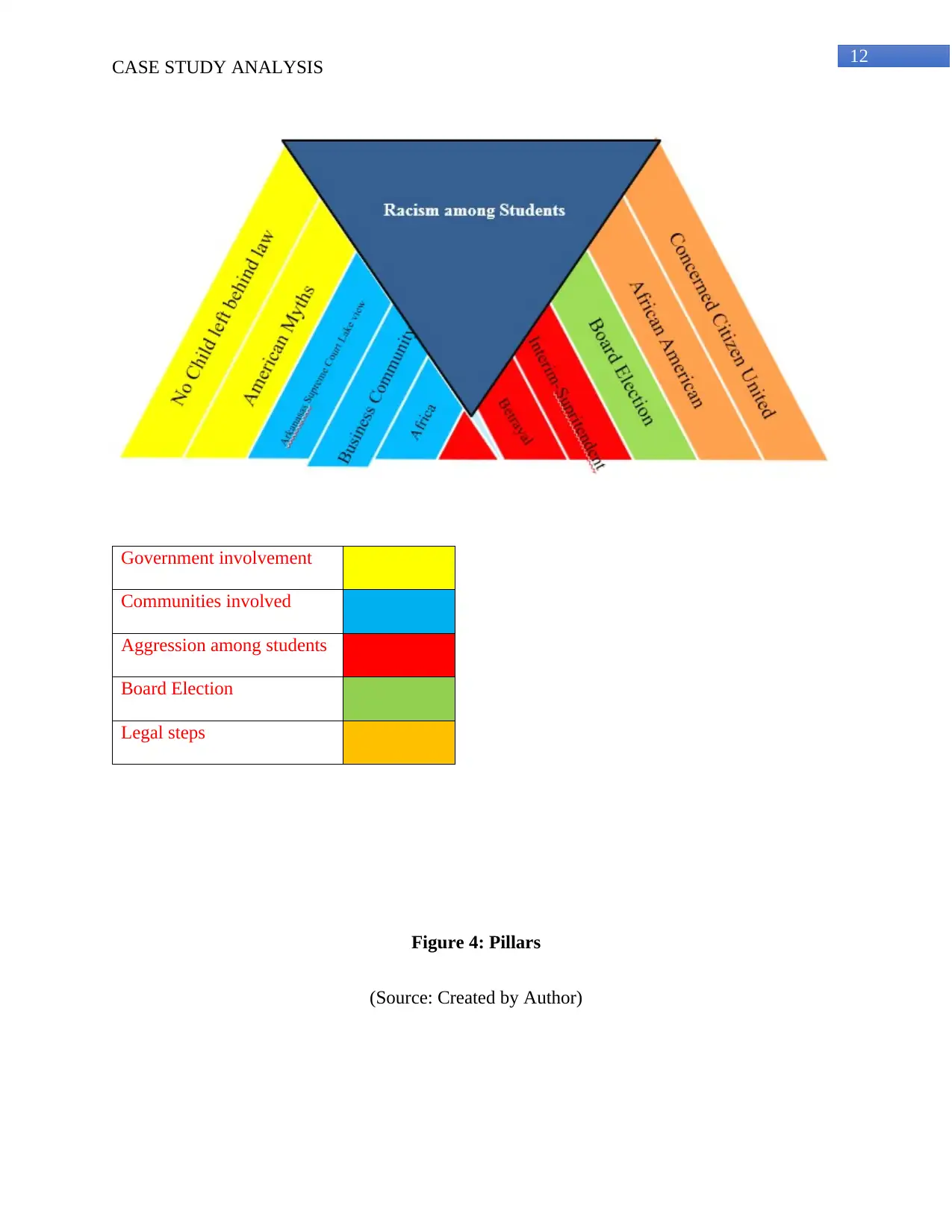
Government involvement
Communities involved
Aggression among students
Board Election
Legal steps
Figure 4: Pillars
(Source: Created by Author)
CASE STUDY ANALYSIS
Government involvement
Communities involved
Aggression among students
Board Election
Legal steps
Figure 4: Pillars
(Source: Created by Author)
⊘ This is a preview!⊘
Do you want full access?
Subscribe today to unlock all pages.
Trusted by 1+ million students worldwide

1 out of 15


Related Documents


Your All-in-One AI-Powered Toolkit for Academic Success.
+13062052269
info@desklib.com
Available 24*7 on WhatsApp / Email
![[object Object]](/_next/static/media/star-bottom.7253800d.svg)
Unlock your academic potential
Copyright © 2020–2026 A2Z Services. All Rights Reserved. Developed and managed by ZUCOL.