Case Study 2: Louise - Human Growth, Development, and Ageing (HSE113)
VerifiedAdded on 2022/08/28
|6
|1710
|18
Case Study
AI Summary
This case study analyzes Louise, a 13-year-old gymnast training intensely for Olympic aspirations. It addresses feedback from a previous assignment, summarizes Louise's case, and explores key growth and developmental stages, including early childhood, late childhood, and adolescence. The study examines the impact of high-level gymnastics on bone development, emphasizing the role of exercise loading. It assesses Louise's adherence to physical activity guidelines and provides recommendations for physical activity, sedentary behavior, and sleep for Louise and her siblings. The assignment highlights potential risks like injury and burnout while discussing the benefits of gymnastics, such as increased flexibility and strong bones. The analysis references relevant guidelines and research to support its findings and recommendations.
Human Growth, Development and Ageing for Exercise - Case Study 2 –
Louise Sigmoid
Student Name:
Student Number:
Seminar Group (Day/Time/Tutor Name):
Campus:
Date of Completion:
Word Count:
Louise Sigmoid
Student Name:
Student Number:
Seminar Group (Day/Time/Tutor Name):
Campus:
Date of Completion:
Word Count:

Paraphrase This Document
Need a fresh take? Get an instant paraphrase of this document with our AI Paraphraser
1
Answer 1A – Feedback from AT1-CS1
My professor gave me the feedback to address my grammar and writing skills in the AT1-CS1. The
feedback from AT1-CS1 helped me to deal with my grammar issues as well as how to deal with my
writing capabilities for improving this report.
Question 1B – Case Study Summary
Louise is a 13 years old girl who is a dedicated gymnast and compete at the state level in Victoria.
She trains six days each week with the leading gymnastic coaches for almost 18 hours of training
per week. Her training involves lots of high-load movements and repetitive sport-specific
movements. Louise hopes to participate for Australia in the next Olympic Games 2020. She is a
self-confident as well as bubbly girl who enjoys to compete and train in gymnastics and stay highly
motivated. Louise rarely falls in illness, has an extremely healthy appetite, sleeps well and can
manage any injuries. Even though her mother is extremely proud of Louise, she is worried
regarding the toll of the high-level gymnastics might have on the body of Louise at a young age.
She is nearly 2 to 3cm shorter than her twin brother, Martin. Moreover, at this age, she has not got
her first menstrual bleed. Recently, a gymnast fitness testing was held where Louise had a sitting
height of 78.5 cm and standing height of 155cm as well as weighed 45 kg. Her mother is concerned
with negative psychological injury and burnout might have on Louise.
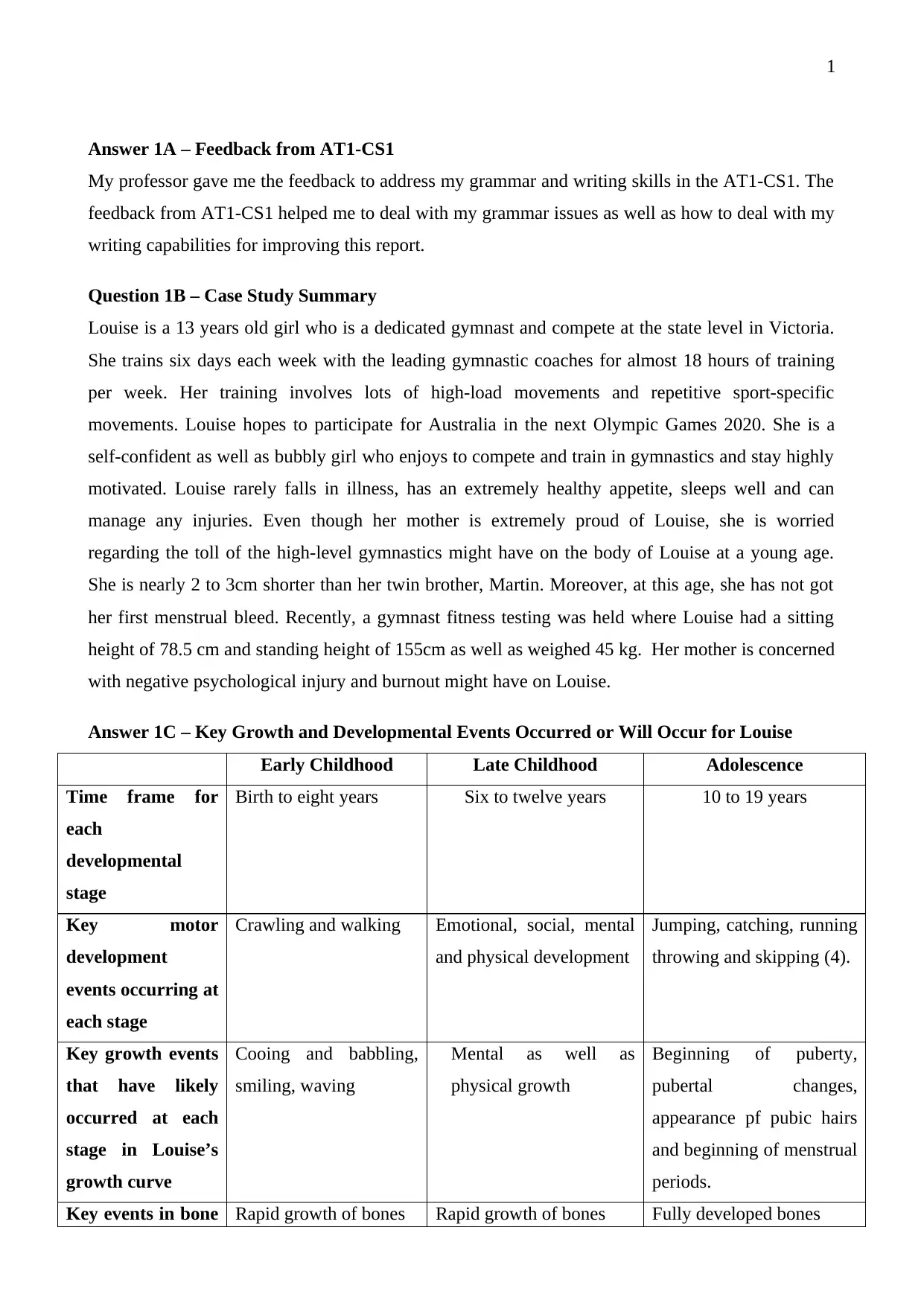
Answer 1C – Key Growth and Developmental Events Occurred or Will Occur for Louise
Early Childhood Late Childhood Adolescence
Time frame for
each
developmental
stage
Birth to eight years Six to twelve years 10 to 19 years
Key motor
development
events occurring at
each stage
Crawling and walking Emotional, social, mental
and physical development
Jumping, catching, running
throwing and skipping (4).
Key growth events
that have likely
occurred at each
stage in Louise’s
growth curve
Cooing and babbling,
smiling, waving
Mental as well as
physical growth
Beginning of puberty,
pubertal changes,
appearance pf pubic hairs
and beginning of menstrual
periods.
Key events in bone Rapid growth of bones Rapid growth of bones Fully developed bones
Answer 1A – Feedback from AT1-CS1
My professor gave me the feedback to address my grammar and writing skills in the AT1-CS1. The
feedback from AT1-CS1 helped me to deal with my grammar issues as well as how to deal with my
writing capabilities for improving this report.
Question 1B – Case Study Summary
Louise is a 13 years old girl who is a dedicated gymnast and compete at the state level in Victoria.
She trains six days each week with the leading gymnastic coaches for almost 18 hours of training
per week. Her training involves lots of high-load movements and repetitive sport-specific
movements. Louise hopes to participate for Australia in the next Olympic Games 2020. She is a
self-confident as well as bubbly girl who enjoys to compete and train in gymnastics and stay highly
motivated. Louise rarely falls in illness, has an extremely healthy appetite, sleeps well and can
manage any injuries. Even though her mother is extremely proud of Louise, she is worried
regarding the toll of the high-level gymnastics might have on the body of Louise at a young age.
She is nearly 2 to 3cm shorter than her twin brother, Martin. Moreover, at this age, she has not got
her first menstrual bleed. Recently, a gymnast fitness testing was held where Louise had a sitting
height of 78.5 cm and standing height of 155cm as well as weighed 45 kg. Her mother is concerned
with negative psychological injury and burnout might have on Louise.
Answer 1C – Key Growth and Developmental Events Occurred or Will Occur for Louise
Early Childhood Late Childhood Adolescence
Time frame for
each
developmental
stage
Birth to eight years Six to twelve years 10 to 19 years
Key motor
development
events occurring at
each stage
Crawling and walking Emotional, social, mental
and physical development
Jumping, catching, running
throwing and skipping (4).
Key growth events
that have likely
occurred at each
stage in Louise’s
growth curve
Cooing and babbling,
smiling, waving
Mental as well as
physical growth
Beginning of puberty,
pubertal changes,
appearance pf pubic hairs
and beginning of menstrual
periods.
Key events in bone Rapid growth of bones Rapid growth of bones Fully developed bones
2
development that
may occur during
adolescence
Key changes to
heart rate that
may occur at some
of the stages
80 to 160 beats each
minute
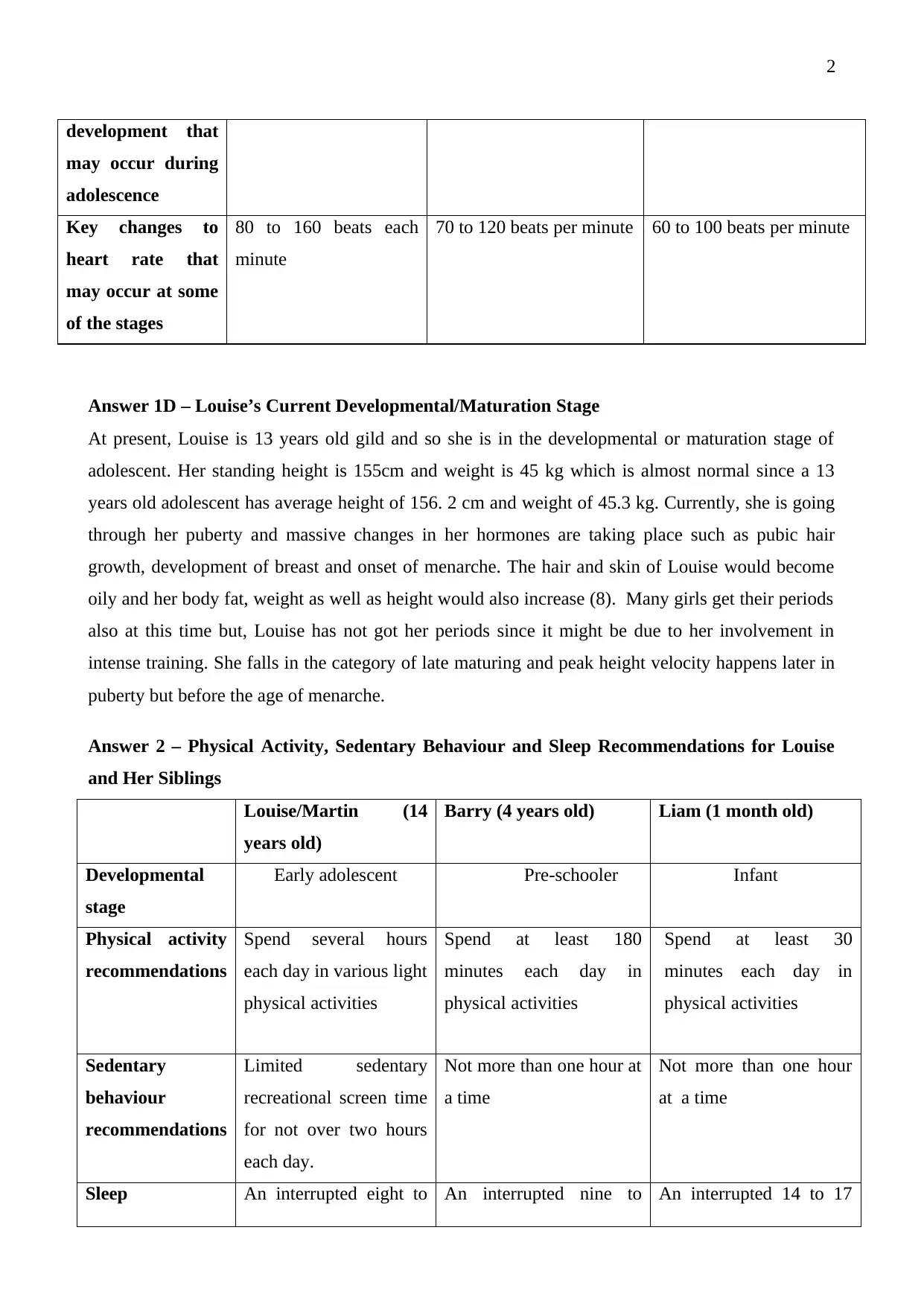
70 to 120 beats per minute 60 to 100 beats per minute
Answer 1D – Louise’s Current Developmental/Maturation Stage
At present, Louise is 13 years old gild and so she is in the developmental or maturation stage of
adolescent. Her standing height is 155cm and weight is 45 kg which is almost normal since a 13
years old adolescent has average height of 156. 2 cm and weight of 45.3 kg. Currently, she is going
through her puberty and massive changes in her hormones are taking place such as pubic hair
growth, development of breast and onset of menarche. The hair and skin of Louise would become
oily and her body fat, weight as well as height would also increase (8). Many girls get their periods
also at this time but, Louise has not got her periods since it might be due to her involvement in
intense training. She falls in the category of late maturing and peak height velocity happens later in
puberty but before the age of menarche.
Answer 2 – Physical Activity, Sedentary Behaviour and Sleep Recommendations for Louise
and Her Siblings
Louise/Martin (14
years old)
Barry (4 years old) Liam (1 month old)
Developmental
stage
Early adolescent Pre-schooler Infant
Physical activity
recommendations
Spend several hours
each day in various light
physical activities
Spend at least 180
minutes each day in
physical activities
Spend at least 30
minutes each day in
physical activities
Sedentary
behaviour
recommendations
Limited sedentary
recreational screen time
for not over two hours
each day.
Not more than one hour at
a time
Not more than one hour
at a time
Sleep An interrupted eight to An interrupted nine to An interrupted 14 to 17
development that
may occur during
adolescence
Key changes to
heart rate that
may occur at some
of the stages
80 to 160 beats each
minute
70 to 120 beats per minute 60 to 100 beats per minute
Answer 1D – Louise’s Current Developmental/Maturation Stage
At present, Louise is 13 years old gild and so she is in the developmental or maturation stage of
adolescent. Her standing height is 155cm and weight is 45 kg which is almost normal since a 13
years old adolescent has average height of 156. 2 cm and weight of 45.3 kg. Currently, she is going
through her puberty and massive changes in her hormones are taking place such as pubic hair
growth, development of breast and onset of menarche. The hair and skin of Louise would become
oily and her body fat, weight as well as height would also increase (8). Many girls get their periods
also at this time but, Louise has not got her periods since it might be due to her involvement in
intense training. She falls in the category of late maturing and peak height velocity happens later in
puberty but before the age of menarche.
Answer 2 – Physical Activity, Sedentary Behaviour and Sleep Recommendations for Louise
and Her Siblings
Louise/Martin (14
years old)
Barry (4 years old) Liam (1 month old)
Developmental
stage
Early adolescent Pre-schooler Infant
Physical activity
recommendations
Spend several hours
each day in various light
physical activities
Spend at least 180
minutes each day in
physical activities
Spend at least 30
minutes each day in
physical activities
Sedentary
behaviour
recommendations
Limited sedentary
recreational screen time
for not over two hours
each day.
Not more than one hour at
a time
Not more than one hour
at a time
Sleep An interrupted eight to An interrupted nine to An interrupted 14 to 17
⊘ This is a preview!⊘
Do you want full access?
Subscribe today to unlock all pages.

Trusted by 1+ million students worldwide
3
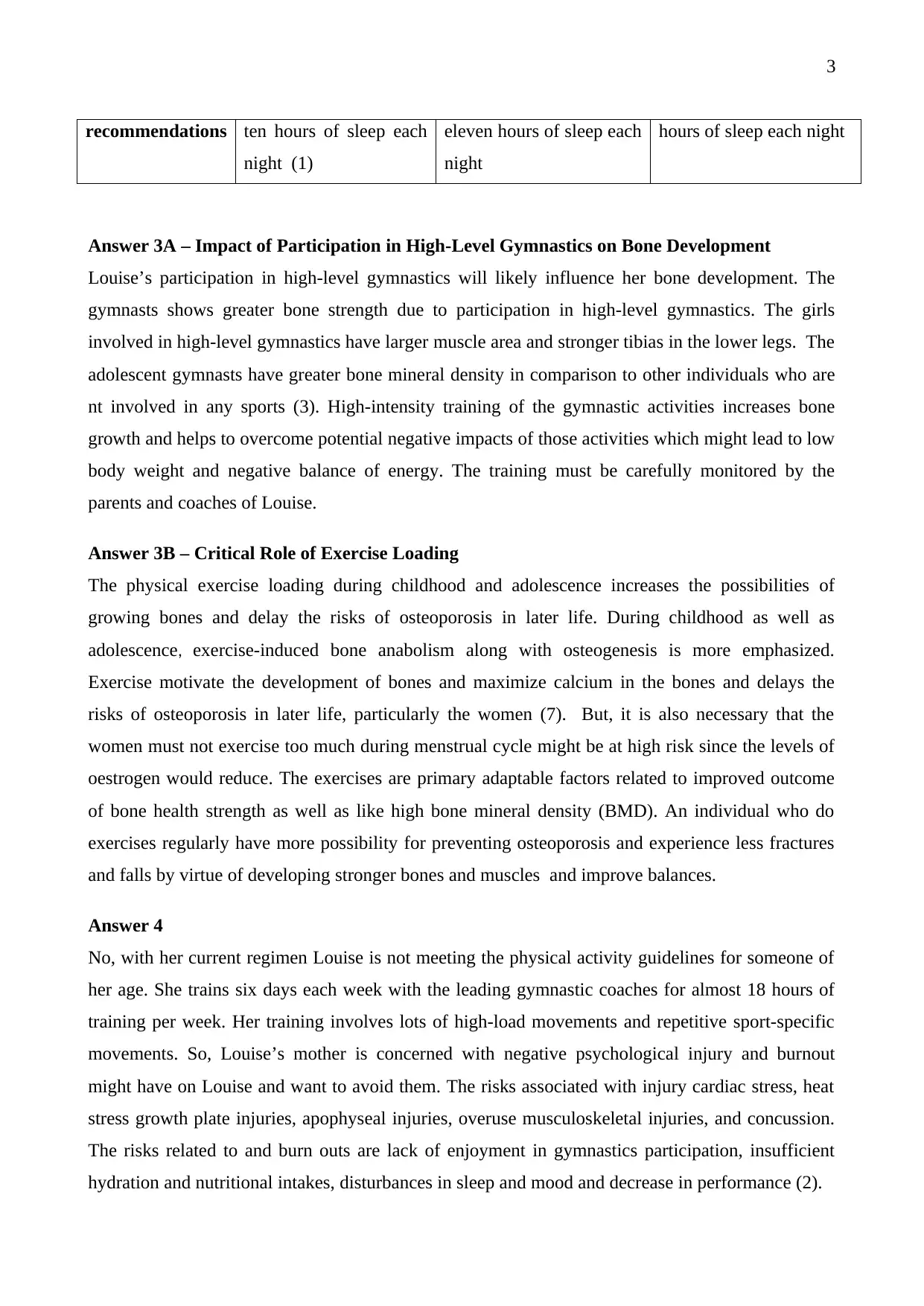
recommendations ten hours of sleep each
night (1)
eleven hours of sleep each
night
hours of sleep each night
Answer 3A – Impact of Participation in High-Level Gymnastics on Bone Development
Louise’s participation in high-level gymnastics will likely influence her bone development. The
gymnasts shows greater bone strength due to participation in high-level gymnastics. The girls
involved in high-level gymnastics have larger muscle area and stronger tibias in the lower legs. The
adolescent gymnasts have greater bone mineral density in comparison to other individuals who are
nt involved in any sports (3). High-intensity training of the gymnastic activities increases bone
growth and helps to overcome potential negative impacts of those activities which might lead to low
body weight and negative balance of energy. The training must be carefully monitored by the
parents and coaches of Louise.
Answer 3B – Critical Role of Exercise Loading
The physical exercise loading during childhood and adolescence increases the possibilities of
growing bones and delay the risks of osteoporosis in later life. During childhood as well as
adolescence, exercise-induced bone anabolism along with osteogenesis is more emphasized.
Exercise motivate the development of bones and maximize calcium in the bones and delays the
risks of osteoporosis in later life, particularly the women (7). But, it is also necessary that the
women must not exercise too much during menstrual cycle might be at high risk since the levels of
oestrogen would reduce. The exercises are primary adaptable factors related to improved outcome
of bone health strength as well as like high bone mineral density (BMD). An individual who do
exercises regularly have more possibility for preventing osteoporosis and experience less fractures
and falls by virtue of developing stronger bones and muscles and improve balances.
Answer 4
No, with her current regimen Louise is not meeting the physical activity guidelines for someone of
her age. She trains six days each week with the leading gymnastic coaches for almost 18 hours of
training per week. Her training involves lots of high-load movements and repetitive sport-specific
movements. So, Louise’s mother is concerned with negative psychological injury and burnout
might have on Louise and want to avoid them. The risks associated with injury cardiac stress, heat
stress growth plate injuries, apophyseal injuries, overuse musculoskeletal injuries, and concussion.
The risks related to and burn outs are lack of enjoyment in gymnastics participation, insufficient
hydration and nutritional intakes, disturbances in sleep and mood and decrease in performance (2).
recommendations ten hours of sleep each
night (1)
eleven hours of sleep each
night
hours of sleep each night
Answer 3A – Impact of Participation in High-Level Gymnastics on Bone Development
Louise’s participation in high-level gymnastics will likely influence her bone development. The
gymnasts shows greater bone strength due to participation in high-level gymnastics. The girls
involved in high-level gymnastics have larger muscle area and stronger tibias in the lower legs. The
adolescent gymnasts have greater bone mineral density in comparison to other individuals who are
nt involved in any sports (3). High-intensity training of the gymnastic activities increases bone
growth and helps to overcome potential negative impacts of those activities which might lead to low
body weight and negative balance of energy. The training must be carefully monitored by the
parents and coaches of Louise.
Answer 3B – Critical Role of Exercise Loading
The physical exercise loading during childhood and adolescence increases the possibilities of
growing bones and delay the risks of osteoporosis in later life. During childhood as well as
adolescence, exercise-induced bone anabolism along with osteogenesis is more emphasized.
Exercise motivate the development of bones and maximize calcium in the bones and delays the
risks of osteoporosis in later life, particularly the women (7). But, it is also necessary that the
women must not exercise too much during menstrual cycle might be at high risk since the levels of
oestrogen would reduce. The exercises are primary adaptable factors related to improved outcome
of bone health strength as well as like high bone mineral density (BMD). An individual who do
exercises regularly have more possibility for preventing osteoporosis and experience less fractures
and falls by virtue of developing stronger bones and muscles and improve balances.
Answer 4
No, with her current regimen Louise is not meeting the physical activity guidelines for someone of
her age. She trains six days each week with the leading gymnastic coaches for almost 18 hours of
training per week. Her training involves lots of high-load movements and repetitive sport-specific
movements. So, Louise’s mother is concerned with negative psychological injury and burnout
might have on Louise and want to avoid them. The risks associated with injury cardiac stress, heat
stress growth plate injuries, apophyseal injuries, overuse musculoskeletal injuries, and concussion.
The risks related to and burn outs are lack of enjoyment in gymnastics participation, insufficient
hydration and nutritional intakes, disturbances in sleep and mood and decrease in performance (2).
Paraphrase This Document
Need a fresh take? Get an instant paraphrase of this document with our AI Paraphraser
4
The benefits of high-level gymnastics participation are increased flexibility and strong bones. Due
to participation in high-level gymnastics, the muscles becomes more flexible. The bones of the
gymnasts become strong and helps to prevent brittleness and stay in shape (6). Louise’s
participation in high-level gymnastics will likely influence her bone development. The gymnasts
shows greater bone strength due to participation in high-level gymnastics. For avoiding injury and
burnout, it is recommended that Louise must engaged in neuromuscular training for preventing the
risks of lower extremity injuries. It must be focused in increasing flexibility, muscle strength,
postural control as well as endurance. The training must be carefully monitored by the coaches of
Louise. It is also suggested that Louise must use protective equipment such as knee pads and elbow
guards for reducing injuries while training and participating in high-level gymnastics.
The benefits of high-level gymnastics participation are increased flexibility and strong bones. Due
to participation in high-level gymnastics, the muscles becomes more flexible. The bones of the
gymnasts become strong and helps to prevent brittleness and stay in shape (6). Louise’s
participation in high-level gymnastics will likely influence her bone development. The gymnasts
shows greater bone strength due to participation in high-level gymnastics. For avoiding injury and
burnout, it is recommended that Louise must engaged in neuromuscular training for preventing the
risks of lower extremity injuries. It must be focused in increasing flexibility, muscle strength,
postural control as well as endurance. The training must be carefully monitored by the coaches of
Louise. It is also suggested that Louise must use protective equipment such as knee pads and elbow
guards for reducing injuries while training and participating in high-level gymnastics.
5
References
1. Australia's Physical Activity and Sedentary Behavior Guidelines and the Australian 24-Hour
Movement Guidelines. Department of Health, 2019. Available, from
https://www1.health.gov.au/internet/main/publishing.nsf/content/health-pubhlth-strateg-phys-
act-guidelines#npa517
2. DiFiori JP, Benjamin HJ, Brenner JS, Gregory A, Jayanthi N, Landry GL, Luke A. Overuse
injuries and burnout in youth sports: a position statement from the American Medical Society
for Sports Medicine. British journal of sports medicine. 2014 Feb 1; 48(4):287-8.
3. Greene DA, Naughton GA, Bradshaw E, Moresi M, Ducher G. Mechanical loading with or
without weight-bearing activity: influence on bone strength index in elite female adolescent
athletes engaged in water polo, gymnastics, and track-and-field. Journal of bone and mineral
metabolism. 2012 Sep 1; 30(5):580-7.
4. Karachle N, Dania A, Venetsanou F. Effects of a recreational gymnastics program on the motor
proficiency of young children. Science of Gymnastics Journal. 2017 Jan 1; 9(1):17-25..
5. Moen F, Myhre K, Sandbakk Ø, Moen F. Psychological determinants of burnout, illness and
injury among elite junior athletes. The Sport Journal. 2016 Aug 1; 19:1-4..
6. Okely AD, Salmon J, Vella S, Cliff D, Timperio A, Tremblay M, Trost S, Shilton T, Hinkley T,
Ridgers N, Phillipson L. A systematic review to update the Australian physical activity
guidelines for children and young people. 2012; 1-56.
7. Santos L, Elliott-Sale KJ, Sale C. Exercise and bone health across the lifespan. Biogerontology.
2017 Dec 1; 18(6):931-46.
8. Wierenga LM, Bos MG, Schreuders E, vd Kamp F, Peper JS, Tamnes CK, Crone EA.
Unraveling age, puberty and testosterone effects on subcortical brain development across
adolescence. Psychoneuroendocrinology. 2018 May 1; 91:105-14.
References
1. Australia's Physical Activity and Sedentary Behavior Guidelines and the Australian 24-Hour
Movement Guidelines. Department of Health, 2019. Available, from
https://www1.health.gov.au/internet/main/publishing.nsf/content/health-pubhlth-strateg-phys-
act-guidelines#npa517
2. DiFiori JP, Benjamin HJ, Brenner JS, Gregory A, Jayanthi N, Landry GL, Luke A. Overuse
injuries and burnout in youth sports: a position statement from the American Medical Society
for Sports Medicine. British journal of sports medicine. 2014 Feb 1; 48(4):287-8.
3. Greene DA, Naughton GA, Bradshaw E, Moresi M, Ducher G. Mechanical loading with or
without weight-bearing activity: influence on bone strength index in elite female adolescent
athletes engaged in water polo, gymnastics, and track-and-field. Journal of bone and mineral
metabolism. 2012 Sep 1; 30(5):580-7.
4. Karachle N, Dania A, Venetsanou F. Effects of a recreational gymnastics program on the motor
proficiency of young children. Science of Gymnastics Journal. 2017 Jan 1; 9(1):17-25..
5. Moen F, Myhre K, Sandbakk Ø, Moen F. Psychological determinants of burnout, illness and
injury among elite junior athletes. The Sport Journal. 2016 Aug 1; 19:1-4..
6. Okely AD, Salmon J, Vella S, Cliff D, Timperio A, Tremblay M, Trost S, Shilton T, Hinkley T,
Ridgers N, Phillipson L. A systematic review to update the Australian physical activity
guidelines for children and young people. 2012; 1-56.
7. Santos L, Elliott-Sale KJ, Sale C. Exercise and bone health across the lifespan. Biogerontology.
2017 Dec 1; 18(6):931-46.
8. Wierenga LM, Bos MG, Schreuders E, vd Kamp F, Peper JS, Tamnes CK, Crone EA.
Unraveling age, puberty and testosterone effects on subcortical brain development across
adolescence. Psychoneuroendocrinology. 2018 May 1; 91:105-14.
⊘ This is a preview!⊘
Do you want full access?
Subscribe today to unlock all pages.
Trusted by 1+ million students worldwide

1 out of 6


Your All-in-One AI-Powered Toolkit for Academic Success.
+13062052269
info@desklib.com
Available 24*7 on WhatsApp / Email
![[object Object]](/_next/static/media/star-bottom.7253800d.svg)
Unlock your academic potential
Copyright © 2020–2026 A2Z Services. All Rights Reserved. Developed and managed by ZUCOL.