Analyzing Michael Brown's Shooting: Justification and Legal Precedents

Verified

Added on  2023/06/11

|4
|788
|305
Case Study
AI Summary
This case study analyzes the Michael Brown shooting from the perspective of Officer Darren Willson, arguing that his actions were justified under Tennessee law and relevant Supreme Court precedents. The analysis draws parallels with Tennessee v. Garner and Graham v. Connor to support the claim that Willson had reasonable grounds to use force, including deadly force, due to Brown's attempted flight, violent behavior, and perceived threat to the officer's safety. The study emphasizes the importance of considering the officer's good faith intentions and the immediate threat posed by Brown in determining the legality of the shooting. It concludes that the application of these legal principles to the Michael Brown case supports the justification of Willson's actions.
Document Page
Running head: MICHAEL BROWN’S SHOOTING 1
Michael Brown’s Shooting
Name
Institution
tabler-icon-diamond-filled.svg

Paraphrase This Document

Need a fresh take? Get an instant paraphrase of this document with our AI Paraphraser
Document Page
MICHAEL BROWN’S SHOOTING 2
MICHAEL BROWN’S SHOOTING
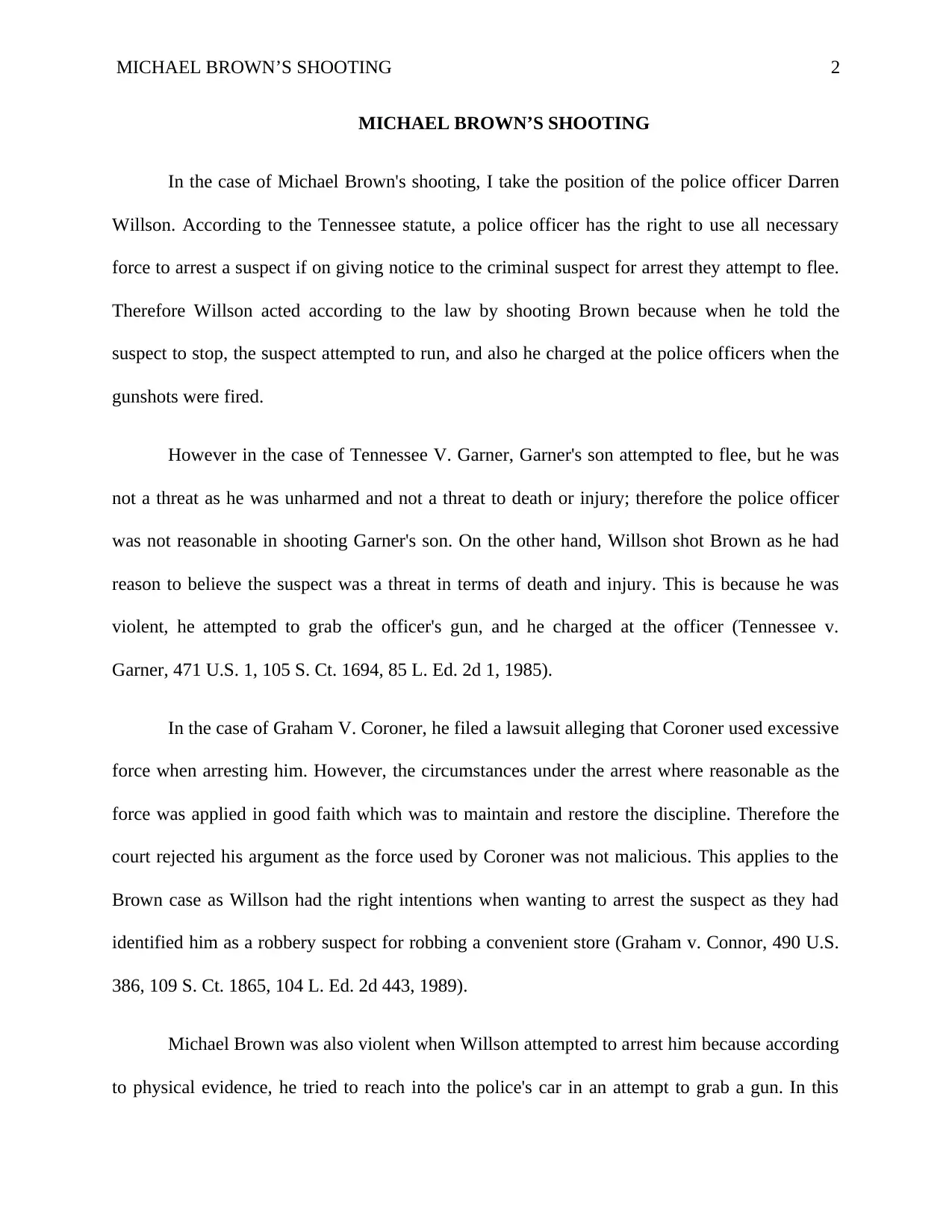
In the case of Michael Brown's shooting, I take the position of the police officer Darren
Willson. According to the Tennessee statute, a police officer has the right to use all necessary
force to arrest a suspect if on giving notice to the criminal suspect for arrest they attempt to flee.
Therefore Willson acted according to the law by shooting Brown because when he told the
suspect to stop, the suspect attempted to run, and also he charged at the police officers when the
gunshots were fired.
However in the case of Tennessee V. Garner, Garner's son attempted to flee, but he was
not a threat as he was unharmed and not a threat to death or injury; therefore the police officer
was not reasonable in shooting Garner's son. On the other hand, Willson shot Brown as he had
reason to believe the suspect was a threat in terms of death and injury. This is because he was
violent, he attempted to grab the officer's gun, and he charged at the officer (Tennessee v.
Garner, 471 U.S. 1, 105 S. Ct. 1694, 85 L. Ed. 2d 1, 1985).
In the case of Graham V. Coroner, he filed a lawsuit alleging that Coroner used excessive
force when arresting him. However, the circumstances under the arrest where reasonable as the
force was applied in good faith which was to maintain and restore the discipline. Therefore the
court rejected his argument as the force used by Coroner was not malicious. This applies to the
Brown case as Willson had the right intentions when wanting to arrest the suspect as they had
identified him as a robbery suspect for robbing a convenient store (Graham v. Connor, 490 U.S.
386, 109 S. Ct. 1865, 104 L. Ed. 2d 443, 1989).
Michael Brown was also violent when Willson attempted to arrest him because according
to physical evidence, he tried to reach into the police's car in an attempt to grab a gun. In this
Document Page
MICHAEL BROWN’S SHOOTING 3
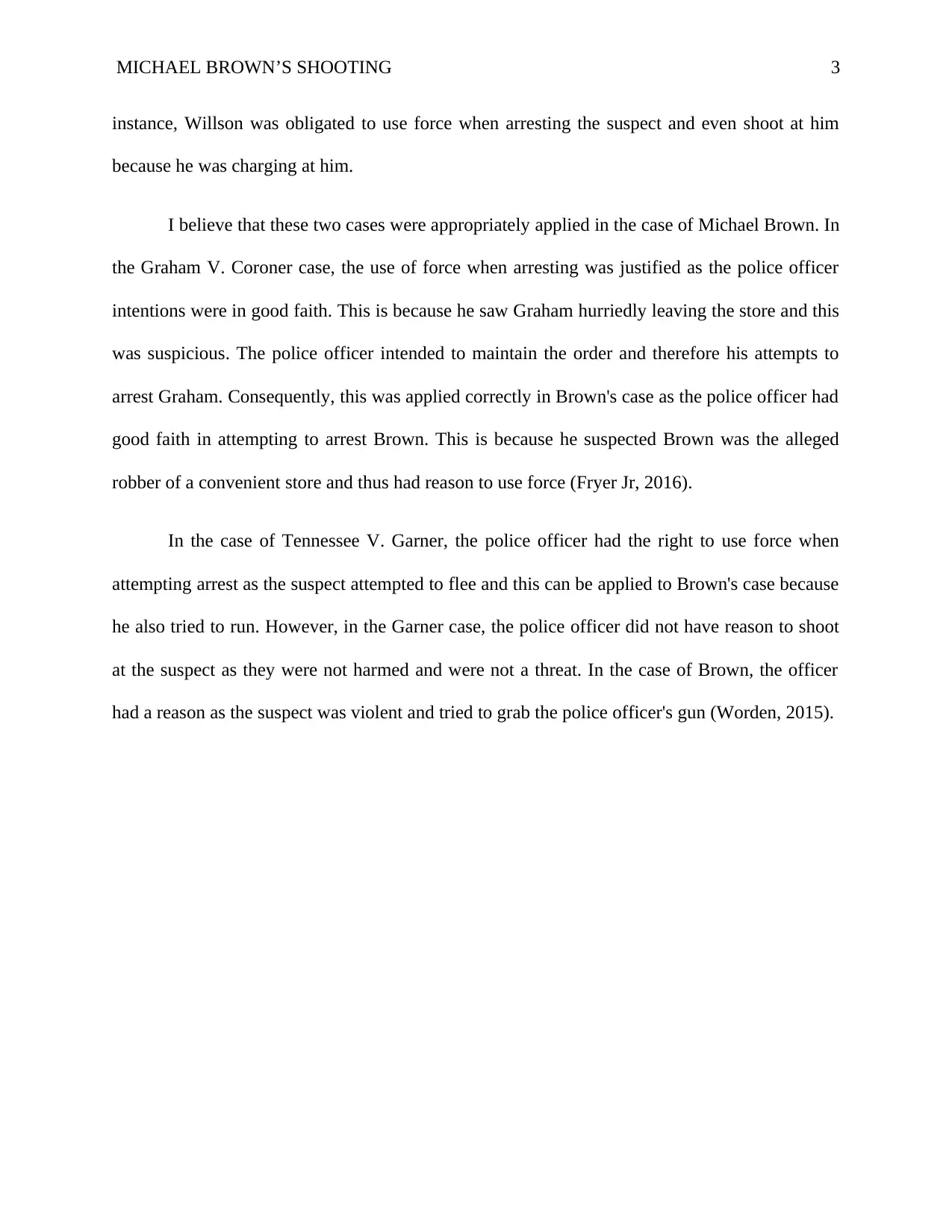
instance, Willson was obligated to use force when arresting the suspect and even shoot at him
because he was charging at him.
I believe that these two cases were appropriately applied in the case of Michael Brown. In
the Graham V. Coroner case, the use of force when arresting was justified as the police officer
intentions were in good faith. This is because he saw Graham hurriedly leaving the store and this
was suspicious. The police officer intended to maintain the order and therefore his attempts to
arrest Graham. Consequently, this was applied correctly in Brown's case as the police officer had
good faith in attempting to arrest Brown. This is because he suspected Brown was the alleged
robber of a convenient store and thus had reason to use force (Fryer Jr, 2016).
In the case of Tennessee V. Garner, the police officer had the right to use force when
attempting arrest as the suspect attempted to flee and this can be applied to Brown's case because
he also tried to run. However, in the Garner case, the police officer did not have reason to shoot
at the suspect as they were not harmed and were not a threat. In the case of Brown, the officer
had a reason as the suspect was violent and tried to grab the police officer's gun (Worden, 2015).
Document Page
MICHAEL BROWN’S SHOOTING 4
References
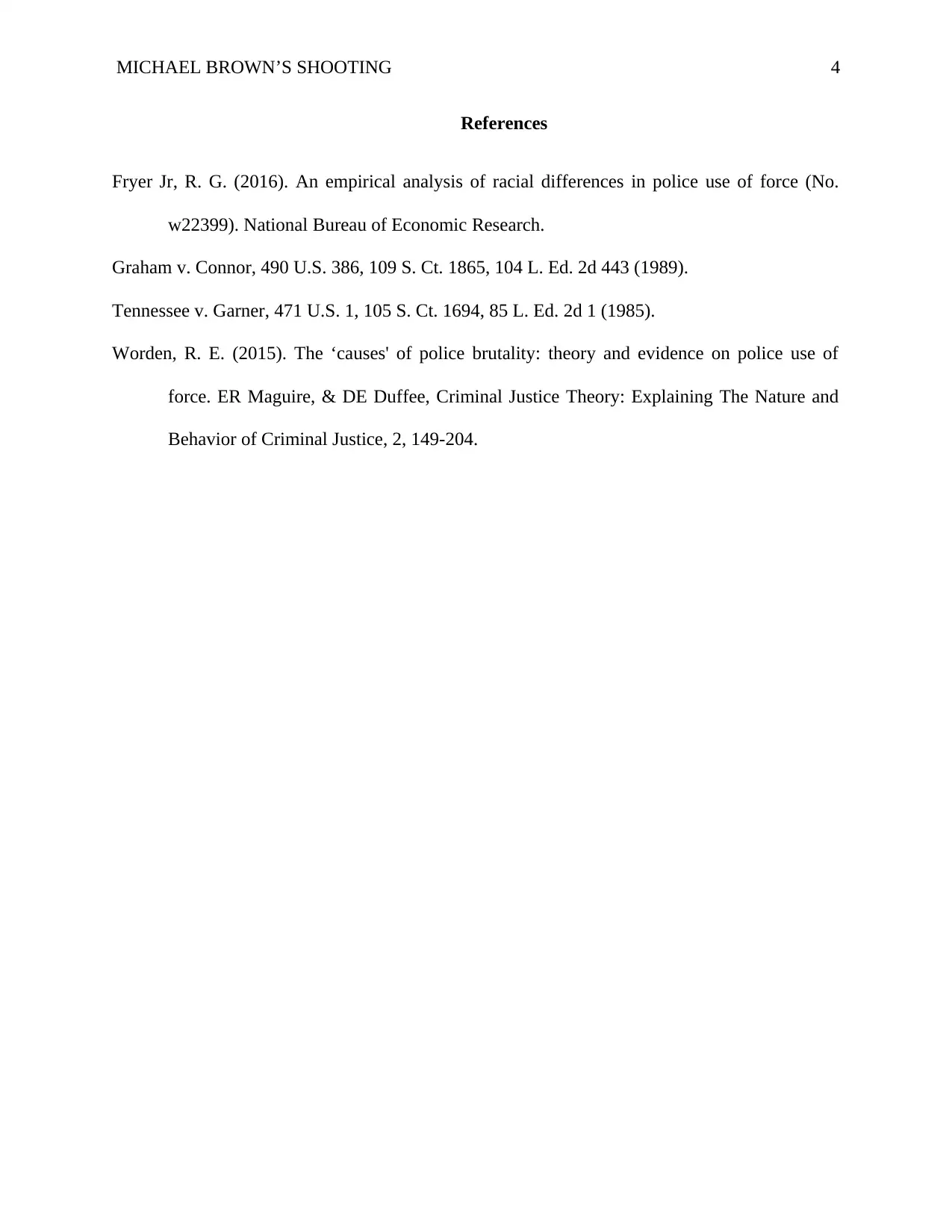
Fryer Jr, R. G. (2016). An empirical analysis of racial differences in police use of force (No.
w22399). National Bureau of Economic Research.
Graham v. Connor, 490 U.S. 386, 109 S. Ct. 1865, 104 L. Ed. 2d 443 (1989).
Tennessee v. Garner, 471 U.S. 1, 105 S. Ct. 1694, 85 L. Ed. 2d 1 (1985).
Worden, R. E. (2015). The ‘causes' of police brutality: theory and evidence on police use of
force. ER Maguire, & DE Duffee, Criminal Justice Theory: Explaining The Nature and
Behavior of Criminal Justice, 2, 149-204.
chevron_up_icon
1 out of 4
circle_padding
hide_on_mobile
zoom_out_icon
[object Object]