Griffith University: Health and Illness in Older People Case Study
VerifiedAdded on 2023/06/08
|11
|3202
|99
Case Study
AI Summary
This assignment presents a case study focusing on a 64-year-old patient, Alan Smith, residing in Melbourne, Australia, who was admitted to a healthcare setting with heart arrhythmia, specifically complete heart block requiring a pacemaker. The case study explores the patient's symptoms, including irregular heartbeat, palpitations, shortness of breath, and co-morbidities like hypertension and high blood sugar. It also examines the impact of stereotypes of older people on healthcare. Part 2 of the assignment focuses on the development of an evidence-based nursing care plan, identifying and justifying five key objectives: assessment, diagnosis, planning (goal outcome), implementation, and evaluation. The plan emphasizes holistic patient assessment, incorporating physiological, psychological, socio-cultural, and economic factors. It also discusses the importance of evidence-based practices, systematic reviews, and the implementation of short and long-term action plans for effective patient care, including medication management, monitoring, and diet control. The assignment highlights the significance of adapting care plans, based on patient response, and the use of technology for efficient data management and analysis to improve the quality of care.

Health and illness in older people

Paraphrase This Document
Need a fresh take? Get an instant paraphrase of this document with our AI Paraphraser
Table of Contents
Part 1- Case Study........................................................................................................................................2
Introduction.............................................................................................................................................2
Main Issues of patient.............................................................................................................................2
Impact of specific stereotypes of older people........................................................................................3
Part 2- Care plan..........................................................................................................................................4
Introduction.............................................................................................................................................4
Identification and justification of top five objectives for nursing care.....................................................4
Conclusion...............................................................................................................................................8
References...................................................................................................................................................9
1 | P a g e
Part 1- Case Study........................................................................................................................................2
Introduction.............................................................................................................................................2
Main Issues of patient.............................................................................................................................2
Impact of specific stereotypes of older people........................................................................................3
Part 2- Care plan..........................................................................................................................................4
Introduction.............................................................................................................................................4
Identification and justification of top five objectives for nursing care.....................................................4
Conclusion...............................................................................................................................................8
References...................................................................................................................................................9
1 | P a g e
Part 1- Case Study
Introduction
The older population are prone to be ill as there are various causes regarding their health
condition along with external environment lead to illness of these older people. Hence, the older
peoples need proper healthcare services in order to keep them healthy. There are several health-
related issues hinder the health outcomes of the older population across the globe. Moreover, the
heart arrhythmia is one of the most critical diseases that increase the concern of the healthcare
authorities and people across the globe (Burnett, 2005). In Australia also the prevalence of heart
arrhythmia among the older population is considerably growing and that increases the concern of
the health authorities of the country. To understand the impacts of this disease a case of a 64-
year patient Alan has been represented here. The purpose of the case study is to understand the
issues of, related to the heart arrhythmia and the effective intervention programs for managing
the impact of this specific disease on Alan. The stereotype for the aging of older people
possesses the potential for reinforcing ageism as they position unwell health as undesirable. It is
not been acknowledge the huge diversity of older adults. The usage of terms such as older
people, old age, seniors and the elderly were in practice interchangeably within the academic
policy, literature, and press for referring to the individuals aging between 55years and above
(DeSilva, 2013).
Main Issues of patient
The case study is on a 64 years patient in Australia. The name of the patient is Alan Smith, who
is residing in Melbourne. Mr Alan Smith was admitted to the healthcare setting with the problem
of heart arrhythmia. He had a complete heart block and he required a pacemaker to live. In the
Echocardiography test of Allan provide the evidence of a mild thickened interventricular septum
with sound left the ventricular function. The patient had been suffering from the issues like an
irregular heartbeat (Buttigieg, Rathert & Eiff, 2015). The disease also referred to the dysrhythmia
and in this disease, the heartbeat of the patient is usually irregular, often the heartbeat is too fast
and sometimes it is too slow. Hence, Alan is also facing the same problem of irregular heartbeat.
2 | P a g e
Introduction
The older population are prone to be ill as there are various causes regarding their health
condition along with external environment lead to illness of these older people. Hence, the older
peoples need proper healthcare services in order to keep them healthy. There are several health-
related issues hinder the health outcomes of the older population across the globe. Moreover, the
heart arrhythmia is one of the most critical diseases that increase the concern of the healthcare
authorities and people across the globe (Burnett, 2005). In Australia also the prevalence of heart
arrhythmia among the older population is considerably growing and that increases the concern of
the health authorities of the country. To understand the impacts of this disease a case of a 64-
year patient Alan has been represented here. The purpose of the case study is to understand the
issues of, related to the heart arrhythmia and the effective intervention programs for managing
the impact of this specific disease on Alan. The stereotype for the aging of older people
possesses the potential for reinforcing ageism as they position unwell health as undesirable. It is
not been acknowledge the huge diversity of older adults. The usage of terms such as older
people, old age, seniors and the elderly were in practice interchangeably within the academic
policy, literature, and press for referring to the individuals aging between 55years and above
(DeSilva, 2013).
Main Issues of patient
The case study is on a 64 years patient in Australia. The name of the patient is Alan Smith, who
is residing in Melbourne. Mr Alan Smith was admitted to the healthcare setting with the problem
of heart arrhythmia. He had a complete heart block and he required a pacemaker to live. In the
Echocardiography test of Allan provide the evidence of a mild thickened interventricular septum
with sound left the ventricular function. The patient had been suffering from the issues like an
irregular heartbeat (Buttigieg, Rathert & Eiff, 2015). The disease also referred to the dysrhythmia
and in this disease, the heartbeat of the patient is usually irregular, often the heartbeat is too fast
and sometimes it is too slow. Hence, Alan is also facing the same problem of irregular heartbeat.
2 | P a g e
⊘ This is a preview!⊘
Do you want full access?
Subscribe today to unlock all pages.

Trusted by 1+ million students worldwide
The disease shows extra beats, as well as it can be supraventricular tachycardia, ventricular
arrhythmias, and Bradyarrhythmias. Sometimes, there is not any symptom observed in the
patient of heart arrhythmia. However, in the case of Alan, the symptoms are present as there are
palpitations in the patient as well as a sometimes evident pause between the heartbeats (Canfield,
Hansen & Rackner, 2012). Besides this, Alan showed light-headedness, shortness of the breath,
passing out, chest pain. Apart from this, Alan also suffering from hypertension as well as his
blood sugar level was also high. Hence, the two co-morbidities in the case of Alan are
hypertension and high blood sugar level along with heart arrhythmia.
Impact of specific stereotypes of older people
In this framework, the experimental studies comprising stereotype activation has represented that
explicit as well as implicit negative aging stereotype possess related detrimental effects upon the
performance of elderly people in mental as well as physical tasks. The implicit stereotypes have
represented that underlining positive stereotypes along with images of getting older could
deteriorate the negative effect of particular circumstances on older people's behaviour (Michael,
Scharf, Letzkus & Vergales, 2016). By comparing the explicit and implicit priming for aging
stereotypes upon the mental performance of older individuals, have shown that the primed
implicitly represent vital differences in their memory. The positive primes illustrate better ability
to recall that the primes, which are negative. It is also found that while the stereotypes of aging
matched the domain outcomes, there was a greater influence upon their performance. This is
suggested that while the stereotype match has been taking place, it is possible to generate
expectations, which turn out to be self-fulfilling prophecies. Mr Alan was very much anxious
about his life and his illness. Moreover, he even did not talk or convey his messages properly.
Hence, the healthcare staff faces significant communication problem in order to prepare an
effective treatment plan for Alan. The recent environmental changes have significant impacts on
the patient of heart arrhythmia. The healthcare setting and nursing intervention help in
improving the condition of Alan. The medication and nursing care reinforce his health and cause
for his improvement. The patient has provided oxygen as in the critical condition he could not
inhale required oxygen it supports him immensely (Naff, 2008).
3 | P a g e
arrhythmias, and Bradyarrhythmias. Sometimes, there is not any symptom observed in the
patient of heart arrhythmia. However, in the case of Alan, the symptoms are present as there are
palpitations in the patient as well as a sometimes evident pause between the heartbeats (Canfield,
Hansen & Rackner, 2012). Besides this, Alan showed light-headedness, shortness of the breath,
passing out, chest pain. Apart from this, Alan also suffering from hypertension as well as his
blood sugar level was also high. Hence, the two co-morbidities in the case of Alan are
hypertension and high blood sugar level along with heart arrhythmia.
Impact of specific stereotypes of older people
In this framework, the experimental studies comprising stereotype activation has represented that
explicit as well as implicit negative aging stereotype possess related detrimental effects upon the
performance of elderly people in mental as well as physical tasks. The implicit stereotypes have
represented that underlining positive stereotypes along with images of getting older could
deteriorate the negative effect of particular circumstances on older people's behaviour (Michael,
Scharf, Letzkus & Vergales, 2016). By comparing the explicit and implicit priming for aging
stereotypes upon the mental performance of older individuals, have shown that the primed
implicitly represent vital differences in their memory. The positive primes illustrate better ability
to recall that the primes, which are negative. It is also found that while the stereotypes of aging
matched the domain outcomes, there was a greater influence upon their performance. This is
suggested that while the stereotype match has been taking place, it is possible to generate
expectations, which turn out to be self-fulfilling prophecies. Mr Alan was very much anxious
about his life and his illness. Moreover, he even did not talk or convey his messages properly.
Hence, the healthcare staff faces significant communication problem in order to prepare an
effective treatment plan for Alan. The recent environmental changes have significant impacts on
the patient of heart arrhythmia. The healthcare setting and nursing intervention help in
improving the condition of Alan. The medication and nursing care reinforce his health and cause
for his improvement. The patient has provided oxygen as in the critical condition he could not
inhale required oxygen it supports him immensely (Naff, 2008).
3 | P a g e
Paraphrase This Document
Need a fresh take? Get an instant paraphrase of this document with our AI Paraphraser
Part 2- Care plan
Introduction
The care of heart arrhythmia patient should be planned carefully in order to manage the
symptoms and the condition of the patient. In this matter, the evidence-based nursing care plan is
useful as it helps to provide effective treatment to the patient according to their condition. Hence,
for the particular patient Alan, the evidence-based nursing care plan had been adopted that
support in understanding the issues of Alan and according to the issues the treatment plan had
been prescribed (Hart & Davis, 2011).
Evidence-based nursing is a decision-making process that that is developed to consider the
appropriateness, effectiveness, and feasibility of the healthcare setting. The evidence-based
nursing is developed with the effective utilization of the available evidence. The available
evidence includes previous care delivery, the situation of the patient in this case Alan and the
advice of the healthcare professionals. Moreover, the evidence-based planning requires the active
cooperation of the embedding evidence and all the health care professionals attached to the
healthcare settings (Parks, 2009).
Identification and justification of top five objectives for nursing care
The Main foundation of nursing is based on the five objectives. The five objectives of nursing
are as below:
Assessment
The first step that should be initiated by the nurse is an assessment. A thorough assessment of Mr
Alan is required to get a clear picture .Assessment of Alan includes a holistic test of the vital
statistics of the patient. In the case of the old aged patient, the complication is more so
4 | P a g e
Introduction
The care of heart arrhythmia patient should be planned carefully in order to manage the
symptoms and the condition of the patient. In this matter, the evidence-based nursing care plan is
useful as it helps to provide effective treatment to the patient according to their condition. Hence,
for the particular patient Alan, the evidence-based nursing care plan had been adopted that
support in understanding the issues of Alan and according to the issues the treatment plan had
been prescribed (Hart & Davis, 2011).
Evidence-based nursing is a decision-making process that that is developed to consider the
appropriateness, effectiveness, and feasibility of the healthcare setting. The evidence-based
nursing is developed with the effective utilization of the available evidence. The available
evidence includes previous care delivery, the situation of the patient in this case Alan and the
advice of the healthcare professionals. Moreover, the evidence-based planning requires the active
cooperation of the embedding evidence and all the health care professionals attached to the
healthcare settings (Parks, 2009).
Identification and justification of top five objectives for nursing care
The Main foundation of nursing is based on the five objectives. The five objectives of nursing
are as below:
Assessment
The first step that should be initiated by the nurse is an assessment. A thorough assessment of Mr
Alan is required to get a clear picture .Assessment of Alan includes a holistic test of the vital
statistics of the patient. In the case of the old aged patient, the complication is more so
4 | P a g e
assessment should be made according to the medical guidelines. Patient with cardiac arrhythmia
and pulmonary heart disease are likely to develop a tendency of stroke. In the assessment, the
nurse should not only asses the pathological and the physiological condition of the patient but
also asses the psychological, socio-cultural and economic background of the patient to have a
clear idea about the background of the patient (Hunnicutt, 2010).
In the case of cardiac arrhythmia the blood pressure, heart rate pulse rate and breathing rate all
need to be assessed properly by the nurse. Electrocardiogram and electroencephalogram should
be done for the proper assessment. Evidence-based nursing practices are helpful in achieving the
five general objectives for nursing. Evidence-based nursing generally strives for providing
effective healthcare practices to their patients. It includes regular checkup, noting down the
symptoms and the pace of improvement which satisfies the excellent care services for the old
ages suffering from heart arrhythmia in this case Mr Alan. The healthcare plans can be evaluated
through three states- pre-implementation of the healthcare plan, concurrent implementation of
the healthcare plans and post-implementation criteria for the healthcare plans. The pre-
implementation stage includes policy making, setting objectives, identification of the technical
feasibility, financial capability, political aspect and administrative operability. During the pre-
implementation stage, the healthcare staffs first check Alan’s heart beat, blood pressure, pulse
rate and various test reports. These reports are analyzed and the policies are developed according
to the type of the patient (Taniguchi, 2008).
Diagnosis:
After the proper assessment is performed, the next objective is the diagnosis. During the
assessment, the pathos physiological condition of Mr Alan should be documented for analysis.
The analysis should be done of the assessment report and with the help of clinical judgment; the
nurse should start the diagnosis phase according to the health needs of Mr Alan. It is essential to
perform a proper diagnosis of the patient to reduce his stress. Before performing the diagnosis
proper symptoms should be analyzed by the nurse. If Alan has a rapid heartbeat, chest pain
dizziness, and light head then steps should be taken (Keller & Raines, 2005).
Special care should be taken for the old aged people who develop chances for the cardiac arrest.
If the proper diagnosis is not done then short-term and long-term planning will be hampered. If
5 | P a g e
and pulmonary heart disease are likely to develop a tendency of stroke. In the assessment, the
nurse should not only asses the pathological and the physiological condition of the patient but
also asses the psychological, socio-cultural and economic background of the patient to have a
clear idea about the background of the patient (Hunnicutt, 2010).
In the case of cardiac arrhythmia the blood pressure, heart rate pulse rate and breathing rate all
need to be assessed properly by the nurse. Electrocardiogram and electroencephalogram should
be done for the proper assessment. Evidence-based nursing practices are helpful in achieving the
five general objectives for nursing. Evidence-based nursing generally strives for providing
effective healthcare practices to their patients. It includes regular checkup, noting down the
symptoms and the pace of improvement which satisfies the excellent care services for the old
ages suffering from heart arrhythmia in this case Mr Alan. The healthcare plans can be evaluated
through three states- pre-implementation of the healthcare plan, concurrent implementation of
the healthcare plans and post-implementation criteria for the healthcare plans. The pre-
implementation stage includes policy making, setting objectives, identification of the technical
feasibility, financial capability, political aspect and administrative operability. During the pre-
implementation stage, the healthcare staffs first check Alan’s heart beat, blood pressure, pulse
rate and various test reports. These reports are analyzed and the policies are developed according
to the type of the patient (Taniguchi, 2008).
Diagnosis:
After the proper assessment is performed, the next objective is the diagnosis. During the
assessment, the pathos physiological condition of Mr Alan should be documented for analysis.
The analysis should be done of the assessment report and with the help of clinical judgment; the
nurse should start the diagnosis phase according to the health needs of Mr Alan. It is essential to
perform a proper diagnosis of the patient to reduce his stress. Before performing the diagnosis
proper symptoms should be analyzed by the nurse. If Alan has a rapid heartbeat, chest pain
dizziness, and light head then steps should be taken (Keller & Raines, 2005).
Special care should be taken for the old aged people who develop chances for the cardiac arrest.
If the proper diagnosis is not done then short-term and long-term planning will be hampered. If
5 | P a g e
⊘ This is a preview!⊘
Do you want full access?
Subscribe today to unlock all pages.
Trusted by 1+ million students worldwide
the planning is not done then recovery of the patient is impossible. It is essential to perform the
diagnosis properly. If Mr Alan is diagnosed with cardiac arrhythmia then only proper action and
long-term planning can be done. The evidence-based practices have three core components;
evidence synthesis, effective utilization of the evidence and transferring the evidence. A
systematic review is required to indulge and continue the practices for the heart arrhythmias
patients. The systematic review requires identifying, storing, maintaining and applying the
collected evidence to provide health care for Mr Alan. In order to have this, the healthcare staffs
must need to know the effective utilization of technology knowledge. They must store the
evidence in the computerized database according to the type of disease, symptoms, test results,
treatment procedure, and cure. As per the case study, Mr Alan is suffering from heart arrhythmia.
Thus, his heartbeat, pulse beat, and blood pressure would be checked up and policies would be
developed according to the report (SATTINGER, 2006).
Planning, Goal Outcome:
Based on the assessment and diagnosis the nurse will be able to make a short and long-term
action plan for Mr Alan. It is absolutely necessary to make two action plans. In cardiac
arrhythmia, it is necessary to give proper medication to make the condition of the patient a little
stable. Long-term planning like proper monitoring of the blood pressure, control diet, use of
medication performing the ECG and EEG on a regular basis should be done (Kimata, 2009).
The healthcare staffs usually take decision according to the care situation. It is required
fundamental knowledge to identify other types, sizes and amount of evidence are required to
answer the healthcare series. Moreover, the healthcare staff must be aware of the availability of
the evidence. A continual nursing education process would be helpful for the healthcare staffs to
recognize the needs of the evidence, types of the required evidence and answer the healthcare
queries. Moreover, the availability of the evidence can be traced with the effective
implementation of nursing knowledge. The nursing knowledge can be beneficial to opine on
every specific type of health-related questions. In the concurrent implementation stage, the
present situation of Mr Alan is measured. It includes the situation of Alan after starting the
treatment and the types of progress. This stage is for evidence collection (Thompson, 2007).
Implementation:
6 | P a g e
diagnosis properly. If Mr Alan is diagnosed with cardiac arrhythmia then only proper action and
long-term planning can be done. The evidence-based practices have three core components;
evidence synthesis, effective utilization of the evidence and transferring the evidence. A
systematic review is required to indulge and continue the practices for the heart arrhythmias
patients. The systematic review requires identifying, storing, maintaining and applying the
collected evidence to provide health care for Mr Alan. In order to have this, the healthcare staffs
must need to know the effective utilization of technology knowledge. They must store the
evidence in the computerized database according to the type of disease, symptoms, test results,
treatment procedure, and cure. As per the case study, Mr Alan is suffering from heart arrhythmia.
Thus, his heartbeat, pulse beat, and blood pressure would be checked up and policies would be
developed according to the report (SATTINGER, 2006).
Planning, Goal Outcome:
Based on the assessment and diagnosis the nurse will be able to make a short and long-term
action plan for Mr Alan. It is absolutely necessary to make two action plans. In cardiac
arrhythmia, it is necessary to give proper medication to make the condition of the patient a little
stable. Long-term planning like proper monitoring of the blood pressure, control diet, use of
medication performing the ECG and EEG on a regular basis should be done (Kimata, 2009).
The healthcare staffs usually take decision according to the care situation. It is required
fundamental knowledge to identify other types, sizes and amount of evidence are required to
answer the healthcare series. Moreover, the healthcare staff must be aware of the availability of
the evidence. A continual nursing education process would be helpful for the healthcare staffs to
recognize the needs of the evidence, types of the required evidence and answer the healthcare
queries. Moreover, the availability of the evidence can be traced with the effective
implementation of nursing knowledge. The nursing knowledge can be beneficial to opine on
every specific type of health-related questions. In the concurrent implementation stage, the
present situation of Mr Alan is measured. It includes the situation of Alan after starting the
treatment and the types of progress. This stage is for evidence collection (Thompson, 2007).
Implementation:
6 | P a g e
Paraphrase This Document
Need a fresh take? Get an instant paraphrase of this document with our AI Paraphraser
Implementation in practical life is the most important part. The action plan which is made by the
nurse should be implemented accordingly without fail. If the proper implementation is not done
then it will be fatal for Mr Alan. In case of cardiac arrhythmia of Alan the short term medication
and stress release treatment should be implemented properly or else it causes cardiac arrest and
heart failure for the old aged people. In the long term basis implementation of the diet plan
should be there so that the problem does not revert. Sometimes during the implementation part
medication is necessary according to some emergency situation (Liu, 2013).
Modification in the action plan should be done during the implementation phase. For example,
some of the medication might not work properly or can cause some side effects to Mr Alan so
the medication might be changed according to the physiological condition of Alan. The evidence
of the nursing care synthesized and analyzed properly to implement productive healthcare
practice. The transfer and synthesization of an evidence-sharing process that enables felicitate
and implement an effective healthcare system. The synthesization requires sufficient
interpersonal skills from the nurses to transfer and share the care evidence so that the treatment
procedure can be enforced immediately (Tourigny, 2016).
Moreover, dissemination of the healthcare evidence is required which can be conducted through
interpersonal communication skills. In addition, communication with the patients is a most
essential aspect for healthcare staffs that requires profound communication to spread information
to the patient. The progress report, the symptoms, the food habits and the type and amount of
medicine are recorded. The post-implementation stage, include the observation of the patient
after the end of the treatment procedure (Sillman & Parsh, 2010).
Evaluation: The evaluation part is another essential part which should be followed by the nurse.
The condition of Mr Alan and the effectiveness of the action plan should be monitored in a fixed
time interval. The plan should be modified according to the needs of Mr Alan. If Mr Alan is
diagnosed with cardiac arrhythmia it is necessary to test of the heart should be performed from
time to time. Moreover, the nursing care and medication should be modified according to the
needs. The nursing plan should be evaluated according to the updated condition of Mr Alan.
Documentation of the updated condition of the patient is absolutely necessary. For example, if a
diet plan for Alan with a heart problem, it may not provide him with proper nutrient which can
cause an imbalance in important parameters (Miller, 2011).
7 | P a g e
nurse should be implemented accordingly without fail. If the proper implementation is not done
then it will be fatal for Mr Alan. In case of cardiac arrhythmia of Alan the short term medication
and stress release treatment should be implemented properly or else it causes cardiac arrest and
heart failure for the old aged people. In the long term basis implementation of the diet plan
should be there so that the problem does not revert. Sometimes during the implementation part
medication is necessary according to some emergency situation (Liu, 2013).
Modification in the action plan should be done during the implementation phase. For example,
some of the medication might not work properly or can cause some side effects to Mr Alan so
the medication might be changed according to the physiological condition of Alan. The evidence
of the nursing care synthesized and analyzed properly to implement productive healthcare
practice. The transfer and synthesization of an evidence-sharing process that enables felicitate
and implement an effective healthcare system. The synthesization requires sufficient
interpersonal skills from the nurses to transfer and share the care evidence so that the treatment
procedure can be enforced immediately (Tourigny, 2016).
Moreover, dissemination of the healthcare evidence is required which can be conducted through
interpersonal communication skills. In addition, communication with the patients is a most
essential aspect for healthcare staffs that requires profound communication to spread information
to the patient. The progress report, the symptoms, the food habits and the type and amount of
medicine are recorded. The post-implementation stage, include the observation of the patient
after the end of the treatment procedure (Sillman & Parsh, 2010).
Evaluation: The evaluation part is another essential part which should be followed by the nurse.
The condition of Mr Alan and the effectiveness of the action plan should be monitored in a fixed
time interval. The plan should be modified according to the needs of Mr Alan. If Mr Alan is
diagnosed with cardiac arrhythmia it is necessary to test of the heart should be performed from
time to time. Moreover, the nursing care and medication should be modified according to the
needs. The nursing plan should be evaluated according to the updated condition of Mr Alan.
Documentation of the updated condition of the patient is absolutely necessary. For example, if a
diet plan for Alan with a heart problem, it may not provide him with proper nutrient which can
cause an imbalance in important parameters (Miller, 2011).
7 | P a g e
The Diet plan should be analyzed and related to the condition of the patient and modified
accordingly. The same theory is applicable for medication, ECG or EEG test is to be performed
for determining the condition of the heart. Medication will be prescribed according to the needs
of Mr Alan. Acute knowledge in evidence embedding and creating evidence in the health care
systems, policies and procedures are necessary for the improvising the decision-making ability of
the healthcare organization. Thus, having potential knowledge of healthcare evidence and
healthcare systems and policies are relatable to expertise the ability of the nurses in the
healthcare settings and treating the heart arrhythmia patient successfully. The nurses observe the
after treatment situation and advise the medicines and food habits (Tavera, Foresti & Cappato,
2007).
Conclusion
Older individuals are major users of the health services because of their medical complexities
related to heart and requirements for proper care. Since the amount of individual in Australia is
constantly rising, thus it is necessary for the health service provider to look after the old age
groups as their chief users. This leads to build culture, which enhances the implementation
procedures for meeting the specific necessities of the old age group in this case Alan. It has been
found out that in spite of the kind of preliminary awareness, participant groups, the discipline of
the case study or method, that negative age primary brings out a great effect on the elderly
people's performance (Haugen & Musser, 2012).
8 | P a g e
accordingly. The same theory is applicable for medication, ECG or EEG test is to be performed
for determining the condition of the heart. Medication will be prescribed according to the needs
of Mr Alan. Acute knowledge in evidence embedding and creating evidence in the health care
systems, policies and procedures are necessary for the improvising the decision-making ability of
the healthcare organization. Thus, having potential knowledge of healthcare evidence and
healthcare systems and policies are relatable to expertise the ability of the nurses in the
healthcare settings and treating the heart arrhythmia patient successfully. The nurses observe the
after treatment situation and advise the medicines and food habits (Tavera, Foresti & Cappato,
2007).
Conclusion
Older individuals are major users of the health services because of their medical complexities
related to heart and requirements for proper care. Since the amount of individual in Australia is
constantly rising, thus it is necessary for the health service provider to look after the old age
groups as their chief users. This leads to build culture, which enhances the implementation
procedures for meeting the specific necessities of the old age group in this case Alan. It has been
found out that in spite of the kind of preliminary awareness, participant groups, the discipline of
the case study or method, that negative age primary brings out a great effect on the elderly
people's performance (Haugen & Musser, 2012).
8 | P a g e
⊘ This is a preview!⊘
Do you want full access?
Subscribe today to unlock all pages.
Trusted by 1+ million students worldwide
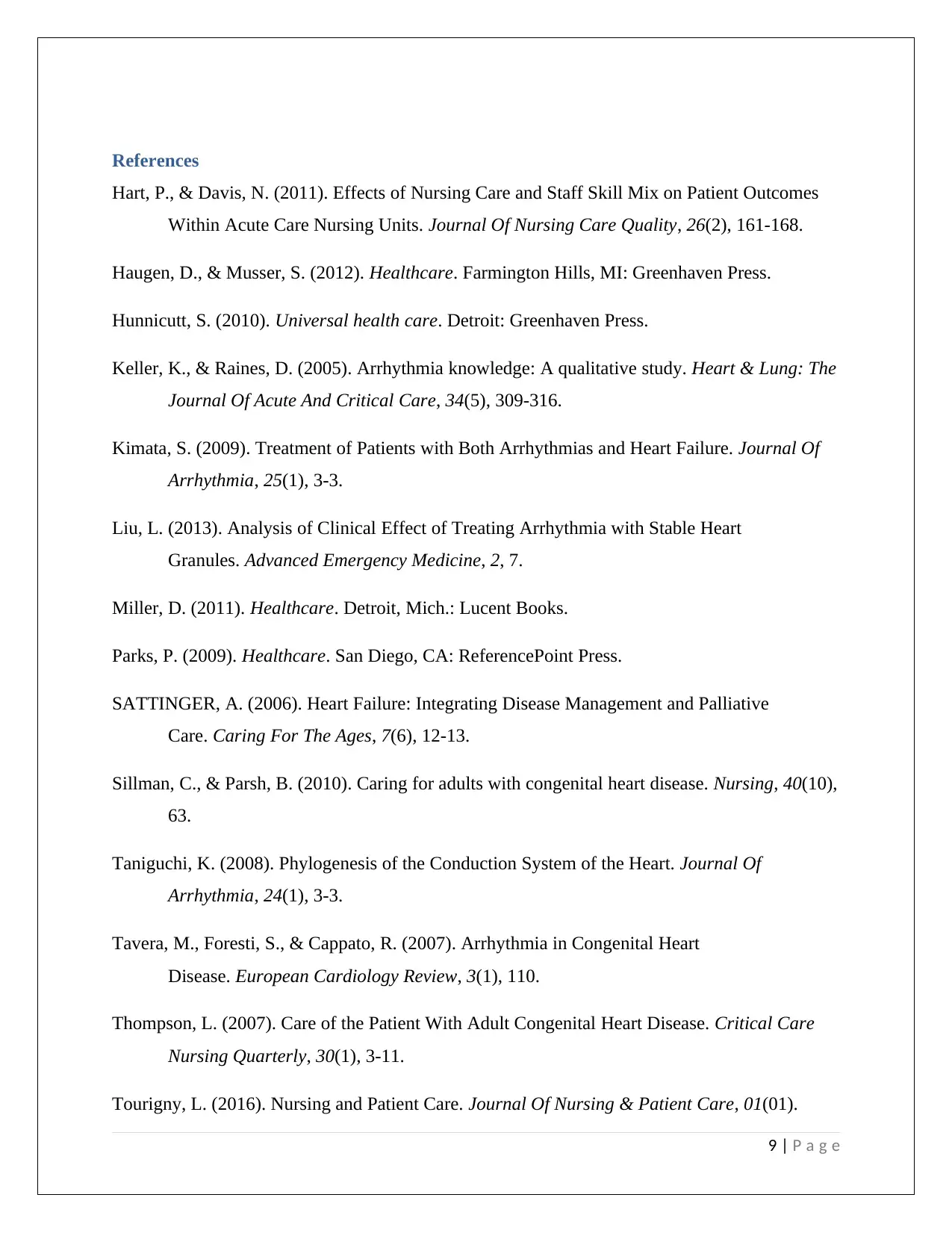
References
Hart, P., & Davis, N. (2011). Effects of Nursing Care and Staff Skill Mix on Patient Outcomes
Within Acute Care Nursing Units. Journal Of Nursing Care Quality, 26(2), 161-168.
Haugen, D., & Musser, S. (2012). Healthcare. Farmington Hills, MI: Greenhaven Press.
Hunnicutt, S. (2010). Universal health care. Detroit: Greenhaven Press.
Keller, K., & Raines, D. (2005). Arrhythmia knowledge: A qualitative study. Heart & Lung: The
Journal Of Acute And Critical Care, 34(5), 309-316.
Kimata, S. (2009). Treatment of Patients with Both Arrhythmias and Heart Failure. Journal Of
Arrhythmia, 25(1), 3-3.
Liu, L. (2013). Analysis of Clinical Effect of Treating Arrhythmia with Stable Heart
Granules. Advanced Emergency Medicine, 2, 7.
Miller, D. (2011). Healthcare. Detroit, Mich.: Lucent Books.
Parks, P. (2009). Healthcare. San Diego, CA: ReferencePoint Press.
SATTINGER, A. (2006). Heart Failure: Integrating Disease Management and Palliative
Care. Caring For The Ages, 7(6), 12-13.
Sillman, C., & Parsh, B. (2010). Caring for adults with congenital heart disease. Nursing, 40(10),
63.
Taniguchi, K. (2008). Phylogenesis of the Conduction System of the Heart. Journal Of
Arrhythmia, 24(1), 3-3.
Tavera, M., Foresti, S., & Cappato, R. (2007). Arrhythmia in Congenital Heart
Disease. European Cardiology Review, 3(1), 110.
Thompson, L. (2007). Care of the Patient With Adult Congenital Heart Disease. Critical Care
Nursing Quarterly, 30(1), 3-11.
Tourigny, L. (2016). Nursing and Patient Care. Journal Of Nursing & Patient Care, 01(01).
9 | P a g e
Hart, P., & Davis, N. (2011). Effects of Nursing Care and Staff Skill Mix on Patient Outcomes
Within Acute Care Nursing Units. Journal Of Nursing Care Quality, 26(2), 161-168.
Haugen, D., & Musser, S. (2012). Healthcare. Farmington Hills, MI: Greenhaven Press.
Hunnicutt, S. (2010). Universal health care. Detroit: Greenhaven Press.
Keller, K., & Raines, D. (2005). Arrhythmia knowledge: A qualitative study. Heart & Lung: The
Journal Of Acute And Critical Care, 34(5), 309-316.
Kimata, S. (2009). Treatment of Patients with Both Arrhythmias and Heart Failure. Journal Of
Arrhythmia, 25(1), 3-3.
Liu, L. (2013). Analysis of Clinical Effect of Treating Arrhythmia with Stable Heart
Granules. Advanced Emergency Medicine, 2, 7.
Miller, D. (2011). Healthcare. Detroit, Mich.: Lucent Books.
Parks, P. (2009). Healthcare. San Diego, CA: ReferencePoint Press.
SATTINGER, A. (2006). Heart Failure: Integrating Disease Management and Palliative
Care. Caring For The Ages, 7(6), 12-13.
Sillman, C., & Parsh, B. (2010). Caring for adults with congenital heart disease. Nursing, 40(10),
63.
Taniguchi, K. (2008). Phylogenesis of the Conduction System of the Heart. Journal Of
Arrhythmia, 24(1), 3-3.
Tavera, M., Foresti, S., & Cappato, R. (2007). Arrhythmia in Congenital Heart
Disease. European Cardiology Review, 3(1), 110.
Thompson, L. (2007). Care of the Patient With Adult Congenital Heart Disease. Critical Care
Nursing Quarterly, 30(1), 3-11.
Tourigny, L. (2016). Nursing and Patient Care. Journal Of Nursing & Patient Care, 01(01).
9 | P a g e
Paraphrase This Document
Need a fresh take? Get an instant paraphrase of this document with our AI Paraphraser

10 | P a g e

1 out of 11


Related Documents


Your All-in-One AI-Powered Toolkit for Academic Success.
+13062052269
info@desklib.com
Available 24*7 on WhatsApp / Email
![[object Object]](/_next/static/media/star-bottom.7253800d.svg)
Unlock your academic potential
Copyright © 2020–2026 A2Z Services. All Rights Reserved. Developed and managed by ZUCOL.