Similarities: Caste System in India and Race in USA Discussion

Verified

Added on  2022/08/23

|5
|760
|8
Discussion Board Post
AI Summary
This discussion post explores the similarities between the caste system in India and race relations in the USA, highlighting institutional parallels and their impact on affirmative action programs. It notes that both systems involve the oppression and exploitation of specific groups, including lower castes, indigenous populations, and women. The post examines the historical context of affirmative action in both countries, noting the British influence in India's quota system and the legacy of racial inequality in the US. It references Jim Crow laws and the struggle for equality, emphasizing the ongoing debate and varying opinions surrounding affirmative action implementation. The discussion concludes by pointing out the significant impact of these systems on organizations in both nations, particularly regarding discrimination, prejudice, and incentive programs.
Document Page
Running Head: POST TOPIC DISCUSSION
Post Topic Discussion
Name of the Student:
Name of the University:
Author Note:
tabler-icon-diamond-filled.svg

Paraphrase This Document

Need a fresh take? Get an instant paraphrase of this document with our AI Paraphraser
Document Page
1POST TOPIC DISCUSSION
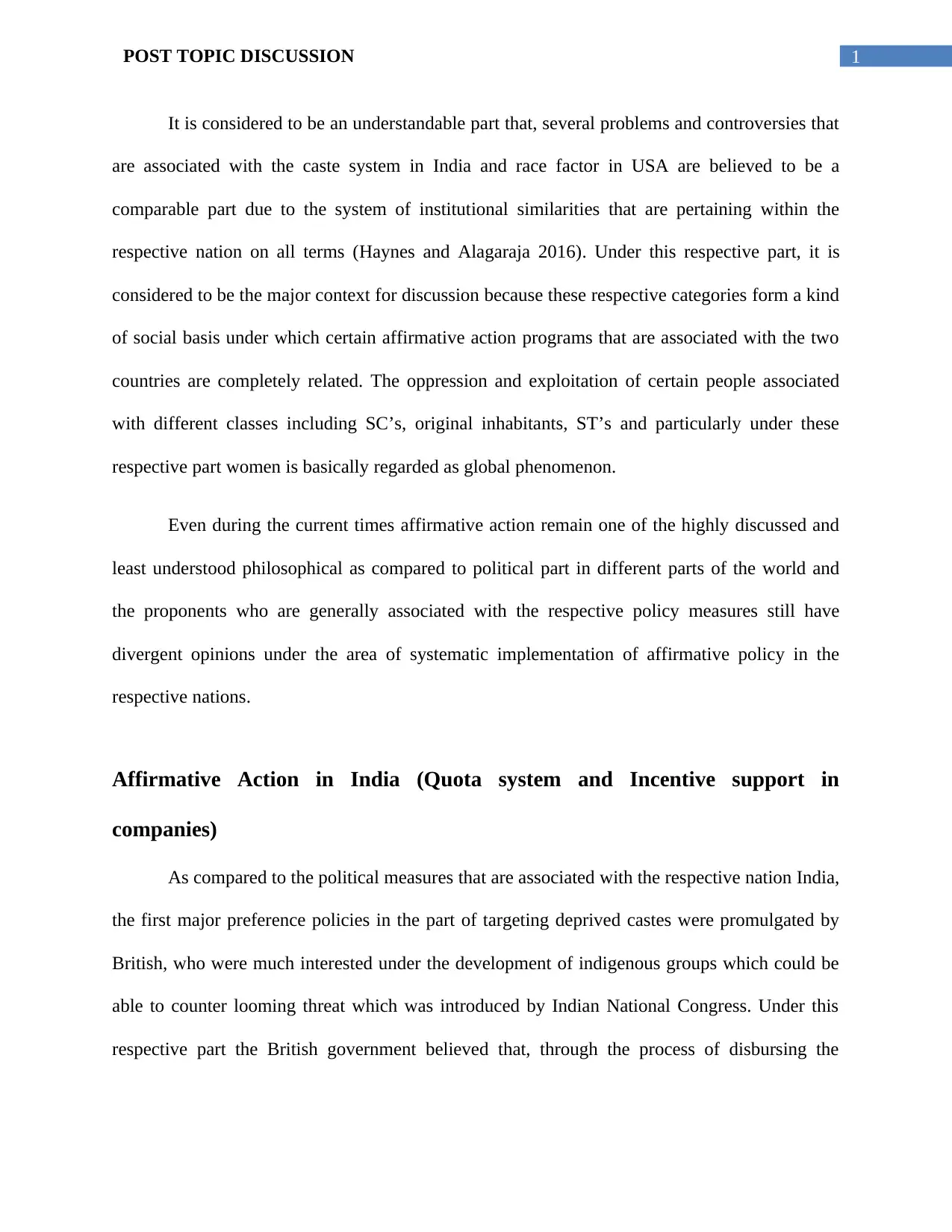
It is considered to be an understandable part that, several problems and controversies that
are associated with the caste system in India and race factor in USA are believed to be a
comparable part due to the system of institutional similarities that are pertaining within the
respective nation on all terms (Haynes and Alagaraja 2016). Under this respective part, it is
considered to be the major context for discussion because these respective categories form a kind
of social basis under which certain affirmative action programs that are associated with the two
countries are completely related. The oppression and exploitation of certain people associated
with different classes including SC’s, original inhabitants, ST’s and particularly under these
respective part women is basically regarded as global phenomenon.
Even during the current times affirmative action remain one of the highly discussed and
least understood philosophical as compared to political part in different parts of the world and
the proponents who are generally associated with the respective policy measures still have
divergent opinions under the area of systematic implementation of affirmative policy in the
respective nations.
Affirmative Action in India (Quota system and Incentive support in
companies)
As compared to the political measures that are associated with the respective nation India,
the first major preference policies in the part of targeting deprived castes were promulgated by
British, who were much interested under the development of indigenous groups which could be
able to counter looming threat which was introduced by Indian National Congress. Under this
respective part the British government believed that, through the process of disbursing the
Document Page
2POST TOPIC DISCUSSION
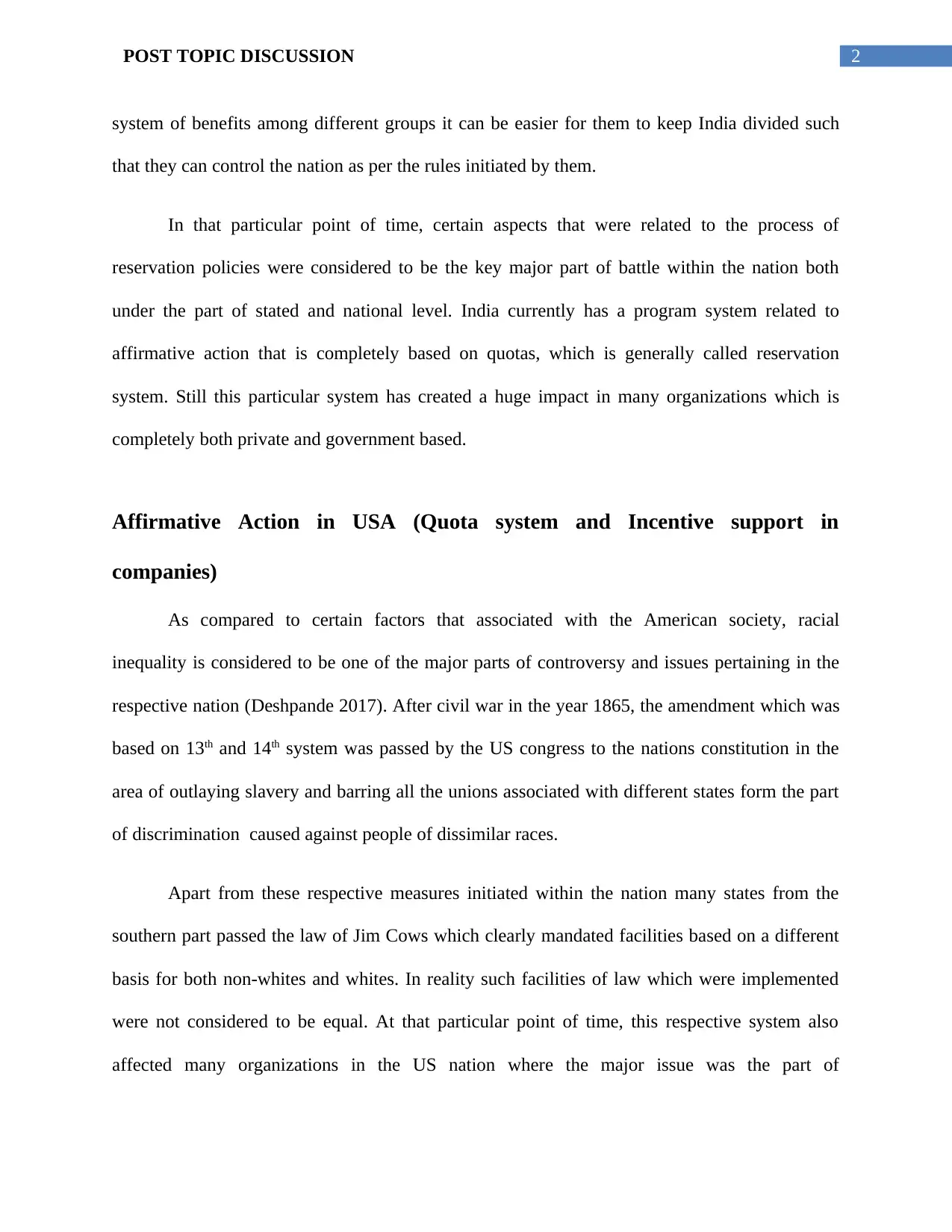
system of benefits among different groups it can be easier for them to keep India divided such
that they can control the nation as per the rules initiated by them.
In that particular point of time, certain aspects that were related to the process of
reservation policies were considered to be the key major part of battle within the nation both
under the part of stated and national level. India currently has a program system related to
affirmative action that is completely based on quotas, which is generally called reservation
system. Still this particular system has created a huge impact in many organizations which is
completely both private and government based.
Affirmative Action in USA (Quota system and Incentive support in
companies)
As compared to certain factors that associated with the American society, racial
inequality is considered to be one of the major parts of controversy and issues pertaining in the
respective nation (Deshpande 2017). After civil war in the year 1865, the amendment which was
based on 13th and 14th system was passed by the US congress to the nations constitution in the
area of outlaying slavery and barring all the unions associated with different states form the part
of discrimination caused against people of dissimilar races.
Apart from these respective measures initiated within the nation many states from the
southern part passed the law of Jim Cows which clearly mandated facilities based on a different
basis for both non-whites and whites. In reality such facilities of law which were implemented
were not considered to be equal. At that particular point of time, this respective system also
affected many organizations in the US nation where the major issue was the part of
Document Page
3POST TOPIC DISCUSSION
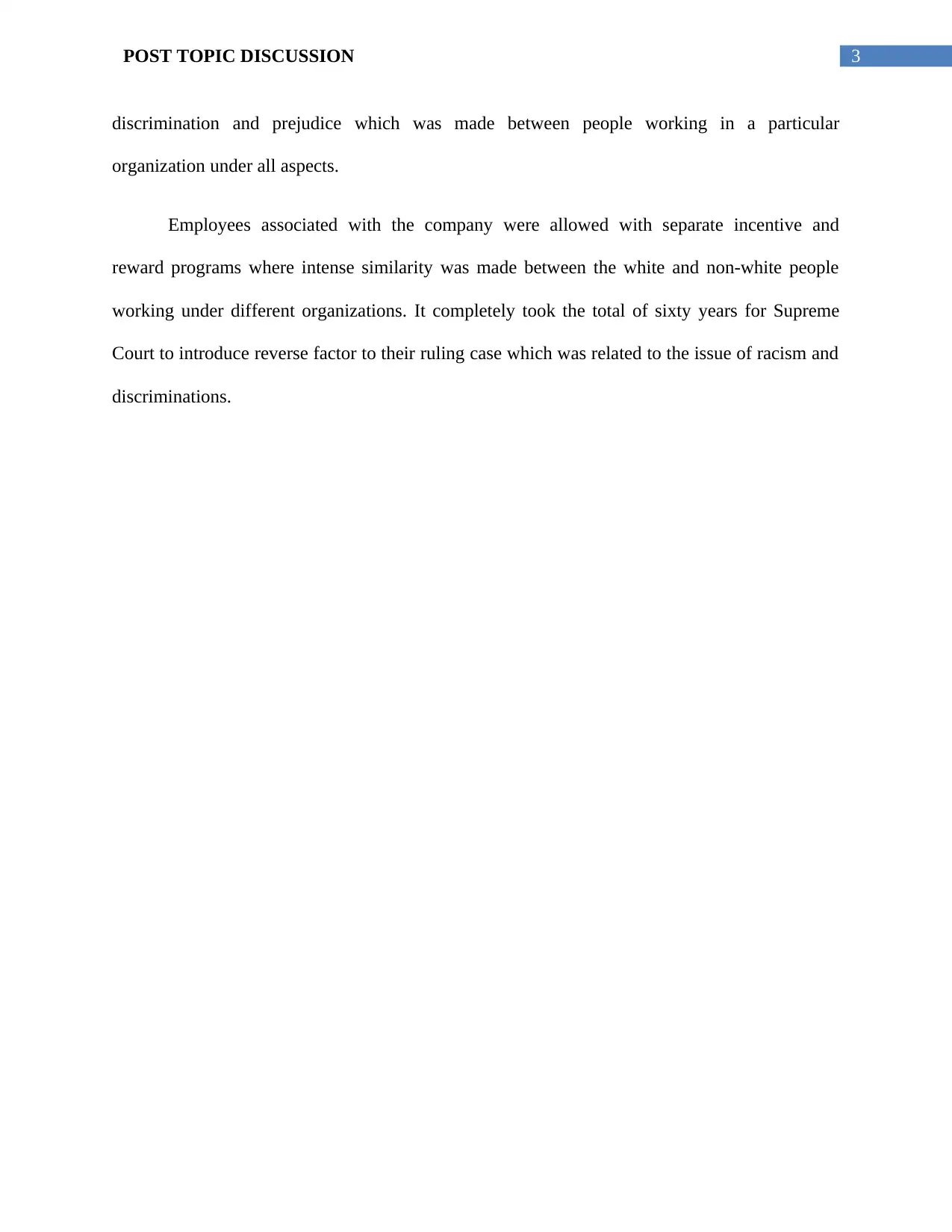
discrimination and prejudice which was made between people working in a particular
organization under all aspects.
Employees associated with the company were allowed with separate incentive and
reward programs where intense similarity was made between the white and non-white people
working under different organizations. It completely took the total of sixty years for Supreme
Court to introduce reverse factor to their ruling case which was related to the issue of racism and
discriminations.
tabler-icon-diamond-filled.svg

Paraphrase This Document

Need a fresh take? Get an instant paraphrase of this document with our AI Paraphraser
Document Page
4POST TOPIC DISCUSSION
References
Deshpande, A., 2017. Affirmative action in India. In Race and Inequality (pp. 77-90). Routledge.
Haynes, R. and Alagaraja, M., 2016. On the discourse of affirmative action and reservation in the
United States and India: clarifying HRD’s role in fostering global diversity. Advances in
Developing Human Resources, 18(1), pp.69-87.
chevron_up_icon
1 out of 5
circle_padding
hide_on_mobile
zoom_out_icon
[object Object]