CB205 Case Study: Analyzing International HRM at Hewlett-Packard

Verified

Added on  2023/04/05

|7
|1716
|135
Case Study
AI Summary
This case study delves into the International Human Resource Management (HRM) practices at Hewlett-Packard (HP), a multinational company with a rich history in the IT sector. It examines HP's strategies for hiring, training, and retaining employees, emphasizing the company's focus on cultural fit and adaptability. The study identifies several challenges HP faces, including adapting to rapid technological advancements, managing geographic diversity, and retaining exceptional employees. Recommendations are provided to address these challenges, such as customizing management styles for different locations, improving the Management by Objectives (MBO) process, and mitigating frustration among new employees. The case study concludes by highlighting the importance of effective HRM in a multinational company like HP and emphasizing the need for continuous improvement and adaptation to maintain a competitive advantage.
Document Page
International Human Resource Management
1
tabler-icon-diamond-filled.svg

Paraphrase This Document

Need a fresh take? Get an instant paraphrase of this document with our AI Paraphraser
Document Page
2
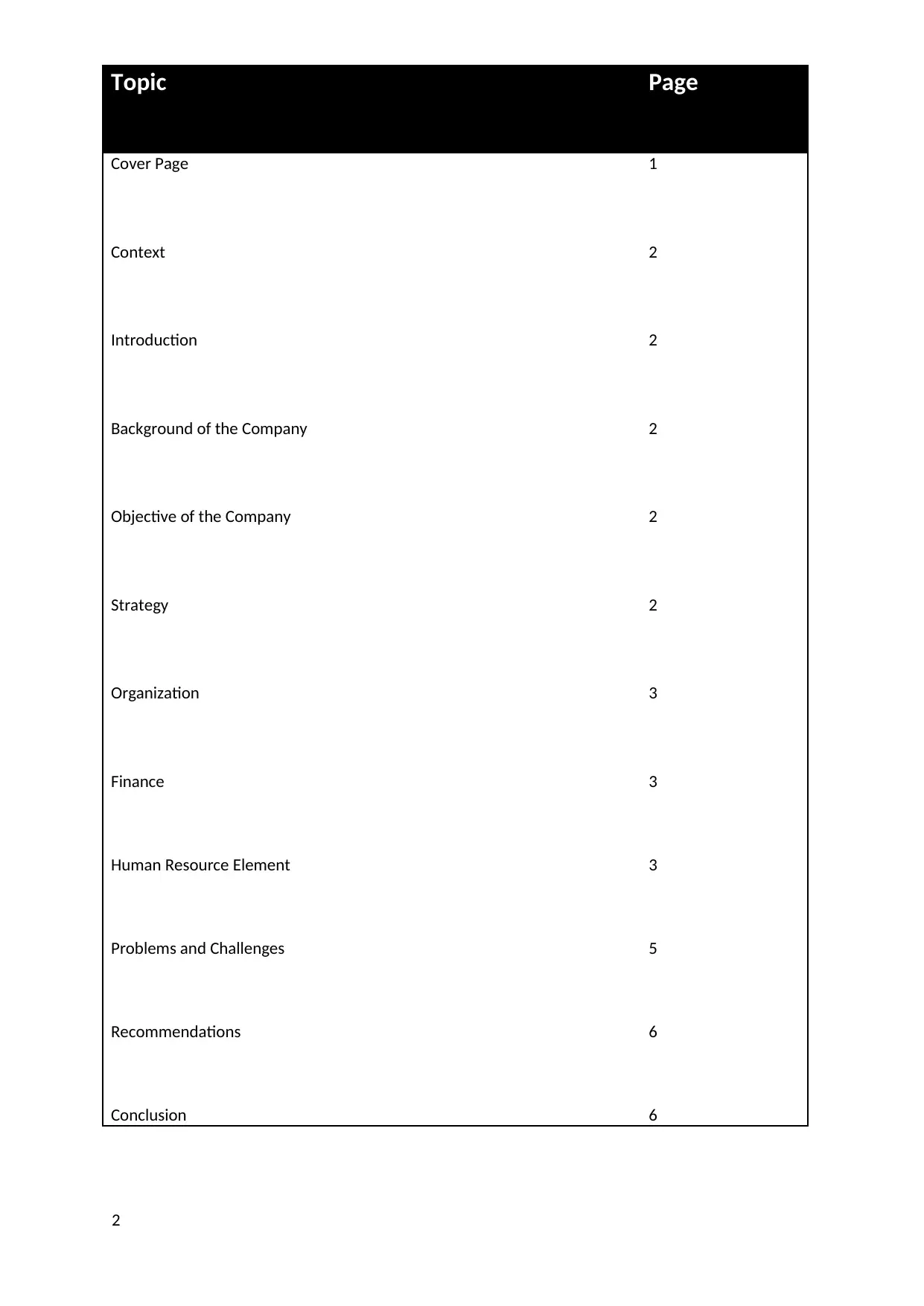
Topic Page
Cover Page 1
Context 2
Introduction 2
Background of the Company 2
Objective of the Company 2
Strategy 2
Organization 3
Finance
Human Resource Element
Problems and Challenges
Recommendations
Conclusion
3
3
5
6
6
Document Page
Introduction
The Human Resource is a department within an organization which is responsible for all the
issues related with employees. They help in making up the workforce of a business or an
organization. The Human Resource Management of an organization has to deal with many
challenges, and has to plan new ways which will help the company to make changes based on
their desired outcomes, to meet its goals.
This assignment is to study the concept of Human Resource Management of a multinational
company Hewlett-Packard (HP). The company HP was the creation of two electrical
engineers in 1938, Bill Hewlett and Dave Packard. It first started as a company for small
electronic instruments, and now it has become one of the largest companies in the IT sector
globally. The company is very selective in accepting candidates for jobs, as they are more
interested in the candidate’s adaptability, skills and interest in learning new things. To get the
best out of each employee, HP uses a process of administration of salary, and a competitive
performance appreciation for the employees. Here the employee with highest skills and
highest performance gets a higher wage. In the upcoming years, HP is going to face many
troubles regarding adaptability, and the durability of the methods used by the managers for
the betterment of HP. This will happen as technology has come a long way since the
beginning, and everyone is aiming to be at the top, thus making the problems of the company,
more complex.
Background of the Company
The “Hewlett-Packard Company (HP)” Was set up by Bill Hewlett and Dave Packard in
1939. They started the company in a garage, and started by producing electronic test and
measuring instruments. Later they added computers, calculators, electronic devices, and by
1980, their sales hit 3.01 billion US dollars. Their sales had increased by 23% at a compound
rate, and their profit had increased by 27% (Hp.com, 2019).
Objective of the Company
For an organization to achieve its goals, it must have some objectives. HP, to achieve its
goals, published writing on “Objectives of Hewlett-Packard Company” in 1957. The writing
was given to all the employees. The objectives had some minor modifications over the years
(Hp.com, 2019).
Strategy
Focussing on research and development of new products with new technologies, other
than focussing on the marketing.
3
Document Page
Stressing on the new technologies and profits rather than more volume of devices.
Maintenance of flexibility and responses by giving responsibility to specific teams
and authority to carryout required tasks.
Organization
In HP, product division is the fundamental unit of business. Six basic functions must be
present in an organization of manufacturing, R&D, marketing, finance, personnel, and quality
assurance. A new division starts to emerge, when a single division becomes very large. By
1980, HP had a total of 40 divisions (Hp.com, 2019). The activities of the divisions were
coordinated by ten groups of products. Each group has a responsibility for managing the
overall financial operations and the member’s performance. Reports of the groups are
discussed for doing some non divisional operations of manufacturing. Products selling in the
form of cross-groups are still active.
Finance
Stressing on the self-financing results in the reduction of debt in long term and
borrowing from foreign for international activities of the company (Glasserman and
Young, 2016).
Focussing on assets management, particularly in the inventory.
Reporting of the details and work from each division provides in seeing the success
and development of each division in the management worldwide.
Success of each division is based on two things – the results of each division
financially as current work and planned, and the total work of the division worldwide
on the basis of products.
Each group produces a balance sheet for cross checking.
Human Resource Elements
Hiring and Training of Candidates
HP is very selective in considering the job for candidates. A great importance is given on the
cultural fit and adaptability of the candidate, because they hire these candidates for a
permanent basis, not for some specific skills required for a temporary period of time (Lu and
Liou, 2015). It thus helps the other employees to stay positive towards each other and
promote inside growth. The possibility for someone getting hired for the position of manager
is very low. Most of the new employees are frustrated as it takes them time to adapt
themselves to the HP working style. So, to prevent this, a four half-day module is presented
to groups of people of less than 30 employees known as “Working at HP” (Jelsma et al.
4
tabler-icon-diamond-filled.svg

Paraphrase This Document

Need a fresh take? Get an instant paraphrase of this document with our AI Paraphraser
Document Page
2019). It is said that this way is most effective when presented to employees after they have
worked for 6 months. These modules contain all the necessary information including the HP
history, its style, policies, performance, personnel, and development of the employees.
Findings
The various skills at HP and the competencies and the production of newly hired HP
employees are very much alike for the non HP workers. Thus most of the experienced
workers from other companies want to work at HP.
A comprehensive system called MBO is used for directing the employees for their
day to day work primarily. MBO is an iterative process and the work of the
employees is based on the objectives of the company derived from the divisions, both
long term and short term.
Management by Wandering About – is an initiative taken by the HP Company for the
open door policy, as an important outgrowth. All the managers at each level are
encouraged to wander throughout the organization in a part of each day. MBWA also
requires division reviews and is coupled with communication devices by high
executives (Obeidat, Al-Dmour and Tarhini, 2015).
Performance of each employee is reviewed on a quarterly basis, thus helping the
workers to maintain pay in equity and spread the accomplishment of employees
throughout the company (Chesser, 2017).
Initiated in 1940, all the employees will have the same share of profit and options for
stock eligibility. Thus the situation will become win-win for everyone.
The timing is flexible.
Problems and Challenges
They face challenges about the adaptability and the durability of the methods used by
the company and the managers. The challenge includes the compounding growth
pressure, newer technologies for the upcoming times, and the increased competition
(Noe, Hollenbeck, Gerhart and Wright, 2017).
The increased problems of hiring new employees and supervisors due to the increased
spread of operations geographically throughout the world, making geographic
diversity, HP are another issue.
The former employees at HP have been the main source of new innovative start-ups in
“Silicon Valley”. These examples make the employees to think out of the box, and it
becomes harder to retain the unexceptional employees (Asrar-ul-Haq and Anwar,
2016).
The challenge in continuing to provide an effective leadership is very critical
especially for the executives of the company.
Recommendations
5
Document Page
There are some experienced employees from renowned companies who have great
skills, but to enter HP, they don’t get that proper opportunity. Thus, it will be a really
good idea for the company to give opportunity to those workers who want to enter
HP, due to their talents and experience. This will help to broaden the thinking of the
company, providing new ideas.
HP uses the same style of management in US and other locations, which lead us to
recommending the management style customization. It is really important for HP as it
will help to overcome the problems related to geographical and cultural barriers.
The Management by Objective (MBO) form is filled by each employee for their own
job, but it sometimes over emphasises on setting the goals rather than working out a
plan. The importance of context or environment is under emphasised. Thus, the use of
MBO must be properly put in order with the organization’s culture. If this approach is
set improperly, and managed and agreed by the organization, it could lead to damage,
including counter productiveness.
As the new employees at all the levels incline to go through a period of adjustments,
which include frustration most of the time, they need to be careful and make sure that
these frustrations are limited, otherwise it may discourage the newer employees.
Conclusion
HP is a multinational company with large problems in the Department of Human Resource
and Management. But the Human Resource employees work for the development of the
company and to fix the problems. This project has given me a vast amount of knowledge
regarding the work of Human Resource in an organization and its importance. It has also
given some great ideas and strategies on how to solve the problems while working in a
multinational company. Through this project, I have also learned much about the company.
6
Document Page
References
Asrar-ul-Haq, M. and Anwar, S., 2016. A systematic review of knowledge management and
knowledge sharing: Trends, issues, and challenges. Cogent Business & Management, 3(1),
p.1127744.
Chesser, J., 2017. Human Resource Management in a Hospitality Environment. Apple
Academic Press, California
Hp.com, (2019) HP Available from
http://www.hp.com/hpinfo/abouthp/histnfacts/publications/measure/pdf/1975_04-05.pdf
Accessed on 22 April 2019
Hp.com, (2019) HP Available from
https://www8.hp.com/us/en/hp-information/about-hp/history/hp-timeline/timeline.html
Accessed on 21April 2019
Jelsma, J.G., Renaud, L.R., Huysmans, M.A., Coffeng, J.K., Loyen, A., van Nassau, F.,
Bosmans, J.E., Speklé, E.M., van der Beek, A.J. and van der Ploeg, H.P., 2019. The Dynamic
Work study: study protocol of a cluster randomized controlled trial of an occupational health
intervention aimed at reducing sitting time in office workers. BMC public health, 19(1),
p.188.
Lu, H.P. and Liou, H.R., 2015. Impacts of Business Companies' Recruitment Advertisements,
Publicity, Sponsorship, and Word-of-Mouth on Graduating Students' Job Pursuit
Intentions. Journal of Accounting, Finance & Management Strategy, 10(1).
Noe, R.A., Hollenbeck, J.R., Gerhart, B. and Wright, P.M., 2017. Human resource
management: Gaining a competitive advantage. New York, NY: McGraw-Hill Education
Obeidat, B.Y., Al-Dmour, R.H. and Tarhini, A., 2015. Knowledge management strategies as
intermediary variables between itbusiness strategic alignment and firm
performance. European scientific journal, ESJ, 11(7)
7
chevron_up_icon
1 out of 7
circle_padding
hide_on_mobile
zoom_out_icon
[object Object]