Ethical Implications of CBA Personal Overdrafts: A Financial Analysis

Verified

Added on  2023/01/12

|5
|1276
|33
Essay
AI Summary
This essay delves into the ethical considerations surrounding CBA personal overdrafts, examining a specific case where a programming error in the automated serviceability calculator led to incorrect approvals and non-compliance with the NCCP Act. The essay discusses the ethical responsibilities of financial institutions, the importance of ethical conduct in financial services, and the consequences of unethical practices, including financial penalties and reputational damage. It highlights the roles of ethical guidelines, social norms, and regulations in ensuring fair conduct and preventing fraud. The essay also explores the actions that an ethical banker or CEO could have taken to prevent or mitigate the situation, emphasizing the need for regular audits, transparent communication, and accountability. References from Sidgwick, Fryer, Walumbwa, Skorin-Kapov, and Hildebrandt are included to support the arguments.
Document Page
CBA personal overdrafts
tabler-icon-diamond-filled.svg

Paraphrase This Document

Need a fresh take? Get an instant paraphrase of this document with our AI Paraphraser
Document Page
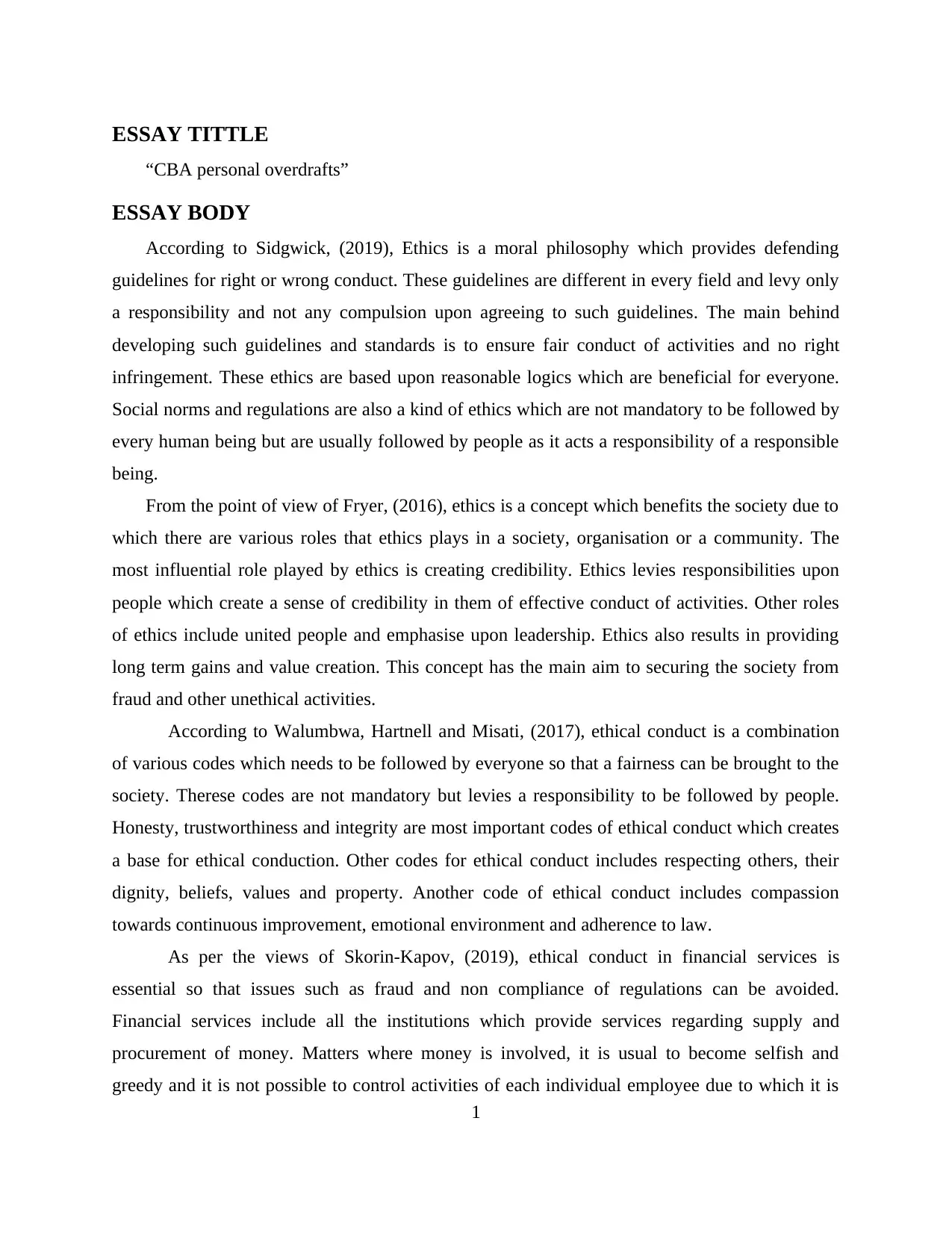
ESSAY TITTLE
“CBA personal overdrafts”
ESSAY BODY
According to Sidgwick, (2019), Ethics is a moral philosophy which provides defending
guidelines for right or wrong conduct. These guidelines are different in every field and levy only
a responsibility and not any compulsion upon agreeing to such guidelines. The main behind
developing such guidelines and standards is to ensure fair conduct of activities and no right
infringement. These ethics are based upon reasonable logics which are beneficial for everyone.
Social norms and regulations are also a kind of ethics which are not mandatory to be followed by
every human being but are usually followed by people as it acts a responsibility of a responsible
being.
From the point of view of Fryer, (2016), ethics is a concept which benefits the society due to
which there are various roles that ethics plays in a society, organisation or a community. The
most influential role played by ethics is creating credibility. Ethics levies responsibilities upon
people which create a sense of credibility in them of effective conduct of activities. Other roles
of ethics include united people and emphasise upon leadership. Ethics also results in providing
long term gains and value creation. This concept has the main aim to securing the society from
fraud and other unethical activities.
According to Walumbwa, Hartnell and Misati, (2017), ethical conduct is a combination
of various codes which needs to be followed by everyone so that a fairness can be brought to the
society. Therese codes are not mandatory but levies a responsibility to be followed by people.
Honesty, trustworthiness and integrity are most important codes of ethical conduct which creates
a base for ethical conduction. Other codes for ethical conduct includes respecting others, their
dignity, beliefs, values and property. Another code of ethical conduct includes compassion
towards continuous improvement, emotional environment and adherence to law.
As per the views of Skorin-Kapov, (2019), ethical conduct in financial services is
essential so that issues such as fraud and non compliance of regulations can be avoided.
Financial services include all the institutions which provide services regarding supply and
procurement of money. Matters where money is involved, it is usual to become selfish and
greedy and it is not possible to control activities of each individual employee due to which it is
1
Document Page
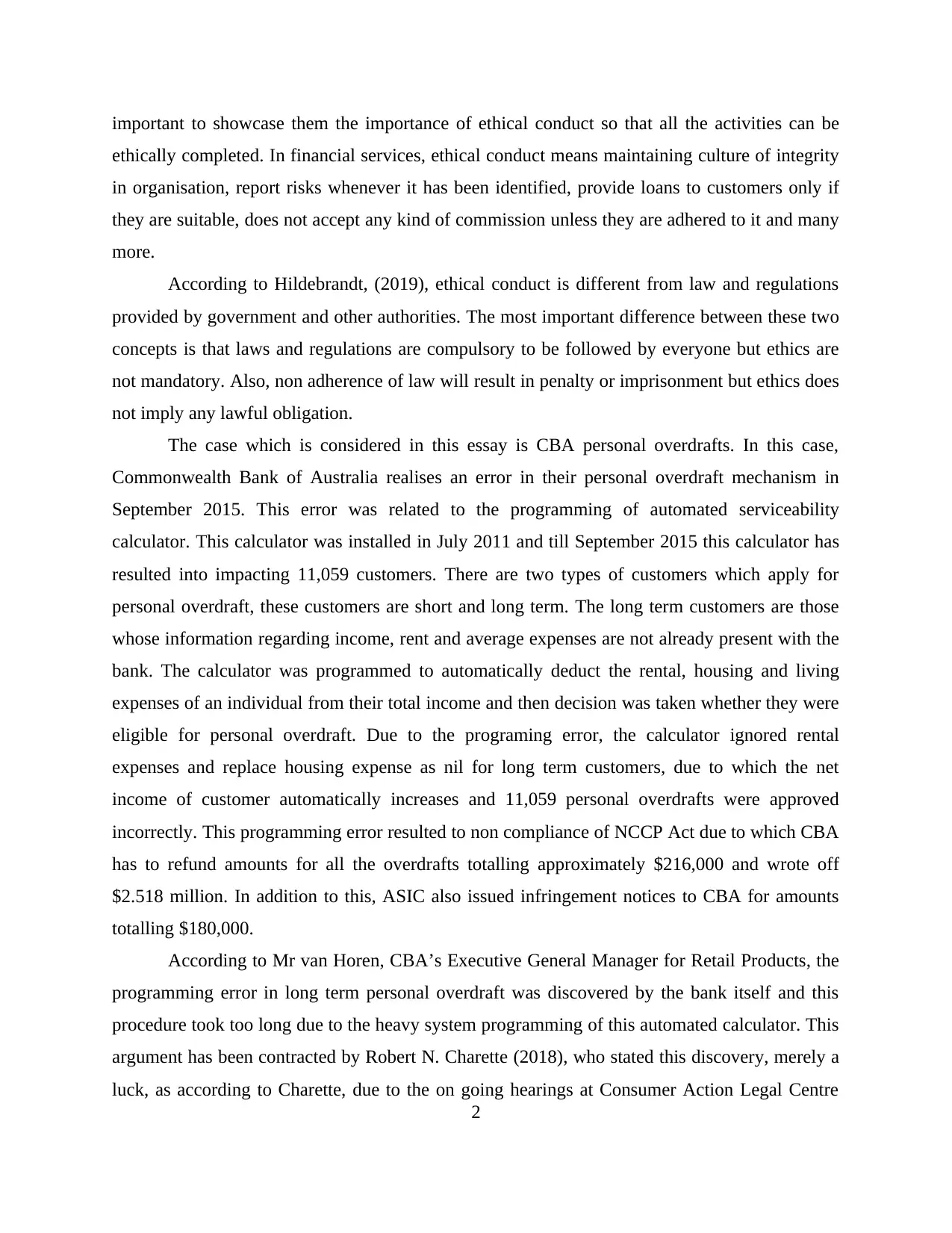
important to showcase them the importance of ethical conduct so that all the activities can be
ethically completed. In financial services, ethical conduct means maintaining culture of integrity
in organisation, report risks whenever it has been identified, provide loans to customers only if
they are suitable, does not accept any kind of commission unless they are adhered to it and many
more.
According to Hildebrandt, (2019), ethical conduct is different from law and regulations
provided by government and other authorities. The most important difference between these two
concepts is that laws and regulations are compulsory to be followed by everyone but ethics are
not mandatory. Also, non adherence of law will result in penalty or imprisonment but ethics does
not imply any lawful obligation.
The case which is considered in this essay is CBA personal overdrafts. In this case,
Commonwealth Bank of Australia realises an error in their personal overdraft mechanism in
September 2015. This error was related to the programming of automated serviceability
calculator. This calculator was installed in July 2011 and till September 2015 this calculator has
resulted into impacting 11,059 customers. There are two types of customers which apply for
personal overdraft, these customers are short and long term. The long term customers are those
whose information regarding income, rent and average expenses are not already present with the
bank. The calculator was programmed to automatically deduct the rental, housing and living
expenses of an individual from their total income and then decision was taken whether they were
eligible for personal overdraft. Due to the programing error, the calculator ignored rental
expenses and replace housing expense as nil for long term customers, due to which the net
income of customer automatically increases and 11,059 personal overdrafts were approved
incorrectly. This programming error resulted to non compliance of NCCP Act due to which CBA
has to refund amounts for all the overdrafts totalling approximately $216,000 and wrote off
$2.518 million. In addition to this, ASIC also issued infringement notices to CBA for amounts
totalling $180,000.
According to Mr van Horen, CBA’s Executive General Manager for Retail Products, the
programming error in long term personal overdraft was discovered by the bank itself and this
procedure took too long due to the heavy system programming of this automated calculator. This
argument has been contracted by Robert N. Charette (2018), who stated this discovery, merely a
luck, as according to Charette, due to the on going hearings at Consumer Action Legal Centre
2
Document Page
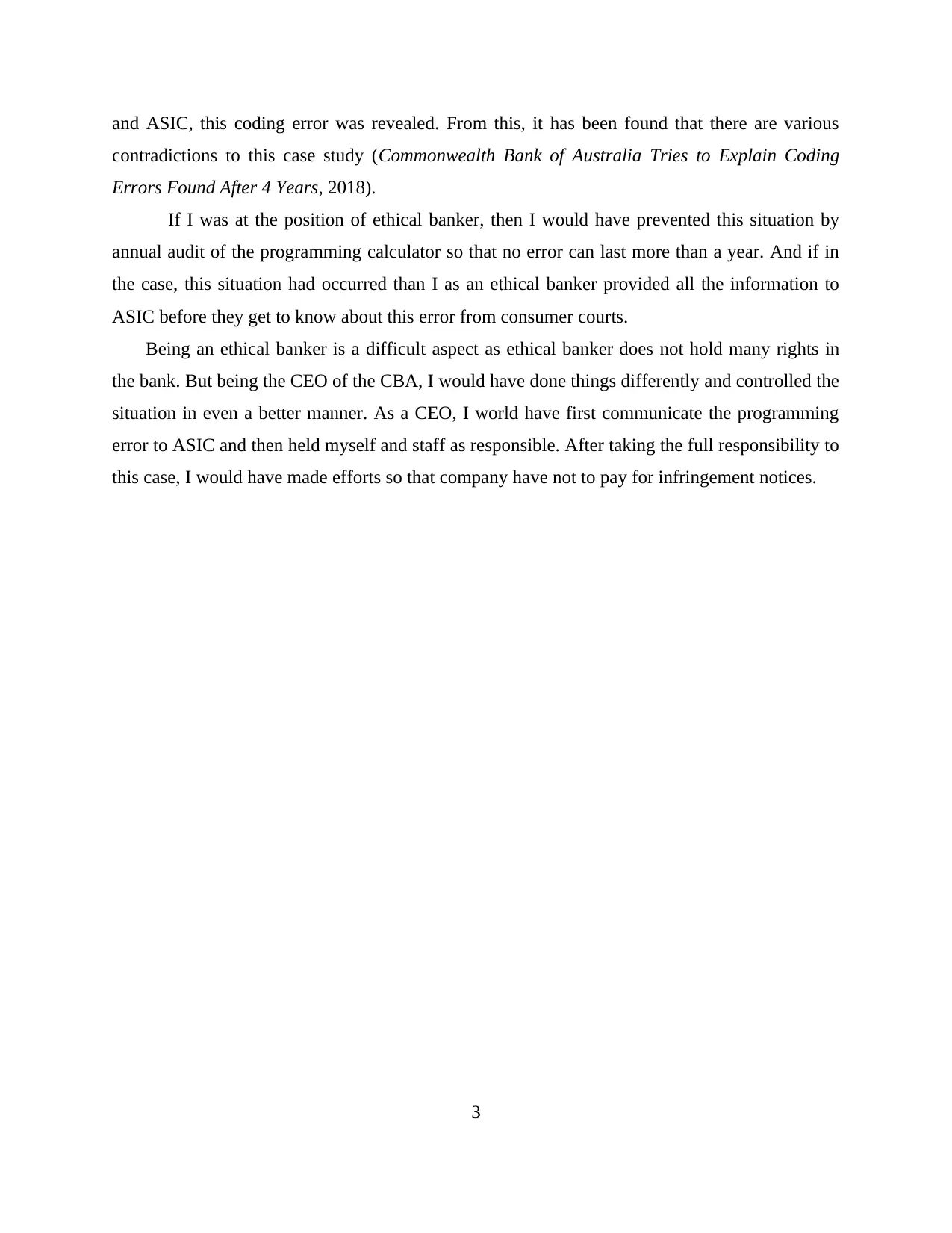
and ASIC, this coding error was revealed. From this, it has been found that there are various
contradictions to this case study (Commonwealth Bank of Australia Tries to Explain Coding
Errors Found After 4 Years, 2018).
If I was at the position of ethical banker, then I would have prevented this situation by
annual audit of the programming calculator so that no error can last more than a year. And if in
the case, this situation had occurred than I as an ethical banker provided all the information to
ASIC before they get to know about this error from consumer courts.
Being an ethical banker is a difficult aspect as ethical banker does not hold many rights in
the bank. But being the CEO of the CBA, I would have done things differently and controlled the
situation in even a better manner. As a CEO, I world have first communicate the programming
error to ASIC and then held myself and staff as responsible. After taking the full responsibility to
this case, I would have made efforts so that company have not to pay for infringement notices.
3
tabler-icon-diamond-filled.svg

Paraphrase This Document

Need a fresh take? Get an instant paraphrase of this document with our AI Paraphraser
Document Page
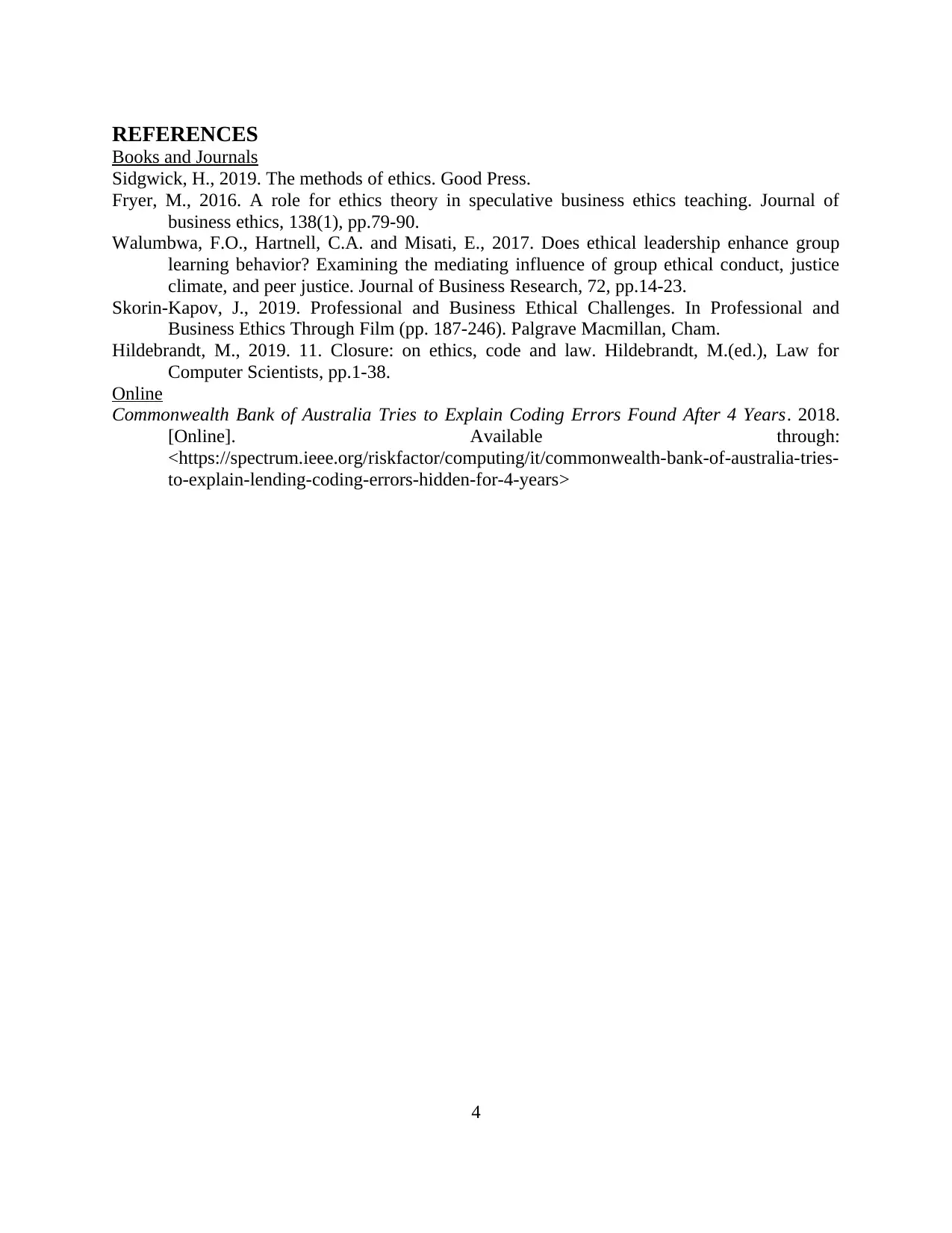
REFERENCES
Books and Journals
Sidgwick, H., 2019. The methods of ethics. Good Press.
Fryer, M., 2016. A role for ethics theory in speculative business ethics teaching. Journal of
business ethics, 138(1), pp.79-90.
Walumbwa, F.O., Hartnell, C.A. and Misati, E., 2017. Does ethical leadership enhance group
learning behavior? Examining the mediating influence of group ethical conduct, justice
climate, and peer justice. Journal of Business Research, 72, pp.14-23.
Skorin-Kapov, J., 2019. Professional and Business Ethical Challenges. In Professional and
Business Ethics Through Film (pp. 187-246). Palgrave Macmillan, Cham.
Hildebrandt, M., 2019. 11. Closure: on ethics, code and law. Hildebrandt, M.(ed.), Law for
Computer Scientists, pp.1-38.
Online
Commonwealth Bank of Australia Tries to Explain Coding Errors Found After 4 Years. 2018.
[Online]. Available through:
<https://spectrum.ieee.org/riskfactor/computing/it/commonwealth-bank-of-australia-tries-
to-explain-lending-coding-errors-hidden-for-4-years>
4
chevron_up_icon
1 out of 5
circle_padding
hide_on_mobile
zoom_out_icon
[object Object]