CBPM4103 IT Project Management: A Green Cloud Computing Project Plan
VerifiedAdded on 2023/06/11
|9
|2035
|146
Report
AI Summary
This report outlines a green cloud computing project, emphasizing its environmental benefits and business value. It covers key aspects such as project objectives, scope, and feasibility, including technical, operational, and financial considerations. The report identifies potential risks associated with cloud computing, such as data breaches and unauthorized access, and suggests mitigation strategies. It also explores the business opportunities presented by green cloud computing, including enhanced efficiency, improved communication, and reduced infrastructure costs. The project schedule and work breakdown structure are detailed, providing a roadmap for implementation. The report concludes by highlighting the importance of energy efficiency and waste reduction in green computing initiatives. Desklib offers a platform for students to access this and other solved assignments for academic support.
Running head: IT PROJECT MANAGEMENT
IT Project Management
Name of the Student
Name of the University
Author Note
IT Project Management
Name of the Student
Name of the University
Author Note

Paraphrase This Document
Need a fresh take? Get an instant paraphrase of this document with our AI Paraphraser
1IT PROJECT MANAGEMENT
Table of Contents
Overview of the Project:............................................................................................................2
Objectives of the Project:...........................................................................................................2
Scope of the Project:..................................................................................................................3
Feasibility Study:.......................................................................................................................3
Risks related to the Project:........................................................................................................4
Business Opportunity:................................................................................................................4
Resources of the Project:............................................................................................................5
Project Schedule.........................................................................................................................6
Work Breakdown Structure:......................................................................................................6
Table of Contents
Overview of the Project:............................................................................................................2
Objectives of the Project:...........................................................................................................2
Scope of the Project:..................................................................................................................3
Feasibility Study:.......................................................................................................................3
Risks related to the Project:........................................................................................................4
Business Opportunity:................................................................................................................4
Resources of the Project:............................................................................................................5
Project Schedule.........................................................................................................................6
Work Breakdown Structure:......................................................................................................6
2IT PROJECT MANAGEMENT
Overview of the Project:
The green computing project that is proposed for the company is green cloud based
services, and it’s application. The cloud computing is very crucial in information and
communication technologies, which protect the environment. There are several varieties of
cloud computing services. The implementation of cloud computing saves the energy, and it is
power efficient. This green cloud technology has the potential to remove footprints of the
carbon, and it also reduces e-waste (Indira & Thangavel 2018). This feature converts the
cloud computing technology in to green cloud computing technology. The development of
green cloud computing is related to green centres of data, as for cloud computing the data
centres are an integral part. The data centres of cloud computing can be defined as a
computing pool, and resource of communication is organised to transform the power onto
computing or in the transfer of data for user satisfaction. The implementation of cloud
computing is so less for that this provides excellent business value to organisations. As not
much equipment is not necessary for implementing the technology in business, so cost
automatically reduced. This technology is not affecting the environment directly or indirectly
(Farahnakian et al., 2015).
Objectives of the Project:
The primary aim of green computing project is to maintain the viability of the economy and
to improve the devices of green computing for environmental development. The green
computing projects mainly are energy efficient and it also reduces the amount of electronic
waste to the environment is not harmed in this technology. Green computing project cuts
down the power that is going to be used for the project as much as possible. Cloud computing
is very efficient and does not use any resource and the equipments. Green computing projects
minimise materials that are harmful to the environment (Farahnakian et al., 2015). The green
Overview of the Project:
The green computing project that is proposed for the company is green cloud based
services, and it’s application. The cloud computing is very crucial in information and
communication technologies, which protect the environment. There are several varieties of
cloud computing services. The implementation of cloud computing saves the energy, and it is
power efficient. This green cloud technology has the potential to remove footprints of the
carbon, and it also reduces e-waste (Indira & Thangavel 2018). This feature converts the
cloud computing technology in to green cloud computing technology. The development of
green cloud computing is related to green centres of data, as for cloud computing the data
centres are an integral part. The data centres of cloud computing can be defined as a
computing pool, and resource of communication is organised to transform the power onto
computing or in the transfer of data for user satisfaction. The implementation of cloud
computing is so less for that this provides excellent business value to organisations. As not
much equipment is not necessary for implementing the technology in business, so cost
automatically reduced. This technology is not affecting the environment directly or indirectly
(Farahnakian et al., 2015).
Objectives of the Project:
The primary aim of green computing project is to maintain the viability of the economy and
to improve the devices of green computing for environmental development. The green
computing projects mainly are energy efficient and it also reduces the amount of electronic
waste to the environment is not harmed in this technology. Green computing project cuts
down the power that is going to be used for the project as much as possible. Cloud computing
is very efficient and does not use any resource and the equipments. Green computing projects
minimise materials that are harmful to the environment (Farahnakian et al., 2015). The green
⊘ This is a preview!⊘
Do you want full access?
Subscribe today to unlock all pages.

Trusted by 1+ million students worldwide
3IT PROJECT MANAGEMENT
computing project also uses the materials for implementation of the technology that is
biodegradable as much as possible. As this technology is efficient so that the lifetime of
technology increases. The goal is to provide a computing project that is environmentally
friendly and does not provide any harm to the environment.
Scope of the Project:
The scope of green cloud computing is very high. As the cloud computing is an essential
feature of the recent information and communication technology. To enable the data centres
of green cloud computing, user has to analyse and understands data centres that are existing
and their cooling designs and power consumptions. The maximum efficiency is achieved by
the requirements by cooling of servers (Gai et al., 2016). The tools for modelling is also
required for the measurement of energy and services component of green cloud computing.
For the holistic solutions of designs are made that it considers most of the servers, and each
switch, and number of the total users who linked with data centres which can minimise the
overall usage of power by the data centres. The main aim of green computing project is to
improve the equipment efficiency that is used in a green cloud computing project.
Feasibility Study:
The feasibility study of green cloud computing is mainly done for the identification of
the problem that is related to feasibility. The feasibility is study is made on different terms
like the financial feasibility, technical feasibility, and operational feasibility. The technical
feasibility is done to see all equipment that is used for implementation of cloud computing is
feasible for the project or not. If the material is feasible then only it can be implemented in
cloud computing. The operational feasibility checks operations that will be made after the
implementation of technology that is the cloud computing technology (Shu et al., 2018). The
financial feasibility checks the amount that is going to be used in the entire project from the
computing project also uses the materials for implementation of the technology that is
biodegradable as much as possible. As this technology is efficient so that the lifetime of
technology increases. The goal is to provide a computing project that is environmentally
friendly and does not provide any harm to the environment.
Scope of the Project:
The scope of green cloud computing is very high. As the cloud computing is an essential
feature of the recent information and communication technology. To enable the data centres
of green cloud computing, user has to analyse and understands data centres that are existing
and their cooling designs and power consumptions. The maximum efficiency is achieved by
the requirements by cooling of servers (Gai et al., 2016). The tools for modelling is also
required for the measurement of energy and services component of green cloud computing.
For the holistic solutions of designs are made that it considers most of the servers, and each
switch, and number of the total users who linked with data centres which can minimise the
overall usage of power by the data centres. The main aim of green computing project is to
improve the equipment efficiency that is used in a green cloud computing project.
Feasibility Study:
The feasibility study of green cloud computing is mainly done for the identification of
the problem that is related to feasibility. The feasibility is study is made on different terms
like the financial feasibility, technical feasibility, and operational feasibility. The technical
feasibility is done to see all equipment that is used for implementation of cloud computing is
feasible for the project or not. If the material is feasible then only it can be implemented in
cloud computing. The operational feasibility checks operations that will be made after the
implementation of technology that is the cloud computing technology (Shu et al., 2018). The
financial feasibility checks the amount that is going to be used in the entire project from the
Paraphrase This Document
Need a fresh take? Get an instant paraphrase of this document with our AI Paraphraser
4IT PROJECT MANAGEMENT
beginning to completion of a project. The financial feasibility is must for any project to gain
success in long-term. The feasibility report is made after a final investigation of the all
feasibility aspects.
Risks related to the Project:
The project that is proposed for the company is green cloud computing project. The
risks are there that is related to cloud computing. As the whole technology is depended on the
internet, so all data are stored on a web (Wadhwa & Verma 2014). As data are stored on the
web, so the chances of a data breach are high. The risks that are associated with green cloud
computing implementation are access that is unauthorised, vendor security risks, legal risks
and the compliance risk, risks related to the controls, risk of availability, data breach risk and
many more. To mitigate the risks associated with a project of green cloud computing of
project manager needs to apply several steps (Patel, Mehrotra & Soner 2015). Whenever the
hardware and software of cloud computing are moved then history must be cleared so that the
data cannot be breached. The data that are stored in cloud computing must be appropriately
encrypted to secure data properly. The software that is used for implementation of green
cloud computing in a project must be updated regularly.
Business Opportunity:
The business opportunity of green cloud computing project is very high. After green
computing project, it enhances the efficiency of business or organisation where cloud
computing project is implemented. It improves the efficiency of employees in an
organisation. The cloud computing project provides continuous communication and
collaboration among employees of business or organisation (Lee, Jeong & Jang 2014). The
cloud computing also provides interoperability. After the system moved to the cloud, then the
system becomes more compatible with many other systems. The cloud computing is much
beginning to completion of a project. The financial feasibility is must for any project to gain
success in long-term. The feasibility report is made after a final investigation of the all
feasibility aspects.
Risks related to the Project:
The project that is proposed for the company is green cloud computing project. The
risks are there that is related to cloud computing. As the whole technology is depended on the
internet, so all data are stored on a web (Wadhwa & Verma 2014). As data are stored on the
web, so the chances of a data breach are high. The risks that are associated with green cloud
computing implementation are access that is unauthorised, vendor security risks, legal risks
and the compliance risk, risks related to the controls, risk of availability, data breach risk and
many more. To mitigate the risks associated with a project of green cloud computing of
project manager needs to apply several steps (Patel, Mehrotra & Soner 2015). Whenever the
hardware and software of cloud computing are moved then history must be cleared so that the
data cannot be breached. The data that are stored in cloud computing must be appropriately
encrypted to secure data properly. The software that is used for implementation of green
cloud computing in a project must be updated regularly.
Business Opportunity:
The business opportunity of green cloud computing project is very high. After green
computing project, it enhances the efficiency of business or organisation where cloud
computing project is implemented. It improves the efficiency of employees in an
organisation. The cloud computing project provides continuous communication and
collaboration among employees of business or organisation (Lee, Jeong & Jang 2014). The
cloud computing also provides interoperability. After the system moved to the cloud, then the
system becomes more compatible with many other systems. The cloud computing is much
5IT PROJECT MANAGEMENT
flexible, and this enables employees to become much more productive than before. The
employees and user can access data from anywhere, and that motivates and boost the
productivity of employees (Mehta, Singhal & Doshi 2016). The implementation of cloud
computing in business is straightforward as their operation is less and the requirements of the
storage is less for implementation of cloud computing. The cloud computing provides high
security for data on the web. All data are backed up for any kind of disaster like data breach.
The cost of infrastructure is reduced as the implementation of a cloud computing project
eliminates high-cost equipment that is needed for any other technology implementation.
Resources of the Project:
The project is about green computing and technology is cloud computing project.
Many people are associated with project and top of a project is project manager whose role is
to manage activities related to the implementation of green cloud computing. The
assumptions that are made from a project is that as the project is green computing project so
that the project has to be power efficient and electronic waste amount must be low. The
infrastructure of a cloud consists of hardware and software (Qiu et al., 2015). The
infrastructure also consists of abstract layers which virtualise resource and presents them
logically for program interface application. The cloud infrastructure refers to components that
are back-end. The hardware of green cloud computing found in most of the enterprise data
centres.
flexible, and this enables employees to become much more productive than before. The
employees and user can access data from anywhere, and that motivates and boost the
productivity of employees (Mehta, Singhal & Doshi 2016). The implementation of cloud
computing in business is straightforward as their operation is less and the requirements of the
storage is less for implementation of cloud computing. The cloud computing provides high
security for data on the web. All data are backed up for any kind of disaster like data breach.
The cost of infrastructure is reduced as the implementation of a cloud computing project
eliminates high-cost equipment that is needed for any other technology implementation.
Resources of the Project:
The project is about green computing and technology is cloud computing project.
Many people are associated with project and top of a project is project manager whose role is
to manage activities related to the implementation of green cloud computing. The
assumptions that are made from a project is that as the project is green computing project so
that the project has to be power efficient and electronic waste amount must be low. The
infrastructure of a cloud consists of hardware and software (Qiu et al., 2015). The
infrastructure also consists of abstract layers which virtualise resource and presents them
logically for program interface application. The cloud infrastructure refers to components that
are back-end. The hardware of green cloud computing found in most of the enterprise data
centres.
⊘ This is a preview!⊘
Do you want full access?
Subscribe today to unlock all pages.
Trusted by 1+ million students worldwide
6IT PROJECT MANAGEMENT
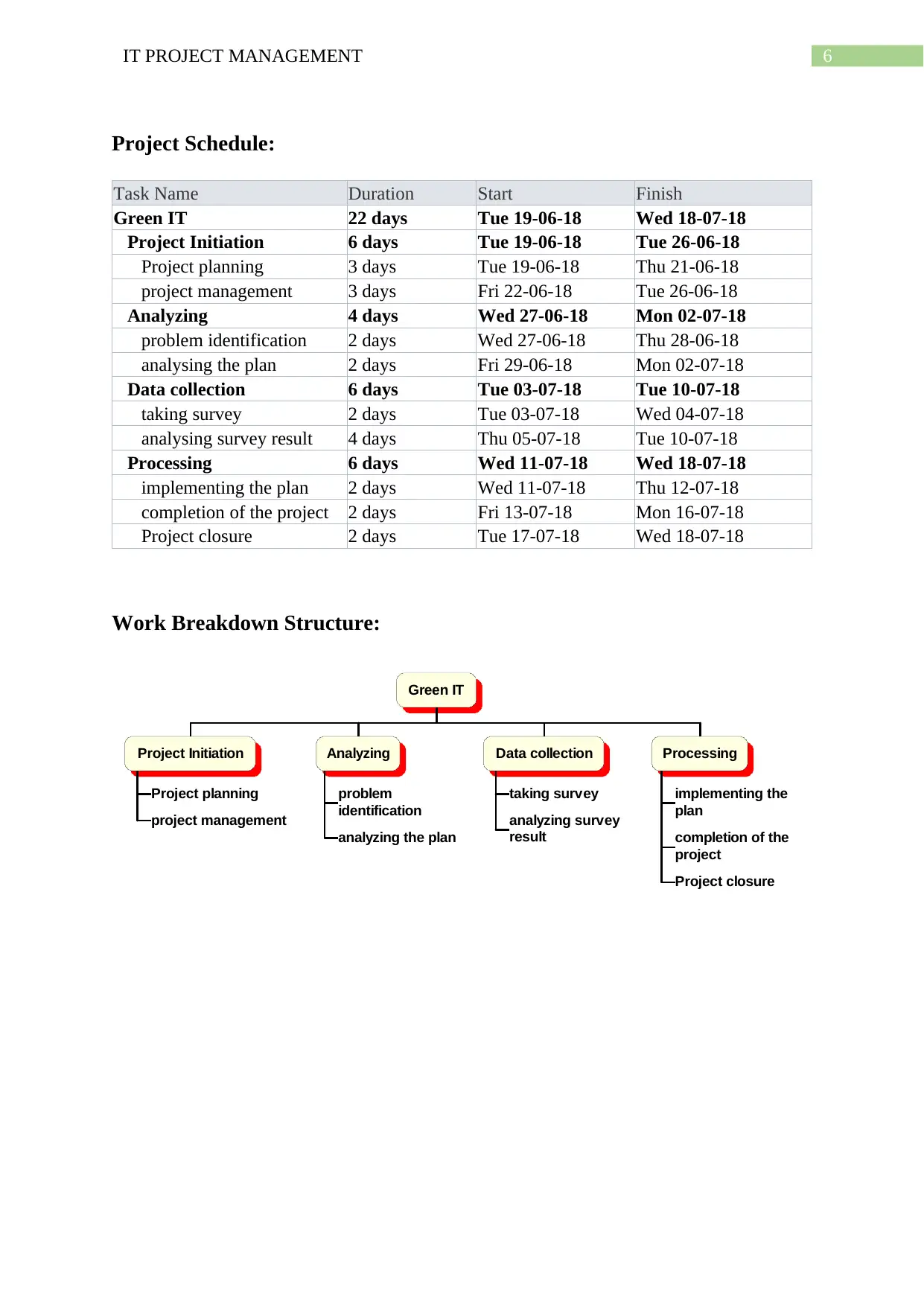
Project Schedule:
Task Name Duration Start Finish
Green IT 22 days Tue 19-06-18 Wed 18-07-18
Project Initiation 6 days Tue 19-06-18 Tue 26-06-18
Project planning 3 days Tue 19-06-18 Thu 21-06-18
project management 3 days Fri 22-06-18 Tue 26-06-18
Analyzing 4 days Wed 27-06-18 Mon 02-07-18
problem identification 2 days Wed 27-06-18 Thu 28-06-18
analysing the plan 2 days Fri 29-06-18 Mon 02-07-18
Data collection 6 days Tue 03-07-18 Tue 10-07-18
taking survey 2 days Tue 03-07-18 Wed 04-07-18
analysing survey result 4 days Thu 05-07-18 Tue 10-07-18
Processing 6 days Wed 11-07-18 Wed 18-07-18
implementing the plan 2 days Wed 11-07-18 Thu 12-07-18
completion of the project 2 days Fri 13-07-18 Mon 16-07-18
Project closure 2 days Tue 17-07-18 Wed 18-07-18
Work Breakdown Structure:
Green IT
Project Initiation
Project planning
project management
Analyzing
problem
identification
analyzing the plan
Data collection
taking survey
analyzing survey
result
Processing
implementing the
plan
completion of the
project
Project closure
Project Schedule:
Task Name Duration Start Finish
Green IT 22 days Tue 19-06-18 Wed 18-07-18
Project Initiation 6 days Tue 19-06-18 Tue 26-06-18
Project planning 3 days Tue 19-06-18 Thu 21-06-18
project management 3 days Fri 22-06-18 Tue 26-06-18
Analyzing 4 days Wed 27-06-18 Mon 02-07-18
problem identification 2 days Wed 27-06-18 Thu 28-06-18
analysing the plan 2 days Fri 29-06-18 Mon 02-07-18
Data collection 6 days Tue 03-07-18 Tue 10-07-18
taking survey 2 days Tue 03-07-18 Wed 04-07-18
analysing survey result 4 days Thu 05-07-18 Tue 10-07-18
Processing 6 days Wed 11-07-18 Wed 18-07-18
implementing the plan 2 days Wed 11-07-18 Thu 12-07-18
completion of the project 2 days Fri 13-07-18 Mon 16-07-18
Project closure 2 days Tue 17-07-18 Wed 18-07-18
Work Breakdown Structure:
Green IT
Project Initiation
Project planning
project management
Analyzing
problem
identification
analyzing the plan
Data collection
taking survey
analyzing survey
result
Processing
implementing the
plan
completion of the
project
Project closure
Paraphrase This Document
Need a fresh take? Get an instant paraphrase of this document with our AI Paraphraser
7IT PROJECT MANAGEMENT
References:
Farahnakian, F., Ashraf, A., Pahikkala, T., Liljeberg, P., Plosila, J., Porres, I., & Tenhunen,
H. (2015). Using ant colony system to consolidate VMs for green cloud
computing. IEEE Transactions on Services Computing, 8(2), 187-198.
Farahnakian, F., Pahikkala, T., Liljeberg, P., Plosila, J., & Tenhunen, H. (2015, June).
Utilization prediction aware VM consolidation approach for green cloud computing.
In Cloud Computing (CLOUD), 2015 IEEE 8th International Conference on (pp. 381-
388). IEEE.
Gai, K., Qiu, M., Zhao, H., Tao, L., & Zong, Z. (2016). Dynamic energy-aware cloudlet-
based mobile cloud computing model for green computing. Journal of Network and
Computer Applications, 59, 46-54.
Indira, K., & Thangavel, M. (2018). Green Cloud Computing. In Cloud Computing
Technologies for Green Enterprises (pp. 114-136). IGI Global.
Lee, H. M., Jeong, Y. S., & Jang, H. J. (2014). Performance analysis based resource
allocation for green cloud computing. The Journal of Supercomputing, 69(3), 1013-
1026.
Mehta, H., Singhal, S., & Doshi, J. (2016). A Comparative Analysis of Green Cloud
Computing Mechanisms.
Patel, Y. S., Mehrotra, N., & Soner, S. (2015, February). Green cloud computing: A review
on Green IT areas for cloud computing environment. In Futuristic Trends on
Computational Analysis and Knowledge Management (ABLAZE), 2015 International
Conference on (pp. 327-332). IEEE.
References:
Farahnakian, F., Ashraf, A., Pahikkala, T., Liljeberg, P., Plosila, J., Porres, I., & Tenhunen,
H. (2015). Using ant colony system to consolidate VMs for green cloud
computing. IEEE Transactions on Services Computing, 8(2), 187-198.
Farahnakian, F., Pahikkala, T., Liljeberg, P., Plosila, J., & Tenhunen, H. (2015, June).
Utilization prediction aware VM consolidation approach for green cloud computing.
In Cloud Computing (CLOUD), 2015 IEEE 8th International Conference on (pp. 381-
388). IEEE.
Gai, K., Qiu, M., Zhao, H., Tao, L., & Zong, Z. (2016). Dynamic energy-aware cloudlet-
based mobile cloud computing model for green computing. Journal of Network and
Computer Applications, 59, 46-54.
Indira, K., & Thangavel, M. (2018). Green Cloud Computing. In Cloud Computing
Technologies for Green Enterprises (pp. 114-136). IGI Global.
Lee, H. M., Jeong, Y. S., & Jang, H. J. (2014). Performance analysis based resource
allocation for green cloud computing. The Journal of Supercomputing, 69(3), 1013-
1026.
Mehta, H., Singhal, S., & Doshi, J. (2016). A Comparative Analysis of Green Cloud
Computing Mechanisms.
Patel, Y. S., Mehrotra, N., & Soner, S. (2015, February). Green cloud computing: A review
on Green IT areas for cloud computing environment. In Futuristic Trends on
Computational Analysis and Knowledge Management (ABLAZE), 2015 International
Conference on (pp. 327-332). IEEE.
8IT PROJECT MANAGEMENT
Qiu, M., Ming, Z., Li, J., Gai, K., & Zong, Z. (2015). Phase-change memory optimisation for
green cloud with genetic algorithm. IEEE Transactions on Computers, 64(12), 3528-
3540.
Shu, W., Wang, W., & Wang, Y. (2014). A novel energy-efficient resource allocation
algorithm based on immune clonal optimisation for green cloud computing.
EURASIP Journal on Wireless Communications and Networking, 2014(1), 64.
Wadhwa, B., & Verma, A. (2014, March). Energy saving approaches for Green Cloud
Computing: A review. In Engineering and Computational Sciences (RAECS), 2014
Recent Advances in (pp. 1-6). IEEE.
Qiu, M., Ming, Z., Li, J., Gai, K., & Zong, Z. (2015). Phase-change memory optimisation for
green cloud with genetic algorithm. IEEE Transactions on Computers, 64(12), 3528-
3540.
Shu, W., Wang, W., & Wang, Y. (2014). A novel energy-efficient resource allocation
algorithm based on immune clonal optimisation for green cloud computing.
EURASIP Journal on Wireless Communications and Networking, 2014(1), 64.
Wadhwa, B., & Verma, A. (2014, March). Energy saving approaches for Green Cloud
Computing: A review. In Engineering and Computational Sciences (RAECS), 2014
Recent Advances in (pp. 1-6). IEEE.
⊘ This is a preview!⊘
Do you want full access?
Subscribe today to unlock all pages.
Trusted by 1+ million students worldwide

1 out of 9


Related Documents


Your All-in-One AI-Powered Toolkit for Academic Success.
+13062052269
info@desklib.com
Available 24*7 on WhatsApp / Email
![[object Object]](/_next/static/media/star-bottom.7253800d.svg)
Unlock your academic potential
Copyright © 2020–2026 A2Z Services. All Rights Reserved. Developed and managed by ZUCOL.