Celebrities and Privacy: Balancing Public Interest and Personal Rights

Verified

Added on  2021/06/16

|6
|2078
|71
Essay
AI Summary
This essay examines the complex issue of celebrity privacy, exploring whether public figures have a right to privacy and the extent to which they should be able to control the publication of information about them. The introduction defines privacy and highlights its importance, referencing legal precedents and the impact of new technologies. The essay then delves into arguments for and against celebrity privacy, considering factors such as the celebrities' role in society, media scrutiny, and the public's interest. The analysis covers various aspects, including respect for individuals, freedom of thought and speech, trust building, and the ability to change and have a second chance. The essay finds that while celebrities often compromise their privacy for publicity, they still deserve protection. The conclusion emphasizes the need for clearly defined laws, respect for individuals' privacy, and consultations between parties involved to avoid privacy violations. The essay draws on various sources, including legal and philosophical viewpoints, to offer a comprehensive analysis of the topic.
Document Page
Running Head: CELEBRITIES AND PRIVACY 1
CELEBRITIES AND PRIVACY
Name
Institutional affiliation
tabler-icon-diamond-filled.svg

Paraphrase This Document

Need a fresh take? Get an instant paraphrase of this document with our AI Paraphraser
Document Page
CELEBRITIES AND PRIVACY 2
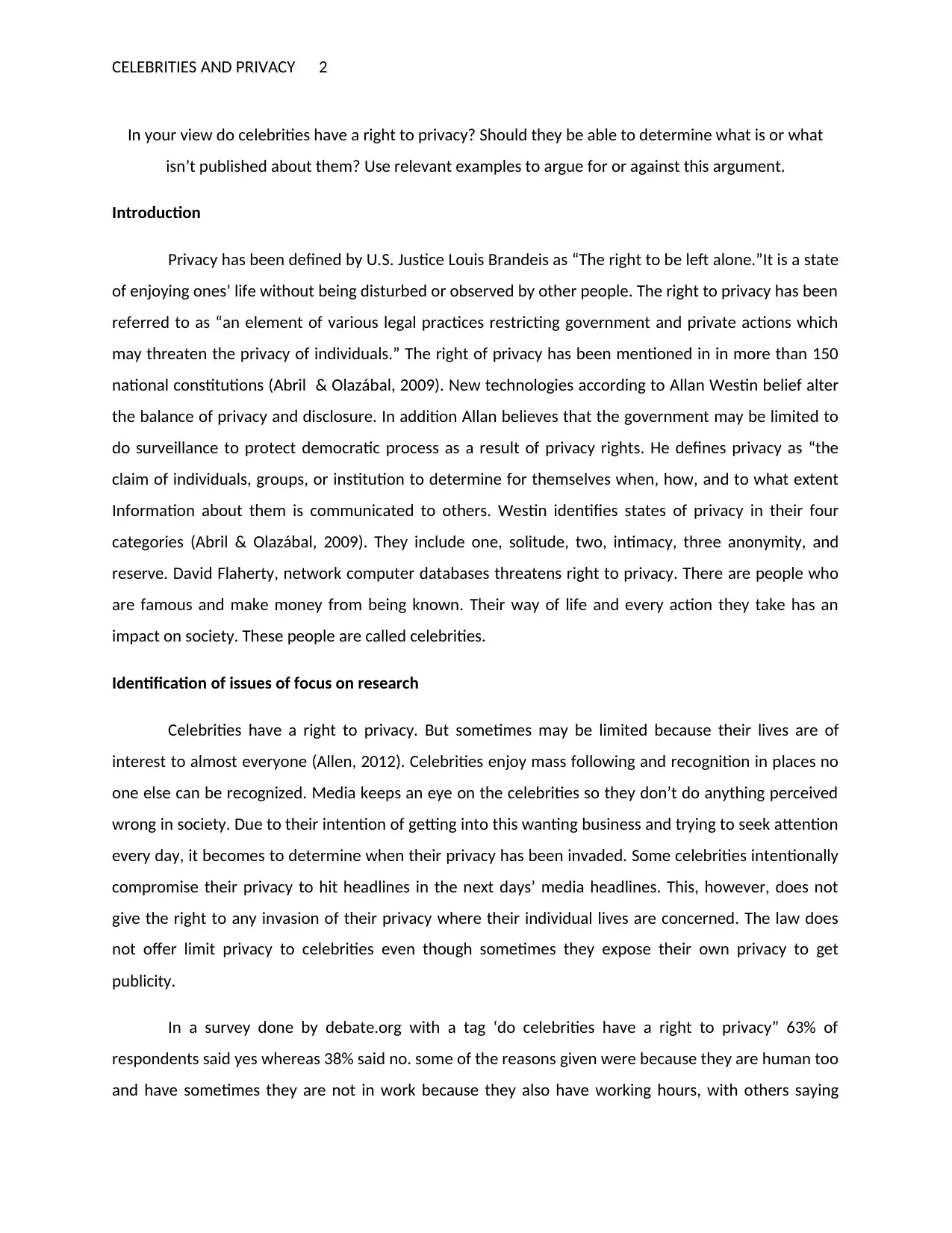
In your view do celebrities have a right to privacy? Should they be able to determine what is or what
isn’t published about them? Use relevant examples to argue for or against this argument.
Introduction
Privacy has been defined by U.S. Justice Louis Brandeis as “The right to be left alone.”It is a state
of enjoying ones’ life without being disturbed or observed by other people. The right to privacy has been
referred to as “an element of various legal practices restricting government and private actions which
may threaten the privacy of individuals.” The right of privacy has been mentioned in in more than 150
national constitutions (Abril & Olazábal, 2009). New technologies according to Allan Westin belief alter
the balance of privacy and disclosure. In addition Allan believes that the government may be limited to
do surveillance to protect democratic process as a result of privacy rights. He defines privacy as “the
claim of individuals, groups, or institution to determine for themselves when, how, and to what extent
Information about them is communicated to others. Westin identifies states of privacy in their four
categories (Abril & Olazábal, 2009). They include one, solitude, two, intimacy, three anonymity, and
reserve. David Flaherty, network computer databases threatens right to privacy. There are people who
are famous and make money from being known. Their way of life and every action they take has an
impact on society. These people are called celebrities.
Identification of issues of focus on research
Celebrities have a right to privacy. But sometimes may be limited because their lives are of
interest to almost everyone (Allen, 2012). Celebrities enjoy mass following and recognition in places no
one else can be recognized. Media keeps an eye on the celebrities so they don’t do anything perceived
wrong in society. Due to their intention of getting into this wanting business and trying to seek attention
every day, it becomes to determine when their privacy has been invaded. Some celebrities intentionally
compromise their privacy to hit headlines in the next days’ media headlines. This, however, does not
give the right to any invasion of their privacy where their individual lives are concerned. The law does
not offer limit privacy to celebrities even though sometimes they expose their own privacy to get
publicity.
In a survey done by debate.org with a tag ‘do celebrities have a right to privacy” 63% of
respondents said yes whereas 38% said no. some of the reasons given were because they are human too
and have sometimes they are not in work because they also have working hours, with others saying
Document Page
CELEBRITIES AND PRIVACY 3
celebrities do not need privacy since they signed a contract to be of public interest. Others said because
they get a lot of payment for their publicity, they have to pay a small price which is compromising their
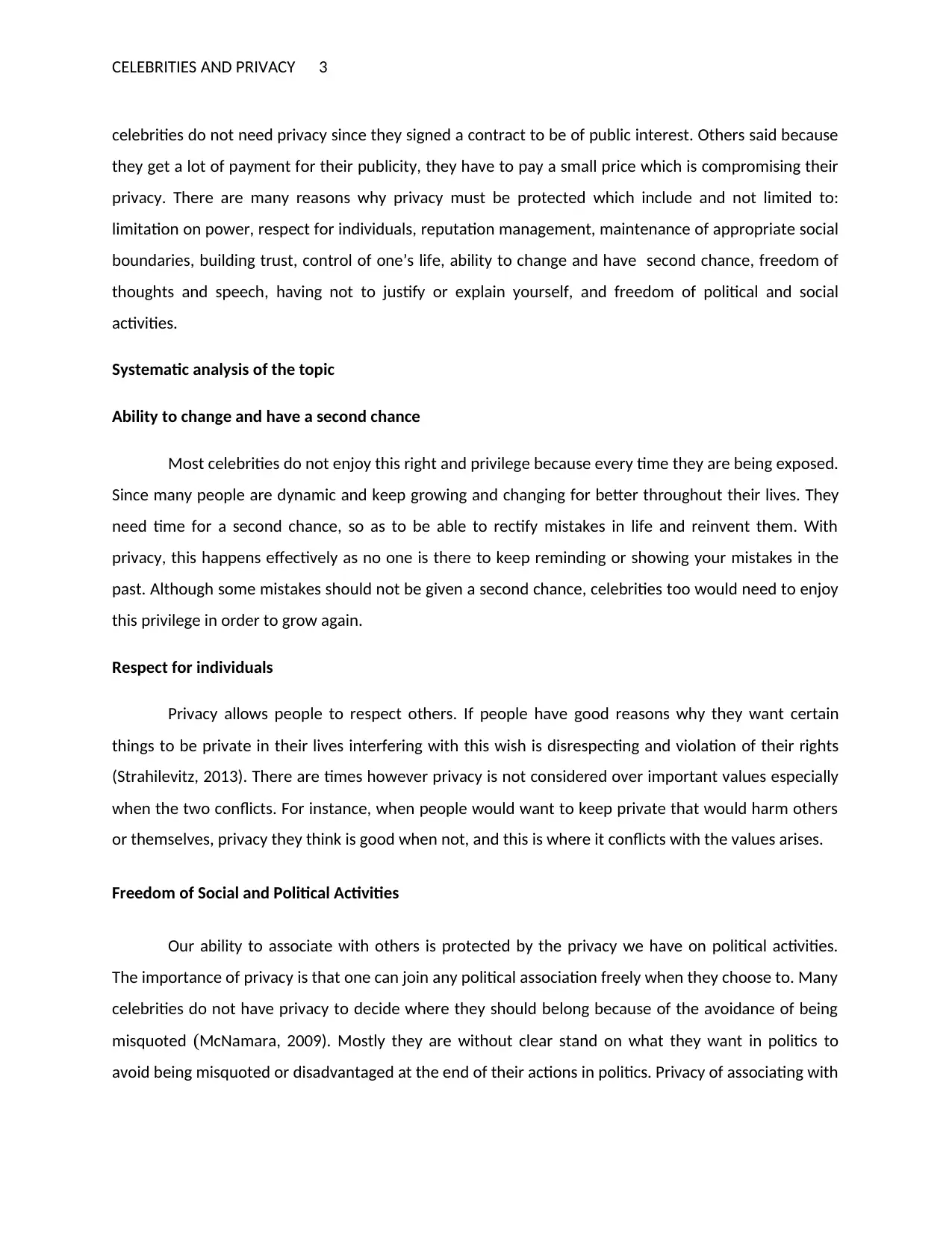
privacy. There are many reasons why privacy must be protected which include and not limited to:
limitation on power, respect for individuals, reputation management, maintenance of appropriate social
boundaries, building trust, control of one’s life, ability to change and have second chance, freedom of
thoughts and speech, having not to justify or explain yourself, and freedom of political and social
activities.
Systematic analysis of the topic
Ability to change and have a second chance
Most celebrities do not enjoy this right and privilege because every time they are being exposed.
Since many people are dynamic and keep growing and changing for better throughout their lives. They
need time for a second chance, so as to be able to rectify mistakes in life and reinvent them. With
privacy, this happens effectively as no one is there to keep reminding or showing your mistakes in the
past. Although some mistakes should not be given a second chance, celebrities too would need to enjoy
this privilege in order to grow again.
Respect for individuals
Privacy allows people to respect others. If people have good reasons why they want certain
things to be private in their lives interfering with this wish is disrespecting and violation of their rights
(Strahilevitz, 2013). There are times however privacy is not considered over important values especially
when the two conflicts. For instance, when people would want to keep private that would harm others
or themselves, privacy they think is good when not, and this is where it conflicts with the values arises.
Freedom of Social and Political Activities
Our ability to associate with others is protected by the privacy we have on political activities.
The importance of privacy is that one can join any political association freely when they choose to. Many
celebrities do not have privacy to decide where they should belong because of the avoidance of being
misquoted (McNamara, 2009). Mostly they are without clear stand on what they want in politics to
avoid being misquoted or disadvantaged at the end of their actions in politics. Privacy of associating with
Document Page
CELEBRITIES AND PRIVACY 4
the politics and political activities even before voting forms our political beliefs. Watchful eyes disrupt
celebrities from taking place in these activities.
Freedom of Thought and Speech
Privacy provides with an opportunity to enables people to have freedom of thoughts. When
people keep watching on us they chill us from exploring ideas outside the mainstream (Kane 2010).
Celebrities will be pressured to make a decision fast or give a comment on something without having to
critically think broadly about it. This put them on dangers of speaking unpopular messages.
Not Having to Explain or Justify Oneself
Privacy matters to every person as we do not need to explain or justify ourselves to people.
There are things we do need to just do them without explaining it to those who doubt our actions. Some
actions we take may be taken to be embarrassing or worse to those who know (Kavka & West 2010).
Many celebrities will find themselves having to explain to the public through the media to maintain their
reputation. This need for justification is not a very good thing as people should not be tied to
perfections.
Trust
Building trust in a relationship with others is very important to every person, business
organizations, companies, government, etc. in life. If confidentiality is breached the trust is lost.
Celebrities often desire to have the trust of their followers. The followers continue building more and
more trust in celebrities if they only know the good side of their story (Hearn & Schoenhoff, 2015). It
becomes dangerous for celebrities’ lives if they privacy is invaded to a larger extent to expose their
weaknesses. Their followers may not want to trust them again if their privacy has been violated and
exposed in a negative way.
Maintaining Appropriate Social Boundaries
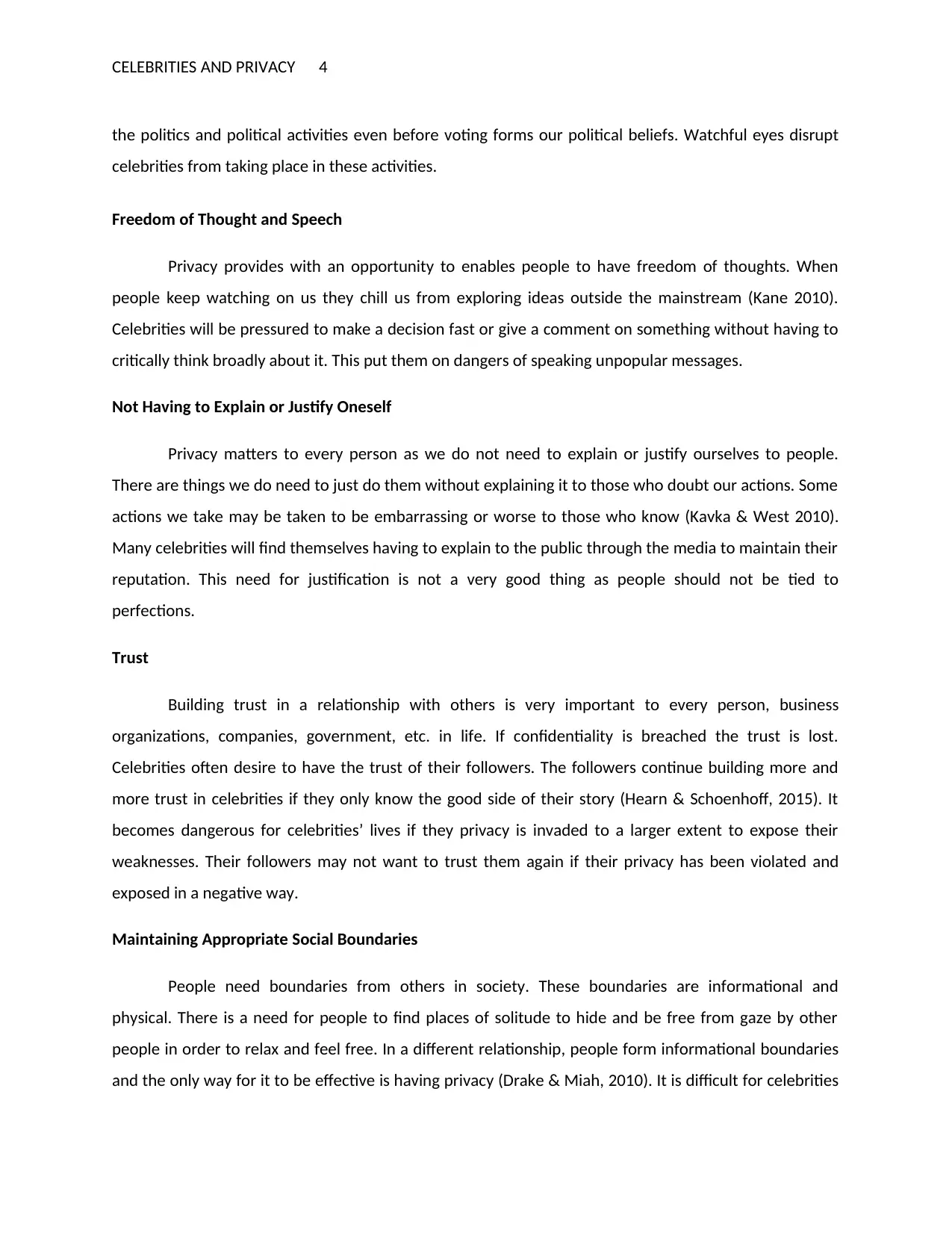
People need boundaries from others in society. These boundaries are informational and
physical. There is a need for people to find places of solitude to hide and be free from gaze by other
people in order to relax and feel free. In a different relationship, people form informational boundaries
and the only way for it to be effective is having privacy (Drake & Miah, 2010). It is difficult for celebrities
tabler-icon-diamond-filled.svg

Paraphrase This Document

Need a fresh take? Get an instant paraphrase of this document with our AI Paraphraser
Document Page
CELEBRITIES AND PRIVACY 5
to have a place they are relaxing without someone chasing after them. They sometimes fail to have
closeness with people since they hear stories they shared in privacy get out to the public. This is not
appropriate as many people don’t want everybody to know every bit of things happening in their lives
which is termed as ‘none of your business’ or mind your own business. There is social friction affecting
the celebrity world as many times they are not able to reduce it.
Findings and recommendations
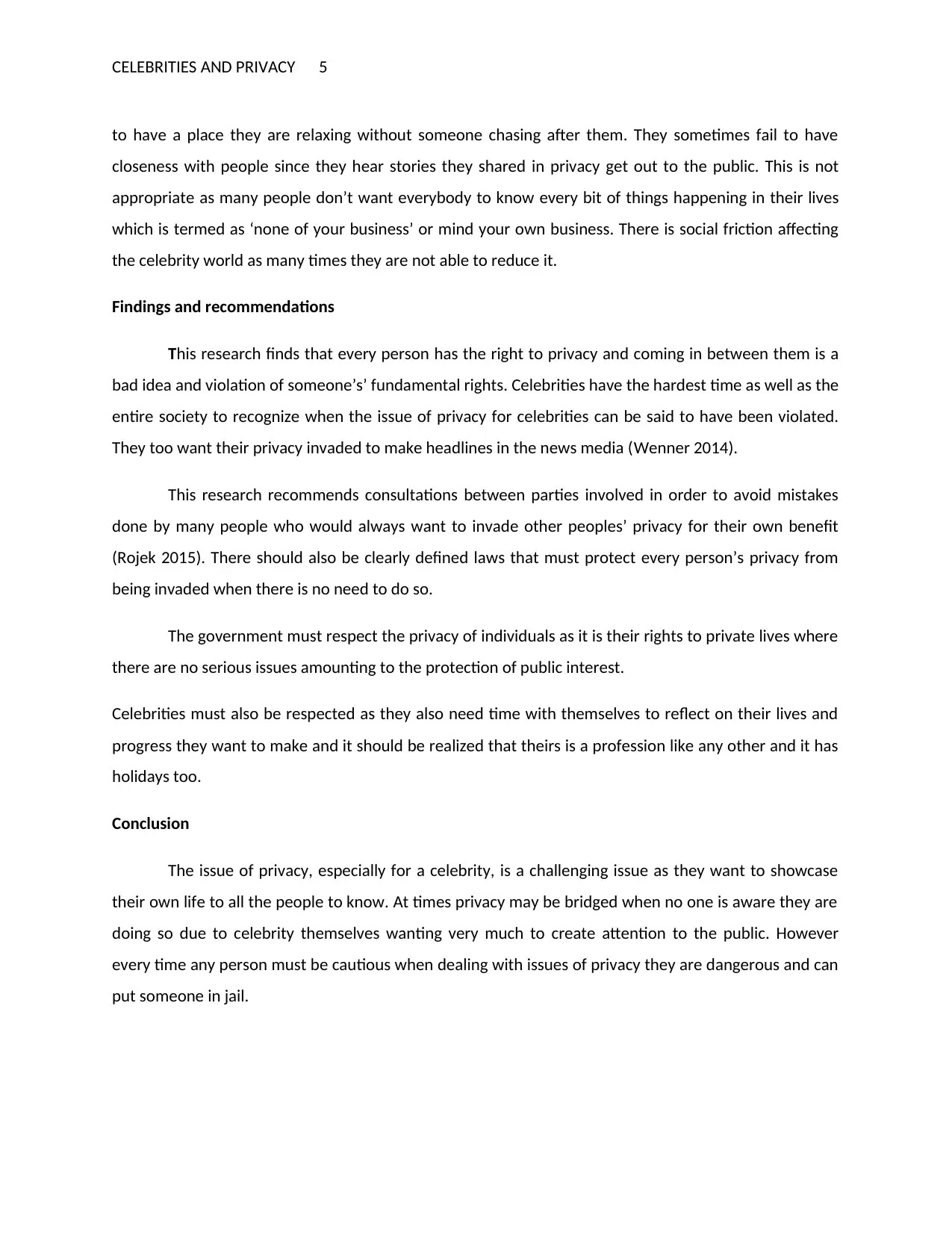
This research finds that every person has the right to privacy and coming in between them is a
bad idea and violation of someone’s’ fundamental rights. Celebrities have the hardest time as well as the
entire society to recognize when the issue of privacy for celebrities can be said to have been violated.
They too want their privacy invaded to make headlines in the news media (Wenner 2014).
This research recommends consultations between parties involved in order to avoid mistakes
done by many people who would always want to invade other peoples’ privacy for their own benefit
(Rojek 2015). There should also be clearly defined laws that must protect every person’s privacy from
being invaded when there is no need to do so.
The government must respect the privacy of individuals as it is their rights to private lives where
there are no serious issues amounting to the protection of public interest.
Celebrities must also be respected as they also need time with themselves to reflect on their lives and
progress they want to make and it should be realized that theirs is a profession like any other and it has
holidays too.
Conclusion
The issue of privacy, especially for a celebrity, is a challenging issue as they want to showcase
their own life to all the people to know. At times privacy may be bridged when no one is aware they are
doing so due to celebrity themselves wanting very much to create attention to the public. However
every time any person must be cautious when dealing with issues of privacy they are dangerous and can
put someone in jail.
Document Page
CELEBRITIES AND PRIVACY 6
References
Abril, P. S., & Olazábal, A. M. (2009). The Celebrity CEO: Corporate Disclosure at the
Intersection of Privacy and Securities Law. Hous. L. Rev., 46, 1545.
Allen, A. L. (2012). Privacy law: positive theory and normative practice. Harv. L. Rev. F., 126,
241.
Drake, P., & Miah, A. (2010). The cultural politics of celebrity. Cultural Politics, 6(1), 49-64.
Follett, L. N. (2010). Taming the Paparazzi in the Wild West: A Look at California's 2009
Amendment to the Anti-Paparazzi Act and a Call for Increased Privacy Protections for
Celebrity Children. S. Cal. L. Rev., 84, 201.
Hearn, A., & Schoenhoff, S. (2015). From celebrity to influencer: Tracing the diffusion of
celebrity value across the data stream. A companion to celebrity, 194-212.
Kane, B. (2010). Balancing anonymity, popularity, & micro-celebrity: the crossroads of social
networking & privacy. Alb. LJ Sci. & Tech., 20, 327.
Kavka, M., & West, A. (2010). Jade the obscure: celebrity death and the mediatized maiden.
Celebrity Studies, 1(2), 216-230.
McNamara, K. (2009). Publicising private lives: celebrities, image control and the
reconfiguration of public space. Social & Cultural Geography, 10(1), 9-23.
Rojek, C. (2015). Celebrity. The Wiley Blackwell Encyclopedia of Consumption and Consumer
Studies, 1-3.
Strahilevitz, L. J. (2013). Toward a positive theory of privacy law. Harvard Law Review, 126(7),
2010-2042.
Wenner, L. A. (2014). Fallen sports heroes, media, & celebrity culture.
chevron_up_icon
1 out of 6
circle_padding
hide_on_mobile
zoom_out_icon
[object Object]