Cell Anatomy Homework Assignment: Stem Cells, Energy Systems, and More
VerifiedAdded on 2022/11/10
|9
|1826
|379
Homework Assignment
AI Summary
This student assignment explores various aspects of cell anatomy and human physiology. The assignment begins with an overview of different cell types, including stem cells, bone cells, blood cells, muscle cells, fat cells, skin cells, nerve cells, endothelial cells, sex cells, and pancreatic cells, detailing their respective functions within the human body. The second section delves into the peripheral nervous system and its control over muscle movements, explaining the process of nerve impulses, the role of neurotransmitters, and the extraction contraction coupling. The assignment then differentiates between aerobic and anaerobic energy systems, explaining their functions and the role of ATP and lactic acid. Finally, the assignment describes the process of oxygen transport within the human body, from the respiratory system to the cellular level, including the role of hemoglobin and myoglobin, and the function of mitochondria in energy production.

Running Head: CELL
0
Anatomy
student
9/14/2019
0
Anatomy
student
9/14/2019
Paraphrase This Document
Need a fresh take? Get an instant paraphrase of this document with our AI Paraphraser

CELL
1
Table of Contents
Q1 (Ans):.....................................................................................................................................................2
Q2 (Ans)..................................................................................................................................................4
Q 3 (Ans).................................................................................................................................................5
Q4 (Ans)..................................................................................................................................................6
References...................................................................................................................................................7
1
Table of Contents
Q1 (Ans):.....................................................................................................................................................2
Q2 (Ans)..................................................................................................................................................4
Q 3 (Ans).................................................................................................................................................5
Q4 (Ans)..................................................................................................................................................6
References...................................................................................................................................................7

CELL
2
Q1 (Ans):
Stem cells: These types of cells are specific cells of the human body that are not specified but
can develop into the specified cells for particular organs or into tissues. These cells can divide
and duplicate multiple times with the purpose of repair the damaged tissues. The regenerative
property of these cells being tasted by scientist for to create new cells (Breschi et al., 2018).
Bone cells: Bones are a kind of mineralized connective type tissue and the important constituent
of the skeleton system. Bones cells works to form bone, which is made-up of collagen matrix and
the calcium phosphate minerals. Three type of bone cells present in the body: osteoclasts,
osteoblasts, and osteocytes. Osteoclasts decompose the bones for the process of resorption and
assimilation, osteocytes helps the formation of bine and assists in balance the calcium in the
body (Sherwood, 2015).
Blood cells: Blood cells are the vital to life as they perform different key function in the body
from transferring the oxygen in the body to control infection. There are three types of blood cells
present in the blood. A red blood cell determines the blood type and also transports the oxygen to
the other cells. A white blood cell belongs to the immune system works to destroy the
microorganisms and help in immunity. Platelets are responsible for blood clot and stop the
excessive loss of blood.
Muscle cells: Muscle cells from muscle tissues connective tissues, cardiac muscles, and smooth
muscles aid in protection, forming involuntary cardiac muscles, contraction of heart etc. (Breschi
et al., 2018).
2
Q1 (Ans):
Stem cells: These types of cells are specific cells of the human body that are not specified but
can develop into the specified cells for particular organs or into tissues. These cells can divide
and duplicate multiple times with the purpose of repair the damaged tissues. The regenerative
property of these cells being tasted by scientist for to create new cells (Breschi et al., 2018).
Bone cells: Bones are a kind of mineralized connective type tissue and the important constituent
of the skeleton system. Bones cells works to form bone, which is made-up of collagen matrix and
the calcium phosphate minerals. Three type of bone cells present in the body: osteoclasts,
osteoblasts, and osteocytes. Osteoclasts decompose the bones for the process of resorption and
assimilation, osteocytes helps the formation of bine and assists in balance the calcium in the
body (Sherwood, 2015).
Blood cells: Blood cells are the vital to life as they perform different key function in the body
from transferring the oxygen in the body to control infection. There are three types of blood cells
present in the blood. A red blood cell determines the blood type and also transports the oxygen to
the other cells. A white blood cell belongs to the immune system works to destroy the
microorganisms and help in immunity. Platelets are responsible for blood clot and stop the
excessive loss of blood.
Muscle cells: Muscle cells from muscle tissues connective tissues, cardiac muscles, and smooth
muscles aid in protection, forming involuntary cardiac muscles, contraction of heart etc. (Breschi
et al., 2018).
⊘ This is a preview!⊘
Do you want full access?
Subscribe today to unlock all pages.

Trusted by 1+ million students worldwide

CELL
3
Fat cells: fat cells also known as adipocytes and recognised as the major cell constituent of the
adipose tissue. These cells aids in providing energy, and have endocrine function as they secrete
hormone for metabolism of sex hormones, BP regulation, sensitivity of insulin, and blood
clotting, cell communication, and storage of fat.
Skin cells: the skin cells like flat, squamous epithelial cells aide to form outermost layer of the
skin which defends the inner structure of the body from any harm, stop dehydration, stores fat,
and creates vitamins and hormones.
Nerve cells: these cells send messages to different of the body such as brain, spinal cord etc. in
the form of impulses.
Endothelial cells: These types of cells construct the inner lines of the blood vessels, the
lymphatic vessels, and different organs like brain, lungs, the skin, and heart. The Endothelial
cells are also accountable for angiogenesis (Breschi et al., 2018).
Sex cells: thee cells are generative cells that are formed in male and womanly gonads. Male’s
gamete ad female’s ova fused during fertilization to produce a new individual.
Pancreatic cells: there are two different kinds of pancreatic cells are exocrine acinar cells and
the endocrine cells. Exocrine acinar cells form and discharge enzymes that help in digestion, and
pancreatic endocrine cells produce hormone helps in digestion, regulating concentration of blood
glucose etc. (Rozenblatt-Rosen et al., 2017)
3
Fat cells: fat cells also known as adipocytes and recognised as the major cell constituent of the
adipose tissue. These cells aids in providing energy, and have endocrine function as they secrete
hormone for metabolism of sex hormones, BP regulation, sensitivity of insulin, and blood
clotting, cell communication, and storage of fat.
Skin cells: the skin cells like flat, squamous epithelial cells aide to form outermost layer of the
skin which defends the inner structure of the body from any harm, stop dehydration, stores fat,
and creates vitamins and hormones.
Nerve cells: these cells send messages to different of the body such as brain, spinal cord etc. in
the form of impulses.
Endothelial cells: These types of cells construct the inner lines of the blood vessels, the
lymphatic vessels, and different organs like brain, lungs, the skin, and heart. The Endothelial
cells are also accountable for angiogenesis (Breschi et al., 2018).
Sex cells: thee cells are generative cells that are formed in male and womanly gonads. Male’s
gamete ad female’s ova fused during fertilization to produce a new individual.
Pancreatic cells: there are two different kinds of pancreatic cells are exocrine acinar cells and
the endocrine cells. Exocrine acinar cells form and discharge enzymes that help in digestion, and
pancreatic endocrine cells produce hormone helps in digestion, regulating concentration of blood
glucose etc. (Rozenblatt-Rosen et al., 2017)
Paraphrase This Document
Need a fresh take? Get an instant paraphrase of this document with our AI Paraphraser

CELL
4
Q2 (Ans)
The peripheral nervous system which is actually an extension of the CNS (central
nervous system) controls body Muscles. Actions like leaning power, and moving hands involves
the coordinated efforts of different muscle groups. The brain sends command to the CNS, which
interprets these signals in to the electrical impulses (Louveau et al., 2015). These impulses are
then transported through the somatic part of the peripheral nervous system to body’s nerves
responsible for regulating the essential muscles. Once the messages reach, a chemical called
acetylcholine is discharged from the nerve endings, triggering the muscle fibre membranes and
causing contraction (Karemaker, 2017).
The extraction contraction coupling is a physiological procedure of transforming the
electrical signals to the mechanical responses. An electrical neural signal triggers the release of
calcium from sarcoplasmic reticulum of the body into the sarcoplasm. Neuron conducts
messages from the brain area or spinal cord to different muscle. Electrical messages travel
throughout the neuron’s axon, which subdivisions through the body muscle, linking to particular
muscle fibres at the neuromuscular junction (Louveau et al., 2015). A small area named the
synaptic cleft divides the synaptic terminal part from the motor-end plate. Between the nerves
and muscles Communication take place via neurotransmitters. The Action potentials of Neuron
cause the discharge of neurotransmitters into the synaptic cleft from the synaptic terminal area,
where they diffuse throughout the synaptic cleft and attach to the receptor molecule of the motor
end plate. This motor end plate possesses the junctional folds: this fold create a big surface area
for the neurotransmitter to attach to the receptors. These receptors are NA+ channels that are
open to permit the Na+ inside the cell when they obtain neurotransmitter signal (Tortora &
Derrickson, 2017).
4
Q2 (Ans)
The peripheral nervous system which is actually an extension of the CNS (central
nervous system) controls body Muscles. Actions like leaning power, and moving hands involves
the coordinated efforts of different muscle groups. The brain sends command to the CNS, which
interprets these signals in to the electrical impulses (Louveau et al., 2015). These impulses are
then transported through the somatic part of the peripheral nervous system to body’s nerves
responsible for regulating the essential muscles. Once the messages reach, a chemical called
acetylcholine is discharged from the nerve endings, triggering the muscle fibre membranes and
causing contraction (Karemaker, 2017).
The extraction contraction coupling is a physiological procedure of transforming the
electrical signals to the mechanical responses. An electrical neural signal triggers the release of
calcium from sarcoplasmic reticulum of the body into the sarcoplasm. Neuron conducts
messages from the brain area or spinal cord to different muscle. Electrical messages travel
throughout the neuron’s axon, which subdivisions through the body muscle, linking to particular
muscle fibres at the neuromuscular junction (Louveau et al., 2015). A small area named the
synaptic cleft divides the synaptic terminal part from the motor-end plate. Between the nerves
and muscles Communication take place via neurotransmitters. The Action potentials of Neuron
cause the discharge of neurotransmitters into the synaptic cleft from the synaptic terminal area,
where they diffuse throughout the synaptic cleft and attach to the receptor molecule of the motor
end plate. This motor end plate possesses the junctional folds: this fold create a big surface area
for the neurotransmitter to attach to the receptors. These receptors are NA+ channels that are
open to permit the Na+ inside the cell when they obtain neurotransmitter signal (Tortora &
Derrickson, 2017).

CELL
5
Q 3 (Ans)
Difference between aerobic and anaerobic energy system (AES)
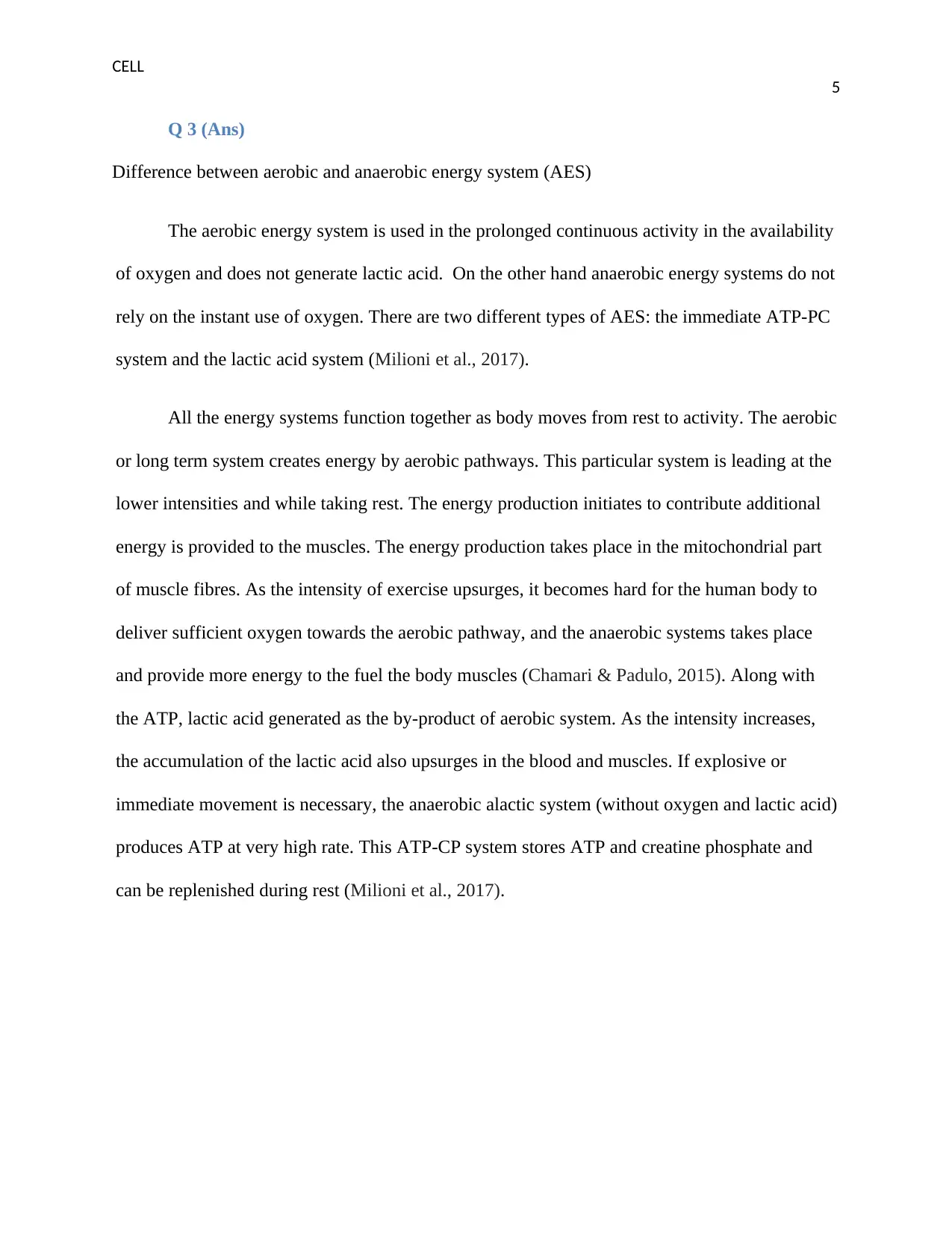
The aerobic energy system is used in the prolonged continuous activity in the availability
of oxygen and does not generate lactic acid. On the other hand anaerobic energy systems do not
rely on the instant use of oxygen. There are two different types of AES: the immediate ATP-PC
system and the lactic acid system (Milioni et al., 2017).
All the energy systems function together as body moves from rest to activity. The aerobic
or long term system creates energy by aerobic pathways. This particular system is leading at the
lower intensities and while taking rest. The energy production initiates to contribute additional
energy is provided to the muscles. The energy production takes place in the mitochondrial part
of muscle fibres. As the intensity of exercise upsurges, it becomes hard for the human body to
deliver sufficient oxygen towards the aerobic pathway, and the anaerobic systems takes place
and provide more energy to the fuel the body muscles (Chamari & Padulo, 2015). Along with
the ATP, lactic acid generated as the by-product of aerobic system. As the intensity increases,
the accumulation of the lactic acid also upsurges in the blood and muscles. If explosive or
immediate movement is necessary, the anaerobic alactic system (without oxygen and lactic acid)
produces ATP at very high rate. This ATP-CP system stores ATP and creatine phosphate and
can be replenished during rest (Milioni et al., 2017).
5
Q 3 (Ans)
Difference between aerobic and anaerobic energy system (AES)
The aerobic energy system is used in the prolonged continuous activity in the availability
of oxygen and does not generate lactic acid. On the other hand anaerobic energy systems do not
rely on the instant use of oxygen. There are two different types of AES: the immediate ATP-PC
system and the lactic acid system (Milioni et al., 2017).
All the energy systems function together as body moves from rest to activity. The aerobic
or long term system creates energy by aerobic pathways. This particular system is leading at the
lower intensities and while taking rest. The energy production initiates to contribute additional
energy is provided to the muscles. The energy production takes place in the mitochondrial part
of muscle fibres. As the intensity of exercise upsurges, it becomes hard for the human body to
deliver sufficient oxygen towards the aerobic pathway, and the anaerobic systems takes place
and provide more energy to the fuel the body muscles (Chamari & Padulo, 2015). Along with
the ATP, lactic acid generated as the by-product of aerobic system. As the intensity increases,
the accumulation of the lactic acid also upsurges in the blood and muscles. If explosive or
immediate movement is necessary, the anaerobic alactic system (without oxygen and lactic acid)
produces ATP at very high rate. This ATP-CP system stores ATP and creatine phosphate and
can be replenished during rest (Milioni et al., 2017).
⊘ This is a preview!⊘
Do you want full access?
Subscribe today to unlock all pages.

Trusted by 1+ million students worldwide

CELL
6
Q4 (Ans)
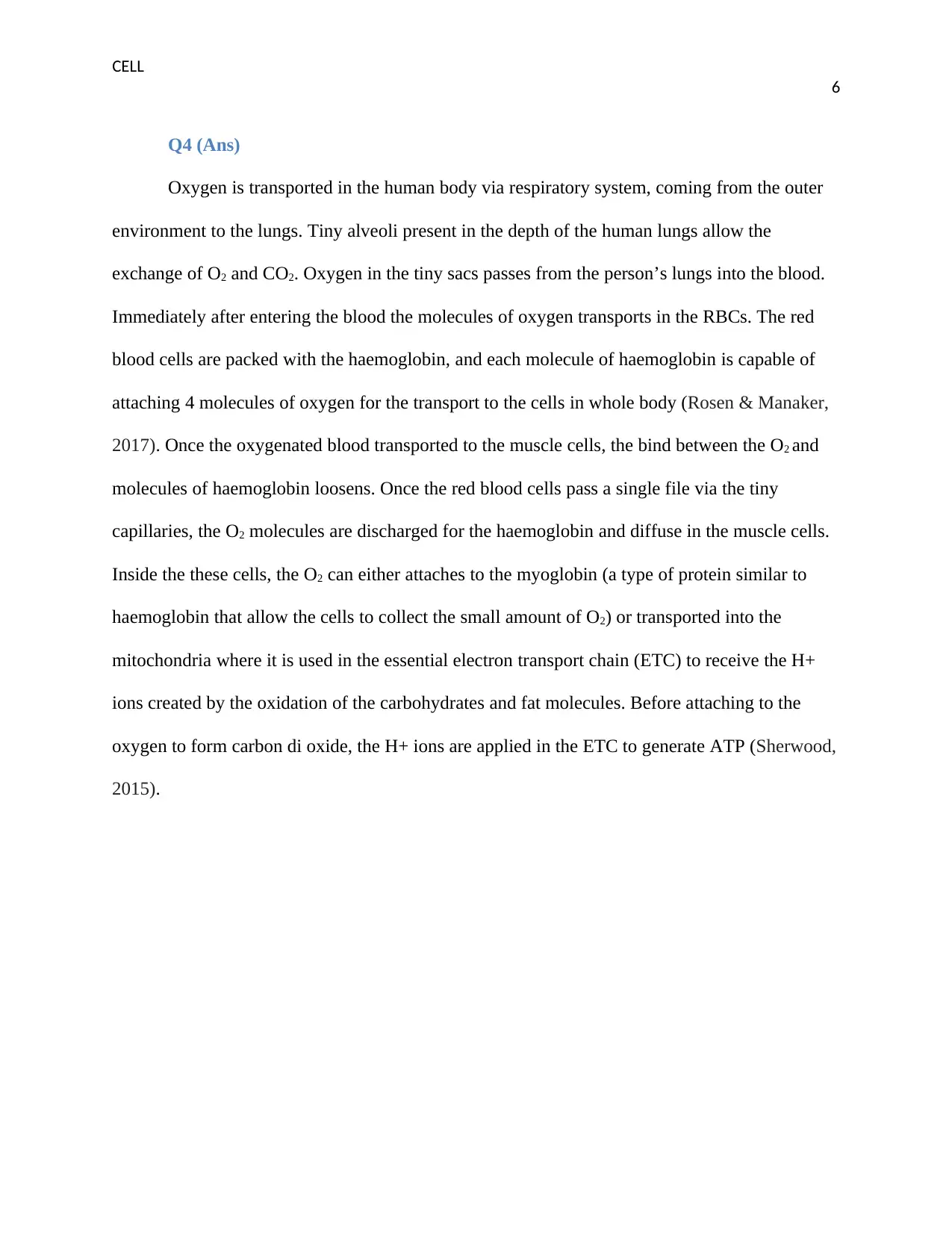
Oxygen is transported in the human body via respiratory system, coming from the outer
environment to the lungs. Tiny alveoli present in the depth of the human lungs allow the
exchange of O2 and CO2. Oxygen in the tiny sacs passes from the person’s lungs into the blood.
Immediately after entering the blood the molecules of oxygen transports in the RBCs. The red
blood cells are packed with the haemoglobin, and each molecule of haemoglobin is capable of
attaching 4 molecules of oxygen for the transport to the cells in whole body (Rosen & Manaker,
2017). Once the oxygenated blood transported to the muscle cells, the bind between the O2 and
molecules of haemoglobin loosens. Once the red blood cells pass a single file via the tiny
capillaries, the O2 molecules are discharged for the haemoglobin and diffuse in the muscle cells.
Inside the these cells, the O2 can either attaches to the myoglobin (a type of protein similar to
haemoglobin that allow the cells to collect the small amount of O2) or transported into the
mitochondria where it is used in the essential electron transport chain (ETC) to receive the H+
ions created by the oxidation of the carbohydrates and fat molecules. Before attaching to the
oxygen to form carbon di oxide, the H+ ions are applied in the ETC to generate ATP (Sherwood,
2015).
6
Q4 (Ans)
Oxygen is transported in the human body via respiratory system, coming from the outer
environment to the lungs. Tiny alveoli present in the depth of the human lungs allow the
exchange of O2 and CO2. Oxygen in the tiny sacs passes from the person’s lungs into the blood.
Immediately after entering the blood the molecules of oxygen transports in the RBCs. The red
blood cells are packed with the haemoglobin, and each molecule of haemoglobin is capable of
attaching 4 molecules of oxygen for the transport to the cells in whole body (Rosen & Manaker,
2017). Once the oxygenated blood transported to the muscle cells, the bind between the O2 and
molecules of haemoglobin loosens. Once the red blood cells pass a single file via the tiny
capillaries, the O2 molecules are discharged for the haemoglobin and diffuse in the muscle cells.
Inside the these cells, the O2 can either attaches to the myoglobin (a type of protein similar to
haemoglobin that allow the cells to collect the small amount of O2) or transported into the
mitochondria where it is used in the essential electron transport chain (ETC) to receive the H+
ions created by the oxidation of the carbohydrates and fat molecules. Before attaching to the
oxygen to form carbon di oxide, the H+ ions are applied in the ETC to generate ATP (Sherwood,
2015).
Paraphrase This Document
Need a fresh take? Get an instant paraphrase of this document with our AI Paraphraser

CELL
7
References
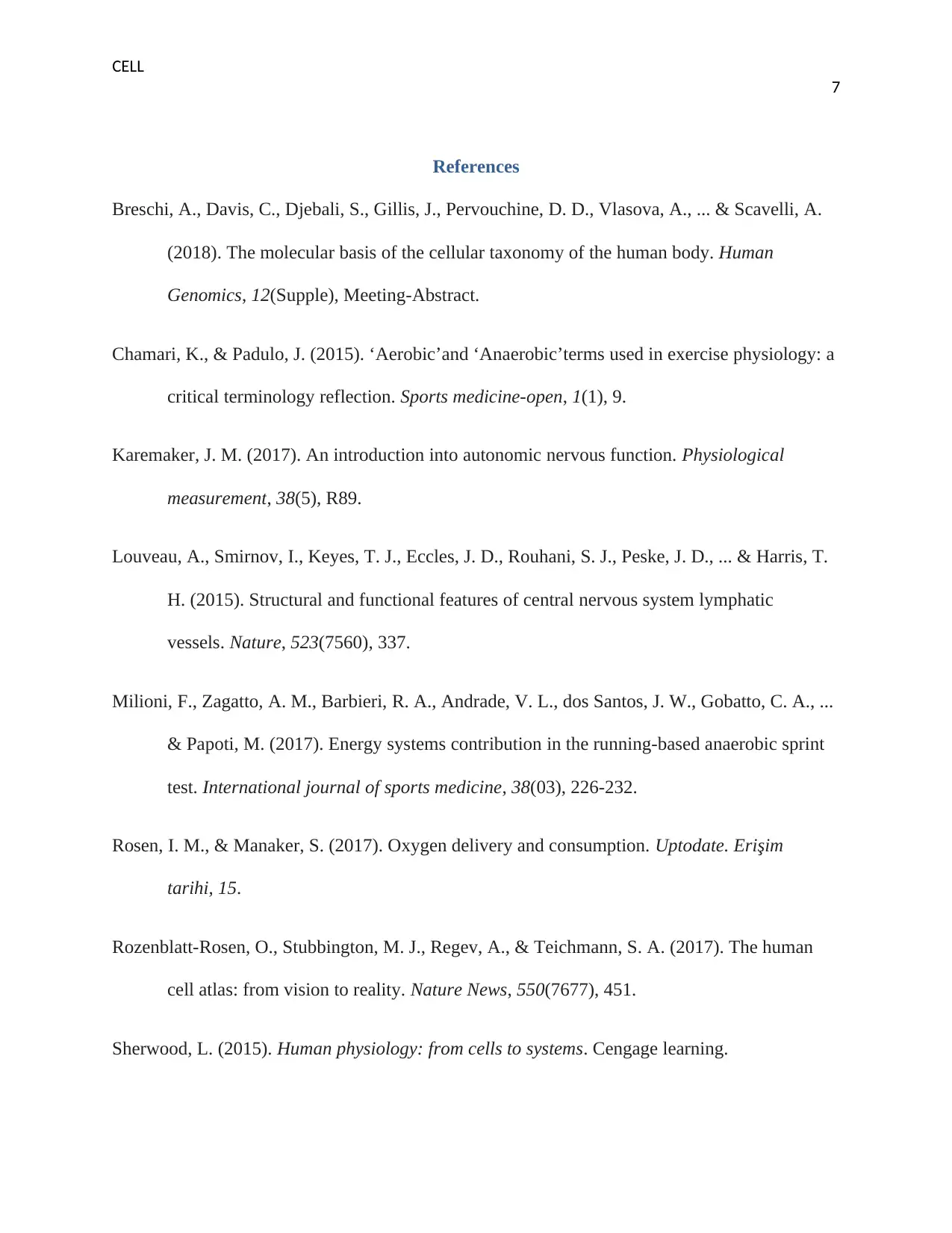
Breschi, A., Davis, C., Djebali, S., Gillis, J., Pervouchine, D. D., Vlasova, A., ... & Scavelli, A.
(2018). The molecular basis of the cellular taxonomy of the human body. Human
Genomics, 12(Supple), Meeting-Abstract.
Chamari, K., & Padulo, J. (2015). ‘Aerobic’and ‘Anaerobic’terms used in exercise physiology: a
critical terminology reflection. Sports medicine-open, 1(1), 9.
Karemaker, J. M. (2017). An introduction into autonomic nervous function. Physiological
measurement, 38(5), R89.
Louveau, A., Smirnov, I., Keyes, T. J., Eccles, J. D., Rouhani, S. J., Peske, J. D., ... & Harris, T.
H. (2015). Structural and functional features of central nervous system lymphatic
vessels. Nature, 523(7560), 337.
Milioni, F., Zagatto, A. M., Barbieri, R. A., Andrade, V. L., dos Santos, J. W., Gobatto, C. A., ...
& Papoti, M. (2017). Energy systems contribution in the running-based anaerobic sprint
test. International journal of sports medicine, 38(03), 226-232.
Rosen, I. M., & Manaker, S. (2017). Oxygen delivery and consumption. Uptodate. Erişim
tarihi, 15.
Rozenblatt-Rosen, O., Stubbington, M. J., Regev, A., & Teichmann, S. A. (2017). The human
cell atlas: from vision to reality. Nature News, 550(7677), 451.
Sherwood, L. (2015). Human physiology: from cells to systems. Cengage learning.
7
References
Breschi, A., Davis, C., Djebali, S., Gillis, J., Pervouchine, D. D., Vlasova, A., ... & Scavelli, A.
(2018). The molecular basis of the cellular taxonomy of the human body. Human
Genomics, 12(Supple), Meeting-Abstract.
Chamari, K., & Padulo, J. (2015). ‘Aerobic’and ‘Anaerobic’terms used in exercise physiology: a
critical terminology reflection. Sports medicine-open, 1(1), 9.
Karemaker, J. M. (2017). An introduction into autonomic nervous function. Physiological
measurement, 38(5), R89.
Louveau, A., Smirnov, I., Keyes, T. J., Eccles, J. D., Rouhani, S. J., Peske, J. D., ... & Harris, T.
H. (2015). Structural and functional features of central nervous system lymphatic
vessels. Nature, 523(7560), 337.
Milioni, F., Zagatto, A. M., Barbieri, R. A., Andrade, V. L., dos Santos, J. W., Gobatto, C. A., ...
& Papoti, M. (2017). Energy systems contribution in the running-based anaerobic sprint
test. International journal of sports medicine, 38(03), 226-232.
Rosen, I. M., & Manaker, S. (2017). Oxygen delivery and consumption. Uptodate. Erişim
tarihi, 15.
Rozenblatt-Rosen, O., Stubbington, M. J., Regev, A., & Teichmann, S. A. (2017). The human
cell atlas: from vision to reality. Nature News, 550(7677), 451.
Sherwood, L. (2015). Human physiology: from cells to systems. Cengage learning.

CELL
8
Tortora, G. J., & Derrickson, B. H. (2017). Introduction to the human body. John Wiley & Sons,
Incorporated.
8
Tortora, G. J., & Derrickson, B. H. (2017). Introduction to the human body. John Wiley & Sons,
Incorporated.
⊘ This is a preview!⊘
Do you want full access?
Subscribe today to unlock all pages.

Trusted by 1+ million students worldwide
1 out of 9
Your All-in-One AI-Powered Toolkit for Academic Success.
+13062052269
info@desklib.com
Available 24*7 on WhatsApp / Email
Unlock your academic potential
Copyright © 2020–2025 A2Z Services. All Rights Reserved. Developed and managed by ZUCOL.