Integrated Methodology for Cellular Manufacturing System Design
VerifiedAdded on 2023/05/29
|79
|19268
|202
Project
AI Summary
This project solution delves into the design of cellular manufacturing systems, focusing on an integrated methodology that addresses process routings and layout design. It highlights the advantages of cell manufacturing, including reduced lead times and improved material flow, while also acknowledging the complexities and limitations of current design techniques. The solution emphasizes the importance of considering various production factors, such as process sequences, handling times, and alternative routings. It explores different approaches to cell formation, including rank order clustering, graph theoretic methods, and artificial intelligence techniques. The project also discusses the challenges of dynamism in cellular relocation, trailer procurement, lot splitting, workload balancing, outsourcing, and human factors. Ultimately, the project aims to provide a comprehensive and practical approach to designing efficient and effective cellular manufacturing systems.

MECHANICAL
By Name
Course
Instructor
Institution
Location
Date
1
By Name
Course
Instructor
Institution
Location
Date
1

Paraphrase This Document
Need a fresh take? Get an instant paraphrase of this document with our AI Paraphraser
ABSTRACT
Cell manufacturing is an idea dependent on group innovation. It empowers organizations
occupied with batch production to plan a manufacturing mechanism which can take preferred
standpoint of the productivity of large scale manufacturing design but in the meantime hold the
item adaptability. In spite of the fact that the advantages of cell manufacturing are well recorded,
it isn't yet generally utilized in industry. This is to a great extent because of the way that the plan
of a cellular manufacturing mechanism is an intricate assignment as it includes a vast number of
items with differing process routings and limitations(Ahmed, Reuter, Gunawan, Guo, and
Romankiw & Deligianni 2012). An extensive research work has uncovered a few disadvantages
in the current techniques for structuring cell manufacturing frameworks. Most strategies work
just with paired information on machine-part in grid.
These methodologies are a long way from practical circumstances in industry as they don't take
all significant production information into consideration in the plan procedure, for example,
production volumes, process groupings, handling times and option routings. Another practical
limitation is that most strategies are heuristic and there is no improvement in the structure of the
procedure. Despite the fact that numerous improvements have been made to advance the
structure procedure utilizing traditional advancement methods, for example, number
programming, their extent of utilization is exceptionally restricted as they can just manage issues
of little scale. The core objective of this work is to build up an incorporated strategy for cell
manufacturing framework plan which addresses the issues of routings in the process of the
design. The project also seeks to achieve the design of the inter and intra cellular layout on the
simultaneous basis.
2
Cell manufacturing is an idea dependent on group innovation. It empowers organizations
occupied with batch production to plan a manufacturing mechanism which can take preferred
standpoint of the productivity of large scale manufacturing design but in the meantime hold the
item adaptability. In spite of the fact that the advantages of cell manufacturing are well recorded,
it isn't yet generally utilized in industry. This is to a great extent because of the way that the plan
of a cellular manufacturing mechanism is an intricate assignment as it includes a vast number of
items with differing process routings and limitations(Ahmed, Reuter, Gunawan, Guo, and
Romankiw & Deligianni 2012). An extensive research work has uncovered a few disadvantages
in the current techniques for structuring cell manufacturing frameworks. Most strategies work
just with paired information on machine-part in grid.
These methodologies are a long way from practical circumstances in industry as they don't take
all significant production information into consideration in the plan procedure, for example,
production volumes, process groupings, handling times and option routings. Another practical
limitation is that most strategies are heuristic and there is no improvement in the structure of the
procedure. Despite the fact that numerous improvements have been made to advance the
structure procedure utilizing traditional advancement methods, for example, number
programming, their extent of utilization is exceptionally restricted as they can just manage issues
of little scale. The core objective of this work is to build up an incorporated strategy for cell
manufacturing framework plan which addresses the issues of routings in the process of the
design. The project also seeks to achieve the design of the inter and intra cellular layout on the
simultaneous basis.
2

Acknowledgement
I sincerely thank the almighty God for seeing us through the five years in campus and having
given us good health, mental and physical strength throughout our stay as undergraduates at the
…………(Write your university here)
Special thanks also go to MR. ……….for his guidance and great intellectual support. I would
also like to thank our hardworking chairman Mr.………… the entire staff and student fraternity
of the department of Mechanical and Industrial Engineering for their accompaniment and
support.
3
I sincerely thank the almighty God for seeing us through the five years in campus and having
given us good health, mental and physical strength throughout our stay as undergraduates at the
…………(Write your university here)
Special thanks also go to MR. ……….for his guidance and great intellectual support. I would
also like to thank our hardworking chairman Mr.………… the entire staff and student fraternity
of the department of Mechanical and Industrial Engineering for their accompaniment and
support.
3
⊘ This is a preview!⊘
Do you want full access?
Subscribe today to unlock all pages.

Trusted by 1+ million students worldwide

Declaration
We hereby declare that this project is our work and has not been submitted for award of degree in any
University.
Name……………………… College Number ……………………………
Signature: ………………………………………. Date: ………………………………
4
We hereby declare that this project is our work and has not been submitted for award of degree in any
University.
Name……………………… College Number ……………………………
Signature: ………………………………………. Date: ………………………………
4
Paraphrase This Document
Need a fresh take? Get an instant paraphrase of this document with our AI Paraphraser
Table of Contents
Contents
ABSTRACT....................................................................................................................................................2
Acknowledgement.......................................................................................................................................3
Declaration..................................................................................................................................................4
Appendices..............................................................................................................................................6
List of Figures...........................................................................................................................................6
List of Tables............................................................................................................................................6
.Nomenclature.........................................................................................................................................6
List of Abbreviations and Acronyms........................................................................................................7
Chapter 1: Introduction...............................................................................................................................8
Background..............................................................................................................................................8
Problem statement................................................................................................................................14
Literature review...................................................................................................................................14
Intercellular and intracellular movements............................................................................................19
Alternative Routing............................................................................................................................20
Dynamism in the cellular relocation..................................................................................................20
Trailer Procurement..........................................................................................................................20
Lot Splitting........................................................................................................................................21
Balancing of the workload.................................................................................................................21
Outsourcing.......................................................................................................................................21
The held Inventory part.....................................................................................................................22
Human factors...................................................................................................................................22
Results of the literature review.............................................................................................................23
Research objectives...............................................................................................................................28
Chapter 2: Method....................................................................................................................................28
2.1 PROJECT PLANNING.........................................................................................................................29
Approaches........................................................................................................................................29
2.2 Rank Order Cluster..........................................................................................................................30
2.3 Graph Theoretic Approach..............................................................................................................32
2.4 Bipartite Graph................................................................................................................................33
5
Contents
ABSTRACT....................................................................................................................................................2
Acknowledgement.......................................................................................................................................3
Declaration..................................................................................................................................................4
Appendices..............................................................................................................................................6
List of Figures...........................................................................................................................................6
List of Tables............................................................................................................................................6
.Nomenclature.........................................................................................................................................6
List of Abbreviations and Acronyms........................................................................................................7
Chapter 1: Introduction...............................................................................................................................8
Background..............................................................................................................................................8
Problem statement................................................................................................................................14
Literature review...................................................................................................................................14
Intercellular and intracellular movements............................................................................................19
Alternative Routing............................................................................................................................20
Dynamism in the cellular relocation..................................................................................................20
Trailer Procurement..........................................................................................................................20
Lot Splitting........................................................................................................................................21
Balancing of the workload.................................................................................................................21
Outsourcing.......................................................................................................................................21
The held Inventory part.....................................................................................................................22
Human factors...................................................................................................................................22
Results of the literature review.............................................................................................................23
Research objectives...............................................................................................................................28
Chapter 2: Method....................................................................................................................................28
2.1 PROJECT PLANNING.........................................................................................................................29
Approaches........................................................................................................................................29
2.2 Rank Order Cluster..........................................................................................................................30
2.3 Graph Theoretic Approach..............................................................................................................32
2.4 Bipartite Graph................................................................................................................................33
5
2.5 Pattern recognition of syntactic.......................................................................................................35
2.5.1 System of experts.....................................................................................................................36
2.5.2 Logic Fuzzy................................................................................................................................36
2.6 Neural System of Network...............................................................................................................37
2.7 Developing the concept...................................................................................................................38
2.8 Eliminating EE..................................................................................................................................46
2.9 Simulation trials...............................................................................................................................49
Chapter 3: Results.....................................................................................................................................51
3.1 Assumptions of the model for the results........................................................................................53
3.2 Parameters of the model proposed.................................................................................................57
Chapter 4 : Discussion...............................................................................................................................59
4.1 Computer modeling analysis...........................................................................................................59
4.2 Analysis of wind tunnel testing........................................................................................................61
4.2.1 Proposed Improvement realized in the research work.............................................................61
4.3 Analysis of road Testing...................................................................................................................63
Figure 11:Layout variation and results...............................................................................................64
4.4 Error analysis...................................................................................................................................64
Chapter 5: Conclusions..............................................................................................................................65
Contributions of this particular Study....................................................................................................66
Properties of the Machine:................................................................................................................67
Chapter 6: Recommendations for further work........................................................................................69
Further phases of CM design.............................................................................................................70
Development of further efficient procedures of better solution.......................................................70
Chapter 7 : References..............................................................................................................................71
Chapter 8_: Bibliography...........................................................................................................................75
Appendix...................................................................................................................................................76
6
2.5.1 System of experts.....................................................................................................................36
2.5.2 Logic Fuzzy................................................................................................................................36
2.6 Neural System of Network...............................................................................................................37
2.7 Developing the concept...................................................................................................................38
2.8 Eliminating EE..................................................................................................................................46
2.9 Simulation trials...............................................................................................................................49
Chapter 3: Results.....................................................................................................................................51
3.1 Assumptions of the model for the results........................................................................................53
3.2 Parameters of the model proposed.................................................................................................57
Chapter 4 : Discussion...............................................................................................................................59
4.1 Computer modeling analysis...........................................................................................................59
4.2 Analysis of wind tunnel testing........................................................................................................61
4.2.1 Proposed Improvement realized in the research work.............................................................61
4.3 Analysis of road Testing...................................................................................................................63
Figure 11:Layout variation and results...............................................................................................64
4.4 Error analysis...................................................................................................................................64
Chapter 5: Conclusions..............................................................................................................................65
Contributions of this particular Study....................................................................................................66
Properties of the Machine:................................................................................................................67
Chapter 6: Recommendations for further work........................................................................................69
Further phases of CM design.............................................................................................................70
Development of further efficient procedures of better solution.......................................................70
Chapter 7 : References..............................................................................................................................71
Chapter 8_: Bibliography...........................................................................................................................75
Appendix...................................................................................................................................................76
6
⊘ This is a preview!⊘
Do you want full access?
Subscribe today to unlock all pages.
Trusted by 1+ million students worldwide
Appendices
Appendix A: Cell illustration
List of Figures
Figure 1: Illustrative cell manufacturing.
Figure 2: common phases of the cell manufacturing.
Figure 3: Coding sample of the machine arrangement
Figure 4: U shaped cellular manufacturing.
Figure 5: Building of simulation.
Figure 6: Linear flow
Figure 7: Matrix of the machine part.
Figure 8: Alteration of the matrix.
Figure 9: Selected simulated samples with grouping measure.
Figure 10: Layout in the cell manufacturing model.
Figure 11:Layout variation and results.
List of Tables
Table 1: Processing time and step-up time
Table 2: Families of the trailers
Table 3: Exponential value increase
.Nomenclature
C circumference m
7
Appendix A: Cell illustration
List of Figures
Figure 1: Illustrative cell manufacturing.
Figure 2: common phases of the cell manufacturing.
Figure 3: Coding sample of the machine arrangement
Figure 4: U shaped cellular manufacturing.
Figure 5: Building of simulation.
Figure 6: Linear flow
Figure 7: Matrix of the machine part.
Figure 8: Alteration of the matrix.
Figure 9: Selected simulated samples with grouping measure.
Figure 10: Layout in the cell manufacturing model.
Figure 11:Layout variation and results.
List of Tables
Table 1: Processing time and step-up time
Table 2: Families of the trailers
Table 3: Exponential value increase
.Nomenclature
C circumference m
7
Paraphrase This Document
Need a fresh take? Get an instant paraphrase of this document with our AI Paraphraser
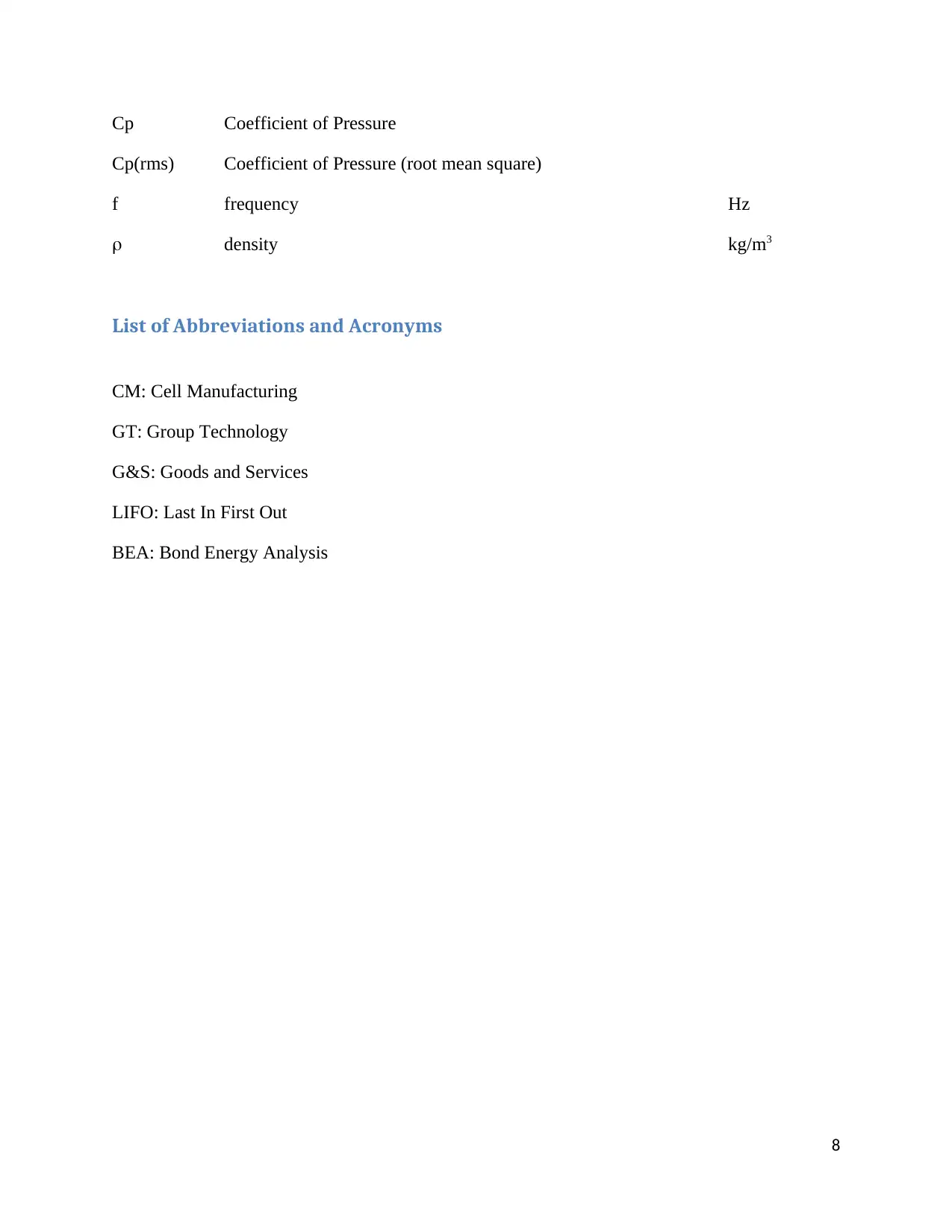
Cp Coefficient of Pressure
Cp(rms) Coefficient of Pressure (root mean square)
f frequency Hz
density kg/m3
List of Abbreviations and Acronyms
CM: Cell Manufacturing
GT: Group Technology
G&S: Goods and Services
LIFO: Last In First Out
BEA: Bond Energy Analysis
8
Cp(rms) Coefficient of Pressure (root mean square)
f frequency Hz
density kg/m3
List of Abbreviations and Acronyms
CM: Cell Manufacturing
GT: Group Technology
G&S: Goods and Services
LIFO: Last In First Out
BEA: Bond Energy Analysis
8
Chapter 1: Introduction
Background
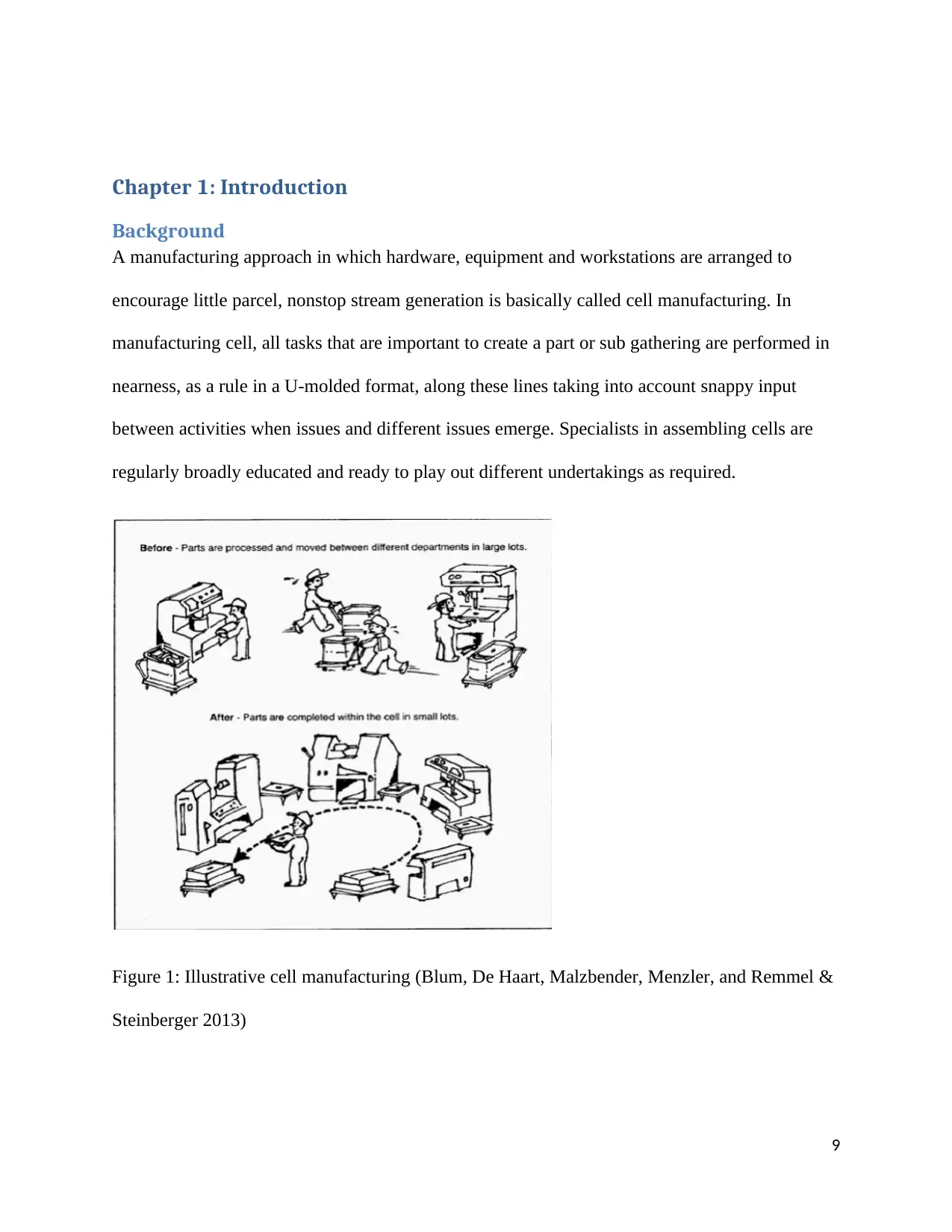
A manufacturing approach in which hardware, equipment and workstations are arranged to
encourage little parcel, nonstop stream generation is basically called cell manufacturing. In
manufacturing cell, all tasks that are important to create a part or sub gathering are performed in
nearness, as a rule in a U-molded format, along these lines taking into account snappy input
between activities when issues and different issues emerge. Specialists in assembling cells are
regularly broadly educated and ready to play out different undertakings as required.
Figure 1: Illustrative cell manufacturing (Blum, De Haart, Malzbender, Menzler, and Remmel &
Steinberger 2013)
9
Background
A manufacturing approach in which hardware, equipment and workstations are arranged to
encourage little parcel, nonstop stream generation is basically called cell manufacturing. In
manufacturing cell, all tasks that are important to create a part or sub gathering are performed in
nearness, as a rule in a U-molded format, along these lines taking into account snappy input
between activities when issues and different issues emerge. Specialists in assembling cells are
regularly broadly educated and ready to play out different undertakings as required.
Figure 1: Illustrative cell manufacturing (Blum, De Haart, Malzbender, Menzler, and Remmel &
Steinberger 2013)
9
⊘ This is a preview!⊘
Do you want full access?
Subscribe today to unlock all pages.
Trusted by 1+ million students worldwide
In conventional assembling situations, comparative machines are set near one another (e.g.
machines, factories, drills, squeezes, and painting, cleaning, and so on.). These formats are
progressively strong to machine breakdowns, have basic dances and apparatuses in a similar
zone, and bolster large amounts of division. Cell Manufacturing frameworks machines are
assembled together as per the groups of parts delivered, which gives a particular favorable
position in that material stream is fundamentally enhanced, which decreases the separation gone
by materials, stock, individuals which builds the general lead times.
The manufacturing sector has turned out to be progressively competitive as business sectors turn
out to be spread worldwide. Subsequently, inexistence is real moves that focus on designing the
systems of manufacturing utilizing inventive ideas. Such appropriation within cell production
may have triggered significant enthusiasm between the two specialists as well as experts who
offer a few important points of interest, incorporating decrease that is expected in the time for
leading period, the activities in the inventories processes as well as the period in setting up the
equipment. This particular process is possible since the components under production possess
lots of similarity in the sizes and in shapes. Revamping such unit design that possess
requirements, in any case, might be tedious and expensive. Further, if these progressions happen
exceptionally every now and again, reconfiguration end up being impossible to achieve or even
being implemented.
When analyzing the same domain, it gives the idea which experts will in general receive a
conventional activity of workshop layout characterized with the advantages of cell producing
frameworks. The exploration in this paper thinks about the new idea of improving cell
manufacturing (CM). This is in an endeavor to expand the effectiveness of manufacturing tasks
by changing the techniques for production. Implanted in this paper are the standards of group
10
machines, factories, drills, squeezes, and painting, cleaning, and so on.). These formats are
progressively strong to machine breakdowns, have basic dances and apparatuses in a similar
zone, and bolster large amounts of division. Cell Manufacturing frameworks machines are
assembled together as per the groups of parts delivered, which gives a particular favorable
position in that material stream is fundamentally enhanced, which decreases the separation gone
by materials, stock, individuals which builds the general lead times.
The manufacturing sector has turned out to be progressively competitive as business sectors turn
out to be spread worldwide. Subsequently, inexistence is real moves that focus on designing the
systems of manufacturing utilizing inventive ideas. Such appropriation within cell production
may have triggered significant enthusiasm between the two specialists as well as experts who
offer a few important points of interest, incorporating decrease that is expected in the time for
leading period, the activities in the inventories processes as well as the period in setting up the
equipment. This particular process is possible since the components under production possess
lots of similarity in the sizes and in shapes. Revamping such unit design that possess
requirements, in any case, might be tedious and expensive. Further, if these progressions happen
exceptionally every now and again, reconfiguration end up being impossible to achieve or even
being implemented.
When analyzing the same domain, it gives the idea which experts will in general receive a
conventional activity of workshop layout characterized with the advantages of cell producing
frameworks. The exploration in this paper thinks about the new idea of improving cell
manufacturing (CM). This is in an endeavor to expand the effectiveness of manufacturing tasks
by changing the techniques for production. Implanted in this paper are the standards of group
10
Paraphrase This Document
Need a fresh take? Get an instant paraphrase of this document with our AI Paraphraser
technology (GT) as it applies to handling groups of parts that have comparative assembling
tasks. The issue of family situated planning to take further set-up efficiencies of conventional
CM that is characterized with the directing adaptability of a practically sorted out work shop is
additionally settled in. Choices for pooling of employments into families, arrival of part families
to the shop and dispatching of employments to singular machines will prompt further
enhancement in occupation stream time.
In this paper a case considered was utilized to exhibit new idea of CM. Accentuation will be set
to think about the model execution regarding set-up and work stream times. Because of the
simplicity with which worldwide data is accessible to the client their necessity for goods and
Services (G&S) are of an exclusive expectation. These G&S must be effectively accessible with
short lead time at extremely competitive costs. This is obvious within the manufacturing industry
in Trinidad and Tobago (T&T). The assortments of items which are created in the manufacturing
projects inside T&T are finished utilizing different forms and are practiced through various
operations, for example in the cases where the production takes place in the open air and the
areas are marked as shops and extensions.
Considering a situation in which the client requests becomes little amounts compared with an
extensive assortment, the JS task ends up being basic. Inside the JS condition as confirmed by
recent manufacturers and their clients are not fulfilled. This is an after effect of issues that are
found within these organizations starting from the administration and to the level of operation.
Some of these results were gotten from different field survey to these organizations and are
presently recorded for reference.
The major shortcoming Issues:
11
tasks. The issue of family situated planning to take further set-up efficiencies of conventional
CM that is characterized with the directing adaptability of a practically sorted out work shop is
additionally settled in. Choices for pooling of employments into families, arrival of part families
to the shop and dispatching of employments to singular machines will prompt further
enhancement in occupation stream time.
In this paper a case considered was utilized to exhibit new idea of CM. Accentuation will be set
to think about the model execution regarding set-up and work stream times. Because of the
simplicity with which worldwide data is accessible to the client their necessity for goods and
Services (G&S) are of an exclusive expectation. These G&S must be effectively accessible with
short lead time at extremely competitive costs. This is obvious within the manufacturing industry
in Trinidad and Tobago (T&T). The assortments of items which are created in the manufacturing
projects inside T&T are finished utilizing different forms and are practiced through various
operations, for example in the cases where the production takes place in the open air and the
areas are marked as shops and extensions.
Considering a situation in which the client requests becomes little amounts compared with an
extensive assortment, the JS task ends up being basic. Inside the JS condition as confirmed by
recent manufacturers and their clients are not fulfilled. This is an after effect of issues that are
found within these organizations starting from the administration and to the level of operation.
Some of these results were gotten from different field survey to these organizations and are
presently recorded for reference.
The major shortcoming Issues:
11
• There is no reported or embraced approach that is entirely followed as far as employment
planning is concerned.
• No arrangement substitution and redesigns of systems.
• No logical upkeep procedures that are used in the machinery arrangement in the plant set up.
•There is shortage of learning and exercises of training in connection to the current methods of
operation and mechanisms of the system upgrade
• Absence of arrangement progression activities in regard to congruity for successful as well as
productive tasks.
• Insignificant representative morals because of absence of inspiration and remuneration.
The characterization of cell manufacturing can be treated as a utilization of GT in which groups
of components which need comparable arrangement of tasks are created inside a cell using all or
the vast majority of the machinery in the cell. An item can be handled logically starting with one
workstation then onto the next within the workshop without trusting that a cluster will be
finished. Cells might be devoted to a procedure, a sub-part, or a whole item. Since just
comparative parts that require a comparative arrangement of tasks are delivered in the cell, the
set-up time for delivering the item will be zero or a restricted sum, bringing about decrease
work-in-process (WIP) stock and throughput times, expanded workers fulfillment and efficiency
of the shop.
All in all, there is need for the physical rearrangement of the components of the machine tools
that are found within the shops of the jobs to certain cell format at impressive expense or
competitive cost. Then again, when new items manufacturing are required in the event that they
12
planning is concerned.
• No arrangement substitution and redesigns of systems.
• No logical upkeep procedures that are used in the machinery arrangement in the plant set up.
•There is shortage of learning and exercises of training in connection to the current methods of
operation and mechanisms of the system upgrade
• Absence of arrangement progression activities in regard to congruity for successful as well as
productive tasks.
• Insignificant representative morals because of absence of inspiration and remuneration.
The characterization of cell manufacturing can be treated as a utilization of GT in which groups
of components which need comparable arrangement of tasks are created inside a cell using all or
the vast majority of the machinery in the cell. An item can be handled logically starting with one
workstation then onto the next within the workshop without trusting that a cluster will be
finished. Cells might be devoted to a procedure, a sub-part, or a whole item. Since just
comparative parts that require a comparative arrangement of tasks are delivered in the cell, the
set-up time for delivering the item will be zero or a restricted sum, bringing about decrease
work-in-process (WIP) stock and throughput times, expanded workers fulfillment and efficiency
of the shop.
All in all, there is need for the physical rearrangement of the components of the machine tools
that are found within the shops of the jobs to certain cell format at impressive expense or
competitive cost. Then again, when new items manufacturing are required in the event that they
12
⊘ This is a preview!⊘
Do you want full access?
Subscribe today to unlock all pages.
Trusted by 1+ million students worldwide

1 out of 79


Related Documents


Your All-in-One AI-Powered Toolkit for Academic Success.
+13062052269
info@desklib.com
Available 24*7 on WhatsApp / Email
![[object Object]](/_next/static/media/star-bottom.7253800d.svg)
Unlock your academic potential
Copyright © 2020–2026 A2Z Services. All Rights Reserved. Developed and managed by ZUCOL.