Comprehensive Analysis: CEMEX Marketing Mix in the Cement Industry
VerifiedAdded on 2021/12/15
|8
|1569
|110
Report
AI Summary
This report provides a comprehensive analysis of the marketing mix of CEMEX, a multinational cement company. It delves into the company's product strategy, highlighting the various types of cement offered, including Portland cement, blast-furnace cement, and Portland-fly ash cement, catering to diverse construction needs. The report examines CEMEX's pricing strategy, emphasizing its customer-oriented approach to maximize revenue generation. Furthermore, it explores the distribution and supply chain strategies, noting CEMEX's direct presence in key markets and its use of supply chains in other regions. The conclusion suggests strategies for CEMEX to expand its market share in the cement industry, particularly in Asia and Africa, and recommends opening wholly owned subsidiaries in strategic locations to strengthen its presence and supply chain efficiency. The report references several sources to support its analysis of CEMEX's marketing mix, and offers recommendations for future growth.
Running head: MARKETING IN CEMENT INDUSTRY
Marketing Mix of CEMEX
Name of the Student
Name of the University
Author note
Marketing Mix of CEMEX
Name of the Student
Name of the University
Author note
Paraphrase This Document
Need a fresh take? Get an instant paraphrase of this document with our AI Paraphraser

1
MARKETING IN CEMENT INDUSTRY
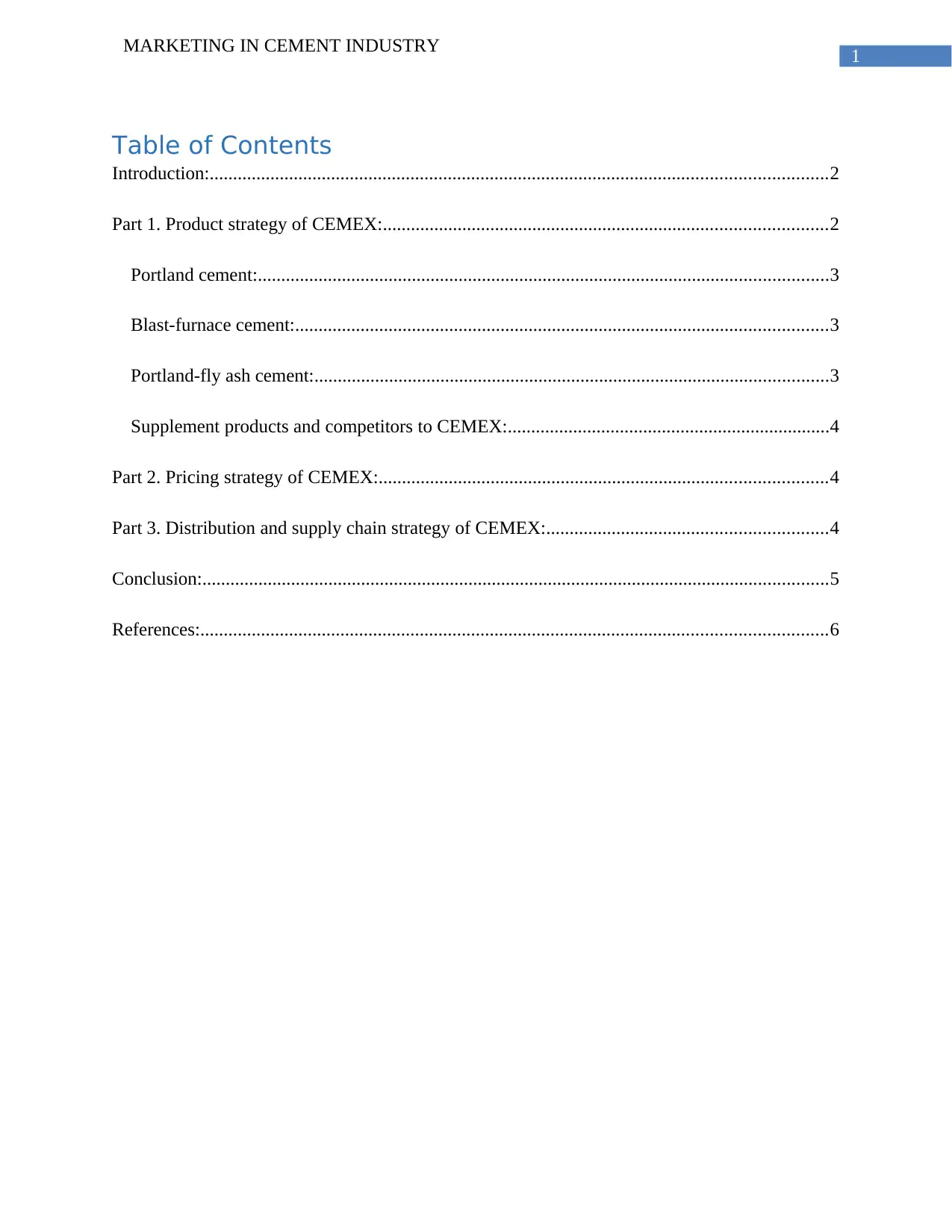
Table of Contents
Introduction:....................................................................................................................................2
Part 1. Product strategy of CEMEX:...............................................................................................2
Portland cement:..........................................................................................................................3
Blast-furnace cement:..................................................................................................................3
Portland-fly ash cement:..............................................................................................................3
Supplement products and competitors to CEMEX:.....................................................................4
Part 2. Pricing strategy of CEMEX:................................................................................................4
Part 3. Distribution and supply chain strategy of CEMEX:............................................................4
Conclusion:......................................................................................................................................5
References:......................................................................................................................................6
MARKETING IN CEMENT INDUSTRY
Table of Contents
Introduction:....................................................................................................................................2
Part 1. Product strategy of CEMEX:...............................................................................................2
Portland cement:..........................................................................................................................3
Blast-furnace cement:..................................................................................................................3
Portland-fly ash cement:..............................................................................................................3
Supplement products and competitors to CEMEX:.....................................................................4
Part 2. Pricing strategy of CEMEX:................................................................................................4
Part 3. Distribution and supply chain strategy of CEMEX:............................................................4
Conclusion:......................................................................................................................................5
References:......................................................................................................................................6

2
MARKETING IN CEMENT INDUSTRY
Introduction:
Cement is one of the most important raw materials used in the construction industry and
find use in a range of constructions like small houses and causeways to housing projects and
multilane bridges. Business Wire reports that the global cement industry is expected to rise to
over USD 725 billion with a expected increase in demand at the rate of 7.3 percent. The factors
like increase in industrialization and expansion of urban settlements are boosting the industry
(Businesswire.com, 2018). The aim of the task would be delving into the marketing mix of a
multinational cement company through through lenses of CEMEX, which is domiciled in
Mexico (Cemexusa.com, 2018). The paper would apply the theory of marketing mix to explore
how the company meet the requirements of customers and operates in the market profitably.
Part 1. Product strategy of CEMEX:
The product strategy of CEMEX is extremely customers oriented and facilitates the
company to serve an array of clients. It can be pointed out that CEMEX is a multinational
company listed on the Mexican Stock Exchange which operate in more than ten countries across
Asia, North America, Europe and South America. Thus, it can be pointed out from the product
umbrella of the company that its product strategy rests on catering to construction projects in
these markets of diverse scale. The company takes into consideration these needs of different
categories of clients (Porter & Heppelmann, 2015). For example, the company provides cement
for small scale projects. However, in order to meet the needs of the multinational and expensive
construction projects, the company also sells a variety of supporting products or accessory
products. The accessory products consists of variety of building rocks, blocks, architecture
products and asphalt. The company through its diverse products caters to different product range
is able to support infrastructural developments in its important host markets like the United
MARKETING IN CEMENT INDUSTRY
Introduction:
Cement is one of the most important raw materials used in the construction industry and
find use in a range of constructions like small houses and causeways to housing projects and
multilane bridges. Business Wire reports that the global cement industry is expected to rise to
over USD 725 billion with a expected increase in demand at the rate of 7.3 percent. The factors
like increase in industrialization and expansion of urban settlements are boosting the industry
(Businesswire.com, 2018). The aim of the task would be delving into the marketing mix of a
multinational cement company through through lenses of CEMEX, which is domiciled in
Mexico (Cemexusa.com, 2018). The paper would apply the theory of marketing mix to explore
how the company meet the requirements of customers and operates in the market profitably.
Part 1. Product strategy of CEMEX:
The product strategy of CEMEX is extremely customers oriented and facilitates the
company to serve an array of clients. It can be pointed out that CEMEX is a multinational
company listed on the Mexican Stock Exchange which operate in more than ten countries across
Asia, North America, Europe and South America. Thus, it can be pointed out from the product
umbrella of the company that its product strategy rests on catering to construction projects in
these markets of diverse scale. The company takes into consideration these needs of different
categories of clients (Porter & Heppelmann, 2015). For example, the company provides cement
for small scale projects. However, in order to meet the needs of the multinational and expensive
construction projects, the company also sells a variety of supporting products or accessory
products. The accessory products consists of variety of building rocks, blocks, architecture
products and asphalt. The company through its diverse products caters to different product range
is able to support infrastructural developments in its important host markets like the United
⊘ This is a preview!⊘
Do you want full access?
Subscribe today to unlock all pages.

Trusted by 1+ million students worldwide

3
MARKETING IN CEMENT INDUSTRY
States of America. CEMEX aims to position itself as the a superior cement and building
materials marketer capable of serving both small scale construction projects as well as expensive
road construction projects in the US (Rutešić et al., 2015).
The United States of America is a developed economy with continuous increase of
demand for diverse types of cement to support its ever increasing infrastructural needs. The
following are main types of cement which CEMEX markets in the United States of America:
Portland cement:
Portland cement is the most widely used variety of cement used in different construction
works in mixture with other building materials. The chief attribute of Portland cement is
adaptability and ability to mix with different types of building materials to attribute the concrete
with strong base. The Portland cement offered by CEMEX is of very high quality and comes in
waterproof packaging bearing the logo of CEMEX (Schöler et al., 2015).
Blast-furnace cement:
The main attribute of blast-furnace cement is its 95 percent granulated blast furnace slag
and gypsum in small amounts. The main market of this category of high quality cement is civil
construction industry due to the high compressive strength of the cement. However, the strength
is reduced due to increase in the proportion of slag (Shu & Huang, 2014).
Portland-fly ash cement:
The Portland-fly ash cement contains fly ash with low water concentration. The main
markets of this quality of cement are the civil construction projects which require early
hardening. The fly ash cement is cheaper than Portland cement and often finds use in low budget
MARKETING IN CEMENT INDUSTRY
States of America. CEMEX aims to position itself as the a superior cement and building
materials marketer capable of serving both small scale construction projects as well as expensive
road construction projects in the US (Rutešić et al., 2015).
The United States of America is a developed economy with continuous increase of
demand for diverse types of cement to support its ever increasing infrastructural needs. The
following are main types of cement which CEMEX markets in the United States of America:
Portland cement:
Portland cement is the most widely used variety of cement used in different construction
works in mixture with other building materials. The chief attribute of Portland cement is
adaptability and ability to mix with different types of building materials to attribute the concrete
with strong base. The Portland cement offered by CEMEX is of very high quality and comes in
waterproof packaging bearing the logo of CEMEX (Schöler et al., 2015).
Blast-furnace cement:
The main attribute of blast-furnace cement is its 95 percent granulated blast furnace slag
and gypsum in small amounts. The main market of this category of high quality cement is civil
construction industry due to the high compressive strength of the cement. However, the strength
is reduced due to increase in the proportion of slag (Shu & Huang, 2014).
Portland-fly ash cement:
The Portland-fly ash cement contains fly ash with low water concentration. The main
markets of this quality of cement are the civil construction projects which require early
hardening. The fly ash cement is cheaper than Portland cement and often finds use in low budget
Paraphrase This Document
Need a fresh take? Get an instant paraphrase of this document with our AI Paraphraser

4
MARKETING IN CEMENT INDUSTRY
construction projects. This type of cement is of extremely high quality and packaged in air tight
and water proof containers bearing the logo of CEMEX.
Supplement products and competitors to CEMEX:
The supplementary products of CEMEX consist of allied services like landscaping and
block as well as asphalt. The main competitors of CEMEX are Lafarge, Holcim and Heidelberg
Cement.
Part 2. Pricing strategy of CEMEX:
The main objective of pricing strategy which the marketing team of CEMEX wants to
achieve catering to the needs of a large number of consumers to ensure high revenue generation.
This is evident from the product strategy of CEMEX. The multinational Mexican cement
company provides diverse types of cement and allied products to meet the needs of the diverse
types ofd customers. For example, to cater to the needs of the small scale projects, the company
provides cement (Schöler et al., 2015). The company in order to cater to the needs of the large
government run projects, the road construction, the company offers asphalt whereas in order to
cater to the needs of the property development projects, the company offers rocks and blocks for
landscaping purposes. Thus, it can be inferred from the very discussion of the product offerings
of CEMEX that the company is able to cater to diverse customers, thus generating immense
revenue (Pangdaeng et al., 2014).
Part 3. Distribution and supply chain strategy of CEMEX:
The distribution and supply chain strategy of CEMEX consist of direct presence as well
as presence through agents. The company operates in its main markets through wholly owned
MARKETING IN CEMENT INDUSTRY
construction projects. This type of cement is of extremely high quality and packaged in air tight
and water proof containers bearing the logo of CEMEX.
Supplement products and competitors to CEMEX:
The supplementary products of CEMEX consist of allied services like landscaping and
block as well as asphalt. The main competitors of CEMEX are Lafarge, Holcim and Heidelberg
Cement.
Part 2. Pricing strategy of CEMEX:
The main objective of pricing strategy which the marketing team of CEMEX wants to
achieve catering to the needs of a large number of consumers to ensure high revenue generation.
This is evident from the product strategy of CEMEX. The multinational Mexican cement
company provides diverse types of cement and allied products to meet the needs of the diverse
types ofd customers. For example, to cater to the needs of the small scale projects, the company
provides cement (Schöler et al., 2015). The company in order to cater to the needs of the large
government run projects, the road construction, the company offers asphalt whereas in order to
cater to the needs of the property development projects, the company offers rocks and blocks for
landscaping purposes. Thus, it can be inferred from the very discussion of the product offerings
of CEMEX that the company is able to cater to diverse customers, thus generating immense
revenue (Pangdaeng et al., 2014).
Part 3. Distribution and supply chain strategy of CEMEX:
The distribution and supply chain strategy of CEMEX consist of direct presence as well
as presence through agents. The company operates in its main markets through wholly owned

5
MARKETING IN CEMENT INDUSTRY
subsidiaries. CEMEX operates in countries where it has no direct presence through supply chains
(Celik et al., 2015).
Conclusion:
It can be concluded from the discussion that CEMEX is a leader in the American market
owing its powerful marketing mix. However, the company must aim to expand its business in
Asia to take the advantage of emerging construction industry. The company should aim at
acquiring more projects in these markets. Further, it can also be recommended that CEMEX
should also aim at expanding into Africa to a greater extent and aim to participate in projects
which have involvement of either its home country government or the American government. It
can also be recommended that the company must open wholly owned subsidiaries in countries
like China. This is because its competitors like Lafarge already have presence in these markets in
form of wholly owned subsidiaries listed on the top stock exchanges in these markets. Thus,
opening of wholly owned subsidiaries would enable the multinational cement manufacturing
company to strengthen its presence in these countries. Further, it would also enable the company
to make its supply chain shorter and more profitable.
MARKETING IN CEMENT INDUSTRY
subsidiaries. CEMEX operates in countries where it has no direct presence through supply chains
(Celik et al., 2015).
Conclusion:
It can be concluded from the discussion that CEMEX is a leader in the American market
owing its powerful marketing mix. However, the company must aim to expand its business in
Asia to take the advantage of emerging construction industry. The company should aim at
acquiring more projects in these markets. Further, it can also be recommended that CEMEX
should also aim at expanding into Africa to a greater extent and aim to participate in projects
which have involvement of either its home country government or the American government. It
can also be recommended that the company must open wholly owned subsidiaries in countries
like China. This is because its competitors like Lafarge already have presence in these markets in
form of wholly owned subsidiaries listed on the top stock exchanges in these markets. Thus,
opening of wholly owned subsidiaries would enable the multinational cement manufacturing
company to strengthen its presence in these countries. Further, it would also enable the company
to make its supply chain shorter and more profitable.
⊘ This is a preview!⊘
Do you want full access?
Subscribe today to unlock all pages.

Trusted by 1+ million students worldwide

6
MARKETING IN CEMENT INDUSTRY
References:
Businesswire.com. (2018). Retrieved from
https://www.businesswire.com/news/home/20180223005279/en/Global-Cement-Market-
2017-2025-Size-Share-Application
Celik, K., Meral, C., Gursel, A. P., Mehta, P. K., Horvath, A., & Monteiro, P. J. (2015).
Mechanical properties, durability, and life-cycle assessment of self-consolidating
concrete mixtures made with blended portland cements containing fly ash and limestone
powder. Cement and Concrete Composites, 56, 59-72.
Cemexusa.com. (2018). Retrieved from
https://www.cemexusa.com/products-and-services/cement
Pangdaeng, S., Phoo-ngernkham, T., Sata, V., & Chindaprasirt, P. (2014). Influence of curing
conditions on properties of high calcium fly ash geopolymer containing Portland cement
as additive. Materials & Design, 53, 269-274.
Porter, M. E., & Heppelmann, J. E. (2015). How smart, connected products are transforming
companies. Harvard Business Review, 93(10), 96-114.
Rutešić, S., Ćetković, J., Knežević, M., Žarković, M., & Vatin, N. (2015). Institutional
framework, current investments and future strategic direction for development of
construction sector in Montenegro. Procedia Engineering, 117, 637-645.
Schöler, A., Lothenbach, B., Winnefeld, F., & Zajac, M. (2015). Hydration of quaternary
Portland cement blends containing blast-furnace slag, siliceous fly ash and limestone
powder. Cement and Concrete Composites, 55, 374-382.
MARKETING IN CEMENT INDUSTRY
References:
Businesswire.com. (2018). Retrieved from
https://www.businesswire.com/news/home/20180223005279/en/Global-Cement-Market-
2017-2025-Size-Share-Application
Celik, K., Meral, C., Gursel, A. P., Mehta, P. K., Horvath, A., & Monteiro, P. J. (2015).
Mechanical properties, durability, and life-cycle assessment of self-consolidating
concrete mixtures made with blended portland cements containing fly ash and limestone
powder. Cement and Concrete Composites, 56, 59-72.
Cemexusa.com. (2018). Retrieved from
https://www.cemexusa.com/products-and-services/cement
Pangdaeng, S., Phoo-ngernkham, T., Sata, V., & Chindaprasirt, P. (2014). Influence of curing
conditions on properties of high calcium fly ash geopolymer containing Portland cement
as additive. Materials & Design, 53, 269-274.
Porter, M. E., & Heppelmann, J. E. (2015). How smart, connected products are transforming
companies. Harvard Business Review, 93(10), 96-114.
Rutešić, S., Ćetković, J., Knežević, M., Žarković, M., & Vatin, N. (2015). Institutional
framework, current investments and future strategic direction for development of
construction sector in Montenegro. Procedia Engineering, 117, 637-645.
Schöler, A., Lothenbach, B., Winnefeld, F., & Zajac, M. (2015). Hydration of quaternary
Portland cement blends containing blast-furnace slag, siliceous fly ash and limestone
powder. Cement and Concrete Composites, 55, 374-382.
Paraphrase This Document
Need a fresh take? Get an instant paraphrase of this document with our AI Paraphraser

7
MARKETING IN CEMENT INDUSTRY
Schöler, A., Lothenbach, B., Winnefeld, F., & Zajac, M. (2015). Hydration of quaternary
Portland cement blends containing blast-furnace slag, siliceous fly ash and limestone
powder. Cement and Concrete Composites, 55, 374-382.
Shu, X., & Huang, B. (2014). Recycling of waste tire rubber in asphalt and portland cement
concrete: An overview. Construction and Building Materials, 67, 217-224.
MARKETING IN CEMENT INDUSTRY
Schöler, A., Lothenbach, B., Winnefeld, F., & Zajac, M. (2015). Hydration of quaternary
Portland cement blends containing blast-furnace slag, siliceous fly ash and limestone
powder. Cement and Concrete Composites, 55, 374-382.
Shu, X., & Huang, B. (2014). Recycling of waste tire rubber in asphalt and portland cement
concrete: An overview. Construction and Building Materials, 67, 217-224.
1 out of 8
Related Documents
Your All-in-One AI-Powered Toolkit for Academic Success.
+13062052269
info@desklib.com
Available 24*7 on WhatsApp / Email
Unlock your academic potential
Copyright © 2020–2025 A2Z Services. All Rights Reserved. Developed and managed by ZUCOL.