CENTLEC Retail: SAP FICO ERP Implementation and Business Benefits
VerifiedAdded on 2020/12/18
|23
|6126
|437
Report
AI Summary
This report examines the implementation of an SAP FICO (ERP) system at CENTLEC Retail, a small retail company facing operational inefficiencies due to manual record-keeping and a lack of technological integration. The report identifies shortcomings in the existing environment, focusing on issues in supply chain management, inventory control, and financial reporting. It justifies the selection of SAP FICO, outlining its benefits in terms of improved decision-making, reduced errors, and enhanced communication. The report details capital expenditures required for implementation, including database management, infrastructure, software, and human resource costs. Furthermore, it addresses the importance of generating sustainable innovation competency through employee training and motivation. A time-based process map (TBPM) is presented to demonstrate potential productivity improvements. The report also discusses the application and value of the S-curve in technology development within the business environment. The report concludes by emphasizing the potential of SAP FICO to streamline operations, improve financial management, and foster sustainable growth for CENTLEC Retail.


Paraphrase This Document
Need a fresh take? Get an instant paraphrase of this document with our AI Paraphraser
Post-ModuleProject
Project Cover Page
Company: CENTLEC
Table of contents
Table of contents.................................................................................................... 2
List of Tables........................................................................................................... 3
Illustration Index..................................................................................................... 3
1. INTRODUCTION............................................................................................... 5
2.Existing environment of CENTLEC and its current shortcomings..........................5
3. Benefit that can be gained by implementing SAP FICO (ERP) system..............6
4. Selecting new technology................................................................................... 7
5. Justification for capital expenditures...........................................................7
6. Generate sustainable innovation competency........................................8
2
Project Cover Page
Company: CENTLEC
Table of contents
Table of contents.................................................................................................... 2
List of Tables........................................................................................................... 3
Illustration Index..................................................................................................... 3
1. INTRODUCTION............................................................................................... 5
2.Existing environment of CENTLEC and its current shortcomings..........................5
3. Benefit that can be gained by implementing SAP FICO (ERP) system..............6
4. Selecting new technology................................................................................... 7
5. Justification for capital expenditures...........................................................7
6. Generate sustainable innovation competency........................................8
2
7.Time based process map..................................................................................... 8
8. Use of S-curve in order to develop new technology.......................................12
9. Value and limitation of S-curve.........................................................................13
10. Description of application process...................................................................14
10. 1. Financial Impact.......................................................................................... 14
10. 2. Human development impact.......................................................................14
11. Conclusion.................................................................................................... 15
REFERENCES....................................................................................................... 17
APPENDIX............................................................................................................. 19
2. Time based map process...................................................................................19
3. Total labour cost............................................................................................... 20
4. Improvement in operational effeciency.............................................................20
5. TBPM of improved operations............................................................................21
6. Annual savings by implementing new process..................................................22
List of Tables
Table 1: capital expenditures........................................................................................................... 7
Table 2:Elapsed and activity timing........................................................................................................ 9
Table 3: elapsed and activity time for Outbound process....................................................................10
Table 4time based process map........................................................................................................... 11
Table 5: Inbound process Time based map process...................................................................19
Table 6: outbound process Time based map process................................................................19
Table 7: TBPM of improved operations.........................................................................................21
Table 8: TBPM of improved operations.........................................................................................21
3
8. Use of S-curve in order to develop new technology.......................................12
9. Value and limitation of S-curve.........................................................................13
10. Description of application process...................................................................14
10. 1. Financial Impact.......................................................................................... 14
10. 2. Human development impact.......................................................................14
11. Conclusion.................................................................................................... 15
REFERENCES....................................................................................................... 17
APPENDIX............................................................................................................. 19
2. Time based map process...................................................................................19
3. Total labour cost............................................................................................... 20
4. Improvement in operational effeciency.............................................................20
5. TBPM of improved operations............................................................................21
6. Annual savings by implementing new process..................................................22
List of Tables
Table 1: capital expenditures........................................................................................................... 7
Table 2:Elapsed and activity timing........................................................................................................ 9
Table 3: elapsed and activity time for Outbound process....................................................................10
Table 4time based process map........................................................................................................... 11
Table 5: Inbound process Time based map process...................................................................19
Table 6: outbound process Time based map process................................................................19
Table 7: TBPM of improved operations.........................................................................................21
Table 8: TBPM of improved operations.........................................................................................21
3
⊘ This is a preview!⊘
Do you want full access?
Subscribe today to unlock all pages.

Trusted by 1+ million students worldwide

Illustration Index
Illustration 1: Time based inbound process map.....................................................................................9
Illustration 2: Time based process map for outbound operations..........................................................10
4
Illustration 1: Time based inbound process map.....................................................................................9
Illustration 2: Time based process map for outbound operations..........................................................10
4
Paraphrase This Document
Need a fresh take? Get an instant paraphrase of this document with our AI Paraphraser
1. INTRODUCTION
Technology has become important in the fast life of today. It is technology,
which has sped up our lives, it is technology, which has brought distant locations
closer and made the world a smaller place to live.In the modern era, and companies
always try to enhance efficiency level of its operations. For this they implement new
technologies in order to minimize errors and raise level of operations. Management
of technology can be defined as management disciplines that help the organization
in managing technologies well and adding value to business. In other words,
management of technology is function of company that helps in continuous
development of operational efficiency. It is integrating planning process that helps
in controlling of technological aspects and improving business performance. MOT is
beneficial for the growth of enterprise because it maximises cost effectiveness of
company. Furthermore, it eliminates duplication of work and resources. This
supports in generating more revenues in the organization.
Present study is based on CENTLEC retail business. CENTLEC is planning to raise its
revenues by changing its operational process and adopt new technologies. Current
project discusses impact of SAP FICO (ERP) system on CENTLEC retail. It also covers
existing shortcomings in the corporation. It will draw a time based process map
(TBPM). Furthermore, it explains values and limitation of S-Curve in the business
environment
2.Existing environment of CENTLEC and its current
shortcomings
CENTLEC retail is a small size retail company. It distributes quality food and grocery
items to consumers. Recently this company adopts flat structure where all
employees are free to make their decisions. It involves workers in decision-making
process so that they feel motivated and perform their duties well (Wang, Syaiful and
Nurul, 2017). Corporation always try to develop positive and healthy environment
so that people can perform their work effectively and they feel satisfied.
All the operations of the cited retail are managed by traditional ways. All
transactions related to supply chain; cash flow, purchasing, sales etc. are
maintained manually. Employees who are working in organization have no
adequate knowledge about the latest accounting software that can help them in
managing records well (Singh, 2016). Due to manual record keeping system,
company fails to conduct operations without mistakes. Most of the employees work
in the purchase department they fail to manage inventory records. This is the
major issue in the company due to which it is unable to generate more profit and
expand its business to other location. Furthermore, workers of CENTLEC Retail have
no knowledge about the latest technologies. Entity is operating its business at small
level and it is not properly preparing its financial statements. That is why most of
the time it fails to keeps accurate record of cash. In the recent time all big
organisations are using advance technologies such as ERP etc. to maintain their
5
Technology has become important in the fast life of today. It is technology,
which has sped up our lives, it is technology, which has brought distant locations
closer and made the world a smaller place to live.In the modern era, and companies
always try to enhance efficiency level of its operations. For this they implement new
technologies in order to minimize errors and raise level of operations. Management
of technology can be defined as management disciplines that help the organization
in managing technologies well and adding value to business. In other words,
management of technology is function of company that helps in continuous
development of operational efficiency. It is integrating planning process that helps
in controlling of technological aspects and improving business performance. MOT is
beneficial for the growth of enterprise because it maximises cost effectiveness of
company. Furthermore, it eliminates duplication of work and resources. This
supports in generating more revenues in the organization.
Present study is based on CENTLEC retail business. CENTLEC is planning to raise its
revenues by changing its operational process and adopt new technologies. Current
project discusses impact of SAP FICO (ERP) system on CENTLEC retail. It also covers
existing shortcomings in the corporation. It will draw a time based process map
(TBPM). Furthermore, it explains values and limitation of S-Curve in the business
environment
2.Existing environment of CENTLEC and its current
shortcomings
CENTLEC retail is a small size retail company. It distributes quality food and grocery
items to consumers. Recently this company adopts flat structure where all
employees are free to make their decisions. It involves workers in decision-making
process so that they feel motivated and perform their duties well (Wang, Syaiful and
Nurul, 2017). Corporation always try to develop positive and healthy environment
so that people can perform their work effectively and they feel satisfied.
All the operations of the cited retail are managed by traditional ways. All
transactions related to supply chain; cash flow, purchasing, sales etc. are
maintained manually. Employees who are working in organization have no
adequate knowledge about the latest accounting software that can help them in
managing records well (Singh, 2016). Due to manual record keeping system,
company fails to conduct operations without mistakes. Most of the employees work
in the purchase department they fail to manage inventory records. This is the
major issue in the company due to which it is unable to generate more profit and
expand its business to other location. Furthermore, workers of CENTLEC Retail have
no knowledge about the latest technologies. Entity is operating its business at small
level and it is not properly preparing its financial statements. That is why most of
the time it fails to keeps accurate record of cash. In the recent time all big
organisations are using advance technologies such as ERP etc. to maintain their
5
records. This helps in avoiding errors and managing all information properly. This is
the way that supports these entities in minimizing cost and raising profit of business
unit. But CENTLEC retail is not using any kind of technology that is why it has to
face complications. It cannot assume deman forecasting, actual production
capabilities due to poor management of technologies. They are using traditional
ways to perform their work. In such conditions many time they get failed to meet
with needs of consumers and deliver them goods on time. These are shortcomings
of the business which affects its operational efficiency (Azevedo, Azevedo and
Romão, 2016). By replacing existing financial system with the new SAP FICO (ERP),
CENTLEC company can minimize mistakes and can take immediate actions for
enhancing operational performance of the company.
3. Benefit that can be gained by implementing SAP FICO
(ERP) system
SAP FICO (ERP) is considered as most effective accounting software. It is the
effective technique that supports in managing unifies data from different business
departments.
It is beneficial in improving decision-making process of the retail. As CENTLEC
is a small size retail thus, it is essential for the entity to make correct decision
related to inventory, purchase, sales etc (Nestell and Olson, 2017). SAP FICO
(ERP) system supports in creating shared database and improving decision-
making process of the retail.
SAP FICO (ERP) system supports in planning realistic future scenarios. It is a
technique that helps in making realistic estimates and forecasting things in
the right manner so that more profit can be generated.
SAP FICO (ERP) system allows companies in minimizing the duplication of
work. This records all the data in systematic manner thus; duplication of work
can be minimized in the corporation (Mudanya, 2018).
It is beneficial tool that helps in improving internal communication between
various departments.
SAP FICO (ERP) system can allow CENTLEC retail in identifying errors in the
operations so that it can manage its work well. This will help in minimizing errors
and managing inventory well. This recording supports the company in reducing the
operational errors and enhancing efficiency level of operations. It can also assist in
improving communication so that employees can perform their work easily without
any confusion (Pawełoszek, 2015).
4. Selecting new technology
One of the major issues identified in the CENTLEC retail, is that manual record
keeping. By implementing the SAP FICO (ERP) system, company is able to keep
electronic records. This will support in minimizing issues of duplication to great
extent. CENTLEC is required to improve its operational, accounting, inventory
6
the way that supports these entities in minimizing cost and raising profit of business
unit. But CENTLEC retail is not using any kind of technology that is why it has to
face complications. It cannot assume deman forecasting, actual production
capabilities due to poor management of technologies. They are using traditional
ways to perform their work. In such conditions many time they get failed to meet
with needs of consumers and deliver them goods on time. These are shortcomings
of the business which affects its operational efficiency (Azevedo, Azevedo and
Romão, 2016). By replacing existing financial system with the new SAP FICO (ERP),
CENTLEC company can minimize mistakes and can take immediate actions for
enhancing operational performance of the company.
3. Benefit that can be gained by implementing SAP FICO
(ERP) system
SAP FICO (ERP) is considered as most effective accounting software. It is the
effective technique that supports in managing unifies data from different business
departments.
It is beneficial in improving decision-making process of the retail. As CENTLEC
is a small size retail thus, it is essential for the entity to make correct decision
related to inventory, purchase, sales etc (Nestell and Olson, 2017). SAP FICO
(ERP) system supports in creating shared database and improving decision-
making process of the retail.
SAP FICO (ERP) system supports in planning realistic future scenarios. It is a
technique that helps in making realistic estimates and forecasting things in
the right manner so that more profit can be generated.
SAP FICO (ERP) system allows companies in minimizing the duplication of
work. This records all the data in systematic manner thus; duplication of work
can be minimized in the corporation (Mudanya, 2018).
It is beneficial tool that helps in improving internal communication between
various departments.
SAP FICO (ERP) system can allow CENTLEC retail in identifying errors in the
operations so that it can manage its work well. This will help in minimizing errors
and managing inventory well. This recording supports the company in reducing the
operational errors and enhancing efficiency level of operations. It can also assist in
improving communication so that employees can perform their work easily without
any confusion (Pawełoszek, 2015).
4. Selecting new technology
One of the major issues identified in the CENTLEC retail, is that manual record
keeping. By implementing the SAP FICO (ERP) system, company is able to keep
electronic records. This will support in minimizing issues of duplication to great
extent. CENTLEC is required to improve its operational, accounting, inventory
6
⊘ This is a preview!⊘
Do you want full access?
Subscribe today to unlock all pages.
Trusted by 1+ million students worldwide
departments. This is possible by implementing SAP FICO (ERP) software in
workplace (Varma and Khan, 2015).
It is essential for the entity to manage it’s all the departures well so that it can
minimize errors and can enhance its profit. Due to ineffective management of
inventory data, company face issues which enhances its operational cost as well.
Managers have to look upon the all areas where changes are required and have to
measure whether these changes will give desired results or not. CENTLEC retail
needs to clarify the problems that are associated with the corporation and have to
make effective planning so that issues can be resolved by implementing the latest
technologies. It has to look upon the vision of the cited retail and has to build
consensus (Daithankar and Pandit, 2014). Company has to select SAP FICO(ERP)
software so that it can manage its records well and can monitor each activity
properly.
5. Justification for capital expenditures
In order to implement the SAP FICO (ERP) system in CENTLEC retail, company have
to invest approx R150000. It is required capital expenditure of 150000 in order to
improve its operational process (Huikku, Hyvönen and Järvinen, 2017).
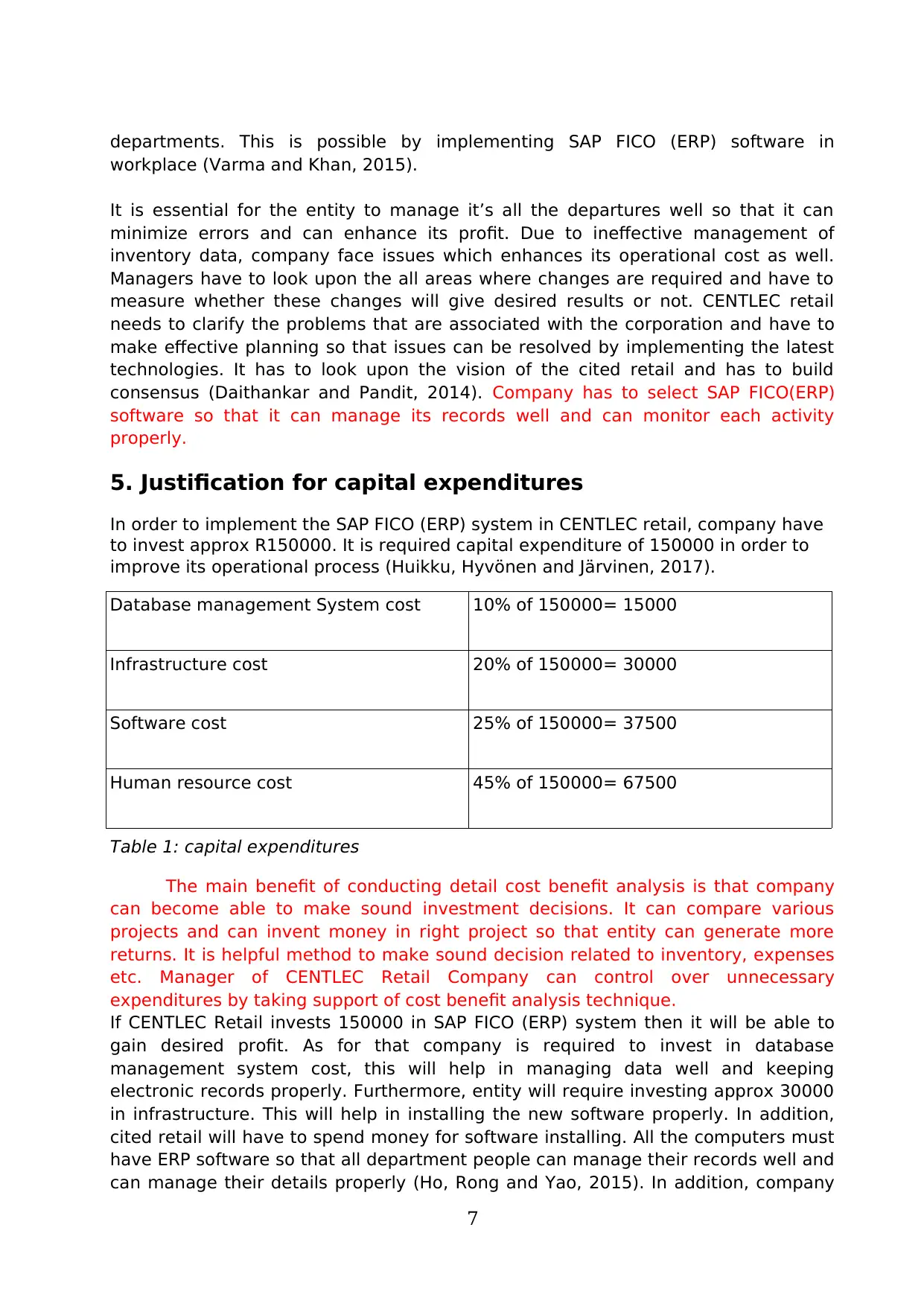
Database management System cost 10% of 150000= 15000
Infrastructure cost 20% of 150000= 30000
Software cost 25% of 150000= 37500
Human resource cost 45% of 150000= 67500
Table 1: capital expenditures
The main benefit of conducting detail cost benefit analysis is that company
can become able to make sound investment decisions. It can compare various
projects and can invent money in right project so that entity can generate more
returns. It is helpful method to make sound decision related to inventory, expenses
etc. Manager of CENTLEC Retail Company can control over unnecessary
expenditures by taking support of cost benefit analysis technique.
If CENTLEC Retail invests 150000 in SAP FICO (ERP) system then it will be able to
gain desired profit. As for that company is required to invest in database
management system cost, this will help in managing data well and keeping
electronic records properly. Furthermore, entity will require investing approx 30000
in infrastructure. This will help in installing the new software properly. In addition,
cited retail will have to spend money for software installing. All the computers must
have ERP software so that all department people can manage their records well and
can manage their details properly (Ho, Rong and Yao, 2015). In addition, company
7
workplace (Varma and Khan, 2015).
It is essential for the entity to manage it’s all the departures well so that it can
minimize errors and can enhance its profit. Due to ineffective management of
inventory data, company face issues which enhances its operational cost as well.
Managers have to look upon the all areas where changes are required and have to
measure whether these changes will give desired results or not. CENTLEC retail
needs to clarify the problems that are associated with the corporation and have to
make effective planning so that issues can be resolved by implementing the latest
technologies. It has to look upon the vision of the cited retail and has to build
consensus (Daithankar and Pandit, 2014). Company has to select SAP FICO(ERP)
software so that it can manage its records well and can monitor each activity
properly.
5. Justification for capital expenditures
In order to implement the SAP FICO (ERP) system in CENTLEC retail, company have
to invest approx R150000. It is required capital expenditure of 150000 in order to
improve its operational process (Huikku, Hyvönen and Järvinen, 2017).
Database management System cost 10% of 150000= 15000
Infrastructure cost 20% of 150000= 30000
Software cost 25% of 150000= 37500
Human resource cost 45% of 150000= 67500
Table 1: capital expenditures
The main benefit of conducting detail cost benefit analysis is that company
can become able to make sound investment decisions. It can compare various
projects and can invent money in right project so that entity can generate more
returns. It is helpful method to make sound decision related to inventory, expenses
etc. Manager of CENTLEC Retail Company can control over unnecessary
expenditures by taking support of cost benefit analysis technique.
If CENTLEC Retail invests 150000 in SAP FICO (ERP) system then it will be able to
gain desired profit. As for that company is required to invest in database
management system cost, this will help in managing data well and keeping
electronic records properly. Furthermore, entity will require investing approx 30000
in infrastructure. This will help in installing the new software properly. In addition,
cited retail will have to spend money for software installing. All the computers must
have ERP software so that all department people can manage their records well and
can manage their details properly (Ho, Rong and Yao, 2015). In addition, company
7
Paraphrase This Document
Need a fresh take? Get an instant paraphrase of this document with our AI Paraphraser
is required to invest in human resource because it will have to give training to these
employees so that they can operate the new software well and can perform well in
the organization. All these expenses will give positive results to the business unit
and it will be able to get desired results.
6. Generate sustainable innovation competency
CENTLEC limited is conducting its operations at small scale. It is very important for
the company that to generate a sustainable innovation competency so that it can
implement new technology in effective manner and can manage its operation well.
Theretail has to organize training for the employees (Daithankar and Pandit, 2014).
In the training program they have to make the workers aware with the importance
of new technology and how entity can improve its efficiency level. Furthermore,
CENTLEC retail has to enhance knowledge of the employees about new technology.
This will assist in improving their skills and they will be able to manage their work
well. Initially people may find difficult to manage work on ERP software but once
they get necessary training then they may be able to perform well in the
organization (Drum, Pernsteiner and Revak, 2016).
Furthermore, CENTLEC retail has to motivate its workers so that they use this new
technology in effective manner. Cited retail is required to provide reward and
recognition to the employees. By this way they will accept changes and will perform
well in the organization. This will encourage them and it will be beneficial for them
in generating sustainable innovation competency in the retail (Nestell and Olson,
2017).
7.Time based process map
Time based process mapping is considered as mapping tool that ensure
performance of the company. It concentrates more on minimizing the cost of
implementing new technology and implementing changes within less period of time.
It emphasis on reducing the wastage and refocusing on the sequence of activities
so that overall operational efficiency of the retail can be improved (Time-based
process mapping based on a case study of IKEA's appliances' transit, 2017).
With the help of TBPM CENTLEC retail can understand current performance of
business and can identify mistakes in the system. This compare cost with quality,
this supports in improving productivity of the corporation and enhancing quality of
work as well.
For example logistic operations of the CENTLEC retail can get influenced by the time
based process mapping. Value added time is the time in which company
becomes able to improve its products. Production time from purchasing to
raw material to final goods can be known as value added time. On other
hand wasted time is the activities due to which actual production gets
delayed such as over processing, transportation, waiting etc. In transit goods
value added time is 60 and wasted time is 40. Same in the separate various
goods value added time is 30 but wasted time is 60.
8
employees so that they can operate the new software well and can perform well in
the organization. All these expenses will give positive results to the business unit
and it will be able to get desired results.
6. Generate sustainable innovation competency
CENTLEC limited is conducting its operations at small scale. It is very important for
the company that to generate a sustainable innovation competency so that it can
implement new technology in effective manner and can manage its operation well.
Theretail has to organize training for the employees (Daithankar and Pandit, 2014).
In the training program they have to make the workers aware with the importance
of new technology and how entity can improve its efficiency level. Furthermore,
CENTLEC retail has to enhance knowledge of the employees about new technology.
This will assist in improving their skills and they will be able to manage their work
well. Initially people may find difficult to manage work on ERP software but once
they get necessary training then they may be able to perform well in the
organization (Drum, Pernsteiner and Revak, 2016).
Furthermore, CENTLEC retail has to motivate its workers so that they use this new
technology in effective manner. Cited retail is required to provide reward and
recognition to the employees. By this way they will accept changes and will perform
well in the organization. This will encourage them and it will be beneficial for them
in generating sustainable innovation competency in the retail (Nestell and Olson,
2017).
7.Time based process map
Time based process mapping is considered as mapping tool that ensure
performance of the company. It concentrates more on minimizing the cost of
implementing new technology and implementing changes within less period of time.
It emphasis on reducing the wastage and refocusing on the sequence of activities
so that overall operational efficiency of the retail can be improved (Time-based
process mapping based on a case study of IKEA's appliances' transit, 2017).
With the help of TBPM CENTLEC retail can understand current performance of
business and can identify mistakes in the system. This compare cost with quality,
this supports in improving productivity of the corporation and enhancing quality of
work as well.
For example logistic operations of the CENTLEC retail can get influenced by the time
based process mapping. Value added time is the time in which company
becomes able to improve its products. Production time from purchasing to
raw material to final goods can be known as value added time. On other
hand wasted time is the activities due to which actual production gets
delayed such as over processing, transportation, waiting etc. In transit goods
value added time is 60 and wasted time is 40. Same in the separate various
goods value added time is 30 but wasted time is 60.
8
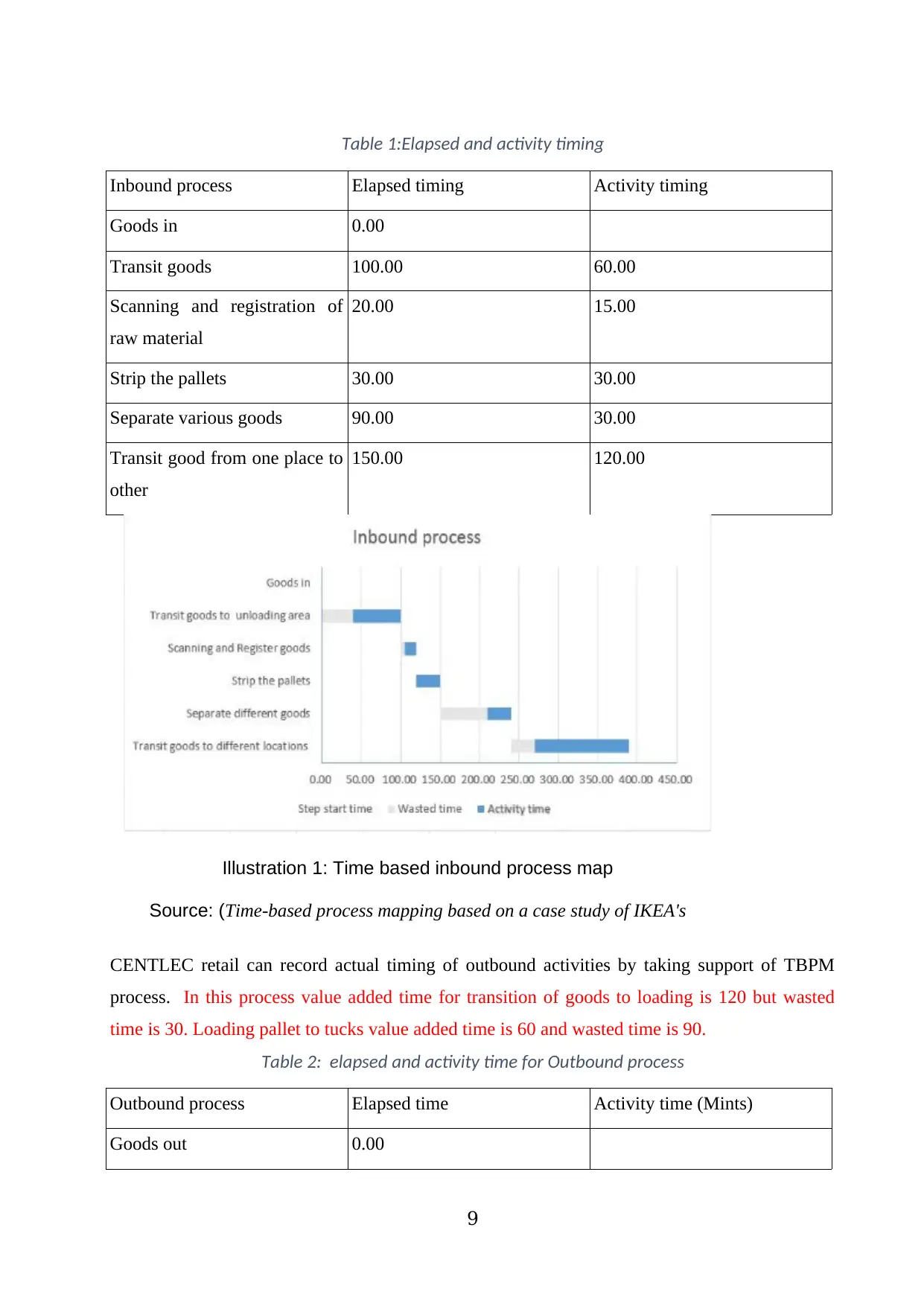
Table 1:Elapsed and activity timing
Inbound process Elapsed timing Activity timing
Goods in 0.00
Transit goods 100.00 60.00
Scanning and registration of
raw material
20.00 15.00
Strip the pallets 30.00 30.00
Separate various goods 90.00 30.00
Transit good from one place to
other
150.00 120.00
Illustration 1: Time based inbound process map
Source: (Time-based process mapping based on a case study of IKEA's
appliances' transit, 2017)
CENTLEC retail can record actual timing of outbound activities by taking support of TBPM
process. In this process value added time for transition of goods to loading is 120 but wasted
time is 30. Loading pallet to tucks value added time is 60 and wasted time is 90.
Table 2: elapsed and activity time for Outbound process
Outbound process Elapsed time Activity time (Mints)
Goods out 0.00
9
Inbound process Elapsed timing Activity timing
Goods in 0.00
Transit goods 100.00 60.00
Scanning and registration of
raw material
20.00 15.00
Strip the pallets 30.00 30.00
Separate various goods 90.00 30.00
Transit good from one place to
other
150.00 120.00
Illustration 1: Time based inbound process map
Source: (Time-based process mapping based on a case study of IKEA's
appliances' transit, 2017)
CENTLEC retail can record actual timing of outbound activities by taking support of TBPM
process. In this process value added time for transition of goods to loading is 120 but wasted
time is 30. Loading pallet to tucks value added time is 60 and wasted time is 90.
Table 2: elapsed and activity time for Outbound process
Outbound process Elapsed time Activity time (Mints)
Goods out 0.00
9
⊘ This is a preview!⊘
Do you want full access?
Subscribe today to unlock all pages.
Trusted by 1+ million students worldwide
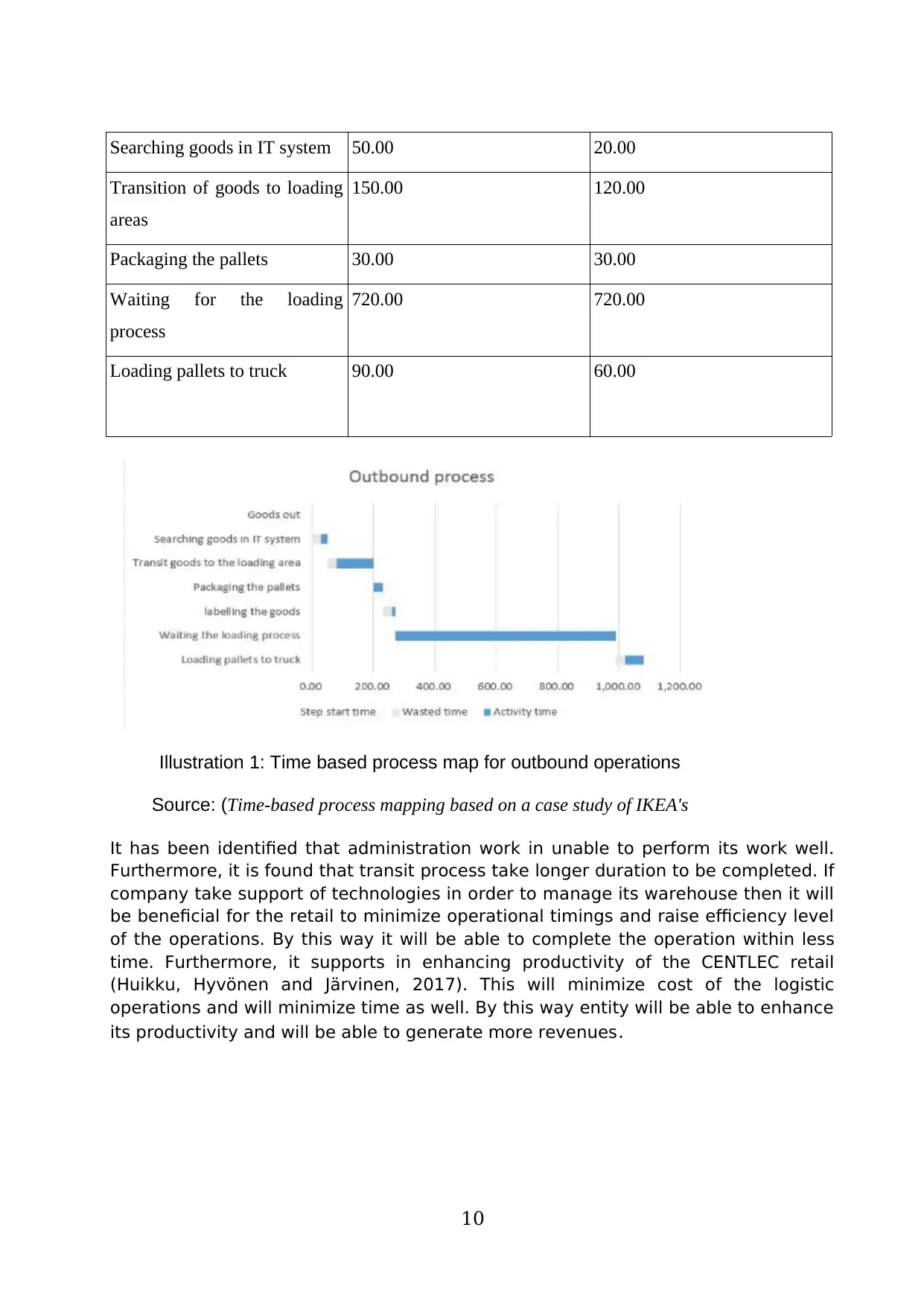
Searching goods in IT system 50.00 20.00
Transition of goods to loading
areas
150.00 120.00
Packaging the pallets 30.00 30.00
Waiting for the loading
process
720.00 720.00
Loading pallets to truck 90.00 60.00
Illustration 1: Time based process map for outbound operations
Source: (Time-based process mapping based on a case study of IKEA's
appliances' transit, 2017)It has been identified that administration work in unable to perform its work well.
Furthermore, it is found that transit process take longer duration to be completed. If
company take support of technologies in order to manage its warehouse then it will
be beneficial for the retail to minimize operational timings and raise efficiency level
of the operations. By this way it will be able to complete the operation within less
time. Furthermore, it supports in enhancing productivity of the CENTLEC retail
(Huikku, Hyvönen and Järvinen, 2017). This will minimize cost of the logistic
operations and will minimize time as well. By this way entity will be able to enhance
its productivity and will be able to generate more revenues.
10
Transition of goods to loading
areas
150.00 120.00
Packaging the pallets 30.00 30.00
Waiting for the loading
process
720.00 720.00
Loading pallets to truck 90.00 60.00
Illustration 1: Time based process map for outbound operations
Source: (Time-based process mapping based on a case study of IKEA's
appliances' transit, 2017)It has been identified that administration work in unable to perform its work well.
Furthermore, it is found that transit process take longer duration to be completed. If
company take support of technologies in order to manage its warehouse then it will
be beneficial for the retail to minimize operational timings and raise efficiency level
of the operations. By this way it will be able to complete the operation within less
time. Furthermore, it supports in enhancing productivity of the CENTLEC retail
(Huikku, Hyvönen and Järvinen, 2017). This will minimize cost of the logistic
operations and will minimize time as well. By this way entity will be able to enhance
its productivity and will be able to generate more revenues.
10
Paraphrase This Document
Need a fresh take? Get an instant paraphrase of this document with our AI Paraphraser
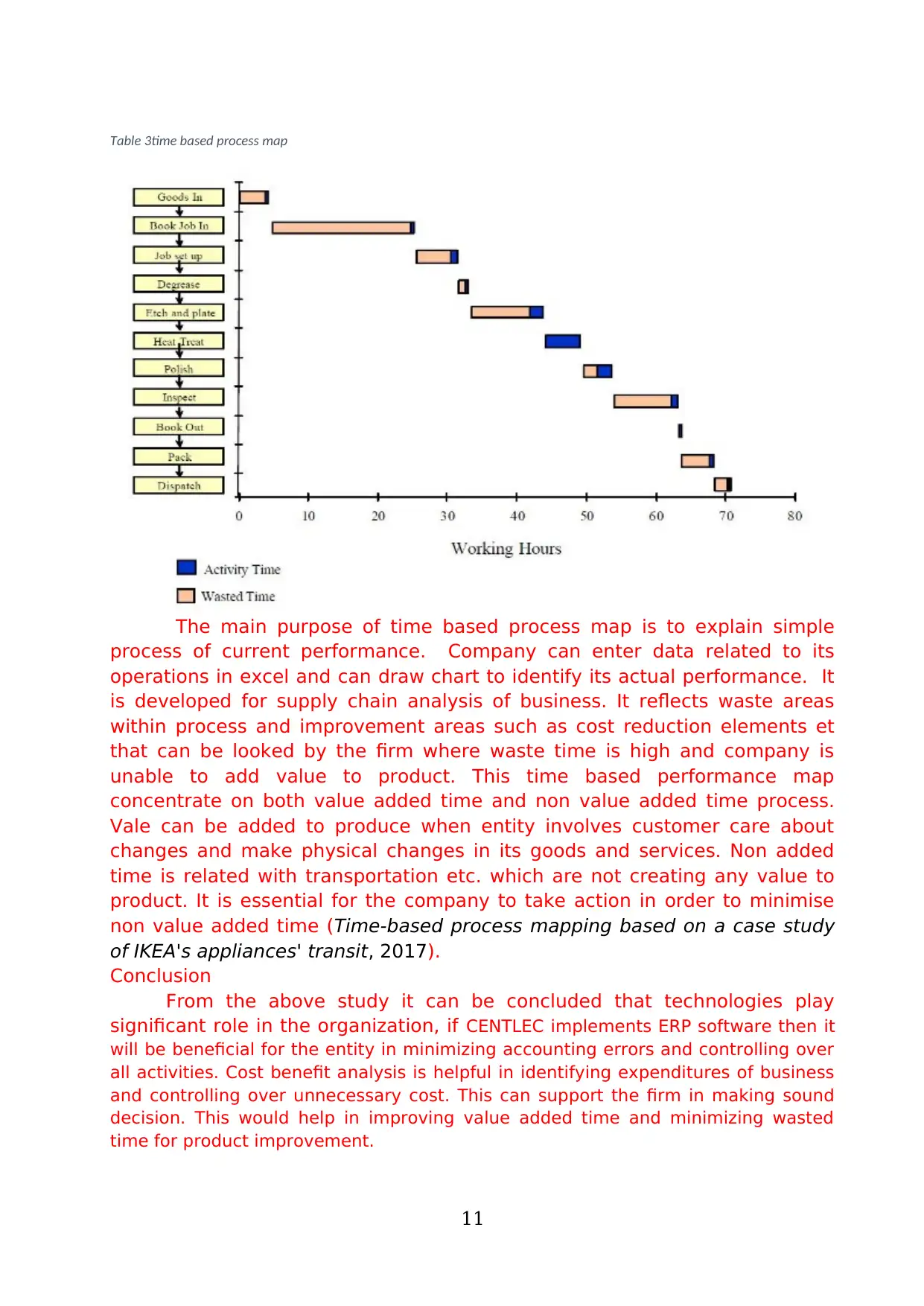
Table 3time based process map
The main purpose of time based process map is to explain simple
process of current performance. Company can enter data related to its
operations in excel and can draw chart to identify its actual performance. It
is developed for supply chain analysis of business. It reflects waste areas
within process and improvement areas such as cost reduction elements et
that can be looked by the firm where waste time is high and company is
unable to add value to product. This time based performance map
concentrate on both value added time and non value added time process.
Vale can be added to produce when entity involves customer care about
changes and make physical changes in its goods and services. Non added
time is related with transportation etc. which are not creating any value to
product. It is essential for the company to take action in order to minimise
non value added time (Time-based process mapping based on a case study
of IKEA's appliances' transit, 2017).
Conclusion
From the above study it can be concluded that technologies play
significant role in the organization, if CENTLEC implements ERP software then it
will be beneficial for the entity in minimizing accounting errors and controlling over
all activities. Cost benefit analysis is helpful in identifying expenditures of business
and controlling over unnecessary cost. This can support the firm in making sound
decision. This would help in improving value added time and minimizing wasted
time for product improvement.
11
The main purpose of time based process map is to explain simple
process of current performance. Company can enter data related to its
operations in excel and can draw chart to identify its actual performance. It
is developed for supply chain analysis of business. It reflects waste areas
within process and improvement areas such as cost reduction elements et
that can be looked by the firm where waste time is high and company is
unable to add value to product. This time based performance map
concentrate on both value added time and non value added time process.
Vale can be added to produce when entity involves customer care about
changes and make physical changes in its goods and services. Non added
time is related with transportation etc. which are not creating any value to
product. It is essential for the company to take action in order to minimise
non value added time (Time-based process mapping based on a case study
of IKEA's appliances' transit, 2017).
Conclusion
From the above study it can be concluded that technologies play
significant role in the organization, if CENTLEC implements ERP software then it
will be beneficial for the entity in minimizing accounting errors and controlling over
all activities. Cost benefit analysis is helpful in identifying expenditures of business
and controlling over unnecessary cost. This can support the firm in making sound
decision. This would help in improving value added time and minimizing wasted
time for product improvement.
11
8. Use of S-curve in order to develop new technology
Introduction
S curve is considered as mathematical model that helps in describing growth of
various variables within stipulated period of time. This is helpful model in order to
determine level of maturity. This curve shows performance of new technology. It has
four main phases ferment, take off, maturity and discontinuity. The ferment phase is
the beginning stage it is the phase then new technology is completely new in the
industry. In the take off stage company find out solutions so that it can overcome
technical obstacles and can meet with the demand. Maturity phase show maturity
level and progress of technology. It defines how new technology is able to improve
production process. Discontinuity stage occurs when existing technology fails to
meet the target adn there is requirement of innovation.
Main body
Technological innovation is the first priority of business units, it supports in
managing operations well and raising efficiency level of the operations. CENTLEC is
operating in the retail retails where it has to deal with many consumers (Ploesser
and et.al, 2017). Technological development can assist the retail in managing
operations well and delivering goods and services to the clients on time.
As per the view of Huikku, Hyvönen and Järvinen, (2017) S- curve is
considered as mathematical model which describes the growth of variables in the
business unit. It helps in identifying the current performance of the business by
using existing technologies and why there is need of implementing new
technologies. This S- curve helps in analysing the benefits of developing new
technologies so that entity can meet with its organizational goal (Singh, 2016). S-
curve can aid the retail industry in determining the level of maturity of the sector. It
analysis overall performance of retail industry with regards to time and efforts.
There are four major phases in this curve: ferment, take-off, maturity and
discontinuity. All these stages described the need of new technologies in the
industry so that overall operational efficiency of the retail can be improved soon.
For example in the ferment stage, retail industry was taking support of manual
entry of each transaction. Employees used to write all cash inflow and outflow in a
diary and all these transactions are being matched at the end of the month. Then
take off phase occurred where companies have started introducing excel. Workers
started using spread sheet system. They manage their records on spreadsheet
12
Introduction
S curve is considered as mathematical model that helps in describing growth of
various variables within stipulated period of time. This is helpful model in order to
determine level of maturity. This curve shows performance of new technology. It has
four main phases ferment, take off, maturity and discontinuity. The ferment phase is
the beginning stage it is the phase then new technology is completely new in the
industry. In the take off stage company find out solutions so that it can overcome
technical obstacles and can meet with the demand. Maturity phase show maturity
level and progress of technology. It defines how new technology is able to improve
production process. Discontinuity stage occurs when existing technology fails to
meet the target adn there is requirement of innovation.
Main body
Technological innovation is the first priority of business units, it supports in
managing operations well and raising efficiency level of the operations. CENTLEC is
operating in the retail retails where it has to deal with many consumers (Ploesser
and et.al, 2017). Technological development can assist the retail in managing
operations well and delivering goods and services to the clients on time.
As per the view of Huikku, Hyvönen and Järvinen, (2017) S- curve is
considered as mathematical model which describes the growth of variables in the
business unit. It helps in identifying the current performance of the business by
using existing technologies and why there is need of implementing new
technologies. This S- curve helps in analysing the benefits of developing new
technologies so that entity can meet with its organizational goal (Singh, 2016). S-
curve can aid the retail industry in determining the level of maturity of the sector. It
analysis overall performance of retail industry with regards to time and efforts.
There are four major phases in this curve: ferment, take-off, maturity and
discontinuity. All these stages described the need of new technologies in the
industry so that overall operational efficiency of the retail can be improved soon.
For example in the ferment stage, retail industry was taking support of manual
entry of each transaction. Employees used to write all cash inflow and outflow in a
diary and all these transactions are being matched at the end of the month. Then
take off phase occurred where companies have started introducing excel. Workers
started using spread sheet system. They manage their records on spreadsheet
12
⊘ This is a preview!⊘
Do you want full access?
Subscribe today to unlock all pages.
Trusted by 1+ million students worldwide

1 out of 23


Related Documents


Your All-in-One AI-Powered Toolkit for Academic Success.
+13062052269
info@desklib.com
Available 24*7 on WhatsApp / Email
![[object Object]](/_next/static/media/star-bottom.7253800d.svg)
Unlock your academic potential
Copyright © 2020–2026 A2Z Services. All Rights Reserved. Developed and managed by ZUCOL.