Implementing Centralized Electronic Medical Record at RPA Hospital

Verified

Added on  2022/12/15

|9
|1743
|351
Report
AI Summary
This report examines the implementation of a centralized Electronic Medical Record (EMR) system within Royal Prince Alfred Hospital (RPA) in Australia. It begins with an introduction to EMRs, highlighting their benefits and prevalence in Australia, where the adoption rate among general practitioners is high. The main body of the report proposes a shift to a centralized system, contrasting it with the current decentralized approach. It then assesses the workplace capacity and readiness for change within RPA, considering factors such as organizational culture, leadership, and expertise. The report outlines a change strategy based on Lewin's change model, detailing the unfreezing, changing, and refreezing phases, and includes a visual representation of the proposed centralized system's workflow. The report also addresses the expected impacts of the change and its sustainability. Finally, it concludes that a centralized EMR system is highly beneficial for RPA, enabling more efficient patient care and improved access to information for practitioners. The report emphasizes the hospital's readiness and capability to implement this change effectively.
Document Page
Electronic Medical Record in
Australia Public Health
tabler-icon-diamond-filled.svg

Paraphrase This Document

Need a fresh take? Get an instant paraphrase of this document with our AI Paraphraser
Document Page
Table of Contents
Table of Contents.............................................................................................................................2
INTRODUCTION...........................................................................................................................4
MAIN BODY..................................................................................................................................4
Proposed Change.........................................................................................................................4
Workplace Capacity and Readiness.............................................................................................5
Change Strategy...........................................................................................................................6
Change Impact and Sustainability...............................................................................................8
CONCLUSION................................................................................................................................8
REFERENCES................................................................................................................................9
Document Page
INTRODUCTION
Electronic medical record refers to electronic system that includes information about
patients' health, history like diagnosis, medicines, tests, allergies, immunization and plans for
treatment (Dubovitskaya and et.al., (2017). This is also known as electronic health record.
Increase use of electronic devices and technology has worked as catalyst for this change in
organization. In Australia 95% general practitioners use electronic patient medical records and
85% of Australians have access to internet. Wide use of internet in Australia by public as well as
by practitioners contributes to good foundation for implementation of Electronic Medical
Record. This report will provide a strategy for implementation of Electronic Medical Record in
Royal Prince Alfred Hospital and will discuss change and workplace capacity for implementing
change in organisation.
MAIN BODY
Proposed Change
Electronic medical record enables practitioners to record details about health and medical
conditions and requirements electronically. Electronic medical record is a system or software
that allows practitioners to quickly enter information of patients when they are new and with
help of this, practitioners can create digital record for each patient. It provides a very important
assistance and support to practitioners while providing care for Royal Prince Alfred Hospital.
However, in present electronic medical record are maintained by those responsible for it. Along
with this, each practitioner create record for their patients. Proposed change is creating a
centralised system for medical health care and providing its mobile access to all practitioners in
Royal Prince Alfred Hospital.
With the proposed change in Royal Prince Alfred Hospital, practitioners will not require
creating electronic record for every new patient (Allen, (2020). This means that a patient when
get treatment from more than one practitioner, in such situation every practitioner they get
treatment from create their electronic record and same information is recorded many times by
practitioners. Centralised electronic medical record will ensure that data and information of
patients is recorded once in Royal Prince Alfred Hospital and then every practitioner in Royal
Prince Alfred Hospital can access this record. This will increase efficiency as there will be all
required information regarding health and medical condition of patient and their treatment by
Document Page
different practitioners. This will also eliminate requirement for creating record of patient by each
practitioner they get treatment from.
Workplace Capacity and Readiness
In order to implement change in organization it is very important that organization have
adequate capacity required for implementing change and also organization is ready for change
adaptation. Capacity and readiness of organization reflect through several elements of
organization such as organizational culture, organizational leadership, commitment, expertise for
change implementation. Regarding capacity and readiness of change in Royal Prince Alfred
Hospital, it a major public teaching hospital in Sydney, Australia (Helfrich and et.al., (2018).
This is a teaching hospital of central clinical school of Sydney medical school at University of
Sydney. Royal Prince Alfred Hospital provides extensive range of diagnostic and treatment
services to more people than any other hospital in NSW. This suggest that Royal Prince Alfred
Hospital have requirement for change as well as capacity through which change can be adopted.
In terms of organizational culture, its culture get influenced by University of Sydney and along
with this, it is also a public health centre and this is why its culture is influenced by culture of
public organizations in Australia. Culture of Royal Prince Alfred Hospital is favourable for
change because change being implemented as positive and favourable impact on everyone in
organization. People in organization have favourable attitude towards technology and this make
implementation easy and facilitated in terms of capacity of organizational culture. Royal Prince
Alfred Hospital also has placed emphasis on innovation in teaching and this means that culture
also values innovation. Regarding organization leadership capacity, leadership in organization is
based on specialised areas within hospital and this is why there is strong and effective leadership
for complete organization (Robertson and et.al., (2018). This make workplace capable for
implementation of change. Concerned with expertise, Royal Prince Alfred Hospital has
pioneered in several areas of medical practice and this suggests that, in terms of expertise
organization has high capacity.
Readiness of organization depends on factors like, culture, leadership, expertise and
considering all these factors Royal Prince Alfred Hospital is ready for implementation of change
within organization.
tabler-icon-diamond-filled.svg

Paraphrase This Document

Need a fresh take? Get an instant paraphrase of this document with our AI Paraphraser
Document Page
Change Strategy
Royal Prince Alfred Hospital has a high capacity for change through strong leadership
and innovative organizational culture and its expertise contribute in enhancing its capacity for
change implementation. In order to implement change organization can adopt Model of change
implementation. These model and its application is as follows-
Unfreezing- In this stage all members in hospital who uses electronic medical record will be
trained for new system that is being implemented in organization. Along with this, they will train
using and operate new system such as how they can record information of patients and how they
can retrieve information of patient. This also involve encouraging practitioners for adopting new
change in organization preparing them for new practices and technology.
Freezing- This is a stage in which technology will be developed and implemented in
organizational practices (Hussain and et.al., (2018). In this stage practitioners are provided
regular support from experts so that they learn how they can operate new technology.
Refreezing- This is a stage in which practitioners will get used to with new technology and uses
in their daily practice while treating patients. In this it is considered that old practices that
practitioners used to undertake do not refurbish.
Document Page
Centralised Electronic Medical Record
Inward Flow of Information
Outward Flow of Information
Patient 1
Practitioner
3
Practitioner
1
Practitioner
1
Centralised System
where Information of
Patients is recorded
Practitioner
2
Practitioner
2
Practitioner
3
Document Page
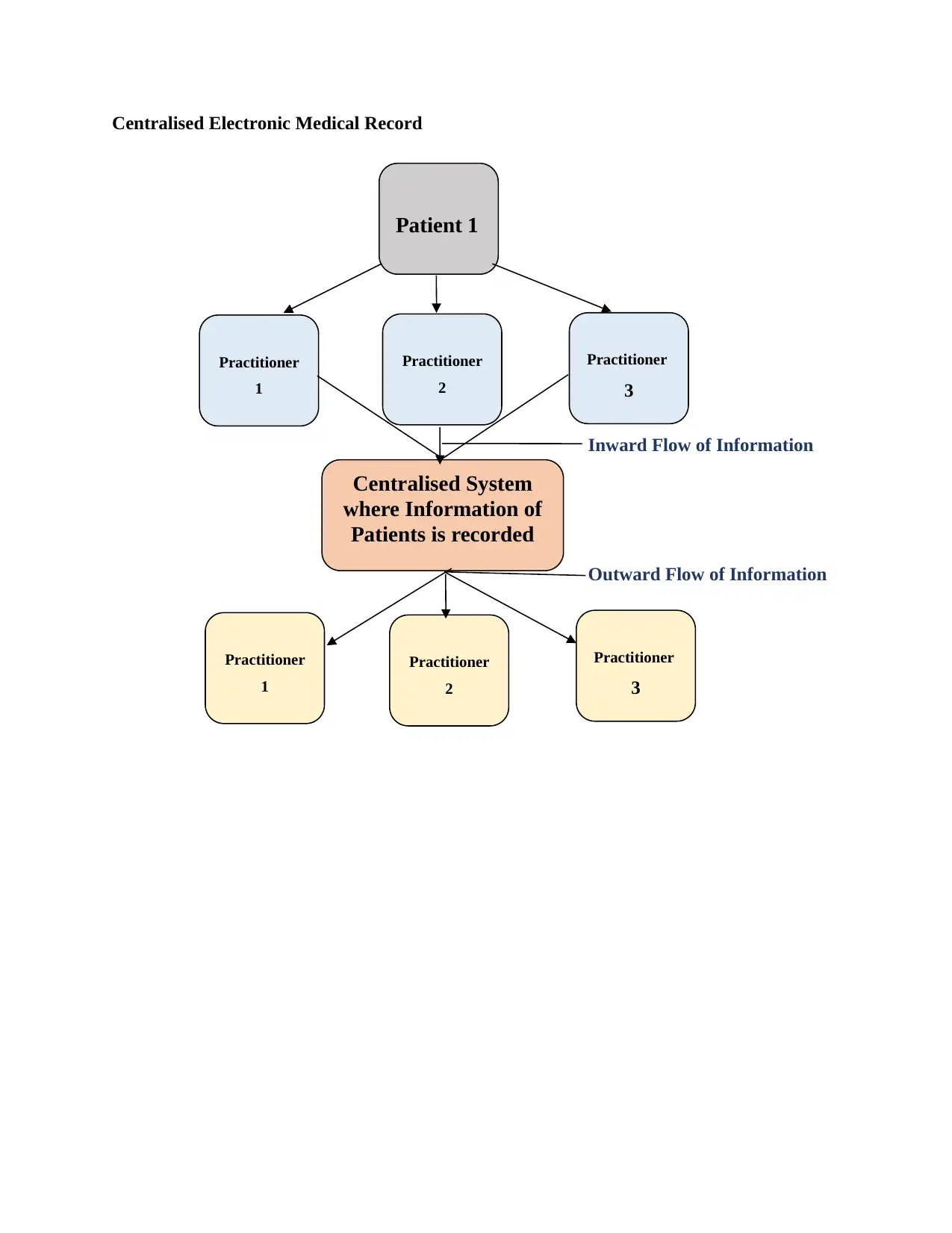
Above figure outlines working of new change that will be implemented in Royal Prince
Alfred Hospital. The figure state how information of a patient will be recorded in system by
different practitioners and then they can retrieve information from centralised system (Jedwab
and et.al., (2019). This will ensure that all practitioners will be able to access information related
to patient and a system will involve all important information of patients. This will enable them
to get efficient care by different practitioners and treatment or care will not affect by lack of
information. This is also appropriate for the situation of Covis-19 in which practitioners will be
able to determine which patients are susceptible to disease. Implementation of change in Royal
Prince Alfred Hospital will follow these steps:
Developing planning for change in organisation
Developing team for change implementation
Developing team for developing centralised electronic system
Implementing change in Royal Prince Alfred Hospital
Change Impact and Sustainability
Change in Royal Prince Alfred Hospital will make several positive impacts on hospital and
its practices. This means that it will only require patients to update information of patient when
they provide them new treatment rather than creating completely new records (Baumann, Baker
and Elshaug, (2018).
Regarding sustainability this change in Royal Prince Alfred Hospital is sustainable
because this is a change that impact regular working of practitioners in Royal Prince Alfred
Hospital rather than specific practices that are carried out specifically (Sroufe, (2017). However,
technology is a driver of this change and development and with application of technology there
is huge scope for improvement and enhancement of centralised electronic medical record.
CONCLUSION
On the basis of above discussion, it can be concluded that centralised electronic medical
record can be highly beneficial for Royal Prince Alfred Hospital. Impact of this will eliminate
potential limitations in treatment of patients because of lack of or inadequate information.
Regarding implementation of this system, Royal Prince Alfred Hospital also has all required
capabilities and organisation is also ready for implementation of change in electronic medical
record.
tabler-icon-diamond-filled.svg

Paraphrase This Document

Need a fresh take? Get an instant paraphrase of this document with our AI Paraphraser
Document Page
REFERENCES
Books and Journals
Allen, D. (2020). Proposing change in university entrance examinations: A tale of two
metaphors. SHIKEN. 23.
Baumann, L. A., Baker, J., & Elshaug, A. G. (2018). The impact of electronic health record
systems on clinical documentation times: A systematic review. Health Policy. 122(8).
827-836.
Dubovitskaya, A & et.al., (2017). Secure and trustable electronic medical records sharing using
blockchain. In AMIA annual symposium proceedings (Vol. 2017, p. 650). American
Medical Informatics Association.
Helfrich, C. D & et.al., (2018). Readiness to change over time: change commitment and change
efficacy in a workplace health-promotion trial. Frontiers in public health. 6. 110.
Hussain, S. T & et.al., (2018). Kurt Lewin's change model: A critical review of the role of
leadership and employee involvement in organizational change. Journal of Innovation
& Knowledge. 3(3). 123-127.
Jedwab, R. M & et.al., (2019). Measuring nursing benefits of an electronic medical record
system: A scoping review. Collegian. 26(5),. 562-582.
Robertson, M. M & et.al., (2018, August). Designing an organizational readiness survey for
Total Worker Health® workplace initiatives. In Congress of the International
Ergonomics Association (pp. 437-445). Springer, Cham.
Sroufe, R. (2017). Integration and organizational change towards sustainability. Journal of
Cleaner Production. 162. 315-329.
Document Page
th the task.
chevron_up_icon
1 out of 9
circle_padding
hide_on_mobile
zoom_out_icon
[object Object]