Leadership and Governance: CEO Ethics, Responsibilities, and Loyalty
VerifiedAdded on 2023/06/05
|9
|2984
|486
Essay
AI Summary
This essay examines the responsibilities of the board of governors in preventing unethical behavior by CEOs, highlighting the importance of asking the right questions, auditing controls, and utilizing executive sessions. It explores how high-performing CEOs lead by example through decisiveness, stakeholder engagement, proactive adaptation, and reliability. The essay also analyzes the impact of CEOs on employee loyalty, emphasizing the need for meaningful transformations, modeling positive mindsets, and building strong, motivated teams. It cautions against relying on fear-based tactics and underscores the importance of valuing diverse opinions to foster genuine loyalty. Desklib offers a platform for students to access similar solved assignments and past papers for academic support.
LEADERSHIP AND GOVERNANCE

Paraphrase This Document
Need a fresh take? Get an instant paraphrase of this document with our AI Paraphraser
1
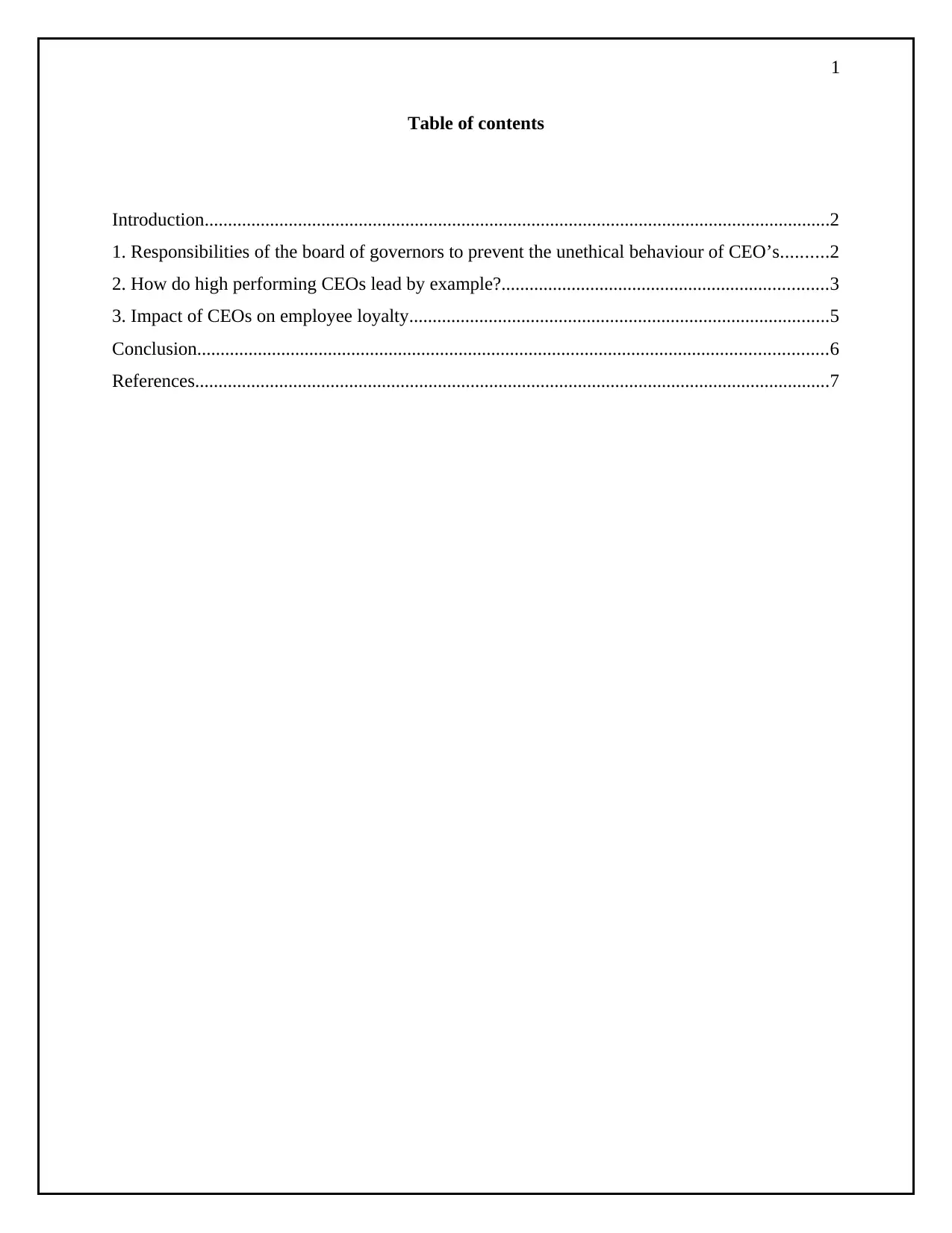
Table of contents
Introduction......................................................................................................................................2
1. Responsibilities of the board of governors to prevent the unethical behaviour of CEO’s..........2
2. How do high performing CEOs lead by example?......................................................................3
3. Impact of CEOs on employee loyalty..........................................................................................5
Conclusion.......................................................................................................................................6
References........................................................................................................................................7
Table of contents
Introduction......................................................................................................................................2
1. Responsibilities of the board of governors to prevent the unethical behaviour of CEO’s..........2
2. How do high performing CEOs lead by example?......................................................................3
3. Impact of CEOs on employee loyalty..........................................................................................5
Conclusion.......................................................................................................................................6
References........................................................................................................................................7
2
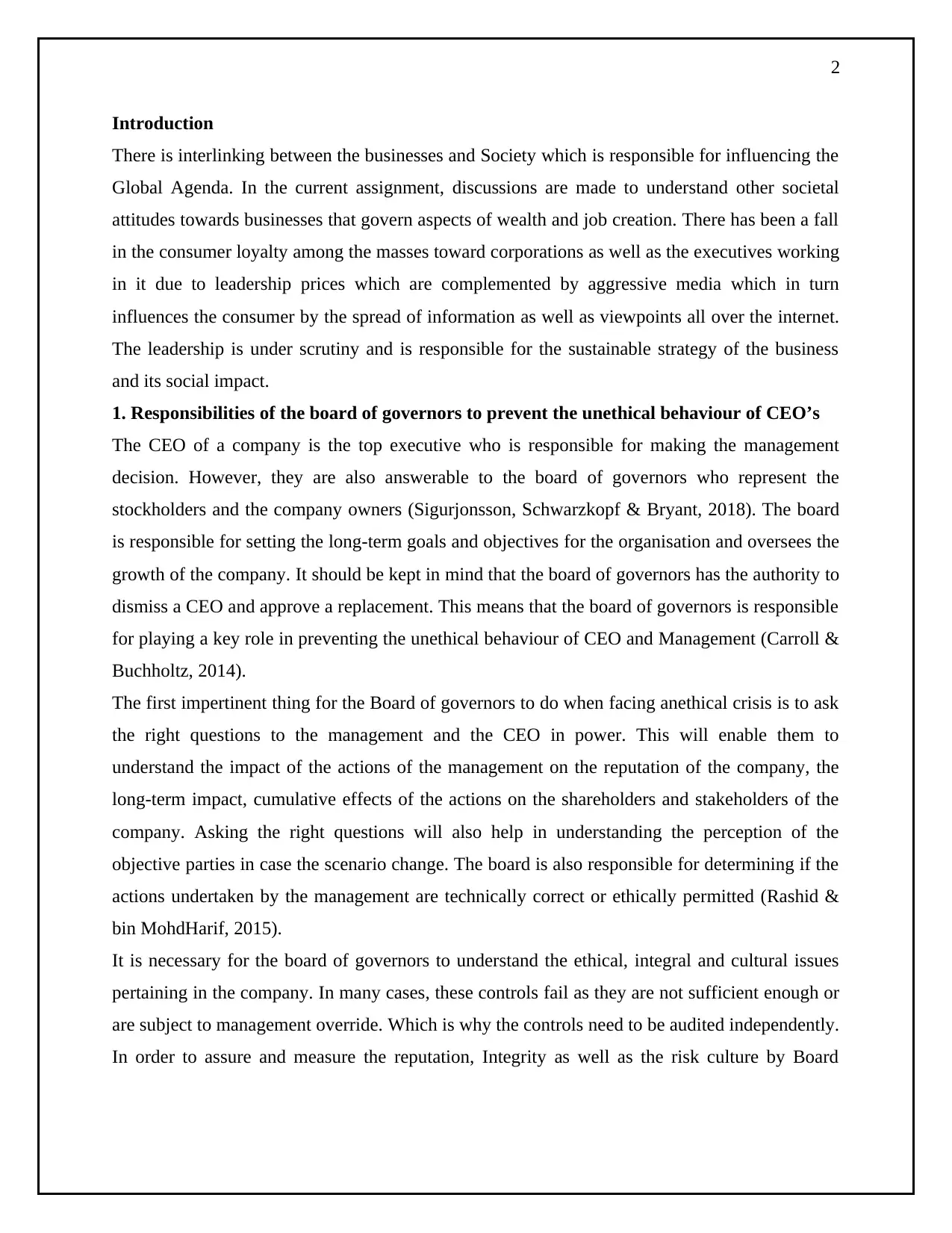
Introduction
There is interlinking between the businesses and Society which is responsible for influencing the
Global Agenda. In the current assignment, discussions are made to understand other societal
attitudes towards businesses that govern aspects of wealth and job creation. There has been a fall
in the consumer loyalty among the masses toward corporations as well as the executives working
in it due to leadership prices which are complemented by aggressive media which in turn
influences the consumer by the spread of information as well as viewpoints all over the internet.
The leadership is under scrutiny and is responsible for the sustainable strategy of the business
and its social impact.
1. Responsibilities of the board of governors to prevent the unethical behaviour of CEO’s
The CEO of a company is the top executive who is responsible for making the management
decision. However, they are also answerable to the board of governors who represent the
stockholders and the company owners (Sigurjonsson, Schwarzkopf & Bryant, 2018). The board
is responsible for setting the long-term goals and objectives for the organisation and oversees the
growth of the company. It should be kept in mind that the board of governors has the authority to
dismiss a CEO and approve a replacement. This means that the board of governors is responsible
for playing a key role in preventing the unethical behaviour of CEO and Management (Carroll &
Buchholtz, 2014).
The first impertinent thing for the Board of governors to do when facing anethical crisis is to ask
the right questions to the management and the CEO in power. This will enable them to
understand the impact of the actions of the management on the reputation of the company, the
long-term impact, cumulative effects of the actions on the shareholders and stakeholders of the
company. Asking the right questions will also help in understanding the perception of the
objective parties in case the scenario change. The board is also responsible for determining if the
actions undertaken by the management are technically correct or ethically permitted (Rashid &
bin MohdHarif, 2015).
It is necessary for the board of governors to understand the ethical, integral and cultural issues
pertaining in the company. In many cases, these controls fail as they are not sufficient enough or
are subject to management override. Which is why the controls need to be audited independently.
In order to assure and measure the reputation, Integrity as well as the risk culture by Board
Introduction
There is interlinking between the businesses and Society which is responsible for influencing the
Global Agenda. In the current assignment, discussions are made to understand other societal
attitudes towards businesses that govern aspects of wealth and job creation. There has been a fall
in the consumer loyalty among the masses toward corporations as well as the executives working
in it due to leadership prices which are complemented by aggressive media which in turn
influences the consumer by the spread of information as well as viewpoints all over the internet.
The leadership is under scrutiny and is responsible for the sustainable strategy of the business
and its social impact.
1. Responsibilities of the board of governors to prevent the unethical behaviour of CEO’s
The CEO of a company is the top executive who is responsible for making the management
decision. However, they are also answerable to the board of governors who represent the
stockholders and the company owners (Sigurjonsson, Schwarzkopf & Bryant, 2018). The board
is responsible for setting the long-term goals and objectives for the organisation and oversees the
growth of the company. It should be kept in mind that the board of governors has the authority to
dismiss a CEO and approve a replacement. This means that the board of governors is responsible
for playing a key role in preventing the unethical behaviour of CEO and Management (Carroll &
Buchholtz, 2014).
The first impertinent thing for the Board of governors to do when facing anethical crisis is to ask
the right questions to the management and the CEO in power. This will enable them to
understand the impact of the actions of the management on the reputation of the company, the
long-term impact, cumulative effects of the actions on the shareholders and stakeholders of the
company. Asking the right questions will also help in understanding the perception of the
objective parties in case the scenario change. The board is also responsible for determining if the
actions undertaken by the management are technically correct or ethically permitted (Rashid &
bin MohdHarif, 2015).
It is necessary for the board of governors to understand the ethical, integral and cultural issues
pertaining in the company. In many cases, these controls fail as they are not sufficient enough or
are subject to management override. Which is why the controls need to be audited independently.
In order to assure and measure the reputation, Integrity as well as the risk culture by Board
⊘ This is a preview!⊘
Do you want full access?
Subscribe today to unlock all pages.

Trusted by 1+ million students worldwide
3
members it is necessary that the assurance report reaches the board of governors without being
tampered with by the management.
The board of governors can also effectively utilise an executive session which involves
questioning and information gathering as a preventative method to cease the unethical actions
taken by CEO and management. It is necessary for the Board of governors to have an authority
to obtain information pertaining to ethics and work culture by conducting interviews with any
individual working in the company (Beach, 2015). The board should also look forward to
obtaining assistance from external sources that can help in monitoring the same. If the board of
governors cannot override the management, this effectively means that the board of governors is
acting along with the management.
Another way in which the board of governors can restrict the unethical behaviour of
Management and CU is by controlling pay for conduct as well as performance. It is
understandable that pay incentives are very strong driving factors and they can be useful for
implementing ethical behaviour as well. In several cases, it has been observed that the board
underutilizes their payment mechanism to exhort a control over the management. Implementing
pay practices will become an incentive for Risk-taking and complimenting them with ethical
conduct can help in reigning in the management (Yadav, 2017). The word means to assess the
conduct and risk that have been undertaken by the management before assigning bonuses.
Another way in which the board of governors can effectively minimise the unethical behaviour
of CEOs is to introduce a board member who is not chosen on the basis of the pre-existing
relationships. Board members having pre-existing relationships will not be asking the right
questions or taking the tough decision as they are bound by their relationships. Hence it is
necessary to appoint Board members who do not have any pre-existing relationships with the
management or the other governors present on the board. This may also include the appointment
of female Board members.
2. How do high performing CEOs lead by example?
The role of a chief executive officer is a very tough one. There is often a misalignment between
the ideologies of the board of governors pertaining to Ideal CEOs and the actual qualities of a
CEO who is responsible for leading the company to a high level of performance. It has been
observed that the successful chief executive officer has very specific traits that are critical to
their ability and performance (Clarke, 2015). If the board of governors focuses on these four
members it is necessary that the assurance report reaches the board of governors without being
tampered with by the management.
The board of governors can also effectively utilise an executive session which involves
questioning and information gathering as a preventative method to cease the unethical actions
taken by CEO and management. It is necessary for the Board of governors to have an authority
to obtain information pertaining to ethics and work culture by conducting interviews with any
individual working in the company (Beach, 2015). The board should also look forward to
obtaining assistance from external sources that can help in monitoring the same. If the board of
governors cannot override the management, this effectively means that the board of governors is
acting along with the management.
Another way in which the board of governors can restrict the unethical behaviour of
Management and CU is by controlling pay for conduct as well as performance. It is
understandable that pay incentives are very strong driving factors and they can be useful for
implementing ethical behaviour as well. In several cases, it has been observed that the board
underutilizes their payment mechanism to exhort a control over the management. Implementing
pay practices will become an incentive for Risk-taking and complimenting them with ethical
conduct can help in reigning in the management (Yadav, 2017). The word means to assess the
conduct and risk that have been undertaken by the management before assigning bonuses.
Another way in which the board of governors can effectively minimise the unethical behaviour
of CEOs is to introduce a board member who is not chosen on the basis of the pre-existing
relationships. Board members having pre-existing relationships will not be asking the right
questions or taking the tough decision as they are bound by their relationships. Hence it is
necessary to appoint Board members who do not have any pre-existing relationships with the
management or the other governors present on the board. This may also include the appointment
of female Board members.
2. How do high performing CEOs lead by example?
The role of a chief executive officer is a very tough one. There is often a misalignment between
the ideologies of the board of governors pertaining to Ideal CEOs and the actual qualities of a
CEO who is responsible for leading the company to a high level of performance. It has been
observed that the successful chief executive officer has very specific traits that are critical to
their ability and performance (Clarke, 2015). If the board of governors focuses on these four
Paraphrase This Document
Need a fresh take? Get an instant paraphrase of this document with our AI Paraphraser
4
specific traits, they are more likely to hire an individual who is better suited for the company and
will be able to lead the same by example.
The first important trait is decisiveness. This means that an individual who has the ability to
make decisions with speed, as well as conviction, is a very good choice for CEO position. It is
not necessary that high-performing executive Undertake great decisions all the time but rather
they are very decisive which makes them stand out from the rest. These individuals have the
capability of making decisions consistently at a fast pace and with a great amount of conviction
irrespective of the situation, incomplete information or unknown realm (Bernstein, 2015). If an
individual is in pursuit of a perfect answer to a given situation, they will require a lot of time
which will make implementation of the solution even difficult. The decisiveness of the CEO will
rub off on the employees which will boost their confidence in taking decisions and necessary
action without stalling the company operations.
The next trait that has been identified is thewillingness to engage for impact. The CEO is
responsible for setting a clear course for conducting the business and require the support of the
employees as well as the stakeholders to continue on this path. This means that high performing
CEO maintain a balance between stakeholder priority and business deliverables (Hou, Priem &
Goranova, 2017). In order to do so, they require stakeholder insight which is done by analysing
the needs as well as motivation. Once the needs and motivation have been identified, the next
step is to align the board with the objective of value creation to drive performance. This involves
perfect plan execution and implementation of disciplined communication as well as influencing
strategies. Individuals who behave likeautocrats do not enjoy a very long stint in a company.
This is because they do not enjoy the support of the board or the team members because of their
willingness to inflict Collateral Damage (Ellwood & Garcia-Lacalle, 2015). Such individuals are
selected as CEO only when the company or the business organisation is in Crisis mode.
Proactive adaptation is another trait of high-performance CEOs. With increasing competitiveness
in the Global market, it is important for the business leaders to adjust and adapt to the rapidly
changing market situation. It has been observed that CEOs who are flexible are more likely to
succeed in the long term (Jenter & Kanaan, 2015). This is because this adaptive individual
deliberately invests most of the time to align the long-term objectives of the company. In order to
be adaptive, it is necessary for these individual executive officers to analyse and interpret a wide
variety of data and relevant information that may or may not be related to the business.
specific traits, they are more likely to hire an individual who is better suited for the company and
will be able to lead the same by example.
The first important trait is decisiveness. This means that an individual who has the ability to
make decisions with speed, as well as conviction, is a very good choice for CEO position. It is
not necessary that high-performing executive Undertake great decisions all the time but rather
they are very decisive which makes them stand out from the rest. These individuals have the
capability of making decisions consistently at a fast pace and with a great amount of conviction
irrespective of the situation, incomplete information or unknown realm (Bernstein, 2015). If an
individual is in pursuit of a perfect answer to a given situation, they will require a lot of time
which will make implementation of the solution even difficult. The decisiveness of the CEO will
rub off on the employees which will boost their confidence in taking decisions and necessary
action without stalling the company operations.
The next trait that has been identified is thewillingness to engage for impact. The CEO is
responsible for setting a clear course for conducting the business and require the support of the
employees as well as the stakeholders to continue on this path. This means that high performing
CEO maintain a balance between stakeholder priority and business deliverables (Hou, Priem &
Goranova, 2017). In order to do so, they require stakeholder insight which is done by analysing
the needs as well as motivation. Once the needs and motivation have been identified, the next
step is to align the board with the objective of value creation to drive performance. This involves
perfect plan execution and implementation of disciplined communication as well as influencing
strategies. Individuals who behave likeautocrats do not enjoy a very long stint in a company.
This is because they do not enjoy the support of the board or the team members because of their
willingness to inflict Collateral Damage (Ellwood & Garcia-Lacalle, 2015). Such individuals are
selected as CEO only when the company or the business organisation is in Crisis mode.
Proactive adaptation is another trait of high-performance CEOs. With increasing competitiveness
in the Global market, it is important for the business leaders to adjust and adapt to the rapidly
changing market situation. It has been observed that CEOs who are flexible are more likely to
succeed in the long term (Jenter & Kanaan, 2015). This is because this adaptive individual
deliberately invests most of the time to align the long-term objectives of the company. In order to
be adaptive, it is necessary for these individual executive officers to analyse and interpret a wide
variety of data and relevant information that may or may not be related to the business.
5
The final trait that has been identified is reliability and ability to deliver. A good CEO is
responsible for consistently producing reliable results. A reliable executive officer usually
establishes a management system which includes a series of performance metrics, multiple
channels of performance monitoring, high and clear accountability as well as ability to rapidly
correct the course that they have taken in case of a mistake (Jenter & Lewellen, 2017). Along
with these parameters, a reliable CEO is always surrounded and supported by a strong team.
3. Impact of CEOs on employee loyalty
A CEO is held accountable for transforming business practices by communicating, implementing
changes, developing strong teams and personally getting involved in the processes and operation
of the company. Hence it is necessary to analyse the impact of the CEO on employee loyalty.
The primary impact of a good chief executive officer is that they make the transformation a
meaningful one (Hartnell et al. 2016). It is easy to understand that people who believe in a cause
will go extraordinary lengths to make it possible. By implementing a meaningful and Powerful
transformation, a CEO can reinforce the commitment and loyalty of the employees. The ultimate
impact of such a strategy depends on the willingness of the CEO to make personal
transformations, engaging employees openly and at a personal level and identify success when it
happens (Hollandts, Aubert, Abdelhamid & Prieur, 2017).
A CEO is also responsible for modelling mindsets and behaviours of employees. This means that
the CEO must be willing to be portrayed as a role model. This can be only done when the CEO
Undertake Journeys of personal transformation. When the employees observe such a kind of
behaviour from their boss they are encouraged to restructure theirmindset as well as behaviour.
This change in mindset will enable in providing support for the implementation of
transformational activities identified by the CEO.
As already mentioned a good CEO is always surrounded by a strong team. Hence it is the
responsibility of the CEO to motivate individual employees who can be helpful in building a
strong and committed team that is aligned with the goals and objectives of the company
(Imaizumi, 2017). Identification of team members requires the CEO to take harsh and tough
decisions in regards to individuals who have the motivation as well as the ability to implement
and follow through the transformational changes. By correctly identifying the team members a
CEO will be able to harness the will and support of a team to undertake transformation.
The final trait that has been identified is reliability and ability to deliver. A good CEO is
responsible for consistently producing reliable results. A reliable executive officer usually
establishes a management system which includes a series of performance metrics, multiple
channels of performance monitoring, high and clear accountability as well as ability to rapidly
correct the course that they have taken in case of a mistake (Jenter & Lewellen, 2017). Along
with these parameters, a reliable CEO is always surrounded and supported by a strong team.
3. Impact of CEOs on employee loyalty
A CEO is held accountable for transforming business practices by communicating, implementing
changes, developing strong teams and personally getting involved in the processes and operation
of the company. Hence it is necessary to analyse the impact of the CEO on employee loyalty.
The primary impact of a good chief executive officer is that they make the transformation a
meaningful one (Hartnell et al. 2016). It is easy to understand that people who believe in a cause
will go extraordinary lengths to make it possible. By implementing a meaningful and Powerful
transformation, a CEO can reinforce the commitment and loyalty of the employees. The ultimate
impact of such a strategy depends on the willingness of the CEO to make personal
transformations, engaging employees openly and at a personal level and identify success when it
happens (Hollandts, Aubert, Abdelhamid & Prieur, 2017).
A CEO is also responsible for modelling mindsets and behaviours of employees. This means that
the CEO must be willing to be portrayed as a role model. This can be only done when the CEO
Undertake Journeys of personal transformation. When the employees observe such a kind of
behaviour from their boss they are encouraged to restructure theirmindset as well as behaviour.
This change in mindset will enable in providing support for the implementation of
transformational activities identified by the CEO.
As already mentioned a good CEO is always surrounded by a strong team. Hence it is the
responsibility of the CEO to motivate individual employees who can be helpful in building a
strong and committed team that is aligned with the goals and objectives of the company
(Imaizumi, 2017). Identification of team members requires the CEO to take harsh and tough
decisions in regards to individuals who have the motivation as well as the ability to implement
and follow through the transformational changes. By correctly identifying the team members a
CEO will be able to harness the will and support of a team to undertake transformation.
⊘ This is a preview!⊘
Do you want full access?
Subscribe today to unlock all pages.
Trusted by 1+ million students worldwide
6
Incase a CEO is unable to motivate the team members as or the employees in the right Direction
they can always utilise the element of fear of their position in the company. However, this leads
to the problematic form of employee loyalty (Ordóñez & Welsh, 2015). This means that the
employees are forced to accept the visions of a CEO because of fear of their power and not
because of their trust in their leader. This will propagate a work environment which will be filled
with anxiety and will make the place difficult to work in.
It is also important for the CEO to remember during the team building and development process
that they should avoid people who will accept any kind of directive from the boss without
offering a perspective that can be different. It is necessary for CEO to appreciate and value the
different opinions that the individual team members have (Knox, 2018). It is also advisable for
CEO to not scrutinize the ideas and belief of the team members critically but encourage it if it is
aligned with the goals and objectives of the company.
It is necessary to keep in mind that loyalty is not a unilateral aspect and requires equal
contribution of opinion and respect from both the parties to ensure mutual respect and
trustworthiness. If the employee does not believe that the management is doing things which
appreciates or values the opinions and loyalty, the CEO will soon find that they are at wit's end.
A loyal CEO will enjoy loyal employees who will do anything possible for their Boss voluntarily
(Silvestro, 2016).
Conclusion
The current assignment has been conducted to analyse the aspects of leadership and governance.
Discussions were made pertaining to the role and responsibilities of the board of governors to
minimise the occurrence of unethical activities from CEO or the management. The assignment
also looks into the different traits of CEO who lead the company by example. Finally, the topic
of employee loyalty and the impact of CEO on the same has been also discussed.
Incase a CEO is unable to motivate the team members as or the employees in the right Direction
they can always utilise the element of fear of their position in the company. However, this leads
to the problematic form of employee loyalty (Ordóñez & Welsh, 2015). This means that the
employees are forced to accept the visions of a CEO because of fear of their power and not
because of their trust in their leader. This will propagate a work environment which will be filled
with anxiety and will make the place difficult to work in.
It is also important for the CEO to remember during the team building and development process
that they should avoid people who will accept any kind of directive from the boss without
offering a perspective that can be different. It is necessary for CEO to appreciate and value the
different opinions that the individual team members have (Knox, 2018). It is also advisable for
CEO to not scrutinize the ideas and belief of the team members critically but encourage it if it is
aligned with the goals and objectives of the company.
It is necessary to keep in mind that loyalty is not a unilateral aspect and requires equal
contribution of opinion and respect from both the parties to ensure mutual respect and
trustworthiness. If the employee does not believe that the management is doing things which
appreciates or values the opinions and loyalty, the CEO will soon find that they are at wit's end.
A loyal CEO will enjoy loyal employees who will do anything possible for their Boss voluntarily
(Silvestro, 2016).
Conclusion
The current assignment has been conducted to analyse the aspects of leadership and governance.
Discussions were made pertaining to the role and responsibilities of the board of governors to
minimise the occurrence of unethical activities from CEO or the management. The assignment
also looks into the different traits of CEO who lead the company by example. Finally, the topic
of employee loyalty and the impact of CEO on the same has been also discussed.
Paraphrase This Document
Need a fresh take? Get an instant paraphrase of this document with our AI Paraphraser
7
References
Beach, L. R. (2015). The human element: Understanding and managing employee behavior.
Routledge. London, UK
Bernstein, M. H. (2015). Regulating business by independent commission. Princeton University
Press. Retrieved from https://books.google.co.in/books?
hl=en&lr=&id=jETWCgAAQBAJ&oi=fnd&pg=PR9&dq=Bernstein,+M.+H.+(2015).
+Regulating+business+by+independent+commission.
+Princeton+University+Press&ots=fPJtAjp4is&sig=WLui1gNuqDgOoPiyHdYXcSIZgpc
#v=onepage&q&f=false
Carroll, A., &Buchholtz, A. (2014). Business and society: Ethics, sustainability, and stakeholder
management. Nelson Education. Edinburgh, Scotland
Clarke, C. (2015). Ethics and economic governance: Using Adam Smith to understand the global
financial crisis. Routledge. London, UK
Ellwood, S., & Garcia-Lacalle, J. (2015). The influence of presence and position of women on
the boards of directors: The case of NHS foundation trusts. Journal of Business Ethics,
130(1), 69-84. Retrieved from https://link.springer.com/article/10.1007/s10551-014-
2206-8
Hartnell, C. A., Kinicki, A. J., Lambert, L. S., Fugate, M., & Doyle Corner, P. (2016). Do
similarities or differences between CEO leadership and organizational culture have a
more positive effect on firm performance? A test of competing predictions. Journal of
Applied Psychology, 101(6), 846. Retrieved from http://psycnet.apa.org/fulltext/2016-
11402-001.html
Hollandts, X., Aubert, N., Abdelhamid, A., &Prieur, V. (2017). Beyond Dichotomy: The
Curvilinear Impact of Employee Ownership on CEO entrenchment. Retrieved from
https://halshs.archives-ouvertes.fr/halshs-01495427/
Hou, W., Priem, R. L., &Goranova, M. (2017). Does one size fit all? Investigating pay–future
performance relationships over the “seasons” of CEO tenure. Journal of management,
43(3), 864-891. Doi: 10.1177/0149206314544744
Imaizumi, M. (2017). Company Culture Drives Productivity: A Study on How Company Culture
Impacts the Bottom Line. Retrieved from
https://repository.tcu.edu/handle/116099117/19901
References
Beach, L. R. (2015). The human element: Understanding and managing employee behavior.
Routledge. London, UK
Bernstein, M. H. (2015). Regulating business by independent commission. Princeton University
Press. Retrieved from https://books.google.co.in/books?
hl=en&lr=&id=jETWCgAAQBAJ&oi=fnd&pg=PR9&dq=Bernstein,+M.+H.+(2015).
+Regulating+business+by+independent+commission.
+Princeton+University+Press&ots=fPJtAjp4is&sig=WLui1gNuqDgOoPiyHdYXcSIZgpc
#v=onepage&q&f=false
Carroll, A., &Buchholtz, A. (2014). Business and society: Ethics, sustainability, and stakeholder
management. Nelson Education. Edinburgh, Scotland
Clarke, C. (2015). Ethics and economic governance: Using Adam Smith to understand the global
financial crisis. Routledge. London, UK
Ellwood, S., & Garcia-Lacalle, J. (2015). The influence of presence and position of women on
the boards of directors: The case of NHS foundation trusts. Journal of Business Ethics,
130(1), 69-84. Retrieved from https://link.springer.com/article/10.1007/s10551-014-
2206-8
Hartnell, C. A., Kinicki, A. J., Lambert, L. S., Fugate, M., & Doyle Corner, P. (2016). Do
similarities or differences between CEO leadership and organizational culture have a
more positive effect on firm performance? A test of competing predictions. Journal of
Applied Psychology, 101(6), 846. Retrieved from http://psycnet.apa.org/fulltext/2016-
11402-001.html
Hollandts, X., Aubert, N., Abdelhamid, A., &Prieur, V. (2017). Beyond Dichotomy: The
Curvilinear Impact of Employee Ownership on CEO entrenchment. Retrieved from
https://halshs.archives-ouvertes.fr/halshs-01495427/
Hou, W., Priem, R. L., &Goranova, M. (2017). Does one size fit all? Investigating pay–future
performance relationships over the “seasons” of CEO tenure. Journal of management,
43(3), 864-891. Doi: 10.1177/0149206314544744
Imaizumi, M. (2017). Company Culture Drives Productivity: A Study on How Company Culture
Impacts the Bottom Line. Retrieved from
https://repository.tcu.edu/handle/116099117/19901
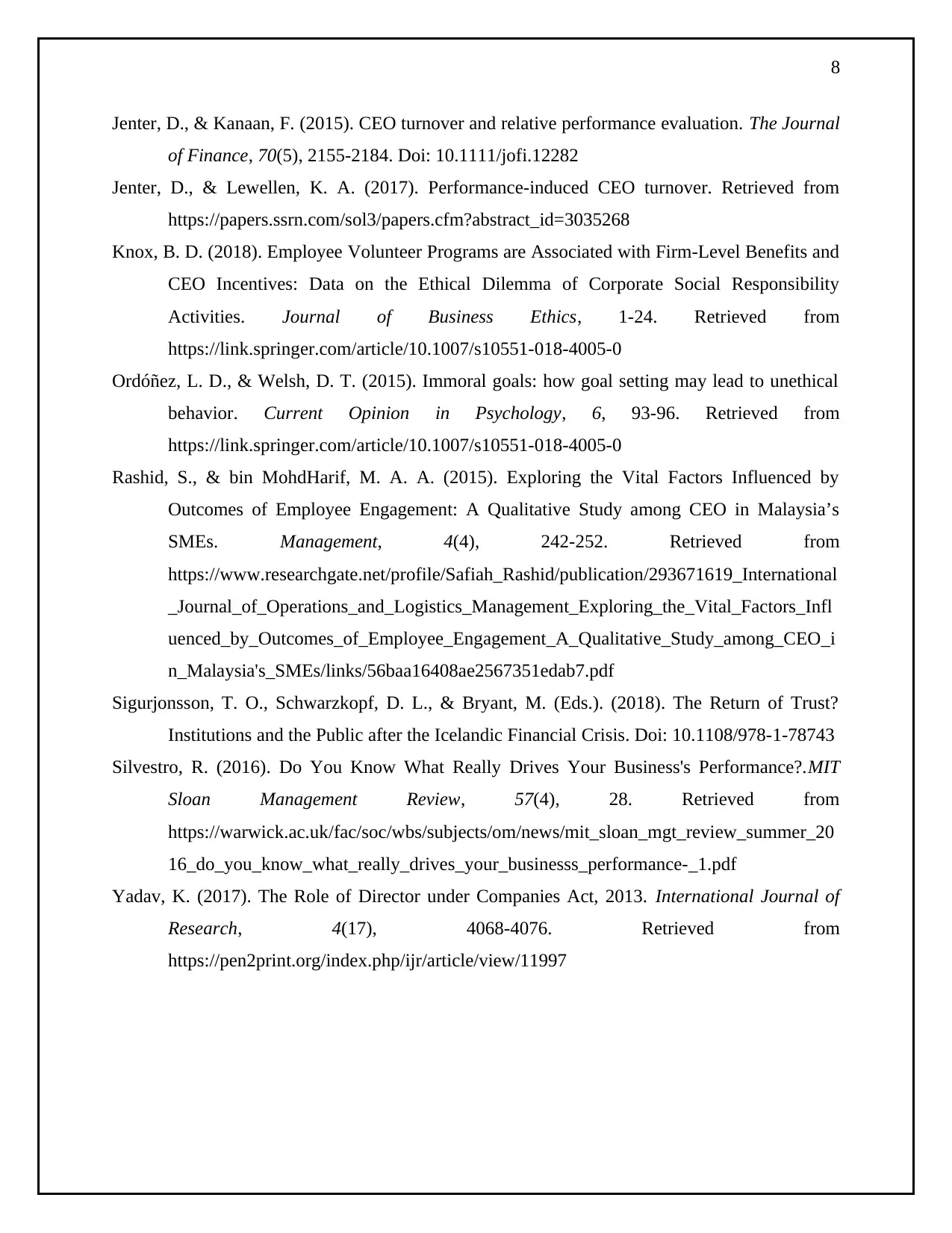
8
Jenter, D., & Kanaan, F. (2015). CEO turnover and relative performance evaluation. The Journal
of Finance, 70(5), 2155-2184. Doi: 10.1111/jofi.12282
Jenter, D., & Lewellen, K. A. (2017). Performance-induced CEO turnover. Retrieved from
https://papers.ssrn.com/sol3/papers.cfm?abstract_id=3035268
Knox, B. D. (2018). Employee Volunteer Programs are Associated with Firm-Level Benefits and
CEO Incentives: Data on the Ethical Dilemma of Corporate Social Responsibility
Activities. Journal of Business Ethics, 1-24. Retrieved from
https://link.springer.com/article/10.1007/s10551-018-4005-0
Ordóñez, L. D., & Welsh, D. T. (2015). Immoral goals: how goal setting may lead to unethical
behavior. Current Opinion in Psychology, 6, 93-96. Retrieved from
https://link.springer.com/article/10.1007/s10551-018-4005-0
Rashid, S., & bin MohdHarif, M. A. A. (2015). Exploring the Vital Factors Influenced by
Outcomes of Employee Engagement: A Qualitative Study among CEO in Malaysia’s
SMEs. Management, 4(4), 242-252. Retrieved from
https://www.researchgate.net/profile/Safiah_Rashid/publication/293671619_International
_Journal_of_Operations_and_Logistics_Management_Exploring_the_Vital_Factors_Infl
uenced_by_Outcomes_of_Employee_Engagement_A_Qualitative_Study_among_CEO_i
n_Malaysia's_SMEs/links/56baa16408ae2567351edab7.pdf
Sigurjonsson, T. O., Schwarzkopf, D. L., & Bryant, M. (Eds.). (2018). The Return of Trust?
Institutions and the Public after the Icelandic Financial Crisis. Doi: 10.1108/978-1-78743
Silvestro, R. (2016). Do You Know What Really Drives Your Business's Performance?.MIT
Sloan Management Review, 57(4), 28. Retrieved from
https://warwick.ac.uk/fac/soc/wbs/subjects/om/news/mit_sloan_mgt_review_summer_20
16_do_you_know_what_really_drives_your_businesss_performance-_1.pdf
Yadav, K. (2017). The Role of Director under Companies Act, 2013. International Journal of
Research, 4(17), 4068-4076. Retrieved from
https://pen2print.org/index.php/ijr/article/view/11997
Jenter, D., & Kanaan, F. (2015). CEO turnover and relative performance evaluation. The Journal
of Finance, 70(5), 2155-2184. Doi: 10.1111/jofi.12282
Jenter, D., & Lewellen, K. A. (2017). Performance-induced CEO turnover. Retrieved from
https://papers.ssrn.com/sol3/papers.cfm?abstract_id=3035268
Knox, B. D. (2018). Employee Volunteer Programs are Associated with Firm-Level Benefits and
CEO Incentives: Data on the Ethical Dilemma of Corporate Social Responsibility
Activities. Journal of Business Ethics, 1-24. Retrieved from
https://link.springer.com/article/10.1007/s10551-018-4005-0
Ordóñez, L. D., & Welsh, D. T. (2015). Immoral goals: how goal setting may lead to unethical
behavior. Current Opinion in Psychology, 6, 93-96. Retrieved from
https://link.springer.com/article/10.1007/s10551-018-4005-0
Rashid, S., & bin MohdHarif, M. A. A. (2015). Exploring the Vital Factors Influenced by
Outcomes of Employee Engagement: A Qualitative Study among CEO in Malaysia’s
SMEs. Management, 4(4), 242-252. Retrieved from
https://www.researchgate.net/profile/Safiah_Rashid/publication/293671619_International
_Journal_of_Operations_and_Logistics_Management_Exploring_the_Vital_Factors_Infl
uenced_by_Outcomes_of_Employee_Engagement_A_Qualitative_Study_among_CEO_i
n_Malaysia's_SMEs/links/56baa16408ae2567351edab7.pdf
Sigurjonsson, T. O., Schwarzkopf, D. L., & Bryant, M. (Eds.). (2018). The Return of Trust?
Institutions and the Public after the Icelandic Financial Crisis. Doi: 10.1108/978-1-78743
Silvestro, R. (2016). Do You Know What Really Drives Your Business's Performance?.MIT
Sloan Management Review, 57(4), 28. Retrieved from
https://warwick.ac.uk/fac/soc/wbs/subjects/om/news/mit_sloan_mgt_review_summer_20
16_do_you_know_what_really_drives_your_businesss_performance-_1.pdf
Yadav, K. (2017). The Role of Director under Companies Act, 2013. International Journal of
Research, 4(17), 4068-4076. Retrieved from
https://pen2print.org/index.php/ijr/article/view/11997
⊘ This is a preview!⊘
Do you want full access?
Subscribe today to unlock all pages.
Trusted by 1+ million students worldwide

1 out of 9


Related Documents


Your All-in-One AI-Powered Toolkit for Academic Success.
+13062052269
info@desklib.com
Available 24*7 on WhatsApp / Email
![[object Object]](/_next/static/media/star-bottom.7253800d.svg)
Unlock your academic potential
Copyright © 2020–2026 A2Z Services. All Rights Reserved. Developed and managed by ZUCOL.