Statistical Analysis of Cereal Data: Type vs. Calories & Shelf
VerifiedAdded on 2023/05/31
|6
|908
|407
Report
AI Summary
This report presents an analysis of cereal data, focusing on nutritional values, manufacturer, and shelf placement. The study uses ANOVA to examine the relationship between cereal manufacturers and shelf placement, finding no significant difference, suggesting manufacturers aren't overly concerned with shelf location as long as products sell. Additionally, an independent sample t-test investigates the link between cereal type (hot or cold) and caloric value, revealing no significant difference. The analysis leads to the conclusion that consumers can choose cereals based on personal preference, as caloric content does not vary significantly between hot and cold types. Desklib provides access to similar solved assignments and resources for students.
Running Head: ANALYSIS OF CEREALS
Analysis of Cereals
Name of the Student
Namr of the University
Stident ID
Analysis of Cereals
Name of the Student
Namr of the University
Stident ID
Paraphrase This Document
Need a fresh take? Get an instant paraphrase of this document with our AI Paraphraser

1ANALYSIS OF CEREALS
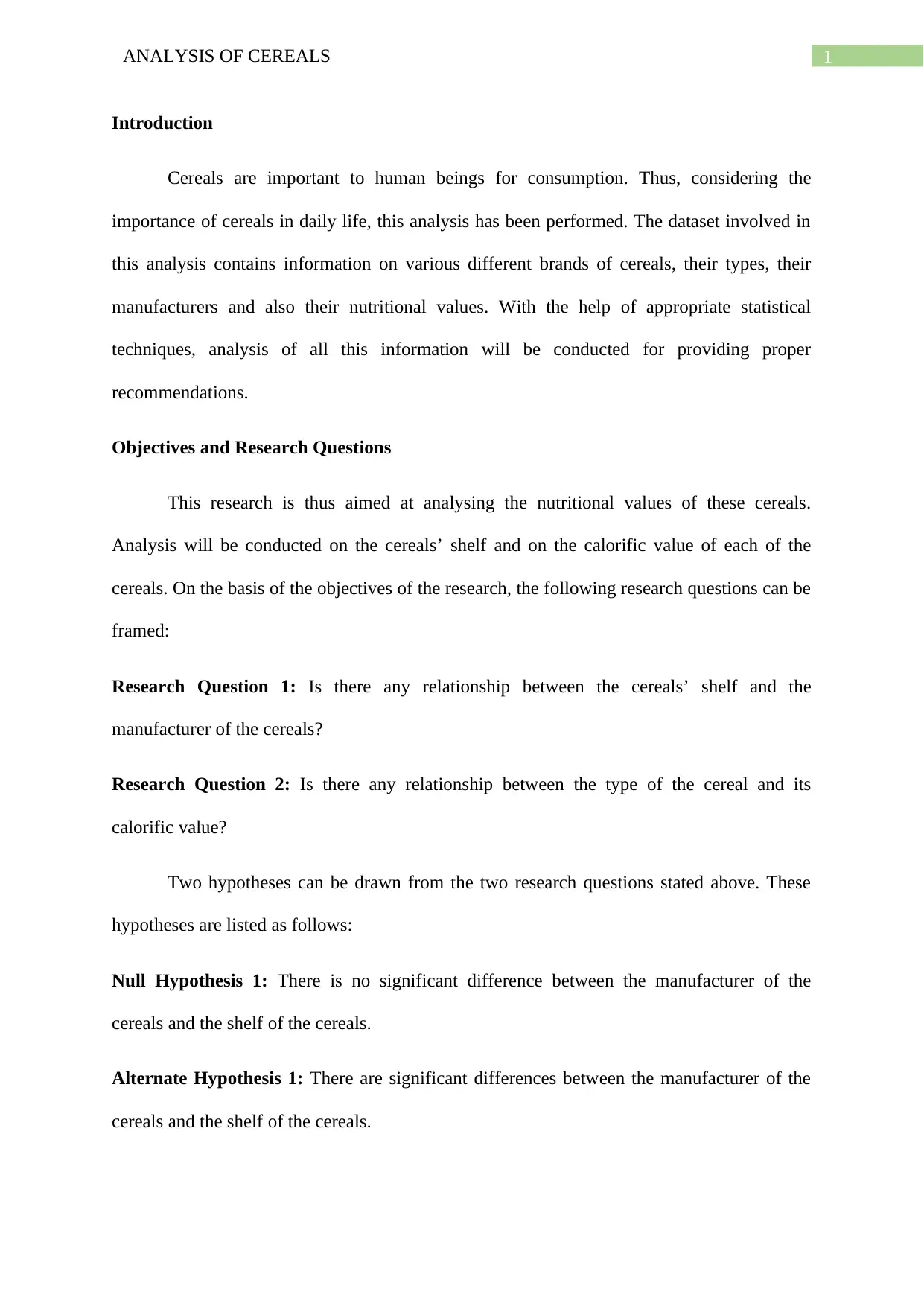
Introduction
Cereals are important to human beings for consumption. Thus, considering the
importance of cereals in daily life, this analysis has been performed. The dataset involved in
this analysis contains information on various different brands of cereals, their types, their
manufacturers and also their nutritional values. With the help of appropriate statistical
techniques, analysis of all this information will be conducted for providing proper
recommendations.
Objectives and Research Questions
This research is thus aimed at analysing the nutritional values of these cereals.
Analysis will be conducted on the cereals’ shelf and on the calorific value of each of the
cereals. On the basis of the objectives of the research, the following research questions can be
framed:
Research Question 1: Is there any relationship between the cereals’ shelf and the
manufacturer of the cereals?
Research Question 2: Is there any relationship between the type of the cereal and its
calorific value?
Two hypotheses can be drawn from the two research questions stated above. These
hypotheses are listed as follows:
Null Hypothesis 1: There is no significant difference between the manufacturer of the
cereals and the shelf of the cereals.
Alternate Hypothesis 1: There are significant differences between the manufacturer of the
cereals and the shelf of the cereals.
Introduction
Cereals are important to human beings for consumption. Thus, considering the
importance of cereals in daily life, this analysis has been performed. The dataset involved in
this analysis contains information on various different brands of cereals, their types, their
manufacturers and also their nutritional values. With the help of appropriate statistical
techniques, analysis of all this information will be conducted for providing proper
recommendations.
Objectives and Research Questions
This research is thus aimed at analysing the nutritional values of these cereals.
Analysis will be conducted on the cereals’ shelf and on the calorific value of each of the
cereals. On the basis of the objectives of the research, the following research questions can be
framed:
Research Question 1: Is there any relationship between the cereals’ shelf and the
manufacturer of the cereals?
Research Question 2: Is there any relationship between the type of the cereal and its
calorific value?
Two hypotheses can be drawn from the two research questions stated above. These
hypotheses are listed as follows:
Null Hypothesis 1: There is no significant difference between the manufacturer of the
cereals and the shelf of the cereals.
Alternate Hypothesis 1: There are significant differences between the manufacturer of the
cereals and the shelf of the cereals.

2ANALYSIS OF CEREALS
Null Hypothesis 2: There is no significant difference between the type of the cereals and the
calorific value of the cereals.
Alternate Hypothesis 2: There are significant differences between the type of the cereals
and the calorific value of the cereals.
Methodology
In order to test the first hypothesis, Analysis of Variance (ANOVA) technique has
been used as with the help of this analysis, the respective difference in the number of shelf
will be determined on the basis of different manufacturers. Since the number of
manufacturers are more than 2, ANOVA technique has been applied.
Similarly, the type of the cereals is 2, hot and cold. Thus, to test the second hypothesis
independent sample t-test will be used as it is the best technique to test the difference between
the average values of two groups.
Codes and Results
The following R Codes has been used in order to run the stated analysis.
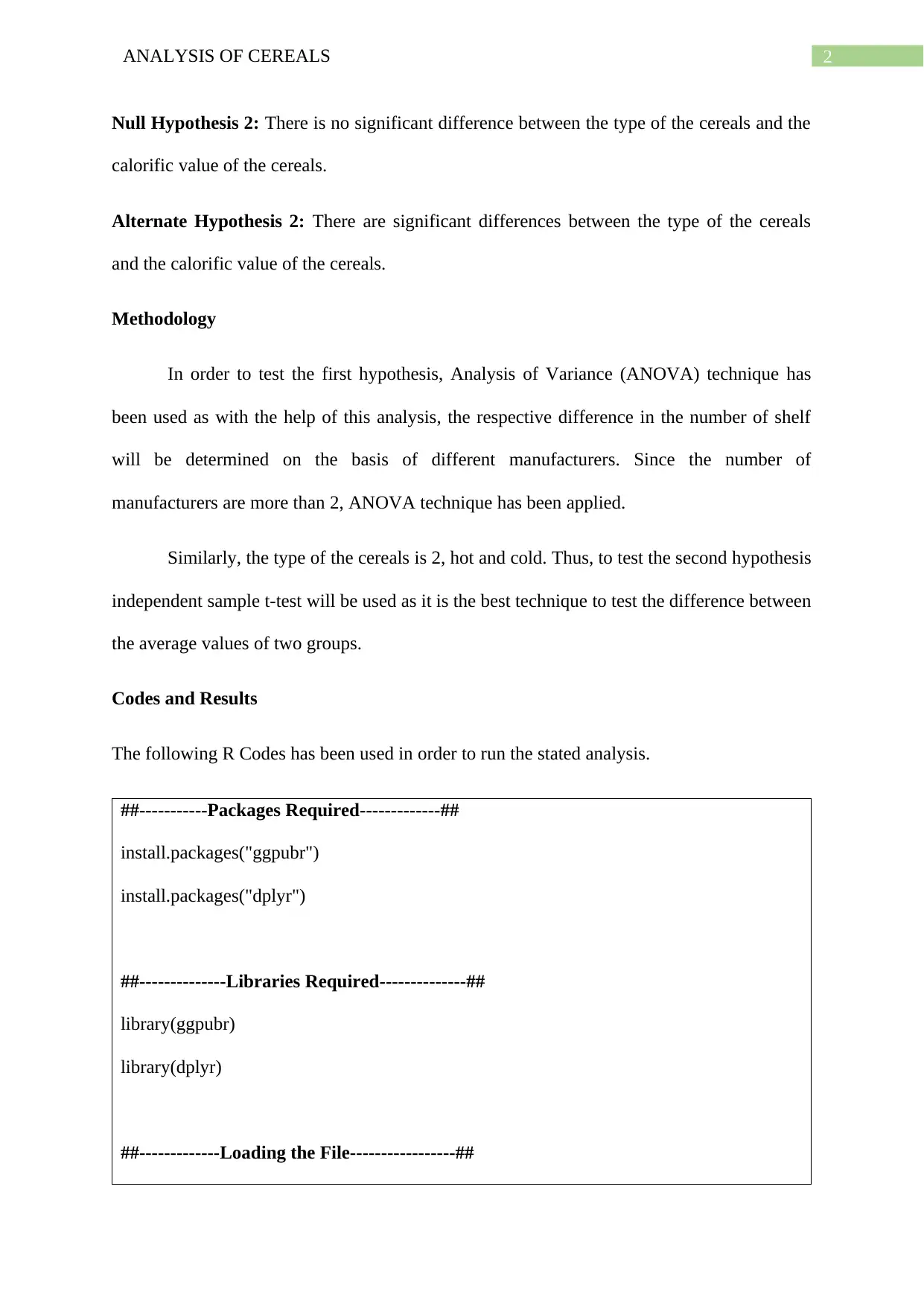
##-----------Packages Required-------------##
install.packages("ggpubr")
install.packages("dplyr")
##--------------Libraries Required--------------##
library(ggpubr)
library(dplyr)
##-------------Loading the File-----------------##
Null Hypothesis 2: There is no significant difference between the type of the cereals and the
calorific value of the cereals.
Alternate Hypothesis 2: There are significant differences between the type of the cereals
and the calorific value of the cereals.
Methodology
In order to test the first hypothesis, Analysis of Variance (ANOVA) technique has
been used as with the help of this analysis, the respective difference in the number of shelf
will be determined on the basis of different manufacturers. Since the number of
manufacturers are more than 2, ANOVA technique has been applied.
Similarly, the type of the cereals is 2, hot and cold. Thus, to test the second hypothesis
independent sample t-test will be used as it is the best technique to test the difference between
the average values of two groups.
Codes and Results
The following R Codes has been used in order to run the stated analysis.
##-----------Packages Required-------------##
install.packages("ggpubr")
install.packages("dplyr")
##--------------Libraries Required--------------##
library(ggpubr)
library(dplyr)
##-------------Loading the File-----------------##
⊘ This is a preview!⊘
Do you want full access?
Subscribe today to unlock all pages.

Trusted by 1+ million students worldwide

3ANALYSIS OF CEREALS
cereal<-read.csv(file.choose())
attach(cereal)
View(cereal)
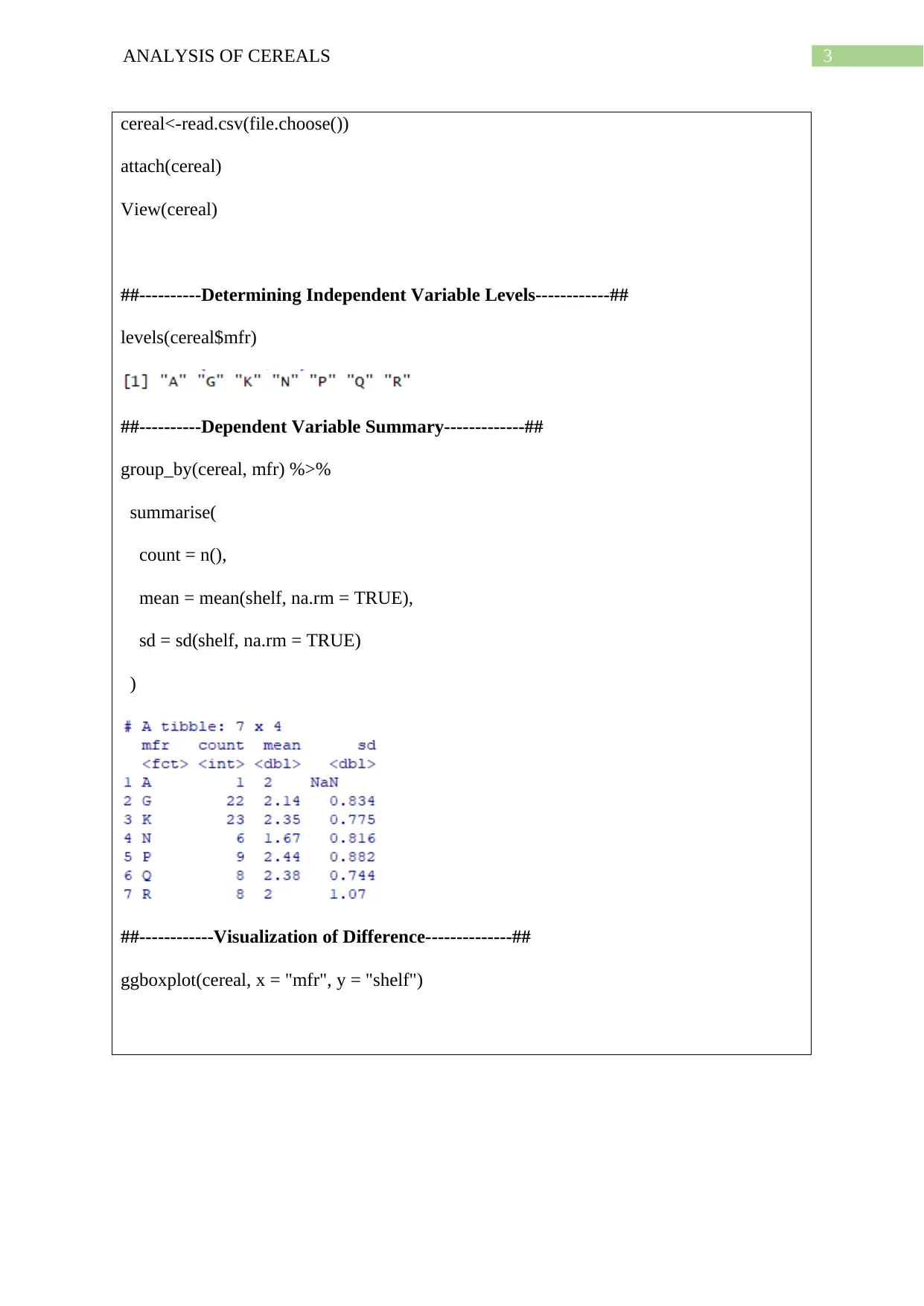
##----------Determining Independent Variable Levels------------##
levels(cereal$mfr)
##----------Dependent Variable Summary-------------##
group_by(cereal, mfr) %>%
summarise(
count = n(),
mean = mean(shelf, na.rm = TRUE),
sd = sd(shelf, na.rm = TRUE)
)
##------------Visualization of Difference--------------##
ggboxplot(cereal, x = "mfr", y = "shelf")
cereal<-read.csv(file.choose())
attach(cereal)
View(cereal)
##----------Determining Independent Variable Levels------------##
levels(cereal$mfr)
##----------Dependent Variable Summary-------------##
group_by(cereal, mfr) %>%
summarise(
count = n(),
mean = mean(shelf, na.rm = TRUE),
sd = sd(shelf, na.rm = TRUE)
)
##------------Visualization of Difference--------------##
ggboxplot(cereal, x = "mfr", y = "shelf")
Paraphrase This Document
Need a fresh take? Get an instant paraphrase of this document with our AI Paraphraser

4ANALYSIS OF CEREALS
1.0
1.5
2.0
2.5
3.0
A G K N P Q R
mfr
shelf
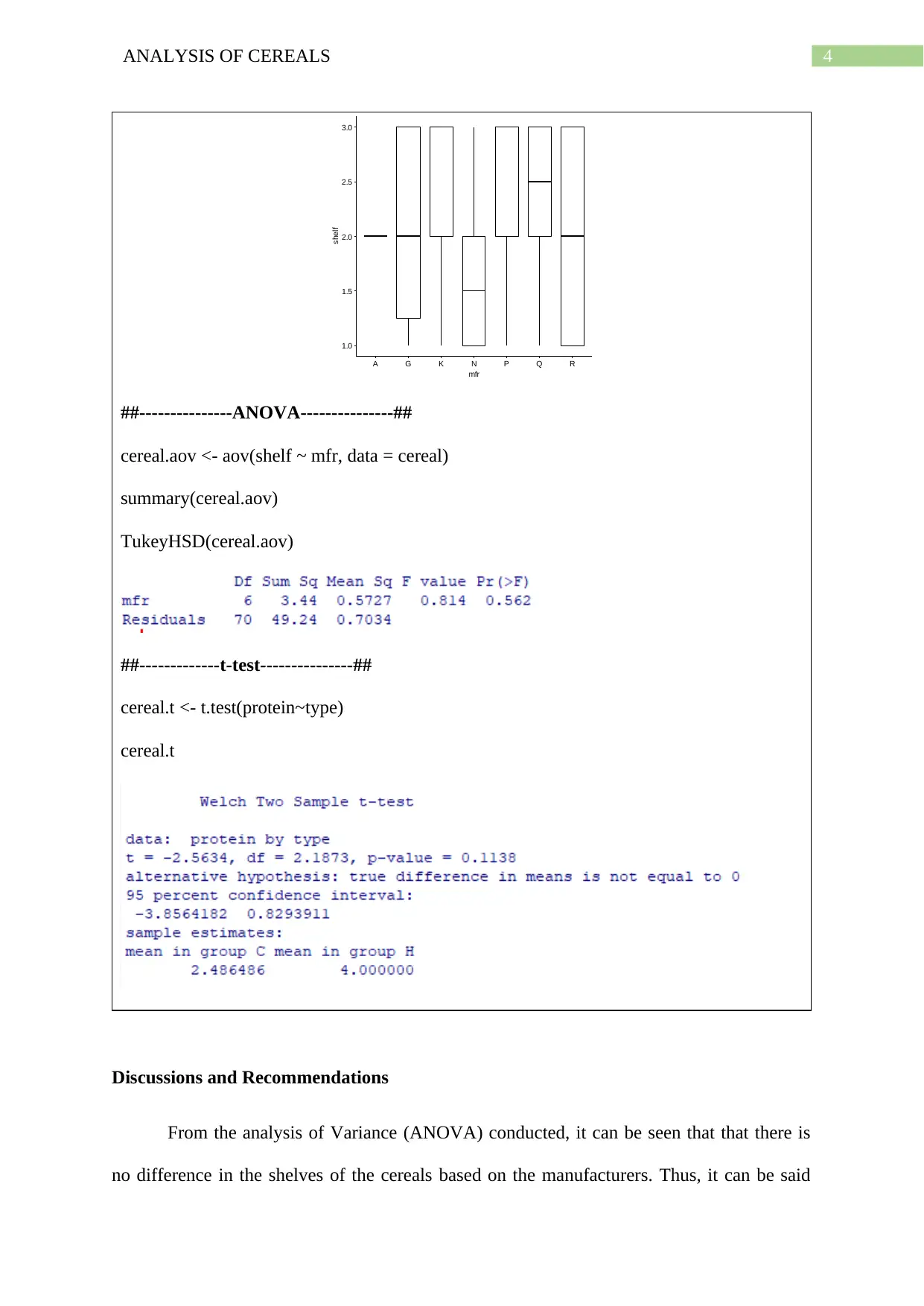
##---------------ANOVA---------------##
cereal.aov <- aov(shelf ~ mfr, data = cereal)
summary(cereal.aov)
TukeyHSD(cereal.aov)
##-------------t-test---------------##
cereal.t <- t.test(protein~type)
cereal.t
Discussions and Recommendations
From the analysis of Variance (ANOVA) conducted, it can be seen that that there is
no difference in the shelves of the cereals based on the manufacturers. Thus, it can be said
1.0
1.5
2.0
2.5
3.0
A G K N P Q R
mfr
shelf
##---------------ANOVA---------------##
cereal.aov <- aov(shelf ~ mfr, data = cereal)
summary(cereal.aov)
TukeyHSD(cereal.aov)
##-------------t-test---------------##
cereal.t <- t.test(protein~type)
cereal.t
Discussions and Recommendations
From the analysis of Variance (ANOVA) conducted, it can be seen that that there is
no difference in the shelves of the cereals based on the manufacturers. Thus, it can be said

5ANALYSIS OF CEREALS
that the manufacturers of the cereals are not concerned about the shelves in which their
product is displayed a long as their product is sold. Further analysis on the difference in the
calorific values shows that the p-value of the analysis is higher than 0.05, which is the level
of significance at which all the tests has been conducted. In both the tests, the p-value is
found to be higher than 0.05. Thus, both the null hypotheses have been rejected. As there is
no difference in the calorific values of the cereals based on its types, a person can choose any
of the cereals, hot or cold that satisfy their nutritional needs. There is no difference in the
calorie content.
that the manufacturers of the cereals are not concerned about the shelves in which their
product is displayed a long as their product is sold. Further analysis on the difference in the
calorific values shows that the p-value of the analysis is higher than 0.05, which is the level
of significance at which all the tests has been conducted. In both the tests, the p-value is
found to be higher than 0.05. Thus, both the null hypotheses have been rejected. As there is
no difference in the calorific values of the cereals based on its types, a person can choose any
of the cereals, hot or cold that satisfy their nutritional needs. There is no difference in the
calorie content.
⊘ This is a preview!⊘
Do you want full access?
Subscribe today to unlock all pages.

Trusted by 1+ million students worldwide
1 out of 6
Related Documents
Your All-in-One AI-Powered Toolkit for Academic Success.
+13062052269
info@desklib.com
Available 24*7 on WhatsApp / Email
Unlock your academic potential
Copyright © 2020–2026 A2Z Services. All Rights Reserved. Developed and managed by ZUCOL.