CHC33015 Certificate III in Individual Support Workbook 3 Assessment
VerifiedAdded on 2023/01/19
|44
|7923
|72
Homework Assignment
AI Summary
This assessment workbook is designed for the CHC33015 Certificate III in Individual Support, focusing on work in health and community services. It includes comprehensive instructions on competency-based assessment, covering topics such as assessment principles, the dimensions of competency, and reasonable adjustments for learners. The workbook outlines the unit of competency, assessment requirements, and methods, including written questions and case studies. It addresses key units like CHCCOM005 (Communicate and work in health or community services) and CHCDIV001 (Work with diverse people). The workbook provides detailed case studies and resources necessary for completing the assessments, emphasizing the importance of valid, reliable, flexible, and fair assessment practices. It also includes a workbook checklist and feedback section to guide learners through the assessment process. The document emphasizes the importance of applying knowledge and skills in real-world scenarios, ensuring that learners demonstrate competence in their roles within health and community services.

CHC33015 Certificate III in
Individual Support
Work in Health and
Community Services
V1.2 Produced 01:44
Individual Support
Work in Health and
Community Services
V1.2 Produced 01:44
Paraphrase This Document
Need a fresh take? Get an instant paraphrase of this document with our AI Paraphraser

Copyright © 2016 Compliant Learning Resources. All rights reserved. No part of this publication may be
reproduced or distributed in any form or by any means, or stored in a database or retrieval system other than
pursuant to the terms of the Copyright Act 1968 (Commonwealth), without the prior written permission of
Compliant Learning Resources.
Assessment Workbook 3 Version No. 1.2 Produced 09 November 2017
Page 2 © Compliant Learning Resources
reproduced or distributed in any form or by any means, or stored in a database or retrieval system other than
pursuant to the terms of the Copyright Act 1968 (Commonwealth), without the prior written permission of
Compliant Learning Resources.
Assessment Workbook 3 Version No. 1.2 Produced 09 November 2017
Page 2 © Compliant Learning Resources

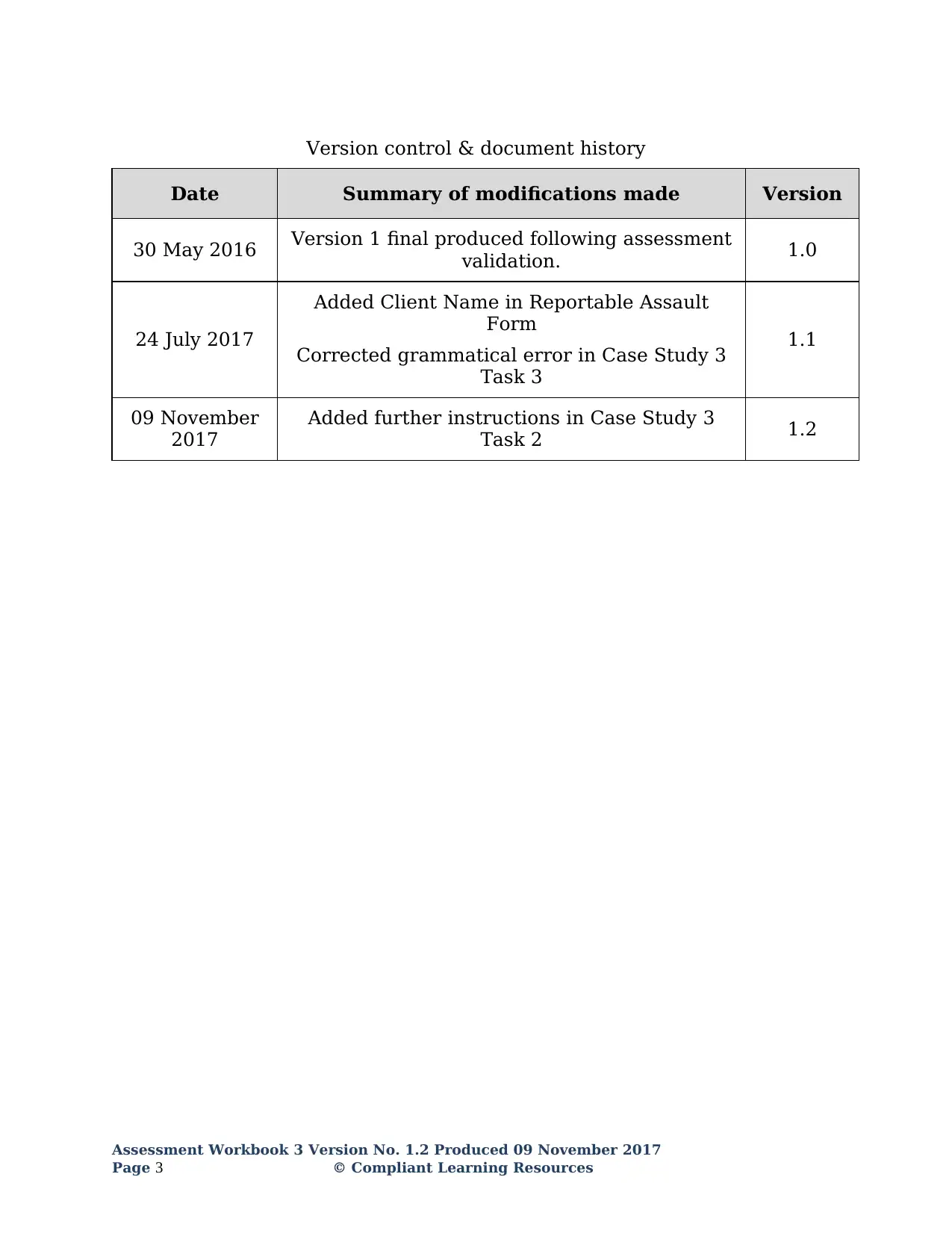
Version control & document history
Date Summary of modifications made Version
30 May 2016 Version 1 final produced following assessment
validation. 1.0
24 July 2017
Added Client Name in Reportable Assault
Form
Corrected grammatical error in Case Study 3
Task 3
1.1
09 November
2017
Added further instructions in Case Study 3
Task 2 1.2
Assessment Workbook 3 Version No. 1.2 Produced 09 November 2017
Page 3 © Compliant Learning Resources
Date Summary of modifications made Version
30 May 2016 Version 1 final produced following assessment
validation. 1.0
24 July 2017
Added Client Name in Reportable Assault
Form
Corrected grammatical error in Case Study 3
Task 3
1.1
09 November
2017
Added further instructions in Case Study 3
Task 2 1.2
Assessment Workbook 3 Version No. 1.2 Produced 09 November 2017
Page 3 © Compliant Learning Resources
⊘ This is a preview!⊘
Do you want full access?
Subscribe today to unlock all pages.

Trusted by 1+ million students worldwide

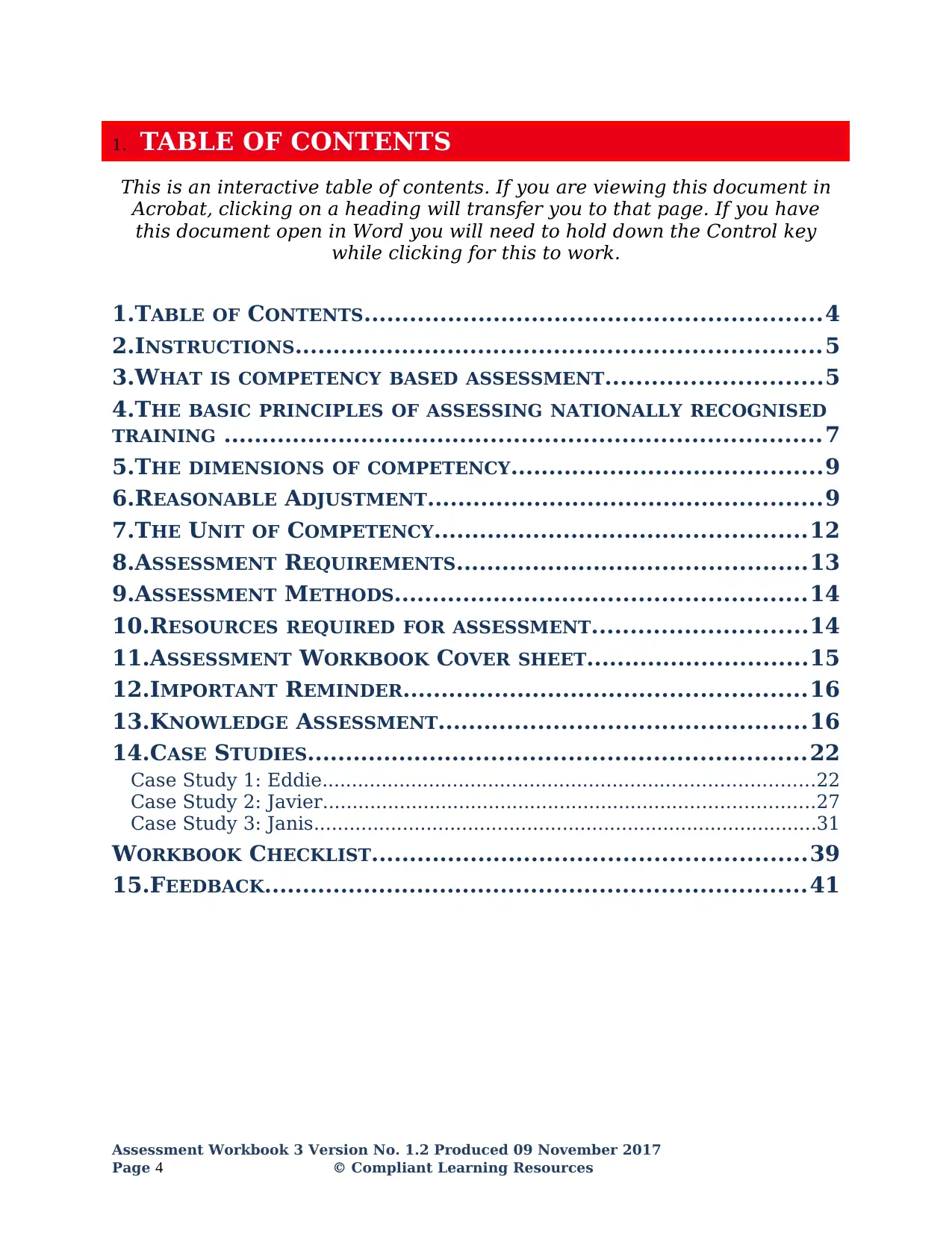
1. TABLE OF CONTENTS
This is an interactive table of contents. If you are viewing this document in
Acrobat, clicking on a heading will transfer you to that page. If you have
this document open in Word you will need to hold down the Control key
while clicking for this to work.
1.TABLE OF CONTENTS............................................................4
2.INSTRUCTIONS.....................................................................5
3.WHAT IS COMPETENCY BASED ASSESSMENT............................5
4.THE BASIC PRINCIPLES OF ASSESSING NATIONALLY RECOGNISED
TRAINING ..............................................................................7
5.THE DIMENSIONS OF COMPETENCY.........................................9
6.REASONABLE ADJUSTMENT....................................................9
7.THE UNIT OF COMPETENCY.................................................12
8.ASSESSMENT REQUIREMENTS..............................................13
9.ASSESSMENT METHODS......................................................14
10.RESOURCES REQUIRED FOR ASSESSMENT............................14
11.ASSESSMENT WORKBOOK COVER SHEET.............................15
12.IMPORTANT REMINDER.....................................................16
13.KNOWLEDGE ASSESSMENT................................................16
14.CASE STUDIES.................................................................22
Case Study 1: Eddie...................................................................................22
Case Study 2: Javier...................................................................................27
Case Study 3: Janis.....................................................................................31
WORKBOOK CHECKLIST.........................................................39
15.FEEDBACK.......................................................................41
Assessment Workbook 3 Version No. 1.2 Produced 09 November 2017
Page 4 © Compliant Learning Resources
This is an interactive table of contents. If you are viewing this document in
Acrobat, clicking on a heading will transfer you to that page. If you have
this document open in Word you will need to hold down the Control key
while clicking for this to work.
1.TABLE OF CONTENTS............................................................4
2.INSTRUCTIONS.....................................................................5
3.WHAT IS COMPETENCY BASED ASSESSMENT............................5
4.THE BASIC PRINCIPLES OF ASSESSING NATIONALLY RECOGNISED
TRAINING ..............................................................................7
5.THE DIMENSIONS OF COMPETENCY.........................................9
6.REASONABLE ADJUSTMENT....................................................9
7.THE UNIT OF COMPETENCY.................................................12
8.ASSESSMENT REQUIREMENTS..............................................13
9.ASSESSMENT METHODS......................................................14
10.RESOURCES REQUIRED FOR ASSESSMENT............................14
11.ASSESSMENT WORKBOOK COVER SHEET.............................15
12.IMPORTANT REMINDER.....................................................16
13.KNOWLEDGE ASSESSMENT................................................16
14.CASE STUDIES.................................................................22
Case Study 1: Eddie...................................................................................22
Case Study 2: Javier...................................................................................27
Case Study 3: Janis.....................................................................................31
WORKBOOK CHECKLIST.........................................................39
15.FEEDBACK.......................................................................41
Assessment Workbook 3 Version No. 1.2 Produced 09 November 2017
Page 4 © Compliant Learning Resources
Paraphrase This Document
Need a fresh take? Get an instant paraphrase of this document with our AI Paraphraser

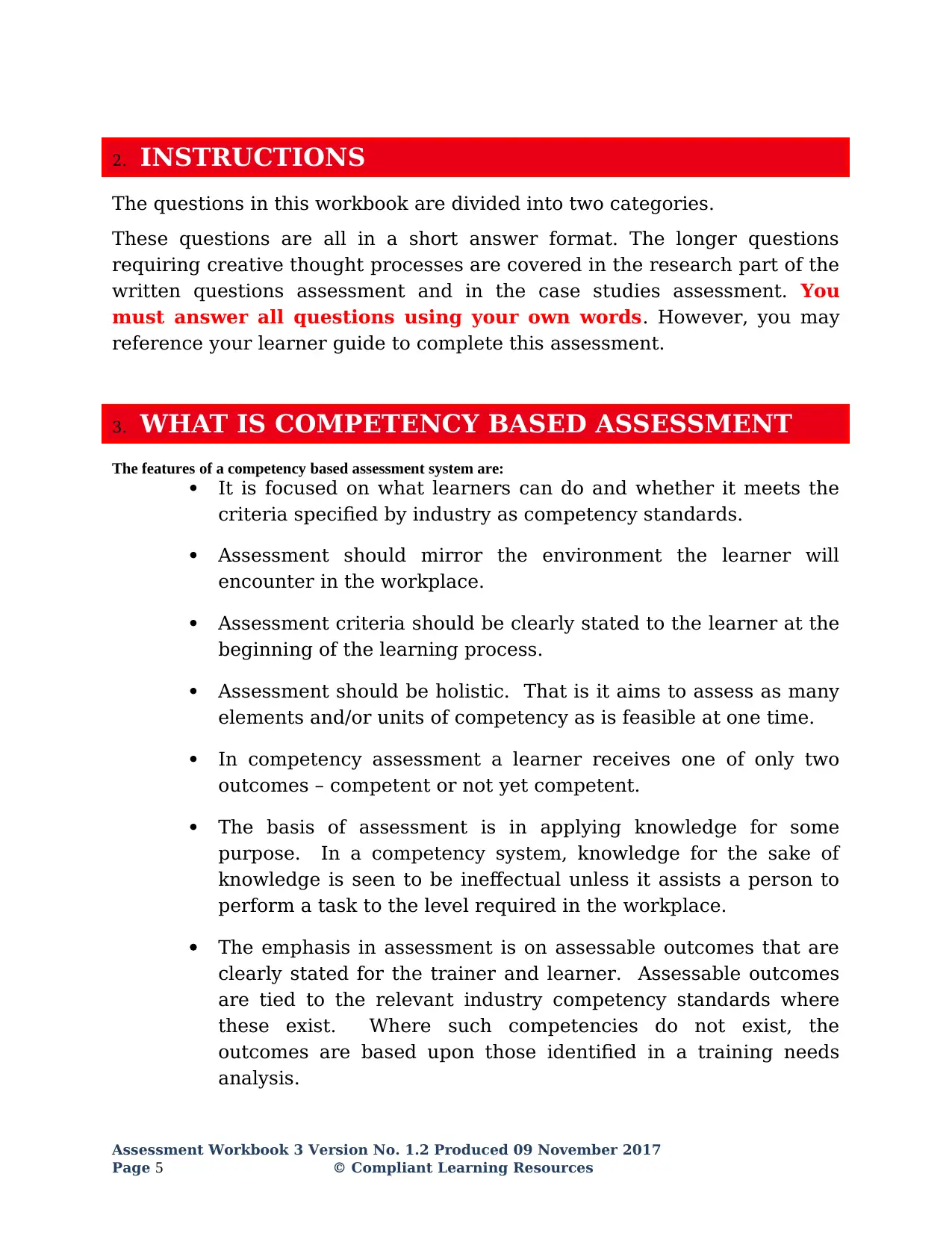
2. INSTRUCTIONS
The questions in this workbook are divided into two categories.
These questions are all in a short answer format. The longer questions
requiring creative thought processes are covered in the research part of the
written questions assessment and in the case studies assessment. You
must answer all questions using your own words. However, you may
reference your learner guide to complete this assessment.
3. WHAT IS COMPETENCY BASED ASSESSMENT
The features of a competency based assessment system are:
It is focused on what learners can do and whether it meets the
criteria specified by industry as competency standards.
Assessment should mirror the environment the learner will
encounter in the workplace.
Assessment criteria should be clearly stated to the learner at the
beginning of the learning process.
Assessment should be holistic. That is it aims to assess as many
elements and/or units of competency as is feasible at one time.
In competency assessment a learner receives one of only two
outcomes – competent or not yet competent.
The basis of assessment is in applying knowledge for some
purpose. In a competency system, knowledge for the sake of
knowledge is seen to be ineffectual unless it assists a person to
perform a task to the level required in the workplace.
The emphasis in assessment is on assessable outcomes that are
clearly stated for the trainer and learner. Assessable outcomes
are tied to the relevant industry competency standards where
these exist. Where such competencies do not exist, the
outcomes are based upon those identified in a training needs
analysis.
Assessment Workbook 3 Version No. 1.2 Produced 09 November 2017
Page 5 © Compliant Learning Resources
The questions in this workbook are divided into two categories.
These questions are all in a short answer format. The longer questions
requiring creative thought processes are covered in the research part of the
written questions assessment and in the case studies assessment. You
must answer all questions using your own words. However, you may
reference your learner guide to complete this assessment.
3. WHAT IS COMPETENCY BASED ASSESSMENT
The features of a competency based assessment system are:
It is focused on what learners can do and whether it meets the
criteria specified by industry as competency standards.
Assessment should mirror the environment the learner will
encounter in the workplace.
Assessment criteria should be clearly stated to the learner at the
beginning of the learning process.
Assessment should be holistic. That is it aims to assess as many
elements and/or units of competency as is feasible at one time.
In competency assessment a learner receives one of only two
outcomes – competent or not yet competent.
The basis of assessment is in applying knowledge for some
purpose. In a competency system, knowledge for the sake of
knowledge is seen to be ineffectual unless it assists a person to
perform a task to the level required in the workplace.
The emphasis in assessment is on assessable outcomes that are
clearly stated for the trainer and learner. Assessable outcomes
are tied to the relevant industry competency standards where
these exist. Where such competencies do not exist, the
outcomes are based upon those identified in a training needs
analysis.
Assessment Workbook 3 Version No. 1.2 Produced 09 November 2017
Page 5 © Compliant Learning Resources

Assessment Workbook 3 Version No. 1.2 Produced 09 November 2017
Page 6 © Compliant Learning Resources
⊘ This is a preview!⊘
Do you want full access?
Subscribe today to unlock all pages.

Trusted by 1+ million students worldwide

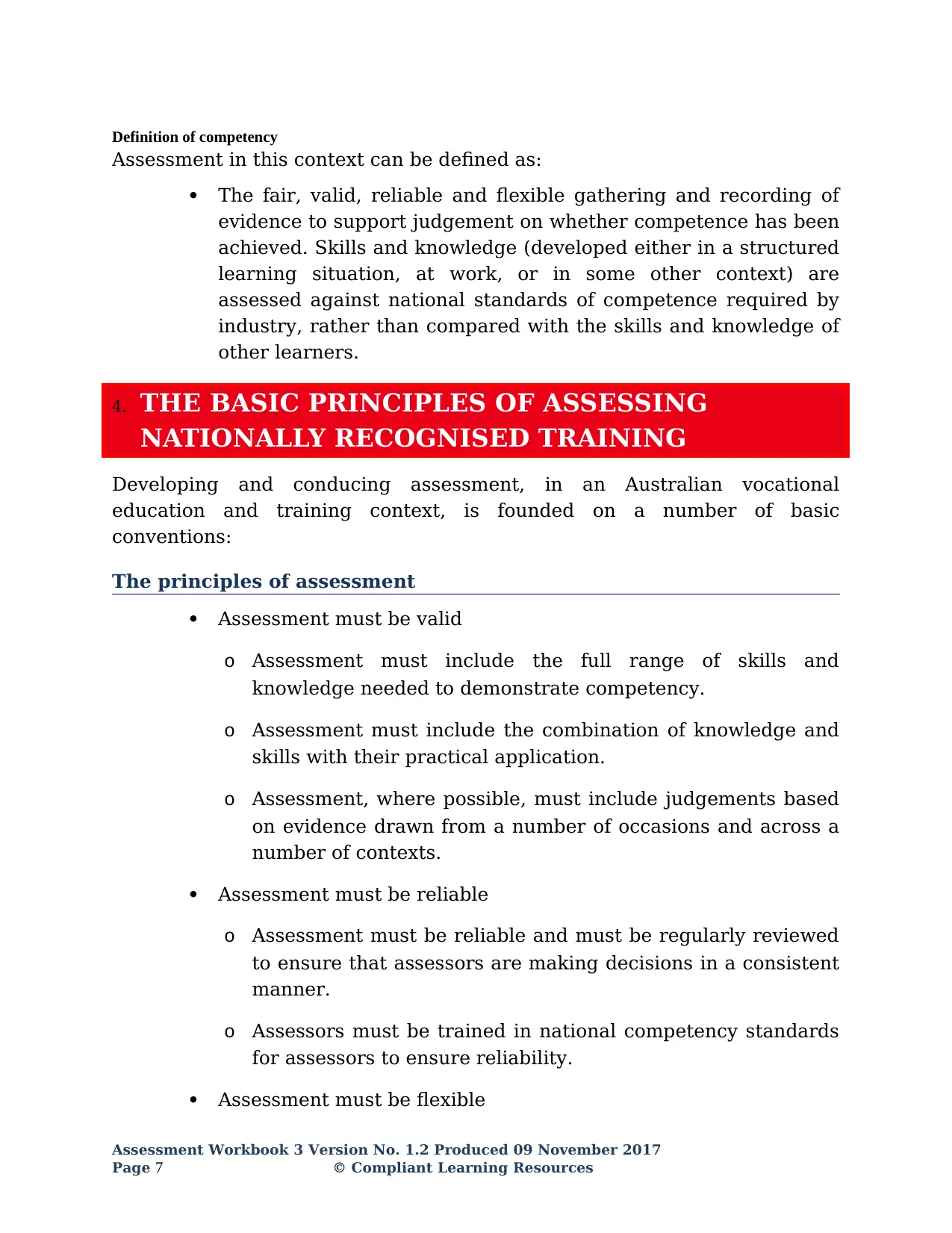
Definition of competency
Assessment in this context can be defined as:
The fair, valid, reliable and flexible gathering and recording of
evidence to support judgement on whether competence has been
achieved. Skills and knowledge (developed either in a structured
learning situation, at work, or in some other context) are
assessed against national standards of competence required by
industry, rather than compared with the skills and knowledge of
other learners.
4. THE BASIC PRINCIPLES OF ASSESSING
NATIONALLY RECOGNISED TRAINING
Developing and conducing assessment, in an Australian vocational
education and training context, is founded on a number of basic
conventions:
The principles of assessment
Assessment must be valid
o Assessment must include the full range of skills and
knowledge needed to demonstrate competency.
o Assessment must include the combination of knowledge and
skills with their practical application.
o Assessment, where possible, must include judgements based
on evidence drawn from a number of occasions and across a
number of contexts.
Assessment must be reliable
o Assessment must be reliable and must be regularly reviewed
to ensure that assessors are making decisions in a consistent
manner.
o Assessors must be trained in national competency standards
for assessors to ensure reliability.
Assessment must be flexible
Assessment Workbook 3 Version No. 1.2 Produced 09 November 2017
Page 7 © Compliant Learning Resources
Assessment in this context can be defined as:
The fair, valid, reliable and flexible gathering and recording of
evidence to support judgement on whether competence has been
achieved. Skills and knowledge (developed either in a structured
learning situation, at work, or in some other context) are
assessed against national standards of competence required by
industry, rather than compared with the skills and knowledge of
other learners.
4. THE BASIC PRINCIPLES OF ASSESSING
NATIONALLY RECOGNISED TRAINING
Developing and conducing assessment, in an Australian vocational
education and training context, is founded on a number of basic
conventions:
The principles of assessment
Assessment must be valid
o Assessment must include the full range of skills and
knowledge needed to demonstrate competency.
o Assessment must include the combination of knowledge and
skills with their practical application.
o Assessment, where possible, must include judgements based
on evidence drawn from a number of occasions and across a
number of contexts.
Assessment must be reliable
o Assessment must be reliable and must be regularly reviewed
to ensure that assessors are making decisions in a consistent
manner.
o Assessors must be trained in national competency standards
for assessors to ensure reliability.
Assessment must be flexible
Assessment Workbook 3 Version No. 1.2 Produced 09 November 2017
Page 7 © Compliant Learning Resources
Paraphrase This Document
Need a fresh take? Get an instant paraphrase of this document with our AI Paraphraser

o Assessment, where possible, must cover both the on and off-
the-job components of training within a course.
o Assessment must provide for the recognition of knowledge,
skills and attitudes regardless of how they have been
acquired.
o Assessment must be made accessible to learners though a
variety of delivery modes, so they can proceed through
modularised training packages to gain competencies.
Assessment must be fair and equitable
o Assessment must be equitable to all groups of learners.
o Assessment procedures and criteria must be made clear to all
learners before assessment.
o Assessment must be mutually developed and agreed upon
between assessor and the assessed.
o Assessment must be able to be challenged. Appropriate
mechanisms must be made for reassessment as a result of
challenge.
The rules of evidence (from Training in Australia by M Tovey, D Lawlor)
When collecting evidence there are certain rules that apply to that
evidence. All evidence must be valid, sufficient, authentic and current;
Valid
o Evidence gathered should meet the requirements of the unit
of competency. This evidence should match or at least reflect
the type of performance that is to be assessed, whether it
covers knowledge, skills or attitudes.
Sufficient
o This rule relates to the amount of evidence gathered It is
imperative that enough evidence is gathered to satisfy the
Assessment Workbook 3 Version No. 1.2 Produced 09 November 2017
Page 8 © Compliant Learning Resources
the-job components of training within a course.
o Assessment must provide for the recognition of knowledge,
skills and attitudes regardless of how they have been
acquired.
o Assessment must be made accessible to learners though a
variety of delivery modes, so they can proceed through
modularised training packages to gain competencies.
Assessment must be fair and equitable
o Assessment must be equitable to all groups of learners.
o Assessment procedures and criteria must be made clear to all
learners before assessment.
o Assessment must be mutually developed and agreed upon
between assessor and the assessed.
o Assessment must be able to be challenged. Appropriate
mechanisms must be made for reassessment as a result of
challenge.
The rules of evidence (from Training in Australia by M Tovey, D Lawlor)
When collecting evidence there are certain rules that apply to that
evidence. All evidence must be valid, sufficient, authentic and current;
Valid
o Evidence gathered should meet the requirements of the unit
of competency. This evidence should match or at least reflect
the type of performance that is to be assessed, whether it
covers knowledge, skills or attitudes.
Sufficient
o This rule relates to the amount of evidence gathered It is
imperative that enough evidence is gathered to satisfy the
Assessment Workbook 3 Version No. 1.2 Produced 09 November 2017
Page 8 © Compliant Learning Resources

requirements that the learner is competent across all aspects
of the unit of competency.
Authentic
o When evidence is gathered the assessor must be satisfied
that evidence is the learner’s own work.
Current
o This relates to the recency of the evidence and whether the
evidence relates to current abilities.
5. THE DIMENSIONS OF COMPETENCY
The national concept of competency includes all aspects of work
performance, and not only narrow task skills. The four dimensions of
competency are:
Task skills
Task management skills
Contingency management skills
Job role and environment skills
6. REASONABLE ADJUSTMENT
Adapted Reasonable Adjustment in teaching, learning and assessment for
learners with a disability - November 2010 - Prepared by - Queensland VET
Development Centre
Reasonable adjustment in VET is the term applied to modifying the learning
environment or making changes to the training delivered to assist a learner
with a disability. A reasonable adjustment can be as simple as changing
classrooms to be closer to amenities, or installing a particular type of
software on a computer for a person with vision impairment.
Why make a reasonable adjustment?
We make reasonable adjustments in VET to make sure that learners with a
disability have:
Assessment Workbook 3 Version No. 1.2 Produced 09 November 2017
Page 9 © Compliant Learning Resources
of the unit of competency.
Authentic
o When evidence is gathered the assessor must be satisfied
that evidence is the learner’s own work.
Current
o This relates to the recency of the evidence and whether the
evidence relates to current abilities.
5. THE DIMENSIONS OF COMPETENCY
The national concept of competency includes all aspects of work
performance, and not only narrow task skills. The four dimensions of
competency are:
Task skills
Task management skills
Contingency management skills
Job role and environment skills
6. REASONABLE ADJUSTMENT
Adapted Reasonable Adjustment in teaching, learning and assessment for
learners with a disability - November 2010 - Prepared by - Queensland VET
Development Centre
Reasonable adjustment in VET is the term applied to modifying the learning
environment or making changes to the training delivered to assist a learner
with a disability. A reasonable adjustment can be as simple as changing
classrooms to be closer to amenities, or installing a particular type of
software on a computer for a person with vision impairment.
Why make a reasonable adjustment?
We make reasonable adjustments in VET to make sure that learners with a
disability have:
Assessment Workbook 3 Version No. 1.2 Produced 09 November 2017
Page 9 © Compliant Learning Resources
⊘ This is a preview!⊘
Do you want full access?
Subscribe today to unlock all pages.

Trusted by 1+ million students worldwide

the same learning opportunities as learners without a disability
the same opportunity to perform and complete assessments as those
without a disability.
Reasonable adjustment applied to participation in teaching, learning
and assessment activities can include:
customising resources and assessment activities within the training
package or accredited course
modifying the presentation medium learner support
use of assistive / adaptive technologies
making information accessible both prior to enrolment and during the
course
monitoring the adjustments to ensure learner needs continue to be
met.
Assistive / Adaptive Technologies
Assistive / adaptive technology means ‘software or hardware that has been
specifically designed to assist people with disabilities in carrying out daily
activities’ (World Wide Web Consortium - W3C). It includes screen readers,
magnifiers, voice recognition software, alternative keyboards, devices for
grasping, visual alert systems, digital note takers.
IMPORTANT NOTE
Reasonable adjustment made for collecting candidate assessment evidence
must not impact on the standard expected by the workplace, as expressed
by the relevant Unit(s) of Competency. E.g. If the assessment was gathering
evidence of the candidates competency in writing, allowing the candidate to
complete the assessment verbally would not be a valid assessment method.
The method of assessment used by any reasonable adjustment must still
meet the competency requirements.
Assessment Workbook 3 Version No. 1.2 Produced 09 November 2017
Page 10 © Compliant Learning Resources
the same opportunity to perform and complete assessments as those
without a disability.
Reasonable adjustment applied to participation in teaching, learning
and assessment activities can include:
customising resources and assessment activities within the training
package or accredited course
modifying the presentation medium learner support
use of assistive / adaptive technologies
making information accessible both prior to enrolment and during the
course
monitoring the adjustments to ensure learner needs continue to be
met.
Assistive / Adaptive Technologies
Assistive / adaptive technology means ‘software or hardware that has been
specifically designed to assist people with disabilities in carrying out daily
activities’ (World Wide Web Consortium - W3C). It includes screen readers,
magnifiers, voice recognition software, alternative keyboards, devices for
grasping, visual alert systems, digital note takers.
IMPORTANT NOTE
Reasonable adjustment made for collecting candidate assessment evidence
must not impact on the standard expected by the workplace, as expressed
by the relevant Unit(s) of Competency. E.g. If the assessment was gathering
evidence of the candidates competency in writing, allowing the candidate to
complete the assessment verbally would not be a valid assessment method.
The method of assessment used by any reasonable adjustment must still
meet the competency requirements.
Assessment Workbook 3 Version No. 1.2 Produced 09 November 2017
Page 10 © Compliant Learning Resources
Paraphrase This Document
Need a fresh take? Get an instant paraphrase of this document with our AI Paraphraser

7. THE UNIT OF COMPETENCY
The units of competency specify the standards of performance required in
the workplace.
This assessment addresses the following unit(s) of competency from
CHC33015 Certificate III in Individual Support:
CHCCOM005 - Communicate and work in health or community
services
1. Communicate effectively with people
2. Collaborate with colleagues
3. Address constraints to communication
4. Report problems to supervisor
5. Complete workplace correspondence and documentation
6. Contribute to continuous improvement
CHCDIV001 - Work with diverse people
1. Reflect on own perspectives
2. Appreciate diversity and inclusiveness, and their benefits
3. Communicate with people from diverse backgrounds and situations
4. Promote understanding across diverse groups
For complete copies of the above units of competency:
Download them from the TGA website: www.training.gov.au
Assessment Workbook 3 Version No. 1.2 Produced 09 November 2017
Page 11 © Compliant Learning Resources
The units of competency specify the standards of performance required in
the workplace.
This assessment addresses the following unit(s) of competency from
CHC33015 Certificate III in Individual Support:
CHCCOM005 - Communicate and work in health or community
services
1. Communicate effectively with people
2. Collaborate with colleagues
3. Address constraints to communication
4. Report problems to supervisor
5. Complete workplace correspondence and documentation
6. Contribute to continuous improvement
CHCDIV001 - Work with diverse people
1. Reflect on own perspectives
2. Appreciate diversity and inclusiveness, and their benefits
3. Communicate with people from diverse backgrounds and situations
4. Promote understanding across diverse groups
For complete copies of the above units of competency:
Download them from the TGA website: www.training.gov.au
Assessment Workbook 3 Version No. 1.2 Produced 09 November 2017
Page 11 © Compliant Learning Resources

8. ASSESSMENT REQUIREMENTS
The assessment requirements specify the evidence and required conditions
for assessment.
Each unit of competency can be unbundled to reveal three key assessment
components:
1. Performance Evidence
- describes the subtasks that make up the element of the unit
2. Knowledge Evidence
- describes the knowledge that must be applied in understanding the
tasks described in the elements
3. Assessment Condition
- describes the environment and conditions that assessments must
be conducted under
The associated assessment method in this kit covers all of these components
as detailed in the matrix to follow:
U
n
i
t
s
o
f
C
o
m
p
e
t
e
n
c
y
Assessment Workbook 3 Version No. 1.2 Produced 09 November 2017
Page 12 © Compliant Learning Resources
The assessment requirements specify the evidence and required conditions
for assessment.
Each unit of competency can be unbundled to reveal three key assessment
components:
1. Performance Evidence
- describes the subtasks that make up the element of the unit
2. Knowledge Evidence
- describes the knowledge that must be applied in understanding the
tasks described in the elements
3. Assessment Condition
- describes the environment and conditions that assessments must
be conducted under
The associated assessment method in this kit covers all of these components
as detailed in the matrix to follow:
U
n
i
t
s
o
f
C
o
m
p
e
t
e
n
c
y
Assessment Workbook 3 Version No. 1.2 Produced 09 November 2017
Page 12 © Compliant Learning Resources
⊘ This is a preview!⊘
Do you want full access?
Subscribe today to unlock all pages.

Trusted by 1+ million students worldwide
1 out of 44
Related Documents
Your All-in-One AI-Powered Toolkit for Academic Success.
+13062052269
info@desklib.com
Available 24*7 on WhatsApp / Email
Unlock your academic potential
Copyright © 2020–2025 A2Z Services. All Rights Reserved. Developed and managed by ZUCOL.