CLWM4100 Taxation Law Case Study: CGT Calculations and Tax Advice

Verified

Added on  2022/08/22

|8
|1262
|10
Case Study
AI Summary
This case study delves into the complexities of Australian taxation law, specifically concerning Capital Gains Tax (CGT). It examines the timing of CGT events, referencing relevant legislation and case law. The core of the case involves Harrison Carter, an Australian resident, and provides a detailed analysis of his tax obligations arising from the sale of an investment property and shares. The assignment requires calculating net capital gains or losses for the years ending 2018 and 2019, utilizing all available methods. The case study offers comprehensive guidance on the application of CGT principles, including the discounted and indexation methods, and provides practical advice based on the scenario. The analysis includes the application of relevant sections of the Income Tax Assessment Act 1997 and case law to determine the tax implications of Harrison's transactions.
Document Page
Running head: TAXATION LAW
Taxation Law
Name of the Student
Name of the University
Authors Note
Course ID
tabler-icon-diamond-filled.svg

Paraphrase This Document

Need a fresh take? Get an instant paraphrase of this document with our AI Paraphraser
Document Page
2TAXATION LAW
Table of Contents
Answer to Part 1:........................................................................................................................3
Answer to Part 2:........................................................................................................................4
Brief Summary:..........................................................................................................................6
References:.................................................................................................................................8
Document Page
3TAXATION LAW
Answer to Part 1:
A capital gains happens only if the proceeds upon the sale goes past the cost paid to
acquire the asset. A capital loss happens if the acquisition price exceed the proceeds obtained
from sale. A capital gains or loss may happen from the occurrence of CGT event in regard to
the CGT asset, barring when there is any kind of exemption that is applicable, rollover relief
that is deferred from capital gains and the provision that negates that loss (Barkoczy 2016).
For instance, under the “section 104-10(3) ITAA 1997”, the timing of the CGT event upon
the transfer of CGT asset is when the taxpayer enters in the agreement for the transfer or else
there is no agreement, when the changes in the ownership happens upon the settlement.
At the time of ascertaining the CGT event the decision of “FCT v Sara Lee
Household & Body Care P/L (2000)” has been considered; the relevant factors are as
follows;
1. The relevant contract represents the sources of obligations to carry-out the transfer of
assets that constitutes the relevant sale of asset.
2. If two or more contract forms the source of obligations to carry-out the sources to
execute the transfer, a judgement is needed as which contract is regarded as property
and the sources of obligations that effects the disposal (Morgan, Mortimer and Pinto
2018).
3. If it is not possible to recognize the single contract under which the sale happens, then
it is important to determine the time when the changes in the ownership happens.
4. The date of sale and the date of acquisition of the same CGT asset might be different
and does not requires to be contemporaneous;
5. The relevant time is when the contract is made and does not considers the time when
the contract became unconditional or particularly enforceable.
Document Page
4TAXATION LAW
6. The sale may happen under the contract despite the fact the transferee is not regarded
as the party to the contract.
On finding that the relevant contract is signed prior to the 30 June, the CGT event and
liability for the CGT will be considered payable in relation to the year ended 30 June. While
in another example of “McDonald v FCT (1998)”, an oral contract for purchase, irrespective
of whether enforceable or not will ascertain the time of purchase. Where the contract is
considered preliminary and not actual contract for purchase, the date of contract will be the
latter.
Answer to Part 2:
In the present case it is found that Harrison has purchased a property for investment
purpose that had the market value of $80,000 at a deposit of 10%. The property was
eventually sold by Harrison with sales proceeds of $1.3 million. The investment property is
referred as CGT asset under the “section 108-5 ITAA 1997”. When the property was sold by
Harrison a “CGT event A1” happened upon the disposal of property (Taylor et al. 2017). The
factual decision of “FCT v Sara Lee Household (2002)” can be cited to say the CGT event
took place when the agreement for sale of property was entered by Harrison. When the
property was disposed by Harrison the ownership of the asset was changed. Referring to
“section 116-20 ITAA 1997” the sales revenue earned by selling the property represents
capital proceeds since it constitutes a market worth of asset that happens from the CGT event.
As a result, under “section 102-5 ITAA 1997” the net amount of capital gains made from
disposal will be included in Harrison assessable earnings.
In later part of the year, Harrison also sold shares portfolio of $10,000 that was
purchased by Harrison during the month of October 1985 as each share price stood $4.
Harrison disposed all the shares at $12 each on 20th June 2018. The shares are held as CGT
tabler-icon-diamond-filled.svg

Paraphrase This Document

Need a fresh take? Get an instant paraphrase of this document with our AI Paraphraser
Document Page
5TAXATION LAW
asset under “section 108-5 ITAA 1997”. As the shares is purchased following September
1985 it is referred as “post-CGT asset” and would liable for CGT (Woellner et al. 2016).
Furthermore, when Harrison disposed the shares a “CGT event A1” took place within
“section 104-10 (1)”. Referring to “FCT v Sara Lee Household (2002)” the time of CGT
event will be 20th June 2018. This is because, the share transfer document was signed by
Harrison on 20th June even though the transfer was registered on 10th July 2018. The capital
gains will be taxable in the year of 2017-18 as the year when the contract happened and will
not be included for assessment in the year 2018-19.
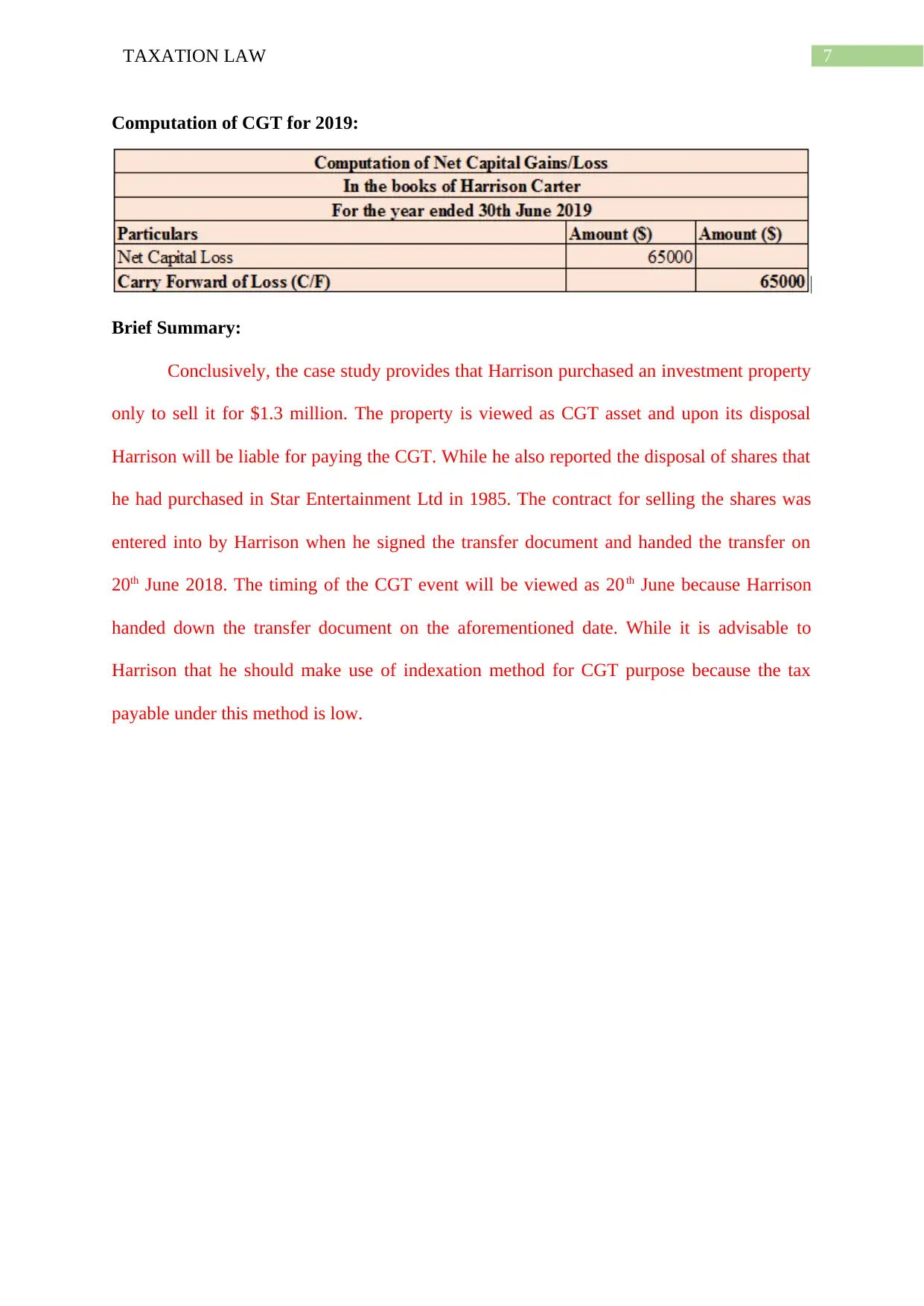
While the statement of ATO reads that, when a taxpayer suffers capital loss while
selling the asset they should use the loss to lower the capital gains which is suffered during
the same year. However, if the taxpayer has failed to report any capital gains and suffers
capital loss, then the losses must be utilized by taxpayer to lower the capital gains in later
years. Correspondingly, Harrison has suffered a capital loss of $65,000 in 2018-19. It is
advised that Harrison should defer the capital loss to next year unless any next capital gains is
reported in future years.
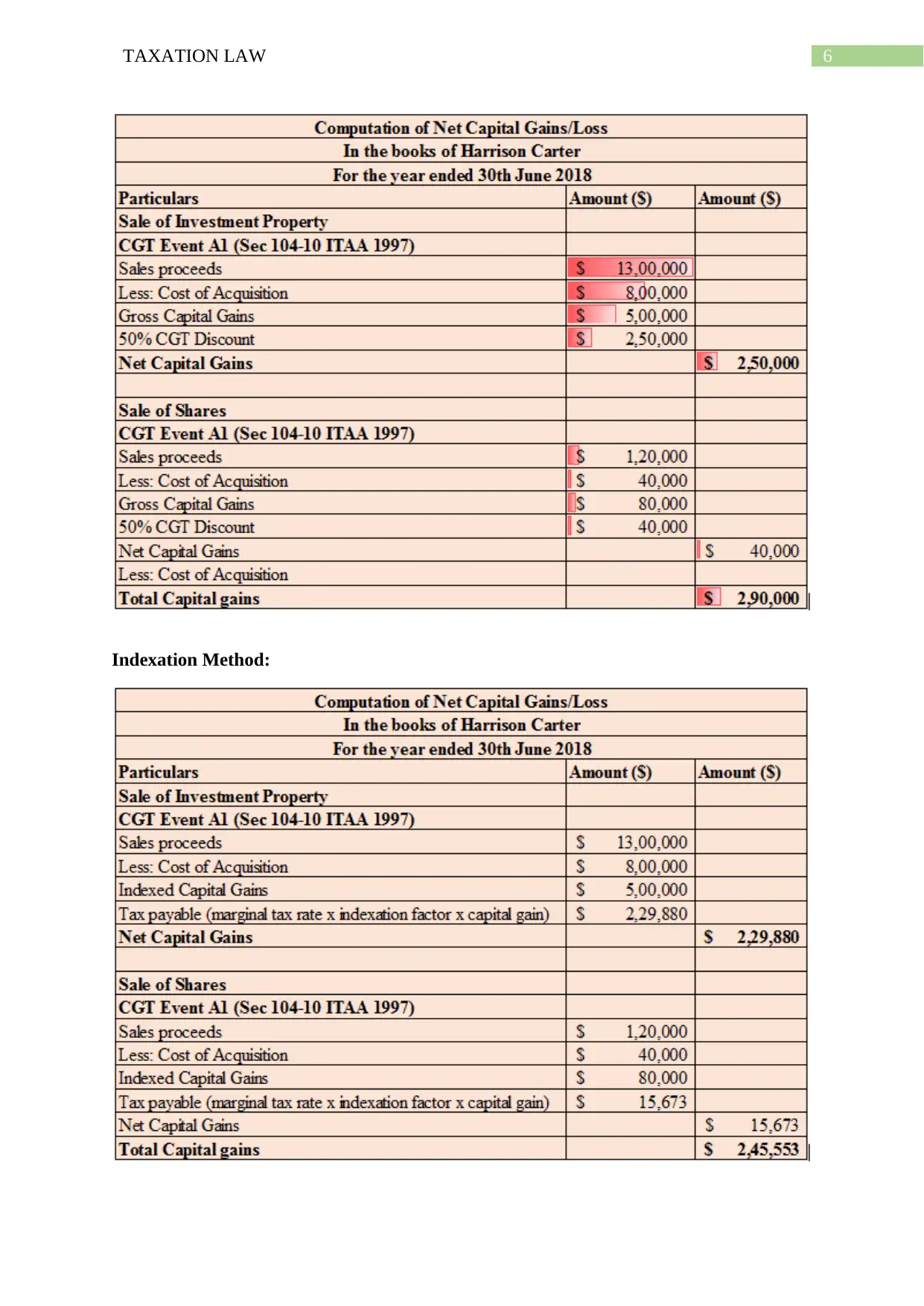
Discounted Method:
Document Page
6TAXATION LAW
Indexation Method:
Document Page
7TAXATION LAW
Computation of CGT for 2019:
Brief Summary:
Conclusively, the case study provides that Harrison purchased an investment property
only to sell it for $1.3 million. The property is viewed as CGT asset and upon its disposal
Harrison will be liable for paying the CGT. While he also reported the disposal of shares that
he had purchased in Star Entertainment Ltd in 1985. The contract for selling the shares was
entered into by Harrison when he signed the transfer document and handed the transfer on
20th June 2018. The timing of the CGT event will be viewed as 20th June because Harrison
handed down the transfer document on the aforementioned date. While it is advisable to
Harrison that he should make use of indexation method for CGT purpose because the tax
payable under this method is low.
tabler-icon-diamond-filled.svg

Paraphrase This Document

Need a fresh take? Get an instant paraphrase of this document with our AI Paraphraser
Document Page
8TAXATION LAW
References:
Barkoczy, S., 2016. Foundations of Taxation Law 2016. OUP Catalogue.
Morgan, A., Mortimer, C. and Pinto, D., 2018. A practical introduction to Australian
taxation law 2018. Oxford University Press.
Taylor, J., Walpole, M., Burton, M., Ciro, T. and Murray, I., 2017. Understanding Taxation
Law 2018. LexisNexis Butterworths.
Woellner, R., Barkoczy, S., Murphy, S., Evans, C. and Pinto, D., 2016. Australian Taxation
Law 2016. OUP Catalogue.
chevron_up_icon
1 out of 8
circle_padding
hide_on_mobile
zoom_out_icon
[object Object]