Chadwick Inc. Case Study: Balanced Scorecard for Norwalk Division
VerifiedAdded on 2022/12/27
|7
|1396
|83
Case Study
AI Summary
This case study analyzes the Balanced Scorecard for the Norwalk Pharmaceutical Division of Chadwick, Inc. It addresses the development of a balanced scorecard, incorporating customer, process, learning and growth, and financial perspectives. The analysis examines how the division's business strategy aligns with its scorecard, identifying key measures and potential conflicts between divisional and corporate scorecards. The study also critically evaluates the strategy formulation process, emphasizing the importance of market research and understanding customer needs. Furthermore, the document explores the differences between divisional and corporate scorecards, and how conflicts can be resolved to ensure organizational alignment. The Norwalk scorecard focuses on managing the portfolio of investments, improving the process of product development, meeting customer needs, and developing employees’ skills both commercial and technical. The study emphasizes the importance of balancing responsibilities and understanding the overall objectives of the organization when creating divisional scorecards.

BALANCED SCORECARD 1
UNIVERSITY NAME
STUDENT NAME
STUDENT ID
COURSE
DATE
UNIVERSITY NAME
STUDENT NAME
STUDENT ID
COURSE
DATE
Paraphrase This Document
Need a fresh take? Get an instant paraphrase of this document with our AI Paraphraser

BALANCED SCORECARD 2
QUESTIONS AND ANSWERS.
Part Develop the balanced scorecard for the Norwalk Pharmaceutical Division of Chadwick, Inc. What
parts of the business strategy that John Greenfield sketched out should be included? Are there any
parts that should be excluded or cannot be made operational? What are the scorecard measures you
should use to implement your scorecard in the Norwalk Pharmaceutical Division? What are the new
measures that need to be developed, and how would you go about developing them? [50%]
Development of a scorecard depends highly on policies or strategies of a company.
Therefore, for a company to have good policies, the following two factors will be considered.
a) A report of competitive advantage of the company in the market.
b) The capacity of the policy.
As seen, the business plans for Norwalk has the following fundamentals:
1) Satisfy the needs of customers
2) Control Norwalk portfolio of investments through minimizing expenditure cost on
execution of the on-hand business base
3) Minimal centralization of staff overheads and therefore directing the responsibility to the
lowest level possible.
4) People development through industrial trainings, and combination of various skills both
technical and commercial.
These strategies are used to prepare a score card having in consideration the following
perspectives:
Customer perspective. In this perspective, Norwalk should look at how to retain a customer for
a specific period of time, portion of market controlled by the company, development of new
products, relationship between suppliers and immediate consumers who are customers in this
perspective and suggestions of applications from both salesmen and customers regarding profits
(Modell, 2009, pg.89).
QUESTIONS AND ANSWERS.
Part Develop the balanced scorecard for the Norwalk Pharmaceutical Division of Chadwick, Inc. What
parts of the business strategy that John Greenfield sketched out should be included? Are there any
parts that should be excluded or cannot be made operational? What are the scorecard measures you
should use to implement your scorecard in the Norwalk Pharmaceutical Division? What are the new
measures that need to be developed, and how would you go about developing them? [50%]
Development of a scorecard depends highly on policies or strategies of a company.
Therefore, for a company to have good policies, the following two factors will be considered.
a) A report of competitive advantage of the company in the market.
b) The capacity of the policy.
As seen, the business plans for Norwalk has the following fundamentals:
1) Satisfy the needs of customers
2) Control Norwalk portfolio of investments through minimizing expenditure cost on
execution of the on-hand business base
3) Minimal centralization of staff overheads and therefore directing the responsibility to the
lowest level possible.
4) People development through industrial trainings, and combination of various skills both
technical and commercial.
These strategies are used to prepare a score card having in consideration the following
perspectives:
Customer perspective. In this perspective, Norwalk should look at how to retain a customer for
a specific period of time, portion of market controlled by the company, development of new
products, relationship between suppliers and immediate consumers who are customers in this
perspective and suggestions of applications from both salesmen and customers regarding profits
(Modell, 2009, pg.89).

BALANCED SCORECARD 3
Process perspective. The company must put into consideration the value creation cycle of its
business through factors like: lab testing, average time taken in each stage of development and
production efficiencies availability.
Learning and growth perspective. The company needs to examine the rate of sales from new
customers and number of new customers compared to on-hand customers, margins on newly
developed product, suggestions from suppliers (distributors) and customers, employees’ attitude,
number of employees possessing technical or commercial skills and rate of employees’ retention.
Financial perspective the company must look at funds and percent to be spend on product
development and research, marketing cost and return on capital employed.
A helpful scorecard to the organization must incorporate strategies or policies developed and the
above perspectives.
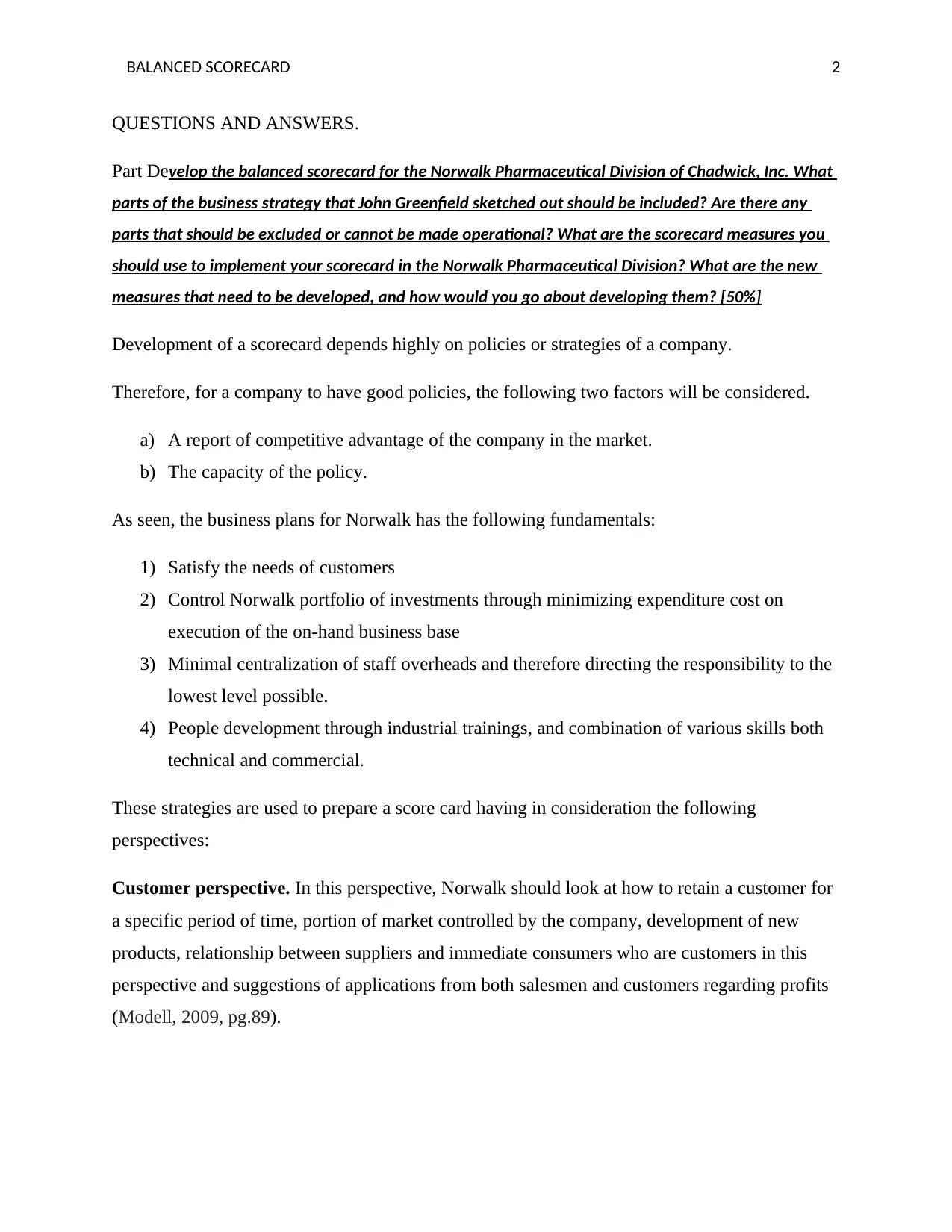
NORWALK SCORECARD.
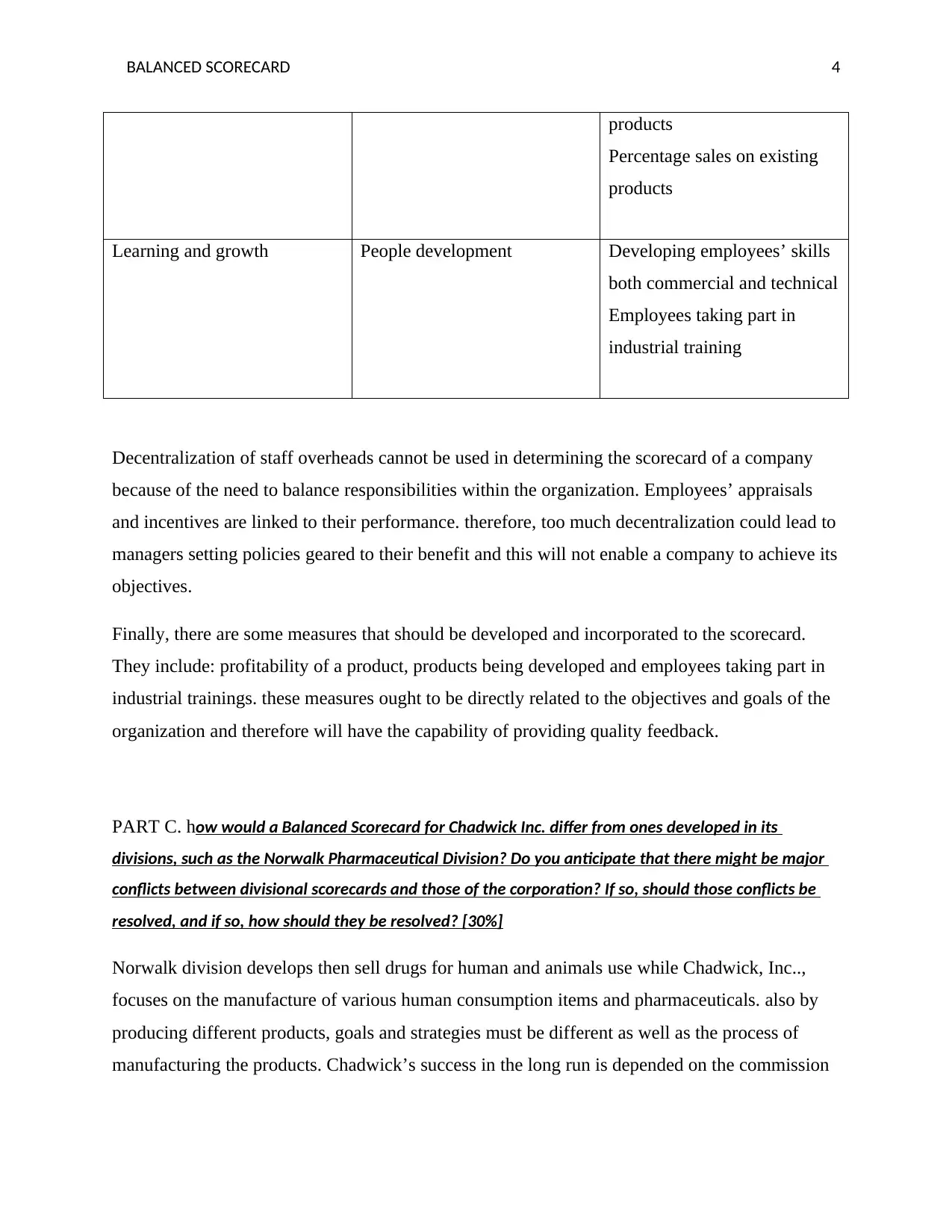
The Norwalk scorecard is shown in the table below:
Perspective Objectives Measures
Financial Manage Norwalk portfolio of
investments
Increasing the Return On
Employee cash flow and the
portion of market controlled.
Working capital
Process Product development Improving the process of
product development.
Market strategies to introduce
a product.
Execute policies to reduce
product development cycle
Customer Meet customer needs Loyalty program
Delivering on time
Percentage sales on new
Process perspective. The company must put into consideration the value creation cycle of its
business through factors like: lab testing, average time taken in each stage of development and
production efficiencies availability.
Learning and growth perspective. The company needs to examine the rate of sales from new
customers and number of new customers compared to on-hand customers, margins on newly
developed product, suggestions from suppliers (distributors) and customers, employees’ attitude,
number of employees possessing technical or commercial skills and rate of employees’ retention.
Financial perspective the company must look at funds and percent to be spend on product
development and research, marketing cost and return on capital employed.
A helpful scorecard to the organization must incorporate strategies or policies developed and the
above perspectives.
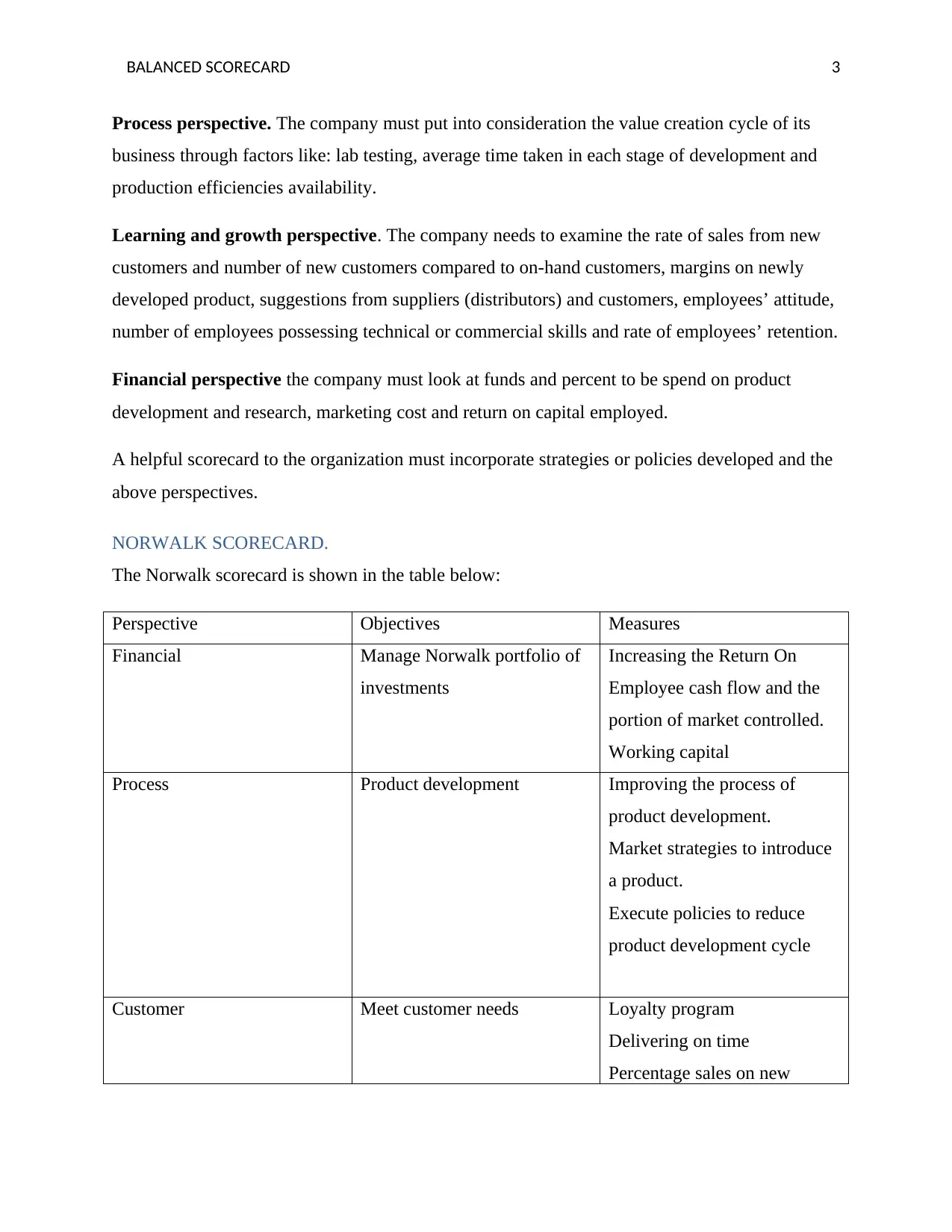
NORWALK SCORECARD.
The Norwalk scorecard is shown in the table below:
Perspective Objectives Measures
Financial Manage Norwalk portfolio of
investments
Increasing the Return On
Employee cash flow and the
portion of market controlled.
Working capital
Process Product development Improving the process of
product development.
Market strategies to introduce
a product.
Execute policies to reduce
product development cycle
Customer Meet customer needs Loyalty program
Delivering on time
Percentage sales on new
⊘ This is a preview!⊘
Do you want full access?
Subscribe today to unlock all pages.

Trusted by 1+ million students worldwide

BALANCED SCORECARD 4
products
Percentage sales on existing
products
Learning and growth People development Developing employees’ skills
both commercial and technical
Employees taking part in
industrial training
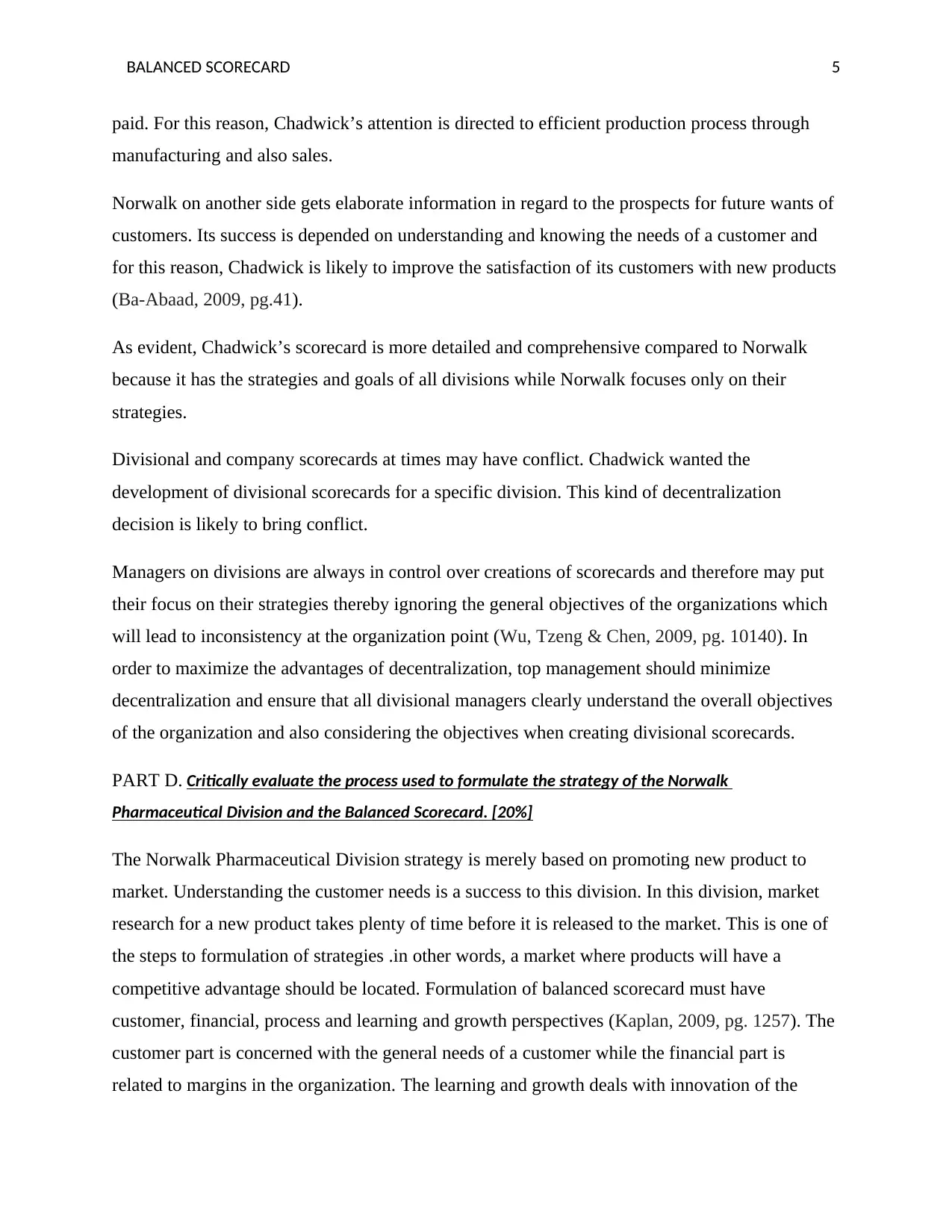
Decentralization of staff overheads cannot be used in determining the scorecard of a company
because of the need to balance responsibilities within the organization. Employees’ appraisals
and incentives are linked to their performance. therefore, too much decentralization could lead to
managers setting policies geared to their benefit and this will not enable a company to achieve its
objectives.
Finally, there are some measures that should be developed and incorporated to the scorecard.
They include: profitability of a product, products being developed and employees taking part in
industrial trainings. these measures ought to be directly related to the objectives and goals of the
organization and therefore will have the capability of providing quality feedback.
PART C. how would a Balanced Scorecard for Chadwick Inc. differ from ones developed in its
divisions, such as the Norwalk Pharmaceutical Division? Do you anticipate that there might be major
conflicts between divisional scorecards and those of the corporation? If so, should those conflicts be
resolved, and if so, how should they be resolved? [30%]
Norwalk division develops then sell drugs for human and animals use while Chadwick, Inc..,
focuses on the manufacture of various human consumption items and pharmaceuticals. also by
producing different products, goals and strategies must be different as well as the process of
manufacturing the products. Chadwick’s success in the long run is depended on the commission
products
Percentage sales on existing
products
Learning and growth People development Developing employees’ skills
both commercial and technical
Employees taking part in
industrial training
Decentralization of staff overheads cannot be used in determining the scorecard of a company
because of the need to balance responsibilities within the organization. Employees’ appraisals
and incentives are linked to their performance. therefore, too much decentralization could lead to
managers setting policies geared to their benefit and this will not enable a company to achieve its
objectives.
Finally, there are some measures that should be developed and incorporated to the scorecard.
They include: profitability of a product, products being developed and employees taking part in
industrial trainings. these measures ought to be directly related to the objectives and goals of the
organization and therefore will have the capability of providing quality feedback.
PART C. how would a Balanced Scorecard for Chadwick Inc. differ from ones developed in its
divisions, such as the Norwalk Pharmaceutical Division? Do you anticipate that there might be major
conflicts between divisional scorecards and those of the corporation? If so, should those conflicts be
resolved, and if so, how should they be resolved? [30%]
Norwalk division develops then sell drugs for human and animals use while Chadwick, Inc..,
focuses on the manufacture of various human consumption items and pharmaceuticals. also by
producing different products, goals and strategies must be different as well as the process of
manufacturing the products. Chadwick’s success in the long run is depended on the commission
Paraphrase This Document
Need a fresh take? Get an instant paraphrase of this document with our AI Paraphraser

BALANCED SCORECARD 5
paid. For this reason, Chadwick’s attention is directed to efficient production process through
manufacturing and also sales.
Norwalk on another side gets elaborate information in regard to the prospects for future wants of
customers. Its success is depended on understanding and knowing the needs of a customer and
for this reason, Chadwick is likely to improve the satisfaction of its customers with new products
(Ba-Abaad, 2009, pg.41).
As evident, Chadwick’s scorecard is more detailed and comprehensive compared to Norwalk
because it has the strategies and goals of all divisions while Norwalk focuses only on their
strategies.
Divisional and company scorecards at times may have conflict. Chadwick wanted the
development of divisional scorecards for a specific division. This kind of decentralization
decision is likely to bring conflict.
Managers on divisions are always in control over creations of scorecards and therefore may put
their focus on their strategies thereby ignoring the general objectives of the organizations which
will lead to inconsistency at the organization point (Wu, Tzeng & Chen, 2009, pg. 10140). In
order to maximize the advantages of decentralization, top management should minimize
decentralization and ensure that all divisional managers clearly understand the overall objectives
of the organization and also considering the objectives when creating divisional scorecards.
PART D. Critically evaluate the process used to formulate the strategy of the Norwalk
Pharmaceutical Division and the Balanced Scorecard. [20%]
The Norwalk Pharmaceutical Division strategy is merely based on promoting new product to
market. Understanding the customer needs is a success to this division. In this division, market
research for a new product takes plenty of time before it is released to the market. This is one of
the steps to formulation of strategies .in other words, a market where products will have a
competitive advantage should be located. Formulation of balanced scorecard must have
customer, financial, process and learning and growth perspectives (Kaplan, 2009, pg. 1257). The
customer part is concerned with the general needs of a customer while the financial part is
related to margins in the organization. The learning and growth deals with innovation of the
paid. For this reason, Chadwick’s attention is directed to efficient production process through
manufacturing and also sales.
Norwalk on another side gets elaborate information in regard to the prospects for future wants of
customers. Its success is depended on understanding and knowing the needs of a customer and
for this reason, Chadwick is likely to improve the satisfaction of its customers with new products
(Ba-Abaad, 2009, pg.41).
As evident, Chadwick’s scorecard is more detailed and comprehensive compared to Norwalk
because it has the strategies and goals of all divisions while Norwalk focuses only on their
strategies.
Divisional and company scorecards at times may have conflict. Chadwick wanted the
development of divisional scorecards for a specific division. This kind of decentralization
decision is likely to bring conflict.
Managers on divisions are always in control over creations of scorecards and therefore may put
their focus on their strategies thereby ignoring the general objectives of the organizations which
will lead to inconsistency at the organization point (Wu, Tzeng & Chen, 2009, pg. 10140). In
order to maximize the advantages of decentralization, top management should minimize
decentralization and ensure that all divisional managers clearly understand the overall objectives
of the organization and also considering the objectives when creating divisional scorecards.
PART D. Critically evaluate the process used to formulate the strategy of the Norwalk
Pharmaceutical Division and the Balanced Scorecard. [20%]
The Norwalk Pharmaceutical Division strategy is merely based on promoting new product to
market. Understanding the customer needs is a success to this division. In this division, market
research for a new product takes plenty of time before it is released to the market. This is one of
the steps to formulation of strategies .in other words, a market where products will have a
competitive advantage should be located. Formulation of balanced scorecard must have
customer, financial, process and learning and growth perspectives (Kaplan, 2009, pg. 1257). The
customer part is concerned with the general needs of a customer while the financial part is
related to margins in the organization. The learning and growth deals with innovation of the

BALANCED SCORECARD 6
products as market process is concerned with market strategies and product development.
Balanced scorecard is important to the organization in that it helps in evaluation of business
objectives.
products as market process is concerned with market strategies and product development.
Balanced scorecard is important to the organization in that it helps in evaluation of business
objectives.
⊘ This is a preview!⊘
Do you want full access?
Subscribe today to unlock all pages.

Trusted by 1+ million students worldwide

BALANCED SCORECARD 7
REFERENCES.
Ba-Abaad, K. M. (2009). Review of the literature of balanced scorecard and performance
measurement: The case of healthcare organizations. Business e-Bulletin, 1(1), 33-47.
Kaplan, R. S. (2009). Conceptual foundations of the balanced scorecard. Handbooks of
management accounting research, 3, 1253-1269.
Modell, S. (2009). Bundling management control innovations: A field study of organizational
experimenting with total quality management and the balanced scorecard. Accounting, Auditing
& Accountability Journal, 22(1), 59-90.
Wu, H. Y., Tzeng, G. H., & Chen, Y. H. (2009). A fuzzy MCDM approach for evaluating
banking performance based on Balanced Scorecard. Expert Systems with Applications, 36(6),
10135-10147.
REFERENCES.
Ba-Abaad, K. M. (2009). Review of the literature of balanced scorecard and performance
measurement: The case of healthcare organizations. Business e-Bulletin, 1(1), 33-47.
Kaplan, R. S. (2009). Conceptual foundations of the balanced scorecard. Handbooks of
management accounting research, 3, 1253-1269.
Modell, S. (2009). Bundling management control innovations: A field study of organizational
experimenting with total quality management and the balanced scorecard. Accounting, Auditing
& Accountability Journal, 22(1), 59-90.
Wu, H. Y., Tzeng, G. H., & Chen, Y. H. (2009). A fuzzy MCDM approach for evaluating
banking performance based on Balanced Scorecard. Expert Systems with Applications, 36(6),
10135-10147.
1 out of 7
Related Documents
Your All-in-One AI-Powered Toolkit for Academic Success.
+13062052269
info@desklib.com
Available 24*7 on WhatsApp / Email
Unlock your academic potential
Copyright © 2020–2026 A2Z Services. All Rights Reserved. Developed and managed by ZUCOL.