Supplier Management: A Comprehensive Case Study of Challenger Company
VerifiedAdded on 2020/04/01
|11
|3327
|228
Case Study
AI Summary
This case study provides a detailed analysis of Challenger Company's supplier management practices. It explores three key aspects: supplier selection and purchasing system evaluation, the use of information and communication technology (ICT) in purchasing operations, and purchasing cost analysis. The study examines Challenger's IT retail business, its supplier selection criteria (including competitive pricing, product quality, and financial stability), and the tools used for supplier evaluation, such as the SAP ERP system. It also discusses the company's use of the internet marketing portal, hachi.tech, and recommends strategies to enhance its operations. Furthermore, the case study analyzes Challenger's purchasing cost analysis, highlighting the company's use of the total cost of ownership (TCO) model to determine product prices and maintain profitability. The study emphasizes the importance of strategic supplier relationships and efficient purchasing processes for Challenger's success in a competitive market.
Running Head: SUPPLIER MANAGEMENT: A CASE STUDY OF CHALLENGER COMPANY 1
Supplier Management: A Case study of Challenger Company.
Student Name.
Institution of affiliation
Professor
Supplier Management: A Case study of Challenger Company.
Student Name.
Institution of affiliation
Professor

Paraphrase This Document
Need a fresh take? Get an instant paraphrase of this document with our AI Paraphraser
SUPPLIER MANAGEMENT: A CASE STUDY OF CHALLENGER COMPANY 2
1. Introduction
The primary purpose of this essay is to provide a detailed analysis of the three
aspects of purchasing operations and management which include supplier selection and
purchasing system evaluation, use of information and communication technology in
conducting purchasing operations and purchasing cost analysis. Purchasing may be
defined as a function of buying goods and services from external sources of a firm. The
whole process of purchasing is always conducted by the purchasing department of an
organization, (Amidoust, Ahmed, Saghfinia &Bahreininejad, 2012). Purchasing
management is a key aspect of an organization. Proper purchasing management
enables enterprises to make informed decisions on whether to buy or make specific
commodities, avoid stock outs, and maintain adequate stock levels, develop good
relations with the suppliers and ensure that proper records of all transactions are kept,
(Lin, 2012).
1.1 The selected local retailer
Based in Singapore, Challenger has been in operation in IT retail market for over
35 years. This company has received distinct reputation as the only homegrown
consumer electronics chain with a large network of about 38 stores located island-wide,
(Challenger, 2017). It was established in 1982 and is well known for its strong brand
name, strong partnerships with major international brands and attractive.
Challenger deals in IT products and accessories entailing brands like Hewlett
Packard, Valore, Samsung, Acer, Asus, Canon, Toshiba, Nikon, and Olympus,
(Challenger, 2017). The company buys these products from trusted suppliers and then
stocks them in its stores, where customers buy them. It also offers services in bulk
purchases, free domestic delivery for purchases worth 1000 dollars and above and
purchases for occasions and special events like door and corporate gifts, (Challenger,
2017).
Challenger mainly targets smartphone and computer users, who are dedicated to
deriving value from their purchases, (Hachi.tech, 2017). These consist of students living
in urban and rural areas and use Laptops, tablets, and smartphones for their studies
1. Introduction
The primary purpose of this essay is to provide a detailed analysis of the three
aspects of purchasing operations and management which include supplier selection and
purchasing system evaluation, use of information and communication technology in
conducting purchasing operations and purchasing cost analysis. Purchasing may be
defined as a function of buying goods and services from external sources of a firm. The
whole process of purchasing is always conducted by the purchasing department of an
organization, (Amidoust, Ahmed, Saghfinia &Bahreininejad, 2012). Purchasing
management is a key aspect of an organization. Proper purchasing management
enables enterprises to make informed decisions on whether to buy or make specific
commodities, avoid stock outs, and maintain adequate stock levels, develop good
relations with the suppliers and ensure that proper records of all transactions are kept,
(Lin, 2012).
1.1 The selected local retailer
Based in Singapore, Challenger has been in operation in IT retail market for over
35 years. This company has received distinct reputation as the only homegrown
consumer electronics chain with a large network of about 38 stores located island-wide,
(Challenger, 2017). It was established in 1982 and is well known for its strong brand
name, strong partnerships with major international brands and attractive.
Challenger deals in IT products and accessories entailing brands like Hewlett
Packard, Valore, Samsung, Acer, Asus, Canon, Toshiba, Nikon, and Olympus,
(Challenger, 2017). The company buys these products from trusted suppliers and then
stocks them in its stores, where customers buy them. It also offers services in bulk
purchases, free domestic delivery for purchases worth 1000 dollars and above and
purchases for occasions and special events like door and corporate gifts, (Challenger,
2017).
Challenger mainly targets smartphone and computer users, who are dedicated to
deriving value from their purchases, (Hachi.tech, 2017). These consist of students living
in urban and rural areas and use Laptops, tablets, and smartphones for their studies
SUPPLIER MANAGEMENT: A CASE STUDY OF CHALLENGER COMPANY 3
and some companies and organizations who buy IT products for office and business
purposes.
The company's main strategy is based on providing high-quality products so that
its clients derive a value for their purchases. The IT Industry faces a stiff competition as
there are several companies providing the same IT products, (Rogers, 2016). Some of
Challenger’s competitors include Best Denki Co Ltd., Pertama Holdings Limited and OA
System Plaza Co. Ltd, among others. To remain competitive, the company has
concentrated on providing high-quality products and venturing in e-commerce through
its hachi.tech portal as its major, (Hachi.tech, 2017). It has also practiced partnerships
so as to remain strong in the industry. For instance, the company has been working
closely with Datapipe, so as to provide high-quality technology solutions, (Challenger,
2017).
Challenger sources for its products from trusted suppliers of reputed companies
such as Apple, Samsung, Acer, Asus and Toshiba among others. This has enabled it to
continually win customer trust for its products.
2. Criteria for supplier selection.
According to Chen & Chao (2012), suppliers are people who provide the
company with different products. Supplier selection is a complex process which involves
evaluation of supplier attributes, products, and congruence to the organization's values,
(Meena & Sermah, 2013). The best suppliers are those who offer goods that match or
exceed the requirements of the firm, (Barney, 2012). Therefore, in choosing suppliers,
managers must be aware of the specific business needs.
Challenger sources its products from different suppliers. It uses multiple sourcing
approaches in obtaining supplies (Challenger, 2017). This has enabled it to escape the
disadvantages of single sourcing, such as high indirect costs and complacency of single
suppliers. The company is, therefore, able to maintain competition, protect its customers
during shortages, strikes and emergencies and maintain a strong backup source.
The company follows the Peter Krailjic’s model in managing its supplies. It
conducts proper classification of its products, proper market analysis to identify its
competitors and consumer needs, strategic positioning of its products and outlay of
and some companies and organizations who buy IT products for office and business
purposes.
The company's main strategy is based on providing high-quality products so that
its clients derive a value for their purchases. The IT Industry faces a stiff competition as
there are several companies providing the same IT products, (Rogers, 2016). Some of
Challenger’s competitors include Best Denki Co Ltd., Pertama Holdings Limited and OA
System Plaza Co. Ltd, among others. To remain competitive, the company has
concentrated on providing high-quality products and venturing in e-commerce through
its hachi.tech portal as its major, (Hachi.tech, 2017). It has also practiced partnerships
so as to remain strong in the industry. For instance, the company has been working
closely with Datapipe, so as to provide high-quality technology solutions, (Challenger,
2017).
Challenger sources for its products from trusted suppliers of reputed companies
such as Apple, Samsung, Acer, Asus and Toshiba among others. This has enabled it to
continually win customer trust for its products.
2. Criteria for supplier selection.
According to Chen & Chao (2012), suppliers are people who provide the
company with different products. Supplier selection is a complex process which involves
evaluation of supplier attributes, products, and congruence to the organization's values,
(Meena & Sermah, 2013). The best suppliers are those who offer goods that match or
exceed the requirements of the firm, (Barney, 2012). Therefore, in choosing suppliers,
managers must be aware of the specific business needs.
Challenger sources its products from different suppliers. It uses multiple sourcing
approaches in obtaining supplies (Challenger, 2017). This has enabled it to escape the
disadvantages of single sourcing, such as high indirect costs and complacency of single
suppliers. The company is, therefore, able to maintain competition, protect its customers
during shortages, strikes and emergencies and maintain a strong backup source.
The company follows the Peter Krailjic’s model in managing its supplies. It
conducts proper classification of its products, proper market analysis to identify its
competitors and consumer needs, strategic positioning of its products and outlay of
⊘ This is a preview!⊘
Do you want full access?
Subscribe today to unlock all pages.

Trusted by 1+ million students worldwide
SUPPLIER MANAGEMENT: A CASE STUDY OF CHALLENGER COMPANY 4
clear action plans which enable it to source trusted suppliers, (Schulze, Seuring &
Ewering, 2012). In selecting its suppliers, the company considers the following factors:
Competitive pricing: The main aim of Challenger Company is to make profits
while providing its clients with high-quality products, (Challenger, 2017). Therefore, it
majors on competitive pricing when selecting its suppliers. Normally, the supplier's bid
and the company selects the best supplier based on the price range.
Product and service quality: The Company sources its products from reputed
companies with strong brands. These companies include Acer, Samsung, and Apple
among others, (Challenger, 2017). The company, therefore, selects suppliers of high
quality and genuine products who would help it maintain its brand reputation.
Reliable delivery methods: Challenger Company has a wide range of stores
where it stocks its IT products such as Phones, laptops, and Computers for its
customers, (Hachi.tech, 2017). It selects suppliers who are able to safely deliver the
supplies to its respective stores safely without damages or delays as required.
Financial stability and credit strength: Most supplies are always delivered in
credit. Challenger also sources its IT products in bulk at wholesale prices and then sells
them back to customers at retail prices, (Challenger, 2017). It buys its products on
credit, and the financial sustainability of its suppliers forms its major consideration.
2.1 Criteria to be utilized in supplier selection.
Supplier selection criteria Selected supplier functions
a) Purchasing strategy The supplier must provide high quality and
adequate products that would enable Challenger's
customers to obtain a value for their purchases.
Social of Processing Identify and understand the background and brand
reputation of the supplier firm, so as to ensure
quality high brands are obtained
Optimisation Aligning suppliers base with Challenger’s supply
chain goals. Keep seeking appropriate techniques
and alternative strategies. Identify the quality of
clear action plans which enable it to source trusted suppliers, (Schulze, Seuring &
Ewering, 2012). In selecting its suppliers, the company considers the following factors:
Competitive pricing: The main aim of Challenger Company is to make profits
while providing its clients with high-quality products, (Challenger, 2017). Therefore, it
majors on competitive pricing when selecting its suppliers. Normally, the supplier's bid
and the company selects the best supplier based on the price range.
Product and service quality: The Company sources its products from reputed
companies with strong brands. These companies include Acer, Samsung, and Apple
among others, (Challenger, 2017). The company, therefore, selects suppliers of high
quality and genuine products who would help it maintain its brand reputation.
Reliable delivery methods: Challenger Company has a wide range of stores
where it stocks its IT products such as Phones, laptops, and Computers for its
customers, (Hachi.tech, 2017). It selects suppliers who are able to safely deliver the
supplies to its respective stores safely without damages or delays as required.
Financial stability and credit strength: Most supplies are always delivered in
credit. Challenger also sources its IT products in bulk at wholesale prices and then sells
them back to customers at retail prices, (Challenger, 2017). It buys its products on
credit, and the financial sustainability of its suppliers forms its major consideration.
2.1 Criteria to be utilized in supplier selection.
Supplier selection criteria Selected supplier functions
a) Purchasing strategy The supplier must provide high quality and
adequate products that would enable Challenger's
customers to obtain a value for their purchases.
Social of Processing Identify and understand the background and brand
reputation of the supplier firm, so as to ensure
quality high brands are obtained
Optimisation Aligning suppliers base with Challenger’s supply
chain goals. Keep seeking appropriate techniques
and alternative strategies. Identify the quality of
Paraphrase This Document
Need a fresh take? Get an instant paraphrase of this document with our AI Paraphraser
SUPPLIER MANAGEMENT: A CASE STUDY OF CHALLENGER COMPANY 5
products offered by the supplier and whether the
supplier offers after sale services.
Globalisation Establishing opportunities for international suppliers
and embracing diversity. The Company has done
this through partnerships and expansion of its
internet presence.
Sustainability Conducting a continuous review and evaluation of
suppliers. Obtaining new suppliers by expanding its
range of products to include spare parts and after
sale services
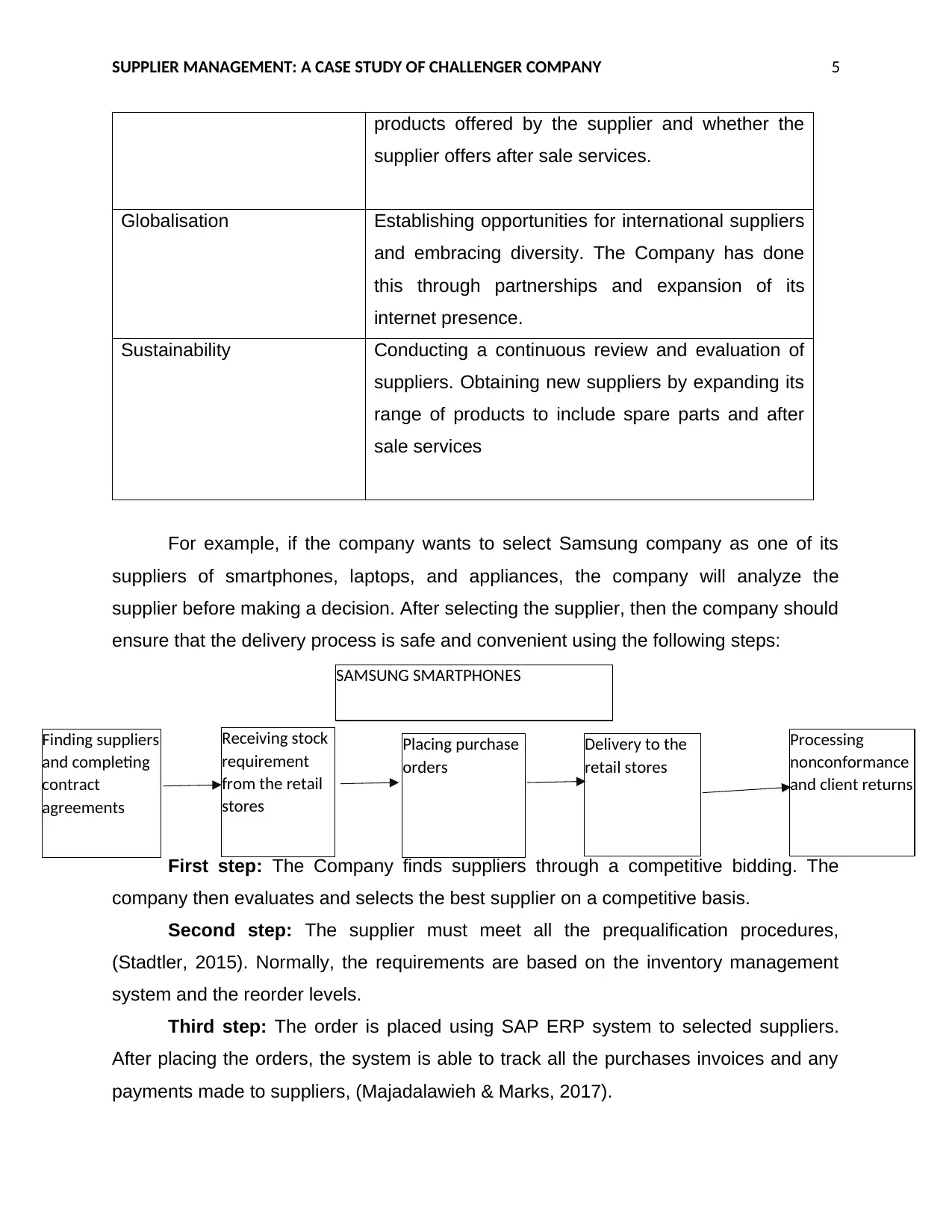
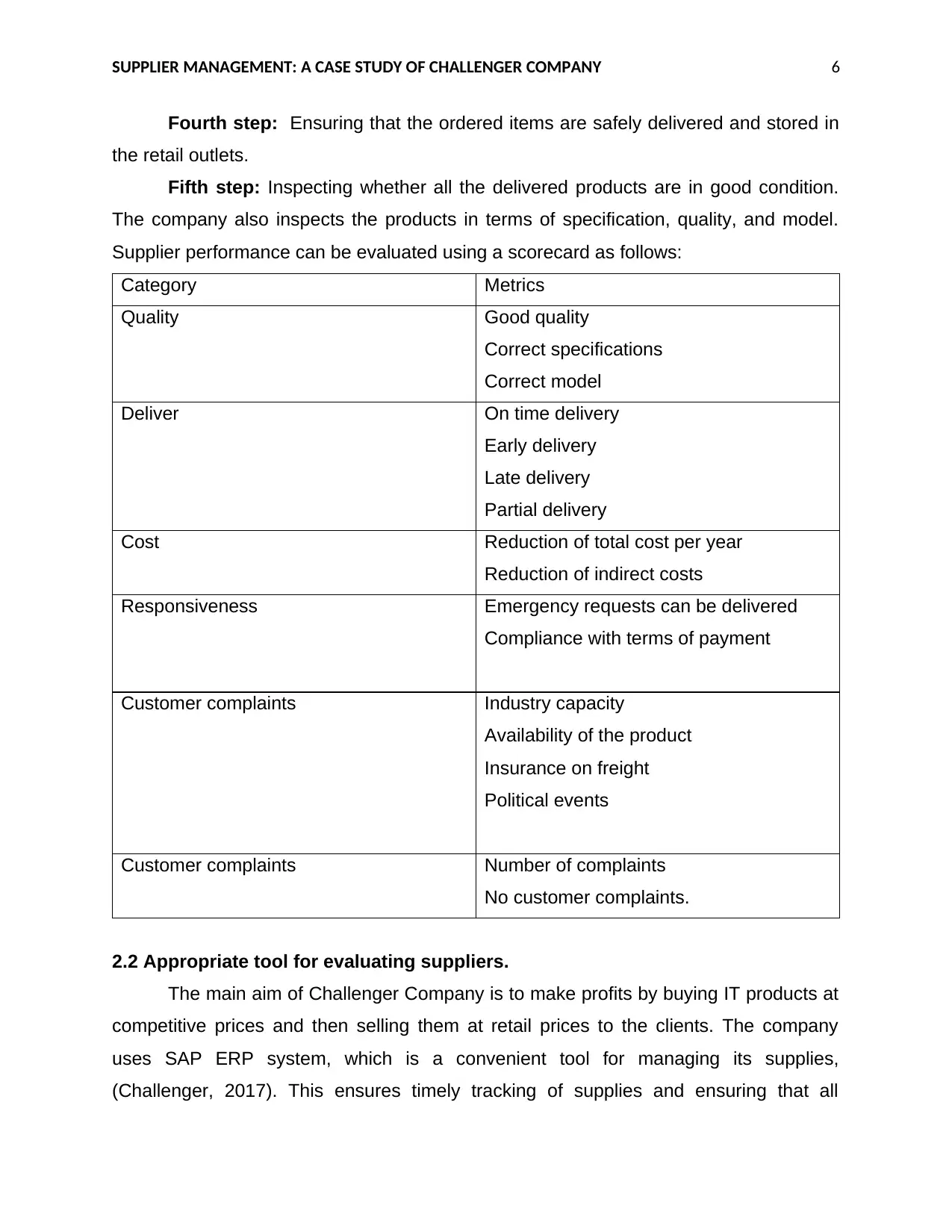
For example, if the company wants to select Samsung company as one of its
suppliers of smartphones, laptops, and appliances, the company will analyze the
supplier before making a decision. After selecting the supplier, then the company should
ensure that the delivery process is safe and convenient using the following steps:
First step: The Company finds suppliers through a competitive bidding. The
company then evaluates and selects the best supplier on a competitive basis.
Second step: The supplier must meet all the prequalification procedures,
(Stadtler, 2015). Normally, the requirements are based on the inventory management
system and the reorder levels.
Third step: The order is placed using SAP ERP system to selected suppliers.
After placing the orders, the system is able to track all the purchases invoices and any
payments made to suppliers, (Majadalawieh & Marks, 2017).
SAMSUNG SMARTPHONES
Processing
nonconformance
and client returns
Delivery to the
retail stores
Placing purchase
orders
Receiving stock
requirement
from the retail
stores
Finding suppliers
and completing
contract
agreements
products offered by the supplier and whether the
supplier offers after sale services.
Globalisation Establishing opportunities for international suppliers
and embracing diversity. The Company has done
this through partnerships and expansion of its
internet presence.
Sustainability Conducting a continuous review and evaluation of
suppliers. Obtaining new suppliers by expanding its
range of products to include spare parts and after
sale services
For example, if the company wants to select Samsung company as one of its
suppliers of smartphones, laptops, and appliances, the company will analyze the
supplier before making a decision. After selecting the supplier, then the company should
ensure that the delivery process is safe and convenient using the following steps:
First step: The Company finds suppliers through a competitive bidding. The
company then evaluates and selects the best supplier on a competitive basis.
Second step: The supplier must meet all the prequalification procedures,
(Stadtler, 2015). Normally, the requirements are based on the inventory management
system and the reorder levels.
Third step: The order is placed using SAP ERP system to selected suppliers.
After placing the orders, the system is able to track all the purchases invoices and any
payments made to suppliers, (Majadalawieh & Marks, 2017).
SAMSUNG SMARTPHONES
Processing
nonconformance
and client returns
Delivery to the
retail stores
Placing purchase
orders
Receiving stock
requirement
from the retail
stores
Finding suppliers
and completing
contract
agreements
SUPPLIER MANAGEMENT: A CASE STUDY OF CHALLENGER COMPANY 6
Fourth step: Ensuring that the ordered items are safely delivered and stored in
the retail outlets.
Fifth step: Inspecting whether all the delivered products are in good condition.
The company also inspects the products in terms of specification, quality, and model.
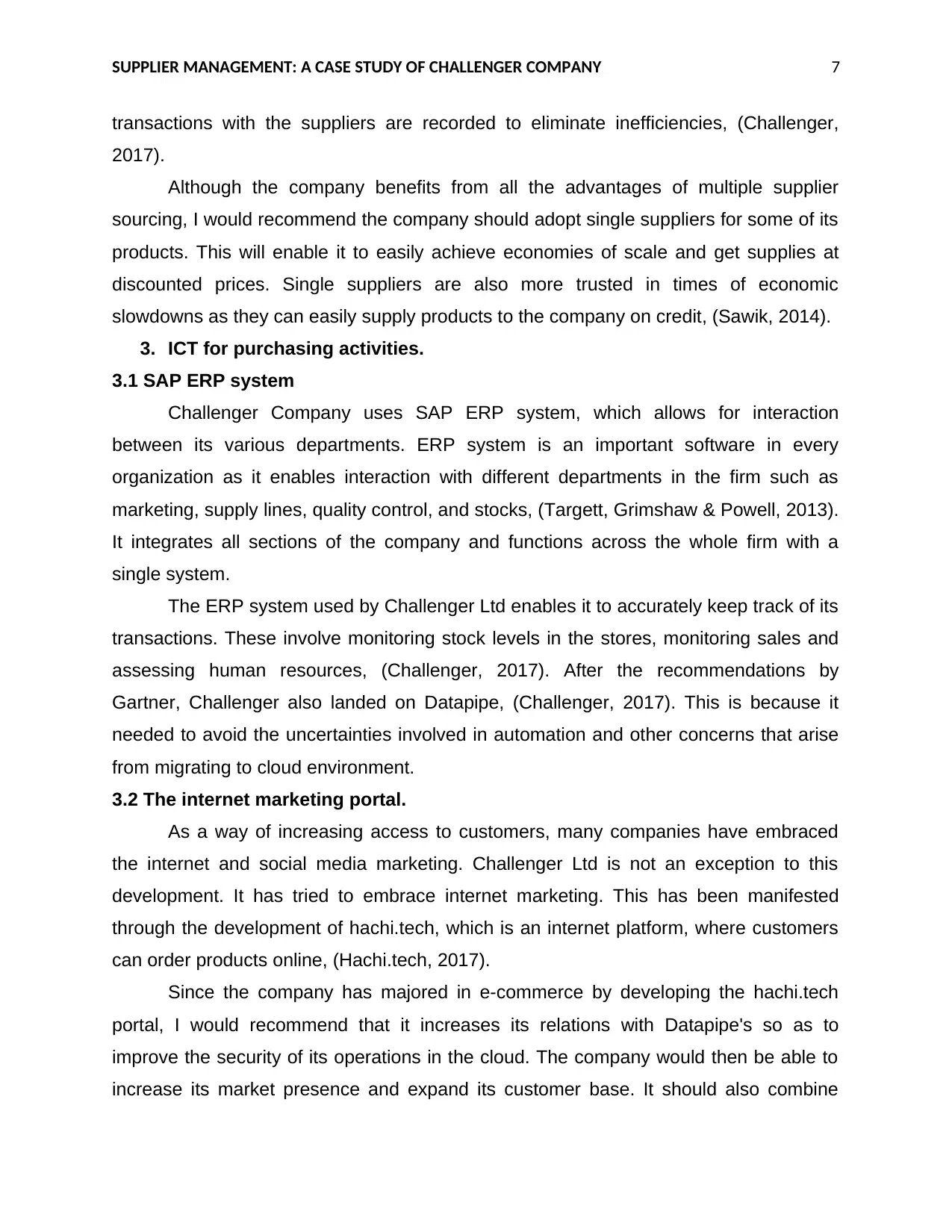
Supplier performance can be evaluated using a scorecard as follows:
Category Metrics
Quality Good quality
Correct specifications
Correct model
Deliver On time delivery
Early delivery
Late delivery
Partial delivery
Cost Reduction of total cost per year
Reduction of indirect costs
Responsiveness Emergency requests can be delivered
Compliance with terms of payment
Customer complaints Industry capacity
Availability of the product
Insurance on freight
Political events
Customer complaints Number of complaints
No customer complaints.
2.2 Appropriate tool for evaluating suppliers.
The main aim of Challenger Company is to make profits by buying IT products at
competitive prices and then selling them at retail prices to the clients. The company
uses SAP ERP system, which is a convenient tool for managing its supplies,
(Challenger, 2017). This ensures timely tracking of supplies and ensuring that all
Fourth step: Ensuring that the ordered items are safely delivered and stored in
the retail outlets.
Fifth step: Inspecting whether all the delivered products are in good condition.
The company also inspects the products in terms of specification, quality, and model.
Supplier performance can be evaluated using a scorecard as follows:
Category Metrics
Quality Good quality
Correct specifications
Correct model
Deliver On time delivery
Early delivery
Late delivery
Partial delivery
Cost Reduction of total cost per year
Reduction of indirect costs
Responsiveness Emergency requests can be delivered
Compliance with terms of payment
Customer complaints Industry capacity
Availability of the product
Insurance on freight
Political events
Customer complaints Number of complaints
No customer complaints.
2.2 Appropriate tool for evaluating suppliers.
The main aim of Challenger Company is to make profits by buying IT products at
competitive prices and then selling them at retail prices to the clients. The company
uses SAP ERP system, which is a convenient tool for managing its supplies,
(Challenger, 2017). This ensures timely tracking of supplies and ensuring that all
⊘ This is a preview!⊘
Do you want full access?
Subscribe today to unlock all pages.
Trusted by 1+ million students worldwide
SUPPLIER MANAGEMENT: A CASE STUDY OF CHALLENGER COMPANY 7
transactions with the suppliers are recorded to eliminate inefficiencies, (Challenger,
2017).
Although the company benefits from all the advantages of multiple supplier
sourcing, I would recommend the company should adopt single suppliers for some of its
products. This will enable it to easily achieve economies of scale and get supplies at
discounted prices. Single suppliers are also more trusted in times of economic
slowdowns as they can easily supply products to the company on credit, (Sawik, 2014).
3. ICT for purchasing activities.
3.1 SAP ERP system
Challenger Company uses SAP ERP system, which allows for interaction
between its various departments. ERP system is an important software in every
organization as it enables interaction with different departments in the firm such as
marketing, supply lines, quality control, and stocks, (Targett, Grimshaw & Powell, 2013).
It integrates all sections of the company and functions across the whole firm with a
single system.
The ERP system used by Challenger Ltd enables it to accurately keep track of its
transactions. These involve monitoring stock levels in the stores, monitoring sales and
assessing human resources, (Challenger, 2017). After the recommendations by
Gartner, Challenger also landed on Datapipe, (Challenger, 2017). This is because it
needed to avoid the uncertainties involved in automation and other concerns that arise
from migrating to cloud environment.
3.2 The internet marketing portal.
As a way of increasing access to customers, many companies have embraced
the internet and social media marketing. Challenger Ltd is not an exception to this
development. It has tried to embrace internet marketing. This has been manifested
through the development of hachi.tech, which is an internet platform, where customers
can order products online, (Hachi.tech, 2017).
Since the company has majored in e-commerce by developing the hachi.tech
portal, I would recommend that it increases its relations with Datapipe's so as to
improve the security of its operations in the cloud. The company would then be able to
increase its market presence and expand its customer base. It should also combine
transactions with the suppliers are recorded to eliminate inefficiencies, (Challenger,
2017).
Although the company benefits from all the advantages of multiple supplier
sourcing, I would recommend the company should adopt single suppliers for some of its
products. This will enable it to easily achieve economies of scale and get supplies at
discounted prices. Single suppliers are also more trusted in times of economic
slowdowns as they can easily supply products to the company on credit, (Sawik, 2014).
3. ICT for purchasing activities.
3.1 SAP ERP system
Challenger Company uses SAP ERP system, which allows for interaction
between its various departments. ERP system is an important software in every
organization as it enables interaction with different departments in the firm such as
marketing, supply lines, quality control, and stocks, (Targett, Grimshaw & Powell, 2013).
It integrates all sections of the company and functions across the whole firm with a
single system.
The ERP system used by Challenger Ltd enables it to accurately keep track of its
transactions. These involve monitoring stock levels in the stores, monitoring sales and
assessing human resources, (Challenger, 2017). After the recommendations by
Gartner, Challenger also landed on Datapipe, (Challenger, 2017). This is because it
needed to avoid the uncertainties involved in automation and other concerns that arise
from migrating to cloud environment.
3.2 The internet marketing portal.
As a way of increasing access to customers, many companies have embraced
the internet and social media marketing. Challenger Ltd is not an exception to this
development. It has tried to embrace internet marketing. This has been manifested
through the development of hachi.tech, which is an internet platform, where customers
can order products online, (Hachi.tech, 2017).
Since the company has majored in e-commerce by developing the hachi.tech
portal, I would recommend that it increases its relations with Datapipe's so as to
improve the security of its operations in the cloud. The company would then be able to
increase its market presence and expand its customer base. It should also combine
Paraphrase This Document
Need a fresh take? Get an instant paraphrase of this document with our AI Paraphraser
SUPPLIER MANAGEMENT: A CASE STUDY OF CHALLENGER COMPANY 8
SAP with Ariba network. This would enable it to strengthen its transactions with its
suppliers and discover new business opportunities. SAP combined with Ariba network is
a business software which enables adequate purchase management and direction of
the entire operations of the workforce system, (Majdalawieh & Marks, 2017). It will also
be able to manage the entire procurement process and build an ethical supply chain,
(Chang, Huang, Chen & Hung 2013).
4. Purchasing Cost Analysis.
The main reason for conducting a purchasing cost analysis is to test whether the
cost of purchasing items is reasonable, (Stadtler, 2015). Prices of commodities charged
by the suppliers may fall into three categories- market prices, previous prices, and
published prices, (Stadtler, 2015). Challenger as a company acts as a retailer, by
purchasing products at wholesale prices and then selling them at a profit, (Challenger,
2017). Therefore it must clearly evaluate the supplier process to determine the cost at
which it is able to purchase the products from the suppliers, without making losses.
The cost of obtaining products largely dictates the prices at which they are sold.
If a company spends less on purchasing its supplies, then it may be able to avail the
same goods at lower prices to the consumers, (Bokor & Markovits-Somogyi, 2015).
Challenger Company uses total cost of ownership (TCO) model to determine the
prices of its products, (Challenger, 2017). In this model, cost of products is done with
regards to other costs associated with maintenance and ensuring that the products are
in good condition, (Mahal & Hussain, 2015). These may include service, maintenance,
and administration.
The benefits enjoyed by Challenger from adopting TCO include ensuring that all
the costs associated with the business are identified and incorporated when attaching
prices to the products, enhancing overall cost management, through proper cost
planning and ensuring that prices of products are achievable by the customers,
(Challenger, 2017).
Although the company has adopted a TCO approach which is a good cost
management tool, it has continued to suffer the disadvantages associated with this tool.
These include lack of a uniform method of cost analysis and time wastage in trying to
identify all the costs associated with all the cost centers, (Mahal & Hussain, 2015). I
SAP with Ariba network. This would enable it to strengthen its transactions with its
suppliers and discover new business opportunities. SAP combined with Ariba network is
a business software which enables adequate purchase management and direction of
the entire operations of the workforce system, (Majdalawieh & Marks, 2017). It will also
be able to manage the entire procurement process and build an ethical supply chain,
(Chang, Huang, Chen & Hung 2013).
4. Purchasing Cost Analysis.
The main reason for conducting a purchasing cost analysis is to test whether the
cost of purchasing items is reasonable, (Stadtler, 2015). Prices of commodities charged
by the suppliers may fall into three categories- market prices, previous prices, and
published prices, (Stadtler, 2015). Challenger as a company acts as a retailer, by
purchasing products at wholesale prices and then selling them at a profit, (Challenger,
2017). Therefore it must clearly evaluate the supplier process to determine the cost at
which it is able to purchase the products from the suppliers, without making losses.
The cost of obtaining products largely dictates the prices at which they are sold.
If a company spends less on purchasing its supplies, then it may be able to avail the
same goods at lower prices to the consumers, (Bokor & Markovits-Somogyi, 2015).
Challenger Company uses total cost of ownership (TCO) model to determine the
prices of its products, (Challenger, 2017). In this model, cost of products is done with
regards to other costs associated with maintenance and ensuring that the products are
in good condition, (Mahal & Hussain, 2015). These may include service, maintenance,
and administration.
The benefits enjoyed by Challenger from adopting TCO include ensuring that all
the costs associated with the business are identified and incorporated when attaching
prices to the products, enhancing overall cost management, through proper cost
planning and ensuring that prices of products are achievable by the customers,
(Challenger, 2017).
Although the company has adopted a TCO approach which is a good cost
management tool, it has continued to suffer the disadvantages associated with this tool.
These include lack of a uniform method of cost analysis and time wastage in trying to
identify all the costs associated with all the cost centers, (Mahal & Hussain, 2015). I
SUPPLIER MANAGEMENT: A CASE STUDY OF CHALLENGER COMPANY 9
would, therefore, recommend the company to adopt Activity-based costing approach to
assign costs of its supplies.
ABC model would enable the company to classify all the costs in their cost
centers. In this approach, the managers of the company would be able to identify the
specific cost centers so as to classify every cost adequately to avoid confusion and time
wastage in conducting a cost analysis, (Bokor & Markovits-Somogyi, 2015).
5. Conclusion.
In conclusion, Challenger Company is a leading retailer, dealing with IT products.
Its competitive strategies which include the provision of high-quality products and use of
trusted suppliers have enabled it to maintain high profits. The company also embraces
IT in its supply chain management, through use of SAP ERP software. The company
also uses proper cost management strategies, through use of total cost of ownership
approach to attach prices of its products and select reliable suppliers. However, the
company should also select single suppliers for some of the product brands so as to
easily enjoy the benefits of receiving goods in bulk such as discounts.
The company should also combine its SAP system on Ariba network and
increase its relations with Datapipe to alleviate risks associated with automation.
Although the company has adopted the total cost of ownership approach in costing its
supplies, it should change to ABC approach so as to be more organized and be able to
assign every cost to its cost center and avoid the confusion and time wastages
associated with TCO.
would, therefore, recommend the company to adopt Activity-based costing approach to
assign costs of its supplies.
ABC model would enable the company to classify all the costs in their cost
centers. In this approach, the managers of the company would be able to identify the
specific cost centers so as to classify every cost adequately to avoid confusion and time
wastage in conducting a cost analysis, (Bokor & Markovits-Somogyi, 2015).
5. Conclusion.
In conclusion, Challenger Company is a leading retailer, dealing with IT products.
Its competitive strategies which include the provision of high-quality products and use of
trusted suppliers have enabled it to maintain high profits. The company also embraces
IT in its supply chain management, through use of SAP ERP software. The company
also uses proper cost management strategies, through use of total cost of ownership
approach to attach prices of its products and select reliable suppliers. However, the
company should also select single suppliers for some of the product brands so as to
easily enjoy the benefits of receiving goods in bulk such as discounts.
The company should also combine its SAP system on Ariba network and
increase its relations with Datapipe to alleviate risks associated with automation.
Although the company has adopted the total cost of ownership approach in costing its
supplies, it should change to ABC approach so as to be more organized and be able to
assign every cost to its cost center and avoid the confusion and time wastages
associated with TCO.
⊘ This is a preview!⊘
Do you want full access?
Subscribe today to unlock all pages.
Trusted by 1+ million students worldwide
SUPPLIER MANAGEMENT: A CASE STUDY OF CHALLENGER COMPANY 10
References
Amindoust, A., Ahmed, S., Saghafinia, A., & Bahreininejad, A. (2012). Sustainable Supplier
Selection: A Ranking Model Based on Fuzzy Inference System. Applied Soft Computing,
12(6), 1668-1677.
Barney, J. B. (2012). Purchasing, Supply Chain Management and Sustained Competitive
Advantage: The Relevance of Resource‐based Theory. Journal of Supply Chain
Management, 48(2), 3-6.
Bokor, Z., & Markovits-Somogyi, R. (2015). Applying Activity-based Costing to Logistics
Service Providers. Periodica Polytechnica. Transportation Engineering, 43(2), 98.
Challenger. (2017, September 20). Challenger Help Center. Retrieved from Do You Have an
Online Store?: https://support.challenger.sg/hc/en-us/articles/227036668-Do-you-have-
an-Online-store-
Challenger. (2017, September 20). Challenger Technologies Ltd. Retrieved from About
Challenger: https://www.challenger.com.sg/store_locator?storeType=Challenger
Chang, Y. K., Huang, C. J., Chen, K. F., & Hung, T. M. (2013). Physical Activity and Working
Memory in Healthy Older Adults: an ERP Study. Psychophysiology, 50(11), 1174-1182.
Chen, Y. H., & Chao, R. J. (2012). Supplier Selection Using Consistent Fuzzy Preference
Relations. Expert Systems with Applications, 39(3), 3233-3240.
Hachi.tech. (2017, September 20). Hachi.Tech Corporation. Retrieved from Shop full Range of
Apple Products: https://www.hachi.tech/
Lin, R. H. (2012). An Integrated Model for Supplier Selection under a Fuzzy Situation.
International Journal of Production Economics, 138(1), 55-61.
Mahal, I., & Hossain, M. A. (2015). Activity-Based Costing (ABC)–An Effective Tool for Better
Management. Research Journal of Finance and Accounting, 6(4), 66-74.
Majdalawieh, M., & Marks, A. (2017, April). A Reference Framework for Enterprise Computing
Curriculum. In World Conference on Information Systems and Technologies (pp. 872-
886).
Springer, Cham.
Meena, P. L., & Sarmah, S. P. (2013). Multiple Sourcing of Supplier Failure Risk and Quantity
Discount: A Genetic Algorithm Approach. Transportation Research Part E: Logistics and
Transportation Review, 50, 84-97.
References
Amindoust, A., Ahmed, S., Saghafinia, A., & Bahreininejad, A. (2012). Sustainable Supplier
Selection: A Ranking Model Based on Fuzzy Inference System. Applied Soft Computing,
12(6), 1668-1677.
Barney, J. B. (2012). Purchasing, Supply Chain Management and Sustained Competitive
Advantage: The Relevance of Resource‐based Theory. Journal of Supply Chain
Management, 48(2), 3-6.
Bokor, Z., & Markovits-Somogyi, R. (2015). Applying Activity-based Costing to Logistics
Service Providers. Periodica Polytechnica. Transportation Engineering, 43(2), 98.
Challenger. (2017, September 20). Challenger Help Center. Retrieved from Do You Have an
Online Store?: https://support.challenger.sg/hc/en-us/articles/227036668-Do-you-have-
an-Online-store-
Challenger. (2017, September 20). Challenger Technologies Ltd. Retrieved from About
Challenger: https://www.challenger.com.sg/store_locator?storeType=Challenger
Chang, Y. K., Huang, C. J., Chen, K. F., & Hung, T. M. (2013). Physical Activity and Working
Memory in Healthy Older Adults: an ERP Study. Psychophysiology, 50(11), 1174-1182.
Chen, Y. H., & Chao, R. J. (2012). Supplier Selection Using Consistent Fuzzy Preference
Relations. Expert Systems with Applications, 39(3), 3233-3240.
Hachi.tech. (2017, September 20). Hachi.Tech Corporation. Retrieved from Shop full Range of
Apple Products: https://www.hachi.tech/
Lin, R. H. (2012). An Integrated Model for Supplier Selection under a Fuzzy Situation.
International Journal of Production Economics, 138(1), 55-61.
Mahal, I., & Hossain, M. A. (2015). Activity-Based Costing (ABC)–An Effective Tool for Better
Management. Research Journal of Finance and Accounting, 6(4), 66-74.
Majdalawieh, M., & Marks, A. (2017, April). A Reference Framework for Enterprise Computing
Curriculum. In World Conference on Information Systems and Technologies (pp. 872-
886).
Springer, Cham.
Meena, P. L., & Sarmah, S. P. (2013). Multiple Sourcing of Supplier Failure Risk and Quantity
Discount: A Genetic Algorithm Approach. Transportation Research Part E: Logistics and
Transportation Review, 50, 84-97.
Paraphrase This Document
Need a fresh take? Get an instant paraphrase of this document with our AI Paraphraser
SUPPLIER MANAGEMENT: A CASE STUDY OF CHALLENGER COMPANY 11
Rogers, A. D. (2016). Examining Small Business Adoption of Computerized Accounting
Systems
Using the Technology Acceptance Model (Doctoral Dissertation, Walden University).
Sawik, T. (2014). Joint Supplier Selection and Scheduling of Customer Orders under Disruption
Risks: Single vs. Dual Sourcing. Omega, 43, 83-95.
Schulze, M., Seuring, S., & Ewering, C. (2012). Applying Activity-based Costing in a Supply
Chain Environment. International Journal of Production Economics, 135(2), 716-725.
Stadtler, H. (2015). Supply Chain Management: An Overview. In Supply Chain Management
and
Advanced Planning (pp. 3-28). Springer Berlin Heidelberg.
Targett, D., Grimshaw, D., & Powell, P. (2013). IT in Business: A Business Manager's
Casebook.
Routledge.
Rogers, A. D. (2016). Examining Small Business Adoption of Computerized Accounting
Systems
Using the Technology Acceptance Model (Doctoral Dissertation, Walden University).
Sawik, T. (2014). Joint Supplier Selection and Scheduling of Customer Orders under Disruption
Risks: Single vs. Dual Sourcing. Omega, 43, 83-95.
Schulze, M., Seuring, S., & Ewering, C. (2012). Applying Activity-based Costing in a Supply
Chain Environment. International Journal of Production Economics, 135(2), 716-725.
Stadtler, H. (2015). Supply Chain Management: An Overview. In Supply Chain Management
and
Advanced Planning (pp. 3-28). Springer Berlin Heidelberg.
Targett, D., Grimshaw, D., & Powell, P. (2013). IT in Business: A Business Manager's
Casebook.
Routledge.

1 out of 11


Related Documents


Your All-in-One AI-Powered Toolkit for Academic Success.
+13062052269
info@desklib.com
Available 24*7 on WhatsApp / Email
![[object Object]](/_next/static/media/star-bottom.7253800d.svg)
Unlock your academic potential
Copyright © 2020–2026 A2Z Services. All Rights Reserved. Developed and managed by ZUCOL.