Investment Decision Making Challenges Facing Savvy Project Managers

Verified

Added on  2023/06/04

|7
|2086
|112
Essay
AI Summary
This essay explores the challenges savvy project managers face in investment decision-making, focusing on situations where projects with negative Net Present Value (NPV) are undertaken. It examines factors such as a company's strategic framework, external stakeholder engagement, internal liaison with senior management, and economic analysis. The essay argues that while a positive NPV is generally favored, projects with a negative NPV may be necessary for strategic reasons, such as maintaining customer base, meeting legal obligations, ensuring employee safety, or aligning with the company's mission and vision. The importance of considering both financial and non-financial aspects, conducting thorough evaluations, and ensuring that projects address customer needs and expectations are emphasized. Ultimately, the essay suggests that the decision to proceed with a project, even with a negative NPV, should be based on a comprehensive analysis of its strategic value and potential long-term benefits.

Document Page
Running Head: Investment Decision Making
Challenges Facing Savvy Project Managers in Making Investment Decisions
By (Name)
(Tutor)
(University)
(Date)
tabler-icon-diamond-filled.svg

Paraphrase This Document

Need a fresh take? Get an instant paraphrase of this document with our AI Paraphraser
Document Page
Investment Decision Making 2
Challenges Facing Savvy Project Managers in Making Investment Decisions
Introduction
The net present value (NPV) refers to the difference between the present value of all
projected cash inflows of a project and the present value of cash outflows (usually the initial
amount of investment) of that particular project over a given period of time. NPV is the most
commonly accepted measure of a project’s viability and is the most commonly used in capital
budgeting. For most profit seeking institutions, a positive NPV gives a go ahead to the
implementation of a project, (Kurt, 2018). NPV is also used to choose between projects in case
of multiple options, in which case the project with the highest NPV is favored over the others.
However, situations do arise where firms undertake projects with a negative NPV. This
can arise from considerations such as consumer expectations and a company’s legal
environment. More often than not the negative NPV is as a result of businesses not being able to
quantify the benefits of a project leading to the classification of such as non-financial factors of
project valuation. Other times it is because rather than the project being undertaken to make
things better it is adopted as a necessity to prevent things from getting worse. It thus features as
an expense in valuation without a quantifiable benefit that can be included in analysis, (Milano,
2017). Some of the factors that could lead to this are briefly outlined below as well as the role
they play in project selection.
Corporate’s Strategic Framework
Every company has a vision, that is where it wants to be and a mission, what it needs to
do in order to achieve its objectives. The first step in investing is the identification of a need
based on the objectives of a company. The other consideration in need identification is the
consideration of where a gap exists in customers’ needs and preferences, (Wilkinson, 2013). For
any given project a company wishes to undertake, a strength weakness opportunities and
threats(SWOT) analysis must be conducted to ensure that despite the NPV analysis conclusion
arrived at, whatever project is picked it’s in line with the company’s objectives, mission and
vision. This tool is a key factor in the final consideration of a project as it reconciles both the
financial and the non-financial aspects of project selection. Therefore, despite a project having a
Document Page
Investment Decision Making 3
very promising prospect the less favored, in this case say one with a negative NPV can be picked
if it is best in line of corporate strategy, (The WritePass Journal, 2012).
External Stakeholder Engagement.
The external stakeholders include its customers, government and the community at large.
Whatever action a company takes it affects the community one way or the other. Its good efforts
endear the society to the company increasing its customer base in the long run as compared to
say if the company happens to be a great environmental pollutant endangering the lives of the
community. Therefore, a company may choose to implement a project with low or even negative
NPV in a bid to secure community support thus maintaining their customer base especially in a
competitive market environment, (Ramahi, 2011). A project that compromises societal values of
the community in which it operates should be avoided despite the accompanying financial lure it
might hold, (Roy, 2018).
The government affects business operations through the enactment of legislatures that
regulate the environment in which they operate as well as the way in which they operate. Each
country has set laws and regulations that businesses and companies are required to abide by. A
project could upon evaluation be very promising but if the government outlaws such an
undertaking it then can’t be actualized, (Shapiro, 1978). Many countries for instance have laws
regarding employees’ compensation and pension schemes. In the case of pension, a company has
to contribute a given amount on a monthly basis towards the retirement scheme of the employees
regardless of their productivity and which has no direct benefits to the corporation. Every
country has a governing body that is charged with regulating the quality of goods and services
that are consumed and produced in that country as well as regulating the prices to ensure
consumer protection. This may not always go well with the financial objectives of a company but
it then has to adhere to the stipulations for it to be sustainable. (Nodson, 2017).
Internal Liaison with Senior Management
Senior management may decide to implement some projects with regards for their
employees, product lines and competition. Employees play a very important role in any
organization as they are the ones responsible in actually implementing the companies stipulated
Document Page
Investment Decision Making 4
activities as outlined by the management towards the achievement of its objectives. Therefore,
their safety and morale is a critical matter for each organization. A company may thus undertake
projects to safeguard the safety of its employees for instance through training or purchase of
safety gear. This dips into their pockets without a necessarily positive reflection in their NPV
other than the smooth functioning of the company, (The WritePass Journal, 2012).
Competition is another arena which could lead to a negative NPV but which many firms
must undertake. One way not to be outsmarted by company rivals is through advertising in the
mass media. This must not necessarily translate to greater sale volume or revenue especially if
the competitors are also heavily into advertising. It merely acts as a tool of maintaining customer
base and relevancy. Competition can also be achieved through introduction of new product lines.
Shoppers for instance prefer to shop where they can get everything under the same roof rather
than move from one place to another. In this case it makes perfect sense for a corporation to
introduce whatever product it is that could make their customers seek out their competitors or
risk a shrink of their customer base. Despite of the poor feasibility of the new product the good
business will write it off in the long run, (Batra and Verma, 2018).
At the end of the day the senior management has the final say concerning what project to
undertake especially where there exists a disparity in the financial and nonfinancial aspects of
projects. After all analysis and considerations together with recommendations have been tabled
the management conducts a thorough analysis of all facts and decides on the best project to
undertake, (Wilkinson, 2013).
Economics Analysis
Whenever a project is picked a company most often has a timeline for instance of when
they expect the project to pay off the invested amount, that is the payback period,(Lan and Viet,
2018).Also when calculating the NPV a given number of years is picked say 10 years in
discounting expected cash flows. However, this does not mean that beyond that period of 10
years the project will not be generating income. As a result, in the computation of the NPV in
that period it is entirely possible to get a negative one which ultimately in the long run will
translate to a positive NPV, (Kester, 2018).
tabler-icon-diamond-filled.svg

Paraphrase This Document

Need a fresh take? Get an instant paraphrase of this document with our AI Paraphraser
Document Page
Investment Decision Making 5
Another important economic factor to consider is customers demand. Whatever project
undertaken should want to fill a niche in the customers’ needs and services. What will the quality
of product or services, how will they be priced? are some of the things that should be considered
in choosing a project to ensure that it is just not viable on paper. This is because the above
factors are a determinant of demand and as such will determinant the success of a project once it
is launched, (Wetzstein, 2013).
Despite the attractiveness of a positive NPV as a basis of project selection, a negative
NPV should not be disregarded without a thorough evaluation of the necessity of the project for
the sake of the business going concern even beyond the valuation period as it could provide the
means to maintain and even expand the company’s market base in later years. The most
important factor in evaluating projects with a negative NPV is to ensure that it is strategic, that
is, despite the benefits being difficult to quantify or even taking a super long time to materialize
there are still justifiable benefits. In addition to the project being strategic, one with the least
negative NPV is desirable, (Milano, 2017).
Before a project is selected a number of considerations must be made even after financial
evaluation is conducted. This is to ensure that despite the NPV outcome the project addresses
customers’ needs and expectations, meets its legal obligations and is in line with the company’s
mission and vision.
Document Page
Investment Decision Making 6
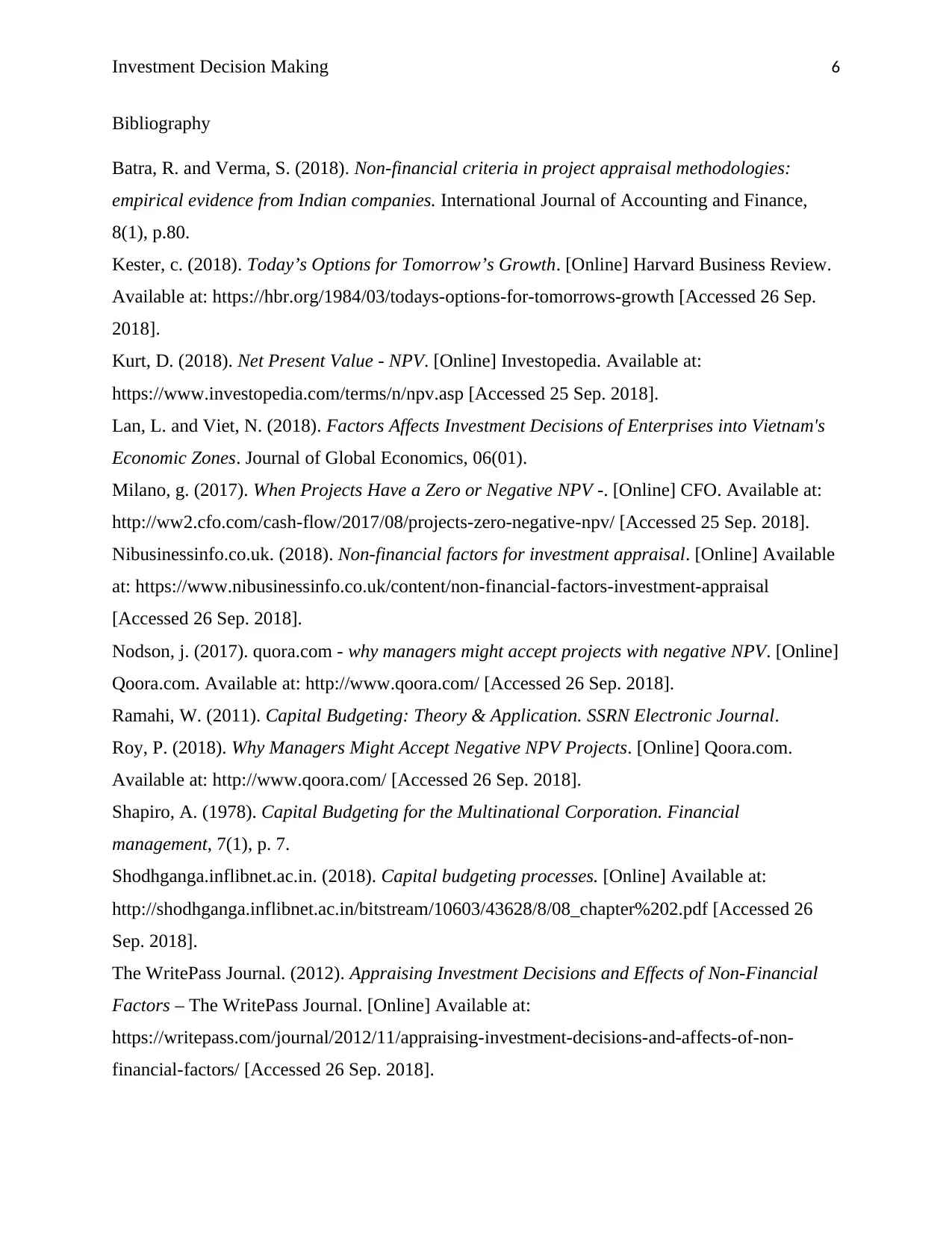
Bibliography
Batra, R. and Verma, S. (2018). Non-financial criteria in project appraisal methodologies:
empirical evidence from Indian companies. International Journal of Accounting and Finance,
8(1), p.80.
Kester, c. (2018). Today’s Options for Tomorrow’s Growth. [Online] Harvard Business Review.
Available at: https://hbr.org/1984/03/todays-options-for-tomorrows-growth [Accessed 26 Sep.
2018].
Kurt, D. (2018). Net Present Value - NPV. [Online] Investopedia. Available at:
https://www.investopedia.com/terms/n/npv.asp [Accessed 25 Sep. 2018].
Lan, L. and Viet, N. (2018). Factors Affects Investment Decisions of Enterprises into Vietnam's
Economic Zones. Journal of Global Economics, 06(01).
Milano, g. (2017). When Projects Have a Zero or Negative NPV -. [Online] CFO. Available at:
http://ww2.cfo.com/cash-flow/2017/08/projects-zero-negative-npv/ [Accessed 25 Sep. 2018].
Nibusinessinfo.co.uk. (2018). Non-financial factors for investment appraisal. [Online] Available
at: https://www.nibusinessinfo.co.uk/content/non-financial-factors-investment-appraisal
[Accessed 26 Sep. 2018].
Nodson, j. (2017). quora.com - why managers might accept projects with negative NPV. [Online]
Qoora.com. Available at: http://www.qoora.com/ [Accessed 26 Sep. 2018].
Ramahi, W. (2011). Capital Budgeting: Theory & Application. SSRN Electronic Journal.
Roy, P. (2018). Why Managers Might Accept Negative NPV Projects. [Online] Qoora.com.
Available at: http://www.qoora.com/ [Accessed 26 Sep. 2018].
Shapiro, A. (1978). Capital Budgeting for the Multinational Corporation. Financial
management, 7(1), p. 7.
Shodhganga.inflibnet.ac.in. (2018). Capital budgeting processes. [Online] Available at:
http://shodhganga.inflibnet.ac.in/bitstream/10603/43628/8/08_chapter%202.pdf [Accessed 26
Sep. 2018].
The WritePass Journal. (2012). Appraising Investment Decisions and Effects of Non-Financial
Factors – The WritePass Journal. [Online] Available at:
https://writepass.com/journal/2012/11/appraising-investment-decisions-and-affects-of-non-
financial-factors/ [Accessed 26 Sep. 2018].
Document Page
Investment Decision Making 7
Wetzstein, M. (2013). Microeconomic Theory: Concepts and Connections. Routledge, 2013,
p.165...
Wilkinson, J. (2013). Capital Budgeting Methods • The Strategic CFO. [Online] The Strategic
CFO. Available at: https://strategiccfo.com/capital-budgeting-methods-2/ [Accessed 28 Sep.
2018].
chevron_up_icon
1 out of 7
circle_padding
hide_on_mobile
zoom_out_icon
[object Object]