Overcoming Marketing Research Challenges: A Focus on Indonesia
VerifiedAdded on 2020/03/01
|10
|2732
|61
Report
AI Summary
This report provides a comprehensive overview of the marketing research challenges encountered in Indonesia, a rapidly developing Asian country. It delves into the difficulties associated with primary and secondary data collection, emphasizing the impact of cultural differences, political and legal environments, and infrastructural limitations. The report highlights the complexities of obtaining reliable information, including issues of corruption and ethical considerations. It also discusses the financial implications of conducting research in Indonesia, such as high costs and currency fluctuations. The analysis further explores the importance of understanding the local culture and the influence of diverse ethnic groups. Recommendations are provided for international businesses to navigate these challenges, including proactive approaches to risk management and the utilization of local expertise. Ultimately, the report underscores the importance of thorough research, cultural sensitivity, and strategic planning for successful marketing ventures in the Indonesian market.
Marketing research challenges in Indonesia1
MARKETING RESEARCH CHALLENGES IN INDONESIA
Name
Department:
School:
Course:
Date:
MARKETING RESEARCH CHALLENGES IN INDONESIA
Name
Department:
School:
Course:
Date:

Paraphrase This Document
Need a fresh take? Get an instant paraphrase of this document with our AI Paraphraser
Marketing research challenges in Indonesia 2
Marketing research challenges in Indonesia
Introduction
Indonesia is one of the fast and promising developing countries in Asia. After the country
experiencing the financial crisis in 1997, it has demonstrated a significant pace of the economic
development; to become one of the world best leading countries (Rosser 2013). The growth of
the economy is due to the realistic macro-economic and internal, and external factors. The
country has 240 million citizens with an economy of $514 billion, which is one of the biggest in
the south Asia (Rosser 2013). Both geopolitical and economic of the Indonesia is incredible.
There was less exposing of the country to the sudden destocking that caused collapsing of the
business back in 2008 (Chinn and Fairlie 2010). The primary export of the Indonesia is coals, gas
and oil. The country has an exceptional organization and corporate level of operating business
activities.
The large population of Indonesia makes the domestic consumption to be high, which
contributes to high market potential in local and international business. According to the
research, the Indonesia economy is growing at 6% annually. The Indonesia GDP was $960 back
in 2009 and $4000 billion currently (Rosser 2013). This papers will seeks to investigate
marketing research challenges concerning the Indonesia market and come up with how to
overcome the risk associated with problems.
Marketing research challenges in Indonesia
Introduction
Indonesia is one of the fast and promising developing countries in Asia. After the country
experiencing the financial crisis in 1997, it has demonstrated a significant pace of the economic
development; to become one of the world best leading countries (Rosser 2013). The growth of
the economy is due to the realistic macro-economic and internal, and external factors. The
country has 240 million citizens with an economy of $514 billion, which is one of the biggest in
the south Asia (Rosser 2013). Both geopolitical and economic of the Indonesia is incredible.
There was less exposing of the country to the sudden destocking that caused collapsing of the
business back in 2008 (Chinn and Fairlie 2010). The primary export of the Indonesia is coals, gas
and oil. The country has an exceptional organization and corporate level of operating business
activities.
The large population of Indonesia makes the domestic consumption to be high, which
contributes to high market potential in local and international business. According to the
research, the Indonesia economy is growing at 6% annually. The Indonesia GDP was $960 back
in 2009 and $4000 billion currently (Rosser 2013). This papers will seeks to investigate
marketing research challenges concerning the Indonesia market and come up with how to
overcome the risk associated with problems.
Marketing research challenges in Indonesia 3
Marketing research challenges
Primary data sources
Primary data requires observations and recording directly from the respondents by
observing them directly. The main data collections are very complicated and lengthy, and costly.
Also, it comprises the constructions of the experiment, sampling process, survey techniques and
questionnaire development (Sekaran and Bougie 2016). Primary research entails collecting and
analyzing the new information by conducting a focus group and telephone interviews, and
market study. Characterization of the primary data includes the high level of use because it
solves the exact problems. One of the disadvantages of the primary is data is that; its cost of
collecting in the foreign developing countries is high because of the inadequate marketing
research infrastructure. Qualitative are structures such as survey and experiments (Bryman and
Bell 2015). The qualitative study takes a form of observation or the focus groups. In contrast is
that the responses are interfered by the culture of the country. The cross-cultural in the
international marketing research needs proper examination of the attitudes and behaviors
There is a significant difference between the national and international marketing
research because of the big difference in the country’s economics, law, politics and culture
(Papadopoulos and Martín Martín 2011). The accessibility and accuracy of the information will
depend if the marketing research was successful or not. One of the biggest problems in collecting
the data from Indonesia is that companies and persons will refuse to give feedback to the
questions the research does ask. The Indonesia businesses are conservative in giving the
information about the information relating to their companies (Papadopoulos and Martín Martín
2011). Additionally, it becomes tough to reach to other firms either directly for the market
Marketing research challenges
Primary data sources
Primary data requires observations and recording directly from the respondents by
observing them directly. The main data collections are very complicated and lengthy, and costly.
Also, it comprises the constructions of the experiment, sampling process, survey techniques and
questionnaire development (Sekaran and Bougie 2016). Primary research entails collecting and
analyzing the new information by conducting a focus group and telephone interviews, and
market study. Characterization of the primary data includes the high level of use because it
solves the exact problems. One of the disadvantages of the primary is data is that; its cost of
collecting in the foreign developing countries is high because of the inadequate marketing
research infrastructure. Qualitative are structures such as survey and experiments (Bryman and
Bell 2015). The qualitative study takes a form of observation or the focus groups. In contrast is
that the responses are interfered by the culture of the country. The cross-cultural in the
international marketing research needs proper examination of the attitudes and behaviors
There is a significant difference between the national and international marketing
research because of the big difference in the country’s economics, law, politics and culture
(Papadopoulos and Martín Martín 2011). The accessibility and accuracy of the information will
depend if the marketing research was successful or not. One of the biggest problems in collecting
the data from Indonesia is that companies and persons will refuse to give feedback to the
questions the research does ask. The Indonesia businesses are conservative in giving the
information about the information relating to their companies (Papadopoulos and Martín Martín
2011). Additionally, it becomes tough to reach to other firms either directly for the market
⊘ This is a preview!⊘
Do you want full access?
Subscribe today to unlock all pages.

Trusted by 1+ million students worldwide
Marketing research challenges in Indonesia 4
research surveys. Moreover, the informational collected in the Indonesia market might be a
wrong, hence false conclusion on the studies. Finally, the business might think that the
information marketing researcher gathering might affect their operation in one way or another.
One way to solve this is that researcher can ask questions directly to the suppliers or consumers
as they come to the companies. Marketers should use the information from the Indonesia
government experts, industry associations or the academic organizations (Okazaki and Taylor
2013). The primary researchers can depend on the experts from the Indonesia because of the
important characters in the academic, government and industrial institutions.
Secondary sources
It involves processing the data from the previous researchers such as press articles or
reports. Secondary data comprises the general data supplied to the enterprises by various data
services like consumer buying behaviors, retail inventory or market share (Sekaran and Bougie
2016). As earlier mentioned, the difficulties arising from the law, politics and culture, may give
the international research a tough time. The unavailability and unreliability of the secondary data
may bring problems to the international companies using secondary information. However, the
secondary sources are possible in the Indonesia share (Sekaran and Bougie 2016). Some of the
information from inexperienced researchers might rely on consumers’ expectations and need.
Therefore, the secondary data lacks trust in Indonesia due to the method of the collections and
analyzing from the persons. Key challenges of conducting research are due to the divided
markets and extreme environment in the parts of the Indonesia (Kitinoja et al. 2011). In the
process of the collecting data, researchers might experience some certain mistakes in the course
of collecting and analyzing, contributed to the lack of experience. The probability of the error
research surveys. Moreover, the informational collected in the Indonesia market might be a
wrong, hence false conclusion on the studies. Finally, the business might think that the
information marketing researcher gathering might affect their operation in one way or another.
One way to solve this is that researcher can ask questions directly to the suppliers or consumers
as they come to the companies. Marketers should use the information from the Indonesia
government experts, industry associations or the academic organizations (Okazaki and Taylor
2013). The primary researchers can depend on the experts from the Indonesia because of the
important characters in the academic, government and industrial institutions.
Secondary sources
It involves processing the data from the previous researchers such as press articles or
reports. Secondary data comprises the general data supplied to the enterprises by various data
services like consumer buying behaviors, retail inventory or market share (Sekaran and Bougie
2016). As earlier mentioned, the difficulties arising from the law, politics and culture, may give
the international research a tough time. The unavailability and unreliability of the secondary data
may bring problems to the international companies using secondary information. However, the
secondary sources are possible in the Indonesia share (Sekaran and Bougie 2016). Some of the
information from inexperienced researchers might rely on consumers’ expectations and need.
Therefore, the secondary data lacks trust in Indonesia due to the method of the collections and
analyzing from the persons. Key challenges of conducting research are due to the divided
markets and extreme environment in the parts of the Indonesia (Kitinoja et al. 2011). In the
process of the collecting data, researchers might experience some certain mistakes in the course
of collecting and analyzing, contributed to the lack of experience. The probability of the error
Paraphrase This Document
Need a fresh take? Get an instant paraphrase of this document with our AI Paraphraser
Marketing research challenges in Indonesia 5
increasing when it reaches the international researchers is high and therefore, chances of trusting
the data collections in Indonesia is very minimal.
Marketers can avoid the problems by practicing the following; researchers should do their
research using their own experienced and skilled staff, and also getting the primary information
is crucial (Okazaki and Taylor 2013). It is important to understand the Indonesia culture.
Christian in Indonesia comprises 9%, 3% are Hindu, 2% Buddhist and most of the Indonesia
Muslim are Sunni (Panagopoulos et al. 2011). Indonesia contains around 300 ethnic groups with
cultural practices over the centuries. Arabic, European, Chinese and Indian influences the culture
(Jafari, Othman and Nor 2012). Conducting a market research in an international surrounding
entails concentrating on the learning and obtaining new things. In the marketing perspectives, it
includes having a vast knowledge of the native’s culture. National culture includes languages
social role, educations, social institutions and religion (Abduh and Azmi Omar 2012). Target
market knowledge is essential for the conducting and analyzing the market research. Skills such
as technology and education are also vital when operating research internationally. Therefore,
native will be very reliable and can collect the right data and information. Similarly, the natives
are well conversant with Indonesia culture and preferences. In Indonesia government, all the
industries collect their secondary data and therefore, the likelihood of getting correct and reliable
information is high (Suryahadi, Hadiwidjaja and Sumarto 2012). So, the secondary data can give
valuable information even though it is not always right.
Research Cost
There is a likelihood of the research ignoring the aspect of the finance when doing
research planning. The errors can arise due to the limited activity contributed by the financial
increasing when it reaches the international researchers is high and therefore, chances of trusting
the data collections in Indonesia is very minimal.
Marketers can avoid the problems by practicing the following; researchers should do their
research using their own experienced and skilled staff, and also getting the primary information
is crucial (Okazaki and Taylor 2013). It is important to understand the Indonesia culture.
Christian in Indonesia comprises 9%, 3% are Hindu, 2% Buddhist and most of the Indonesia
Muslim are Sunni (Panagopoulos et al. 2011). Indonesia contains around 300 ethnic groups with
cultural practices over the centuries. Arabic, European, Chinese and Indian influences the culture
(Jafari, Othman and Nor 2012). Conducting a market research in an international surrounding
entails concentrating on the learning and obtaining new things. In the marketing perspectives, it
includes having a vast knowledge of the native’s culture. National culture includes languages
social role, educations, social institutions and religion (Abduh and Azmi Omar 2012). Target
market knowledge is essential for the conducting and analyzing the market research. Skills such
as technology and education are also vital when operating research internationally. Therefore,
native will be very reliable and can collect the right data and information. Similarly, the natives
are well conversant with Indonesia culture and preferences. In Indonesia government, all the
industries collect their secondary data and therefore, the likelihood of getting correct and reliable
information is high (Suryahadi, Hadiwidjaja and Sumarto 2012). So, the secondary data can give
valuable information even though it is not always right.
Research Cost
There is a likelihood of the research ignoring the aspect of the finance when doing
research planning. The errors can arise due to the limited activity contributed by the financial
Marketing research challenges in Indonesia 6
constraints. Sometimes researchers are forced to terminate the research process due to the lack of
the finances. The process of the collecting and analyzing the primary and secondary data in
international research is costly compared to the national marketing research (Zikmund et al.
2013). Also, the cost the company incurs in the process of the research affects the company
profit. Corruption, higher travel cost, high inflations, currency fluctuations in the Indonesia
market can lead to a huge cost (Terpstra, Foley and Sarathy 2012). Therefore, in case of the
Indonesia currency fluctuating, it affects the travel and staff cost, and more so, the research cost
will increase. The research should avert the influence of the currency fluctuation and research
well on the Indonesia currency fluctuation.
Political and legal environment
The political and legal environment of the country affects the marketing research
activities of the international firms. The businesses should be aware of the sanctions which
distort free international market research and business operations. The firms should know the
laws of the state and control their business activity. For instance, the Indonesia limits importation
of the United States relating to entertainment to protect their cultural activities (Sekaran and
Bougie 2016). In addition, there are regulations such as grants that encourage the international
business to invest in the countries of operation. The international marketers should observe
global political and legal system so that they can plan marketing approach correctly.
Ethical issues
Corruptions, moral obligations, human rights, employment practices contribute to ethical
problems in the Indonesia. Misunderstanding will arise due to the vast changes in the
management approach in the Indonesia (He and Wei 2011). . Even though recent studies show
constraints. Sometimes researchers are forced to terminate the research process due to the lack of
the finances. The process of the collecting and analyzing the primary and secondary data in
international research is costly compared to the national marketing research (Zikmund et al.
2013). Also, the cost the company incurs in the process of the research affects the company
profit. Corruption, higher travel cost, high inflations, currency fluctuations in the Indonesia
market can lead to a huge cost (Terpstra, Foley and Sarathy 2012). Therefore, in case of the
Indonesia currency fluctuating, it affects the travel and staff cost, and more so, the research cost
will increase. The research should avert the influence of the currency fluctuation and research
well on the Indonesia currency fluctuation.
Political and legal environment
The political and legal environment of the country affects the marketing research
activities of the international firms. The businesses should be aware of the sanctions which
distort free international market research and business operations. The firms should know the
laws of the state and control their business activity. For instance, the Indonesia limits importation
of the United States relating to entertainment to protect their cultural activities (Sekaran and
Bougie 2016). In addition, there are regulations such as grants that encourage the international
business to invest in the countries of operation. The international marketers should observe
global political and legal system so that they can plan marketing approach correctly.
Ethical issues
Corruptions, moral obligations, human rights, employment practices contribute to ethical
problems in the Indonesia. Misunderstanding will arise due to the vast changes in the
management approach in the Indonesia (He and Wei 2011). . Even though recent studies show
⊘ This is a preview!⊘
Do you want full access?
Subscribe today to unlock all pages.
Trusted by 1+ million students worldwide
Marketing research challenges in Indonesia 7
low violation of human rights in Indonesia, it is of an essence to seek the auditor when
researching. The formalization of the Indonesia environmental is still on course, and thus it poses
challenges in the international marketer to follows the policies. Despite the changes in the
structure of the government, it has been unable to curb the issues of the corruption in Indonesia
(Sekaran and Bougie 2016). Therefore, the factors of the corruption have made international
marketers to be reluctant towards Indonesia, in spite of country being a business hub.
Infrastructure and telecommunication
There has been tremendous growth in mobile industries across Asia-pacific area with an
increase of 60% annually (He and Wei 2011). Hence, the Indonesia citizen is having access to
the phone, but previous, they would not have proper access to the telecommunication services.
Due to the drastic growth of trucks, cars and motorcycles in Indonesia, it makes the
infrastructure in the area very inadequate (Rosser 2013). Therefore, for the proper market
research for international business, the government should improve and increase the
telecommunication services and infrastructure.
The main aim of the Marketing research is to improve the marketing decisions; by setting
the decision-making plan. Accurate and efficient data information enables excellent decision
making (He and Wei 2011). Organization and individuals should handle the needs of the
consumers that comprise the market and the situations they meet themselves in. Reliable data
are relevant in the competitive markets where the decision implementation requires major
monetary resources (Czinkota and Ronkainen 2013). The advantage of the market research is to
avert the risk and to know the demand of the markets and to reduce the chances of developing
wrong good and services.
low violation of human rights in Indonesia, it is of an essence to seek the auditor when
researching. The formalization of the Indonesia environmental is still on course, and thus it poses
challenges in the international marketer to follows the policies. Despite the changes in the
structure of the government, it has been unable to curb the issues of the corruption in Indonesia
(Sekaran and Bougie 2016). Therefore, the factors of the corruption have made international
marketers to be reluctant towards Indonesia, in spite of country being a business hub.
Infrastructure and telecommunication
There has been tremendous growth in mobile industries across Asia-pacific area with an
increase of 60% annually (He and Wei 2011). Hence, the Indonesia citizen is having access to
the phone, but previous, they would not have proper access to the telecommunication services.
Due to the drastic growth of trucks, cars and motorcycles in Indonesia, it makes the
infrastructure in the area very inadequate (Rosser 2013). Therefore, for the proper market
research for international business, the government should improve and increase the
telecommunication services and infrastructure.
The main aim of the Marketing research is to improve the marketing decisions; by setting
the decision-making plan. Accurate and efficient data information enables excellent decision
making (He and Wei 2011). Organization and individuals should handle the needs of the
consumers that comprise the market and the situations they meet themselves in. Reliable data
are relevant in the competitive markets where the decision implementation requires major
monetary resources (Czinkota and Ronkainen 2013). The advantage of the market research is to
avert the risk and to know the demand of the markets and to reduce the chances of developing
wrong good and services.
Paraphrase This Document
Need a fresh take? Get an instant paraphrase of this document with our AI Paraphraser
Marketing research challenges in Indonesia 8
Recommendation
Indonesia is a pretty place for the international trade but has a lot of threats. Hence, the
international organization should take a proactive approach while considering the market
research and investment opportunities. Vibrant tourism, reinforced banking sectors, diversity of
natural possessions, political strength and high competition contributed to the low labor costs is
strengths that assist in the decision making for the internal marketers. In contrast, the following
weaknesses should be taken into account when articulating actual risk management; lack of
transparency and high level of corruption in Indonesia, lack of infrastructure, low investment
rate, high level of poverty and unemployment due to the inter-ethnic pressures, and limited
banking sector.
Conclusion
Apparently, the issues of the various challenges from the international marketing research
are developing. Due to the globalizations, emerging markets are taking a significant role in
international marketing research and trade. In Indonesia, there are three significant challenges in
the marketing research; inadequate primary and secondary data, and higher marketing research
cost. A company operating global may experience numerous difficulties in the process of
marketing research in Indonesia. First, one of the intricate designs is the multicultural
environment. Secondly, the cost of the collecting and analyzing primary and secondary data in
the foreign countries is one of the hitches. The essay offers an outstanding overview of the
viability and risk involved in the conducting research and investing in the Indonesia. Several
challenges such as uncertain legal structure, lack of infrastructure and corruption pose numerous
difficulties for the international marketers.
Recommendation
Indonesia is a pretty place for the international trade but has a lot of threats. Hence, the
international organization should take a proactive approach while considering the market
research and investment opportunities. Vibrant tourism, reinforced banking sectors, diversity of
natural possessions, political strength and high competition contributed to the low labor costs is
strengths that assist in the decision making for the internal marketers. In contrast, the following
weaknesses should be taken into account when articulating actual risk management; lack of
transparency and high level of corruption in Indonesia, lack of infrastructure, low investment
rate, high level of poverty and unemployment due to the inter-ethnic pressures, and limited
banking sector.
Conclusion
Apparently, the issues of the various challenges from the international marketing research
are developing. Due to the globalizations, emerging markets are taking a significant role in
international marketing research and trade. In Indonesia, there are three significant challenges in
the marketing research; inadequate primary and secondary data, and higher marketing research
cost. A company operating global may experience numerous difficulties in the process of
marketing research in Indonesia. First, one of the intricate designs is the multicultural
environment. Secondly, the cost of the collecting and analyzing primary and secondary data in
the foreign countries is one of the hitches. The essay offers an outstanding overview of the
viability and risk involved in the conducting research and investing in the Indonesia. Several
challenges such as uncertain legal structure, lack of infrastructure and corruption pose numerous
difficulties for the international marketers.
Marketing research challenges in Indonesia 9
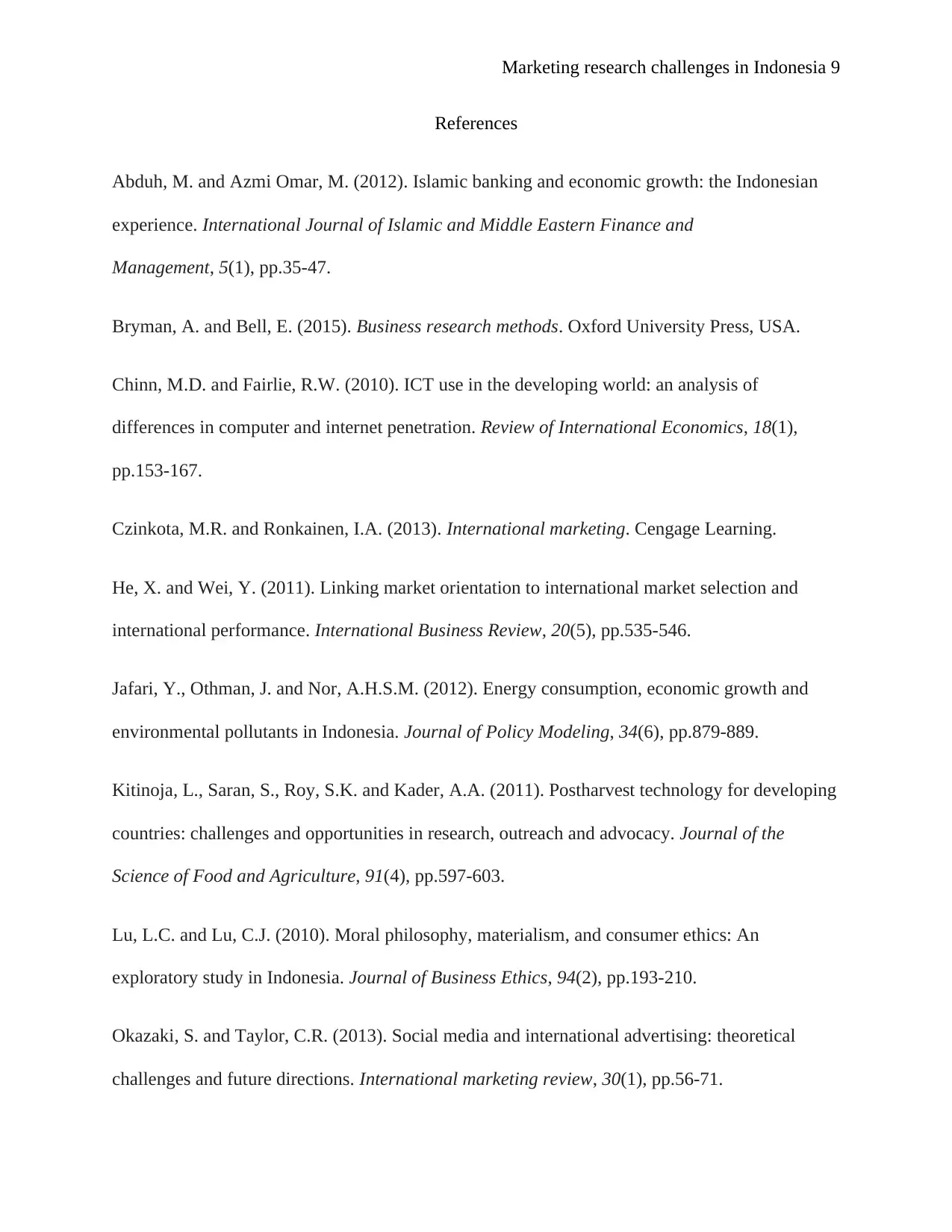
References
Abduh, M. and Azmi Omar, M. (2012). Islamic banking and economic growth: the Indonesian
experience. International Journal of Islamic and Middle Eastern Finance and
Management, 5(1), pp.35-47.
Bryman, A. and Bell, E. (2015). Business research methods. Oxford University Press, USA.
Chinn, M.D. and Fairlie, R.W. (2010). ICT use in the developing world: an analysis of
differences in computer and internet penetration. Review of International Economics, 18(1),
pp.153-167.
Czinkota, M.R. and Ronkainen, I.A. (2013). International marketing. Cengage Learning.
He, X. and Wei, Y. (2011). Linking market orientation to international market selection and
international performance. International Business Review, 20(5), pp.535-546.
Jafari, Y., Othman, J. and Nor, A.H.S.M. (2012). Energy consumption, economic growth and
environmental pollutants in Indonesia. Journal of Policy Modeling, 34(6), pp.879-889.
Kitinoja, L., Saran, S., Roy, S.K. and Kader, A.A. (2011). Postharvest technology for developing
countries: challenges and opportunities in research, outreach and advocacy. Journal of the
Science of Food and Agriculture, 91(4), pp.597-603.
Lu, L.C. and Lu, C.J. (2010). Moral philosophy, materialism, and consumer ethics: An
exploratory study in Indonesia. Journal of Business Ethics, 94(2), pp.193-210.
Okazaki, S. and Taylor, C.R. (2013). Social media and international advertising: theoretical
challenges and future directions. International marketing review, 30(1), pp.56-71.
References
Abduh, M. and Azmi Omar, M. (2012). Islamic banking and economic growth: the Indonesian
experience. International Journal of Islamic and Middle Eastern Finance and
Management, 5(1), pp.35-47.
Bryman, A. and Bell, E. (2015). Business research methods. Oxford University Press, USA.
Chinn, M.D. and Fairlie, R.W. (2010). ICT use in the developing world: an analysis of
differences in computer and internet penetration. Review of International Economics, 18(1),
pp.153-167.
Czinkota, M.R. and Ronkainen, I.A. (2013). International marketing. Cengage Learning.
He, X. and Wei, Y. (2011). Linking market orientation to international market selection and
international performance. International Business Review, 20(5), pp.535-546.
Jafari, Y., Othman, J. and Nor, A.H.S.M. (2012). Energy consumption, economic growth and
environmental pollutants in Indonesia. Journal of Policy Modeling, 34(6), pp.879-889.
Kitinoja, L., Saran, S., Roy, S.K. and Kader, A.A. (2011). Postharvest technology for developing
countries: challenges and opportunities in research, outreach and advocacy. Journal of the
Science of Food and Agriculture, 91(4), pp.597-603.
Lu, L.C. and Lu, C.J. (2010). Moral philosophy, materialism, and consumer ethics: An
exploratory study in Indonesia. Journal of Business Ethics, 94(2), pp.193-210.
Okazaki, S. and Taylor, C.R. (2013). Social media and international advertising: theoretical
challenges and future directions. International marketing review, 30(1), pp.56-71.
⊘ This is a preview!⊘
Do you want full access?
Subscribe today to unlock all pages.
Trusted by 1+ million students worldwide
Marketing research challenges in Indonesia 10
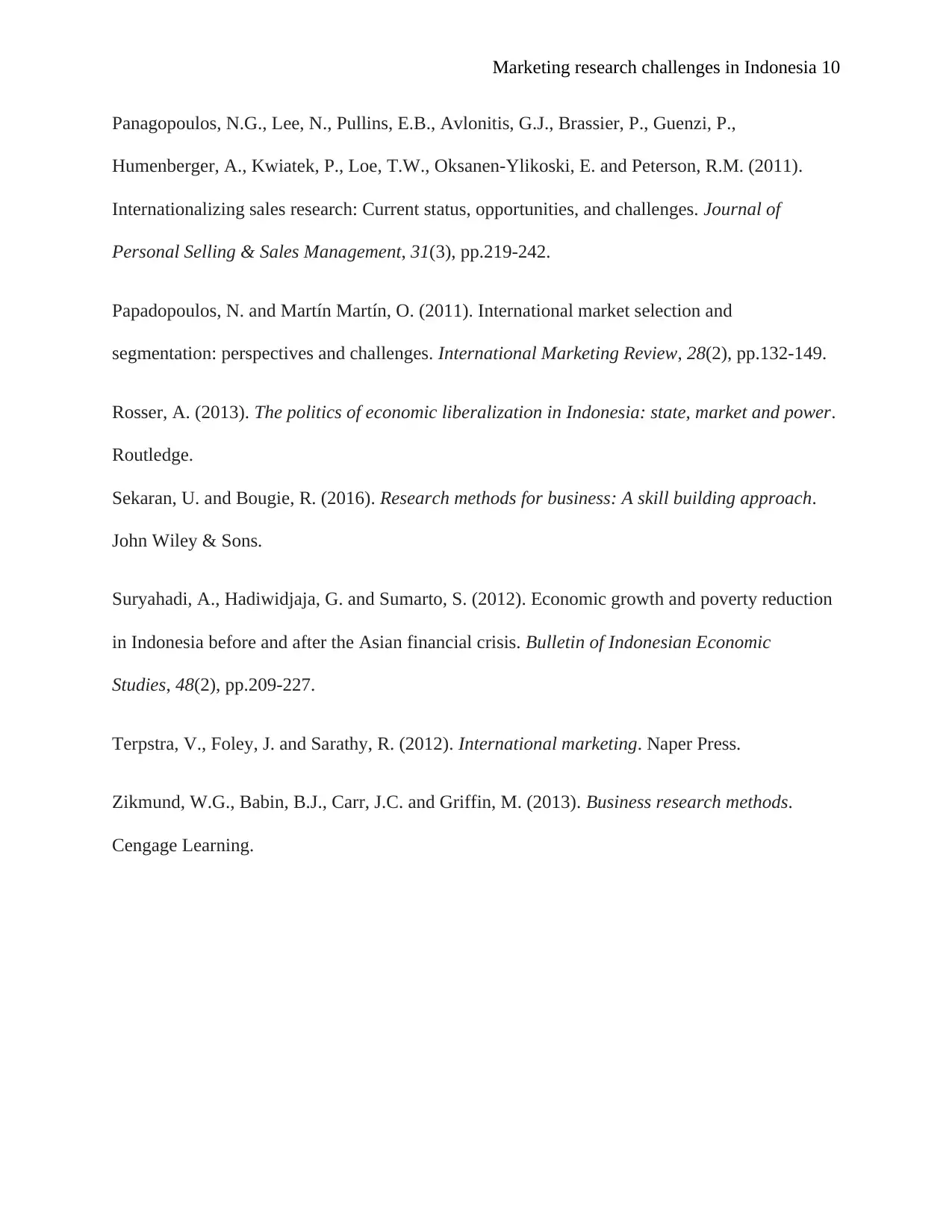
Panagopoulos, N.G., Lee, N., Pullins, E.B., Avlonitis, G.J., Brassier, P., Guenzi, P.,
Humenberger, A., Kwiatek, P., Loe, T.W., Oksanen-Ylikoski, E. and Peterson, R.M. (2011).
Internationalizing sales research: Current status, opportunities, and challenges. Journal of
Personal Selling & Sales Management, 31(3), pp.219-242.
Papadopoulos, N. and Martín Martín, O. (2011). International market selection and
segmentation: perspectives and challenges. International Marketing Review, 28(2), pp.132-149.
Rosser, A. (2013). The politics of economic liberalization in Indonesia: state, market and power.
Routledge.
Sekaran, U. and Bougie, R. (2016). Research methods for business: A skill building approach.
John Wiley & Sons.
Suryahadi, A., Hadiwidjaja, G. and Sumarto, S. (2012). Economic growth and poverty reduction
in Indonesia before and after the Asian financial crisis. Bulletin of Indonesian Economic
Studies, 48(2), pp.209-227.
Terpstra, V., Foley, J. and Sarathy, R. (2012). International marketing. Naper Press.
Zikmund, W.G., Babin, B.J., Carr, J.C. and Griffin, M. (2013). Business research methods.
Cengage Learning.
Panagopoulos, N.G., Lee, N., Pullins, E.B., Avlonitis, G.J., Brassier, P., Guenzi, P.,
Humenberger, A., Kwiatek, P., Loe, T.W., Oksanen-Ylikoski, E. and Peterson, R.M. (2011).
Internationalizing sales research: Current status, opportunities, and challenges. Journal of
Personal Selling & Sales Management, 31(3), pp.219-242.
Papadopoulos, N. and Martín Martín, O. (2011). International market selection and
segmentation: perspectives and challenges. International Marketing Review, 28(2), pp.132-149.
Rosser, A. (2013). The politics of economic liberalization in Indonesia: state, market and power.
Routledge.
Sekaran, U. and Bougie, R. (2016). Research methods for business: A skill building approach.
John Wiley & Sons.
Suryahadi, A., Hadiwidjaja, G. and Sumarto, S. (2012). Economic growth and poverty reduction
in Indonesia before and after the Asian financial crisis. Bulletin of Indonesian Economic
Studies, 48(2), pp.209-227.
Terpstra, V., Foley, J. and Sarathy, R. (2012). International marketing. Naper Press.
Zikmund, W.G., Babin, B.J., Carr, J.C. and Griffin, M. (2013). Business research methods.
Cengage Learning.

1 out of 10


Related Documents


Your All-in-One AI-Powered Toolkit for Academic Success.
+13062052269
info@desklib.com
Available 24*7 on WhatsApp / Email
![[object Object]](/_next/static/media/star-bottom.7253800d.svg)
Unlock your academic potential
Copyright © 2020–2026 A2Z Services. All Rights Reserved. Developed and managed by ZUCOL.