Report: Key Challenges Facing Organizations in the Next Twenty Years
VerifiedAdded on 2023/04/25
|10
|912
|189
Report
AI Summary
This report provides an overview of the significant organizational challenges that businesses are expected to face over the next twenty years. It highlights five key areas: changes in human behavior, organizational culture, the role of technology in research, leadership effectiveness, and environmental issues. The report discusses the impact of workforce diversity, cultural discrepancies, and the need for high-performance and innovative cultures. It emphasizes the importance of adapting to technological advancements, new leadership styles, and environmental sustainability. The report concludes by stressing the importance of continuous innovation and investment in technology, leadership development, and cultural diversity to ensure business survival in a competitive global market. References from various researchers support the analysis.
ORGANIZATIONAL
CHALLENGES
NEXT TWO DECADES
CHALLENGES
NEXT TWO DECADES
Paraphrase This Document
Need a fresh take? Get an instant paraphrase of this document with our AI Paraphraser

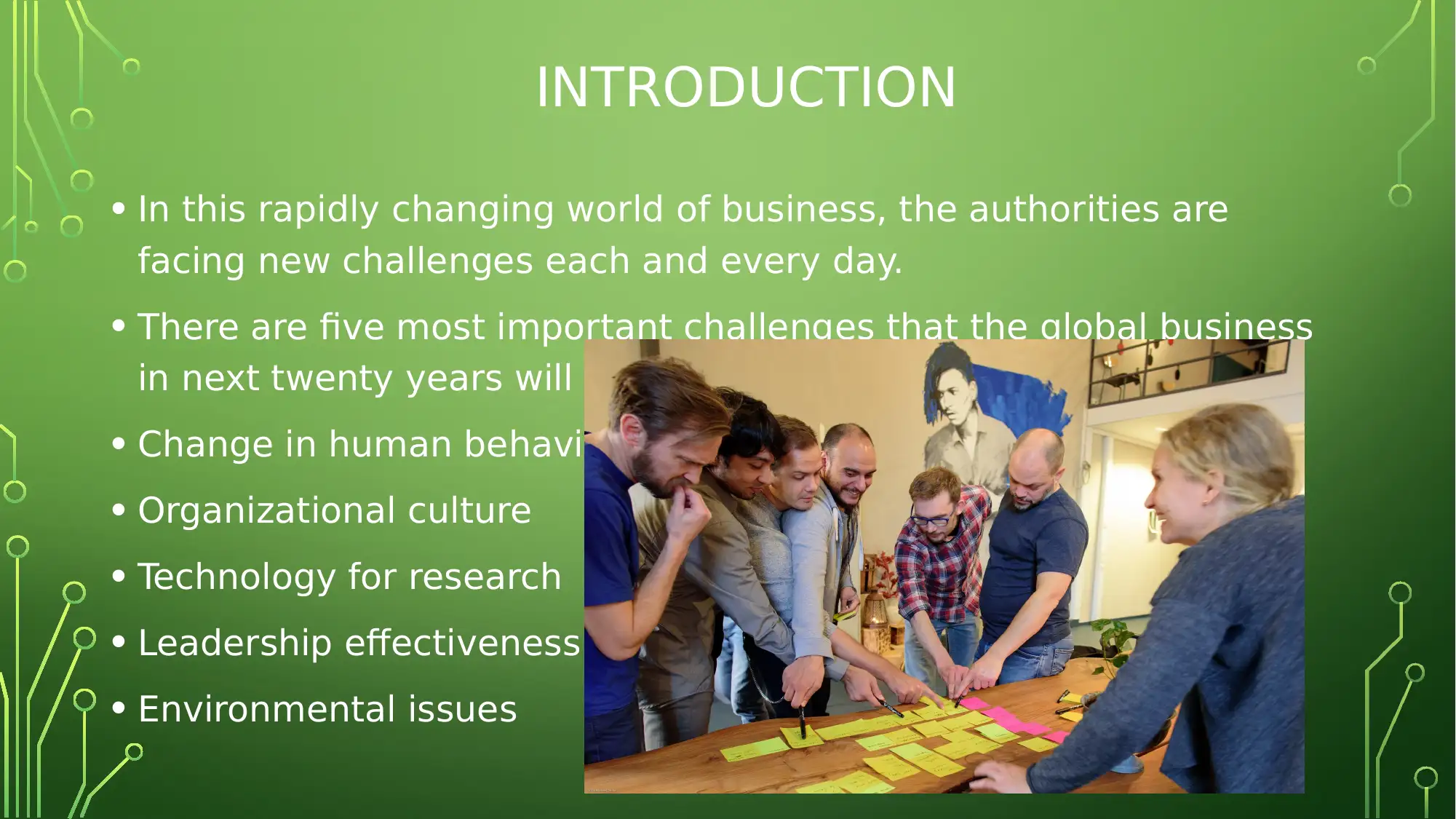
INTRODUCTION
• In this rapidly changing world of business, the authorities are
facing new challenges each and every day.
• There are five most important challenges that the global business
in next twenty years will face include-
• Change in human behaviour
• Organizational culture
• Technology for research
• Leadership effectiveness
• Environmental issues
• In this rapidly changing world of business, the authorities are
facing new challenges each and every day.
• There are five most important challenges that the global business
in next twenty years will face include-
• Change in human behaviour
• Organizational culture
• Technology for research
• Leadership effectiveness
• Environmental issues

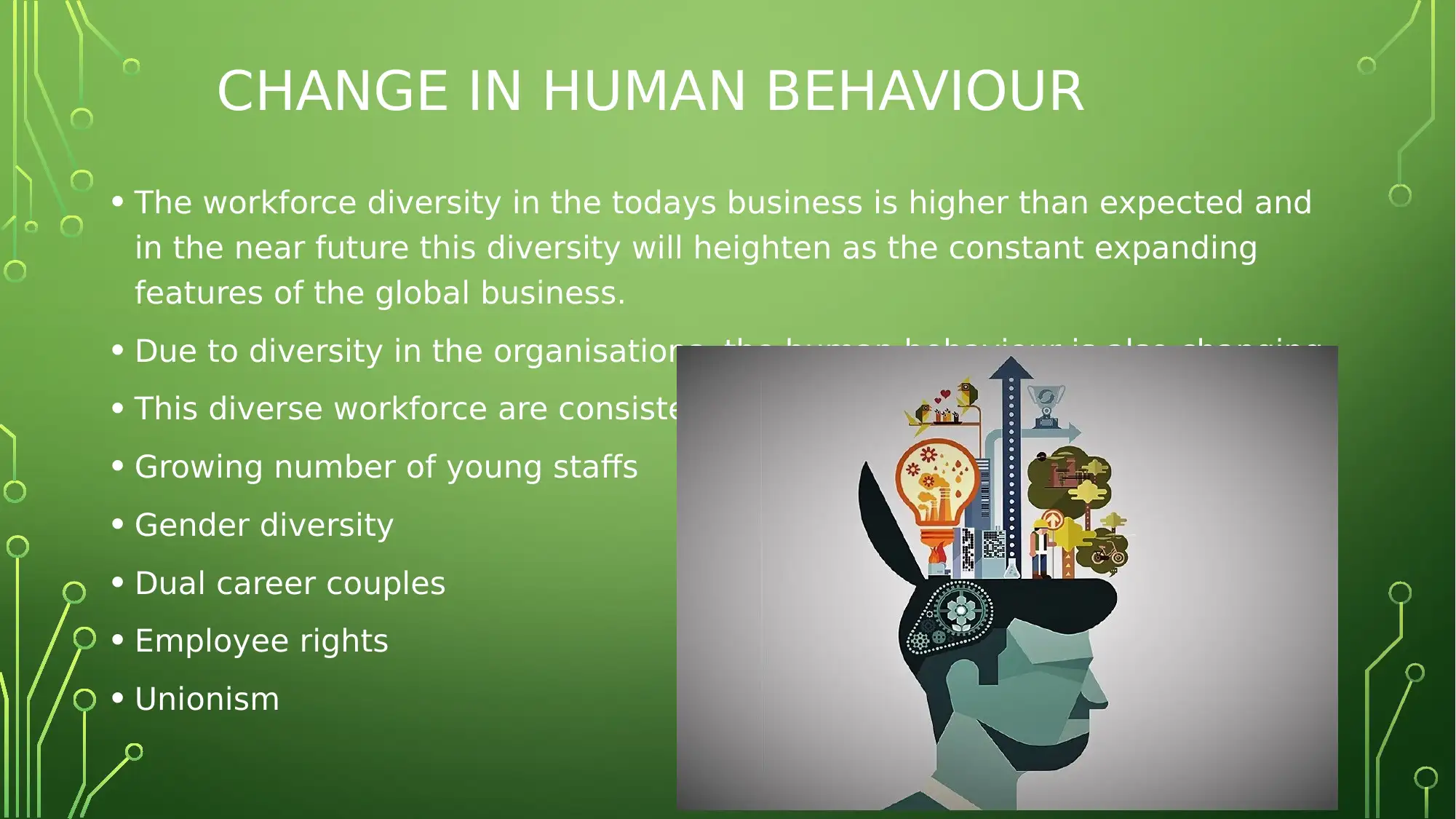
CHANGE IN HUMAN BEHAVIOUR
• The workforce diversity in the todays business is higher than expected and
in the near future this diversity will heighten as the constant expanding
features of the global business.
• Due to diversity in the organisations, the human behaviour is also changing.
• This diverse workforce are consisted of-
• Growing number of young staffs
• Gender diversity
• Dual career couples
• Employee rights
• Unionism
• The workforce diversity in the todays business is higher than expected and
in the near future this diversity will heighten as the constant expanding
features of the global business.
• Due to diversity in the organisations, the human behaviour is also changing.
• This diverse workforce are consisted of-
• Growing number of young staffs
• Gender diversity
• Dual career couples
• Employee rights
• Unionism
⊘ This is a preview!⊘
Do you want full access?
Subscribe today to unlock all pages.

Trusted by 1+ million students worldwide

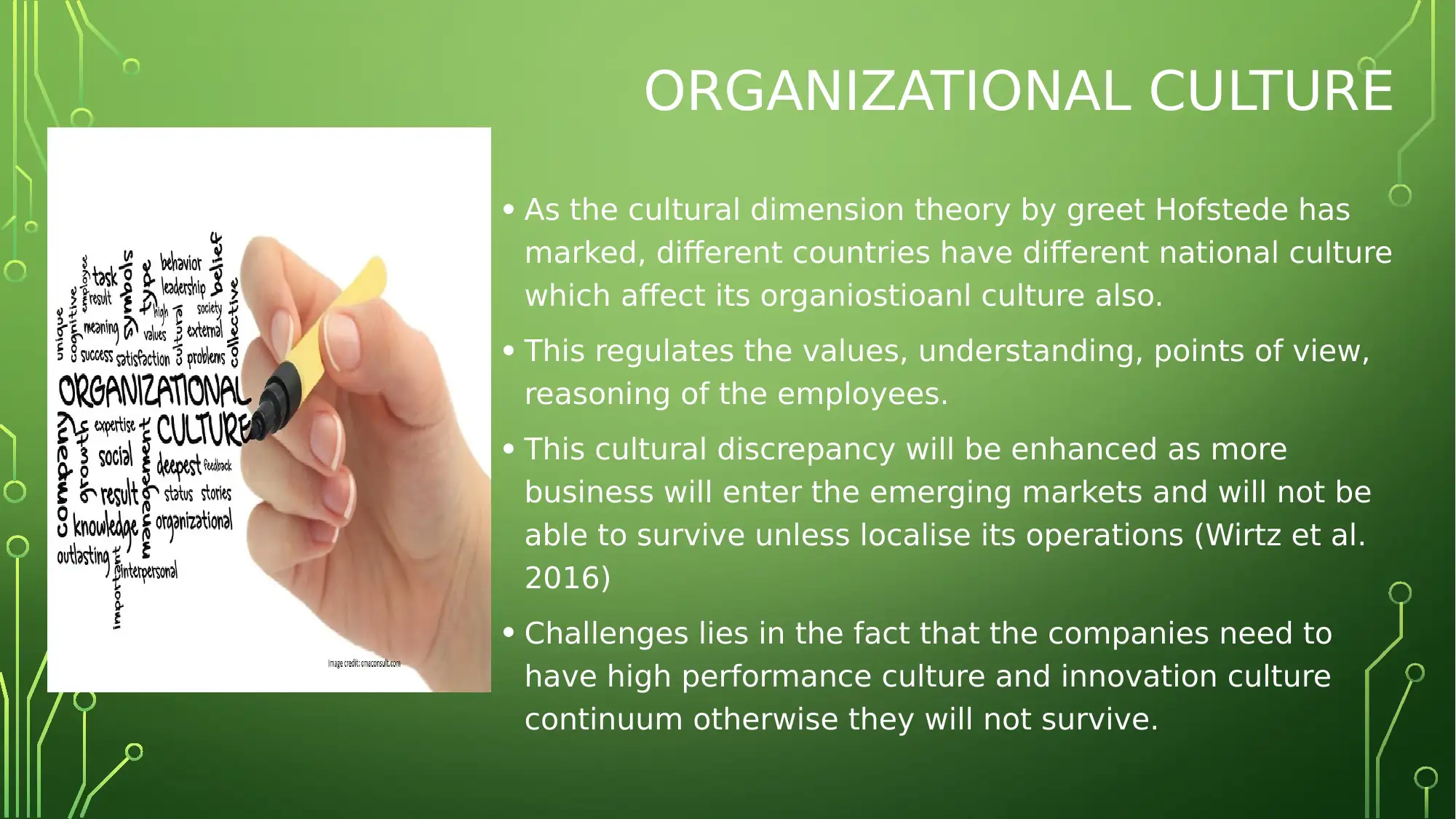
ORGANIZATIONAL CULTURE
• As the cultural dimension theory by greet Hofstede has
marked, different countries have different national culture
which affect its organiostioanl culture also.
• This regulates the values, understanding, points of view,
reasoning of the employees.
• This cultural discrepancy will be enhanced as more
business will enter the emerging markets and will not be
able to survive unless localise its operations (Wirtz et al.
2016)
• Challenges lies in the fact that the companies need to
have high performance culture and innovation culture
continuum otherwise they will not survive.
• As the cultural dimension theory by greet Hofstede has
marked, different countries have different national culture
which affect its organiostioanl culture also.
• This regulates the values, understanding, points of view,
reasoning of the employees.
• This cultural discrepancy will be enhanced as more
business will enter the emerging markets and will not be
able to survive unless localise its operations (Wirtz et al.
2016)
• Challenges lies in the fact that the companies need to
have high performance culture and innovation culture
continuum otherwise they will not survive.
Paraphrase This Document
Need a fresh take? Get an instant paraphrase of this document with our AI Paraphraser

TECHNOLOGY FOR RESEARCH
• With the advent of technology after globalisation, it has become
challenging for the global as well as local businesses to cope up with
these changes (Lehmann 2017).
• The operations, marketing and productions are depending upon research
and development incorporating technology (Fountas et al. 2015).
• Hence, the companies where the workforce do not have skills to cope up
with the changing technology, will be abolished in next twenty years
definitely.
• With the advent of technology after globalisation, it has become
challenging for the global as well as local businesses to cope up with
these changes (Lehmann 2017).
• The operations, marketing and productions are depending upon research
and development incorporating technology (Fountas et al. 2015).
• Hence, the companies where the workforce do not have skills to cope up
with the changing technology, will be abolished in next twenty years
definitely.

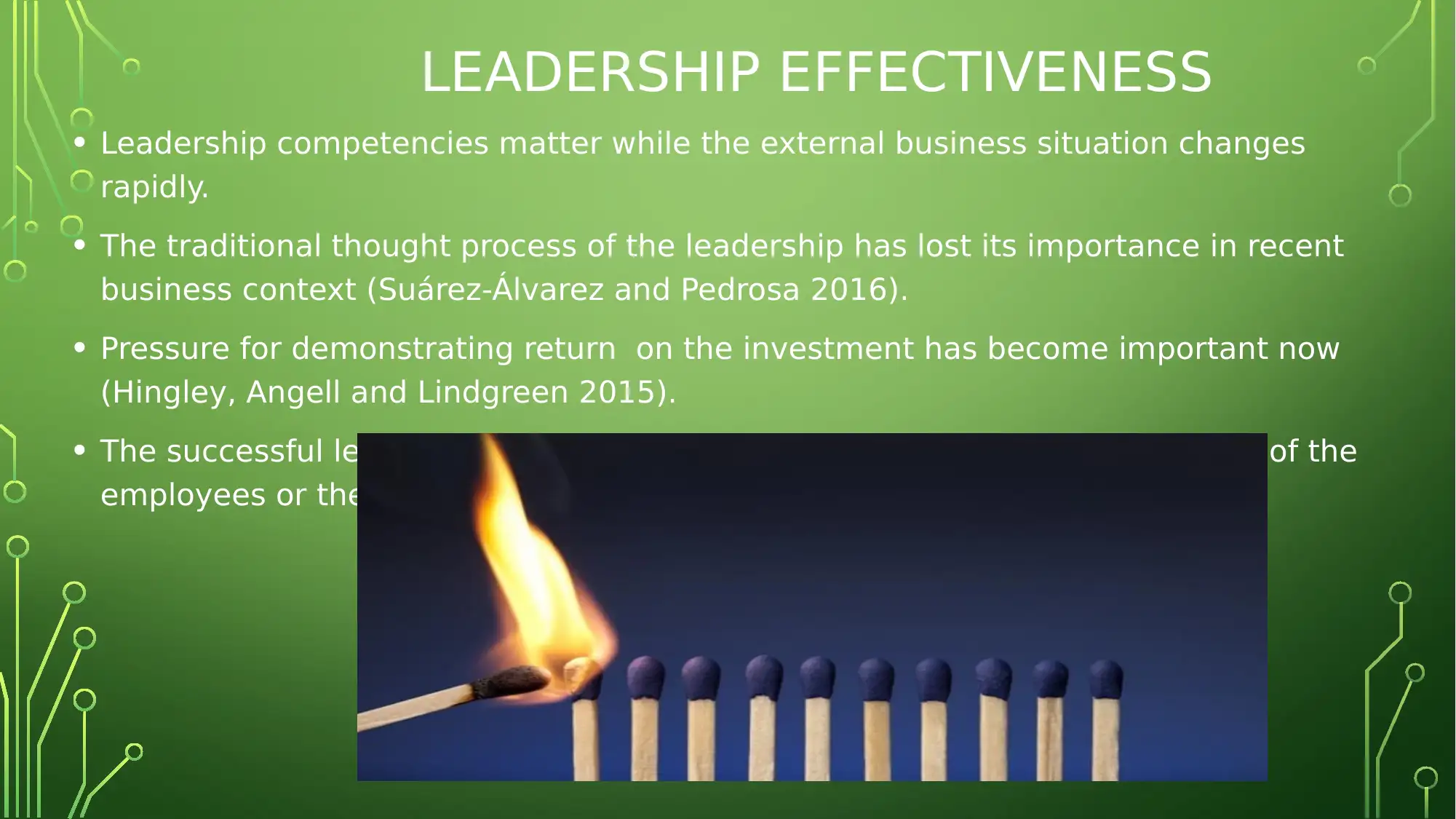
LEADERSHIP EFFECTIVENESS
• Leadership competencies matter while the external business situation changes
rapidly.
• The traditional thought process of the leadership has lost its importance in recent
business context (Suárez-Álvarez and Pedrosa 2016).
• Pressure for demonstrating return on the investment has become important now
(Hingley, Angell and Lindgreen 2015).
• The successful leaders are finding new ways of coping up with the demands of the
employees or the other stakeholders.
• Leadership competencies matter while the external business situation changes
rapidly.
• The traditional thought process of the leadership has lost its importance in recent
business context (Suárez-Álvarez and Pedrosa 2016).
• Pressure for demonstrating return on the investment has become important now
(Hingley, Angell and Lindgreen 2015).
• The successful leaders are finding new ways of coping up with the demands of the
employees or the other stakeholders.
⊘ This is a preview!⊘
Do you want full access?
Subscribe today to unlock all pages.

Trusted by 1+ million students worldwide

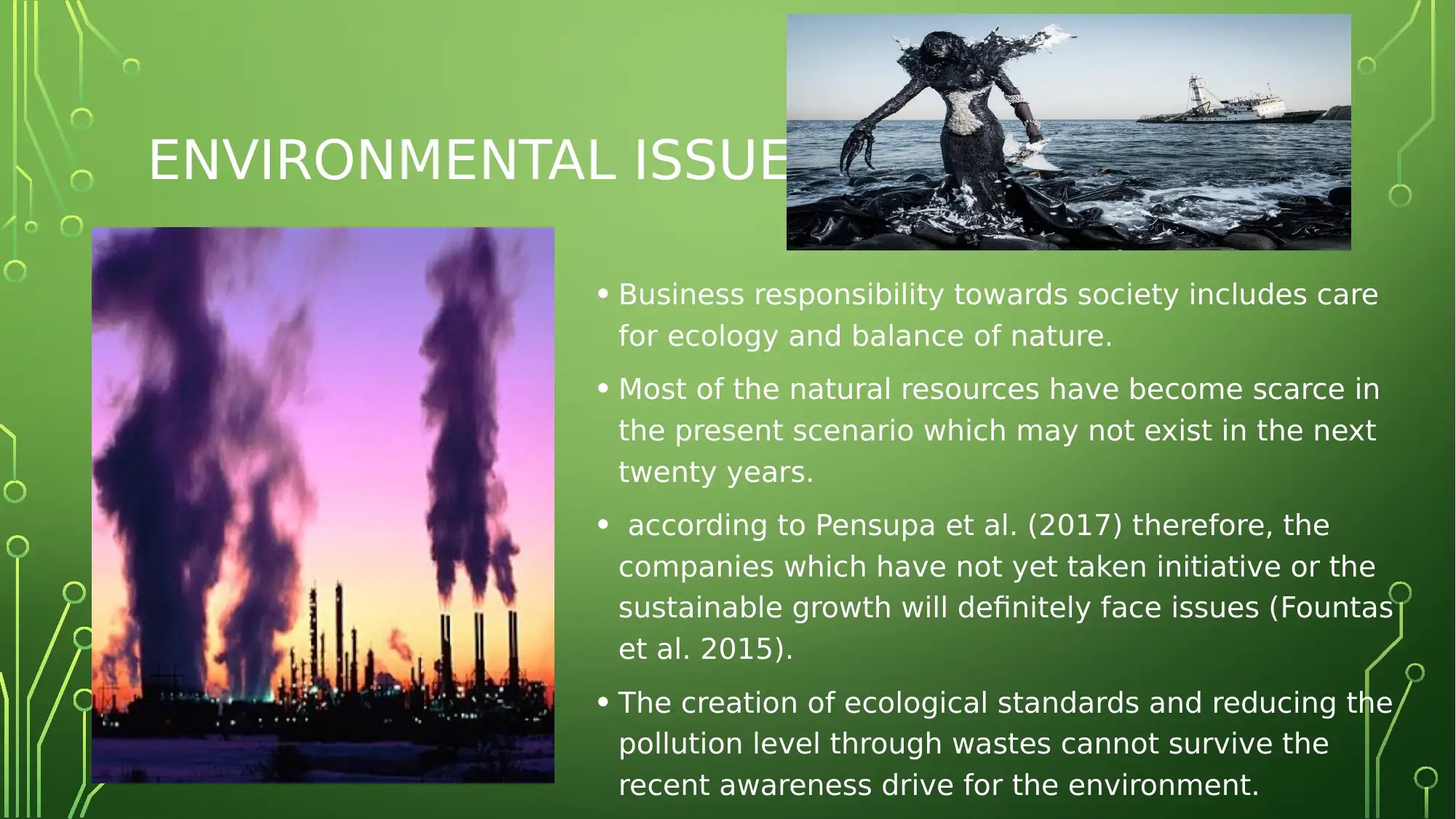
ENVIRONMENTAL ISSUES
• Business responsibility towards society includes care
for ecology and balance of nature.
• Most of the natural resources have become scarce in
the present scenario which may not exist in the next
twenty years.
• according to Pensupa et al. (2017) therefore, the
companies which have not yet taken initiative or the
sustainable growth will definitely face issues (Fountas
et al. 2015).
• The creation of ecological standards and reducing the
pollution level through wastes cannot survive the
recent awareness drive for the environment.
• Business responsibility towards society includes care
for ecology and balance of nature.
• Most of the natural resources have become scarce in
the present scenario which may not exist in the next
twenty years.
• according to Pensupa et al. (2017) therefore, the
companies which have not yet taken initiative or the
sustainable growth will definitely face issues (Fountas
et al. 2015).
• The creation of ecological standards and reducing the
pollution level through wastes cannot survive the
recent awareness drive for the environment.
Paraphrase This Document
Need a fresh take? Get an instant paraphrase of this document with our AI Paraphraser

SUMMARY
• With the change in the business situations after globalisation, the companies are
introducing changes ion several aspects.
• However, the change if does not continue, the business cannot survive this
tremendous competition.
• More investment in the technology, change in leadership style, retaining the talented
employed by supporting the cultural diversity in the organizations can help the
business to retain their position
• However, more investment on the innovation process in every aspects can help the
business otherwise the global business is going to face huge problem in next two
decades.
• With the change in the business situations after globalisation, the companies are
introducing changes ion several aspects.
• However, the change if does not continue, the business cannot survive this
tremendous competition.
• More investment in the technology, change in leadership style, retaining the talented
employed by supporting the cultural diversity in the organizations can help the
business to retain their position
• However, more investment on the innovation process in every aspects can help the
business otherwise the global business is going to face huge problem in next two
decades.

REFERENCES:
• Fountas, S., Carli, G., Sørensen, C.G., Tsiropoulos, Z., Cavalaris, C., Vatsanidou, A., Liakos, B., Canavari, M., Wiebensohn, J. and Tisserye, B.,
2015. Farm management information systems: Current situation and future perspectives. Computers and Electronics in Agriculture, 115,
pp.40-50.
• Hingley, M., Angell, R. and Lindgreen, A., 2015. The current situation and future conceptualization of power in industrial markets. Industrial
Marketing Management, 48, pp.226-230.
• Lehmann, O.F., 2017. Customer Projects: What is the Future of the Business?'. PM World Journal, 4(2).
• Peng, M.W., 2017. Cultures, institutions, and strategic choices: Toward an institutional perspective on business strategy. The Blackwell
handbook of cross‐cultural management, pp.52-66.
• Pensupa, N., Leu, S.Y., Hu, Y., Du, C., Liu, H., Jing, H., Wang, H. and Lin, C.S.K., 2017. Recent trends in sustainable textile waste recycling
methods: current situation and future prospects. In Chemistry and Chemical Technologies in Waste Valorization (pp. 189-228). Springer,
Cham.
• Suárez-Álvarez, J. and Pedrosa, I., 2016. The assessment of entrepreneurial personality: The current situation and future directions. Papeles
del Psicólogo, 37(1), pp.62-68.
• Wirtz, B.W., Pistoia, A., Ullrich, S. and Göttel, V., 2016. Business models: Origin, development and future research perspectives. Long range
planning, 49(1), pp.36-54.
• Fountas, S., Carli, G., Sørensen, C.G., Tsiropoulos, Z., Cavalaris, C., Vatsanidou, A., Liakos, B., Canavari, M., Wiebensohn, J. and Tisserye, B.,
2015. Farm management information systems: Current situation and future perspectives. Computers and Electronics in Agriculture, 115,
pp.40-50.
• Hingley, M., Angell, R. and Lindgreen, A., 2015. The current situation and future conceptualization of power in industrial markets. Industrial
Marketing Management, 48, pp.226-230.
• Lehmann, O.F., 2017. Customer Projects: What is the Future of the Business?'. PM World Journal, 4(2).
• Peng, M.W., 2017. Cultures, institutions, and strategic choices: Toward an institutional perspective on business strategy. The Blackwell
handbook of cross‐cultural management, pp.52-66.
• Pensupa, N., Leu, S.Y., Hu, Y., Du, C., Liu, H., Jing, H., Wang, H. and Lin, C.S.K., 2017. Recent trends in sustainable textile waste recycling
methods: current situation and future prospects. In Chemistry and Chemical Technologies in Waste Valorization (pp. 189-228). Springer,
Cham.
• Suárez-Álvarez, J. and Pedrosa, I., 2016. The assessment of entrepreneurial personality: The current situation and future directions. Papeles
del Psicólogo, 37(1), pp.62-68.
• Wirtz, B.W., Pistoia, A., Ullrich, S. and Göttel, V., 2016. Business models: Origin, development and future research perspectives. Long range
planning, 49(1), pp.36-54.
⊘ This is a preview!⊘
Do you want full access?
Subscribe today to unlock all pages.

Trusted by 1+ million students worldwide

1 out of 10
Related Documents
Your All-in-One AI-Powered Toolkit for Academic Success.
+13062052269
info@desklib.com
Available 24*7 on WhatsApp / Email
Unlock your academic potential
Copyright © 2020–2025 A2Z Services. All Rights Reserved. Developed and managed by ZUCOL.