Healthcare Leadership Development: Challenges and Solutions Report
VerifiedAdded on 2023/04/21
|13
|1209
|179
Report
AI Summary
This report provides an in-depth analysis of the challenges and opportunities in healthcare leadership development. It begins with an overview of the research, including the qualitative study design and methodology involving interviews with healthcare leadership experts. The report highlights key findings such as industry lags, professional conflicts, time constraints, and financial hurdles faced by healthcare organizations. It then explores the relevance of leadership development to promoting healthcare leadership, organizational growth, and the implementation of effective change management strategies. The report also presents a conceptual model emphasizing task-oriented leadership and its translation into practice, including adherence to professional standards, collaboration, and the role of clinical champions. Finally, the report references various sources to support its findings and recommendations for enhancing leadership development in the healthcare sector.

Leadership
development in
Healthcare
Name of the Student
Name of the University
development in
Healthcare
Name of the Student
Name of the University
Paraphrase This Document
Need a fresh take? Get an instant paraphrase of this document with our AI Paraphraser

Article Summary (Background)
• Article-Leadership development in
healthcare: a qualitative study
• Not much advancements have been
made by researchers in the domain of
developing clinical leaders
• Healthcare leadership encompass the
capability to ethically and effectively
influence people for the benefit of patient
population (McAlearney, 2006)
• Contemporary challenges arise from both
organizational and environmental factors
• Research aim- To determine the
challenges in leadership development in
healthcare
Figure 1- Effective
leadership
Source- (Petruzzelli, 2015)
• Article-Leadership development in
healthcare: a qualitative study
• Not much advancements have been
made by researchers in the domain of
developing clinical leaders
• Healthcare leadership encompass the
capability to ethically and effectively
influence people for the benefit of patient
population (McAlearney, 2006)
• Contemporary challenges arise from both
organizational and environmental factors
• Research aim- To determine the
challenges in leadership development in
healthcare
Figure 1- Effective
leadership
Source- (Petruzzelli, 2015)

Article Summary (Methodology)
• Method- Qualitative study design employed that is typically
exploratory in nature and helps in gaining a sound understanding
of the underlying opinions, motivations and reasons behind a
phenomenon (McAlearney, 2006)
• Data collection method- 35 semi-structured interviews conducted
with healthcare leadership experts
• Expert interviews combined with organizational case studies, thus
resulting in 160 interviews (September-December 2003).
• Method- Qualitative study design employed that is typically
exploratory in nature and helps in gaining a sound understanding
of the underlying opinions, motivations and reasons behind a
phenomenon (McAlearney, 2006)
• Data collection method- 35 semi-structured interviews conducted
with healthcare leadership experts
• Expert interviews combined with organizational case studies, thus
resulting in 160 interviews (September-December 2003).
⊘ This is a preview!⊘
Do you want full access?
Subscribe today to unlock all pages.

Trusted by 1+ million students worldwide

Article Summary (Methodology)
• Snowball sampling used for recruitment of key informants.
• Healthcare organizations were sample based on reported
reputation and experiences, in relation to healthcare
leadership development (McAlearney, 2006)
• Grounded theory approach used for the research
• Data analysis involved verbatim transcription, followed by
thematic analysis.
• Snowball sampling used for recruitment of key informants.
• Healthcare organizations were sample based on reported
reputation and experiences, in relation to healthcare
leadership development (McAlearney, 2006)
• Grounded theory approach used for the research
• Data analysis involved verbatim transcription, followed by
thematic analysis.
Paraphrase This Document
Need a fresh take? Get an instant paraphrase of this document with our AI Paraphraser

Article Summary (Results)
• Industry lag- Organizations displayed rare sense of commitment towards
leadership development and were at least 10-15 years behind different
industries (McAlearney, 2006)
• Representativeness- There was a need to make the organizations
illustrative of the complete patient population and community. Diversity
is required in the management staff for responding to the needs of the
client community.
• Professional conflict- The organizations must segregate dissimilar
professional groups for development of leadership
• Industry lag- Organizations displayed rare sense of commitment towards
leadership development and were at least 10-15 years behind different
industries (McAlearney, 2006)
• Representativeness- There was a need to make the organizations
illustrative of the complete patient population and community. Diversity
is required in the management staff for responding to the needs of the
client community.
• Professional conflict- The organizations must segregate dissimilar
professional groups for development of leadership

Article Summary (Results)
• Time constraint- The organizations most often encounter
challenges of freeing their time for participation in programs.
• Technical hurdle- Different problems also arise during
leadership development due to the lack of technical
capabilities of an organization (McAlearney, 2006)
• Financial constraint- Financial constraints and tight budgets
are prevalent in healthcare organizations that put healthcare
leadership activities at risk.
• Time constraint- The organizations most often encounter
challenges of freeing their time for participation in programs.
• Technical hurdle- Different problems also arise during
leadership development due to the lack of technical
capabilities of an organization (McAlearney, 2006)
• Financial constraint- Financial constraints and tight budgets
are prevalent in healthcare organizations that put healthcare
leadership activities at risk.
⊘ This is a preview!⊘
Do you want full access?
Subscribe today to unlock all pages.

Trusted by 1+ million students worldwide

Relevance to promoting healthcare
leadership (1)
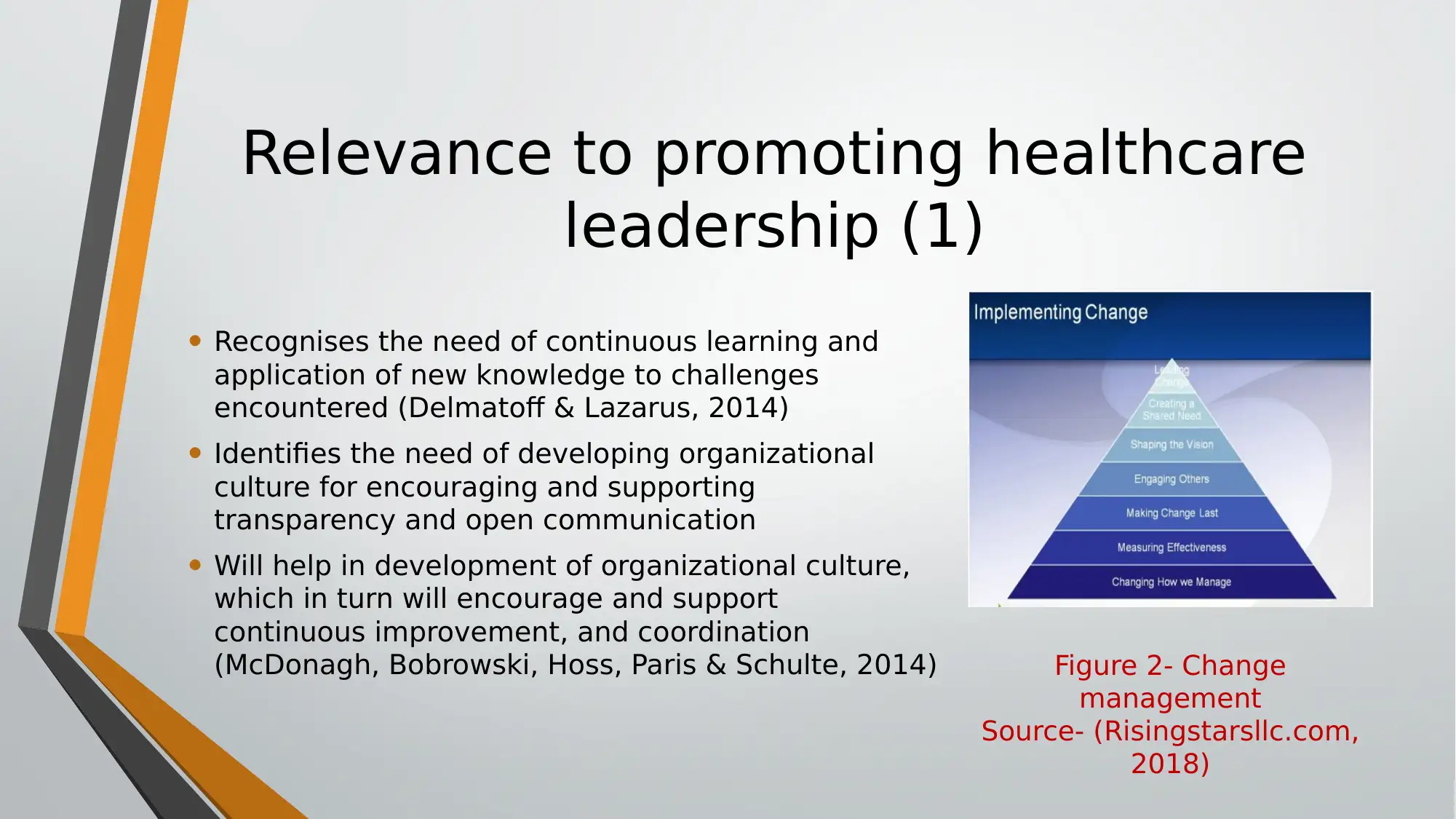
• Recognises the need of continuous learning and
application of new knowledge to challenges
encountered (Delmatoff & Lazarus, 2014)
• Identifies the need of developing organizational
culture for encouraging and supporting
transparency and open communication
• Will help in development of organizational culture,
which in turn will encourage and support
continuous improvement, and coordination
(McDonagh, Bobrowski, Hoss, Paris & Schulte, 2014) Figure 2- Change
management
Source- (Risingstarsllc.com,
2018)
leadership (1)
• Recognises the need of continuous learning and
application of new knowledge to challenges
encountered (Delmatoff & Lazarus, 2014)
• Identifies the need of developing organizational
culture for encouraging and supporting
transparency and open communication
• Will help in development of organizational culture,
which in turn will encourage and support
continuous improvement, and coordination
(McDonagh, Bobrowski, Hoss, Paris & Schulte, 2014) Figure 2- Change
management
Source- (Risingstarsllc.com,
2018)
Paraphrase This Document
Need a fresh take? Get an instant paraphrase of this document with our AI Paraphraser

Relevance to promoting healthcare
leadership (2)
• Abides by rigid work schedules, thus preventing any lag
• Requires all employees to set definite goals and formulate
precise plans for achieving them
• Will also help in development of personal skills and re-
orientation of health services, thus promoting healthcare
service delivery (West, Eckert, Steward & Pasmore, 2014)
• Will assist in conduction of an operational and business analysis
leadership (2)
• Abides by rigid work schedules, thus preventing any lag
• Requires all employees to set definite goals and formulate
precise plans for achieving them
• Will also help in development of personal skills and re-
orientation of health services, thus promoting healthcare
service delivery (West, Eckert, Steward & Pasmore, 2014)
• Will assist in conduction of an operational and business analysis

Relevance to organizational growth
• Will facilitate strategic growth planning for
progressing to the desired future situation
• Will help in updating the vision, mission, and
values of the organization to align them with
the growth objectives (D’Andreamatteo,
Ianni, Lega & Sargiacomo, 2015)
• Will facilitate brainstorming sessions for
considering strategic options that would
favour leadership development
Risingstarsllc.com. (2018
Figure 3- Stages of growth
Source- (IHI, 2018)
• Will facilitate strategic growth planning for
progressing to the desired future situation
• Will help in updating the vision, mission, and
values of the organization to align them with
the growth objectives (D’Andreamatteo,
Ianni, Lega & Sargiacomo, 2015)
• Will facilitate brainstorming sessions for
considering strategic options that would
favour leadership development
Risingstarsllc.com. (2018
Figure 3- Stages of growth
Source- (IHI, 2018)
⊘ This is a preview!⊘
Do you want full access?
Subscribe today to unlock all pages.

Trusted by 1+ million students worldwide

Conceptual model/framework
• Task-oriented leadership is relevant for
healthcare sector.
• Step-wise planning and presence of reward or
punishment system will help in encountering
the common challenges
• Involves constant defining of the goals and
organizational structure
• Focuses on prioritisation of accomplishment of
intended outcomes (Denis & van Gestel, 2016)
Figure 4- Leadership
attributes
Source- (Afiahealth.com,
• Task-oriented leadership is relevant for
healthcare sector.
• Step-wise planning and presence of reward or
punishment system will help in encountering
the common challenges
• Involves constant defining of the goals and
organizational structure
• Focuses on prioritisation of accomplishment of
intended outcomes (Denis & van Gestel, 2016)
Figure 4- Leadership
attributes
Source- (Afiahealth.com,
Paraphrase This Document
Need a fresh take? Get an instant paraphrase of this document with our AI Paraphraser

Translation to practice
• Demonstrate adherence to the professional standards for
quality and safe care
• Engaging with multidisciplinary healthcare personnel for best
practice delivery
• Realising the importance of collaboration and communication
• Implementing a networked process for research-based
knowledge translation
• Identifying the role of clinical champions as drivers of
healthcare innovations (Srinivasan & Chandwani, 2014)
• Garnering support of opinion leaders for influencing changes
through leadership action and behaviour Figure 5- Leadership
Source- (Rybolt, 2018)
• Demonstrate adherence to the professional standards for
quality and safe care
• Engaging with multidisciplinary healthcare personnel for best
practice delivery
• Realising the importance of collaboration and communication
• Implementing a networked process for research-based
knowledge translation
• Identifying the role of clinical champions as drivers of
healthcare innovations (Srinivasan & Chandwani, 2014)
• Garnering support of opinion leaders for influencing changes
through leadership action and behaviour Figure 5- Leadership
Source- (Rybolt, 2018)

ReferencesAfiahealth.com. (2018). Strategies for Implementing Change in Healthcare. Retrieved from
https://afiahealth.com/leading-managing-complex-change/
D’Andreamatteo, A., Ianni, L., Lega, F., & Sargiacomo, M. (2015). Lean in healthcare: A comprehensive review. Health policy, 119(9), 1197-
1209. Retrieved from https://doi.org/10.1016/j.healthpol.2015.02.002
Delmatoff, J., & Lazarus, I. R. (2014). The most effective leadership style for the new landscape of healthcare. Journal of Healthcare
Management, 59(4), 245-249. Retrieved from https
://journals.lww.com/jhmonline/Abstract/2014/07000/The_Most_Effective_Leadership_Style_for_the_New.3.aspx
Denis, J. L., & van Gestel, N. (2016). Medical doctors in healthcare leadership: theoretical and practical challenges. BMC health services
research, 16(2), 158. Retrieved from https://doi.org/10.1186/s12913-016-1392-8
IHI. (2018). Changes for Improvement. Retrieved from http://www.ihi.org/resources/Pages/Changes/default.aspx
McAlearney, A. S. (2006). Leadership development in healthcare: a qualitative study. Journal of Organizational Behavior: The
International Journal of Industrial, Occupational and Organizational Psychology and Behavior, 27(7), 967-982. Retrieved from
https://doi.org/10.1002/job.417
McDonagh, K. J., Bobrowski, P., Hoss, M. A. K., Paris, N. M., & Schulte, M. (2014). The leadership gap: Ensuring effective healthcare
leadership requires inclusion of women at the top. Open Journal of Leadership, 3(02), 20. Retrieved from https
://file.scirp.org/pdf/OJL_2014052909244311.pdf
Petruzzelli, M. (2015). More Change is Coming to Health Care: Be Prepared with Effective Leadership at Every Level. Retrieved from https://
www.thenationalcouncil.org/capitol-connector/2015/02/change-coming-health-care-prepared-effective-leadership-every-level/
Risingstarsllc.com. (2018). Change Management and Change Consulting for Thriving in Healthcare’s Changing Landscape. Retrieved from
https://www.risingstarsllc.com/organizational-development/change-management/
Rybolt, O. (2018). Is healthcare ready to be led by women? Retrieved from https://www.athenahealth.com/insight/healthcare-ready-be-led-women
Srinivasan, V., & Chandwani, R. (2014). HRM innovations in rapid growth contexts: The healthcare sector in India. The International Journal of
Human Resource Management, 25(10), 1505-1525. Retrieved from https://doi.org/10.1080/09585192.2013.870308
West, M. A., Eckert, R., Steward, K., & Pasmore, W. A. (2014). Developing collective leadership for health care. London: King's Fund.
Retrieved from http://www.ctrtraining.co.uk/documents/DevelopingCollectiveLeadership-KingsFundMay2014.pdf
https://afiahealth.com/leading-managing-complex-change/
D’Andreamatteo, A., Ianni, L., Lega, F., & Sargiacomo, M. (2015). Lean in healthcare: A comprehensive review. Health policy, 119(9), 1197-
1209. Retrieved from https://doi.org/10.1016/j.healthpol.2015.02.002
Delmatoff, J., & Lazarus, I. R. (2014). The most effective leadership style for the new landscape of healthcare. Journal of Healthcare
Management, 59(4), 245-249. Retrieved from https
://journals.lww.com/jhmonline/Abstract/2014/07000/The_Most_Effective_Leadership_Style_for_the_New.3.aspx
Denis, J. L., & van Gestel, N. (2016). Medical doctors in healthcare leadership: theoretical and practical challenges. BMC health services
research, 16(2), 158. Retrieved from https://doi.org/10.1186/s12913-016-1392-8
IHI. (2018). Changes for Improvement. Retrieved from http://www.ihi.org/resources/Pages/Changes/default.aspx
McAlearney, A. S. (2006). Leadership development in healthcare: a qualitative study. Journal of Organizational Behavior: The
International Journal of Industrial, Occupational and Organizational Psychology and Behavior, 27(7), 967-982. Retrieved from
https://doi.org/10.1002/job.417
McDonagh, K. J., Bobrowski, P., Hoss, M. A. K., Paris, N. M., & Schulte, M. (2014). The leadership gap: Ensuring effective healthcare
leadership requires inclusion of women at the top. Open Journal of Leadership, 3(02), 20. Retrieved from https
://file.scirp.org/pdf/OJL_2014052909244311.pdf
Petruzzelli, M. (2015). More Change is Coming to Health Care: Be Prepared with Effective Leadership at Every Level. Retrieved from https://
www.thenationalcouncil.org/capitol-connector/2015/02/change-coming-health-care-prepared-effective-leadership-every-level/
Risingstarsllc.com. (2018). Change Management and Change Consulting for Thriving in Healthcare’s Changing Landscape. Retrieved from
https://www.risingstarsllc.com/organizational-development/change-management/
Rybolt, O. (2018). Is healthcare ready to be led by women? Retrieved from https://www.athenahealth.com/insight/healthcare-ready-be-led-women
Srinivasan, V., & Chandwani, R. (2014). HRM innovations in rapid growth contexts: The healthcare sector in India. The International Journal of
Human Resource Management, 25(10), 1505-1525. Retrieved from https://doi.org/10.1080/09585192.2013.870308
West, M. A., Eckert, R., Steward, K., & Pasmore, W. A. (2014). Developing collective leadership for health care. London: King's Fund.
Retrieved from http://www.ctrtraining.co.uk/documents/DevelopingCollectiveLeadership-KingsFundMay2014.pdf
⊘ This is a preview!⊘
Do you want full access?
Subscribe today to unlock all pages.

Trusted by 1+ million students worldwide
1 out of 13
Your All-in-One AI-Powered Toolkit for Academic Success.
+13062052269
info@desklib.com
Available 24*7 on WhatsApp / Email
Unlock your academic potential
Copyright © 2020–2026 A2Z Services. All Rights Reserved. Developed and managed by ZUCOL.