Applying Strategies to Manage Challenging Behavior in Primary School

Verified

Added on  2023/06/11

|4
|667
|358
Essay
AI Summary
This essay explores strategies for managing challenging behavior in primary school settings, emphasizing adherence to school policies and procedures. It highlights the importance of avoiding punishment and instead focusing on positive reinforcement techniques such as rewards and offering choices to students. The essay suggests that teachers should establish clear rules and procedures, regularly revise them, and use rewards like tokens or small gifts to motivate positive behavior. Offering students choices can also help them feel more in control, reducing negative behaviors. The overall goal is to shift children from negative attitudes towards positive behavior through love, care, and consistent application of agreed-upon strategies. Desklib provides access to this document and other study resources.
Document Page
Running head: challenging behavior
Challenging behavior ( 4.2)
tabler-icon-diamond-filled.svg

Paraphrase This Document

Need a fresh take? Get an instant paraphrase of this document with our AI Paraphraser
Document Page
Challenging behavior
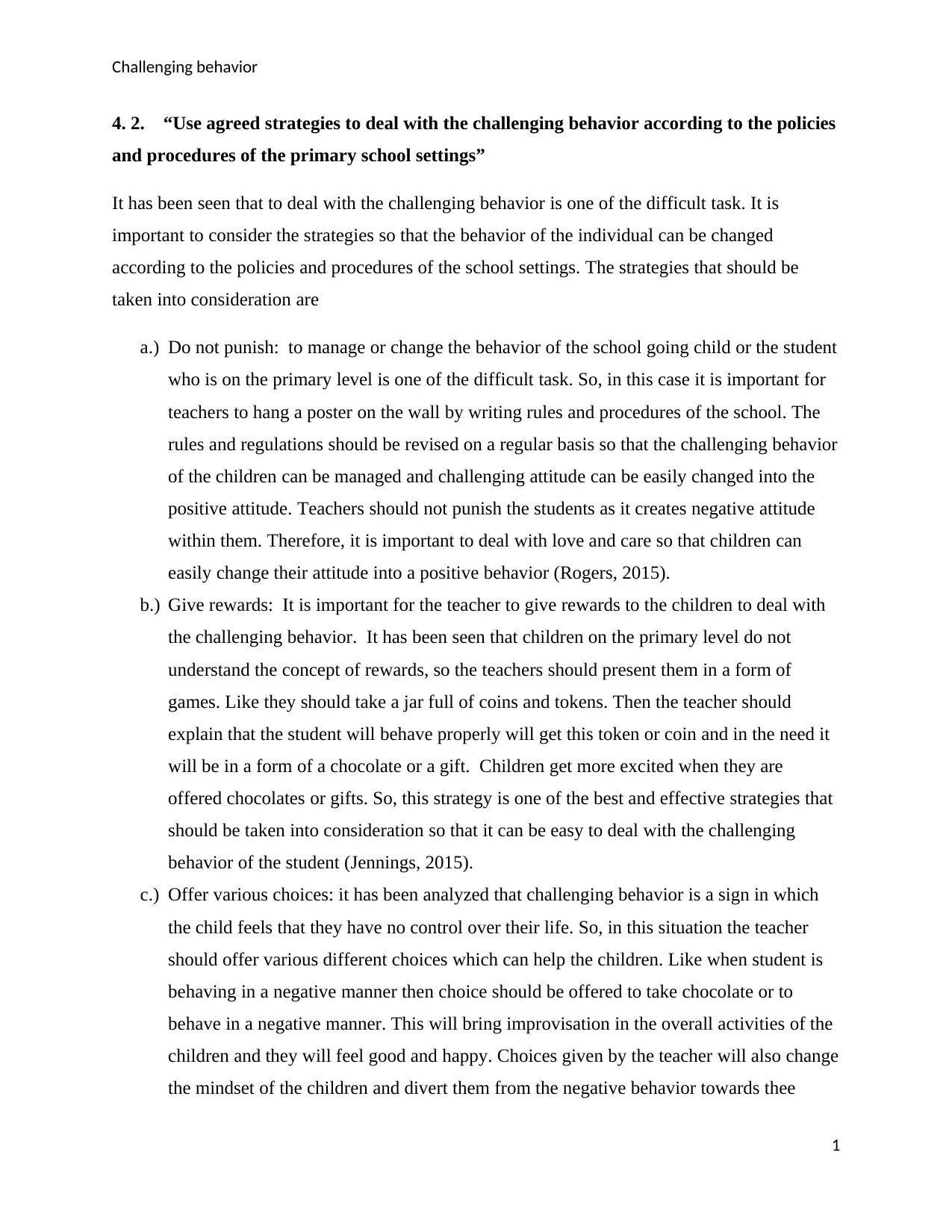
4. 2. “Use agreed strategies to deal with the challenging behavior according to the policies
and procedures of the primary school settings”
It has been seen that to deal with the challenging behavior is one of the difficult task. It is
important to consider the strategies so that the behavior of the individual can be changed
according to the policies and procedures of the school settings. The strategies that should be
taken into consideration are
a.) Do not punish: to manage or change the behavior of the school going child or the student
who is on the primary level is one of the difficult task. So, in this case it is important for
teachers to hang a poster on the wall by writing rules and procedures of the school. The
rules and regulations should be revised on a regular basis so that the challenging behavior
of the children can be managed and challenging attitude can be easily changed into the
positive attitude. Teachers should not punish the students as it creates negative attitude
within them. Therefore, it is important to deal with love and care so that children can
easily change their attitude into a positive behavior (Rogers, 2015).
b.) Give rewards: It is important for the teacher to give rewards to the children to deal with
the challenging behavior. It has been seen that children on the primary level do not
understand the concept of rewards, so the teachers should present them in a form of
games. Like they should take a jar full of coins and tokens. Then the teacher should
explain that the student will behave properly will get this token or coin and in the need it
will be in a form of a chocolate or a gift. Children get more excited when they are
offered chocolates or gifts. So, this strategy is one of the best and effective strategies that
should be taken into consideration so that it can be easy to deal with the challenging
behavior of the student (Jennings, 2015).
c.) Offer various choices: it has been analyzed that challenging behavior is a sign in which
the child feels that they have no control over their life. So, in this situation the teacher
should offer various different choices which can help the children. Like when student is
behaving in a negative manner then choice should be offered to take chocolate or to
behave in a negative manner. This will bring improvisation in the overall activities of the
children and they will feel good and happy. Choices given by the teacher will also change
the mindset of the children and divert them from the negative behavior towards thee
1
Document Page
Challenging behavior
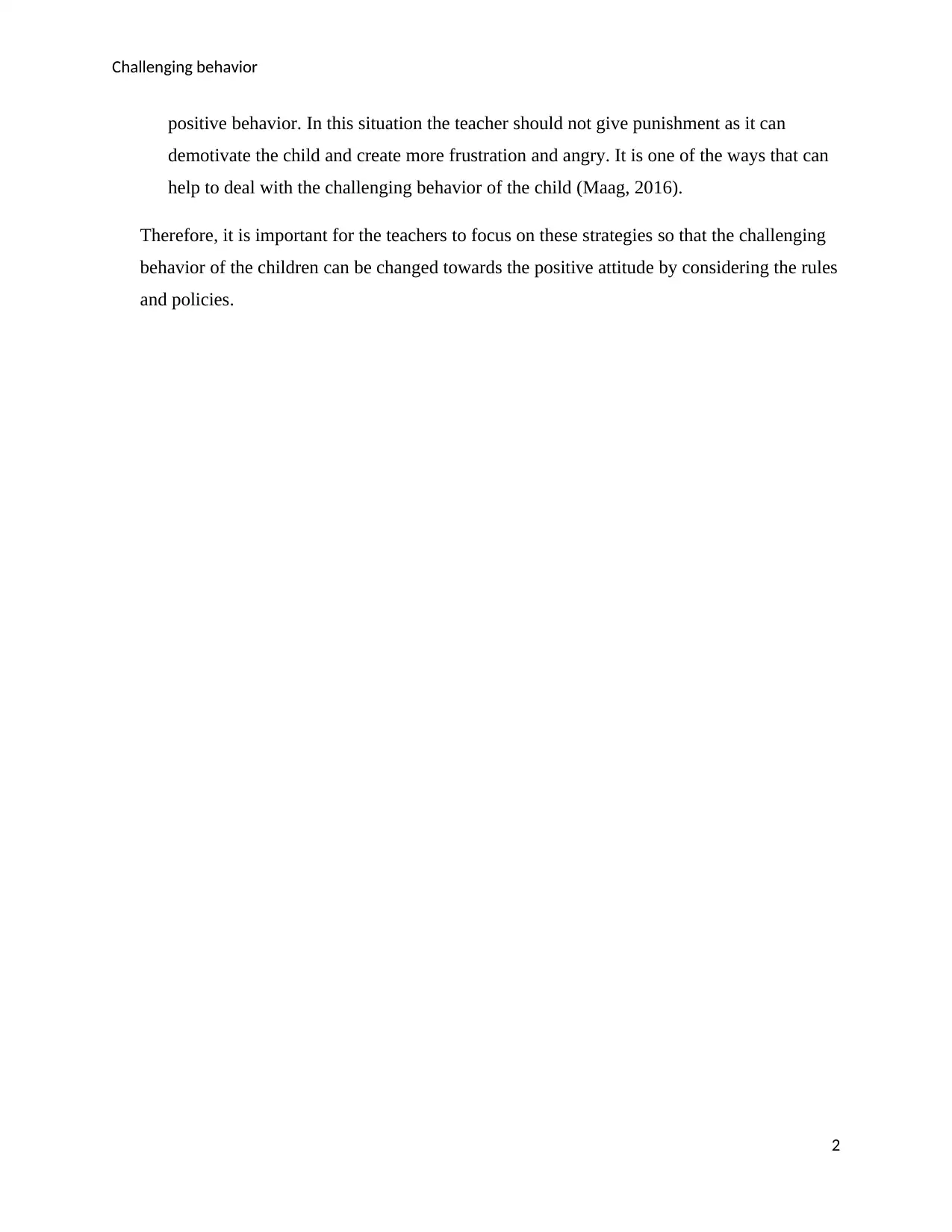
positive behavior. In this situation the teacher should not give punishment as it can
demotivate the child and create more frustration and angry. It is one of the ways that can
help to deal with the challenging behavior of the child (Maag, 2016).
Therefore, it is important for the teachers to focus on these strategies so that the challenging
behavior of the children can be changed towards the positive attitude by considering the rules
and policies.
2
Document Page
Challenging behavior
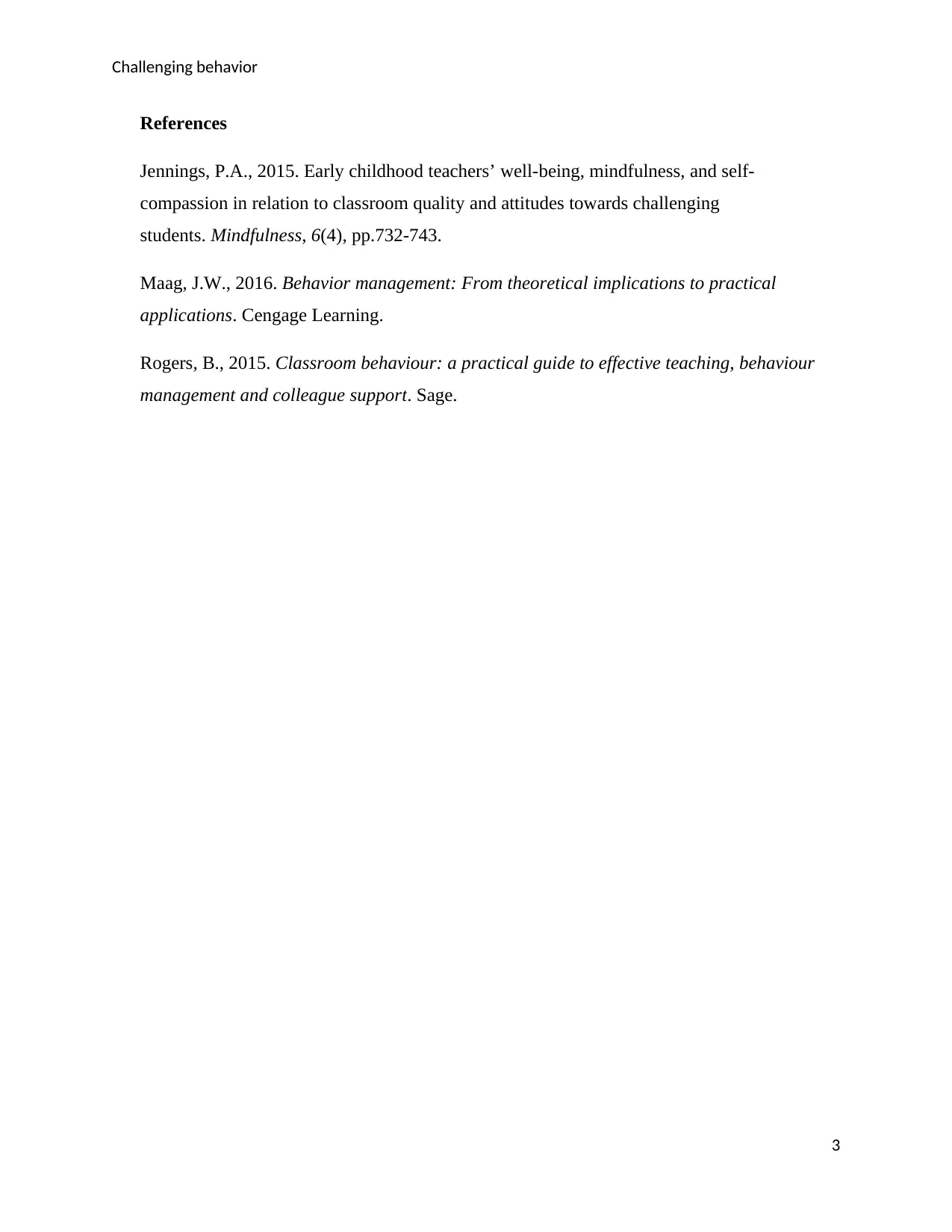
References
Jennings, P.A., 2015. Early childhood teachers’ well-being, mindfulness, and self-
compassion in relation to classroom quality and attitudes towards challenging
students. Mindfulness, 6(4), pp.732-743.
Maag, J.W., 2016. Behavior management: From theoretical implications to practical
applications. Cengage Learning.
Rogers, B., 2015. Classroom behaviour: a practical guide to effective teaching, behaviour
management and colleague support. Sage.
3
chevron_up_icon
1 out of 4
circle_padding
hide_on_mobile
zoom_out_icon
[object Object]