Exploring Interventions for Learning Disability Challenges
VerifiedAdded on 2022/11/28
|15
|5449
|448
Report
AI Summary
This research report delves into the nature of learning disabilities and effective interventions for managing challenging behaviors. It examines the skills required by staff, explores current practices in the UK, USA, and Australia, and identifies ways to improve the standard of living for individuals with learning disabilities. The report covers causation, treatment, and the importance of communication, patience, and special education. It highlights strategies such as encouraging social activities, providing training for professionals, and creating supportive environments. The methodology includes a detailed search strategy and inclusion/exclusion criteria. The findings are based on research articles and expert documentation, concluding with recommendations for improving the quality of life for people with learning disabilities.

Research Project

Paraphrase This Document
Need a fresh take? Get an instant paraphrase of this document with our AI Paraphraser
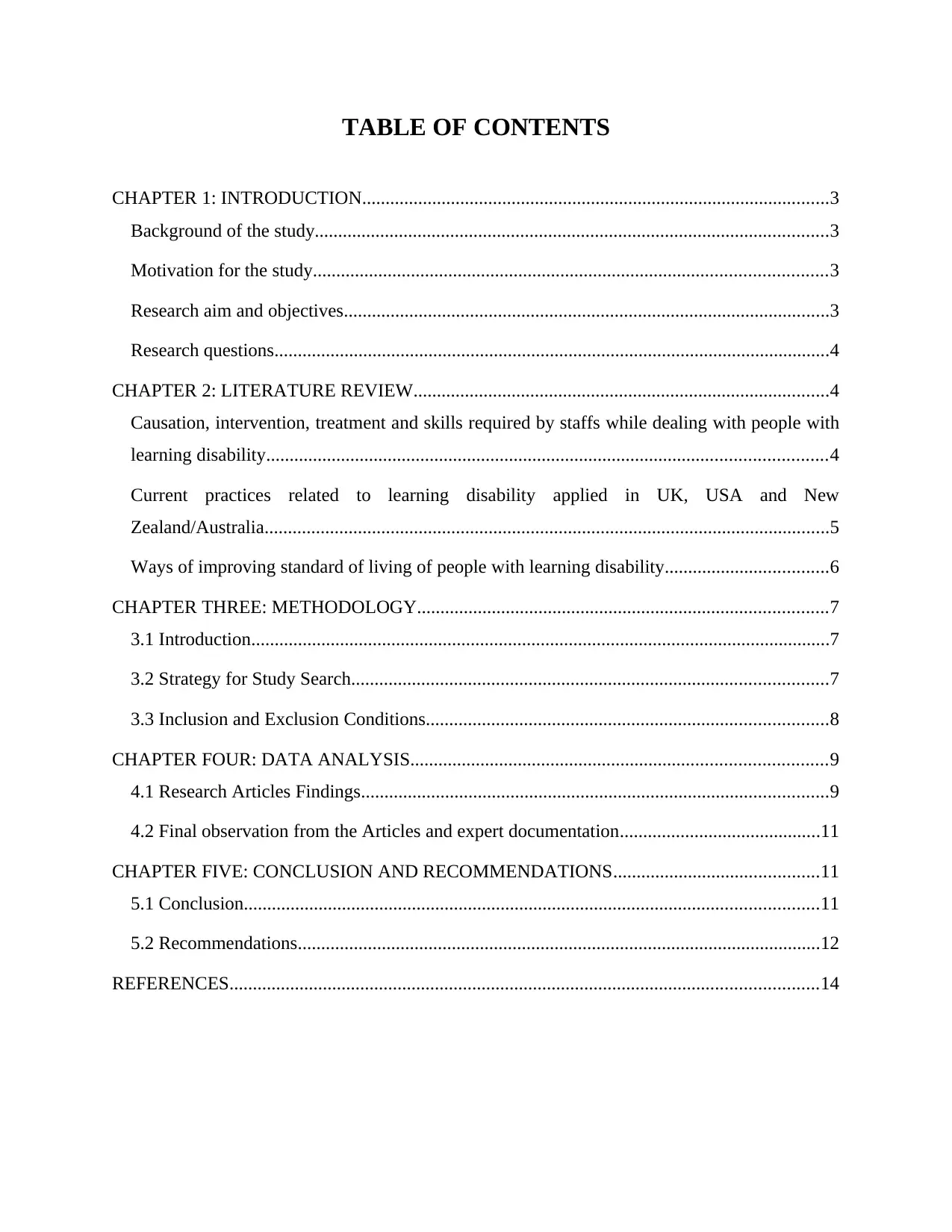
TABLE OF CONTENTS
CHAPTER 1: INTRODUCTION....................................................................................................3
Background of the study..............................................................................................................3
Motivation for the study..............................................................................................................3
Research aim and objectives........................................................................................................3
Research questions.......................................................................................................................4
CHAPTER 2: LITERATURE REVIEW.........................................................................................4
Causation, intervention, treatment and skills required by staffs while dealing with people with
learning disability........................................................................................................................4
Current practices related to learning disability applied in UK, USA and New
Zealand/Australia.........................................................................................................................5
Ways of improving standard of living of people with learning disability...................................6
CHAPTER THREE: METHODOLOGY........................................................................................7
3.1 Introduction............................................................................................................................7
3.2 Strategy for Study Search......................................................................................................7
3.3 Inclusion and Exclusion Conditions......................................................................................8
CHAPTER FOUR: DATA ANALYSIS.........................................................................................9
4.1 Research Articles Findings....................................................................................................9
4.2 Final observation from the Articles and expert documentation...........................................11
CHAPTER FIVE: CONCLUSION AND RECOMMENDATIONS............................................11
5.1 Conclusion...........................................................................................................................11
5.2 Recommendations................................................................................................................12
REFERENCES..............................................................................................................................14
CHAPTER 1: INTRODUCTION....................................................................................................3
Background of the study..............................................................................................................3
Motivation for the study..............................................................................................................3
Research aim and objectives........................................................................................................3
Research questions.......................................................................................................................4
CHAPTER 2: LITERATURE REVIEW.........................................................................................4
Causation, intervention, treatment and skills required by staffs while dealing with people with
learning disability........................................................................................................................4
Current practices related to learning disability applied in UK, USA and New
Zealand/Australia.........................................................................................................................5
Ways of improving standard of living of people with learning disability...................................6
CHAPTER THREE: METHODOLOGY........................................................................................7
3.1 Introduction............................................................................................................................7
3.2 Strategy for Study Search......................................................................................................7
3.3 Inclusion and Exclusion Conditions......................................................................................8
CHAPTER FOUR: DATA ANALYSIS.........................................................................................9
4.1 Research Articles Findings....................................................................................................9
4.2 Final observation from the Articles and expert documentation...........................................11
CHAPTER FIVE: CONCLUSION AND RECOMMENDATIONS............................................11
5.1 Conclusion...........................................................................................................................11
5.2 Recommendations................................................................................................................12
REFERENCES..............................................................................................................................14
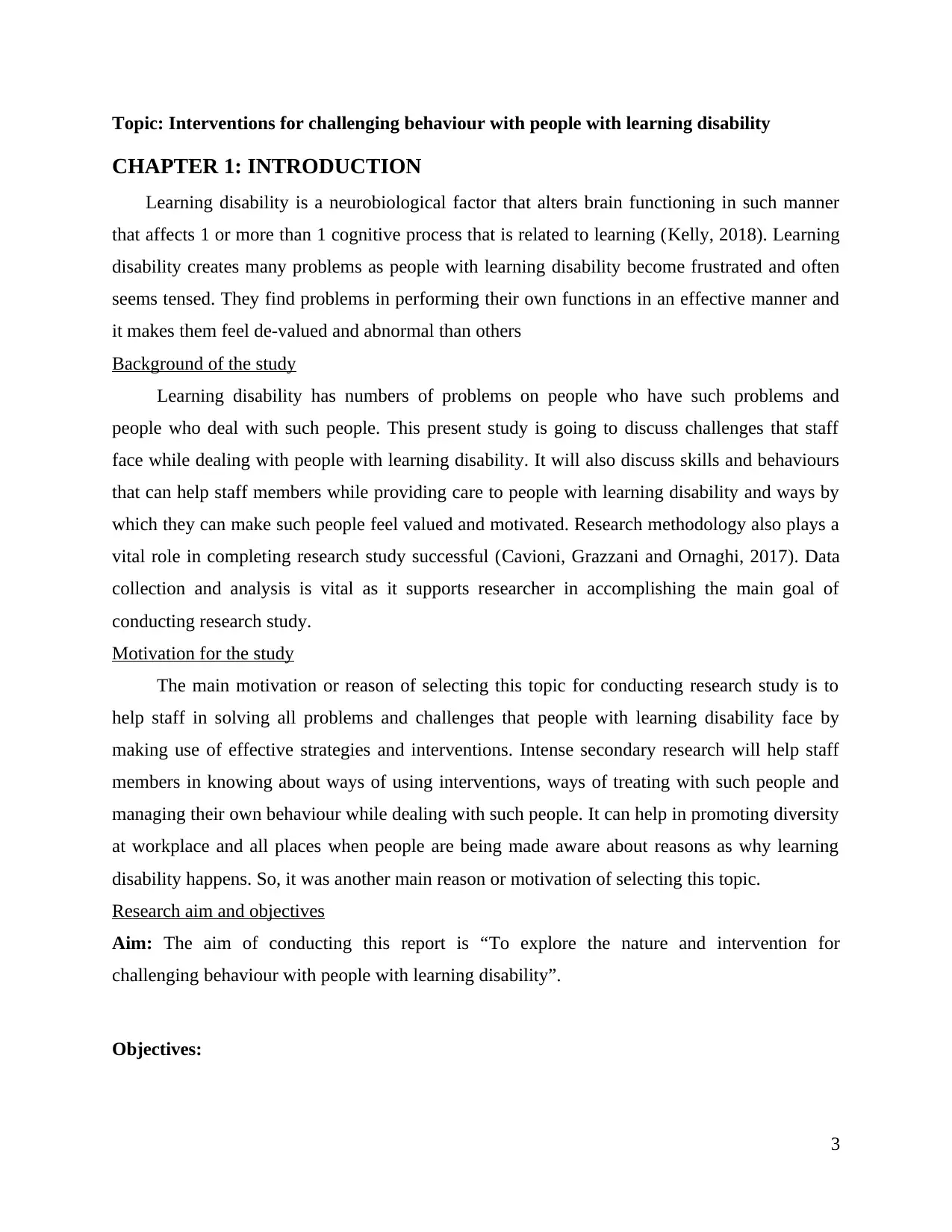
Topic: Interventions for challenging behaviour with people with learning disability
CHAPTER 1: INTRODUCTION
Learning disability is a neurobiological factor that alters brain functioning in such manner
that affects 1 or more than 1 cognitive process that is related to learning (Kelly, 2018). Learning
disability creates many problems as people with learning disability become frustrated and often
seems tensed. They find problems in performing their own functions in an effective manner and
it makes them feel de-valued and abnormal than others
Background of the study
Learning disability has numbers of problems on people who have such problems and
people who deal with such people. This present study is going to discuss challenges that staff
face while dealing with people with learning disability. It will also discuss skills and behaviours
that can help staff members while providing care to people with learning disability and ways by
which they can make such people feel valued and motivated. Research methodology also plays a
vital role in completing research study successful (Cavioni, Grazzani and Ornaghi, 2017). Data
collection and analysis is vital as it supports researcher in accomplishing the main goal of
conducting research study.
Motivation for the study
The main motivation or reason of selecting this topic for conducting research study is to
help staff in solving all problems and challenges that people with learning disability face by
making use of effective strategies and interventions. Intense secondary research will help staff
members in knowing about ways of using interventions, ways of treating with such people and
managing their own behaviour while dealing with such people. It can help in promoting diversity
at workplace and all places when people are being made aware about reasons as why learning
disability happens. So, it was another main reason or motivation of selecting this topic.
Research aim and objectives
Aim: The aim of conducting this report is “To explore the nature and intervention for
challenging behaviour with people with learning disability”.
Objectives:
3
CHAPTER 1: INTRODUCTION
Learning disability is a neurobiological factor that alters brain functioning in such manner
that affects 1 or more than 1 cognitive process that is related to learning (Kelly, 2018). Learning
disability creates many problems as people with learning disability become frustrated and often
seems tensed. They find problems in performing their own functions in an effective manner and
it makes them feel de-valued and abnormal than others
Background of the study
Learning disability has numbers of problems on people who have such problems and
people who deal with such people. This present study is going to discuss challenges that staff
face while dealing with people with learning disability. It will also discuss skills and behaviours
that can help staff members while providing care to people with learning disability and ways by
which they can make such people feel valued and motivated. Research methodology also plays a
vital role in completing research study successful (Cavioni, Grazzani and Ornaghi, 2017). Data
collection and analysis is vital as it supports researcher in accomplishing the main goal of
conducting research study.
Motivation for the study
The main motivation or reason of selecting this topic for conducting research study is to
help staff in solving all problems and challenges that people with learning disability face by
making use of effective strategies and interventions. Intense secondary research will help staff
members in knowing about ways of using interventions, ways of treating with such people and
managing their own behaviour while dealing with such people. It can help in promoting diversity
at workplace and all places when people are being made aware about reasons as why learning
disability happens. So, it was another main reason or motivation of selecting this topic.
Research aim and objectives
Aim: The aim of conducting this report is “To explore the nature and intervention for
challenging behaviour with people with learning disability”.
Objectives:
3
⊘ This is a preview!⊘
Do you want full access?
Subscribe today to unlock all pages.

Trusted by 1+ million students worldwide
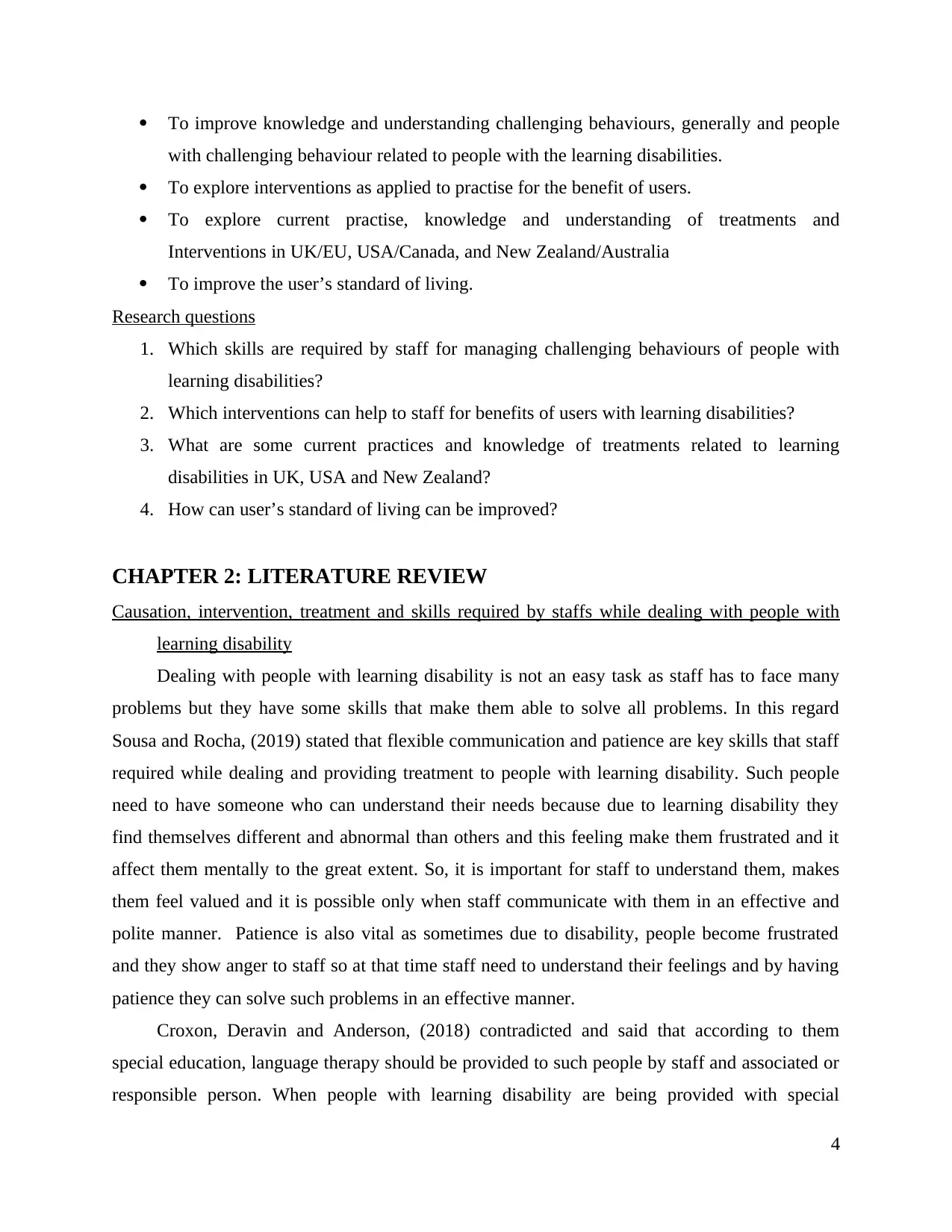
To improve knowledge and understanding challenging behaviours, generally and people
with challenging behaviour related to people with the learning disabilities.
To explore interventions as applied to practise for the benefit of users.
To explore current practise, knowledge and understanding of treatments and
Interventions in UK/EU, USA/Canada, and New Zealand/Australia
To improve the user’s standard of living.
Research questions
1. Which skills are required by staff for managing challenging behaviours of people with
learning disabilities?
2. Which interventions can help to staff for benefits of users with learning disabilities?
3. What are some current practices and knowledge of treatments related to learning
disabilities in UK, USA and New Zealand?
4. How can user’s standard of living can be improved?
CHAPTER 2: LITERATURE REVIEW
Causation, intervention, treatment and skills required by staffs while dealing with people with
learning disability
Dealing with people with learning disability is not an easy task as staff has to face many
problems but they have some skills that make them able to solve all problems. In this regard
Sousa and Rocha, (2019) stated that flexible communication and patience are key skills that staff
required while dealing and providing treatment to people with learning disability. Such people
need to have someone who can understand their needs because due to learning disability they
find themselves different and abnormal than others and this feeling make them frustrated and it
affect them mentally to the great extent. So, it is important for staff to understand them, makes
them feel valued and it is possible only when staff communicate with them in an effective and
polite manner. Patience is also vital as sometimes due to disability, people become frustrated
and they show anger to staff so at that time staff need to understand their feelings and by having
patience they can solve such problems in an effective manner.
Croxon, Deravin and Anderson, (2018) contradicted and said that according to them
special education, language therapy should be provided to such people by staff and associated or
responsible person. When people with learning disability are being provided with special
4
with challenging behaviour related to people with the learning disabilities.
To explore interventions as applied to practise for the benefit of users.
To explore current practise, knowledge and understanding of treatments and
Interventions in UK/EU, USA/Canada, and New Zealand/Australia
To improve the user’s standard of living.
Research questions
1. Which skills are required by staff for managing challenging behaviours of people with
learning disabilities?
2. Which interventions can help to staff for benefits of users with learning disabilities?
3. What are some current practices and knowledge of treatments related to learning
disabilities in UK, USA and New Zealand?
4. How can user’s standard of living can be improved?
CHAPTER 2: LITERATURE REVIEW
Causation, intervention, treatment and skills required by staffs while dealing with people with
learning disability
Dealing with people with learning disability is not an easy task as staff has to face many
problems but they have some skills that make them able to solve all problems. In this regard
Sousa and Rocha, (2019) stated that flexible communication and patience are key skills that staff
required while dealing and providing treatment to people with learning disability. Such people
need to have someone who can understand their needs because due to learning disability they
find themselves different and abnormal than others and this feeling make them frustrated and it
affect them mentally to the great extent. So, it is important for staff to understand them, makes
them feel valued and it is possible only when staff communicate with them in an effective and
polite manner. Patience is also vital as sometimes due to disability, people become frustrated
and they show anger to staff so at that time staff need to understand their feelings and by having
patience they can solve such problems in an effective manner.
Croxon, Deravin and Anderson, (2018) contradicted and said that according to them
special education, language therapy should be provided to such people by staff and associated or
responsible person. When people with learning disability are being provided with special
4
Paraphrase This Document
Need a fresh take? Get an instant paraphrase of this document with our AI Paraphraser
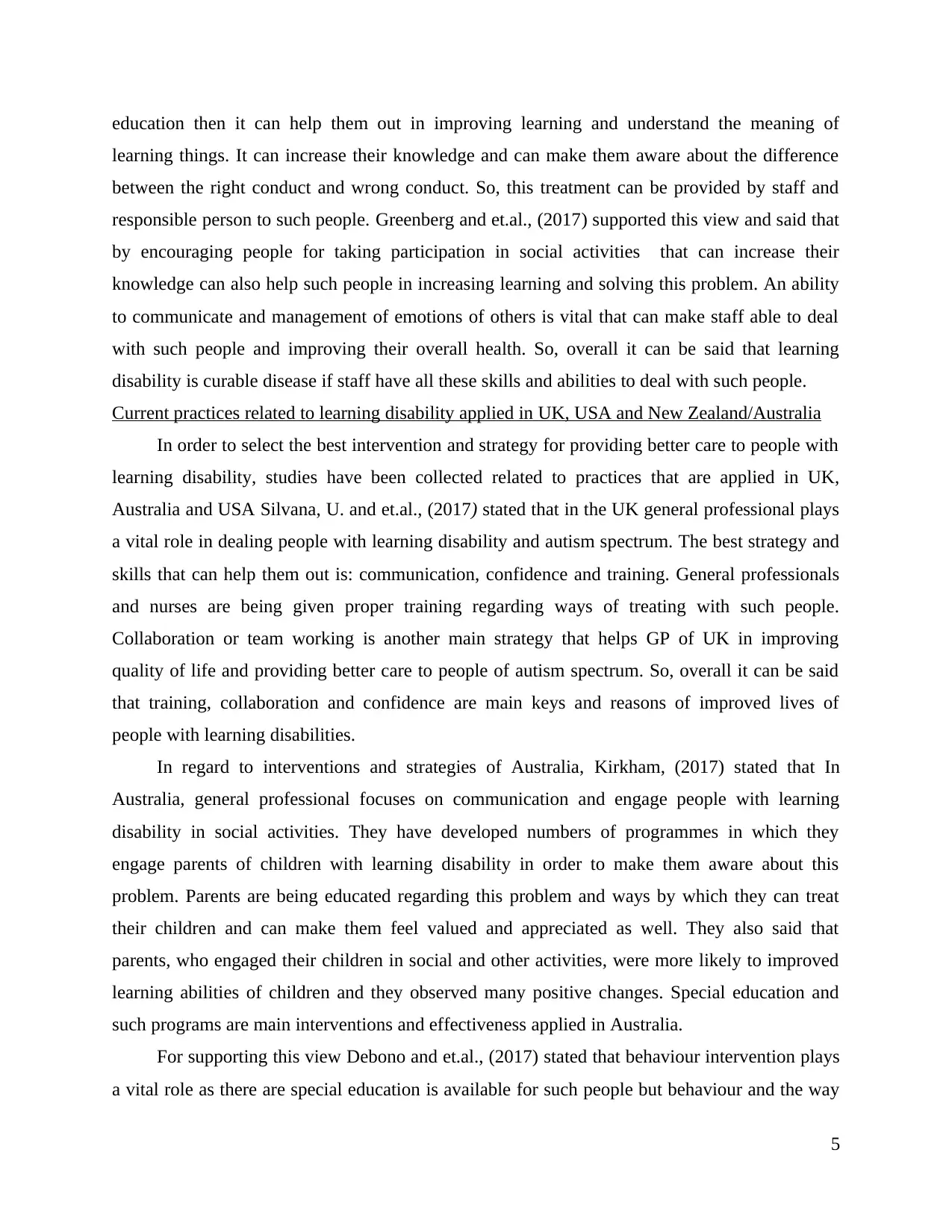
education then it can help them out in improving learning and understand the meaning of
learning things. It can increase their knowledge and can make them aware about the difference
between the right conduct and wrong conduct. So, this treatment can be provided by staff and
responsible person to such people. Greenberg and et.al., (2017) supported this view and said that
by encouraging people for taking participation in social activities that can increase their
knowledge can also help such people in increasing learning and solving this problem. An ability
to communicate and management of emotions of others is vital that can make staff able to deal
with such people and improving their overall health. So, overall it can be said that learning
disability is curable disease if staff have all these skills and abilities to deal with such people.
Current practices related to learning disability applied in UK, USA and New Zealand/Australia
In order to select the best intervention and strategy for providing better care to people with
learning disability, studies have been collected related to practices that are applied in UK,
Australia and USA Silvana, U. and et.al., (2017) stated that in the UK general professional plays
a vital role in dealing people with learning disability and autism spectrum. The best strategy and
skills that can help them out is: communication, confidence and training. General professionals
and nurses are being given proper training regarding ways of treating with such people.
Collaboration or team working is another main strategy that helps GP of UK in improving
quality of life and providing better care to people of autism spectrum. So, overall it can be said
that training, collaboration and confidence are main keys and reasons of improved lives of
people with learning disabilities.
In regard to interventions and strategies of Australia, Kirkham, (2017) stated that In
Australia, general professional focuses on communication and engage people with learning
disability in social activities. They have developed numbers of programmes in which they
engage parents of children with learning disability in order to make them aware about this
problem. Parents are being educated regarding this problem and ways by which they can treat
their children and can make them feel valued and appreciated as well. They also said that
parents, who engaged their children in social and other activities, were more likely to improved
learning abilities of children and they observed many positive changes. Special education and
such programs are main interventions and effectiveness applied in Australia.
For supporting this view Debono and et.al., (2017) stated that behaviour intervention plays
a vital role as there are special education is available for such people but behaviour and the way
5
learning things. It can increase their knowledge and can make them aware about the difference
between the right conduct and wrong conduct. So, this treatment can be provided by staff and
responsible person to such people. Greenberg and et.al., (2017) supported this view and said that
by encouraging people for taking participation in social activities that can increase their
knowledge can also help such people in increasing learning and solving this problem. An ability
to communicate and management of emotions of others is vital that can make staff able to deal
with such people and improving their overall health. So, overall it can be said that learning
disability is curable disease if staff have all these skills and abilities to deal with such people.
Current practices related to learning disability applied in UK, USA and New Zealand/Australia
In order to select the best intervention and strategy for providing better care to people with
learning disability, studies have been collected related to practices that are applied in UK,
Australia and USA Silvana, U. and et.al., (2017) stated that in the UK general professional plays
a vital role in dealing people with learning disability and autism spectrum. The best strategy and
skills that can help them out is: communication, confidence and training. General professionals
and nurses are being given proper training regarding ways of treating with such people.
Collaboration or team working is another main strategy that helps GP of UK in improving
quality of life and providing better care to people of autism spectrum. So, overall it can be said
that training, collaboration and confidence are main keys and reasons of improved lives of
people with learning disabilities.
In regard to interventions and strategies of Australia, Kirkham, (2017) stated that In
Australia, general professional focuses on communication and engage people with learning
disability in social activities. They have developed numbers of programmes in which they
engage parents of children with learning disability in order to make them aware about this
problem. Parents are being educated regarding this problem and ways by which they can treat
their children and can make them feel valued and appreciated as well. They also said that
parents, who engaged their children in social and other activities, were more likely to improved
learning abilities of children and they observed many positive changes. Special education and
such programs are main interventions and effectiveness applied in Australia.
For supporting this view Debono and et.al., (2017) stated that behaviour intervention plays
a vital role as there are special education is available for such people but behaviour and the way
5
of treating with them is vital. The way in which people treat with people with learning
disabilities help them out in improving their learning as it boost their confidence and encourage
them to live a healthy and peaceful life. Healthy and nutritional values of food also improve their
mood and make them feel valued and it helps them out in concentrating on their activities.
Ways of improving standard of living of people with learning disability
There are numbers of ways and strategies by which standard of living of people with
learning disabilities can be improved. According to Colver and et.al., (2018) one of the best way
of making people with learning disability feel valued and improving their standard of living is:
improving the atmosphere at home and places where they live. It is believed that atmosphere and
surrounding plays a vital role in increasing our knowledge, making us active and making us
positive. For example: people who live in homes with plants, open balconies and societies where
all people perform social activities are more likely to feel active and energetic all the time.
People who have willing to learn new things also play a vital role and by engaging with such
people, standard of living of such people with disability can be improved.
Camm-Crosbie and et.al., (2019) stated that people with learning disabilities are being
isolated in the society that makes them feel de-valued. So, it is important for all people to
understand their needs and requirements of improving their living standard. By knowing their
needs, society members should treat with such people in an effective manner with extra care.
They should be allowed in all social activities and all activities that can make them feel pleased
and happy. Happiness is the main key of improved life. In addition, Thabtah, (2019) stated that
In Iceland, some people and partners provided special care to such people. Styrktarfelag, non-
profit organization in Iceland is responsible for provision of services for people with intellectual
disabilities and that is why it started providing care such as: adult employment, children’s day
care, independent living and others. All these actions helped them out in improving overall
standard of such people and made them able to live a healthy and peaceful life. Other countries
are also striving hard for providing all these care to people with disabilities in order to improve
their lives and standard. So, overall it can be said that all these activities and proper care can help
such people and can improve quality of lives and can promote diversity Improving Quality of
Life for People with Disabilities, (2020).
6
disabilities help them out in improving their learning as it boost their confidence and encourage
them to live a healthy and peaceful life. Healthy and nutritional values of food also improve their
mood and make them feel valued and it helps them out in concentrating on their activities.
Ways of improving standard of living of people with learning disability
There are numbers of ways and strategies by which standard of living of people with
learning disabilities can be improved. According to Colver and et.al., (2018) one of the best way
of making people with learning disability feel valued and improving their standard of living is:
improving the atmosphere at home and places where they live. It is believed that atmosphere and
surrounding plays a vital role in increasing our knowledge, making us active and making us
positive. For example: people who live in homes with plants, open balconies and societies where
all people perform social activities are more likely to feel active and energetic all the time.
People who have willing to learn new things also play a vital role and by engaging with such
people, standard of living of such people with disability can be improved.
Camm-Crosbie and et.al., (2019) stated that people with learning disabilities are being
isolated in the society that makes them feel de-valued. So, it is important for all people to
understand their needs and requirements of improving their living standard. By knowing their
needs, society members should treat with such people in an effective manner with extra care.
They should be allowed in all social activities and all activities that can make them feel pleased
and happy. Happiness is the main key of improved life. In addition, Thabtah, (2019) stated that
In Iceland, some people and partners provided special care to such people. Styrktarfelag, non-
profit organization in Iceland is responsible for provision of services for people with intellectual
disabilities and that is why it started providing care such as: adult employment, children’s day
care, independent living and others. All these actions helped them out in improving overall
standard of such people and made them able to live a healthy and peaceful life. Other countries
are also striving hard for providing all these care to people with disabilities in order to improve
their lives and standard. So, overall it can be said that all these activities and proper care can help
such people and can improve quality of lives and can promote diversity Improving Quality of
Life for People with Disabilities, (2020).
6
⊘ This is a preview!⊘
Do you want full access?
Subscribe today to unlock all pages.
Trusted by 1+ million students worldwide
CHAPTER THREE: METHODOLOGY
3.1 Introduction
The research methodology basically refers to the practical ways of carrying out the
research. Also, this deals in the ways in which researcher systematically designs a study for
ensuring reliable and valid results which can help in addressing the aims and objectives of the
research. This focuses on various aspects of the research such as the data which is collected,
ways in which it will be collected, ways in which it is analysed and many more other aspects.
The chapter of methodology must help in justifying that the choices of design made are best fit
for the aim and objectives of the research and will help in providing valid and reliable results. If
the research methodology is good and appropriate, then this can help in providing scientifically
sound findings which is not possible with the poor methodology. This research methodology will
focus on the strategies for gaining insights about the challenging behaviours with the people who
are having learning disabilities (Hsiao, 2018). This will also focus on the causes of the same in
the people of UK, USA and Australia. The research methodology will also be chosen such that it
can help in identifying the interventions and their benefits for the people with learning
disabilities and their challenging behaviours. The strategies for the search will also help in
identifying the skills which are required in the users for managing those challenging behaviours
(Bouck, Satsangi and Park, 2018). It will include the major aspects including the strategy of
search and inclusion and exclusion criteria. This is how; the appropriate research methodology
will help in achieving the objectives of this research which is to identify and meet up the
challenging behaviours of the people with learning disabilities.
3.2 Strategy for Study Search
There are various strategies developed and implemented by the researcher for carrying out the
research and answering the research questions. These strategies include primary and secondary.
There is a need for choosing the appropriate strategy according to the research aims and
objectives. Primary strategies deal with the primary data collection which is written and collected
by the researcher itself. This can also be evaluated that primary strategies includes the
interviews, fieldworks, surveys, questionnaires, internet communications through blogs, emails
etc. On the other hand, the secondary strategies include secondary data collection which means
the researcher collects the information which is already collected or published by some other
7
3.1 Introduction
The research methodology basically refers to the practical ways of carrying out the
research. Also, this deals in the ways in which researcher systematically designs a study for
ensuring reliable and valid results which can help in addressing the aims and objectives of the
research. This focuses on various aspects of the research such as the data which is collected,
ways in which it will be collected, ways in which it is analysed and many more other aspects.
The chapter of methodology must help in justifying that the choices of design made are best fit
for the aim and objectives of the research and will help in providing valid and reliable results. If
the research methodology is good and appropriate, then this can help in providing scientifically
sound findings which is not possible with the poor methodology. This research methodology will
focus on the strategies for gaining insights about the challenging behaviours with the people who
are having learning disabilities (Hsiao, 2018). This will also focus on the causes of the same in
the people of UK, USA and Australia. The research methodology will also be chosen such that it
can help in identifying the interventions and their benefits for the people with learning
disabilities and their challenging behaviours. The strategies for the search will also help in
identifying the skills which are required in the users for managing those challenging behaviours
(Bouck, Satsangi and Park, 2018). It will include the major aspects including the strategy of
search and inclusion and exclusion criteria. This is how; the appropriate research methodology
will help in achieving the objectives of this research which is to identify and meet up the
challenging behaviours of the people with learning disabilities.
3.2 Strategy for Study Search
There are various strategies developed and implemented by the researcher for carrying out the
research and answering the research questions. These strategies include primary and secondary.
There is a need for choosing the appropriate strategy according to the research aims and
objectives. Primary strategies deal with the primary data collection which is written and collected
by the researcher itself. This can also be evaluated that primary strategies includes the
interviews, fieldworks, surveys, questionnaires, internet communications through blogs, emails
etc. On the other hand, the secondary strategies include secondary data collection which means
the researcher collects the information which is already collected or published by some other
7
Paraphrase This Document
Need a fresh take? Get an instant paraphrase of this document with our AI Paraphraser
researchers or publishers. Through these strategies, the researcher lists, summarizes compares
and critically evaluates the information gained for drawing significant conclusions and also helps
in presenting current state of knowledge in particular subject or discipline. The secondary
sources include the systematic reviews, meta-analysis, reviews, clinical care notes, patient
education information, government and legal information, newsletters and many more. This
research will focus on the various secondary sources including books, journals, publications
which are available on the Google scholar platform, the various other platforms for healthcare
related databanks such as Medline, ScienceDirect, Pubmed, Tandfonline, National Health Se
Economic evaluation database (NHS EED), Wiley Online Library and many more. All the
sources will be selected by considering the aims and objectives of the research and must be
related to the specific study topic (Whittle and et.al., 2018). The secondary resources chosen
must help in gaining valuable insights about the challenging behaviour of the individuals who
suffer from learning disability and also which can help in resolving the issues of the same along
with finding strategies which can help the users in managing the challenging behaviour of the
people with learning disabilities. The selected data will be critically analysed and presented in
the literature review. Various themes will be developed according to the objectives of research.
Online data will also be collected through various internet sources because internet provides
wide variety of data from funded and free research resources which can be simply accessed with
the button click. Data will also be collected through government and non-government archives
(Lahana and et.al., 2017). These records and documentations contain various certifiable
information which helps in gaining valuable and in-depth insights on various research contexts.
The data will be analysed through thematic analysis in which data from the different sources will
be analysed through theoretical analysis. This will help in gaining significant outcomes and will
also help in answering the research questions based on the challenging behaviour of the people
having learning disabilities.
3.3 Inclusion and Exclusion Conditions
Inclusion and exclusion conditions play the most important role during the selection of
secondary resources as these limits the researcher to only some sources instead of taking
information from each one of them. Inclusion criteria are basically the characteristics which must
be included in the prospective subjects whereas on the other hand, the exclusion criteria includes
those characteristics which must disqualify the subjects from included in the study. This is how;
8
and critically evaluates the information gained for drawing significant conclusions and also helps
in presenting current state of knowledge in particular subject or discipline. The secondary
sources include the systematic reviews, meta-analysis, reviews, clinical care notes, patient
education information, government and legal information, newsletters and many more. This
research will focus on the various secondary sources including books, journals, publications
which are available on the Google scholar platform, the various other platforms for healthcare
related databanks such as Medline, ScienceDirect, Pubmed, Tandfonline, National Health Se
Economic evaluation database (NHS EED), Wiley Online Library and many more. All the
sources will be selected by considering the aims and objectives of the research and must be
related to the specific study topic (Whittle and et.al., 2018). The secondary resources chosen
must help in gaining valuable insights about the challenging behaviour of the individuals who
suffer from learning disability and also which can help in resolving the issues of the same along
with finding strategies which can help the users in managing the challenging behaviour of the
people with learning disabilities. The selected data will be critically analysed and presented in
the literature review. Various themes will be developed according to the objectives of research.
Online data will also be collected through various internet sources because internet provides
wide variety of data from funded and free research resources which can be simply accessed with
the button click. Data will also be collected through government and non-government archives
(Lahana and et.al., 2017). These records and documentations contain various certifiable
information which helps in gaining valuable and in-depth insights on various research contexts.
The data will be analysed through thematic analysis in which data from the different sources will
be analysed through theoretical analysis. This will help in gaining significant outcomes and will
also help in answering the research questions based on the challenging behaviour of the people
having learning disabilities.
3.3 Inclusion and Exclusion Conditions
Inclusion and exclusion conditions play the most important role during the selection of
secondary resources as these limits the researcher to only some sources instead of taking
information from each one of them. Inclusion criteria are basically the characteristics which must
be included in the prospective subjects whereas on the other hand, the exclusion criteria includes
those characteristics which must disqualify the subjects from included in the study. This is how;
8
the inclusion as well as exclusion criteria helps in defining what to be included and what to be
excluded. The inclusion criteria include the journals which contain keywords such as challenging
behaviour, learning disability, strategies for meeting up issues due to learning disabilities,
interventions for challenging behaviours etc. The sources must be completely in English and no
other language because there is not enough time for translating the information from other
language to English. The data sources with keywords like interventions and staff skills,
dissemination of key information related to causations etc. can also be included at certain levels.
The publications which are published in the last 5 years will be included and also their authors
must be professional and core expertise in the field of particular study which is challenging
behaviour for people with learning disabilities (Bossink, van der Putten and Vlaskamp, 2017).
On the other hand, those articles and journals will be excluded which does not have these
keywords which means which does not talk about challenging behaviour of the people with
learning disabilities. It will also exclude those publications and sources in which the data will be
written in language other than English. Furthermore, the sources which were published before
five years will also be excluded because they will not help in gaining the current information
regarding the people with learning disabilities in UK, US, New Zealand and Australia. The
updated information can help in analysing the new strategies which are implemented for
managing the challenging behaviour of those people. This is how; inclusion and exclusion
criteria will help in deciding the sources which needs to be included and which not. This will
help in carrying out the research in less time and with great efficiency. This will also help in
achieving the significant and desirable research outcomes.
CHAPTER FOUR: DATA ANALYSIS
4.1 Research Articles Findings
This can be observed from the literature review and by going through various secondary
sources that challenging behaviour is basically a behaviour which is displayed by someone and
becomes challenging for others to manage which can also put the other person at risk. This can
be observed that lots of the people having learning disabilities possess behaviours which tend to
be challenging. One study done by Bigby and Beadle‐Brown (2018), helped in evaluating that
the children or the people with learning disabilities often face behaviour problems such as
increased anxiety and stress, reduced self-confidence and many more. Various other symptoms
9
excluded. The inclusion criteria include the journals which contain keywords such as challenging
behaviour, learning disability, strategies for meeting up issues due to learning disabilities,
interventions for challenging behaviours etc. The sources must be completely in English and no
other language because there is not enough time for translating the information from other
language to English. The data sources with keywords like interventions and staff skills,
dissemination of key information related to causations etc. can also be included at certain levels.
The publications which are published in the last 5 years will be included and also their authors
must be professional and core expertise in the field of particular study which is challenging
behaviour for people with learning disabilities (Bossink, van der Putten and Vlaskamp, 2017).
On the other hand, those articles and journals will be excluded which does not have these
keywords which means which does not talk about challenging behaviour of the people with
learning disabilities. It will also exclude those publications and sources in which the data will be
written in language other than English. Furthermore, the sources which were published before
five years will also be excluded because they will not help in gaining the current information
regarding the people with learning disabilities in UK, US, New Zealand and Australia. The
updated information can help in analysing the new strategies which are implemented for
managing the challenging behaviour of those people. This is how; inclusion and exclusion
criteria will help in deciding the sources which needs to be included and which not. This will
help in carrying out the research in less time and with great efficiency. This will also help in
achieving the significant and desirable research outcomes.
CHAPTER FOUR: DATA ANALYSIS
4.1 Research Articles Findings
This can be observed from the literature review and by going through various secondary
sources that challenging behaviour is basically a behaviour which is displayed by someone and
becomes challenging for others to manage which can also put the other person at risk. This can
be observed that lots of the people having learning disabilities possess behaviours which tend to
be challenging. One study done by Bigby and Beadle‐Brown (2018), helped in evaluating that
the children or the people with learning disabilities often face behaviour problems such as
increased anxiety and stress, reduced self-confidence and many more. Various other symptoms
9
⊘ This is a preview!⊘
Do you want full access?
Subscribe today to unlock all pages.
Trusted by 1+ million students worldwide
can also be seen including social isolation and aggressive behaviour. There are various reasons
or causes which can lead to challenging behaviours. There is no single reason for its happening
but it includes the causes such as discomfort, relationships, environment, frustration etc. This can
be observed that the people who have learning disabilities tend to show more challenging
behaviours than other for expressing themselves. The people who provide support to the people
with learning disabilities face various issues and risks such as self harm or self injury which can
be implemented by the person, harm to others which can give harm to other people providing
support, self-neglect, exploitation, neglect or abuse by others, breakdown of the family or the
residential support and rapid escalation of the challenging behaviour. It is must for the carers to
work in partnership with the children and the young people who have learning disability (Crnic
and et.al., 2017). They must involve them in the decisions taken and must also support and
encourage them to become self independent. The severity of the learning disability of the person
must be taken into account along with the communication difficulties or any other physical or
mental health problems at the time of providing support to them. The area chosen for providing
support and interventions must be in setting with least restrictions such as home, near to home,
residential care etc. This must be analysed that the challenging behaviour is due to the unmet
needs or the worst impacts associated with the learning disabilities etc. (Chadwick, Quinn and
Fullwood, 2017) The carers or the practitioners must also know the effect of the physical and
social environment on the learning disabilities and the challenging behaviour which includes the
ways in which staff and carer responds to the behaviour of people.
The people who are the health and social care provider must ensure that the teams they are
having for carrying out the assessments and delivering the appropriate interventions have the
proper training and supervision which can ensure the necessary skills and competencies. This
was also observed that if the interventions are not delivered properly and effectively, then the
person tends to have more complex needs. This is why; the companies and organisations must
ensure that the teams which provide care must have coordinated and prompt access to support,
specialist assessment and intervention services (Pelleboer‐Gunnink and et.al., 2017). Health and
social care provider must ensure that all the people working with the individuals having learning
disability and challenging behaviour are trained enough for delivering proactive strategies for
reducing the behaviour risks including development of personalised daily activities, adaptation of
the environment and routine of the person, importance of including people and the carers in the
10
or causes which can lead to challenging behaviours. There is no single reason for its happening
but it includes the causes such as discomfort, relationships, environment, frustration etc. This can
be observed that the people who have learning disabilities tend to show more challenging
behaviours than other for expressing themselves. The people who provide support to the people
with learning disabilities face various issues and risks such as self harm or self injury which can
be implemented by the person, harm to others which can give harm to other people providing
support, self-neglect, exploitation, neglect or abuse by others, breakdown of the family or the
residential support and rapid escalation of the challenging behaviour. It is must for the carers to
work in partnership with the children and the young people who have learning disability (Crnic
and et.al., 2017). They must involve them in the decisions taken and must also support and
encourage them to become self independent. The severity of the learning disability of the person
must be taken into account along with the communication difficulties or any other physical or
mental health problems at the time of providing support to them. The area chosen for providing
support and interventions must be in setting with least restrictions such as home, near to home,
residential care etc. This must be analysed that the challenging behaviour is due to the unmet
needs or the worst impacts associated with the learning disabilities etc. (Chadwick, Quinn and
Fullwood, 2017) The carers or the practitioners must also know the effect of the physical and
social environment on the learning disabilities and the challenging behaviour which includes the
ways in which staff and carer responds to the behaviour of people.
The people who are the health and social care provider must ensure that the teams they are
having for carrying out the assessments and delivering the appropriate interventions have the
proper training and supervision which can ensure the necessary skills and competencies. This
was also observed that if the interventions are not delivered properly and effectively, then the
person tends to have more complex needs. This is why; the companies and organisations must
ensure that the teams which provide care must have coordinated and prompt access to support,
specialist assessment and intervention services (Pelleboer‐Gunnink and et.al., 2017). Health and
social care provider must ensure that all the people working with the individuals having learning
disability and challenging behaviour are trained enough for delivering proactive strategies for
reducing the behaviour risks including development of personalised daily activities, adaptation of
the environment and routine of the person, importance of including people and the carers in the
10
Paraphrase This Document
Need a fresh take? Get an instant paraphrase of this document with our AI Paraphraser
interventions and planned support, strategies for diverting the person when they show the signs
of distress and also delivering the reactive strategies.
4.2 Final observation from the Articles and expert documentation
The major thing observed from the data and information collected and gathered is that the
organisations must ensure that the staffs also gets emotional and personal support so that the
interventions can be delivered effectively to the people who have learning disability and
challenging behaviour. The staff also faced various problems while providing support to the
people with learning disabilities so they must be able to seek help for the difficulties which arises
due to the interaction with them (Beckmann and Minnaert, 2018). Also, they must be able to
manage their stress which can help in delivering effective care to the individuals. There must be
a designated and responsible leadership team for developing, managing and evaluating the care
pathways. This can also be identified from the research that the involvement of the family
members is must for developing and delivering the support and intervention to children (O'dwyer
and et.al., 2017). The nurses or the practitioners must also make them aware about the
interventions and support in a very understandable and proper language including the NICE’s
information for the public. The major interventions and practices identified through the research
include engaging them in various relaxation techniques and distracting and divert them in such
activities in which they feel enjoying. This can also be observed that they must find ways in
which they can express themselves, they must do the things in which they feel enjoyed and
rewarding, they must be helped by someone in working out common triggers, also the
interventions must be based on the cognitive behavioural principles and must be delivered
individually to the carers and the patient itself. Those people can also be offered with
antipsychotic medications along with psychological or other interventions.
This is how; the research aims at identifying the challenging behaviours of the people having
learning disability and the ways in which these can be met and solved through various
interventions.
CHAPTER FIVE: CONCLUSION AND RECOMMENDATIONS
5.1 Conclusion
It has been summarized from the above study that learning disability create numbers of
problem as it affects people mentally and makes them feel de-valued. Staff or people who
11
of distress and also delivering the reactive strategies.
4.2 Final observation from the Articles and expert documentation
The major thing observed from the data and information collected and gathered is that the
organisations must ensure that the staffs also gets emotional and personal support so that the
interventions can be delivered effectively to the people who have learning disability and
challenging behaviour. The staff also faced various problems while providing support to the
people with learning disabilities so they must be able to seek help for the difficulties which arises
due to the interaction with them (Beckmann and Minnaert, 2018). Also, they must be able to
manage their stress which can help in delivering effective care to the individuals. There must be
a designated and responsible leadership team for developing, managing and evaluating the care
pathways. This can also be identified from the research that the involvement of the family
members is must for developing and delivering the support and intervention to children (O'dwyer
and et.al., 2017). The nurses or the practitioners must also make them aware about the
interventions and support in a very understandable and proper language including the NICE’s
information for the public. The major interventions and practices identified through the research
include engaging them in various relaxation techniques and distracting and divert them in such
activities in which they feel enjoying. This can also be observed that they must find ways in
which they can express themselves, they must do the things in which they feel enjoyed and
rewarding, they must be helped by someone in working out common triggers, also the
interventions must be based on the cognitive behavioural principles and must be delivered
individually to the carers and the patient itself. Those people can also be offered with
antipsychotic medications along with psychological or other interventions.
This is how; the research aims at identifying the challenging behaviours of the people having
learning disability and the ways in which these can be met and solved through various
interventions.
CHAPTER FIVE: CONCLUSION AND RECOMMENDATIONS
5.1 Conclusion
It has been summarized from the above study that learning disability create numbers of
problem as it affects people mentally and makes them feel de-valued. Staff or people who
11
provide care to such people also play a vital role as they help such people in increasing
knowledge and solving all problems by making use of effective strategies. It has further
discussed some strategies, interventions and skills that are required for providing better care to
people with learning disability in order to solve challenges and problems that they face. This
study has shown importance of training to staff and collaboration in order to remain calm,
reducing errors and remaining active while dealing and providing treatment to people with
learning disabilities. It has further discussed some ways and strategies by which all challenges
can be decreased and living standard can be improved of people who have learning disabilities.
Data collection and research methodology also plays a vital role in conducting as well as making
research study successful. It helps researcher in collecting accurate, viable and validate data for
accomplishing goals of conducting research study. Lastly, it has shown application of
interventions related to learning disabilities in UK, USA and Australia in order to know
prevalence and effectiveness of staff and strategies.
5.2 Recommendations
Various recommendations can be provided for improving the quality of life of the people
with learning disabilities who possess challenging behaviour. This include that the professionals,
judgement and practitioners must adhere to the NICE guidelines before implementing the
interventions. The needs and the values of the individuals must be considered which can help in
making decisions which are in the interest of the patient as well as their families and carers. The
main aim must be to improve the support of the person instead of changing the person from
within. The patient must know who to contact in case of any problem and how to contact. The
environmental factors must be equally considered as this also helps in destroying or improving
the challenging behaviours. The patient must be aware of the alternatives for achieving specific
outcomes for example with emotional regulation, social interaction or improved communication.
This must also be recommended that when the person shows early signs of distress, then the
family members or the carers must try to divert the person (Hyman, Levy and Myers, 2020). The
staff providing the care and support must be properly competent and also skilled so that they
cannot only take part in improving the condition but also take part in monitoring the outcomes by
making use of periodic service review method. The patient themselves must be able to manage
their own stress and issues. The carers and the family members must be trained skilfully and
12
knowledge and solving all problems by making use of effective strategies. It has further
discussed some strategies, interventions and skills that are required for providing better care to
people with learning disability in order to solve challenges and problems that they face. This
study has shown importance of training to staff and collaboration in order to remain calm,
reducing errors and remaining active while dealing and providing treatment to people with
learning disabilities. It has further discussed some ways and strategies by which all challenges
can be decreased and living standard can be improved of people who have learning disabilities.
Data collection and research methodology also plays a vital role in conducting as well as making
research study successful. It helps researcher in collecting accurate, viable and validate data for
accomplishing goals of conducting research study. Lastly, it has shown application of
interventions related to learning disabilities in UK, USA and Australia in order to know
prevalence and effectiveness of staff and strategies.
5.2 Recommendations
Various recommendations can be provided for improving the quality of life of the people
with learning disabilities who possess challenging behaviour. This include that the professionals,
judgement and practitioners must adhere to the NICE guidelines before implementing the
interventions. The needs and the values of the individuals must be considered which can help in
making decisions which are in the interest of the patient as well as their families and carers. The
main aim must be to improve the support of the person instead of changing the person from
within. The patient must know who to contact in case of any problem and how to contact. The
environmental factors must be equally considered as this also helps in destroying or improving
the challenging behaviours. The patient must be aware of the alternatives for achieving specific
outcomes for example with emotional regulation, social interaction or improved communication.
This must also be recommended that when the person shows early signs of distress, then the
family members or the carers must try to divert the person (Hyman, Levy and Myers, 2020). The
staff providing the care and support must be properly competent and also skilled so that they
cannot only take part in improving the condition but also take part in monitoring the outcomes by
making use of periodic service review method. The patient themselves must be able to manage
their own stress and issues. The carers and the family members must be trained skilfully and
12
⊘ This is a preview!⊘
Do you want full access?
Subscribe today to unlock all pages.
Trusted by 1+ million students worldwide

1 out of 15


Related Documents


Your All-in-One AI-Powered Toolkit for Academic Success.
+13062052269
info@desklib.com
Available 24*7 on WhatsApp / Email
![[object Object]](/_next/static/media/star-bottom.7253800d.svg)
Unlock your academic potential
Copyright © 2020–2026 A2Z Services. All Rights Reserved. Developed and managed by ZUCOL.