Chanel: Marketing Strategies, Stakeholders, and Value Creation Report
VerifiedAdded on 2021/02/21
|12
|3207
|452
Report
AI Summary
This report provides a comprehensive marketing analysis of Chanel, a prominent luxury fashion brand. It begins with an introduction to the company, including its mission, vision, and objectives. The main body of the report delves into a situation analysis, utilizing PESTLE and SWOT analyses to assess the external and internal environments. It examines Chanel's marketing strategies, including STP (Segmentation, Targeting, Positioning) and the Ansoff Matrix, and details the marketing mix decisions (Product, Price, Place, Promotion, People, Process, and Physical Evidence). Furthermore, the report explores stakeholder engagement and its impact on marketing activities, using a stakeholder matrix to identify key players. Finally, it highlights the role of marketing in creating value for customers, concluding with a summary of the key findings and recommendations. The report demonstrates a strong understanding of marketing principles and their application in the context of a global luxury brand.
CHANEL

Paraphrase This Document
Need a fresh take? Get an instant paraphrase of this document with our AI Paraphraser
Table of Contents
INTRODUCTION...........................................................................................................................3
MAIN BODY...................................................................................................................................3
Mission, Vision and Objectives..............................................................................................3
Situation Analysis...................................................................................................................3
Marketing Strategies...............................................................................................................5
Marketing Mix decision.........................................................................................................6
The engagement and impact of stakeholders on marketing activities ...................................8
The role of marketing creating value for customer................................................................9
CONCLUSION..............................................................................................................................10
REFERENCE.................................................................................................................................11
INTRODUCTION...........................................................................................................................3
MAIN BODY...................................................................................................................................3
Mission, Vision and Objectives..............................................................................................3
Situation Analysis...................................................................................................................3
Marketing Strategies...............................................................................................................5
Marketing Mix decision.........................................................................................................6
The engagement and impact of stakeholders on marketing activities ...................................8
The role of marketing creating value for customer................................................................9
CONCLUSION..............................................................................................................................10
REFERENCE.................................................................................................................................11
INTRODUCTION
Chanel is France based private company. The company operate their business activities in
fashion industry. The company was founded in 1909 by Gabrielle bonheur “Coco” Chanel. The
headquarters of the company are in Paris, France and London, United Kingdom (Lovelock and
Patterson, 2015). Chanel has more than 310 locations worldwide. There are more than 20,000
employees in the company and the company has generated 11 billion US$ in 2018. This report
will discuss the mission, vision and objectives of the company This report will also consider the
Market strategies and the Marketing decisions of the company and the situations analysis.
Furthermore, the report will highlight the Stakeholder engagement and their impact of marketing
activities. Lastly the report will highlight the roles of marketing in creating value customers.
MAIN BODY
Mission, Vision and Objectives
Mission:
To become the ultimate luxurious fashion brand.
Vision:
To open 20 more stores across Asia and America (Lovelock and Patterson, 2015).
Objectives:
To increase the market-share of the company up-to 3 percentages
To decrease the employee turnover ratio of the company by 10 percentage minimum.
To increase the customer satisfaction level up to 15 percentage till 2020.
Situation Analysis
Chanel is France based private company. The company operate their business activities in
fashion industry. The company was founded in 1909 by Gabrielle bonheur “Coco” Chanel. The
headquarters of the company are in Paris, France and London, United Kingdom (Lovelock and
Patterson, 2015). Chanel has more than 310 locations worldwide. There are more than 20,000
employees in the company and the company has generated 11 billion US$ in 2018. This report
will discuss the mission, vision and objectives of the company This report will also consider the
Market strategies and the Marketing decisions of the company and the situations analysis.
Furthermore, the report will highlight the Stakeholder engagement and their impact of marketing
activities. Lastly the report will highlight the roles of marketing in creating value customers.
MAIN BODY
Mission, Vision and Objectives
Mission:
To become the ultimate luxurious fashion brand.
Vision:
To open 20 more stores across Asia and America (Lovelock and Patterson, 2015).
Objectives:
To increase the market-share of the company up-to 3 percentages
To decrease the employee turnover ratio of the company by 10 percentage minimum.
To increase the customer satisfaction level up to 15 percentage till 2020.
Situation Analysis
⊘ This is a preview!⊘
Do you want full access?
Subscribe today to unlock all pages.

Trusted by 1+ million students worldwide
Pestle Analysis:
Political factors: The company has major business operation in countries like United Kingdom,
France, Denmark, United State and many more. These countries are politically stable and the
corruption rate is very low which helps the company
Economic factor: As the major operations of the Chanel are in the developed countries, the
economics of these country are stable and the purchasing power of the customers are
comparatively higher than the other countries. The Economic factor also has positive impact on
the company (Chaffey and Ellis-Chadwick, 2019).
Social factors: The social factor includes trends, customers buying, reputation of the company
and many more. Chanel has positive influence of social factor because the company is well-
known in the society for the trendy products as well as bring regular innovation is the fashion
industry. The reputation of being trendy in the market attracts lot of customer towards the brand.
Technological factors: The factor that are in technological factor are technological innovation,
copy rights, technology maturity etc. Chanel spends a lot of money in research and development
in the market which helps company to bring innovation in the business operations to reduce the
cost of the product. Moreover, Chanel also have online as well as social media presence. Chanel
always stay updated with their technological factors.
Legal factor: The legal factor involves consumer rights and laws, health and safety act labour law
and many more. The impact of Legal factor is negative on Chanel. The company is practicing
their business activities in many countries. The different law structure of the countries forces the
Political factors: The company has major business operation in countries like United Kingdom,
France, Denmark, United State and many more. These countries are politically stable and the
corruption rate is very low which helps the company
Economic factor: As the major operations of the Chanel are in the developed countries, the
economics of these country are stable and the purchasing power of the customers are
comparatively higher than the other countries. The Economic factor also has positive impact on
the company (Chaffey and Ellis-Chadwick, 2019).
Social factors: The social factor includes trends, customers buying, reputation of the company
and many more. Chanel has positive influence of social factor because the company is well-
known in the society for the trendy products as well as bring regular innovation is the fashion
industry. The reputation of being trendy in the market attracts lot of customer towards the brand.
Technological factors: The factor that are in technological factor are technological innovation,
copy rights, technology maturity etc. Chanel spends a lot of money in research and development
in the market which helps company to bring innovation in the business operations to reduce the
cost of the product. Moreover, Chanel also have online as well as social media presence. Chanel
always stay updated with their technological factors.
Legal factor: The legal factor involves consumer rights and laws, health and safety act labour law
and many more. The impact of Legal factor is negative on Chanel. The company is practicing
their business activities in many countries. The different law structure of the countries forces the
Paraphrase This Document
Need a fresh take? Get an instant paraphrase of this document with our AI Paraphraser
company to change their business operational structure according to the Law of respected
country
Environmental factors: The fashion industry is the second largest sector in creating pollution.
The products of the company are having huge amount of carbon footprints on the environment.
The company uses chemicals to dye their product which have harmful effects on the surrounding
(Tuten and Solomon, 2017).
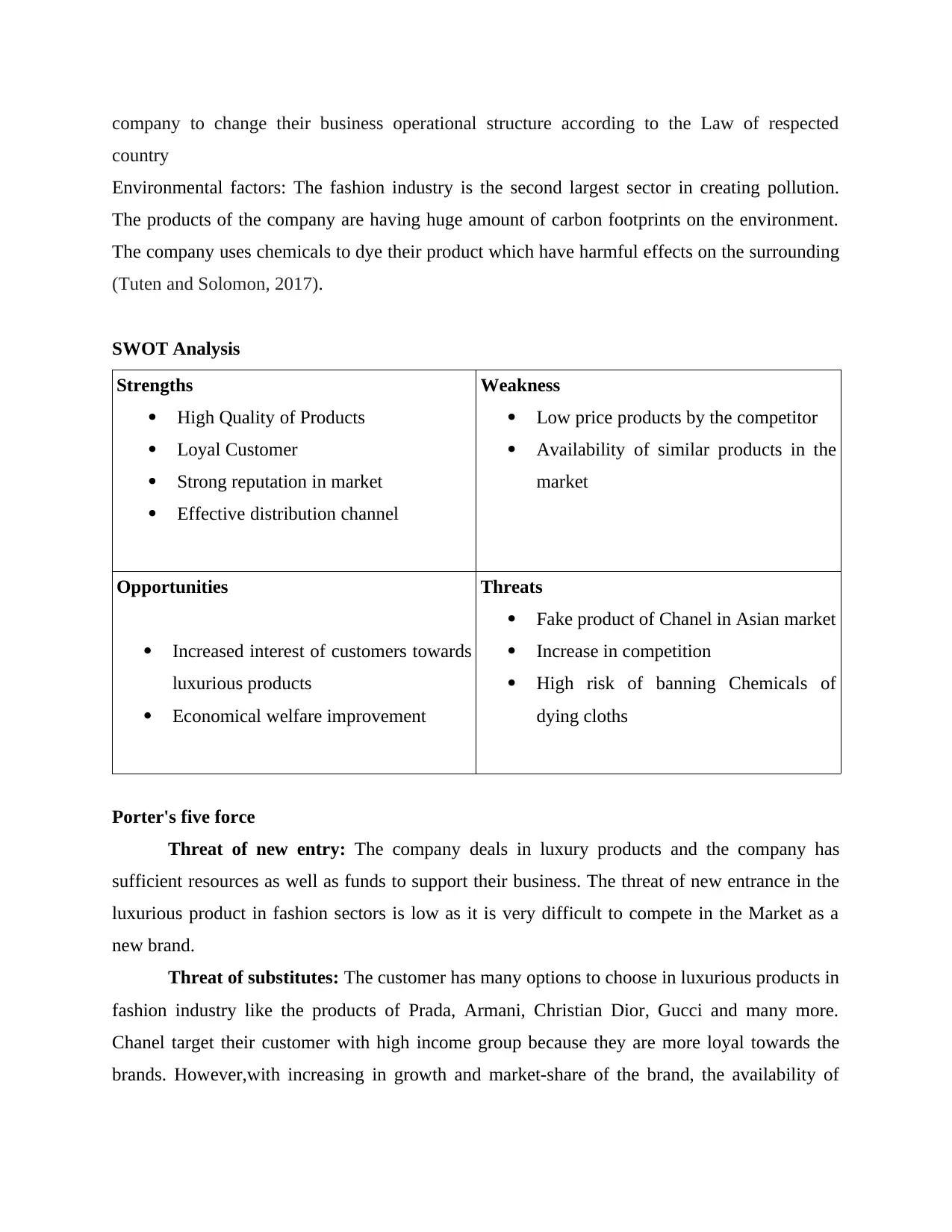
SWOT Analysis
Strengths
High Quality of Products
Loyal Customer
Strong reputation in market
Effective distribution channel
Weakness
Low price products by the competitor
Availability of similar products in the
market
Opportunities
Increased interest of customers towards
luxurious products
Economical welfare improvement
Threats
Fake product of Chanel in Asian market
Increase in competition
High risk of banning Chemicals of
dying cloths
Porter's five force
Threat of new entry: The company deals in luxury products and the company has
sufficient resources as well as funds to support their business. The threat of new entrance in the
luxurious product in fashion sectors is low as it is very difficult to compete in the Market as a
new brand.
Threat of substitutes: The customer has many options to choose in luxurious products in
fashion industry like the products of Prada, Armani, Christian Dior, Gucci and many more.
Chanel target their customer with high income group because they are more loyal towards the
brands. However,with increasing in growth and market-share of the brand, the availability of
country
Environmental factors: The fashion industry is the second largest sector in creating pollution.
The products of the company are having huge amount of carbon footprints on the environment.
The company uses chemicals to dye their product which have harmful effects on the surrounding
(Tuten and Solomon, 2017).
SWOT Analysis
Strengths
High Quality of Products
Loyal Customer
Strong reputation in market
Effective distribution channel
Weakness
Low price products by the competitor
Availability of similar products in the
market
Opportunities
Increased interest of customers towards
luxurious products
Economical welfare improvement
Threats
Fake product of Chanel in Asian market
Increase in competition
High risk of banning Chemicals of
dying cloths
Porter's five force
Threat of new entry: The company deals in luxury products and the company has
sufficient resources as well as funds to support their business. The threat of new entrance in the
luxurious product in fashion sectors is low as it is very difficult to compete in the Market as a
new brand.
Threat of substitutes: The customer has many options to choose in luxurious products in
fashion industry like the products of Prada, Armani, Christian Dior, Gucci and many more.
Chanel target their customer with high income group because they are more loyal towards the
brands. However,with increasing in growth and market-share of the brand, the availability of
fake products are also increases of companies name in the market. The threat of substitutes is
very high for Chanel.
Supplier power: The Brand has various products like cloths, perfume, jewelry, bags and
many more the company need different material for different products. The company is having
long partnership for providing them raw materials like cotton, leather, gold to manufacture the
final good causes high bargain power of suppliers (Lovelock and Patterson, 2015).
Buyer Power: Once the Chanel sets their range of price of their products. The customer
has almost no power to change the price of the products yet the switching cost is quite low. This
may strengthen the power of buyer at some area.
Competition rivalry: Chanel deals in luxury products in fashion industry and the rivalry
in this business sector is medium high. The economic concentrate of luxury company is more
than 55 percentage which indicates the nature of market is competitive in this sector. The
company is among the leading business in the sector which means it can be affects by normal
brands.
Marketing Strategies
STP
STP stands for Segmentation, targeting and positioning strategy of the business. This
helps the company to implement proper marketing mix. The product used to understand STP of
Chanel is Handbags
Segmentation: Chanel uses demographic segmentation strategies to target the customers
for their Handbags on the bases of their age group, gender and income group and many more.
Targeting: The Chanel uses differentiated targeting strategies, which helps the company
to target customer based on high income group.
Positioning: The organisation do the positioning of their handbags by using product class
strategies as the Chanel deals in luxury handbags. (Kotler and et.al., 2015).
Ansoff matrix
Ansoff matrix is the model helps the company to identify the best marketing strategy
according to the product and business activities. The four strategies in Ansoff matrix model are
as follows
Market penetration: This is the safest strategy among all of them. This strategy helps the
company to promote the sales of a particular area. In this Chanel do promotional activities to
very high for Chanel.
Supplier power: The Brand has various products like cloths, perfume, jewelry, bags and
many more the company need different material for different products. The company is having
long partnership for providing them raw materials like cotton, leather, gold to manufacture the
final good causes high bargain power of suppliers (Lovelock and Patterson, 2015).
Buyer Power: Once the Chanel sets their range of price of their products. The customer
has almost no power to change the price of the products yet the switching cost is quite low. This
may strengthen the power of buyer at some area.
Competition rivalry: Chanel deals in luxury products in fashion industry and the rivalry
in this business sector is medium high. The economic concentrate of luxury company is more
than 55 percentage which indicates the nature of market is competitive in this sector. The
company is among the leading business in the sector which means it can be affects by normal
brands.
Marketing Strategies
STP
STP stands for Segmentation, targeting and positioning strategy of the business. This
helps the company to implement proper marketing mix. The product used to understand STP of
Chanel is Handbags
Segmentation: Chanel uses demographic segmentation strategies to target the customers
for their Handbags on the bases of their age group, gender and income group and many more.
Targeting: The Chanel uses differentiated targeting strategies, which helps the company
to target customer based on high income group.
Positioning: The organisation do the positioning of their handbags by using product class
strategies as the Chanel deals in luxury handbags. (Kotler and et.al., 2015).
Ansoff matrix
Ansoff matrix is the model helps the company to identify the best marketing strategy
according to the product and business activities. The four strategies in Ansoff matrix model are
as follows
Market penetration: This is the safest strategy among all of them. This strategy helps the
company to promote the sales of a particular area. In this Chanel do promotional activities to
⊘ This is a preview!⊘
Do you want full access?
Subscribe today to unlock all pages.
Trusted by 1+ million students worldwide
promote the sales of their particular store of area. This is generally done by advertisement,
discounts and participation or organisation events.
Market development: In this strategy the company introduce their existing product in
market of new market. This helps the company to explore their new market and increase their
business operations globally. Chanel is currently using this market strategies. This helps the
company to enter and explore new market with their existing product. Chanel enter the market of
America and Australia by using this method. This has helped the company to increase their
market-share worldwide. (Kotler and et.al., 2017).
Product development: In this the company introduce new product in the existing market.
This method has higher rate to succeed than market development because the company is having
a image in the existing market. The chances of succeeding for Chanel has introduce First's men
makeup in their existing market of United kingdom and USA. This methods helps the company
to increase the success rate of their newly launch production in the existing market.
Diversification: Diversification is the strategy in which company enter new market with
new products. This is the riskiest method as the company is having no knowledge about the
product as well as the market. This chance of failure is more for Chanel in this method.
Marketing Mix decision
Product
Chanel sells different types of the product and every product are having different product
line. The company offer a huge variety in the market which include cloths, makeups, handbags,
jewelry etc. this attract the customer and purchase the product according to their choose. The
quality of the product is higher than the competition which allow the company to charge more
form the customers (Kerin, and Hartley, 2015).
Price
Chanel is currently using the competitive pricing strategy for the pricing of their product
as the data of competitors are easily available. The price of the products of Chanel is higher than
the price of competition because the company provide more feature and better quality of
products. In some products the company also optional product pricing strategies, in this company
sells the bases product and accessories separately (Katsikeas and et.al., 2016). The company has
fixed price for their final products.
Place
discounts and participation or organisation events.
Market development: In this strategy the company introduce their existing product in
market of new market. This helps the company to explore their new market and increase their
business operations globally. Chanel is currently using this market strategies. This helps the
company to enter and explore new market with their existing product. Chanel enter the market of
America and Australia by using this method. This has helped the company to increase their
market-share worldwide. (Kotler and et.al., 2017).
Product development: In this the company introduce new product in the existing market.
This method has higher rate to succeed than market development because the company is having
a image in the existing market. The chances of succeeding for Chanel has introduce First's men
makeup in their existing market of United kingdom and USA. This methods helps the company
to increase the success rate of their newly launch production in the existing market.
Diversification: Diversification is the strategy in which company enter new market with
new products. This is the riskiest method as the company is having no knowledge about the
product as well as the market. This chance of failure is more for Chanel in this method.
Marketing Mix decision
Product
Chanel sells different types of the product and every product are having different product
line. The company offer a huge variety in the market which include cloths, makeups, handbags,
jewelry etc. this attract the customer and purchase the product according to their choose. The
quality of the product is higher than the competition which allow the company to charge more
form the customers (Kerin, and Hartley, 2015).
Price
Chanel is currently using the competitive pricing strategy for the pricing of their product
as the data of competitors are easily available. The price of the products of Chanel is higher than
the price of competition because the company provide more feature and better quality of
products. In some products the company also optional product pricing strategies, in this company
sells the bases product and accessories separately (Katsikeas and et.al., 2016). The company has
fixed price for their final products.
Place
Paraphrase This Document
Need a fresh take? Get an instant paraphrase of this document with our AI Paraphraser
The company uses two different channels to sale their products. The first though internet
where the customers directly purchase from the company and the other is though wholesalers and
retailer which they sell the product of the company. The merchandise of the company is
availability at more than 500 retailers in United Kingdom only.
Promotion
The Chanel do their promotion through various channels. The company promote their
products through both traditional and modern method. Chanel uses TV, radio and newspaper
advertisement to promote their product as well as the company also promote their product with
social media apps like Facebook, YouTube and many more. Chanel uses a percentage of sales to
identify their promotion budget.
People
Chanel has employees working in different departments like human resource, marketing
and sales, research, distribution channel and anymore. The employees of the company are
provided special training according to their department and their role in business activities. The
company also have many favorable policies for their employees which helps the company to
decrease their employee turnover (Haider and et.al., 2019).
Process
The company has installed systems at retailer store to make them aware about the stock
and the retailer never faces situation like out of stock moreover the company also sells their
business online. Chanel is heavily involved in research and developing which helps the company
to identify the needs and issues of the customer.
Physical evidence
Chanel pack their products in a unique color box which helps the customer to identify them
easily furthermore the company is having separate shelves at retailer which are also different
from other company’s shelves. The company is also having a user-friendly website which helps
the customer to view the products from various angle though PC or mobile (Fill and Turnbull,
2016.).
The engagement and impact of stakeholders on marketing activities
The engagement and impact of the stakeholder are determined by using of stakeholder
matrix.
where the customers directly purchase from the company and the other is though wholesalers and
retailer which they sell the product of the company. The merchandise of the company is
availability at more than 500 retailers in United Kingdom only.
Promotion
The Chanel do their promotion through various channels. The company promote their
products through both traditional and modern method. Chanel uses TV, radio and newspaper
advertisement to promote their product as well as the company also promote their product with
social media apps like Facebook, YouTube and many more. Chanel uses a percentage of sales to
identify their promotion budget.
People
Chanel has employees working in different departments like human resource, marketing
and sales, research, distribution channel and anymore. The employees of the company are
provided special training according to their department and their role in business activities. The
company also have many favorable policies for their employees which helps the company to
decrease their employee turnover (Haider and et.al., 2019).
Process
The company has installed systems at retailer store to make them aware about the stock
and the retailer never faces situation like out of stock moreover the company also sells their
business online. Chanel is heavily involved in research and developing which helps the company
to identify the needs and issues of the customer.
Physical evidence
Chanel pack their products in a unique color box which helps the customer to identify them
easily furthermore the company is having separate shelves at retailer which are also different
from other company’s shelves. The company is also having a user-friendly website which helps
the customer to view the products from various angle though PC or mobile (Fill and Turnbull,
2016.).
The engagement and impact of stakeholders on marketing activities
The engagement and impact of the stakeholder are determined by using of stakeholder
matrix.
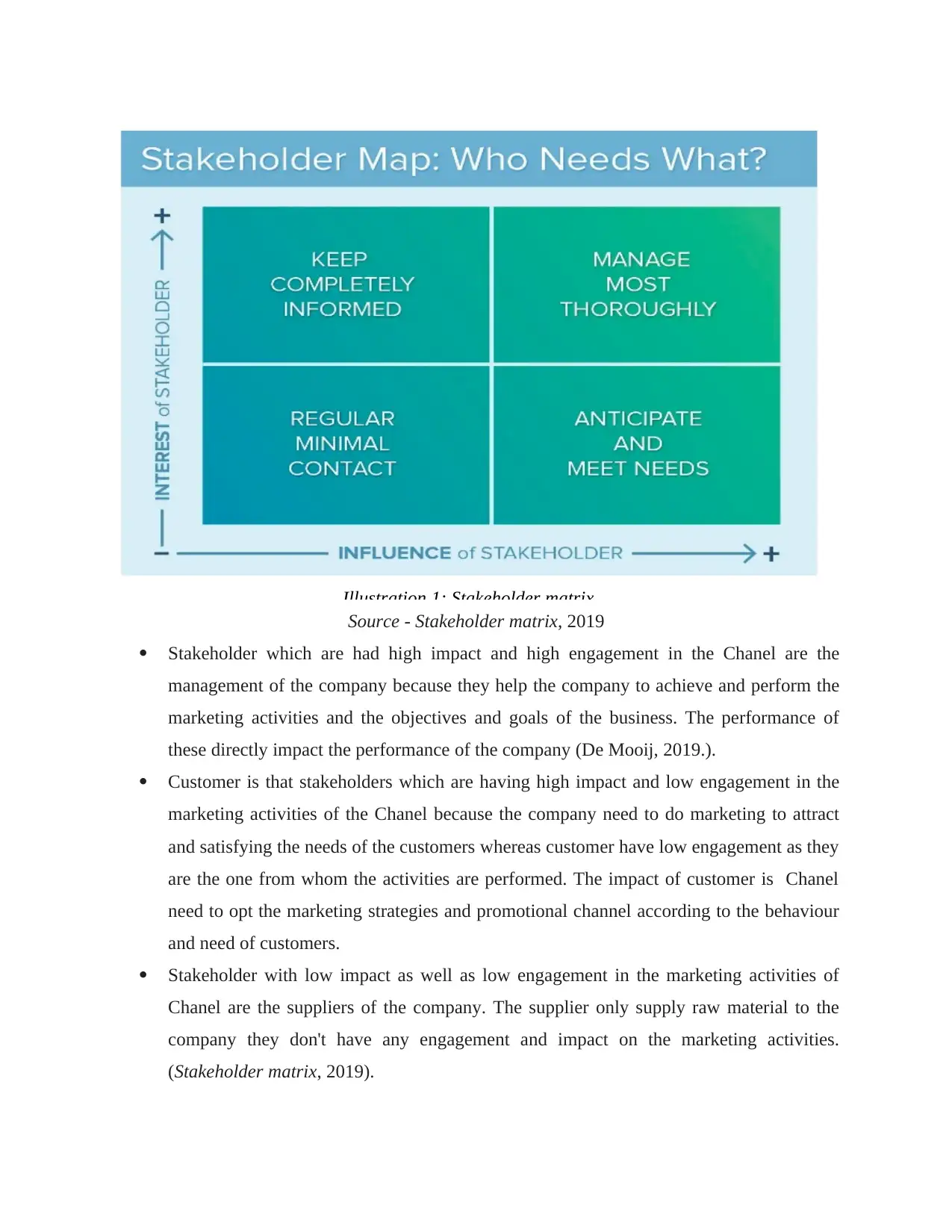
Source - Stakeholder matrix, 2019
Stakeholder which are had high impact and high engagement in the Chanel are the
management of the company because they help the company to achieve and perform the
marketing activities and the objectives and goals of the business. The performance of
these directly impact the performance of the company (De Mooij, 2019.).
Customer is that stakeholders which are having high impact and low engagement in the
marketing activities of the Chanel because the company need to do marketing to attract
and satisfying the needs of the customers whereas customer have low engagement as they
are the one from whom the activities are performed. The impact of customer is Chanel
need to opt the marketing strategies and promotional channel according to the behaviour
and need of customers.
Stakeholder with low impact as well as low engagement in the marketing activities of
Chanel are the suppliers of the company. The supplier only supply raw material to the
company they don't have any engagement and impact on the marketing activities.
(Stakeholder matrix, 2019).
Illustration 1: Stakeholder matrix
Stakeholder which are had high impact and high engagement in the Chanel are the
management of the company because they help the company to achieve and perform the
marketing activities and the objectives and goals of the business. The performance of
these directly impact the performance of the company (De Mooij, 2019.).
Customer is that stakeholders which are having high impact and low engagement in the
marketing activities of the Chanel because the company need to do marketing to attract
and satisfying the needs of the customers whereas customer have low engagement as they
are the one from whom the activities are performed. The impact of customer is Chanel
need to opt the marketing strategies and promotional channel according to the behaviour
and need of customers.
Stakeholder with low impact as well as low engagement in the marketing activities of
Chanel are the suppliers of the company. The supplier only supply raw material to the
company they don't have any engagement and impact on the marketing activities.
(Stakeholder matrix, 2019).
Illustration 1: Stakeholder matrix
⊘ This is a preview!⊘
Do you want full access?
Subscribe today to unlock all pages.
Trusted by 1+ million students worldwide
Employees are those stakeholders which are having high engagement and low impact on
the marketing activities because employees perform the activities according to the
guidelines of the management. The performance of the employees work and customer
handling can impact the Chanel but in a very small manner. (Charter and Polonsky,
2017).
The role of marketing creating value for customer
Product
The products play an important role in creating value of every purchase for the
customers. The quality of products helps the company to create good reputation in front of the
customers. Chanel company deals in luxury product. The company is well-known for good
quality of their products moreover Chanel has the best quality among all the competition, and
they also provide extra features to their products. The quality of products of Chanel helps them
to create value for the customer.
Price
The pricing policy of the company have a vital impact on creating the value for the
customers. The price of the items can influence the customers to purchase it and vice versa
because the price is the fix monetary value for the product to own it. Chanel uses different
pricing strategies for various products. Chanel charges prices based on their quality of their
product and their customers are quite satisfied with price. The different pricing strategies play an
important role in creating the value for the customers (Chaffey and Ellis-Chadwick, 2019).
Place
The availability of the products of the company have a significant role in creating the
value for the customers. If the products are not available easily it can have a negative impact.
The Chanel merchandise are available in more than 500 retailer store in United Kingdom only.
The company also sells their product through internet. Availability of the Chanel productions in
United Kingdom are very high. This has helped the company to create the value for their
customers (Baker, 2016).
Promotion
Promotional activities matter lot in creating value because the promotional activities
helps the company to increase their awareness in the market. Chanel uses various methods to
the marketing activities because employees perform the activities according to the
guidelines of the management. The performance of the employees work and customer
handling can impact the Chanel but in a very small manner. (Charter and Polonsky,
2017).
The role of marketing creating value for customer
Product
The products play an important role in creating value of every purchase for the
customers. The quality of products helps the company to create good reputation in front of the
customers. Chanel company deals in luxury product. The company is well-known for good
quality of their products moreover Chanel has the best quality among all the competition, and
they also provide extra features to their products. The quality of products of Chanel helps them
to create value for the customer.
Price
The pricing policy of the company have a vital impact on creating the value for the
customers. The price of the items can influence the customers to purchase it and vice versa
because the price is the fix monetary value for the product to own it. Chanel uses different
pricing strategies for various products. Chanel charges prices based on their quality of their
product and their customers are quite satisfied with price. The different pricing strategies play an
important role in creating the value for the customers (Chaffey and Ellis-Chadwick, 2019).
Place
The availability of the products of the company have a significant role in creating the
value for the customers. If the products are not available easily it can have a negative impact.
The Chanel merchandise are available in more than 500 retailer store in United Kingdom only.
The company also sells their product through internet. Availability of the Chanel productions in
United Kingdom are very high. This has helped the company to create the value for their
customers (Baker, 2016).
Promotion
Promotional activities matter lot in creating value because the promotional activities
helps the company to increase their awareness in the market. Chanel uses various methods to
Paraphrase This Document
Need a fresh take? Get an instant paraphrase of this document with our AI Paraphraser
promotion their business activities. The company promotion through both traditional and not
traditional channels moreover Chanel has an effective customer care department, which helps
them to create value.
People
The people working in Chanel are well-trained according to their department. Chanel
organise various training and development programs to increase the effectiveness of their
employees. The effectiveness of the employees helps the company to perform better in the
market as well it also helps to create good value of their products (Atwal and Williams, 2017).
Physical evidence
The physical evidence of the Chanel the helps the company to create value of their
products for the customers are their unique color box for their products as well as the company is
having a user-friendly website which helps to customer to view the product form different angles
through internet.
Process
Process consider of various factors like distribution channel, Resource and department,
production and many more. The effectiveness and efficiency of these departments of Chanel
helps to create better value of their products. Chanel spends lot in research and developing of
market and the process. This helps the company to bring innovation and stay updated in the
market (Armstrong and et.al., 2018).
CONCLUSION
From the above report it has been summarized that Chanel is french based private company. This
report is based on the marketing strategies of Chanel. This report has discussed the Objectives,
Vision and Mission of the company. Along with this situation analysis which include the Pestle,
Swot analysis and Porter's five forces. The report has also highlighted about the Marketing
strategies which concluded STP and Ansoff matrix as well as the file highlighted about the
Marketing Mix decisions. The report has also discussed the Stakeholder engagement and their
impact on marketing activities. Lastly the report has concluded the role of the marketing in
creating value for the customers.
traditional channels moreover Chanel has an effective customer care department, which helps
them to create value.
People
The people working in Chanel are well-trained according to their department. Chanel
organise various training and development programs to increase the effectiveness of their
employees. The effectiveness of the employees helps the company to perform better in the
market as well it also helps to create good value of their products (Atwal and Williams, 2017).
Physical evidence
The physical evidence of the Chanel the helps the company to create value of their
products for the customers are their unique color box for their products as well as the company is
having a user-friendly website which helps to customer to view the product form different angles
through internet.
Process
Process consider of various factors like distribution channel, Resource and department,
production and many more. The effectiveness and efficiency of these departments of Chanel
helps to create better value of their products. Chanel spends lot in research and developing of
market and the process. This helps the company to bring innovation and stay updated in the
market (Armstrong and et.al., 2018).
CONCLUSION
From the above report it has been summarized that Chanel is french based private company. This
report is based on the marketing strategies of Chanel. This report has discussed the Objectives,
Vision and Mission of the company. Along with this situation analysis which include the Pestle,
Swot analysis and Porter's five forces. The report has also highlighted about the Marketing
strategies which concluded STP and Ansoff matrix as well as the file highlighted about the
Marketing Mix decisions. The report has also discussed the Stakeholder engagement and their
impact on marketing activities. Lastly the report has concluded the role of the marketing in
creating value for the customers.
REFERENCE
Books and Journal
Armstrong, G. M and et.al., 2018. Marketing: an introduction. Pearson UK.
Atwal, G. and Williams, A., 2017. Luxury brand marketing–the experience is everything!. In
Advances in luxury brand management (pp. 43-57). Palgrave Macmillan, Cham.
Baker, M. J., 2016. What is marketing?. In The Marketing Book(pp. 25-42). Routledge.
Chaffey, D. and Ellis-Chadwick, F., 2019. Digital marketing. Pearson UK.
Charter, M. and Polonsky, M. J., 2017. Greener marketing: a global perspective on greening
marketing practice. Routledge.
De Mooij, M., 2019. Consumer behaviour and culture: Consequences for global marketing and
advertising. SAGE Publications Limited.
Fill, C. and Turnbull, S. L., 2016. Marketing communications: brands, experiences and
participation. Pearson.
Haider, A. A. and et.al., 2019. Marketing Management.
Katsikeas, C. S and et.al., 2016. Assessing performance outcomes in marketing. Journal of
Marketing, 80(2).pp.1-20.
Kerin, R. and Hartley, S., 2015. Marketing: the core. McGraw-Hill.
Kotler, P and et.al., 2017. Marketing for hospitality and tourism.
Kotler, P and et.al., 2015. Marketing. Pearson Higher Education AU.
Lovelock, C. and Patterson, P., 2015. Services marketing. Pearson Australia.
Tuten, T. L. and Solomon, M. R., 2017. Social media marketing. Sage.
Online
Stakeholder matrix. 2019. [Online]. Available through: <https://www.smartsheet.com/what-
stakeholder-analysis-and-mapping-and-how-do-you-do-it-effectively>
Books and Journal
Armstrong, G. M and et.al., 2018. Marketing: an introduction. Pearson UK.
Atwal, G. and Williams, A., 2017. Luxury brand marketing–the experience is everything!. In
Advances in luxury brand management (pp. 43-57). Palgrave Macmillan, Cham.
Baker, M. J., 2016. What is marketing?. In The Marketing Book(pp. 25-42). Routledge.
Chaffey, D. and Ellis-Chadwick, F., 2019. Digital marketing. Pearson UK.
Charter, M. and Polonsky, M. J., 2017. Greener marketing: a global perspective on greening
marketing practice. Routledge.
De Mooij, M., 2019. Consumer behaviour and culture: Consequences for global marketing and
advertising. SAGE Publications Limited.
Fill, C. and Turnbull, S. L., 2016. Marketing communications: brands, experiences and
participation. Pearson.
Haider, A. A. and et.al., 2019. Marketing Management.
Katsikeas, C. S and et.al., 2016. Assessing performance outcomes in marketing. Journal of
Marketing, 80(2).pp.1-20.
Kerin, R. and Hartley, S., 2015. Marketing: the core. McGraw-Hill.
Kotler, P and et.al., 2017. Marketing for hospitality and tourism.
Kotler, P and et.al., 2015. Marketing. Pearson Higher Education AU.
Lovelock, C. and Patterson, P., 2015. Services marketing. Pearson Australia.
Tuten, T. L. and Solomon, M. R., 2017. Social media marketing. Sage.
Online
Stakeholder matrix. 2019. [Online]. Available through: <https://www.smartsheet.com/what-
stakeholder-analysis-and-mapping-and-how-do-you-do-it-effectively>
⊘ This is a preview!⊘
Do you want full access?
Subscribe today to unlock all pages.
Trusted by 1+ million students worldwide

1 out of 12


Related Documents


Your All-in-One AI-Powered Toolkit for Academic Success.
+13062052269
info@desklib.com
Available 24*7 on WhatsApp / Email
![[object Object]](/_next/static/media/star-bottom.7253800d.svg)
Unlock your academic potential
Copyright © 2020–2026 A2Z Services. All Rights Reserved. Developed and managed by ZUCOL.