Leading Change & Innovation Report: Change Management Strategies
VerifiedAdded on 2021/06/17
|24
|5732
|349
Report
AI Summary
This report examines leading change and innovation within the context of Metro Inc., a major retail supermarket chain in Canada. It explores the importance of leadership in fostering innovation and managing organizational change, emphasizing the role of servant leadership in building a culture of teamwork, coordination, and high performance. The report delves into Metro Inc.'s organizational background, change management approaches, and techniques for enhancing creativity. It analyzes how leaders can serve as role models, promote change, and drive innovation through various strategies, including the use of the ADKAR model. Furthermore, the report discusses Dawson's nine considerations for organizational change, highlighting the need for adaptability, continuous improvement, and effective communication to achieve success in a competitive business environment. The content focuses on how teamwork, collaboration, and coordination are essential in creating a high-performing workforce within a transformational servant-led culture.
Running head: LEADING CHANGE & INNOVATION
Leading Change & Innovation
Name of student
Name of University
Author note
Leading Change & Innovation
Name of student
Name of University
Author note

Paraphrase This Document
Need a fresh take? Get an instant paraphrase of this document with our AI Paraphraser
1LEADING CHANGE & INNOVATION
Table of Contents
Introduction......................................................................................................................................3
Organizational background..............................................................................................................3
Sustaining changes, monitoring and leading change.......................................................................3
The organization at present..............................................................................................................9
Building a Climate for Innovation through leadership and organizational culture.......................11
Change Process to transform the system.......................................................................................13
Approaches to change management..............................................................................................15
Expressive Change and Creativity Enhancement Techniques.......................................................17
Conclusion.....................................................................................................................................18
References......................................................................................................................................20
Table of Contents
Introduction......................................................................................................................................3
Organizational background..............................................................................................................3
Sustaining changes, monitoring and leading change.......................................................................3
The organization at present..............................................................................................................9
Building a Climate for Innovation through leadership and organizational culture.......................11
Change Process to transform the system.......................................................................................13
Approaches to change management..............................................................................................15
Expressive Change and Creativity Enhancement Techniques.......................................................17
Conclusion.....................................................................................................................................18
References......................................................................................................................................20
2LEADING CHANGE & INNOVATION
Introduction
The report is prepared to discuss about the movement as a leader who possesses relevant
knowledge and skills to manage significant changes and promote innovation all throughout. The
business organization that will be chosen as the case study is Metro Inc. in Canada. Metro Inc. is
one of the major retail supermarket chains in Canada that has been considered as an online
grocery store. The company delivers the best quality and freshest products and services to its
customers and the company has maintained a positive culture with proper support given by the
leaders of the organization. Leadership is essential to promote innovation and foster the growth
and development of the organization within the retail sector, furthermore determine the
approaches that are to be undertaken to become high performing in the transformational servant
led culture or structure (Fullan, 2014).
Organizational background
Metro Inc is one of the major retail supermarket chains in Canada that is a leader in food
and pharmaceutical distribution. The company operates more than 600 food stores including
Metro Food, Food Basics, Adonis, etc. Few of the drugstores are Metro Pharmacy, Brunet, Drug
Basics, etc. The company boosts and operating income of CDN$601.6 million and revenue is
more than CDN$11,402.8 million. The number of employees is more than 65000
(corpo.metro.ca, 2018).
Introduction
The report is prepared to discuss about the movement as a leader who possesses relevant
knowledge and skills to manage significant changes and promote innovation all throughout. The
business organization that will be chosen as the case study is Metro Inc. in Canada. Metro Inc. is
one of the major retail supermarket chains in Canada that has been considered as an online
grocery store. The company delivers the best quality and freshest products and services to its
customers and the company has maintained a positive culture with proper support given by the
leaders of the organization. Leadership is essential to promote innovation and foster the growth
and development of the organization within the retail sector, furthermore determine the
approaches that are to be undertaken to become high performing in the transformational servant
led culture or structure (Fullan, 2014).
Organizational background
Metro Inc is one of the major retail supermarket chains in Canada that is a leader in food
and pharmaceutical distribution. The company operates more than 600 food stores including
Metro Food, Food Basics, Adonis, etc. Few of the drugstores are Metro Pharmacy, Brunet, Drug
Basics, etc. The company boosts and operating income of CDN$601.6 million and revenue is
more than CDN$11,402.8 million. The number of employees is more than 65000
(corpo.metro.ca, 2018).
⊘ This is a preview!⊘
Do you want full access?
Subscribe today to unlock all pages.

Trusted by 1+ million students worldwide
3LEADING CHANGE & INNOVATION
Sustaining changes, monitoring and leading change
According to Dawson and Andriopoulos (2014), within the competitive business
environment, the companies in Europe and America compete with other companies that have
lower costs of production. Due to his, it has become necessary to change the competitiveness
program and manage it according to value of products delivered, innovation, quality and other
technological aspects. Tezz, being an automotive company has invested in various plants in
different countries to ensure it can bring innovation, creativity, sustainability and better revenue
generation (Doppelt, 2017).
Can the promotion of new ideas and concepts by the leaders at work enhance the
leadership skills?
At Metro, there is continuous need to innovate, remain creative and promote new ideas for
fulfilling the changing needs of customers. To meet their demands and expectations, it is
necessary for the leaders to manage consistent sharing and exchange of ideas and opinions and
improve own leadership skills along with the knowledge of workers to facilitate the production
process at Metro Inc., Canada. Innovation and creativity would be essential for sustaining
business as well as differentiate the products and service properly within the competitive
business environment. It will lead to economic growth as well as enhance the leader skills to
form a transformational servant led culture and structure (Norman & Verganti, 2014). Changes
are incremental and thus are essential components for managing transformational changes. It will
also help in obtaining the different views, opinions and decisions made by individuals working at
Metro Inc, furthermore bring consistent changes through innovation, creativity and openness.
The change initiatives would also help in managing the situations to involve or engage the
Sustaining changes, monitoring and leading change
According to Dawson and Andriopoulos (2014), within the competitive business
environment, the companies in Europe and America compete with other companies that have
lower costs of production. Due to his, it has become necessary to change the competitiveness
program and manage it according to value of products delivered, innovation, quality and other
technological aspects. Tezz, being an automotive company has invested in various plants in
different countries to ensure it can bring innovation, creativity, sustainability and better revenue
generation (Doppelt, 2017).
Can the promotion of new ideas and concepts by the leaders at work enhance the
leadership skills?
At Metro, there is continuous need to innovate, remain creative and promote new ideas for
fulfilling the changing needs of customers. To meet their demands and expectations, it is
necessary for the leaders to manage consistent sharing and exchange of ideas and opinions and
improve own leadership skills along with the knowledge of workers to facilitate the production
process at Metro Inc., Canada. Innovation and creativity would be essential for sustaining
business as well as differentiate the products and service properly within the competitive
business environment. It will lead to economic growth as well as enhance the leader skills to
form a transformational servant led culture and structure (Norman & Verganti, 2014). Changes
are incremental and thus are essential components for managing transformational changes. It will
also help in obtaining the different views, opinions and decisions made by individuals working at
Metro Inc, furthermore bring consistent changes through innovation, creativity and openness.
The change initiatives would also help in managing the situations to involve or engage the
Paraphrase This Document
Need a fresh take? Get an instant paraphrase of this document with our AI Paraphraser
4LEADING CHANGE & INNOVATION
employees properly and remain more autocratic in driving the changes all throughout (Frame &
White, 2014).
How can the leaders serve as role models and develop a culture of servant leadership at the
organization?
One of the major ways by which the employees can be informed about the leadership is
to act as a role model whom they can respect, admire and emulate. Once the business owner of
Metro Inc provides a powerful, consistent and brings out the role model, it will be easy for the
employees to follow the lead. The leader can serve as a positive role model by demonstrating the
personal responsibilities for the actions that have been accepted and undertaken by him. Few
examples include apologizing for the loss of temper, criticizing employees for their mistakes and
about looking forward in case the company faces a down turn (Gobble, 2013). All these
behaviors present in the business leader can make him act as a responsible role model and
establish a culture to promote communication, consideration of individual views and opinions
and creativity. This would encourage cooperation and enhance the customers’ services’ delivery
too. The most important characteristic of being a role model to others could be the ability to
innovate, be creative and remain open to innovation. The management of time is important
keeping focus on the tight priorities should be managed properly to ensure completion of tasks
within the assigned time (Dawson & Andriopoulos, 2014). To develop a culture of servant
leadership, the leaders must promote the significance of team working, coordination and
communication, which should increase the production rate and ensure managing the workload
quite comprehensively.
How does leadership promote changes within the organizations?
employees properly and remain more autocratic in driving the changes all throughout (Frame &
White, 2014).
How can the leaders serve as role models and develop a culture of servant leadership at the
organization?
One of the major ways by which the employees can be informed about the leadership is
to act as a role model whom they can respect, admire and emulate. Once the business owner of
Metro Inc provides a powerful, consistent and brings out the role model, it will be easy for the
employees to follow the lead. The leader can serve as a positive role model by demonstrating the
personal responsibilities for the actions that have been accepted and undertaken by him. Few
examples include apologizing for the loss of temper, criticizing employees for their mistakes and
about looking forward in case the company faces a down turn (Gobble, 2013). All these
behaviors present in the business leader can make him act as a responsible role model and
establish a culture to promote communication, consideration of individual views and opinions
and creativity. This would encourage cooperation and enhance the customers’ services’ delivery
too. The most important characteristic of being a role model to others could be the ability to
innovate, be creative and remain open to innovation. The management of time is important
keeping focus on the tight priorities should be managed properly to ensure completion of tasks
within the assigned time (Dawson & Andriopoulos, 2014). To develop a culture of servant
leadership, the leaders must promote the significance of team working, coordination and
communication, which should increase the production rate and ensure managing the workload
quite comprehensively.
How does leadership promote changes within the organizations?
5LEADING CHANGE & INNOVATION
The servant leadership allows for fulfilling the needs and requirements of the employees,
which has helped in managing the human aspects of change and planned for smooth transitions
and handling the political aspects of change. Leadership affects various factors that are
considered as major drivers of change both externally and internally. With the leader of Metro
Inc working as the role model of the employees, new ideas have been promoted, which has given
rise to the development of new products and services along with triggering changes through
internal activities (Bloom, Draca & Van Reenen, 2016). The supply chain is influenced by
innovation and new technologies have come into play like use of in-time technologies and RFID
technology. The leaders make sure that the company follows the Government laws and rules
properly and manage the international agreements on trade and tariffs. The employees are
educated through training and development sessions for meeting up to the societal expectations
and operate both ethically and in a socially responsible manner. This would also allow the
business to grow with higher level of commitment by employees and create scopes for merger
and acquisitions, privatization of public sector businesses and international expansion too
(Cummings & Worley, 2014).
Does the servant leadership help in managing teamwork, coordination and betterment of
team performance?
Metro Inc. describes the servant leadership as an important aspect that one wants to serve
people and a constant choice of remaining at the beginning, aspire to lead. It is a kind of
philosophy that evaluates the practices and various leadership skills and qualities including
empathy, considering views and opinions of others in the teams, persuasion, conceptualization
and commitment to the growth and development of employees at work. A servant leader can
The servant leadership allows for fulfilling the needs and requirements of the employees,
which has helped in managing the human aspects of change and planned for smooth transitions
and handling the political aspects of change. Leadership affects various factors that are
considered as major drivers of change both externally and internally. With the leader of Metro
Inc working as the role model of the employees, new ideas have been promoted, which has given
rise to the development of new products and services along with triggering changes through
internal activities (Bloom, Draca & Van Reenen, 2016). The supply chain is influenced by
innovation and new technologies have come into play like use of in-time technologies and RFID
technology. The leaders make sure that the company follows the Government laws and rules
properly and manage the international agreements on trade and tariffs. The employees are
educated through training and development sessions for meeting up to the societal expectations
and operate both ethically and in a socially responsible manner. This would also allow the
business to grow with higher level of commitment by employees and create scopes for merger
and acquisitions, privatization of public sector businesses and international expansion too
(Cummings & Worley, 2014).
Does the servant leadership help in managing teamwork, coordination and betterment of
team performance?
Metro Inc. describes the servant leadership as an important aspect that one wants to serve
people and a constant choice of remaining at the beginning, aspire to lead. It is a kind of
philosophy that evaluates the practices and various leadership skills and qualities including
empathy, considering views and opinions of others in the teams, persuasion, conceptualization
and commitment to the growth and development of employees at work. A servant leader can
⊘ This is a preview!⊘
Do you want full access?
Subscribe today to unlock all pages.
Trusted by 1+ million students worldwide
6LEADING CHANGE & INNOVATION
share power and put the needs of others working for the company at first and then help them to
develop, grow and manage optimization of performance. This assists in personal advancement as
well as concentrates on performance planning, everyday coaching and understanding the
expectations of others. The main responsibility of the servant leader would be to nurture the
employees by enduring investment of the lives of leaders in the lives of the employees who
would follow the leader (Anderson, 2016). The servant leadership could promote team problem
solving capabilities and motivate the employees by providing them with autonomy, power and
resources all throughout.
The management of teamwork, coordination and betterment of team performance is
dependent upon the transformational servant leadership and the ADKAR model has been utilized
often to make sure that a proper culture and structure is maintained at the company. The
ADKAR model helped the servant leaders to bring change management practices through
awareness, desire, knowledge, ability and reinforcement. The awareness aspect helped them to
gain clear understanding about the needs for changes and nature of changes to be communicated
to the employees at Metro Inc. The desire aspect makes them interested in providing support to
the changes, encourage participation of the workers and provide their useful ideas to contribute
to the proposed change (Hrebiniak, 2013). This could facilitate the communication process and
enhance the knowledge of employees. The development of knowledge and skills would help in
transition of changes that had been implemented and allow the employees to obtain knowledge
too through formal training modules and mentoring sessions. The ability of individuals will be
improved and this can ensure that the changes stay in place and individuals slowly adopt to the
new ways of doing things at present. Lastly, the reinforcement of new skills and competencies
achieved by the individuals through proper support by the servant leaders should build a new
share power and put the needs of others working for the company at first and then help them to
develop, grow and manage optimization of performance. This assists in personal advancement as
well as concentrates on performance planning, everyday coaching and understanding the
expectations of others. The main responsibility of the servant leader would be to nurture the
employees by enduring investment of the lives of leaders in the lives of the employees who
would follow the leader (Anderson, 2016). The servant leadership could promote team problem
solving capabilities and motivate the employees by providing them with autonomy, power and
resources all throughout.
The management of teamwork, coordination and betterment of team performance is
dependent upon the transformational servant leadership and the ADKAR model has been utilized
often to make sure that a proper culture and structure is maintained at the company. The
ADKAR model helped the servant leaders to bring change management practices through
awareness, desire, knowledge, ability and reinforcement. The awareness aspect helped them to
gain clear understanding about the needs for changes and nature of changes to be communicated
to the employees at Metro Inc. The desire aspect makes them interested in providing support to
the changes, encourage participation of the workers and provide their useful ideas to contribute
to the proposed change (Hrebiniak, 2013). This could facilitate the communication process and
enhance the knowledge of employees. The development of knowledge and skills would help in
transition of changes that had been implemented and allow the employees to obtain knowledge
too through formal training modules and mentoring sessions. The ability of individuals will be
improved and this can ensure that the changes stay in place and individuals slowly adopt to the
new ways of doing things at present. Lastly, the reinforcement of new skills and competencies
achieved by the individuals through proper support by the servant leaders should build a new
Paraphrase This Document
Need a fresh take? Get an instant paraphrase of this document with our AI Paraphraser
7LEADING CHANGE & INNOVATION
sustainable culture revolving through the changes at Metro Inc (Carayannis, Sindakis & Walter,
2015).
Is it true to the fact that teamwork, collaboration and coordination bring formation of a
high performing workforce within a Transformational Servant led culture/structure?
Yes, teamwork and coordination while implementing changes within the organization can
help to develop a vision and recognize the workload or behavioral change. This will assist in
shared ownership and engage all the employees together. The servant leadership support would
facilitate the design process, communication and implementation of changes communicated to
every employee. The leadership support is expected to bring change management plan required
to identify the potential risks at the early stages and overcome the barriers to change as early as
possible. The key components should include vision or goal of the organization, communication
tools and strategies used, resources and major stakeholders, understanding the roles and
responsibilities clearly and lastly managing the institutionalization and post roll out process
(Anderson, 2016). The cooperation among workers brings out the best from them and they can
easily share their individual ideas, which make them capable of engaging the stakeholders and
develop an initiative to drive changes forward. Communication at all levels create a sense of
transparency and openness along with the clarification of goals and objectives, addressing the
concerns, providing feedbacks to the employees of Metro Inc and sharing information.
Communication should be done through multiple channels to improve the structural aspects of
the company and adopt the desired changes to measure progress at regular intervals (Dawson &
Andriopoulos, 2014).
What are the nine considerations of Dawson on the organizational change process?
sustainable culture revolving through the changes at Metro Inc (Carayannis, Sindakis & Walter,
2015).
Is it true to the fact that teamwork, collaboration and coordination bring formation of a
high performing workforce within a Transformational Servant led culture/structure?
Yes, teamwork and coordination while implementing changes within the organization can
help to develop a vision and recognize the workload or behavioral change. This will assist in
shared ownership and engage all the employees together. The servant leadership support would
facilitate the design process, communication and implementation of changes communicated to
every employee. The leadership support is expected to bring change management plan required
to identify the potential risks at the early stages and overcome the barriers to change as early as
possible. The key components should include vision or goal of the organization, communication
tools and strategies used, resources and major stakeholders, understanding the roles and
responsibilities clearly and lastly managing the institutionalization and post roll out process
(Anderson, 2016). The cooperation among workers brings out the best from them and they can
easily share their individual ideas, which make them capable of engaging the stakeholders and
develop an initiative to drive changes forward. Communication at all levels create a sense of
transparency and openness along with the clarification of goals and objectives, addressing the
concerns, providing feedbacks to the employees of Metro Inc and sharing information.
Communication should be done through multiple channels to improve the structural aspects of
the company and adopt the desired changes to measure progress at regular intervals (Dawson &
Andriopoulos, 2014).
What are the nine considerations of Dawson on the organizational change process?
8LEADING CHANGE & INNOVATION
According to Dawson (2014), no silver bullet is the first consideration to manage changes
and bring competitive success. It allows for making assumptions behind the linear sequential
models and implement successful changes while the shifting of terrains are the norms to achieve
high performance in a transformational servant led culture. It can include the contextual changes,
changing views and opinions of the various stakeholders, contingencies that occur suddenly and
disruptions within the environment as well (Dawson & Andriopoulos, 2014). This is how
shifting terrains can help in adjusting with the unforeseen consequences and ensure changes
through proper and considerable planning. Allowing considerable amount of time is essential for
continuous improvement and enhances the skills of team members working at Metro Inc to
exchange and share ideas for giving sense to what has to be achieved and how. Enabling change
as a learning experience is another consideration of Dawson that makes individuals learn from
the failure and success experiences, furthermore deliver a specific message to the intended
audience to develop own skills and abilities (Sarros, Cooper & Santora, 2008). Training the new
skills and acquisition methods are important for making sure that the employees are equipped
with changes and the right messages and information are delivered to the right audiences through
effective communication procedure. Communication must be promoted both formally and
informally to align with the contextual needs of people while the change considered as power
politics should assist in continuing with the desired changes without any occurrence of
uncertainties and failures in the future. These are the basic nine considerations that can reflect the
effectiveness of the organizational change process and at the same time, facilitate critical
thinking among employees, improve the workplace culture and become high performing within
the Transformational Servant led culture and structure (Noruzy et al., 2013).
According to Dawson (2014), no silver bullet is the first consideration to manage changes
and bring competitive success. It allows for making assumptions behind the linear sequential
models and implement successful changes while the shifting of terrains are the norms to achieve
high performance in a transformational servant led culture. It can include the contextual changes,
changing views and opinions of the various stakeholders, contingencies that occur suddenly and
disruptions within the environment as well (Dawson & Andriopoulos, 2014). This is how
shifting terrains can help in adjusting with the unforeseen consequences and ensure changes
through proper and considerable planning. Allowing considerable amount of time is essential for
continuous improvement and enhances the skills of team members working at Metro Inc to
exchange and share ideas for giving sense to what has to be achieved and how. Enabling change
as a learning experience is another consideration of Dawson that makes individuals learn from
the failure and success experiences, furthermore deliver a specific message to the intended
audience to develop own skills and abilities (Sarros, Cooper & Santora, 2008). Training the new
skills and acquisition methods are important for making sure that the employees are equipped
with changes and the right messages and information are delivered to the right audiences through
effective communication procedure. Communication must be promoted both formally and
informally to align with the contextual needs of people while the change considered as power
politics should assist in continuing with the desired changes without any occurrence of
uncertainties and failures in the future. These are the basic nine considerations that can reflect the
effectiveness of the organizational change process and at the same time, facilitate critical
thinking among employees, improve the workplace culture and become high performing within
the Transformational Servant led culture and structure (Noruzy et al., 2013).
⊘ This is a preview!⊘
Do you want full access?
Subscribe today to unlock all pages.
Trusted by 1+ million students worldwide
9LEADING CHANGE & INNOVATION
The organization at present
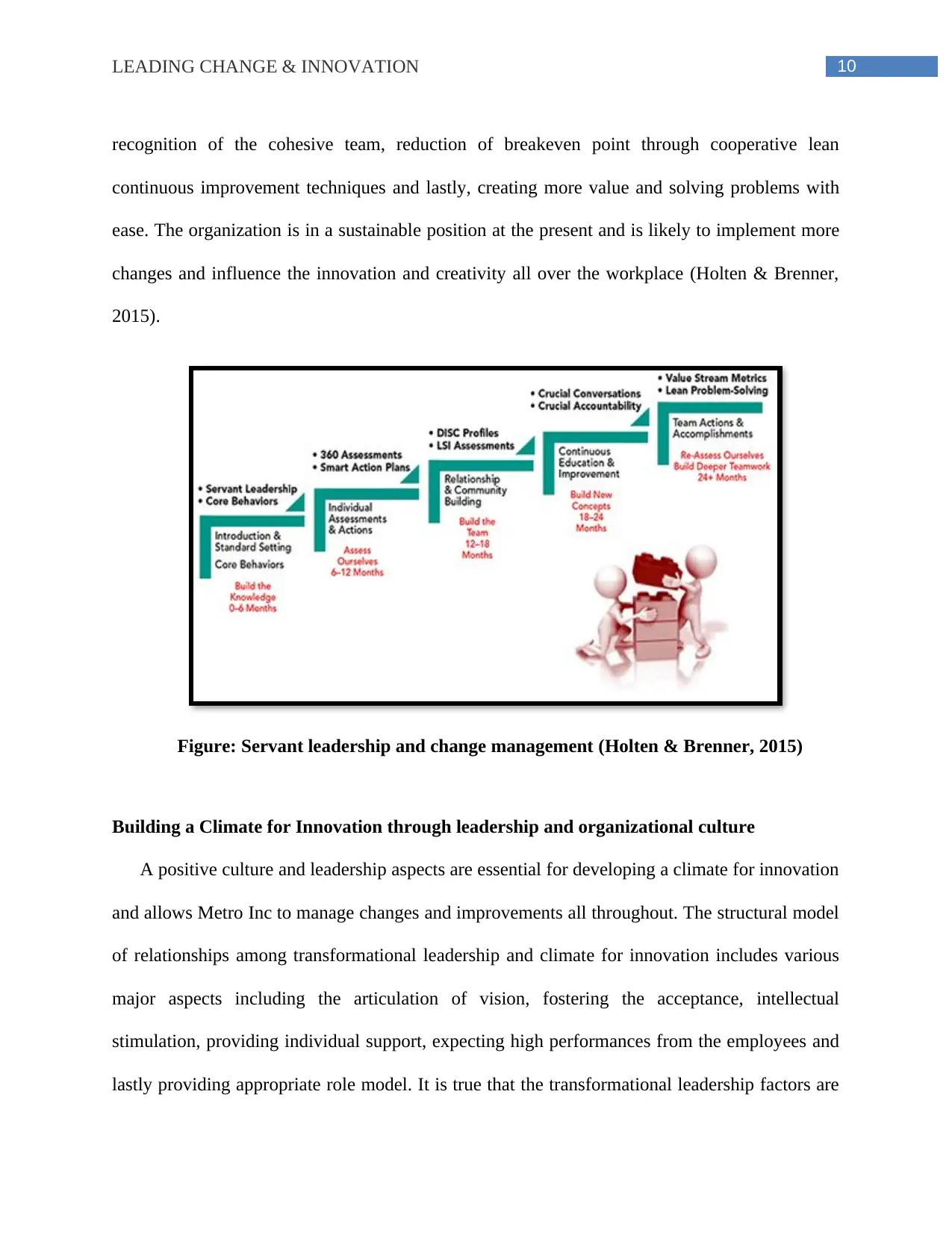
With the help of the servant leadership approach, the organization has achieved highest
standards and even becomes a high performing workforce. At first, the core behaviors are
assessed and knowledge is developed and afterwards the smart action plans are prepared. This
has helped in individual assessment and evaluating the actions undertaken by them to build
relationships and community. The teamwork is facilitated and proper cooperation at work further
influenced the production value. Metro being a large sized retail supermarket chain in Canada,
promotes a diversified workforce consisting of individuals’ whose needs have been prioritized on
to bring out their best in terms of performance. Implementation of new technologies,
machineries, investment in infrastructures is vital and at the same time, management of human
resources is done properly when driven by servant leadership (Büschgens, Bausch & Balkin,
2013). It has developed a cohesive workforce and established better communication streams
between the various groups of people, new systems of training are recreated to influence the
behaviors of the employees and remain transformative to the culture and development of
workforce. The changes could be seen in respect of innovation, creativity, better teamwork,
communication and higher production at Metro Inc. The servant led culture has allowed focusing
on long term objectives and getting the right behaviors of behaviors to support the teamwork and
provide excellent customers’ services too (Donate & de Pablo, 2015). It has always been a major
aspect of the strategic plan and with the servant leadership approach, the transformation of
culture and structure further contributed to the satisfaction of both employees and customers.
Vast amounts of major changes have made the organization high performing in the servant led
culture or structure. The few areas where changes are facilitated include improvement of
“employer of choice” status by attracting the most suitable employees, enabling customer
The organization at present
With the help of the servant leadership approach, the organization has achieved highest
standards and even becomes a high performing workforce. At first, the core behaviors are
assessed and knowledge is developed and afterwards the smart action plans are prepared. This
has helped in individual assessment and evaluating the actions undertaken by them to build
relationships and community. The teamwork is facilitated and proper cooperation at work further
influenced the production value. Metro being a large sized retail supermarket chain in Canada,
promotes a diversified workforce consisting of individuals’ whose needs have been prioritized on
to bring out their best in terms of performance. Implementation of new technologies,
machineries, investment in infrastructures is vital and at the same time, management of human
resources is done properly when driven by servant leadership (Büschgens, Bausch & Balkin,
2013). It has developed a cohesive workforce and established better communication streams
between the various groups of people, new systems of training are recreated to influence the
behaviors of the employees and remain transformative to the culture and development of
workforce. The changes could be seen in respect of innovation, creativity, better teamwork,
communication and higher production at Metro Inc. The servant led culture has allowed focusing
on long term objectives and getting the right behaviors of behaviors to support the teamwork and
provide excellent customers’ services too (Donate & de Pablo, 2015). It has always been a major
aspect of the strategic plan and with the servant leadership approach, the transformation of
culture and structure further contributed to the satisfaction of both employees and customers.
Vast amounts of major changes have made the organization high performing in the servant led
culture or structure. The few areas where changes are facilitated include improvement of
“employer of choice” status by attracting the most suitable employees, enabling customer
Paraphrase This Document
Need a fresh take? Get an instant paraphrase of this document with our AI Paraphraser
10LEADING CHANGE & INNOVATION
recognition of the cohesive team, reduction of breakeven point through cooperative lean
continuous improvement techniques and lastly, creating more value and solving problems with
ease. The organization is in a sustainable position at the present and is likely to implement more
changes and influence the innovation and creativity all over the workplace (Holten & Brenner,
2015).
Figure: Servant leadership and change management (Holten & Brenner, 2015)
Building a Climate for Innovation through leadership and organizational culture
A positive culture and leadership aspects are essential for developing a climate for innovation
and allows Metro Inc to manage changes and improvements all throughout. The structural model
of relationships among transformational leadership and climate for innovation includes various
major aspects including the articulation of vision, fostering the acceptance, intellectual
stimulation, providing individual support, expecting high performances from the employees and
lastly providing appropriate role model. It is true that the transformational leadership factors are
recognition of the cohesive team, reduction of breakeven point through cooperative lean
continuous improvement techniques and lastly, creating more value and solving problems with
ease. The organization is in a sustainable position at the present and is likely to implement more
changes and influence the innovation and creativity all over the workplace (Holten & Brenner,
2015).
Figure: Servant leadership and change management (Holten & Brenner, 2015)
Building a Climate for Innovation through leadership and organizational culture
A positive culture and leadership aspects are essential for developing a climate for innovation
and allows Metro Inc to manage changes and improvements all throughout. The structural model
of relationships among transformational leadership and climate for innovation includes various
major aspects including the articulation of vision, fostering the acceptance, intellectual
stimulation, providing individual support, expecting high performances from the employees and
lastly providing appropriate role model. It is true that the transformational leadership factors are
11LEADING CHANGE & INNOVATION
the most important for shaping the culture of innovation (Boutros & Purdie, 2014). The
performance oriented organizational culture and climate for innovation are interconnected
concepts, which can facilitate the articulating of vision, set high performance expectations and
provide individual support for their enhancement of skills, knowledge and expertise. When a
positive work culture is created, it becomes easy to form a climate for organizational innovation
and facilitate the processes of production and delivery of products and services to its customers.
The two most important transformational leadership factors including the articulates vision and
provides individual support are considered as effective factors responsible for building a climate
for innovation at the organization (Saruhan, 2014). According to Sarros et al. (2008), the
transformational leader of the organization defines a vision and it has been accepted and
anticipated by individuals working there. The articulating of vision has further helped in
achieving the desired results and even engaged the staffs altogether with the shared vision
components of culture related to the management of innovation. Individual’s support not only
enhances the ability to set high performance expectations, but also strengthens the relationships
between the leaders and employees through the vision statement and improvement in existing
skills and knowledge too (Piercy, 2016). The intellectual stimulation could enhance the
capabilities of the leader to articulate the vision of the organization and at the same time,
influence change in culture for building a climate for innovation at Metro Inc. A transformational
servant leader must take into consideration the feelings of others and understand the needs of
theirs, so that those could be met and organizational change is encouraged. It would bring
innovation, at the same time, foster creativity, achieve high performance, and drive the employee
behaviors and performances too (Adams & McNicholas, 2007).
the most important for shaping the culture of innovation (Boutros & Purdie, 2014). The
performance oriented organizational culture and climate for innovation are interconnected
concepts, which can facilitate the articulating of vision, set high performance expectations and
provide individual support for their enhancement of skills, knowledge and expertise. When a
positive work culture is created, it becomes easy to form a climate for organizational innovation
and facilitate the processes of production and delivery of products and services to its customers.
The two most important transformational leadership factors including the articulates vision and
provides individual support are considered as effective factors responsible for building a climate
for innovation at the organization (Saruhan, 2014). According to Sarros et al. (2008), the
transformational leader of the organization defines a vision and it has been accepted and
anticipated by individuals working there. The articulating of vision has further helped in
achieving the desired results and even engaged the staffs altogether with the shared vision
components of culture related to the management of innovation. Individual’s support not only
enhances the ability to set high performance expectations, but also strengthens the relationships
between the leaders and employees through the vision statement and improvement in existing
skills and knowledge too (Piercy, 2016). The intellectual stimulation could enhance the
capabilities of the leader to articulate the vision of the organization and at the same time,
influence change in culture for building a climate for innovation at Metro Inc. A transformational
servant leader must take into consideration the feelings of others and understand the needs of
theirs, so that those could be met and organizational change is encouraged. It would bring
innovation, at the same time, foster creativity, achieve high performance, and drive the employee
behaviors and performances too (Adams & McNicholas, 2007).
⊘ This is a preview!⊘
Do you want full access?
Subscribe today to unlock all pages.
Trusted by 1+ million students worldwide

1 out of 24


Related Documents


Your All-in-One AI-Powered Toolkit for Academic Success.
+13062052269
info@desklib.com
Available 24*7 on WhatsApp / Email
![[object Object]](/_next/static/media/star-bottom.7253800d.svg)
Unlock your academic potential
Copyright © 2020–2026 A2Z Services. All Rights Reserved. Developed and managed by ZUCOL.