MGT540 Report: Assessing Change Management at Lakeland Wonders
VerifiedAdded on 2023/06/09
|16
|3728
|417
Report
AI Summary
This report provides a comprehensive analysis of organizational change management, focusing on various theoretical perspectives and practical applications. It begins with an executive summary and introduction, outlining the importance of effective change management. The report then delves into Section A, which identifies, examines, and critically analyzes different approaches to organizational change, including Lewin’s change management model and Kotter’s change management theory. Section B assesses Cheryl Hailstrom’s change management program at Lakeland Wonders, particularly her communication strategies, offering a critique and recommendations for improvement. The report examines the context of change, the reasons behind it, and evaluates the appropriateness of Hailstrom's approach in the Lakeland Wonders case, supported by scholarly literature. The report concludes with a synthesis of the findings and recommendations for enhancing change management practices. Overall, the report aims to provide a clear understanding of change management principles and their practical application in real-world organizational settings.
Management of change
Change communication
Name
Professor
Course
Date
Change communication
Name
Professor
Course
Date

Paraphrase This Document
Need a fresh take? Get an instant paraphrase of this document with our AI Paraphraser
Management of change
1. Executive summary
Organization change is an important aspect of any form of enterprise, therefore, it should
be made a priority that this change is managed properly and in the required manner so that it can
bring about positive contributions to the firm and not otherwise cause so much harm and
misunderstandings among staff and personnel in an organization.
This report comprises of some of the important components of organization change and
management of this change (Dozier, Grunig, Grunig, 2013). Whenever there is need for change
in an organization, there is always a section of personnel and staff within the organization that
feel the change is not necessary. They will therefore try to resist the change, some of the causes
of change resistance will be looked at and the possible ways of avoiding this toxic resistance will
be mentioned.
1. Executive summary
Organization change is an important aspect of any form of enterprise, therefore, it should
be made a priority that this change is managed properly and in the required manner so that it can
bring about positive contributions to the firm and not otherwise cause so much harm and
misunderstandings among staff and personnel in an organization.
This report comprises of some of the important components of organization change and
management of this change (Dozier, Grunig, Grunig, 2013). Whenever there is need for change
in an organization, there is always a section of personnel and staff within the organization that
feel the change is not necessary. They will therefore try to resist the change, some of the causes
of change resistance will be looked at and the possible ways of avoiding this toxic resistance will
be mentioned.
Management of change
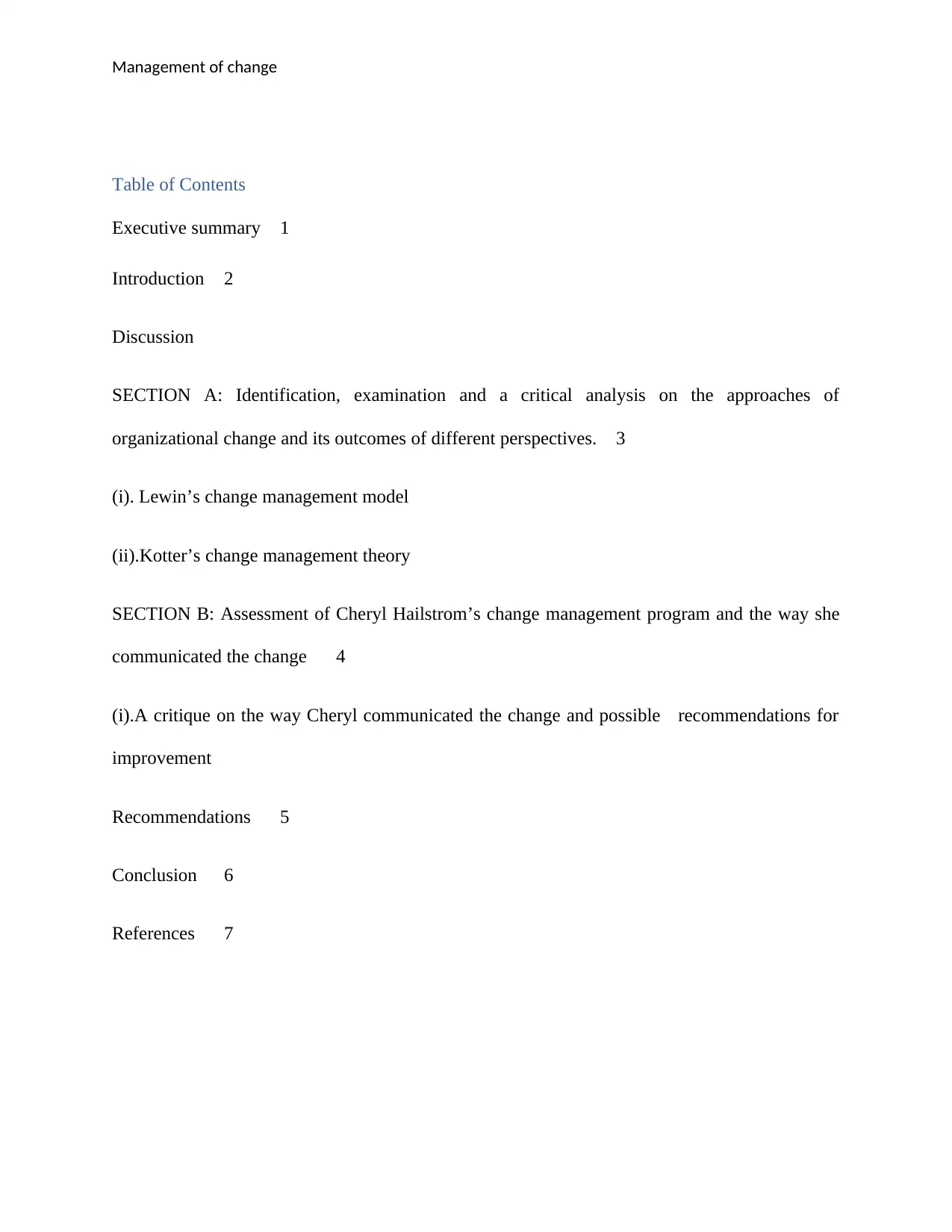
Table of Contents
Executive summary 1
Introduction 2
Discussion
SECTION A: Identification, examination and a critical analysis on the approaches of
organizational change and its outcomes of different perspectives. 3
(i). Lewin’s change management model
(ii).Kotter’s change management theory
SECTION B: Assessment of Cheryl Hailstrom’s change management program and the way she
communicated the change 4
(i).A critique on the way Cheryl communicated the change and possible recommendations for
improvement
Recommendations 5
Conclusion 6
References 7
Table of Contents
Executive summary 1
Introduction 2
Discussion
SECTION A: Identification, examination and a critical analysis on the approaches of
organizational change and its outcomes of different perspectives. 3
(i). Lewin’s change management model
(ii).Kotter’s change management theory
SECTION B: Assessment of Cheryl Hailstrom’s change management program and the way she
communicated the change 4
(i).A critique on the way Cheryl communicated the change and possible recommendations for
improvement
Recommendations 5
Conclusion 6
References 7
⊘ This is a preview!⊘
Do you want full access?
Subscribe today to unlock all pages.

Trusted by 1+ million students worldwide
Management of change
2. Introduction
Change management is a discipline that guides and monitors how people in an
organization setting prepare and support individuals to successfully adopt change in an
organization (Anderson & Anderson, 2010).The transition is always hectic but necessary actions
have to be taken to ensure that it goes as smooth as possible. Persons have to be influenced to
pursue the change which involves mentioning the reasons why the change is necessary.
This write-up will look at various aspects of change management program, an approach that
organizational change has taken and also making the necessary recommendations for
improvement (Hayes, 2018).To be more specific, this report will critique the way in which
Cheryl Hailstrom has communicated the change she is seeking to implement This report will be
divided into two sections, the first section will comprise of identification, examination and a
critical analysis on the approaches of organizational change and its outcomes on from a range of
different theoretical perspectives (Carnall, 2018).The second section will comprise of asses on
Cheryl Hailstrom’s change management program, in particular the way she has communicated
the change. Some improvements and recommendations will be made in regard to this
2. Introduction
Change management is a discipline that guides and monitors how people in an
organization setting prepare and support individuals to successfully adopt change in an
organization (Anderson & Anderson, 2010).The transition is always hectic but necessary actions
have to be taken to ensure that it goes as smooth as possible. Persons have to be influenced to
pursue the change which involves mentioning the reasons why the change is necessary.
This write-up will look at various aspects of change management program, an approach that
organizational change has taken and also making the necessary recommendations for
improvement (Hayes, 2018).To be more specific, this report will critique the way in which
Cheryl Hailstrom has communicated the change she is seeking to implement This report will be
divided into two sections, the first section will comprise of identification, examination and a
critical analysis on the approaches of organizational change and its outcomes on from a range of
different theoretical perspectives (Carnall, 2018).The second section will comprise of asses on
Cheryl Hailstrom’s change management program, in particular the way she has communicated
the change. Some improvements and recommendations will be made in regard to this
Paraphrase This Document
Need a fresh take? Get an instant paraphrase of this document with our AI Paraphraser
Management of change
Discussion
3. SECTION A:
Identification, examination and a critical analysis on the approaches of organizational
change and its outcomes of different perspectives.
The term change itself has been considered to be the only constant reality in life. Be it
personal life or organizations’ change is something that will always be there, things will always
keep changing time and time again (Cameron & Green, 2015).Great scholars and academicians
have termed it as inevitable.
As mentioned earlier, change management is often associated with transition. This transition can
be in the form of people, companies, ideas, projects or even ways of doing things in an
organization. Change is always introduced when there is need of that change. More often change
is recommended when the existing tool or means of doing things is not appropriate and it does
not help or play the role it is supposed to thus hindering the achievement of organization goals.
Change management is therefore the application of the fundamental identified and well-
structured methods so as to help propel an organization from its current state desired place that is
much. better (Doppelt, 2017).There are various approaches towards change management. In
these various approaches certain models can be applied that would play a very important role in
ensuring that an organization smoothly transits from its current position to a much better
position. Some of the best approaches for change management have been discussed below;
(i). Lewin’s change management model
Discussion
3. SECTION A:
Identification, examination and a critical analysis on the approaches of organizational
change and its outcomes of different perspectives.
The term change itself has been considered to be the only constant reality in life. Be it
personal life or organizations’ change is something that will always be there, things will always
keep changing time and time again (Cameron & Green, 2015).Great scholars and academicians
have termed it as inevitable.
As mentioned earlier, change management is often associated with transition. This transition can
be in the form of people, companies, ideas, projects or even ways of doing things in an
organization. Change is always introduced when there is need of that change. More often change
is recommended when the existing tool or means of doing things is not appropriate and it does
not help or play the role it is supposed to thus hindering the achievement of organization goals.
Change management is therefore the application of the fundamental identified and well-
structured methods so as to help propel an organization from its current state desired place that is
much. better (Doppelt, 2017).There are various approaches towards change management. In
these various approaches certain models can be applied that would play a very important role in
ensuring that an organization smoothly transits from its current position to a much better
position. Some of the best approaches for change management have been discussed below;
(i). Lewin’s change management model
Management of change
This is considered to be not only the most popular change management model but also
most effective one. It has played a very crucial role in helping organization partake change and
also comfortably adopt it. Kurt Lewin is believed to the designer of this very important change
management model (Frankland, Mitchell, Ferguson, Sziklai, Verma, Popowski, Sturgeon, 2013).
In his model, Kurt Lewin mentions that it has three very distinct but related stages. These stages
are; Unfreeze, change and refreeze. These three stages are explained below;
Unfreeze
This is the initial stage/step of the change model. It is basically associated with all the
necessary steps and action taken so as to prepare of the change. Lewin suggested that members
of the organization should be prepared to change; a motivation factor behind this change should
be the fact that this change is very crucial and is needed for the survival of the organization
(Sikdar & Payyazhi, 2014). It is considered to be very important because as normal, human
beings will always try to resist the change, therefore this stage comes in and alerts members of an
organization that a change is in place and they should be prepared.
Change
This is the second stage of this change management model. It is a stage where the actual
transition and change takes place. The implementation of change takes place in this stage. It is a
stage that takes quite a considerable amount of time before it is fully in play because it is in
human beings nature to take time before embracing and adopting new ways of doing things.
This is considered to be not only the most popular change management model but also
most effective one. It has played a very crucial role in helping organization partake change and
also comfortably adopt it. Kurt Lewin is believed to the designer of this very important change
management model (Frankland, Mitchell, Ferguson, Sziklai, Verma, Popowski, Sturgeon, 2013).
In his model, Kurt Lewin mentions that it has three very distinct but related stages. These stages
are; Unfreeze, change and refreeze. These three stages are explained below;
Unfreeze
This is the initial stage/step of the change model. It is basically associated with all the
necessary steps and action taken so as to prepare of the change. Lewin suggested that members
of the organization should be prepared to change; a motivation factor behind this change should
be the fact that this change is very crucial and is needed for the survival of the organization
(Sikdar & Payyazhi, 2014). It is considered to be very important because as normal, human
beings will always try to resist the change, therefore this stage comes in and alerts members of an
organization that a change is in place and they should be prepared.
Change
This is the second stage of this change management model. It is a stage where the actual
transition and change takes place. The implementation of change takes place in this stage. It is a
stage that takes quite a considerable amount of time before it is fully in play because it is in
human beings nature to take time before embracing and adopting new ways of doing things.
⊘ This is a preview!⊘
Do you want full access?
Subscribe today to unlock all pages.
Trusted by 1+ million students worldwide
Management of change
It is always important however, to constantly let the leaders play their role in reminding what the
organization is embracing. Kurt Lewins identifies communication and time as important aspects
in this particular stage.
Refreeze
This is the last stage of this change management model. Once the change has been fully
accepted and embraced by various stakeholders in an organization, the organization starts to
become stable again (Grunig, 2013).It is now in a position to fully execute its activities because
of stability that comes with it. From the word refreeze, things in an organization start to go back
to the way they were and normal operations become begin taking place. It is during this stage
that employees become confident and comfortable about change that has been introduced.
(ii). Kotter’s change management theory
In addition to its great popularity, Kotter’s change management theory is considered to be
one of the most adopted change approach system in the world (Kotter, 2012). It was proposed by
John Kotter. There are various stages that are associated with this particular change management
theory. These stages are outlined below;
Increase urgency-This is the stage that involves constantly creating a sense of urgency among
the members in an organization so as to convince them that the impending change is really
crucial to the organization.
Build the team-For this stage Kotter propose that it is associated with gathering of the right
people in an organization by selecting persons with different skills and knowledge in preparation
for the impending change.
It is always important however, to constantly let the leaders play their role in reminding what the
organization is embracing. Kurt Lewins identifies communication and time as important aspects
in this particular stage.
Refreeze
This is the last stage of this change management model. Once the change has been fully
accepted and embraced by various stakeholders in an organization, the organization starts to
become stable again (Grunig, 2013).It is now in a position to fully execute its activities because
of stability that comes with it. From the word refreeze, things in an organization start to go back
to the way they were and normal operations become begin taking place. It is during this stage
that employees become confident and comfortable about change that has been introduced.
(ii). Kotter’s change management theory
In addition to its great popularity, Kotter’s change management theory is considered to be
one of the most adopted change approach system in the world (Kotter, 2012). It was proposed by
John Kotter. There are various stages that are associated with this particular change management
theory. These stages are outlined below;
Increase urgency-This is the stage that involves constantly creating a sense of urgency among
the members in an organization so as to convince them that the impending change is really
crucial to the organization.
Build the team-For this stage Kotter propose that it is associated with gathering of the right
people in an organization by selecting persons with different skills and knowledge in preparation
for the impending change.
Paraphrase This Document
Need a fresh take? Get an instant paraphrase of this document with our AI Paraphraser
Management of change
Get the vision correct-This stage is associated with creating of correct vision that would aid in
spearheading the change yet to be introduced.\
Communicate-This stage is associated with communicating to the personnel in the organization
why the change is very crucial and why those very times is the correct time to introduce that
change (Kotter, 2012).
Get things moving-In order to carry out with the change, then support is needed; resistance will
be normal but should not hinder change.
Focus on short term goals-Basically; what Kotter meant is that focusing on short term goals is
the most appropriate way of achieving ultimate goal (Kotter, 2012).The long term goals should
therefore be subdivided into many short term goals that are achievable.
Do not give up- No matter what and how things get on the way, giving up should not be an
option, persistence should.
Incorporate change-As much as the change will be managed properly, it is always important that
it gets reinforced time over time (Kotter, 2012).
4. SECTION B:
Assessment of Cheryl Hailstrom’s change management program and the way she
communicated the change
Cheryl Hailstorm is the current CEO at Lakeland Wonders Company and she feels that
there are a number of aspects that needs to be improved in regard to the operation of the
company. It is less than six months since she was named CEO of Lakeland and she really has a
lot of energy and enthusiasm. Having successfully worked at Lakeland for quite some time, for
Get the vision correct-This stage is associated with creating of correct vision that would aid in
spearheading the change yet to be introduced.\
Communicate-This stage is associated with communicating to the personnel in the organization
why the change is very crucial and why those very times is the correct time to introduce that
change (Kotter, 2012).
Get things moving-In order to carry out with the change, then support is needed; resistance will
be normal but should not hinder change.
Focus on short term goals-Basically; what Kotter meant is that focusing on short term goals is
the most appropriate way of achieving ultimate goal (Kotter, 2012).The long term goals should
therefore be subdivided into many short term goals that are achievable.
Do not give up- No matter what and how things get on the way, giving up should not be an
option, persistence should.
Incorporate change-As much as the change will be managed properly, it is always important that
it gets reinforced time over time (Kotter, 2012).
4. SECTION B:
Assessment of Cheryl Hailstrom’s change management program and the way she
communicated the change
Cheryl Hailstorm is the current CEO at Lakeland Wonders Company and she feels that
there are a number of aspects that needs to be improved in regard to the operation of the
company. It is less than six months since she was named CEO of Lakeland and she really has a
lot of energy and enthusiasm. Having successfully worked at Lakeland for quite some time, for
Management of change
instance she is well known to be behind the sudden and rapid growth of Kids & Company; she
believes that things need to change and wit her new CEO position then she can make things
happen (Kotter, 2012). Cheryl tried a number of ways to try and make people in the company not
only see but also share her great vision for Lakeland. Some of the means that Cheryl tried
include; leading by example, setting of aggressive deadlines for typically new products among
others.
Cheryl thought that Lakeland should embrace make a change and the change was triggered by
Bull’s-Eye store which was looking for an extremely exclusive line of wooden toys and they
(Bull’s-Eye store) felt that Lakeland is the one supposed to do it. The change was therefore
establishment of offshore manufacturing capabilities. Cheryl insists that Mark, more than anyone
else know better that offshore manufacturing is the future of Lakeland. Cheryl argues that there
is the need to go beyond normal upscale market and get into the midmarket.
She is so convinced that this change is the future of Lakeland Wonders and that it should
be brought into play as quickly as possible. As a matter of fact, it reaches a point where Cheryl
thinks that people in the organizations are not visionary as she is. Well, this change is very and
maybe very crucial for Lakeland but the way Cheryl raises it and presents it to the rest of the
organization is not appropriate (Kotter, 2012). Generally, Cheryl feels that everyone is so dug
into the old ways of doing things and cannot even at any point start considering a change.
Cheryl organizes a meeting that is supposed to discuss this issue regarding the change that she
dearly wants to implement. In the meeting, we see that Cheryl is so much confident about the
change and so determine to take it through that she doesn’t even recognize other’s opinions
instance she is well known to be behind the sudden and rapid growth of Kids & Company; she
believes that things need to change and wit her new CEO position then she can make things
happen (Kotter, 2012). Cheryl tried a number of ways to try and make people in the company not
only see but also share her great vision for Lakeland. Some of the means that Cheryl tried
include; leading by example, setting of aggressive deadlines for typically new products among
others.
Cheryl thought that Lakeland should embrace make a change and the change was triggered by
Bull’s-Eye store which was looking for an extremely exclusive line of wooden toys and they
(Bull’s-Eye store) felt that Lakeland is the one supposed to do it. The change was therefore
establishment of offshore manufacturing capabilities. Cheryl insists that Mark, more than anyone
else know better that offshore manufacturing is the future of Lakeland. Cheryl argues that there
is the need to go beyond normal upscale market and get into the midmarket.
She is so convinced that this change is the future of Lakeland Wonders and that it should
be brought into play as quickly as possible. As a matter of fact, it reaches a point where Cheryl
thinks that people in the organizations are not visionary as she is. Well, this change is very and
maybe very crucial for Lakeland but the way Cheryl raises it and presents it to the rest of the
organization is not appropriate (Kotter, 2012). Generally, Cheryl feels that everyone is so dug
into the old ways of doing things and cannot even at any point start considering a change.
Cheryl organizes a meeting that is supposed to discuss this issue regarding the change that she
dearly wants to implement. In the meeting, we see that Cheryl is so much confident about the
change and so determine to take it through that she doesn’t even recognize other’s opinions
⊘ This is a preview!⊘
Do you want full access?
Subscribe today to unlock all pages.
Trusted by 1+ million students worldwide
Management of change
regarding the change. Every time someone objects and has a different version regarding the
change, Cheryl tries to fight them and defends the change with all she’s got.
The former CEO seemed to get hold of things and she tells Cheryl that Lakeland is an old
company, it has been in operation for 94 years and at times one needs to try to pull people even
much slower so as to avoid destroying the whole company. Cheryl is so determine and she feels
that they should implement this change so quick so as not to lose the Bull’s-Eye deal. She has
various reasons for taking the change to the next level.
(i). A critique on the way Cheryl communicated the change and possible recommendations
for improvement
Change is an important aspect in an organization, it is very fragile and the way one
communicates the need for change then they must be very specific in the way they do it. Cheryl
communicated change to his collogues at Lakeland Wonders but it happened that some of them
did not agree with her (Pohl, 2010). Well, it is a normal thing to find resistance to change since
not all people in an organization can be as visionary as others, and they would always try to
continue do things the way they were before.
There are three steps that need to be followed to the latter in change communication so as to
avoid so many unnecessary cases of rigid resistance.
First and foremost, communication of change begins with first telling your organization
what you want. Be clear and bold. Just hit the nail on the head, there should not be any beating
around the bush. As a matter of fact, one should stand out and mention what is it that they feel
should be changed and how necessary it is for the change to take place. The reason for the
change should be mentioned and why that change is needed at that particular time should also be
regarding the change. Every time someone objects and has a different version regarding the
change, Cheryl tries to fight them and defends the change with all she’s got.
The former CEO seemed to get hold of things and she tells Cheryl that Lakeland is an old
company, it has been in operation for 94 years and at times one needs to try to pull people even
much slower so as to avoid destroying the whole company. Cheryl is so determine and she feels
that they should implement this change so quick so as not to lose the Bull’s-Eye deal. She has
various reasons for taking the change to the next level.
(i). A critique on the way Cheryl communicated the change and possible recommendations
for improvement
Change is an important aspect in an organization, it is very fragile and the way one
communicates the need for change then they must be very specific in the way they do it. Cheryl
communicated change to his collogues at Lakeland Wonders but it happened that some of them
did not agree with her (Pohl, 2010). Well, it is a normal thing to find resistance to change since
not all people in an organization can be as visionary as others, and they would always try to
continue do things the way they were before.
There are three steps that need to be followed to the latter in change communication so as to
avoid so many unnecessary cases of rigid resistance.
First and foremost, communication of change begins with first telling your organization
what you want. Be clear and bold. Just hit the nail on the head, there should not be any beating
around the bush. As a matter of fact, one should stand out and mention what is it that they feel
should be changed and how necessary it is for the change to take place. The reason for the
change should be mentioned and why that change is needed at that particular time should also be
Paraphrase This Document
Need a fresh take? Get an instant paraphrase of this document with our AI Paraphraser
Management of change
stipulated. One should also go ahead into mentioning the full extent of the change that they are
suggesting (Invernizzi, Romenti, Fumagalli, 2012).
Cheryl communicated the change in quite an absurd manner, during this stage, she mentioned the
change that she needed which was establishment of an offshore manufacturing capabilities
(Keppel & Wardell‐Johnson, 2012). The change was very clear but she did not mention why the
change was so necessary then. She just says that Lakeland cannot afford missing the Bull’s-Eye
contract. As a matter of fact from the look of things, then one could easily say that she was not so
sure about the change she wanted. She was so stuck into not letting Bull’s-Eye stores down that
she had to fabricate some change in her own company not to disappoint Bull’s-Eye down. This
should not be the case, a change should be genuine and legit and it should always have an impact
that should be positive to the life of an organization.
Moreover, Cheryl had all reasons to enforce that change because she felt that it was the only
hope for Lakeland to meet the board’s targets. This was quite impressive but she crossed a red
line with this. As depicted from the conversation, we see that Cheryl argues with anyone who is
against this change. During their board meeting Cheryl was so determine to prove a point that the
change was necessary that she even ended up missing it at all (Reiß, 2012).The second step
towards change communication is being a living example of the change that you want to see in
an organization(Pohl, 2010). This basically means changing the way you do things. Try to do
things in the new way that you feel people should be doing them in that organization. Act as a
role model, let the other people in the organization see you as a very different person and let your
actions influence them to embrace what you think for the company, the change
stipulated. One should also go ahead into mentioning the full extent of the change that they are
suggesting (Invernizzi, Romenti, Fumagalli, 2012).
Cheryl communicated the change in quite an absurd manner, during this stage, she mentioned the
change that she needed which was establishment of an offshore manufacturing capabilities
(Keppel & Wardell‐Johnson, 2012). The change was very clear but she did not mention why the
change was so necessary then. She just says that Lakeland cannot afford missing the Bull’s-Eye
contract. As a matter of fact from the look of things, then one could easily say that she was not so
sure about the change she wanted. She was so stuck into not letting Bull’s-Eye stores down that
she had to fabricate some change in her own company not to disappoint Bull’s-Eye down. This
should not be the case, a change should be genuine and legit and it should always have an impact
that should be positive to the life of an organization.
Moreover, Cheryl had all reasons to enforce that change because she felt that it was the only
hope for Lakeland to meet the board’s targets. This was quite impressive but she crossed a red
line with this. As depicted from the conversation, we see that Cheryl argues with anyone who is
against this change. During their board meeting Cheryl was so determine to prove a point that the
change was necessary that she even ended up missing it at all (Reiß, 2012).The second step
towards change communication is being a living example of the change that you want to see in
an organization(Pohl, 2010). This basically means changing the way you do things. Try to do
things in the new way that you feel people should be doing them in that organization. Act as a
role model, let the other people in the organization see you as a very different person and let your
actions influence them to embrace what you think for the company, the change
Management of change
Cheryl was very good at this; we see that she tried so hard to the change that she wanted to see
for Lakeland. For instance, it is mentioned that Cheryl was setting aggressive targets for new
manufacturing; she was trying to be part of the change that she wanted. Despite all these efforts
that Cheryl was making, she was not persistent and patient enough.
Last but not least, in change communication one should always go an extra mile into
resourcing and measuring the change that you’ve asked for (Invernizzi et al, 2012).One should
have the resources to deliver the change they are recommending. Be in a position not to make the
organization incur so much cost, but instead, try to find an alternative of obtaining the resources
to finance the change that you want.
Well, this is the point that Cheryl missed out in her communication of the change program that
she wanted. She was not so clear n where the resources to finance the change she wanted would
come from (Raineri, 2011).When she is asked about the matter, she deflects and says that they
can just outsource. This was not so impressive and it is exactly what made a number of some of
her colleagues disagree with her.
5. Recommendations
Based on the analysis in the way Cheryl communicated her change, the following
recommendations can be suggested for improvement;
She should tell the organization exactly what she wants and in regard to that the following
aspects must be explained;
a) Why does Lakeland need the change and why at that particular moment
b) What is the full extent of the change she is proposing?
Cheryl was very good at this; we see that she tried so hard to the change that she wanted to see
for Lakeland. For instance, it is mentioned that Cheryl was setting aggressive targets for new
manufacturing; she was trying to be part of the change that she wanted. Despite all these efforts
that Cheryl was making, she was not persistent and patient enough.
Last but not least, in change communication one should always go an extra mile into
resourcing and measuring the change that you’ve asked for (Invernizzi et al, 2012).One should
have the resources to deliver the change they are recommending. Be in a position not to make the
organization incur so much cost, but instead, try to find an alternative of obtaining the resources
to finance the change that you want.
Well, this is the point that Cheryl missed out in her communication of the change program that
she wanted. She was not so clear n where the resources to finance the change she wanted would
come from (Raineri, 2011).When she is asked about the matter, she deflects and says that they
can just outsource. This was not so impressive and it is exactly what made a number of some of
her colleagues disagree with her.
5. Recommendations
Based on the analysis in the way Cheryl communicated her change, the following
recommendations can be suggested for improvement;
She should tell the organization exactly what she wants and in regard to that the following
aspects must be explained;
a) Why does Lakeland need the change and why at that particular moment
b) What is the full extent of the change she is proposing?
⊘ This is a preview!⊘
Do you want full access?
Subscribe today to unlock all pages.
Trusted by 1+ million students worldwide

1 out of 16


Related Documents


Your All-in-One AI-Powered Toolkit for Academic Success.
+13062052269
info@desklib.com
Available 24*7 on WhatsApp / Email
![[object Object]](/_next/static/media/star-bottom.7253800d.svg)
Unlock your academic potential
Copyright © 2020–2026 A2Z Services. All Rights Reserved. Developed and managed by ZUCOL.