Organizational Change Management Analysis: Richardson Timber Report
VerifiedAdded on 2020/03/16
|15
|3075
|126
Report
AI Summary
This report, prepared for B. R. Richardson Timber Product Corporation, diagnoses organizational issues and proposes solutions. It identifies challenges in information technology, employee empowerment, corporate social responsibility, and workforce diversity. The report recommends embracing modern IT, improving employee working conditions, empowering employees, and diversifying the workforce. It discusses organizational change management models, including Harold Leavitt’s model, Kurt Lewin’s theory (unfreeze-change-refreeze), and the 7-Stage Model. The analysis highlights the importance of change for growth, efficiency, and innovation, emphasizing the need for stakeholder consideration and the application of change management theories for successful implementation. The report concludes with a call for the corporation to evaluate its needs, develop a credible scheme, and consider all stakeholders to ensure effective and sustainable modifications.
Running Head: ORGANIZATION CHANGE MANAGEMENT 1
ORGANIZATIONAL CHANGE MANAGEMENT
Name
Institution
ORGANIZATIONAL CHANGE MANAGEMENT
Name
Institution

Paraphrase This Document
Need a fresh take? Get an instant paraphrase of this document with our AI Paraphraser
ORGANIZATION CHANGE MANAGEMENT 2
LETTER OF TRANSMITTAL
Mr. Richard Bowman,
B. R Richardson Timber Product Corporation,
P.O. Box 66,
Papoose, Oregon.
04/10/2017.
Dear Mr. Bowman,
Following your request, a report is hereby prepared diagnosing the issues at Richardson
Timber Product Corporation. The paper discusses the major challenges in the organization and
highlights probable recommendations to help in solving the issues.
Also, organizational change management models are discussed. These theories will
enable the corporation to develop suitable framework of modifications. The organization can
adopt the best model in implementing change.
Yours sincerely,
Jack Lawler.
Partner,
Oregon Consulting Associates.
LETTER OF TRANSMITTAL
Mr. Richard Bowman,
B. R Richardson Timber Product Corporation,
P.O. Box 66,
Papoose, Oregon.
04/10/2017.
Dear Mr. Bowman,
Following your request, a report is hereby prepared diagnosing the issues at Richardson
Timber Product Corporation. The paper discusses the major challenges in the organization and
highlights probable recommendations to help in solving the issues.
Also, organizational change management models are discussed. These theories will
enable the corporation to develop suitable framework of modifications. The organization can
adopt the best model in implementing change.
Yours sincerely,
Jack Lawler.
Partner,
Oregon Consulting Associates.
ORGANIZATION CHANGE MANAGEMENT 3
Executive Summary
This report identifies and discusses the organizational issues in Richardson Timber
Product Corporation and further recommends probable measures to be pursued to surmount the
problems. In the study, various challenges were noted. First, information technology is not
embraced in the organization making communication among management, employees, and other
stakeholders ineffective. Also, there is inappropriate employee empowerment program which
ought to be handled. Again, the corporate social responsibility in the corporation is below par
leading to a poor reputation in the community and inadequate employee diversification regarding
age. Therefore, the following recommendations were made to aid modifications in Richardson
Timber Product Corporation:
Richardson Timber Corporation should embrace modern information technology.
Computers can be used in the organization to serve various purposes such as financial
analysis, documentations, and communication.
Employees working conditions should be improved. They have to be provided with
quality helmets and ensure that equipment such as band saws have guards to avoid
accidents.
Richardson Timber should empower its employees to make them feel to be part of the
organization.
More employees should be employed to reduce workload and minimize unrest at work.
Executive Summary
This report identifies and discusses the organizational issues in Richardson Timber
Product Corporation and further recommends probable measures to be pursued to surmount the
problems. In the study, various challenges were noted. First, information technology is not
embraced in the organization making communication among management, employees, and other
stakeholders ineffective. Also, there is inappropriate employee empowerment program which
ought to be handled. Again, the corporate social responsibility in the corporation is below par
leading to a poor reputation in the community and inadequate employee diversification regarding
age. Therefore, the following recommendations were made to aid modifications in Richardson
Timber Product Corporation:
Richardson Timber Corporation should embrace modern information technology.
Computers can be used in the organization to serve various purposes such as financial
analysis, documentations, and communication.
Employees working conditions should be improved. They have to be provided with
quality helmets and ensure that equipment such as band saws have guards to avoid
accidents.
Richardson Timber should empower its employees to make them feel to be part of the
organization.
More employees should be employed to reduce workload and minimize unrest at work.
⊘ This is a preview!⊘
Do you want full access?
Subscribe today to unlock all pages.

Trusted by 1+ million students worldwide
ORGANIZATION CHANGE MANAGEMENT 4
Table of Contents
Executive Summary.........................................................................................................................3
1.0 Introduction................................................................................................................................5
1.1 Background............................................................................................................................5
1.2 Objectives...............................................................................................................................5
1.3 Scope......................................................................................................................................5
2.0 Organizational issues in Richardson Timber Product Corporation...........................................6
2.1 Information technology..........................................................................................................6
2.2 Poor corporate social responsibility.......................................................................................6
2.3 Employee empowerment........................................................................................................7
2.4 Workforce diversity...............................................................................................................8
3.0 The process of change...............................................................................................................8
3.1 Harold Leavitt’s organizational model..................................................................................8
3.2 Kurt Lewin’s theory...............................................................................................................9
3.3 7 - Stage Model................................................................................................................11
4.0 Conclusion...............................................................................................................................12
5.0 Recommendations....................................................................................................................12
6.0 References................................................................................................................................14
Table of Contents
Executive Summary.........................................................................................................................3
1.0 Introduction................................................................................................................................5
1.1 Background............................................................................................................................5
1.2 Objectives...............................................................................................................................5
1.3 Scope......................................................................................................................................5
2.0 Organizational issues in Richardson Timber Product Corporation...........................................6
2.1 Information technology..........................................................................................................6
2.2 Poor corporate social responsibility.......................................................................................6
2.3 Employee empowerment........................................................................................................7
2.4 Workforce diversity...............................................................................................................8
3.0 The process of change...............................................................................................................8
3.1 Harold Leavitt’s organizational model..................................................................................8
3.2 Kurt Lewin’s theory...............................................................................................................9
3.3 7 - Stage Model................................................................................................................11
4.0 Conclusion...............................................................................................................................12
5.0 Recommendations....................................................................................................................12
6.0 References................................................................................................................................14
Paraphrase This Document
Need a fresh take? Get an instant paraphrase of this document with our AI Paraphraser
ORGANIZATION CHANGE MANAGEMENT 5
1.0 Introduction
1.1 Background
Change is inevitable for any organization looking forward to growth, efficiency,
innovation, and more general success. To meet the goals, targets, and expectations in a
corporation, there is a need for development and implementation of new ideas (Bolaji, 2011).
Change is an enhanced interlocking between an organization and the setting in which it is
evolving as well as a more effective and efficient working methods (Freeman &McVea,
2014).To effectively implement change in an organization, it should be one that can be embraced
by the majority of the corporation community. Richardson Timber Product Corporation needs a
positive change by all means to realize a significant growth.
1.2 Objectives
The purpose of this report is to analyze the issues in B. R. Richardson Timber Product
Corporation and how they have affected the organization. Also, it is purposed to suggest
probable measures to be undertaken to cope with the challenges.
1.3 Scope
The report evaluates the situation of Richardson Timber Product Corporation and
critically analyzes the corporation operation and management issues. The analysis is drawn from
the responses provided by the organization employees and observations during a visit to the
company.
1.0 Introduction
1.1 Background
Change is inevitable for any organization looking forward to growth, efficiency,
innovation, and more general success. To meet the goals, targets, and expectations in a
corporation, there is a need for development and implementation of new ideas (Bolaji, 2011).
Change is an enhanced interlocking between an organization and the setting in which it is
evolving as well as a more effective and efficient working methods (Freeman &McVea,
2014).To effectively implement change in an organization, it should be one that can be embraced
by the majority of the corporation community. Richardson Timber Product Corporation needs a
positive change by all means to realize a significant growth.
1.2 Objectives
The purpose of this report is to analyze the issues in B. R. Richardson Timber Product
Corporation and how they have affected the organization. Also, it is purposed to suggest
probable measures to be undertaken to cope with the challenges.
1.3 Scope
The report evaluates the situation of Richardson Timber Product Corporation and
critically analyzes the corporation operation and management issues. The analysis is drawn from
the responses provided by the organization employees and observations during a visit to the
company.
ORGANIZATION CHANGE MANAGEMENT 6
2.0 Organizational issues in Richardson Timber Product Corporation
2.1 Inadequate use of information technology
Technology is an ever-growing process. Technological developments in an organization
increase the aspirations and expectations of employees, investors, customers, competitors and
other stakeholders of the corporation (Akinsaya&Momoh, 2012). It also develops the concept of
competition with other producers and suppliers. Embracing modern means of communication is
very vital in conveying information among the organization's management, employees,
consumers, and suppliers. Richardson Timber experiences communication issues among the
management and employees. Juanita reiterates that information concerning the flow of cash in
the organization is a weak spot of Joe’s administration. Some members' supervision regarding
their performance is poor leading to sloppy work. An example is Nita misbidding because Sue
did not get the bid back to a customer. Another instance is when Sue ran out of invoice papers
which meant that they had to scamper around to look for a solution. Therefore, it is the
responsibility of the management to keep pace with the growing technology to maximize the
opportunities for success (Patrick, 2010). Richardson Timber ought to embrace modern
information technologies to improve consumer satisfaction and employee performance.
2.2 Poor corporate social responsibility
The relationship between an organization and the public plays a significant role in its
success. A corporation is obliged to develop and maintain a functional association with the
society in which it is established (Beverungen & Case, 2011).The company and the people
around need each other equally (Beverungen, Dunne &Hoedemaekers, 2013). The organization
is meant to serve the community satisfactorily and contribute significantly to the growth of the
society.
2.0 Organizational issues in Richardson Timber Product Corporation
2.1 Inadequate use of information technology
Technology is an ever-growing process. Technological developments in an organization
increase the aspirations and expectations of employees, investors, customers, competitors and
other stakeholders of the corporation (Akinsaya&Momoh, 2012). It also develops the concept of
competition with other producers and suppliers. Embracing modern means of communication is
very vital in conveying information among the organization's management, employees,
consumers, and suppliers. Richardson Timber experiences communication issues among the
management and employees. Juanita reiterates that information concerning the flow of cash in
the organization is a weak spot of Joe’s administration. Some members' supervision regarding
their performance is poor leading to sloppy work. An example is Nita misbidding because Sue
did not get the bid back to a customer. Another instance is when Sue ran out of invoice papers
which meant that they had to scamper around to look for a solution. Therefore, it is the
responsibility of the management to keep pace with the growing technology to maximize the
opportunities for success (Patrick, 2010). Richardson Timber ought to embrace modern
information technologies to improve consumer satisfaction and employee performance.
2.2 Poor corporate social responsibility
The relationship between an organization and the public plays a significant role in its
success. A corporation is obliged to develop and maintain a functional association with the
society in which it is established (Beverungen & Case, 2011).The company and the people
around need each other equally (Beverungen, Dunne &Hoedemaekers, 2013). The organization
is meant to serve the community satisfactorily and contribute significantly to the growth of the
society.
⊘ This is a preview!⊘
Do you want full access?
Subscribe today to unlock all pages.
Trusted by 1+ million students worldwide
ORGANIZATION CHANGE MANAGEMENT 7
Richardson Timber has a poor reputation in the community. The lousy relationship is as a
result of increased matters of turnover, accidents, and fatality. For instance, Fuller was hit by a
beam and was off for seven weeks. He was replaced. The organization has failed to create a
propitious environment for workers. The glue section is overcrowded making movement around
difficult. There are band saws without guarding which can cause accidents. Furthermore,
workers use helmets of poor quality which endangers their safety. Therefore, the management
should ensure that they put safety measures in their operation right from cutting trees,
transportation, and processing to manage accidents and death.
2.3 Employee empowerment
Employees are essential elements of a corporation. When the management and the
workers share the same values goals and attitudes, it becomes easy for an organization to meet its
objectives (Bjerregaard&Lauring, 2013). Maintaining mutual relation between managers and
workers boosts morale improving performance (Benrazavi & Silong, 2013). Employees ought to
feel they are in charge of their work and can perform their duties at their convenience. Some
workers at Richardson Timber tend to be unhappy. Employees overwork and have no enough
time for their families and leisure which causes unrest at work. They have a softball team, but
some are frustrated because they cannot always play for they work into the late evening.
Additionally, the management does not care about the worker's conditions and welfare. The
employees are expected to work regardless of the prevailing circumstances. For instance, one
worker was hurt and died, but the other employees were supposed to work with their colleague
dead.
Richardson Timber has a poor reputation in the community. The lousy relationship is as a
result of increased matters of turnover, accidents, and fatality. For instance, Fuller was hit by a
beam and was off for seven weeks. He was replaced. The organization has failed to create a
propitious environment for workers. The glue section is overcrowded making movement around
difficult. There are band saws without guarding which can cause accidents. Furthermore,
workers use helmets of poor quality which endangers their safety. Therefore, the management
should ensure that they put safety measures in their operation right from cutting trees,
transportation, and processing to manage accidents and death.
2.3 Employee empowerment
Employees are essential elements of a corporation. When the management and the
workers share the same values goals and attitudes, it becomes easy for an organization to meet its
objectives (Bjerregaard&Lauring, 2013). Maintaining mutual relation between managers and
workers boosts morale improving performance (Benrazavi & Silong, 2013). Employees ought to
feel they are in charge of their work and can perform their duties at their convenience. Some
workers at Richardson Timber tend to be unhappy. Employees overwork and have no enough
time for their families and leisure which causes unrest at work. They have a softball team, but
some are frustrated because they cannot always play for they work into the late evening.
Additionally, the management does not care about the worker's conditions and welfare. The
employees are expected to work regardless of the prevailing circumstances. For instance, one
worker was hurt and died, but the other employees were supposed to work with their colleague
dead.
Paraphrase This Document
Need a fresh take? Get an instant paraphrase of this document with our AI Paraphraser
ORGANIZATION CHANGE MANAGEMENT 8
2.4 Workforce diversity
Workforce diversification dimensions mainly consist of age and gender. It affects an
organization in several ways. It can be a source of creativity, cost advantage, marketing, conflict
resolution, resource acquisition, and system flexibility (Engelen, 2011). Most of the workers at
Richardson Timer Product Corporation are youngsters. They do not take their work seriously and
are not very responsible. They take off whenever they feel it leading to an increase in employee
turnover in the organization. Eventually, the company’s performance is altered and its reputation
diminished. Richardson Timber should balance its employees regarding age to bring in some
more experienced workers. Their experience will not only be vital to the company's performance
but also a role model to the youngsters (Diab & Ajlouni, 2015). Incorporating employees of
diversified ages and gender will help the organization in innovation and conflict resolution
management among employees.
3.0 The process of change
Richardson Timber Product Corporation needs change for the organization to stabilize
and cope with the challenges discussed above. The following models of organizational change
management can be applied.
3.1 Harold Leavitt’s organizational model
Corporations are made up of systems which consist of four critical variables. These are
structure, goal, technology, and players.
2.4 Workforce diversity
Workforce diversification dimensions mainly consist of age and gender. It affects an
organization in several ways. It can be a source of creativity, cost advantage, marketing, conflict
resolution, resource acquisition, and system flexibility (Engelen, 2011). Most of the workers at
Richardson Timer Product Corporation are youngsters. They do not take their work seriously and
are not very responsible. They take off whenever they feel it leading to an increase in employee
turnover in the organization. Eventually, the company’s performance is altered and its reputation
diminished. Richardson Timber should balance its employees regarding age to bring in some
more experienced workers. Their experience will not only be vital to the company's performance
but also a role model to the youngsters (Diab & Ajlouni, 2015). Incorporating employees of
diversified ages and gender will help the organization in innovation and conflict resolution
management among employees.
3.0 The process of change
Richardson Timber Product Corporation needs change for the organization to stabilize
and cope with the challenges discussed above. The following models of organizational change
management can be applied.
3.1 Harold Leavitt’s organizational model
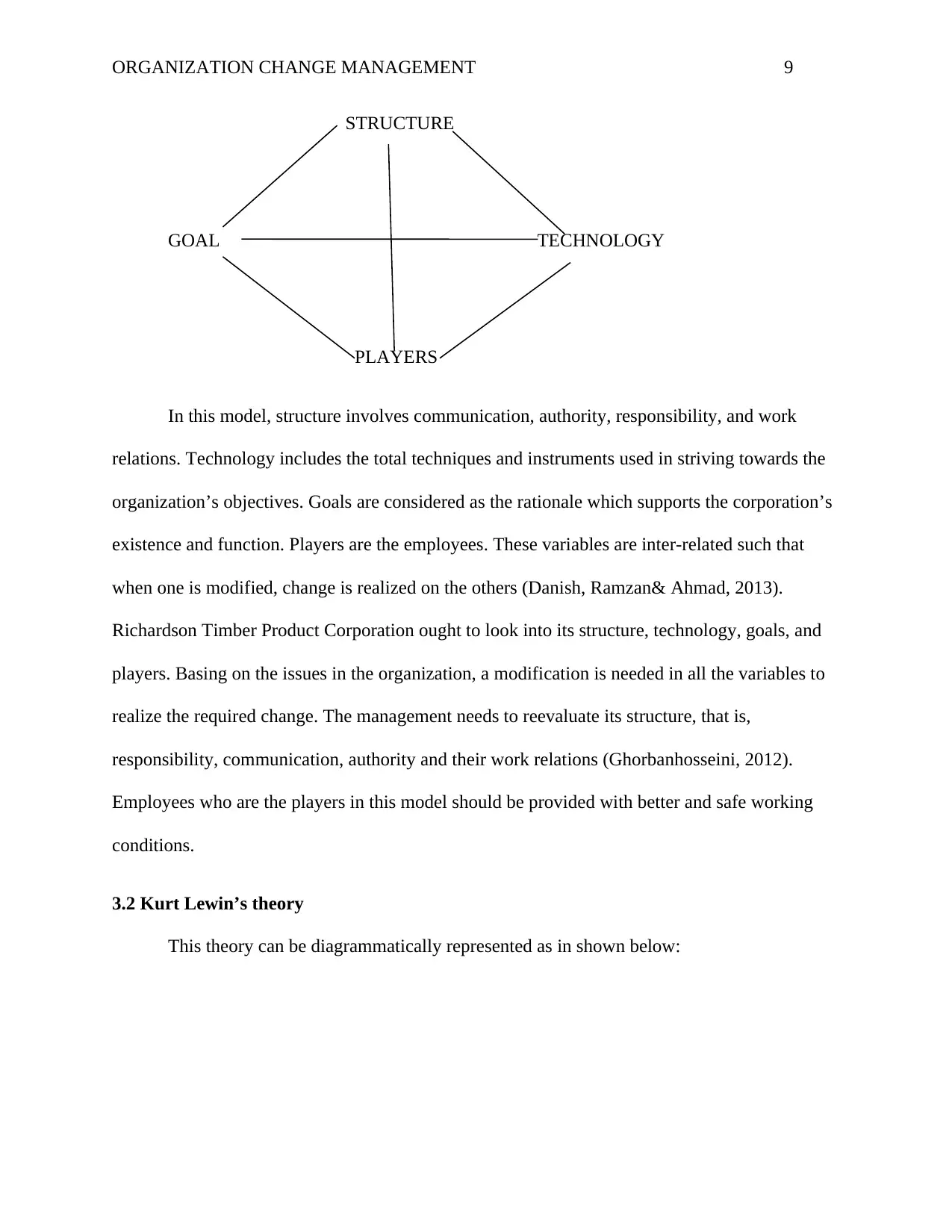
Corporations are made up of systems which consist of four critical variables. These are
structure, goal, technology, and players.
ORGANIZATION CHANGE MANAGEMENT 9
STRUCTURE
GOAL TECHNOLOGY
PLAYERS
In this model, structure involves communication, authority, responsibility, and work
relations. Technology includes the total techniques and instruments used in striving towards the
organization’s objectives. Goals are considered as the rationale which supports the corporation’s
existence and function. Players are the employees. These variables are inter-related such that
when one is modified, change is realized on the others (Danish, Ramzan& Ahmad, 2013).
Richardson Timber Product Corporation ought to look into its structure, technology, goals, and
players. Basing on the issues in the organization, a modification is needed in all the variables to
realize the required change. The management needs to reevaluate its structure, that is,
responsibility, communication, authority and their work relations (Ghorbanhosseini, 2012).
Employees who are the players in this model should be provided with better and safe working
conditions.
3.2 Kurt Lewin’s theory
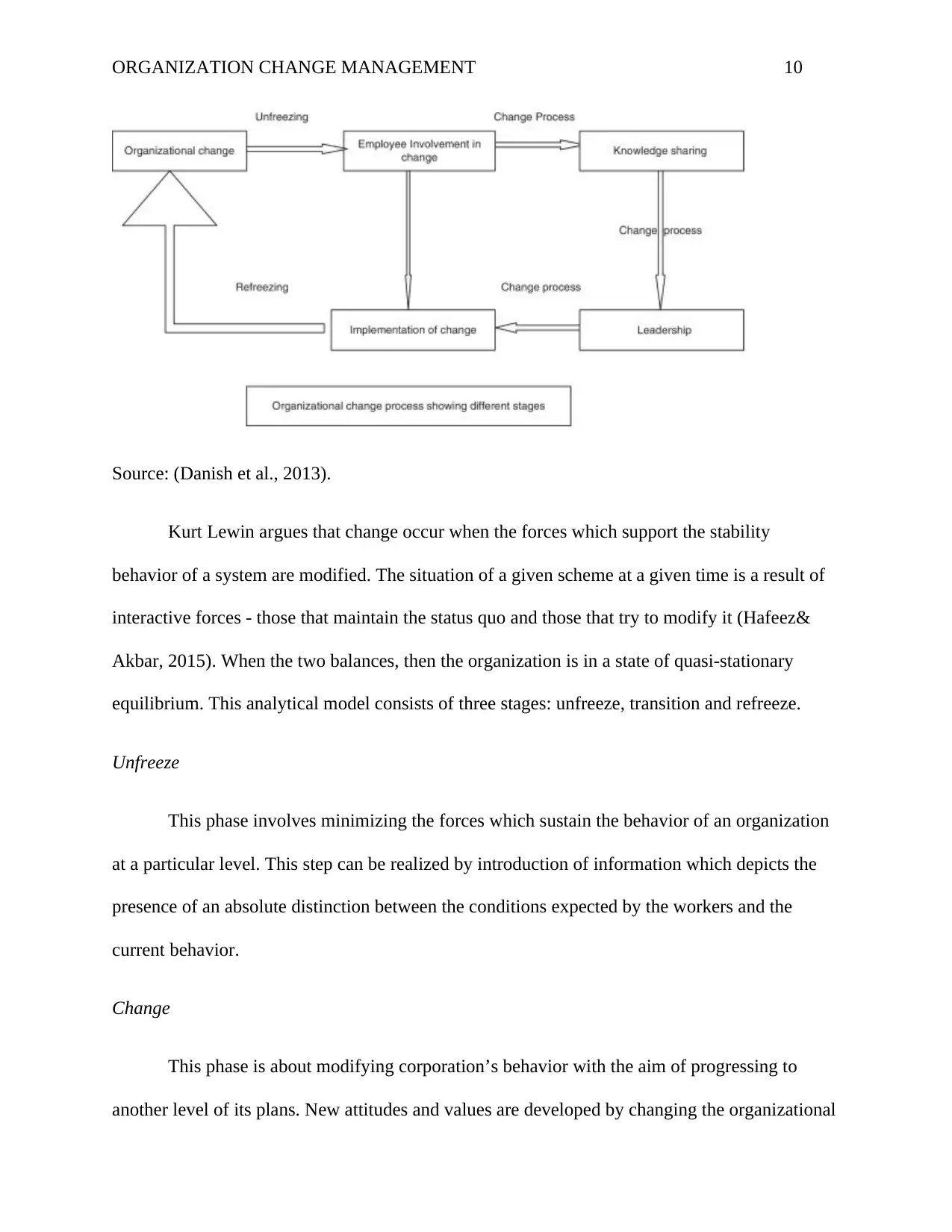
This theory can be diagrammatically represented as in shown below:
STRUCTURE
GOAL TECHNOLOGY
PLAYERS
In this model, structure involves communication, authority, responsibility, and work
relations. Technology includes the total techniques and instruments used in striving towards the
organization’s objectives. Goals are considered as the rationale which supports the corporation’s
existence and function. Players are the employees. These variables are inter-related such that
when one is modified, change is realized on the others (Danish, Ramzan& Ahmad, 2013).
Richardson Timber Product Corporation ought to look into its structure, technology, goals, and
players. Basing on the issues in the organization, a modification is needed in all the variables to
realize the required change. The management needs to reevaluate its structure, that is,
responsibility, communication, authority and their work relations (Ghorbanhosseini, 2012).
Employees who are the players in this model should be provided with better and safe working
conditions.
3.2 Kurt Lewin’s theory
This theory can be diagrammatically represented as in shown below:
⊘ This is a preview!⊘
Do you want full access?
Subscribe today to unlock all pages.
Trusted by 1+ million students worldwide
ORGANIZATION CHANGE MANAGEMENT 10
Source: (Danish et al., 2013).
Kurt Lewin argues that change occur when the forces which support the stability
behavior of a system are modified. The situation of a given scheme at a given time is a result of
interactive forces - those that maintain the status quo and those that try to modify it (Hafeez&
Akbar, 2015). When the two balances, then the organization is in a state of quasi-stationary
equilibrium. This analytical model consists of three stages: unfreeze, transition and refreeze.
Unfreeze
This phase involves minimizing the forces which sustain the behavior of an organization
at a particular level. This step can be realized by introduction of information which depicts the
presence of an absolute distinction between the conditions expected by the workers and the
current behavior.
Change
This phase is about modifying corporation’s behavior with the aim of progressing to
another level of its plans. New attitudes and values are developed by changing the organizational
Source: (Danish et al., 2013).
Kurt Lewin argues that change occur when the forces which support the stability
behavior of a system are modified. The situation of a given scheme at a given time is a result of
interactive forces - those that maintain the status quo and those that try to modify it (Hafeez&
Akbar, 2015). When the two balances, then the organization is in a state of quasi-stationary
equilibrium. This analytical model consists of three stages: unfreeze, transition and refreeze.
Unfreeze
This phase involves minimizing the forces which sustain the behavior of an organization
at a particular level. This step can be realized by introduction of information which depicts the
presence of an absolute distinction between the conditions expected by the workers and the
current behavior.
Change
This phase is about modifying corporation’s behavior with the aim of progressing to
another level of its plans. New attitudes and values are developed by changing the organizational
Paraphrase This Document
Need a fresh take? Get an instant paraphrase of this document with our AI Paraphraser
ORGANIZATION CHANGE MANAGEMENT 11
processes and structures. The corporation’s management implements the changes required to
meet the set goals in the system (Mhaskar, 2010). The employees are given time to adjust and
accept the new values and attitudes introduced in the organization.
Refreeze
At this stage, the implemented changes are reinforced to bring about stability in the
organization. The reinforcement can be accomplished by converting the new behaviors into
policies to bar introduction of more alternatives. Organizational norms, policies, culture, and
structures are the main pillars which aid in supporting the implementation of refreezing phase.
3.3 7 - Stage Model
This model was suggested by American authors; Jeanne Watson, Bruce Westley and
Ronald Lippitt and it is a development of Kurt Lewin’s theory. The seven stages of this model
are as follows:
Existence and increasing of a need for change – this step corresponds to the Lewin's
unfreezing phase. This is the point when an organization identifies the challenges it is facing and
develops a necessity to solve them.
Setting an outline of relations attached to change – in this phase, the relationship between
the organization and the agents of change is established. The management initiates a scheme to
try solving the issues identified.
Analyzing the corporations concerns – the issues in the organization are diagnosed to
device appropriate measures in coping with them.
processes and structures. The corporation’s management implements the changes required to
meet the set goals in the system (Mhaskar, 2010). The employees are given time to adjust and
accept the new values and attitudes introduced in the organization.
Refreeze
At this stage, the implemented changes are reinforced to bring about stability in the
organization. The reinforcement can be accomplished by converting the new behaviors into
policies to bar introduction of more alternatives. Organizational norms, policies, culture, and
structures are the main pillars which aid in supporting the implementation of refreezing phase.
3.3 7 - Stage Model
This model was suggested by American authors; Jeanne Watson, Bruce Westley and
Ronald Lippitt and it is a development of Kurt Lewin’s theory. The seven stages of this model
are as follows:
Existence and increasing of a need for change – this step corresponds to the Lewin's
unfreezing phase. This is the point when an organization identifies the challenges it is facing and
develops a necessity to solve them.
Setting an outline of relations attached to change – in this phase, the relationship between
the organization and the agents of change is established. The management initiates a scheme to
try solving the issues identified.
Analyzing the corporations concerns – the issues in the organization are diagnosed to
device appropriate measures in coping with them.
ORGANIZATION CHANGE MANAGEMENT 12
Probing the alternative methods and goals – targets and intentions for actions of change
of the system are set.
Converting aims into real efforts to change – at this stage, the set measures are put into
action steered towards the realization of needed change.
Stabilizing change – this stage corresponds to the refreezing phase in Lewin’s model.
Modifications are implemented and reinforced to bring the change required.
Defining the final relationship between the corporation and the change agents – the
organization assesses the progress of change.
4.0 Conclusion
Before modification is introduced, an organization is supposed to evaluate whether there
is a need for change. The conditions in the corporation should be analyzed and a credible scheme
that suits its needs developed. Also, it is vital to ensure that all the stakeholders are considered
for significant modification to be successfully implemented. It is clear that there are a variety of
factors which may trigger a change in a company. Various theories on organizational change
management ought to be applied to corporations that need change. These models can be
employed by the Richardson Timber Product Corporation to stabilize.
Planning is crucial in implementing change process in an organization. Therefore, a
corporation has to adopt the best model to modify its structure by creating an outline that is
essential to the company. This framework provides guidelines which steer the company towards
meeting the set objectives and intentions.
Probing the alternative methods and goals – targets and intentions for actions of change
of the system are set.
Converting aims into real efforts to change – at this stage, the set measures are put into
action steered towards the realization of needed change.
Stabilizing change – this stage corresponds to the refreezing phase in Lewin’s model.
Modifications are implemented and reinforced to bring the change required.
Defining the final relationship between the corporation and the change agents – the
organization assesses the progress of change.
4.0 Conclusion
Before modification is introduced, an organization is supposed to evaluate whether there
is a need for change. The conditions in the corporation should be analyzed and a credible scheme
that suits its needs developed. Also, it is vital to ensure that all the stakeholders are considered
for significant modification to be successfully implemented. It is clear that there are a variety of
factors which may trigger a change in a company. Various theories on organizational change
management ought to be applied to corporations that need change. These models can be
employed by the Richardson Timber Product Corporation to stabilize.
Planning is crucial in implementing change process in an organization. Therefore, a
corporation has to adopt the best model to modify its structure by creating an outline that is
essential to the company. This framework provides guidelines which steer the company towards
meeting the set objectives and intentions.
⊘ This is a preview!⊘
Do you want full access?
Subscribe today to unlock all pages.
Trusted by 1+ million students worldwide

1 out of 15


Related Documents


Your All-in-One AI-Powered Toolkit for Academic Success.
+13062052269
info@desklib.com
Available 24*7 on WhatsApp / Email
![[object Object]](/_next/static/media/star-bottom.7253800d.svg)
Unlock your academic potential
Copyright © 2020–2026 A2Z Services. All Rights Reserved. Developed and managed by ZUCOL.