Organizational Change Preparedness Report - ORGB4871
VerifiedAdded on 2022/12/22
|8
|2293
|39
Report
AI Summary
This report delves into the critical aspects of change preparedness within organizations. It begins by emphasizing the importance of preparing for change, highlighting the reduction in operational costs, mitigation of risks and uncertainties, and the prevention of resistance to change. The report then explores the essential managerial and leadership roles, skills, and strategies required to facilitate positive change outcomes, including team management, problem-solving, and strategic planning. It identifies five key areas for assessment to prepare the organization for change, such as the management team, organizational processes, the level of competition, cost-cutting measures, and personnel skills. Furthermore, it outlines various assessment methods, including interviews, focus groups, surveys, observations, and flowchart techniques. The report also details how to utilize collected information, such as through force field analysis, to determine organizational readiness for change. Finally, it presents two strategies to facilitate organizational readiness: employee motivation programs and change awareness initiatives. The assignment concludes with a summary that reflects on the enhanced understanding of change preparedness, the identification of key areas requiring change, data collection methods, and the importance of strategic planning for successful implementation.
ORGB4871_T00595938_Nazish Qayyum Assignment 2_May 6, 2019 1
Introduction
Development is a process that involves growth of an organization to be more advanced in its
operations than before (Brown & Harvey, 2006). Change involves making organization’s
operations, practices and functions to be different in comparison with the past. Change
preparedness is forecasting future changes and devising means to deal with them. According to
Cummings & Worley, (2014), managers must ensure that employees embrace new changes that
in their organization. Managers must have skills that will enable them to plan, organize and
evaluate reaction of employees towards change. Performance indicators must be put into place to
determine workers’ behaviors and attitudes towards or against change. This report will discuss
the importance of change, managerial skills and strategies to instill change, areas that require
change, methods of assessing change in an organization and the strategies that facilitate change
in an organization. A summary will be made from the discussion.
Q1. Discuss the importance of preparing the organization for change.
Reduction in operational costs
Preparing employees for change plays a major role in reducing operational cost. For example,
when a new machine is introduced in an organization and employees are well versed on how to
use it, there will be low costs that an organization will incur on accidents arising from poor
handling of the machine since all workers have required skills for operating that particular
machine.
Reduction of risks and uncertainties in an organization
Risks and uncertainties are part of the organizational environment. Occurrence of these risks and
uncertainties in the organization can pose negative impacts to that particular organization. There
is need to timely prepare organization’s team on vital measures that can assist them in tackling
risks and uncertainties (Bolander et al., 2015). Preparing employees earlier increases their skills
of forecasting future risks and devise strategies of preventing their occurrence thus saving an
organization from potential loses as a result of such risks.
To prevent resistance to change.
Introduction
Development is a process that involves growth of an organization to be more advanced in its
operations than before (Brown & Harvey, 2006). Change involves making organization’s
operations, practices and functions to be different in comparison with the past. Change
preparedness is forecasting future changes and devising means to deal with them. According to
Cummings & Worley, (2014), managers must ensure that employees embrace new changes that
in their organization. Managers must have skills that will enable them to plan, organize and
evaluate reaction of employees towards change. Performance indicators must be put into place to
determine workers’ behaviors and attitudes towards or against change. This report will discuss
the importance of change, managerial skills and strategies to instill change, areas that require
change, methods of assessing change in an organization and the strategies that facilitate change
in an organization. A summary will be made from the discussion.
Q1. Discuss the importance of preparing the organization for change.
Reduction in operational costs
Preparing employees for change plays a major role in reducing operational cost. For example,
when a new machine is introduced in an organization and employees are well versed on how to
use it, there will be low costs that an organization will incur on accidents arising from poor
handling of the machine since all workers have required skills for operating that particular
machine.
Reduction of risks and uncertainties in an organization
Risks and uncertainties are part of the organizational environment. Occurrence of these risks and
uncertainties in the organization can pose negative impacts to that particular organization. There
is need to timely prepare organization’s team on vital measures that can assist them in tackling
risks and uncertainties (Bolander et al., 2015). Preparing employees earlier increases their skills
of forecasting future risks and devise strategies of preventing their occurrence thus saving an
organization from potential loses as a result of such risks.
To prevent resistance to change.
Paraphrase This Document
Need a fresh take? Get an instant paraphrase of this document with our AI Paraphraser

ORGB4871_T00595938_Nazish Qayyum_Assignment 2_May 6, 2019 2
Organizations that prepare their workers for future changes have the benefit of making their
workers to embrace future changes. Resistance to change arises as result of the frustrations on
incompetence that make employees to fear for their positions. Preparing them earlier via
trainings will enable them to get required skills and competencies that are vital to incoming
changes.
Q2. Describe managerial/leadership roles, skills, and strategies facilitating positive change
outcomes in relation to assisting the organization to prepare for change.
Managers who are responsible for instituting change must have perfect skills that will enable them
to achieve the required objectives. Among the kills that managers should have include skills in
managing teams, problem solving skills and decision making skills (Georgalis et al., 2015). Skills
in managing teams creates better relationships among employees who are anticipating for change.
Problem solving skill enables managers to quickly solve arising problems as result of change
process.
New changes also require strategies for preparing employees to embrace new changes. These
strategies include planning, transparency, trust, communication, change direction, training
opportunities extra. Planning will enable employees to understand when, how and the reasons why
the proposed change was put into place. Transparency entails providing enough details pertaining
the proposed change. Trust is built when benefits for new change are communicated in
opportunistic way. Managers should also provide timely communication that describes why a
particular change was proposed and make a forum where organization team can ask questions via
team meeting concerning their views on the proposed change (Lewis, 2019).
Q3. Describe five areas you would assess to prepare the organization for change.
Management team.
Changes that are expected to take place in an organization due to attrition in management team
must be well managed in order to curb the negative effect on their fellow managers and other
employees. Leaders must prepare employees to avoid the fate of losing them due to emotional
effects and plan on how to incorporate another person with recommendable qualifications from
within the organization to fill the vacant position that was left due to attrition. This will make top
Organizations that prepare their workers for future changes have the benefit of making their
workers to embrace future changes. Resistance to change arises as result of the frustrations on
incompetence that make employees to fear for their positions. Preparing them earlier via
trainings will enable them to get required skills and competencies that are vital to incoming
changes.
Q2. Describe managerial/leadership roles, skills, and strategies facilitating positive change
outcomes in relation to assisting the organization to prepare for change.
Managers who are responsible for instituting change must have perfect skills that will enable them
to achieve the required objectives. Among the kills that managers should have include skills in
managing teams, problem solving skills and decision making skills (Georgalis et al., 2015). Skills
in managing teams creates better relationships among employees who are anticipating for change.
Problem solving skill enables managers to quickly solve arising problems as result of change
process.
New changes also require strategies for preparing employees to embrace new changes. These
strategies include planning, transparency, trust, communication, change direction, training
opportunities extra. Planning will enable employees to understand when, how and the reasons why
the proposed change was put into place. Transparency entails providing enough details pertaining
the proposed change. Trust is built when benefits for new change are communicated in
opportunistic way. Managers should also provide timely communication that describes why a
particular change was proposed and make a forum where organization team can ask questions via
team meeting concerning their views on the proposed change (Lewis, 2019).
Q3. Describe five areas you would assess to prepare the organization for change.
Management team.
Changes that are expected to take place in an organization due to attrition in management team
must be well managed in order to curb the negative effect on their fellow managers and other
employees. Leaders must prepare employees to avoid the fate of losing them due to emotional
effects and plan on how to incorporate another person with recommendable qualifications from
within the organization to fill the vacant position that was left due to attrition. This will make top

ORGB4871_T00595938_Nazish Qayyum_Assignment 2_May 6, 2019 3
managers to easily adjust to the new changes without necessarily affecting organization
productiveness.
Processes of an organization
A forecast in a cheap and time saving process will make a company to anticipate for change.
They will have to timely prepare for an adoption of new processes that will increase its
efficiency. A change in these processes will be accompanied by different ways of acquiring
resources up to the final products that the organization.
Level of competition
Organizations can also find the need of assessing how to change their strategies to maintain their
competiveness (Noe et al., 2017). To address this, the organization can decide to foster short
term changes that focuses on making its staff to acquire skills that match with the level of
competition or focus on long term changes that includes new technological know-hows of
producing new products that are more appealing to customers than those of their competitors.
Cost cutting
Each organization puts more efforts for achieving high profits from their business. Where there
is a continuous lose in organizational returns, an assessment will be done with the aim of
reducing the losses. Among the ways of reducing cost is downsize employees with duplicated
roles. (Susskind et al., 2018). This will make some employees to lose their work but again the
change will benefit the organization in terms of cost saving.
Personnel skills
It is very crucial to assess skills of organizational workforce. Workers can be prepared to acquire
new skill and competencies through training and development. Having workers with ready skills
opens new opportunities that require the attained skill in coping with new changes. All these
changes happen when an organization assess and find the need for the changes.
Q4. Describe the methods of assessment you would use to assess each of the five areas you
have identified in the previous question.
managers to easily adjust to the new changes without necessarily affecting organization
productiveness.
Processes of an organization
A forecast in a cheap and time saving process will make a company to anticipate for change.
They will have to timely prepare for an adoption of new processes that will increase its
efficiency. A change in these processes will be accompanied by different ways of acquiring
resources up to the final products that the organization.
Level of competition
Organizations can also find the need of assessing how to change their strategies to maintain their
competiveness (Noe et al., 2017). To address this, the organization can decide to foster short
term changes that focuses on making its staff to acquire skills that match with the level of
competition or focus on long term changes that includes new technological know-hows of
producing new products that are more appealing to customers than those of their competitors.
Cost cutting
Each organization puts more efforts for achieving high profits from their business. Where there
is a continuous lose in organizational returns, an assessment will be done with the aim of
reducing the losses. Among the ways of reducing cost is downsize employees with duplicated
roles. (Susskind et al., 2018). This will make some employees to lose their work but again the
change will benefit the organization in terms of cost saving.
Personnel skills
It is very crucial to assess skills of organizational workforce. Workers can be prepared to acquire
new skill and competencies through training and development. Having workers with ready skills
opens new opportunities that require the attained skill in coping with new changes. All these
changes happen when an organization assess and find the need for the changes.
Q4. Describe the methods of assessment you would use to assess each of the five areas you
have identified in the previous question.
⊘ This is a preview!⊘
Do you want full access?
Subscribe today to unlock all pages.

Trusted by 1+ million students worldwide

ORGB4871_T00595938_Nazish Qayyum_Assignment 2_May 6, 2019 4
To assess whether employees are complying with the changes, organization can use the
following methods.
Interview
Interview is a tools that are used for collecting information concerning the proposed change in an
organization. Individual worker can be interviewed on how they perceive and embrace changes
that are being anticipated in the organization. There is confidentiality in in the responses that are
provided. This method is time consuming and responses can be exaggerated.
Focused groups
It entails forming of employees groups for the purpose of gathering their opinions or views
concerning the proposed change. These groups provide insights of high quality due to diversified
knowledge that is based on education level, gender etc. They should be in smaller groups of 6-20
people.
Surveys
This tool is used for assessing change in organizations via questionnaires that are distributed
either physically or through emails. This method saves time and enables participants to provide
their views about change without fear and influence. Returning rate may be low and some
questions may not be answered thus limiting its validity.
Observations
Observing actions and behaviors of employees provides a reliable feedback concerning how
employees have embraced change. Employees with moody and undesirable attitudes indicates
that employees are not interested nor ready to adopt the new change.
Flow chart methods
In this technique, processes for change are drawn on a flow chart. This charts enables
organization team to go through the changes step by step to aid their understanding. Mastering of
the flow chart by stakeholders indicate a positive response to the change.
To assess whether employees are complying with the changes, organization can use the
following methods.
Interview
Interview is a tools that are used for collecting information concerning the proposed change in an
organization. Individual worker can be interviewed on how they perceive and embrace changes
that are being anticipated in the organization. There is confidentiality in in the responses that are
provided. This method is time consuming and responses can be exaggerated.
Focused groups
It entails forming of employees groups for the purpose of gathering their opinions or views
concerning the proposed change. These groups provide insights of high quality due to diversified
knowledge that is based on education level, gender etc. They should be in smaller groups of 6-20
people.
Surveys
This tool is used for assessing change in organizations via questionnaires that are distributed
either physically or through emails. This method saves time and enables participants to provide
their views about change without fear and influence. Returning rate may be low and some
questions may not be answered thus limiting its validity.
Observations
Observing actions and behaviors of employees provides a reliable feedback concerning how
employees have embraced change. Employees with moody and undesirable attitudes indicates
that employees are not interested nor ready to adopt the new change.
Flow chart methods
In this technique, processes for change are drawn on a flow chart. This charts enables
organization team to go through the changes step by step to aid their understanding. Mastering of
the flow chart by stakeholders indicate a positive response to the change.
Paraphrase This Document
Need a fresh take? Get an instant paraphrase of this document with our AI Paraphraser

ORGB4871_T00595938_Nazish Qayyum_Assignment 2_May 6, 2019 5
Q5. Describe how you would use the information you collected from your assessment
methods to determine if your organization is ready for change. Use examples to illustrate
how you would use content analysis and/or force field analysis
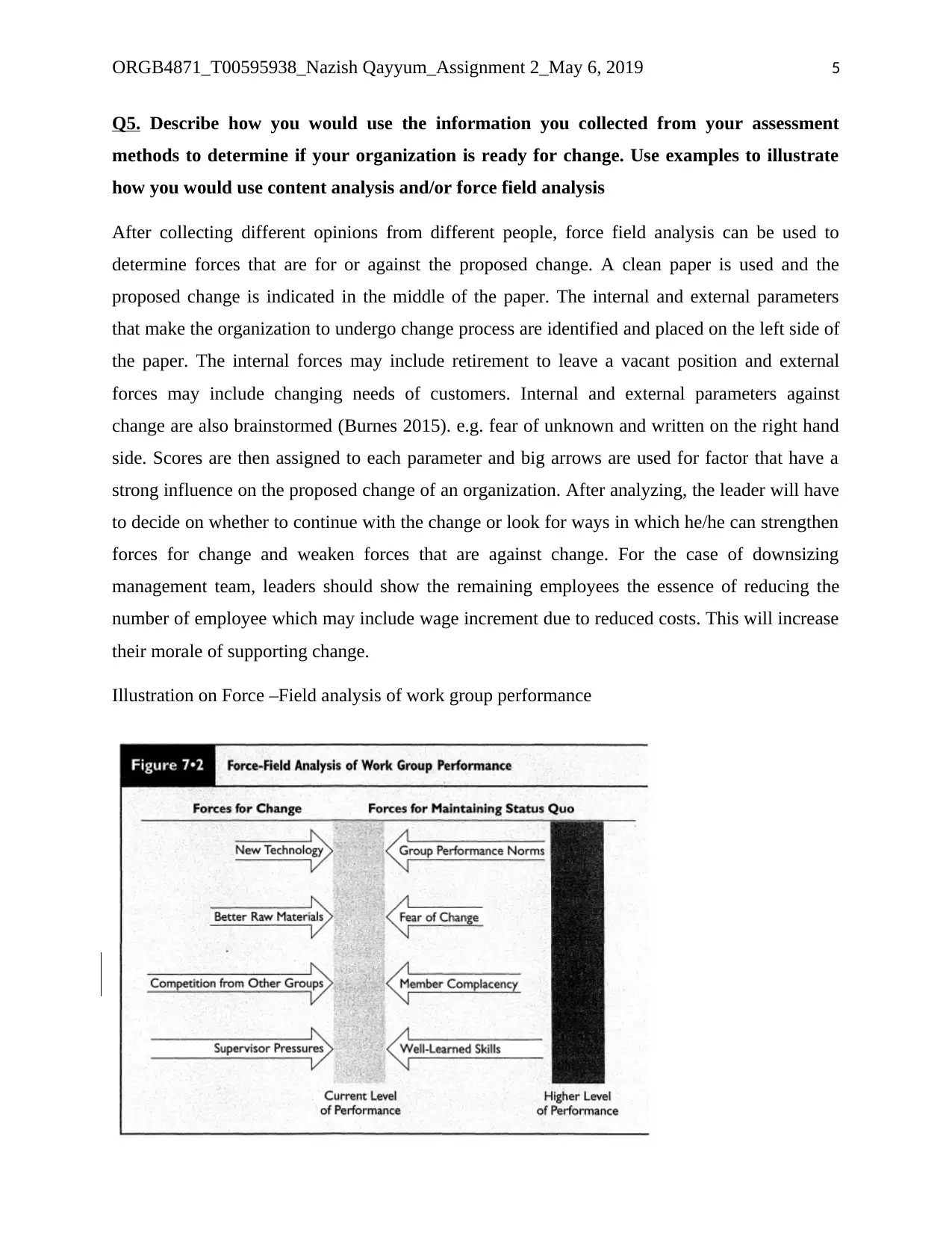
After collecting different opinions from different people, force field analysis can be used to
determine forces that are for or against the proposed change. A clean paper is used and the
proposed change is indicated in the middle of the paper. The internal and external parameters
that make the organization to undergo change process are identified and placed on the left side of
the paper. The internal forces may include retirement to leave a vacant position and external
forces may include changing needs of customers. Internal and external parameters against
change are also brainstormed (Burnes 2015). e.g. fear of unknown and written on the right hand
side. Scores are then assigned to each parameter and big arrows are used for factor that have a
strong influence on the proposed change of an organization. After analyzing, the leader will have
to decide on whether to continue with the change or look for ways in which he/he can strengthen
forces for change and weaken forces that are against change. For the case of downsizing
management team, leaders should show the remaining employees the essence of reducing the
number of employee which may include wage increment due to reduced costs. This will increase
their morale of supporting change.
Illustration on Force –Field analysis of work group performance
Q5. Describe how you would use the information you collected from your assessment
methods to determine if your organization is ready for change. Use examples to illustrate
how you would use content analysis and/or force field analysis
After collecting different opinions from different people, force field analysis can be used to
determine forces that are for or against the proposed change. A clean paper is used and the
proposed change is indicated in the middle of the paper. The internal and external parameters
that make the organization to undergo change process are identified and placed on the left side of
the paper. The internal forces may include retirement to leave a vacant position and external
forces may include changing needs of customers. Internal and external parameters against
change are also brainstormed (Burnes 2015). e.g. fear of unknown and written on the right hand
side. Scores are then assigned to each parameter and big arrows are used for factor that have a
strong influence on the proposed change of an organization. After analyzing, the leader will have
to decide on whether to continue with the change or look for ways in which he/he can strengthen
forces for change and weaken forces that are against change. For the case of downsizing
management team, leaders should show the remaining employees the essence of reducing the
number of employee which may include wage increment due to reduced costs. This will increase
their morale of supporting change.
Illustration on Force –Field analysis of work group performance

ORGB4871_T00595938_Nazish Qayyum_Assignment 2_May 6, 2019 6
Q6. Describe two strategies that would facilitate organization readiness for change.
Managers have a role of putting into place strategies that will facilitate readiness for change
(Smither et al., 2016). They can do this through:
Employee motivation program
Motivating employees who show efforts of embracing change in front of others will make
change adoption easy. The managers can decide to only focus on those that embrace change and
ignore others so that they can see the importance of adopting the change by recognizing,
rewarding and even promoting them. Time framework should be considered while organizing for
training programs.
Change awareness programs
Creating change awareness in the organization also facilitate readiness for change in an
organization. Organizations can achieve this through constantly reminding employees about the
proposed changes through emails, meetings and noticeboards (Zheng ,2015). This will increase
the rate at which change will spread in the organization and positively be adopted.
Summary
From the discussion, this assignment has greatly increased my understanding concerning changes
preparedness in different organizations. I have acquired much knowledge on the reasons as to
why change is required in organizations. The assignment has also enabled me to gain insight on
the various areas in organizations that require change to make a company’s operations to be
effective and efficient. Through the assignment, I have understood methods that are used to
collect data that indicate views concerning the proposed change in the organization. Different
analysis can be used to determine how an organization has prepared for the proposed change. In
addition, working strategies for the proposed change must be put into place to ensure the success
of change.
Q6. Describe two strategies that would facilitate organization readiness for change.
Managers have a role of putting into place strategies that will facilitate readiness for change
(Smither et al., 2016). They can do this through:
Employee motivation program
Motivating employees who show efforts of embracing change in front of others will make
change adoption easy. The managers can decide to only focus on those that embrace change and
ignore others so that they can see the importance of adopting the change by recognizing,
rewarding and even promoting them. Time framework should be considered while organizing for
training programs.
Change awareness programs
Creating change awareness in the organization also facilitate readiness for change in an
organization. Organizations can achieve this through constantly reminding employees about the
proposed changes through emails, meetings and noticeboards (Zheng ,2015). This will increase
the rate at which change will spread in the organization and positively be adopted.
Summary
From the discussion, this assignment has greatly increased my understanding concerning changes
preparedness in different organizations. I have acquired much knowledge on the reasons as to
why change is required in organizations. The assignment has also enabled me to gain insight on
the various areas in organizations that require change to make a company’s operations to be
effective and efficient. Through the assignment, I have understood methods that are used to
collect data that indicate views concerning the proposed change in the organization. Different
analysis can be used to determine how an organization has prepared for the proposed change. In
addition, working strategies for the proposed change must be put into place to ensure the success
of change.
⊘ This is a preview!⊘
Do you want full access?
Subscribe today to unlock all pages.

Trusted by 1+ million students worldwide

ORGB4871_T00595938_Nazish Qayyum_Assignment 2_May 6, 2019 7
References
Bolander, W., Satornino, C. B., Hughes, D. E., & Ferris, G. R. (2015). Social networks within
sales organizations: Their development and importance for salesperson performance. Journal of
Marketing, 79(6), 1-16.
Brown, D. R., & Harvey, D. (2006). Organization development. Seven Edition, Pearson
Education, 166.
Burnes, B. (2015). Understanding resistance to change–building on Coch and French. Journal of
change management, 15(2), 92-116.
Cummings, T. G., & Worley, C. G. (2014). Organization development and change. Cengage
learning.
Georgalis, J., Samaratunge, R., Kimberley, N., & Lu, Y. (2015). Change process characteristics
and resistance to organisational change: The role of employee perceptions of justice. Australian
Journal of Management, 40(1), 89-113.
Lewis, L. (2019). Organizational change: Creating change through strategic communication.
Wiley-Blackwell.
Noe, R. A., Hollenbeck, J. R., Gerhart, B., & Wright, P. M. (2017). Human resource
management: Gaining a competitive advantage. New York, NY: McGraw-Hill Education.
Smither, R., Houston, J., & McIntire, S. (2016). Organization development: Strategies for
changing environments. Routledge.
Susskind, A. M., Moore, O. A., & Kacmar, K. M. (2018). Organizational Downsizing: How
Communication Networks Connect with Employee Performance.
Zheng, D. (2015). Organizatonal support and goal commitment improving employees' goal
commitment: The contribution of perceived organizational support (Doctoral dissertation,
University of Houston).
References
Bolander, W., Satornino, C. B., Hughes, D. E., & Ferris, G. R. (2015). Social networks within
sales organizations: Their development and importance for salesperson performance. Journal of
Marketing, 79(6), 1-16.
Brown, D. R., & Harvey, D. (2006). Organization development. Seven Edition, Pearson
Education, 166.
Burnes, B. (2015). Understanding resistance to change–building on Coch and French. Journal of
change management, 15(2), 92-116.
Cummings, T. G., & Worley, C. G. (2014). Organization development and change. Cengage
learning.
Georgalis, J., Samaratunge, R., Kimberley, N., & Lu, Y. (2015). Change process characteristics
and resistance to organisational change: The role of employee perceptions of justice. Australian
Journal of Management, 40(1), 89-113.
Lewis, L. (2019). Organizational change: Creating change through strategic communication.
Wiley-Blackwell.
Noe, R. A., Hollenbeck, J. R., Gerhart, B., & Wright, P. M. (2017). Human resource
management: Gaining a competitive advantage. New York, NY: McGraw-Hill Education.
Smither, R., Houston, J., & McIntire, S. (2016). Organization development: Strategies for
changing environments. Routledge.
Susskind, A. M., Moore, O. A., & Kacmar, K. M. (2018). Organizational Downsizing: How
Communication Networks Connect with Employee Performance.
Zheng, D. (2015). Organizatonal support and goal commitment improving employees' goal
commitment: The contribution of perceived organizational support (Doctoral dissertation,
University of Houston).
Paraphrase This Document
Need a fresh take? Get an instant paraphrase of this document with our AI Paraphraser

ORGB4871_T00595938_Nazish Qayyum_Assignment 2_May 6, 2019 8
1 out of 8
Related Documents
Your All-in-One AI-Powered Toolkit for Academic Success.
+13062052269
info@desklib.com
Available 24*7 on WhatsApp / Email
Unlock your academic potential
Copyright © 2020–2026 A2Z Services. All Rights Reserved. Developed and managed by ZUCOL.