MG625: Analysis of Change Management, Resistance, and Models
VerifiedAdded on 2022/12/28
|10
|2501
|2
Report
AI Summary
This report delves into the complexities of change management within organizations, focusing on the reasons behind employee resistance to change and offering practical recommendations for managers to mitigate this resistance. It explores various factors contributing to resistance, such as fear of failure, lack of competence, lack of trust, unwillingness to change routines, and perceived loss of control. The report recommends strategies for managers to overcome resistance, including training, employee engagement, effective communication, appropriate guidance and motivation, and highlighting the value of change. Furthermore, it examines the effectiveness of change management by highlighting its impact on competition, customer satisfaction, growth and development, loyalty and stability, and productivity. The report then uses the Lewin Change Management Model, encompassing unfreezing, changing, and refreezing stages, to analyze the change process, emphasizing its practical steps and its role in generating the perception of change for business planning and customer needs. The report concludes by emphasizing the importance of change management in fostering innovation and achieving organizational success.
MG625 Assessment

Paraphrase This Document
Need a fresh take? Get an instant paraphrase of this document with our AI Paraphraser
Table of Contents
.........................................................................................................................................................1
INTRODUCTION...........................................................................................................................2
MAIN BODY...................................................................................................................................2
Question 2...................................................................................................................................2
Question 3...................................................................................................................................5
CONCLUSION ...............................................................................................................................8
REFERENCES................................................................................................................................9
1
.........................................................................................................................................................1
INTRODUCTION...........................................................................................................................2
MAIN BODY...................................................................................................................................2
Question 2...................................................................................................................................2
Question 3...................................................................................................................................5
CONCLUSION ...............................................................................................................................8
REFERENCES................................................................................................................................9
1
INTRODUCTION
Change management can be defined as the managing the change in an organization which
has been brought up by top management for the betterment and improving the organizational
performance so that more growth and development can take place due to adoption of change.
There are various methods, models, techniques and tools available to mange the change in an
organization (Cameron and Green, 2019). Therefore, the following discussion are made on the
analysis that why employees often resist change when it is introduced in a workplace,
recommending the ways in which the mangers can reduce the extent of such resistance,
determining the effectiveness of such change management, examining various models such as
Lewin, Rodgers, Kotter and CIPD change model in order get more clarity and justification of
change in an organization for proper understanding and gaining knowledge that a manager can
manage such change in the company in an efficient and effective manner so that employees can
also be potentially adopt such change in the company with proper findings and conclusion.
MAIN BODY
Question 2
Why employees often resist change when it is introduced in a workplace
Fear of failure
It is one of the biggest factor that employees resist to change in an organization because
anything new in the company showcases the new ideas and new work for the employee and they
fear that if they fail in doing the new task then they will loose the impression in the firm.
Lack in competence
Employees are unwilling to compete with one another because they fear failure but
change comes with competition among employees which means that who can easily adopt the
change and who cannot and that is why employees resist to change (Galli, 2018).
Lack of trust
Change management is generally introduced by the top management and therefore,
employees lacks trust if change are against their favour so because of lack in trust on
management they resist change in an organization and this can prove a serious matter for growth
of the company.
Unwillingness to change the routine
2
Change management can be defined as the managing the change in an organization which
has been brought up by top management for the betterment and improving the organizational
performance so that more growth and development can take place due to adoption of change.
There are various methods, models, techniques and tools available to mange the change in an
organization (Cameron and Green, 2019). Therefore, the following discussion are made on the
analysis that why employees often resist change when it is introduced in a workplace,
recommending the ways in which the mangers can reduce the extent of such resistance,
determining the effectiveness of such change management, examining various models such as
Lewin, Rodgers, Kotter and CIPD change model in order get more clarity and justification of
change in an organization for proper understanding and gaining knowledge that a manager can
manage such change in the company in an efficient and effective manner so that employees can
also be potentially adopt such change in the company with proper findings and conclusion.
MAIN BODY
Question 2
Why employees often resist change when it is introduced in a workplace
Fear of failure
It is one of the biggest factor that employees resist to change in an organization because
anything new in the company showcases the new ideas and new work for the employee and they
fear that if they fail in doing the new task then they will loose the impression in the firm.
Lack in competence
Employees are unwilling to compete with one another because they fear failure but
change comes with competition among employees which means that who can easily adopt the
change and who cannot and that is why employees resist to change (Galli, 2018).
Lack of trust
Change management is generally introduced by the top management and therefore,
employees lacks trust if change are against their favour so because of lack in trust on
management they resist change in an organization and this can prove a serious matter for growth
of the company.
Unwillingness to change the routine
2
⊘ This is a preview!⊘
Do you want full access?
Subscribe today to unlock all pages.

Trusted by 1+ million students worldwide
It is usually known that if change is being adopted by the company than obviously time
and routine will also change as per the needs and requirements of the change in an organisation.
Therefore, it is difficult for the employees to adopt change their work management, time
management and routine management.
Loss of control
Employees have the perception that if any changes takes place in the company they they
will loose the control on the existing norms, policies, procedures and workings. Loosing control
over anything is never liked by the person according to the human nature and that is why
employees resist change.
Recommend ways in which managers can reduce the extent of such resistance
Overcoming opposition
It is important for the manger to train the employees in such a way that they face
competition instead of resisting it. Overcoming opposition is a very powerful tool that a manager
can adopt to support employees so that they can increase their competitive skills and abilities.
Engagement of employees
Managers must try to assist employees to engage with themselves as well as with other
employees and employers also. This is helpful because engagement is beneficial for the
employees in sharing and contributing their tasks with each other with good learnings and
growth (Hayes, 2018).
Following the change process
If manager follows the change process then it can become easy for them to support
employees to overcome resistance to change because change process defines the proper and
appropriate steps to follow so that employees can take interest in change in an organization.
Proper communication
Manager is required to make sure that the communication process that they are following
is actually effective or not because sometimes lack of communication can also be the cause of
resistance so therefore, efficiency in communication process must be there for more clarity and
visibility (Hughes, 2018).
Appropriate guidance and motivation
Manager needs to ensure that they must guide and motivate their employees to adopt the
change in an organization because motivation and is a powerful tool where employees overcome
3
and routine will also change as per the needs and requirements of the change in an organisation.
Therefore, it is difficult for the employees to adopt change their work management, time
management and routine management.
Loss of control
Employees have the perception that if any changes takes place in the company they they
will loose the control on the existing norms, policies, procedures and workings. Loosing control
over anything is never liked by the person according to the human nature and that is why
employees resist change.
Recommend ways in which managers can reduce the extent of such resistance
Overcoming opposition
It is important for the manger to train the employees in such a way that they face
competition instead of resisting it. Overcoming opposition is a very powerful tool that a manager
can adopt to support employees so that they can increase their competitive skills and abilities.
Engagement of employees
Managers must try to assist employees to engage with themselves as well as with other
employees and employers also. This is helpful because engagement is beneficial for the
employees in sharing and contributing their tasks with each other with good learnings and
growth (Hayes, 2018).
Following the change process
If manager follows the change process then it can become easy for them to support
employees to overcome resistance to change because change process defines the proper and
appropriate steps to follow so that employees can take interest in change in an organization.
Proper communication
Manager is required to make sure that the communication process that they are following
is actually effective or not because sometimes lack of communication can also be the cause of
resistance so therefore, efficiency in communication process must be there for more clarity and
visibility (Hughes, 2018).
Appropriate guidance and motivation
Manager needs to ensure that they must guide and motivate their employees to adopt the
change in an organization because motivation and is a powerful tool where employees overcome
3
Paraphrase This Document
Need a fresh take? Get an instant paraphrase of this document with our AI Paraphraser
it's resisted nature and proper guidance can successfully help employees in gaining the adoption
to change.
Value of change
Manager must state the reason behind the change in the company so that employees can
get an appropriate mission and vision to adopt the change in a potential manner. Manager must
let their employees to know that what benefits and growth they can get after adoption of chan ge
personally and professionally as well.
Its effectiveness
Builds up competition
Importance of change in an organization is that it helps among the employees and
employers as well to build up the competition in an organization and in the market place as well
which helps in building the competitive nature of the company to fight against the tough
competition in an industry.
Developing satisfied customers
If company has adopted the change in an organization and successfully fought against the
resistance among employees then it is natural that the reason behind change will get successful
which ultimately develop the customer satisfaction while giving them the better experience than
before (Jayatilleke and Lai, 2018).
Growth and development
Change management and growth and development of an organisation are complementary
to each other because until and unless change is not been adopted then the scope to grow and
develop for the company cannot increase as there is more learnings and knowledge in change.
Loyalty and stability
Company can experience the better loyalty and stability in the market among customers
because major reason behind the change is that the company wants to stable it's position in the
market by gaining more sales and revenue generations effectively and hence it leads to the
loyalty and stability in the market place (Gigliotti, Vardaman, Marshall and Gonzalez, 2019).
Increment of productivity
Increasing productive nature of the company is the major goal because it decides that
where the company stands in an industry with what financial status and performances. Therefore,
4
to change.
Value of change
Manager must state the reason behind the change in the company so that employees can
get an appropriate mission and vision to adopt the change in a potential manner. Manager must
let their employees to know that what benefits and growth they can get after adoption of chan ge
personally and professionally as well.
Its effectiveness
Builds up competition
Importance of change in an organization is that it helps among the employees and
employers as well to build up the competition in an organization and in the market place as well
which helps in building the competitive nature of the company to fight against the tough
competition in an industry.
Developing satisfied customers
If company has adopted the change in an organization and successfully fought against the
resistance among employees then it is natural that the reason behind change will get successful
which ultimately develop the customer satisfaction while giving them the better experience than
before (Jayatilleke and Lai, 2018).
Growth and development
Change management and growth and development of an organisation are complementary
to each other because until and unless change is not been adopted then the scope to grow and
develop for the company cannot increase as there is more learnings and knowledge in change.
Loyalty and stability
Company can experience the better loyalty and stability in the market among customers
because major reason behind the change is that the company wants to stable it's position in the
market by gaining more sales and revenue generations effectively and hence it leads to the
loyalty and stability in the market place (Gigliotti, Vardaman, Marshall and Gonzalez, 2019).
Increment of productivity
Increasing productive nature of the company is the major goal because it decides that
where the company stands in an industry with what financial status and performances. Therefore,
4
change aids the organization to increase it's productivity to the next level for betterment of the
company
Question 3
Effective Change Management Model
Every business consider the change and they are very familiar with this concept because
in this time, change is require for every small and large business so that they can get success.
Every organisation need to focus on their business activities so that they can easily address their
customers requirements and also changes also help to give the positive outcomes which will lead
the success (Singh, 2018). To adopt the change smoothly , organisations are use many change
management model like Rodgers, Kotter,Lewin and CIPD etc. For this report, Lewin change
management model will be used to address all the changes so that organisation can determine
their business activities very effectively so that owner of the business can make appropriate plans
which will helpful to lead the organisational growth. The description of change management
model are given below-
Lewin Change Management Model
This model is essential because it is helpful in organisational changes. This model is
developed by Kurt Lewin that involved three steps like unfreezing, changing and refreezing.
This change model represent the practical steps that determine change process and help in
generating the perception of change where it mainly require. Change help to make plan for the
business and also full fill the requirements of customers. There are various steps include in
change model which are discussed below - Unfreeze – This is first step of this model and that determined that before organisation
adopt the change, there is a need to implemented change process. With the help of this
model, change can be implemented very easily. This is the initial stage which can lead
the transition in the whole process of change management (Stouten, Rousseau and De
Cremer, 2018). It help to enhance the readiness and willingness to adopt the change and
forget about the existing comfort and ready for transforming situations. Through this step,
organisation manager can spread the awareness of requirement of change so that people
can know the positive impact which can affect the business operations. In this stage ,
communication among the employees are playing the prominent part because it can
improve the desired result to adopt the change.
5
company
Question 3
Effective Change Management Model
Every business consider the change and they are very familiar with this concept because
in this time, change is require for every small and large business so that they can get success.
Every organisation need to focus on their business activities so that they can easily address their
customers requirements and also changes also help to give the positive outcomes which will lead
the success (Singh, 2018). To adopt the change smoothly , organisations are use many change
management model like Rodgers, Kotter,Lewin and CIPD etc. For this report, Lewin change
management model will be used to address all the changes so that organisation can determine
their business activities very effectively so that owner of the business can make appropriate plans
which will helpful to lead the organisational growth. The description of change management
model are given below-
Lewin Change Management Model
This model is essential because it is helpful in organisational changes. This model is
developed by Kurt Lewin that involved three steps like unfreezing, changing and refreezing.
This change model represent the practical steps that determine change process and help in
generating the perception of change where it mainly require. Change help to make plan for the
business and also full fill the requirements of customers. There are various steps include in
change model which are discussed below - Unfreeze – This is first step of this model and that determined that before organisation
adopt the change, there is a need to implemented change process. With the help of this
model, change can be implemented very easily. This is the initial stage which can lead
the transition in the whole process of change management (Stouten, Rousseau and De
Cremer, 2018). It help to enhance the readiness and willingness to adopt the change and
forget about the existing comfort and ready for transforming situations. Through this step,
organisation manager can spread the awareness of requirement of change so that people
can know the positive impact which can affect the business operations. In this stage ,
communication among the employees are playing the prominent part because it can
improve the desired result to adopt the change.
5
⊘ This is a preview!⊘
Do you want full access?
Subscribe today to unlock all pages.
Trusted by 1+ million students worldwide
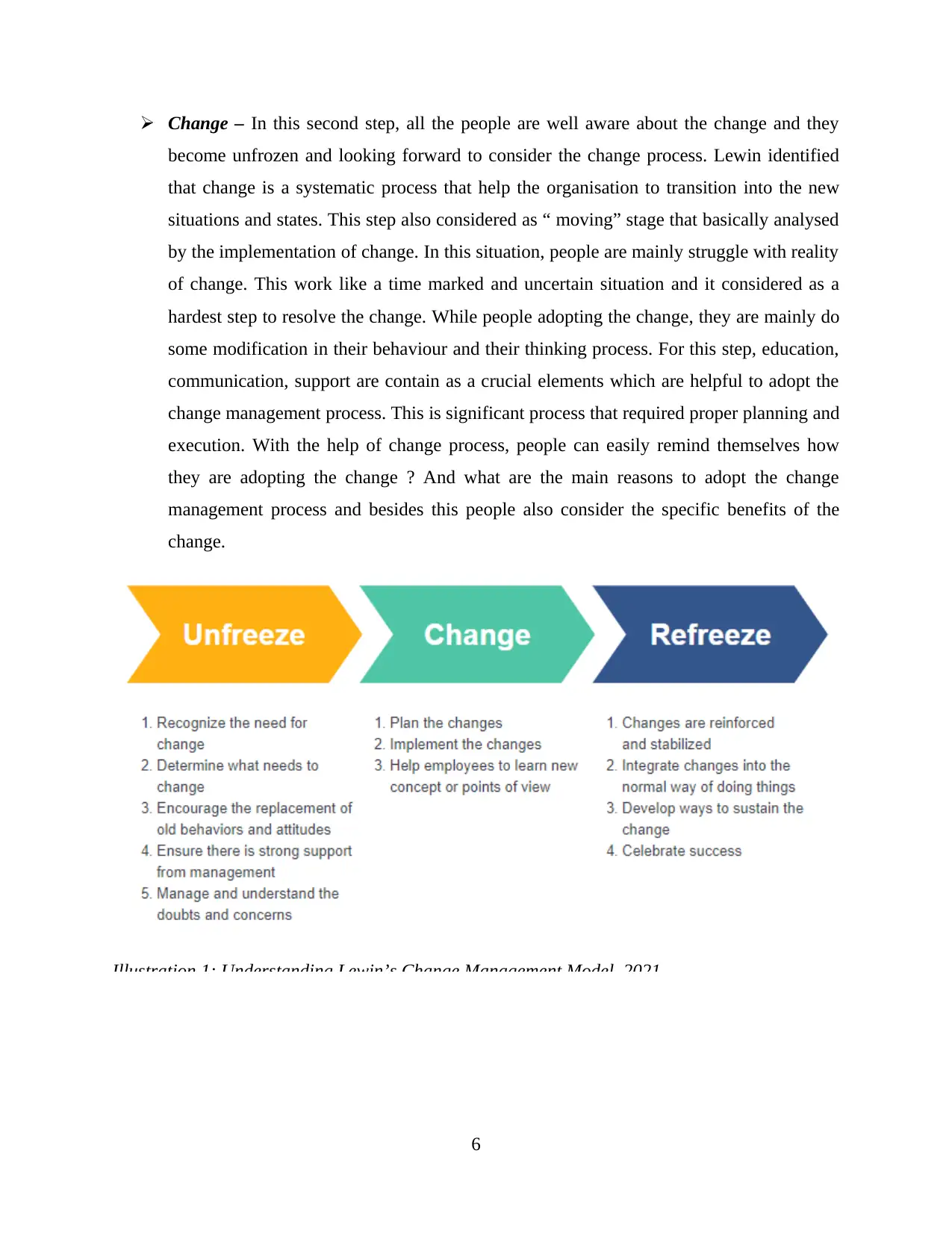
Change – In this second step, all the people are well aware about the change and they
become unfrozen and looking forward to consider the change process. Lewin identified
that change is a systematic process that help the organisation to transition into the new
situations and states. This step also considered as “ moving” stage that basically analysed
by the implementation of change. In this situation, people are mainly struggle with reality
of change. This work like a time marked and uncertain situation and it considered as a
hardest step to resolve the change. While people adopting the change, they are mainly do
some modification in their behaviour and their thinking process. For this step, education,
communication, support are contain as a crucial elements which are helpful to adopt the
change management process. This is significant process that required proper planning and
execution. With the help of change process, people can easily remind themselves how
they are adopting the change ? And what are the main reasons to adopt the change
management process and besides this people also consider the specific benefits of the
change.
Illustration 1: Understanding Lewin’s Change Management Model, 2021
6
become unfrozen and looking forward to consider the change process. Lewin identified
that change is a systematic process that help the organisation to transition into the new
situations and states. This step also considered as “ moving” stage that basically analysed
by the implementation of change. In this situation, people are mainly struggle with reality
of change. This work like a time marked and uncertain situation and it considered as a
hardest step to resolve the change. While people adopting the change, they are mainly do
some modification in their behaviour and their thinking process. For this step, education,
communication, support are contain as a crucial elements which are helpful to adopt the
change management process. This is significant process that required proper planning and
execution. With the help of change process, people can easily remind themselves how
they are adopting the change ? And what are the main reasons to adopt the change
management process and besides this people also consider the specific benefits of the
change.
Illustration 1: Understanding Lewin’s Change Management Model, 2021
6
Paraphrase This Document
Need a fresh take? Get an instant paraphrase of this document with our AI Paraphraser
Refreeze – This is a final step, in which Lewin refer concept of refreezing to the
symbolize the reinforcement, stabilizing the new stage after the change successful
adopted by the people. After the change and transition stage, this stage considered. In this
stage, people finally accept the change fully and apply the new way of working which
will help in their job role. People understand that change is the crucial part of their life
and form new relationship. People change their behaviour as per the change require so
that they can easily maintain all the working conditions. People agree with the consitions
of change and they easily apply the change in their attitude, behaviour. Refreezing steps
demonstrate the new norms and status and adopt the new techniques and so that people
can easily forget their past habits (Vahs and Weiand, 2020 ).
Change is everywhere and it is depend upon the matter of demand of the people and
organisation so that they can easily maintain their personal and professional life and follow right
direction. Sometime, every organisation should need to do some modification in their personal
and professional life. Most of the organisation should adopt the Lewin Change Management
Model, so that they can systematically plan their working activities and also help to maintain the
require situation which are necessary to adopt the change. Lewin change model is a three step
model that determine the effectiveness of the business plan that are helpful to apply the change
process. In step is unfreezing, in this step, people identify the need of change and then consider
those things which are helpful in replacement of exiting behaviour and attitude. In next step,
people become serious to plan and implement the change so that they can effectively adopt the
change in their life. In last stage, changes are reinforced and stabilized so that they can develop
their condition to sustain the change(Vos and Rupert, 2018). Most of the people argue that
refreezing step is very outdated in term of business due to constant need of change but it is
analysed and observed that all these change steps are beneficial for the organisation to adopt the
change and help them in change management.
7
symbolize the reinforcement, stabilizing the new stage after the change successful
adopted by the people. After the change and transition stage, this stage considered. In this
stage, people finally accept the change fully and apply the new way of working which
will help in their job role. People understand that change is the crucial part of their life
and form new relationship. People change their behaviour as per the change require so
that they can easily maintain all the working conditions. People agree with the consitions
of change and they easily apply the change in their attitude, behaviour. Refreezing steps
demonstrate the new norms and status and adopt the new techniques and so that people
can easily forget their past habits (Vahs and Weiand, 2020 ).
Change is everywhere and it is depend upon the matter of demand of the people and
organisation so that they can easily maintain their personal and professional life and follow right
direction. Sometime, every organisation should need to do some modification in their personal
and professional life. Most of the organisation should adopt the Lewin Change Management
Model, so that they can systematically plan their working activities and also help to maintain the
require situation which are necessary to adopt the change. Lewin change model is a three step
model that determine the effectiveness of the business plan that are helpful to apply the change
process. In step is unfreezing, in this step, people identify the need of change and then consider
those things which are helpful in replacement of exiting behaviour and attitude. In next step,
people become serious to plan and implement the change so that they can effectively adopt the
change in their life. In last stage, changes are reinforced and stabilized so that they can develop
their condition to sustain the change(Vos and Rupert, 2018). Most of the people argue that
refreezing step is very outdated in term of business due to constant need of change but it is
analysed and observed that all these change steps are beneficial for the organisation to adopt the
change and help them in change management.
7
CONCLUSION
As per this report, it is analysed that the importance of change increasing because every
people want new and innovative products so that they can make their life more easily so there is
a need to do some changes in business operations and activities related to the production and
manufacturing. To adopt and accept the change successful, every organisation need to use
change management model in which they can help their employees to accept the change and also
make them understand the advantages of change.
8
As per this report, it is analysed that the importance of change increasing because every
people want new and innovative products so that they can make their life more easily so there is
a need to do some changes in business operations and activities related to the production and
manufacturing. To adopt and accept the change successful, every organisation need to use
change management model in which they can help their employees to accept the change and also
make them understand the advantages of change.
8
⊘ This is a preview!⊘
Do you want full access?
Subscribe today to unlock all pages.
Trusted by 1+ million students worldwide
REFERENCES
Books and Journals
Cameron, E. and Green, M., 2019. Making sense of change management: A complete guide to
the models, tools and techniques of organizational change. Kogan Page Publishers.
Galli, B.J., 2018. Change management models: A comparative analysis and concerns. IEEE
Engineering Management Review. 46(3). pp.124-132.
Gigliotti, R., et. al., 2019. The role of perceived organizational support in individual change
readiness. Journal of Change Management. 19(2). pp.86-100.
Hayes, J., 2018. The theory and practice of change management. Palgrave.
Hughes, M., 2018. Reflections: studying organizational change leadership as a subfield. Journal
of Change Management. 18(1). pp.10-22.
Jayatilleke, S. and Lai, R., 2018. A systematic review of requirements change
management. Information and Software Technology, 93, pp.163-185.
Singh, S.K., 2018. Managing organizational change in emerging markets. Journal of
Organizational Change Management.
Stouten, J., Rousseau, D.M. and De Cremer, D., 2018. Successful organizational change:
Integrating the management practice and scholarly literatures. Academy of Management
Annals. 12(2). pp.752-788.
Vahs, D. and Weiand, A., 2020. Workbook change management: Methoden und Techniken.
Schäffer-Poeschel.
Vos, J.F. and Rupert, J., 2018. Change agent's contribution to recipients' resistance to change: A
two-sided story. European management journal. 36(4). pp.453-462.
9
Books and Journals
Cameron, E. and Green, M., 2019. Making sense of change management: A complete guide to
the models, tools and techniques of organizational change. Kogan Page Publishers.
Galli, B.J., 2018. Change management models: A comparative analysis and concerns. IEEE
Engineering Management Review. 46(3). pp.124-132.
Gigliotti, R., et. al., 2019. The role of perceived organizational support in individual change
readiness. Journal of Change Management. 19(2). pp.86-100.
Hayes, J., 2018. The theory and practice of change management. Palgrave.
Hughes, M., 2018. Reflections: studying organizational change leadership as a subfield. Journal
of Change Management. 18(1). pp.10-22.
Jayatilleke, S. and Lai, R., 2018. A systematic review of requirements change
management. Information and Software Technology, 93, pp.163-185.
Singh, S.K., 2018. Managing organizational change in emerging markets. Journal of
Organizational Change Management.
Stouten, J., Rousseau, D.M. and De Cremer, D., 2018. Successful organizational change:
Integrating the management practice and scholarly literatures. Academy of Management
Annals. 12(2). pp.752-788.
Vahs, D. and Weiand, A., 2020. Workbook change management: Methoden und Techniken.
Schäffer-Poeschel.
Vos, J.F. and Rupert, J., 2018. Change agent's contribution to recipients' resistance to change: A
two-sided story. European management journal. 36(4). pp.453-462.
9

1 out of 10


Related Documents


Your All-in-One AI-Powered Toolkit for Academic Success.
+13062052269
info@desklib.com
Available 24*7 on WhatsApp / Email
![[object Object]](/_next/static/media/star-bottom.7253800d.svg)
Unlock your academic potential
Copyright © 2020–2026 A2Z Services. All Rights Reserved. Developed and managed by ZUCOL.