Report: Changing Attitudes Towards Disability in the Media Policy

Verified

Added on  2023/06/14

|6
|1057
|140
Report
AI Summary
This report delves into the portrayal of individuals with disabilities in the media and its subsequent impact on societal perceptions. It critically analyzes the policy environment surrounding the representation of disability, utilizing a power-holder map to illustrate the various influences at play. The report examines the role of media in shaping attitudes, highlighting both positive and negative consequences of different portrayals. It references studies and initiatives aimed at promoting more balanced and inclusive representation, such as the Creative Diversity Network and the Screen Diversity and Inclusion Network. The analysis considers the importance of authentic storytelling by individuals with disabilities to counter stereotypes and foster genuine understanding. The report concludes by emphasizing the need for continued efforts to increase the presence of people with disabilities in various media roles, thereby normalizing disability and challenging preconceived notions.
Document Page
Running Head: CHANGING ATTITUDES
CHANGING ATTITUDES
Name of the Student
Name of the University
Author Note
tabler-icon-diamond-filled.svg

Paraphrase This Document

Need a fresh take? Get an instant paraphrase of this document with our AI Paraphraser
Document Page
1CHANGING ATTITUDES
Executive Summary
The paper explores to understand the environment of the portrayal of the different situations
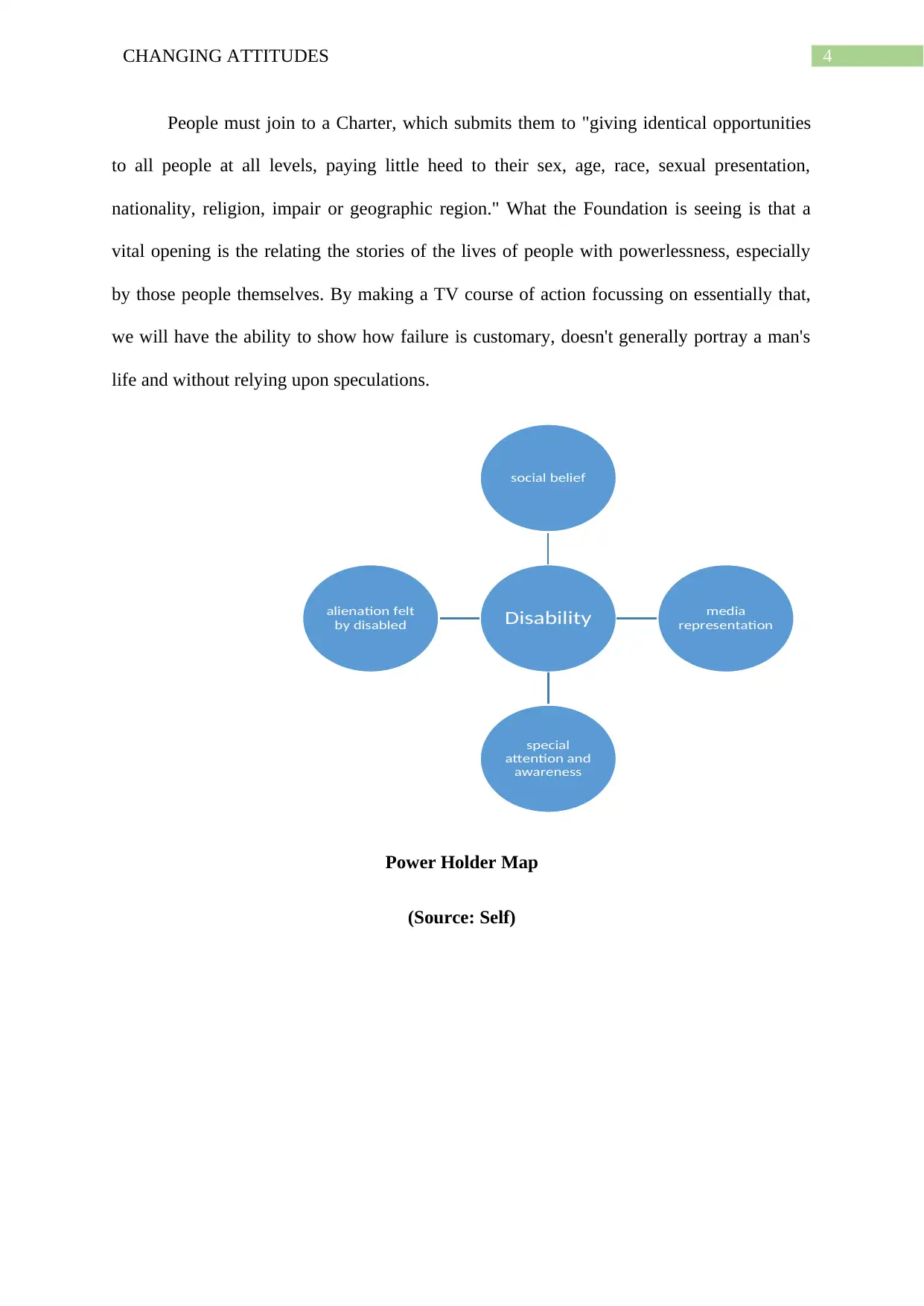
that are presented due to the representation of disabled in media. The power holder’s map
shows the environmental effects.
Document Page
2CHANGING ATTITUDES
The environment of the article clearly focusses on the development of the society
keeping in mind the portrayal of the disabled in the media and its impacts on the different
societies. The media is a strong source of dissemination of the information around the world
which helps in the formations of the perceptions regarding the disabled individuals. One of
the major issues highlighted are the effect that the portrayal in the media have on the disabled
people (Pearson and Trevisan 2015). The society nay become very understanding of their
plights but it is unpleasant for the individuals who want to be treated as equals.
Underlining a handicapped person's valiance, however good natured, can serve to
escalate differentiate, which in this way braces a clear sentiment detachment. More especially
about impair there is a Dutch academic examination Disability, Prejudice and Reality TV that
speaks to the diserse nature of the issues while overseeing standard gatherings of spectators
seeing a Dutch unscripted TV show which had a couple of individuals with physical
insufficiency. On one side they found that having people with insufficiency appearing by
chance with no unquestionable thought paid to them is helpful for normalizing handicap as a
segment of consistent every day presence, yet it can in like manner diminish the impact as the
powerlessness delineation gathers that inadequacy is a non-issue that has no impact on
people's lives (Haller and Zhang 2014). A Nepalese report kept an eye on the thought of
positive portrayal of failure in the pervasive children's program Khushi Ko Sansar (translates
to "Happy World") which showed up in any occasion without a moment's hesitation positive
changes in standard attitudes towards kids with disable. The makers saw this might be a
feasible technique in making countries where there are inconsequential sponsorships and
resources for people with debilitate.
Clearly there ought to be more people with inadequacy appearing on TV, over
different kinds, as a component of standard programming. Regardless, there is a hazard that
this thought starting at now showed can essentially strengthen standard speculations about
Document Page
3CHANGING ATTITUDES
people with powerlessness. The Ruderman Family Foundation is furthermore a vital
supporter of research around powerlessness delineation. Murder extent of people with
insufficiencies by their parental figures is an examination of the media declaring of in excess
of 200 murder cases incorporating people with failure in North America between 2011-2015.
66 exceptional passing were analysed in more detail through 101 media reports. In the UK,
the Creative Diversity Network (CDN) has been championing the stories of people with
insufficiency on TV and other media since it was set up five years back (Lockyer 2015).
Unusually the customarily forceful TV stations are collaborating instead of fighting with each
other.
Australia has had rules for TV content creators on how failure should be portrayed
and included for quite a while, in spite of the way that the confirmation of the nonstop
stereotyped delineation on various TV programs show this has an approach. Media arranged
assortment as a subject is getting balance in the national exchange with the present dispatch
of Media Diversity Australia (MDA) which moreover tries to propel more balanced depiction
in Australian media, reflecting the make-up of the general gathering (Attitude.org.au, 2018).
In spite of the way that MDA is generally focussed on social establishments, failure is joined
as a component of that varying assortment. Doubtlessly what we require is both a
development in people with failure basically appearing on TV, in lead parts, as arbitrators and
as individuals in news stories commenting on issues other than inadequacy. There are new
exercises and frameworks now appearing. Pushed in August 2017, the Screen Diversity and
Inclusion Network (SDIN) joins an extensive number of the best players in the Australian
media scene, including the comprehensively financed supporters, the ABC and SBS,
permitted to-air business broadcaster Ten, Foxtel and Australia's huge government film
bodies.
tabler-icon-diamond-filled.svg

Paraphrase This Document

Need a fresh take? Get an instant paraphrase of this document with our AI Paraphraser
Document Page
4CHANGING ATTITUDES
People must join to a Charter, which submits them to "giving identical opportunities
to all people at all levels, paying little heed to their sex, age, race, sexual presentation,
nationality, religion, impair or geographic region." What the Foundation is seeing is that a
vital opening is the relating the stories of the lives of people with powerlessness, especially
by those people themselves. By making a TV course of action focussing on essentially that,
we will have the ability to show how failure is customary, doesn't generally portray a man's
life and without relying upon speculations.
Power Holder Map
(Source: Self)
Disability
social belief
media
representation
special
attention and
awareness
alienation felt
by disabled
Document Page
5CHANGING ATTITUDES
References
Attitude.org.au 2018. Can television change attitudes. [online] Attitude.org.au. Available at:
http://www.attitude.org.au/changing-attitudes/can-television-change-attitudes/ [Accessed 8
May 2018].
Haller, B. and Zhang, L., 2014. Stigma or Empowerment? What Do Disabled People Say
About Their Representation In News and Entertainment Media?. Review of Disability
Studies: An International Journal, 9(4).
Lockyer, S., 2015. ‘It’s really scared of disability’: Disabled comedians’ perspectives of the
British television comedy industry. The Journal of Popular Television, 3(2), pp.179-193.
Pearson, C. and Trevisan, F., 2015. Disability activism in the new media ecology:
Campaigning strategies in the digital era. Disability & Society, 30(6), pp.924-940.
chevron_up_icon
1 out of 6
circle_padding
hide_on_mobile
zoom_out_icon
[object Object]