English 1302: Character Analysis of A Very Old Man with Enormous Wings
VerifiedAdded on 2023/05/29
|5
|1398
|131
Essay
AI Summary
This essay undertakes a character analysis of the 'old man,' often referred to as the angel, in Gabriel Garcia Marquez's short story, 'A Very Old Man with Enormous Wings.' The analysis begins with a brief introduction of the author and a plot summary, followed by an examination of the angel's physical appearance, background, language, and interactions with other characters. The essay explores the symbolism within the story, particularly the significance of the wings and the spider-woman. The analysis highlights the themes of human nature, compassion, cruelty, and the treatment of the different. The essay concludes by emphasizing Marquez's effective portrayal of these complex themes through the character of the old man and the symbolic elements within the narrative.
1
Student’s last name
Name of the student
Name of the instructor
Analysis of Very Old Man Short Story Character
Introduction
The paper aims to do a character analysis of the ‘old-man’ or the ‘angel’ in the short story
A Very Old Man with Enormous Wings: A Tale for Children (Marquez and Tornaritis). The essay
begins with a short introduction of the author followed by the summary of the plot. Then, the
essay will highlight the main characters of the story and their relation and interaction to the
chosen character. It will then focus on the analyzing the character of the angel. In addition, the
essay will also try to find if there is any symbolism in the story or the author tried to convey any
message.
Discussion
Character analysis includes a description of the physical appearance of the character, its
background, the language used by the character, its personality and relations to other characters.
In doing the character analysis of the ‘angel’ in the short story, all these aspects will be explained
elaborately. Symbolism refers to the use of symbols to indicate any idea or quality. In the chosen
short story, symbolism has been used, which will be discussed as well.
Gabriel Garcia Marquez has written the story. Marquez was a Colombian writer born in
1927. A Nobel Prize winner for literature in 1982, Marquez was most popular for authoring short
stories (NobelPrize.org).
Student’s last name
Name of the student
Name of the instructor
Analysis of Very Old Man Short Story Character
Introduction
The paper aims to do a character analysis of the ‘old-man’ or the ‘angel’ in the short story
A Very Old Man with Enormous Wings: A Tale for Children (Marquez and Tornaritis). The essay
begins with a short introduction of the author followed by the summary of the plot. Then, the
essay will highlight the main characters of the story and their relation and interaction to the
chosen character. It will then focus on the analyzing the character of the angel. In addition, the
essay will also try to find if there is any symbolism in the story or the author tried to convey any
message.
Discussion
Character analysis includes a description of the physical appearance of the character, its
background, the language used by the character, its personality and relations to other characters.
In doing the character analysis of the ‘angel’ in the short story, all these aspects will be explained
elaborately. Symbolism refers to the use of symbols to indicate any idea or quality. In the chosen
short story, symbolism has been used, which will be discussed as well.
Gabriel Garcia Marquez has written the story. Marquez was a Colombian writer born in
1927. A Nobel Prize winner for literature in 1982, Marquez was most popular for authoring short
stories (NobelPrize.org).
Paraphrase This Document
Need a fresh take? Get an instant paraphrase of this document with our AI Paraphraser

2
Student’s last name
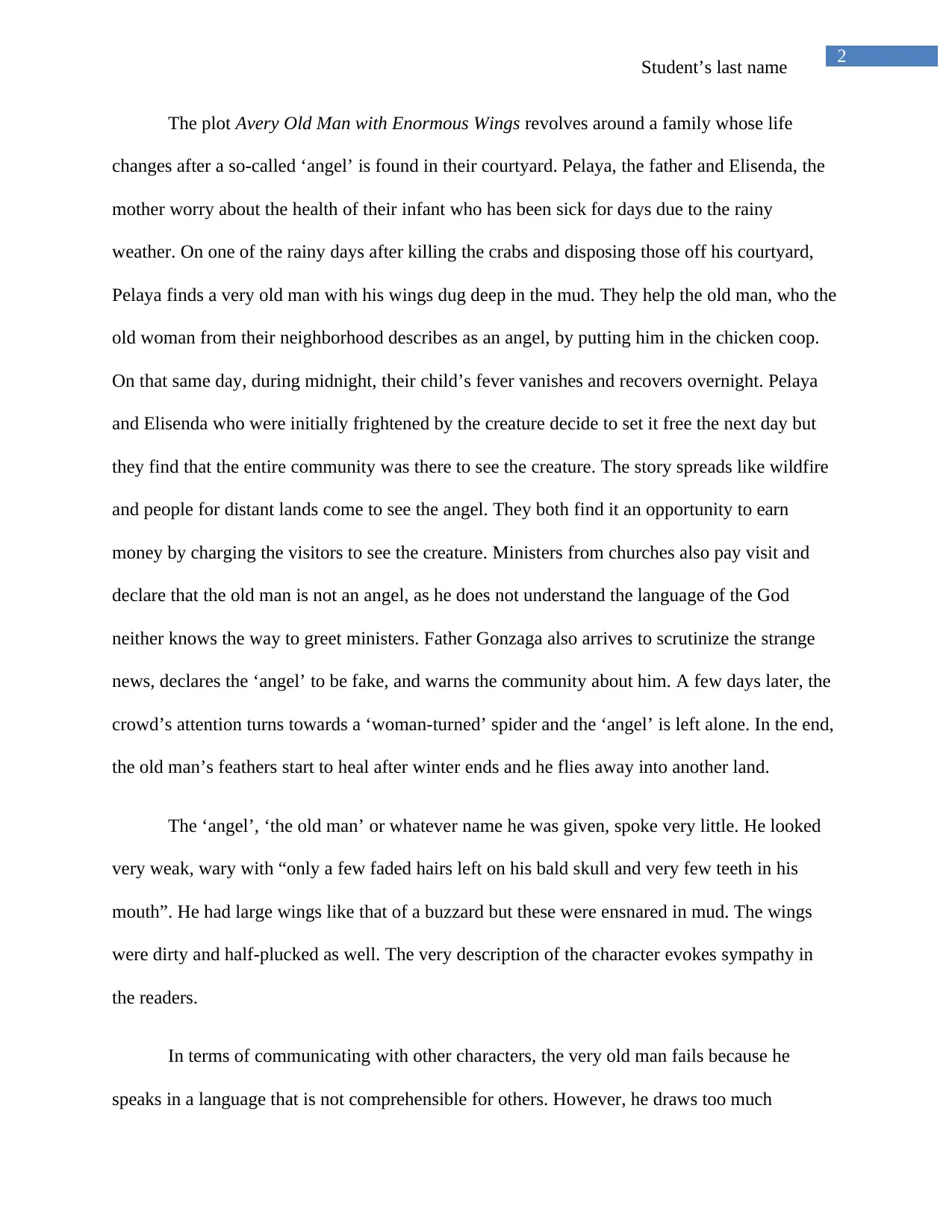
The plot Avery Old Man with Enormous Wings revolves around a family whose life
changes after a so-called ‘angel’ is found in their courtyard. Pelaya, the father and Elisenda, the
mother worry about the health of their infant who has been sick for days due to the rainy
weather. On one of the rainy days after killing the crabs and disposing those off his courtyard,
Pelaya finds a very old man with his wings dug deep in the mud. They help the old man, who the
old woman from their neighborhood describes as an angel, by putting him in the chicken coop.
On that same day, during midnight, their child’s fever vanishes and recovers overnight. Pelaya
and Elisenda who were initially frightened by the creature decide to set it free the next day but
they find that the entire community was there to see the creature. The story spreads like wildfire
and people for distant lands come to see the angel. They both find it an opportunity to earn
money by charging the visitors to see the creature. Ministers from churches also pay visit and
declare that the old man is not an angel, as he does not understand the language of the God
neither knows the way to greet ministers. Father Gonzaga also arrives to scrutinize the strange
news, declares the ‘angel’ to be fake, and warns the community about him. A few days later, the
crowd’s attention turns towards a ‘woman-turned’ spider and the ‘angel’ is left alone. In the end,
the old man’s feathers start to heal after winter ends and he flies away into another land.
The ‘angel’, ‘the old man’ or whatever name he was given, spoke very little. He looked
very weak, wary with “only a few faded hairs left on his bald skull and very few teeth in his
mouth”. He had large wings like that of a buzzard but these were ensnared in mud. The wings
were dirty and half-plucked as well. The very description of the character evokes sympathy in
the readers.
In terms of communicating with other characters, the very old man fails because he
speaks in a language that is not comprehensible for others. However, he draws too much
Student’s last name
The plot Avery Old Man with Enormous Wings revolves around a family whose life
changes after a so-called ‘angel’ is found in their courtyard. Pelaya, the father and Elisenda, the
mother worry about the health of their infant who has been sick for days due to the rainy
weather. On one of the rainy days after killing the crabs and disposing those off his courtyard,
Pelaya finds a very old man with his wings dug deep in the mud. They help the old man, who the
old woman from their neighborhood describes as an angel, by putting him in the chicken coop.
On that same day, during midnight, their child’s fever vanishes and recovers overnight. Pelaya
and Elisenda who were initially frightened by the creature decide to set it free the next day but
they find that the entire community was there to see the creature. The story spreads like wildfire
and people for distant lands come to see the angel. They both find it an opportunity to earn
money by charging the visitors to see the creature. Ministers from churches also pay visit and
declare that the old man is not an angel, as he does not understand the language of the God
neither knows the way to greet ministers. Father Gonzaga also arrives to scrutinize the strange
news, declares the ‘angel’ to be fake, and warns the community about him. A few days later, the
crowd’s attention turns towards a ‘woman-turned’ spider and the ‘angel’ is left alone. In the end,
the old man’s feathers start to heal after winter ends and he flies away into another land.
The ‘angel’, ‘the old man’ or whatever name he was given, spoke very little. He looked
very weak, wary with “only a few faded hairs left on his bald skull and very few teeth in his
mouth”. He had large wings like that of a buzzard but these were ensnared in mud. The wings
were dirty and half-plucked as well. The very description of the character evokes sympathy in
the readers.
In terms of communicating with other characters, the very old man fails because he
speaks in a language that is not comprehensible for others. However, he draws too much

3
Student’s last name
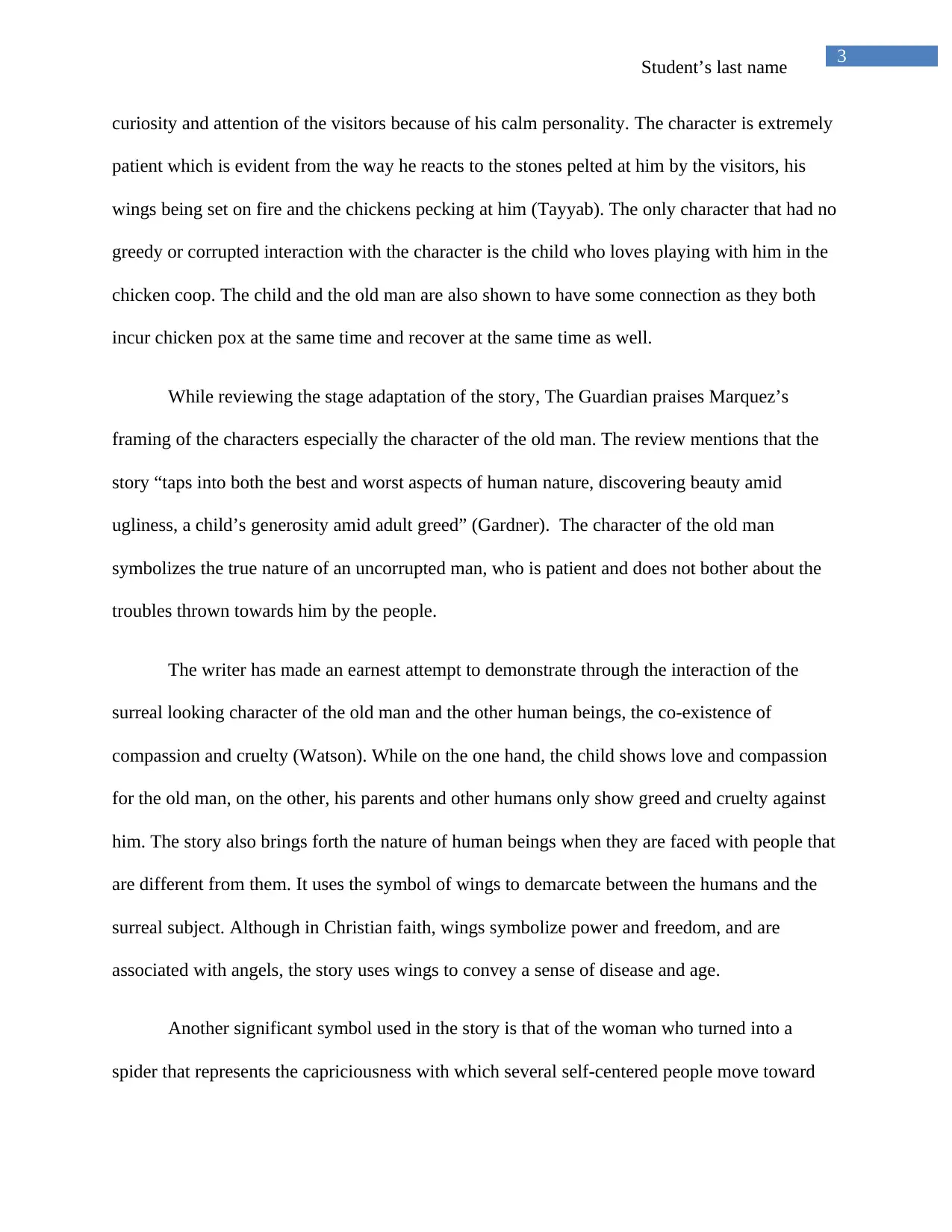
curiosity and attention of the visitors because of his calm personality. The character is extremely
patient which is evident from the way he reacts to the stones pelted at him by the visitors, his
wings being set on fire and the chickens pecking at him (Tayyab). The only character that had no
greedy or corrupted interaction with the character is the child who loves playing with him in the
chicken coop. The child and the old man are also shown to have some connection as they both
incur chicken pox at the same time and recover at the same time as well.
While reviewing the stage adaptation of the story, The Guardian praises Marquez’s
framing of the characters especially the character of the old man. The review mentions that the
story “taps into both the best and worst aspects of human nature, discovering beauty amid
ugliness, a child’s generosity amid adult greed” (Gardner). The character of the old man
symbolizes the true nature of an uncorrupted man, who is patient and does not bother about the
troubles thrown towards him by the people.
The writer has made an earnest attempt to demonstrate through the interaction of the
surreal looking character of the old man and the other human beings, the co-existence of
compassion and cruelty (Watson). While on the one hand, the child shows love and compassion
for the old man, on the other, his parents and other humans only show greed and cruelty against
him. The story also brings forth the nature of human beings when they are faced with people that
are different from them. It uses the symbol of wings to demarcate between the humans and the
surreal subject. Although in Christian faith, wings symbolize power and freedom, and are
associated with angels, the story uses wings to convey a sense of disease and age.
Another significant symbol used in the story is that of the woman who turned into a
spider that represents the capriciousness with which several self-centered people move toward
Student’s last name
curiosity and attention of the visitors because of his calm personality. The character is extremely
patient which is evident from the way he reacts to the stones pelted at him by the visitors, his
wings being set on fire and the chickens pecking at him (Tayyab). The only character that had no
greedy or corrupted interaction with the character is the child who loves playing with him in the
chicken coop. The child and the old man are also shown to have some connection as they both
incur chicken pox at the same time and recover at the same time as well.
While reviewing the stage adaptation of the story, The Guardian praises Marquez’s
framing of the characters especially the character of the old man. The review mentions that the
story “taps into both the best and worst aspects of human nature, discovering beauty amid
ugliness, a child’s generosity amid adult greed” (Gardner). The character of the old man
symbolizes the true nature of an uncorrupted man, who is patient and does not bother about the
troubles thrown towards him by the people.
The writer has made an earnest attempt to demonstrate through the interaction of the
surreal looking character of the old man and the other human beings, the co-existence of
compassion and cruelty (Watson). While on the one hand, the child shows love and compassion
for the old man, on the other, his parents and other humans only show greed and cruelty against
him. The story also brings forth the nature of human beings when they are faced with people that
are different from them. It uses the symbol of wings to demarcate between the humans and the
surreal subject. Although in Christian faith, wings symbolize power and freedom, and are
associated with angels, the story uses wings to convey a sense of disease and age.
Another significant symbol used in the story is that of the woman who turned into a
spider that represents the capriciousness with which several self-centered people move toward
⊘ This is a preview!⊘
Do you want full access?
Subscribe today to unlock all pages.

Trusted by 1+ million students worldwide

4
Student’s last name
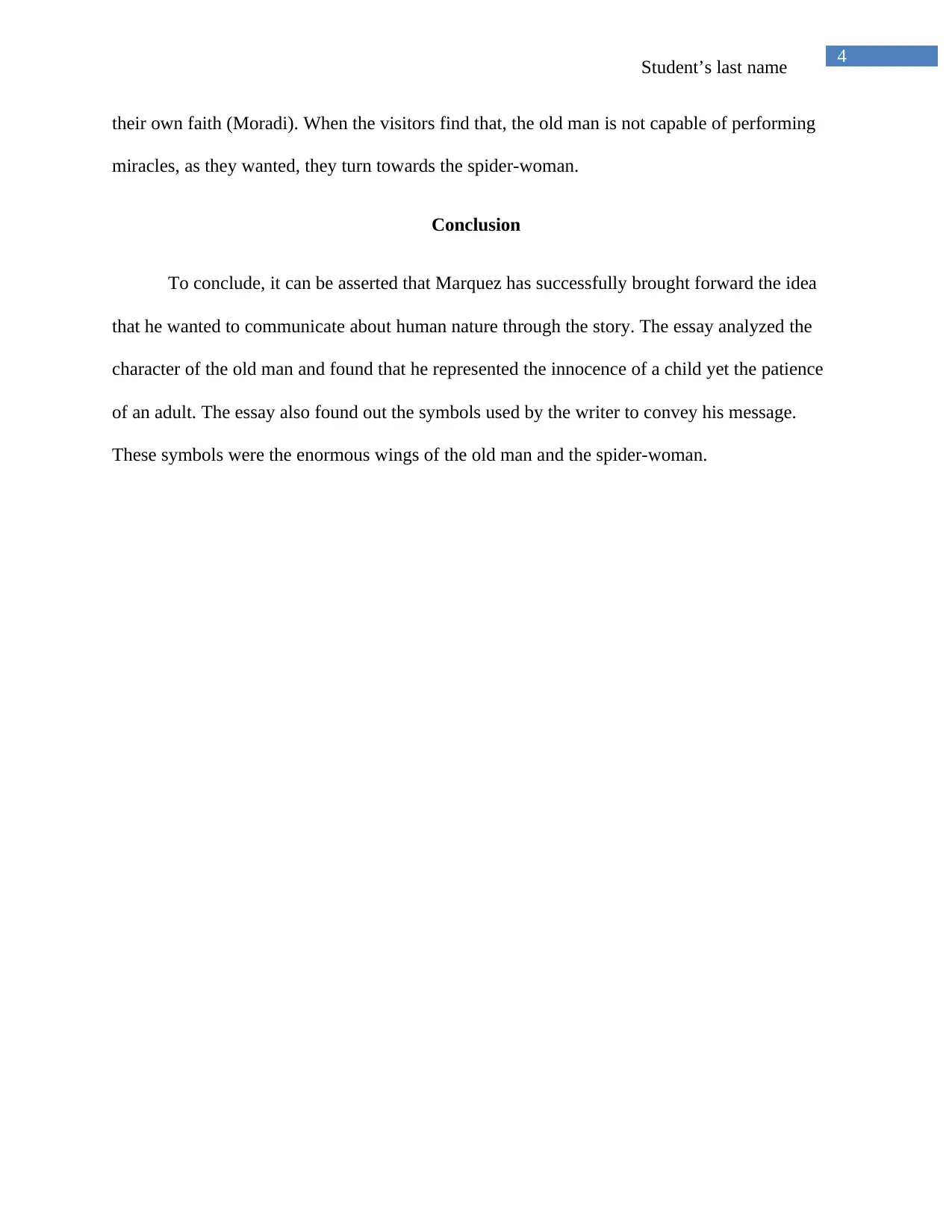
their own faith (Moradi). When the visitors find that, the old man is not capable of performing
miracles, as they wanted, they turn towards the spider-woman.
Conclusion
To conclude, it can be asserted that Marquez has successfully brought forward the idea
that he wanted to communicate about human nature through the story. The essay analyzed the
character of the old man and found that he represented the innocence of a child yet the patience
of an adult. The essay also found out the symbols used by the writer to convey his message.
These symbols were the enormous wings of the old man and the spider-woman.
Student’s last name
their own faith (Moradi). When the visitors find that, the old man is not capable of performing
miracles, as they wanted, they turn towards the spider-woman.
Conclusion
To conclude, it can be asserted that Marquez has successfully brought forward the idea
that he wanted to communicate about human nature through the story. The essay analyzed the
character of the old man and found that he represented the innocence of a child yet the patience
of an adult. The essay also found out the symbols used by the writer to convey his message.
These symbols were the enormous wings of the old man and the spider-woman.
Paraphrase This Document
Need a fresh take? Get an instant paraphrase of this document with our AI Paraphraser

5
Student’s last name
Works cited:
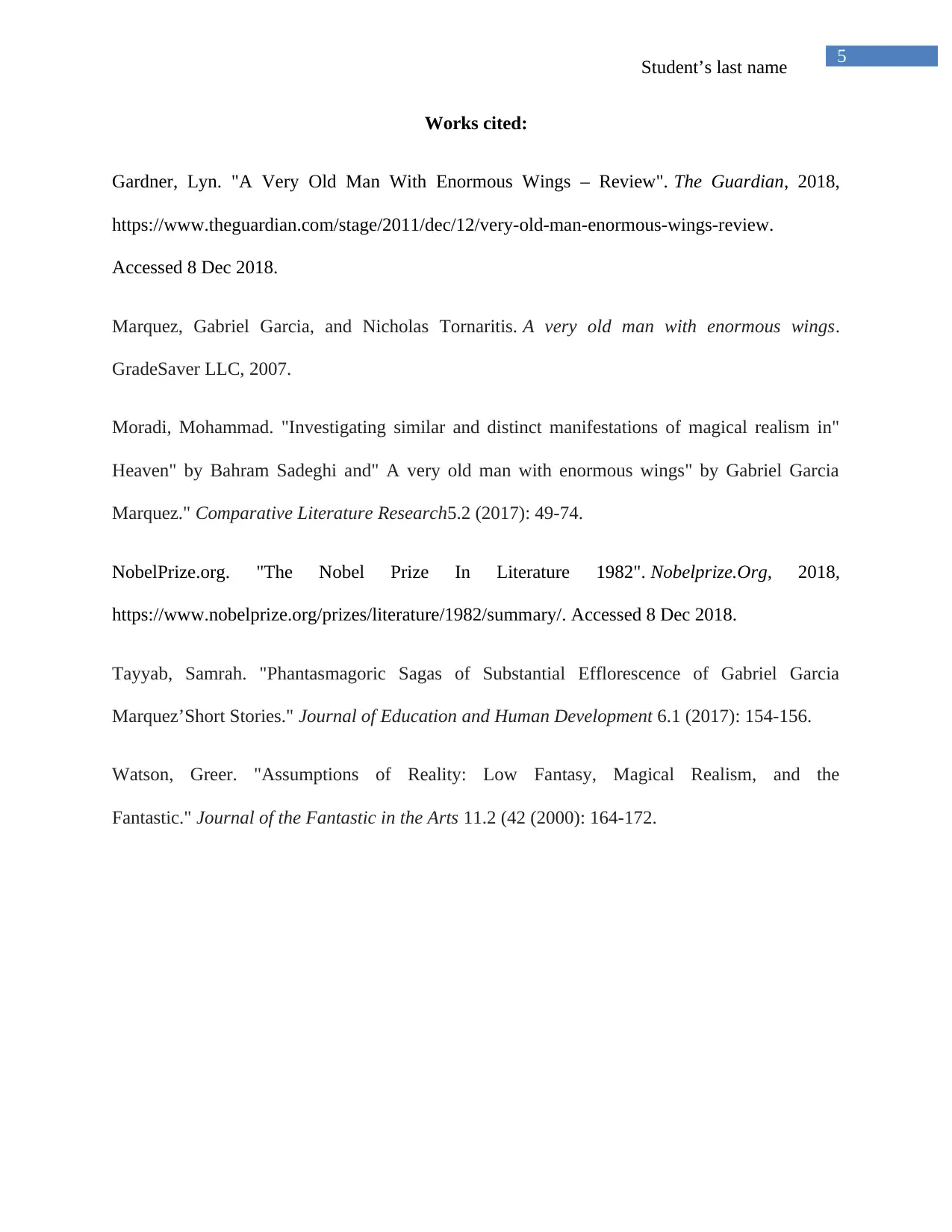
Gardner, Lyn. "A Very Old Man With Enormous Wings – Review". The Guardian, 2018,
https://www.theguardian.com/stage/2011/dec/12/very-old-man-enormous-wings-review.
Accessed 8 Dec 2018.
Marquez, Gabriel Garcia, and Nicholas Tornaritis. A very old man with enormous wings.
GradeSaver LLC, 2007.
Moradi, Mohammad. "Investigating similar and distinct manifestations of magical realism in"
Heaven" by Bahram Sadeghi and" A very old man with enormous wings" by Gabriel Garcia
Marquez." Comparative Literature Research5.2 (2017): 49-74.
NobelPrize.org. "The Nobel Prize In Literature 1982". Nobelprize.Org, 2018,
https://www.nobelprize.org/prizes/literature/1982/summary/. Accessed 8 Dec 2018.
Tayyab, Samrah. "Phantasmagoric Sagas of Substantial Efflorescence of Gabriel Garcia
Marquez’Short Stories." Journal of Education and Human Development 6.1 (2017): 154-156.
Watson, Greer. "Assumptions of Reality: Low Fantasy, Magical Realism, and the
Fantastic." Journal of the Fantastic in the Arts 11.2 (42 (2000): 164-172.
Student’s last name
Works cited:
Gardner, Lyn. "A Very Old Man With Enormous Wings – Review". The Guardian, 2018,
https://www.theguardian.com/stage/2011/dec/12/very-old-man-enormous-wings-review.
Accessed 8 Dec 2018.
Marquez, Gabriel Garcia, and Nicholas Tornaritis. A very old man with enormous wings.
GradeSaver LLC, 2007.
Moradi, Mohammad. "Investigating similar and distinct manifestations of magical realism in"
Heaven" by Bahram Sadeghi and" A very old man with enormous wings" by Gabriel Garcia
Marquez." Comparative Literature Research5.2 (2017): 49-74.
NobelPrize.org. "The Nobel Prize In Literature 1982". Nobelprize.Org, 2018,
https://www.nobelprize.org/prizes/literature/1982/summary/. Accessed 8 Dec 2018.
Tayyab, Samrah. "Phantasmagoric Sagas of Substantial Efflorescence of Gabriel Garcia
Marquez’Short Stories." Journal of Education and Human Development 6.1 (2017): 154-156.
Watson, Greer. "Assumptions of Reality: Low Fantasy, Magical Realism, and the
Fantastic." Journal of the Fantastic in the Arts 11.2 (42 (2000): 164-172.
1 out of 5
Your All-in-One AI-Powered Toolkit for Academic Success.
+13062052269
info@desklib.com
Available 24*7 on WhatsApp / Email
Unlock your academic potential
Copyright © 2020–2026 A2Z Services. All Rights Reserved. Developed and managed by ZUCOL.