Corporate Governance and Stakeholders: Charter Hall Long WALE REIT
VerifiedAdded on 2023/04/03
|16
|3448
|202
Case Study
AI Summary
This case study provides a comprehensive analysis of the corporate governance practices of Charter Hall Long WALE REIT, an Australian Real Estate Investment Trust (REIT) listed on the ASX. It evaluates the company's adherence to corporate governance principles, focusing on its board structure, management methodologies, ethical conduct, and stakeholder communication. The study examines the board's composition, including the roles of independent and non-independent directors, and assesses the effectiveness of its committees. It also explores the company's commitment to ethical business actions through its Codes of Conduct and its approach to Corporate Social Responsibility. The analysis incorporates theories such as agency theory and stewardship theory to understand the board's orientation and its relationship with stakeholders. Furthermore, the case study investigates how Charter Hall uses voluntary disclosures to maintain legitimacy and communicate with its stakeholders, drawing on legitimacy theory and stakeholder theories. The report concludes by highlighting the company's efforts to ensure effective management, promote ethical behavior, and enhance its overall corporate image.
Running Head: Corporate Governance
Corporate Governance
Corporate Governance

Paraphrase This Document
Need a fresh take? Get an instant paraphrase of this document with our AI Paraphraser
Corporate Governance
2
Executive Summary
The growth of neoliberal capital has been instigating the analysis of the question of business in a
modern way, rejecting the older models of profit maximization. Corporate Governance is such
an issue that refers to the systematic functioning of the entire business which has been developed
under the proper appropriation of the business principles morals and ethics. The analysis that
will be developed below will be carrying a comprehensive report regarding an Australian firm to
evaluate how corporate governance does increase the image of the organization in achieving the
business objectives.
2
Executive Summary
The growth of neoliberal capital has been instigating the analysis of the question of business in a
modern way, rejecting the older models of profit maximization. Corporate Governance is such
an issue that refers to the systematic functioning of the entire business which has been developed
under the proper appropriation of the business principles morals and ethics. The analysis that
will be developed below will be carrying a comprehensive report regarding an Australian firm to
evaluate how corporate governance does increase the image of the organization in achieving the
business objectives.
Corporate Governance
3
Table of Contents
Introduction......................................................................................................................................3
Introduction to the Company: A Summarization.............................................................................3
A Brief Summary on Corporate Governance of Charter Hall Long WALE REIT.........................5
Methodology1: Strong Basement for Management.....................................................................5
Methodology 2: The board is the supreme to develop the Nomination Committee....................8
Methodology 3: Ethical and Moral Business Actions.................................................................8
Board Orientation of Charter Hall Group........................................................................................9
Company Communication and Legitimacy Theory......................................................................11
Conclusion.....................................................................................................................................13
References......................................................................................................................................14
3
Table of Contents
Introduction......................................................................................................................................3
Introduction to the Company: A Summarization.............................................................................3
A Brief Summary on Corporate Governance of Charter Hall Long WALE REIT.........................5
Methodology1: Strong Basement for Management.....................................................................5
Methodology 2: The board is the supreme to develop the Nomination Committee....................8
Methodology 3: Ethical and Moral Business Actions.................................................................8
Board Orientation of Charter Hall Group........................................................................................9
Company Communication and Legitimacy Theory......................................................................11
Conclusion.....................................................................................................................................13
References......................................................................................................................................14
⊘ This is a preview!⊘
Do you want full access?
Subscribe today to unlock all pages.

Trusted by 1+ million students worldwide
Corporate Governance
4
Introduction
Corporate Governance is a well-structured set of rules, systems, regulations, practices, and
processes that the entire business organization is directed and controlled by. Corporate
Governance, therefore, is the basic form of the whole principles of a business organization
(Tricker&Tricker, 2015). The question which thus arises is to develop a critical structural model
that would be able to incorporate all the different interests in such a way that not only the
different interests of the stakeholders will be assured but also the holistic ‘interest model’ will
entirely be directed and controlled towards the orientation of achieving the business organization
of the firm (Claessens&Yurtoglu, 2013). Charter Hall Long WALE REIT is a Real Estate
Investment Trust ("REIT") recorded on the ASX in Australia. The REIT is centered on
furnishing investors with steady and secure pay and the credibility for both income and
development of capital through a presentation to long WALE properties. The Charter Hall is
effectively figured out how to develop the portfolio through immediate and aberrant ventures
over numerous real estate sectors (Khan, Muttakin, & Siddiqui, 2013). The REIT is centered
around resources that are overwhelmingly rented to inhabitants with solid contracts on long haul
leases.
Charter Hall Long WALE REIT is overseen by Charter Hall Group, one of Australia's driving
completely incorporated property gatherings, with an experience of more than 27 years'
overseeing amazing real estate for the benefit of institutional, retail, wholesale customers. At
current, Charter Hall has $28.4 billion of assets under administration and oversees 820 properties
over the retail sectors (Armstrong et al., 2015).
Introduction to the Company: A Summarization
The evaluation of the corporate governance in the Charter Hall Long WALE REIT cannot be
carried out critically unless the basic functioning of the business that the company is pursuing
can be briefed (McCahery, Sautner& Starks, 2016). It is due to the development of the
understanding of how the company proceeds in its business, which is impacted by corporate
4
Introduction
Corporate Governance is a well-structured set of rules, systems, regulations, practices, and
processes that the entire business organization is directed and controlled by. Corporate
Governance, therefore, is the basic form of the whole principles of a business organization
(Tricker&Tricker, 2015). The question which thus arises is to develop a critical structural model
that would be able to incorporate all the different interests in such a way that not only the
different interests of the stakeholders will be assured but also the holistic ‘interest model’ will
entirely be directed and controlled towards the orientation of achieving the business organization
of the firm (Claessens&Yurtoglu, 2013). Charter Hall Long WALE REIT is a Real Estate
Investment Trust ("REIT") recorded on the ASX in Australia. The REIT is centered on
furnishing investors with steady and secure pay and the credibility for both income and
development of capital through a presentation to long WALE properties. The Charter Hall is
effectively figured out how to develop the portfolio through immediate and aberrant ventures
over numerous real estate sectors (Khan, Muttakin, & Siddiqui, 2013). The REIT is centered
around resources that are overwhelmingly rented to inhabitants with solid contracts on long haul
leases.
Charter Hall Long WALE REIT is overseen by Charter Hall Group, one of Australia's driving
completely incorporated property gatherings, with an experience of more than 27 years'
overseeing amazing real estate for the benefit of institutional, retail, wholesale customers. At
current, Charter Hall has $28.4 billion of assets under administration and oversees 820 properties
over the retail sectors (Armstrong et al., 2015).
Introduction to the Company: A Summarization
The evaluation of the corporate governance in the Charter Hall Long WALE REIT cannot be
carried out critically unless the basic functioning of the business that the company is pursuing
can be briefed (McCahery, Sautner& Starks, 2016). It is due to the development of the
understanding of how the company proceeds in its business, which is impacted by corporate
Paraphrase This Document
Need a fresh take? Get an instant paraphrase of this document with our AI Paraphraser
Corporate Governance
5
governance. The form and contents of business sense are constituted by the stakeholder's model
—the type of stakeholders, the interests they have and the existing antagonisms between them; it
is essential to brief an overview on the business and its functioning to understand how the
corporate governance is acting upon the company.
Charter Hall's interests are certainly lined up with the REIT's administration and performance.
The REIT will likewise profit by access to Charter Hall's demonstrated reputation in attracting
venture open doors for the company’s assets, with $18 billion of exchanges executed in the
course of the most recent five years, including acquisitions of $12.4 billion and divestment of
$5.6 billion (https://www.longwalereit.com.au/).
The company was enlisted under the Australian Security Exchange in 8th of November, 2016.
The data lastly available from 31st of December, 2018, the following facts are getting revealed
(https://www.longwalereit.com.au/):
The company is possessing 113 properties across Australia.
The company is possessing a portfolio worth $1.87
The company has a capitalization rate of 6.19% if the as weighted average is taken.
The occupancy is 100%
The company is included in the All-World Small Cap Index of MSCI and FTSE
The above-mentioned basic information regarding the company will be helping in developing the
understanding of Corporate Governance in the topics following. The complete data is
deciphering that the company is going through a typical uprise in the Australian market. The
financial success that the company is achieving proves that it is credibly pursuing its business
objectives. The vital issue of the entire research will be targeting the investigation on the
techniques of corporate governance of the company (Yermack, 2017).
A Brief Summary on Corporate Governance of Charter Hall Long WALE REIT
Charter Hall Group (containing Charter Hall Limited and the Charter Hall Property Trust,
recorded together on the ASX) is focused on conveying stable and maintainable comes back to
Security holders and speculators. The Board of the company perceives the significance of proper
administration in accomplishing the business goals and in releasing its obligations to all partners
5
governance. The form and contents of business sense are constituted by the stakeholder's model
—the type of stakeholders, the interests they have and the existing antagonisms between them; it
is essential to brief an overview on the business and its functioning to understand how the
corporate governance is acting upon the company.
Charter Hall's interests are certainly lined up with the REIT's administration and performance.
The REIT will likewise profit by access to Charter Hall's demonstrated reputation in attracting
venture open doors for the company’s assets, with $18 billion of exchanges executed in the
course of the most recent five years, including acquisitions of $12.4 billion and divestment of
$5.6 billion (https://www.longwalereit.com.au/).
The company was enlisted under the Australian Security Exchange in 8th of November, 2016.
The data lastly available from 31st of December, 2018, the following facts are getting revealed
(https://www.longwalereit.com.au/):
The company is possessing 113 properties across Australia.
The company is possessing a portfolio worth $1.87
The company has a capitalization rate of 6.19% if the as weighted average is taken.
The occupancy is 100%
The company is included in the All-World Small Cap Index of MSCI and FTSE
The above-mentioned basic information regarding the company will be helping in developing the
understanding of Corporate Governance in the topics following. The complete data is
deciphering that the company is going through a typical uprise in the Australian market. The
financial success that the company is achieving proves that it is credibly pursuing its business
objectives. The vital issue of the entire research will be targeting the investigation on the
techniques of corporate governance of the company (Yermack, 2017).
A Brief Summary on Corporate Governance of Charter Hall Long WALE REIT
Charter Hall Group (containing Charter Hall Limited and the Charter Hall Property Trust,
recorded together on the ASX) is focused on conveying stable and maintainable comes back to
Security holders and speculators. The Board of the company perceives the significance of proper
administration in accomplishing the business goals and in releasing its obligations to all partners
Corporate Governance
6
of the Group (Edmans, 2014). Charter Hall's administration system, as outlined in this Corporate
Governance (Statement), has been intended to guarantee that the company is successfully dealt
with; that the statutory commitments are met, and that Charter Hall's way of life of corporate
trustworthiness is strengthened. The thought is given to the Corporate Governance Standards and
Recommendations by the ASX Corporate Governance Council (ASX Corporate Governance
Principles) (Crowther&Seifi, 2018).
Methodology1: Strong Basement for Management
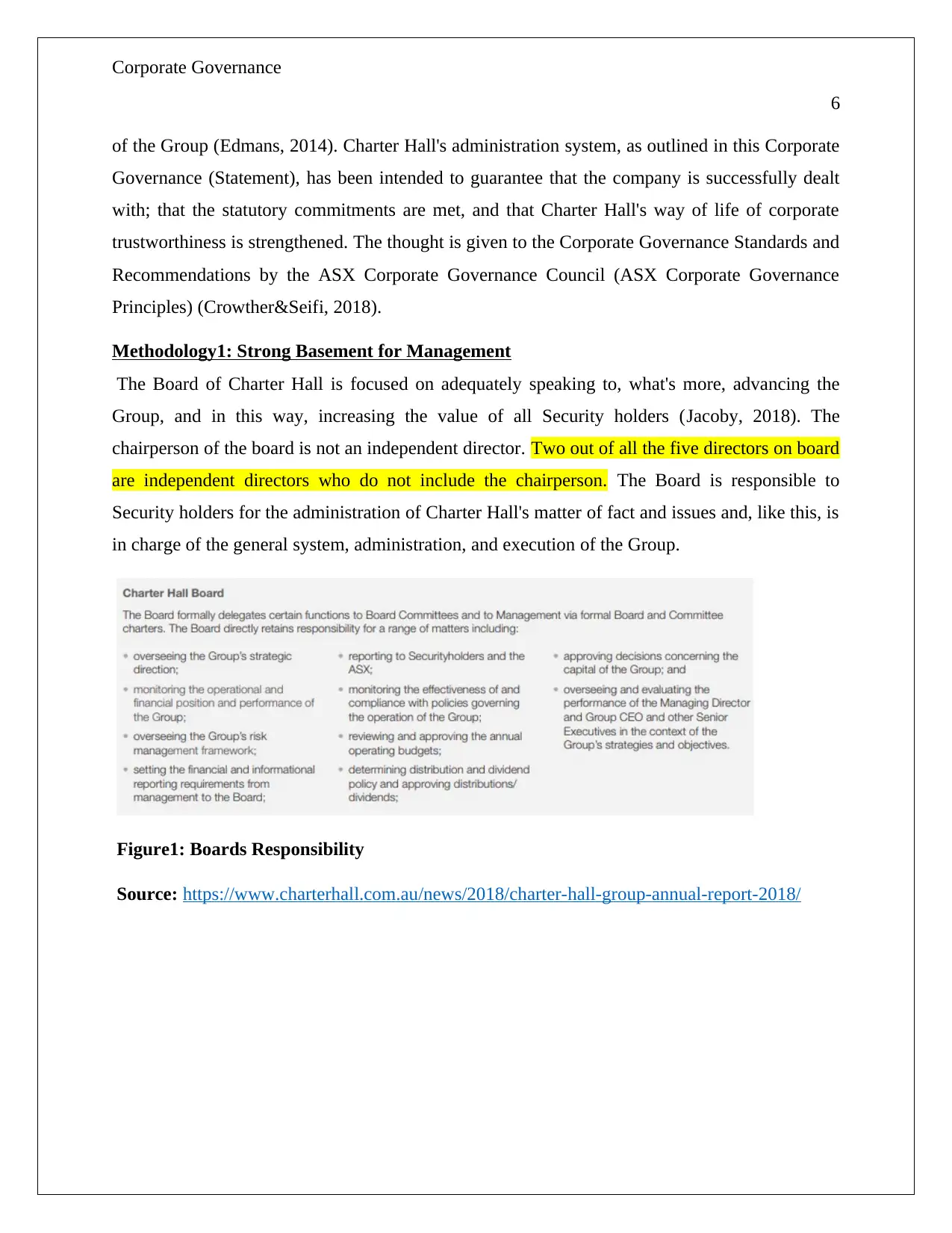
The Board of Charter Hall is focused on adequately speaking to, what's more, advancing the
Group, and in this way, increasing the value of all Security holders (Jacoby, 2018). The
chairperson of the board is not an independent director. Two out of all the five directors on board
are independent directors who do not include the chairperson. The Board is responsible to
Security holders for the administration of Charter Hall's matter of fact and issues and, like this, is
in charge of the general system, administration, and execution of the Group.
Figure1: Boards Responsibility
Source: https://www.charterhall.com.au/news/2018/charter-hall-group-annual-report-2018/
6
of the Group (Edmans, 2014). Charter Hall's administration system, as outlined in this Corporate
Governance (Statement), has been intended to guarantee that the company is successfully dealt
with; that the statutory commitments are met, and that Charter Hall's way of life of corporate
trustworthiness is strengthened. The thought is given to the Corporate Governance Standards and
Recommendations by the ASX Corporate Governance Council (ASX Corporate Governance
Principles) (Crowther&Seifi, 2018).
Methodology1: Strong Basement for Management
The Board of Charter Hall is focused on adequately speaking to, what's more, advancing the
Group, and in this way, increasing the value of all Security holders (Jacoby, 2018). The
chairperson of the board is not an independent director. Two out of all the five directors on board
are independent directors who do not include the chairperson. The Board is responsible to
Security holders for the administration of Charter Hall's matter of fact and issues and, like this, is
in charge of the general system, administration, and execution of the Group.
Figure1: Boards Responsibility
Source: https://www.charterhall.com.au/news/2018/charter-hall-group-annual-report-2018/
⊘ This is a preview!⊘
Do you want full access?
Subscribe today to unlock all pages.
Trusted by 1+ million students worldwide
Corporate Governance
7
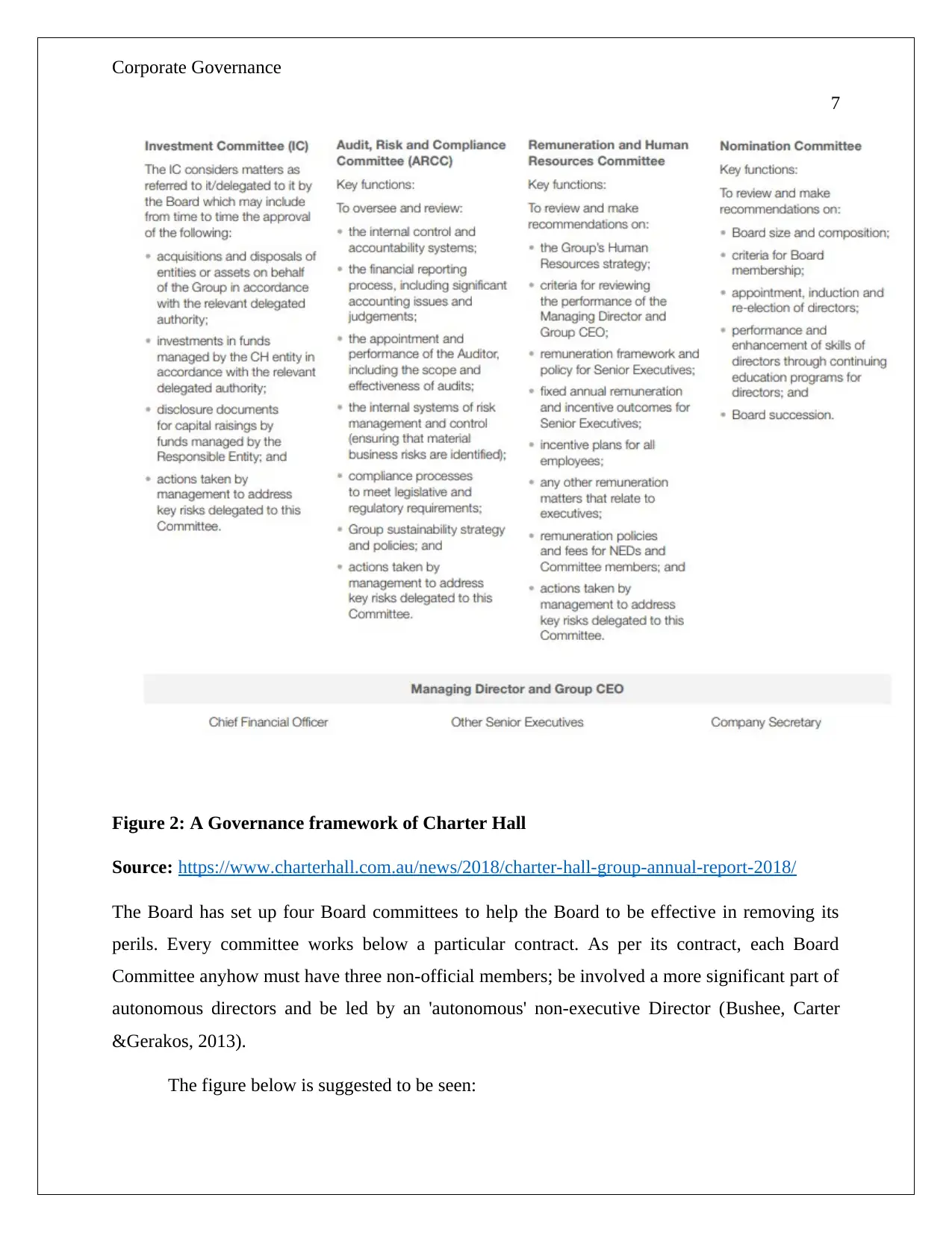
Figure 2: A Governance framework of Charter Hall
Source: https://www.charterhall.com.au/news/2018/charter-hall-group-annual-report-2018/
The Board has set up four Board committees to help the Board to be effective in removing its
perils. Every committee works below a particular contract. As per its contract, each Board
Committee anyhow must have three non-official members; be involved a more significant part of
autonomous directors and be led by an 'autonomous' non-executive Director (Bushee, Carter
&Gerakos, 2013).
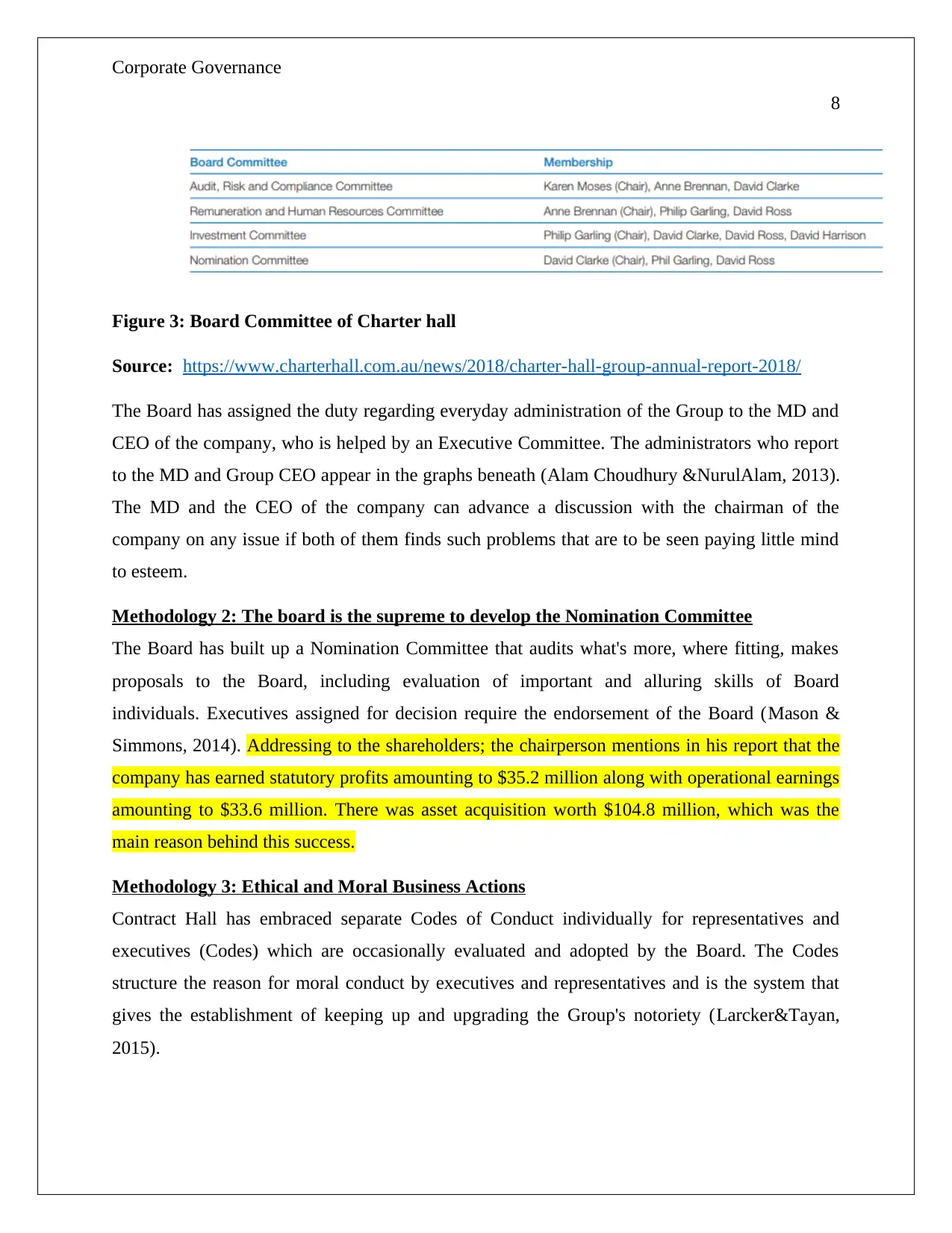
The figure below is suggested to be seen:
7
Figure 2: A Governance framework of Charter Hall
Source: https://www.charterhall.com.au/news/2018/charter-hall-group-annual-report-2018/
The Board has set up four Board committees to help the Board to be effective in removing its
perils. Every committee works below a particular contract. As per its contract, each Board
Committee anyhow must have three non-official members; be involved a more significant part of
autonomous directors and be led by an 'autonomous' non-executive Director (Bushee, Carter
&Gerakos, 2013).
The figure below is suggested to be seen:
Paraphrase This Document
Need a fresh take? Get an instant paraphrase of this document with our AI Paraphraser
Corporate Governance
8
Figure 3: Board Committee of Charter hall
Source: https://www.charterhall.com.au/news/2018/charter-hall-group-annual-report-2018/
The Board has assigned the duty regarding everyday administration of the Group to the MD and
CEO of the company, who is helped by an Executive Committee. The administrators who report
to the MD and Group CEO appear in the graphs beneath (Alam Choudhury &NurulAlam, 2013).
The MD and the CEO of the company can advance a discussion with the chairman of the
company on any issue if both of them finds such problems that are to be seen paying little mind
to esteem.
Methodology 2: The board is the supreme to develop the Nomination Committee
The Board has built up a Nomination Committee that audits what's more, where fitting, makes
proposals to the Board, including evaluation of important and alluring skills of Board
individuals. Executives assigned for decision require the endorsement of the Board (Mason &
Simmons, 2014). Addressing to the shareholders; the chairperson mentions in his report that the
company has earned statutory profits amounting to $35.2 million along with operational earnings
amounting to $33.6 million. There was asset acquisition worth $104.8 million, which was the
main reason behind this success.
Methodology 3: Ethical and Moral Business Actions
Contract Hall has embraced separate Codes of Conduct individually for representatives and
executives (Codes) which are occasionally evaluated and adopted by the Board. The Codes
structure the reason for moral conduct by executives and representatives and is the system that
gives the establishment of keeping up and upgrading the Group's notoriety (Larcker&Tayan,
2015).
8
Figure 3: Board Committee of Charter hall
Source: https://www.charterhall.com.au/news/2018/charter-hall-group-annual-report-2018/
The Board has assigned the duty regarding everyday administration of the Group to the MD and
CEO of the company, who is helped by an Executive Committee. The administrators who report
to the MD and Group CEO appear in the graphs beneath (Alam Choudhury &NurulAlam, 2013).
The MD and the CEO of the company can advance a discussion with the chairman of the
company on any issue if both of them finds such problems that are to be seen paying little mind
to esteem.
Methodology 2: The board is the supreme to develop the Nomination Committee
The Board has built up a Nomination Committee that audits what's more, where fitting, makes
proposals to the Board, including evaluation of important and alluring skills of Board
individuals. Executives assigned for decision require the endorsement of the Board (Mason &
Simmons, 2014). Addressing to the shareholders; the chairperson mentions in his report that the
company has earned statutory profits amounting to $35.2 million along with operational earnings
amounting to $33.6 million. There was asset acquisition worth $104.8 million, which was the
main reason behind this success.
Methodology 3: Ethical and Moral Business Actions
Contract Hall has embraced separate Codes of Conduct individually for representatives and
executives (Codes) which are occasionally evaluated and adopted by the Board. The Codes
structure the reason for moral conduct by executives and representatives and is the system that
gives the establishment of keeping up and upgrading the Group's notoriety (Larcker&Tayan,
2015).
Corporate Governance
9
Board Orientation of the company
This discussion will be developed under the formal understanding on how the functioning inside
the company has been carried out to decide the orientation of the board of the directors—the
atmosphere of the work and business culture inside the company in holistic form. Board
orientation can be of different types. There are several criteria that are used to judge the kind of
board orientation that exists in a company, and one such criterion is the number of independent
and non-independent directors. For CLW Australia we have 2 directors that are independent and
3 others who are non-independent, including the chairperson. With the analysis of the board
composition, we can compare two theories. The first theory would be the agency theory. This
theory offers an approach where the majority directors of the board are all independent director
meaning they do not have direct ties to the company but are appointed by the shareholders f the
company and paid for their consultancy services. Secondly, we have the stewardship board
theory wherein the board consists of a majority on non-independent directors. In the stewardship
sort of orientation of a board in a company, these board members are focused on growing
business assets. The basic difference between an agency board orientation and stewardship board
orientation is that the independent members of the agency board solely focus on the goals that
are instructed by the shareholders they work for. This may include dividends, profit, and growth.
In comparison to this, the stewardship board orientation has a different agenda for its non-
independent members. It mainly focuses on the growth of the business. This is done on behalf of
the shareholders of the company. The outcomes of these two approaches are also different from
each other. As an agency type orientation of board looks after the stakeholder's needs, it is
destined to go along the same line and develop business strategies based on that. In case of a
stewardship board orientation, all stakeholder's needs are looked after, and several approaches
are taken to find out holistic strategies that would work in everyone's favor. Another significant
difference in these two approaches is that the agency board mostly looks over remuneration
reports, financial reports that would favor and safeguard the few influential stakeholders while
the stewardship board members focus more on the ethical line of the business and have a deeper
sense of Corporate Social Responsibility. This ethical approach of the board can be witnessed in
many forms. Mainly focused on Corporate Social Responsibility, these kinds of boards have
more potential to look forward to client and customer needs, keep the line of business running
9
Board Orientation of the company
This discussion will be developed under the formal understanding on how the functioning inside
the company has been carried out to decide the orientation of the board of the directors—the
atmosphere of the work and business culture inside the company in holistic form. Board
orientation can be of different types. There are several criteria that are used to judge the kind of
board orientation that exists in a company, and one such criterion is the number of independent
and non-independent directors. For CLW Australia we have 2 directors that are independent and
3 others who are non-independent, including the chairperson. With the analysis of the board
composition, we can compare two theories. The first theory would be the agency theory. This
theory offers an approach where the majority directors of the board are all independent director
meaning they do not have direct ties to the company but are appointed by the shareholders f the
company and paid for their consultancy services. Secondly, we have the stewardship board
theory wherein the board consists of a majority on non-independent directors. In the stewardship
sort of orientation of a board in a company, these board members are focused on growing
business assets. The basic difference between an agency board orientation and stewardship board
orientation is that the independent members of the agency board solely focus on the goals that
are instructed by the shareholders they work for. This may include dividends, profit, and growth.
In comparison to this, the stewardship board orientation has a different agenda for its non-
independent members. It mainly focuses on the growth of the business. This is done on behalf of
the shareholders of the company. The outcomes of these two approaches are also different from
each other. As an agency type orientation of board looks after the stakeholder's needs, it is
destined to go along the same line and develop business strategies based on that. In case of a
stewardship board orientation, all stakeholder's needs are looked after, and several approaches
are taken to find out holistic strategies that would work in everyone's favor. Another significant
difference in these two approaches is that the agency board mostly looks over remuneration
reports, financial reports that would favor and safeguard the few influential stakeholders while
the stewardship board members focus more on the ethical line of the business and have a deeper
sense of Corporate Social Responsibility. This ethical approach of the board can be witnessed in
many forms. Mainly focused on Corporate Social Responsibility, these kinds of boards have
more potential to look forward to client and customer needs, keep the line of business running
⊘ This is a preview!⊘
Do you want full access?
Subscribe today to unlock all pages.
Trusted by 1+ million students worldwide
Corporate Governance
10
ethically and also voluntarily disclose all relevant data belonging to Corporate Social
Responsibility. To develop this discussion, the below-mentioned points are needed to be
mentioned to secure a compact and comprehensive understanding (Misangyi& Acharya, 2014).
Before starting the entire discussion, it is to be mentioned critically that the development of the
business functioning in recent days are being generally oriented in a most democratic and non-
authoritarian way using transformational leadership theory to develop a culture where every staff
can raise his or her opinion at their corresponding level.
The following points in this regard can be taken into account:
The Board has built up an Audit Risk and Compliance Committee (ARCC) to supervise the
quality and respectability of bookkeeping, review, money related and chance administration
rehearses for the Group (Sapra, Subramanian & Subramanian, 2014). The ARCC has involved
just autonomous executives and is led by a free chief who isn't the Chairman of the Board. The
Board has built up a Charter which sets out the Committee's job, obligations, and creation,
structure and enrolment prerequisites. The duties of ARCC are:
Surveying the internal framework of the company
screen the uprightness of the fiscal summaries
consider massive budgetary revealing incidents and decisions made regarding the
company’s budget reports
survey and advise the board of directors on issues identifying with the auditor
screen consistence by the company with legitimate and administrative prerequisites
audit the portion of crucial dangers to the applicable Committee
routinely screen chance administration reports given by the board
Evaluate at standard interims whether the Group's consistency plan, inward financial
control frameworks, hazard the board strategies, and hazard the executive's frameworks
are satisfactory (Jiang & Kim, 2015).
The Committee's present enrolment is set out under the segment 'Board Committees' prior in this
announcement, and the autonomy of the individuals is given in the report of directors. Subtleties
of the committee's gatherings for the announcing time frame, and individual’s participation, are
additionally given in the Directors' Report. The Board surveys typically the aptitudes and ability
10
ethically and also voluntarily disclose all relevant data belonging to Corporate Social
Responsibility. To develop this discussion, the below-mentioned points are needed to be
mentioned to secure a compact and comprehensive understanding (Misangyi& Acharya, 2014).
Before starting the entire discussion, it is to be mentioned critically that the development of the
business functioning in recent days are being generally oriented in a most democratic and non-
authoritarian way using transformational leadership theory to develop a culture where every staff
can raise his or her opinion at their corresponding level.
The following points in this regard can be taken into account:
The Board has built up an Audit Risk and Compliance Committee (ARCC) to supervise the
quality and respectability of bookkeeping, review, money related and chance administration
rehearses for the Group (Sapra, Subramanian & Subramanian, 2014). The ARCC has involved
just autonomous executives and is led by a free chief who isn't the Chairman of the Board. The
Board has built up a Charter which sets out the Committee's job, obligations, and creation,
structure and enrolment prerequisites. The duties of ARCC are:
Surveying the internal framework of the company
screen the uprightness of the fiscal summaries
consider massive budgetary revealing incidents and decisions made regarding the
company’s budget reports
survey and advise the board of directors on issues identifying with the auditor
screen consistence by the company with legitimate and administrative prerequisites
audit the portion of crucial dangers to the applicable Committee
routinely screen chance administration reports given by the board
Evaluate at standard interims whether the Group's consistency plan, inward financial
control frameworks, hazard the board strategies, and hazard the executive's frameworks
are satisfactory (Jiang & Kim, 2015).
The Committee's present enrolment is set out under the segment 'Board Committees' prior in this
announcement, and the autonomy of the individuals is given in the report of directors. Subtleties
of the committee's gatherings for the announcing time frame, and individual’s participation, are
additionally given in the Directors' Report. The Board surveys typically the aptitudes and ability
Paraphrase This Document
Need a fresh take? Get an instant paraphrase of this document with our AI Paraphraser
Corporate Governance
11
of individuals from the ARCC and have verified that individuals from the ARCC have a fitting
dimension of budgetary and property industry mastery to release their duties.
To observe and oversee the managerial conflicts, the company has developed the following
measures:
Board individuals must proclaim their notions according to the laws and regulations of
corporate governance.
Board individuals with an individual material enthusiasm for an issue are not to be
available at a Board meeting amid the thought of the problem and consequent vote except
if the Board (barring the applicable Board part) settle generally;
Board individuals with a contention not including a material individual intrigue might be
required to missing themselves from the essential consultations of the Board.
Extensively, the committee is in charge of auditing and making suggestions to the Board in
regard of official compensation and impetus approaches; value based motivator plans; assorted
variety and consideration destinations; ability the executives and progression arranging; and
enrolment, maintenance, execution estimation, and end strategies and methods.
There are two principles defined in the company named as Securities Trading Policy and
Performance Rights Offer Plan that allow the staffs of the company, starting from the executives
to the general members. The company's law applies to everyone to their associated duties and
task.
Company Communication and Legitimacy Theory
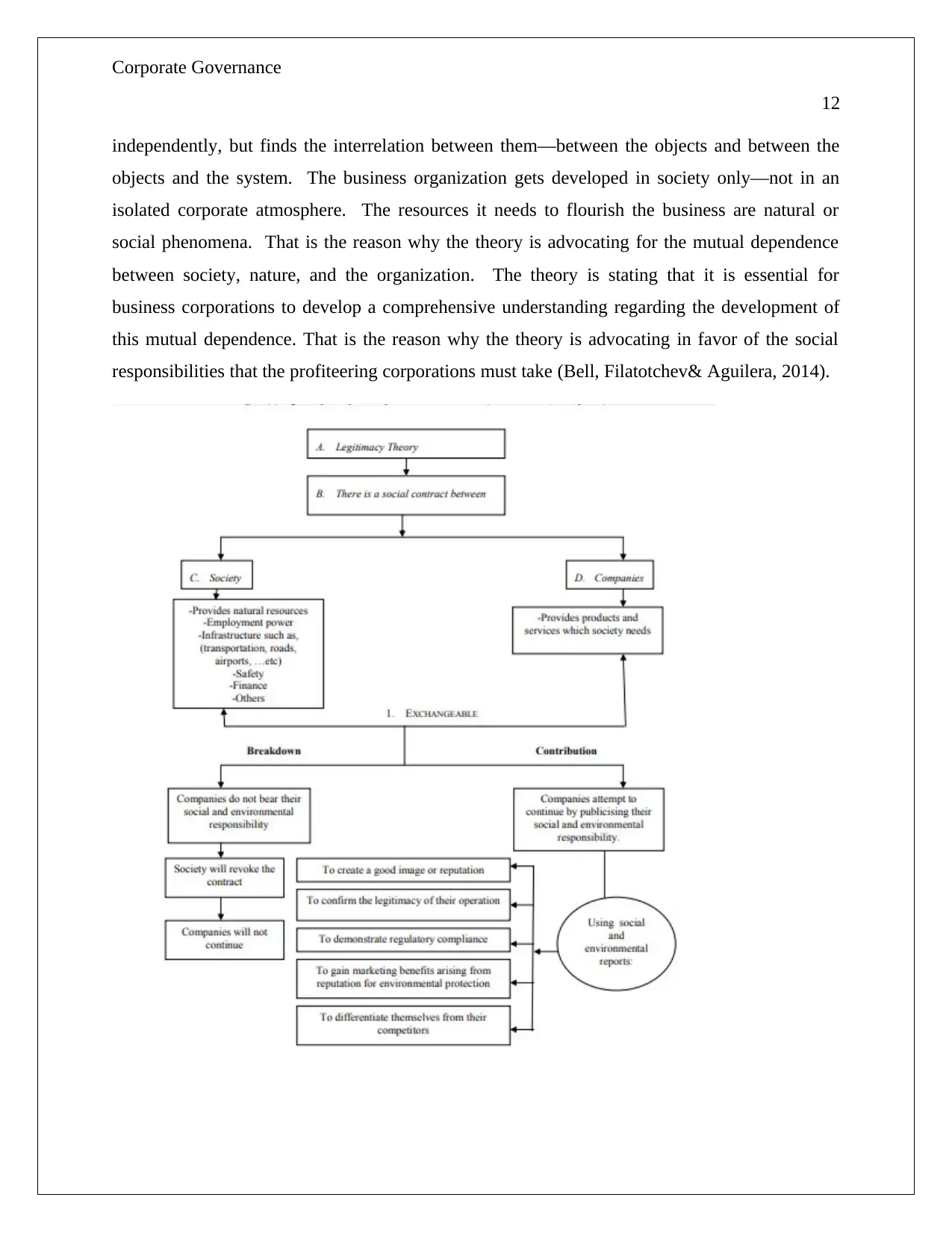
The legitimacy theory deals with the triangular relationship that is maintained between a
business organization, society, and nature. This theory simply deals with maintaining a healthy
relationship with stakeholders and provides relevant information of the company directed at
different groups depending on relevance to establish their credibility. There are ethical grounds
involved with legitimacy theory as this would be a way to make the organization seem legitimate
to the group to which the information is targeted at. Before developing any critical theoretical
model or diagram, it is essential to understand the philosophy that the theory is speaking about,
The philosophy behind this theory is a holistic one that identifies every object in a system not
11
of individuals from the ARCC and have verified that individuals from the ARCC have a fitting
dimension of budgetary and property industry mastery to release their duties.
To observe and oversee the managerial conflicts, the company has developed the following
measures:
Board individuals must proclaim their notions according to the laws and regulations of
corporate governance.
Board individuals with an individual material enthusiasm for an issue are not to be
available at a Board meeting amid the thought of the problem and consequent vote except
if the Board (barring the applicable Board part) settle generally;
Board individuals with a contention not including a material individual intrigue might be
required to missing themselves from the essential consultations of the Board.
Extensively, the committee is in charge of auditing and making suggestions to the Board in
regard of official compensation and impetus approaches; value based motivator plans; assorted
variety and consideration destinations; ability the executives and progression arranging; and
enrolment, maintenance, execution estimation, and end strategies and methods.
There are two principles defined in the company named as Securities Trading Policy and
Performance Rights Offer Plan that allow the staffs of the company, starting from the executives
to the general members. The company's law applies to everyone to their associated duties and
task.
Company Communication and Legitimacy Theory
The legitimacy theory deals with the triangular relationship that is maintained between a
business organization, society, and nature. This theory simply deals with maintaining a healthy
relationship with stakeholders and provides relevant information of the company directed at
different groups depending on relevance to establish their credibility. There are ethical grounds
involved with legitimacy theory as this would be a way to make the organization seem legitimate
to the group to which the information is targeted at. Before developing any critical theoretical
model or diagram, it is essential to understand the philosophy that the theory is speaking about,
The philosophy behind this theory is a holistic one that identifies every object in a system not
Corporate Governance
12
independently, but finds the interrelation between them—between the objects and between the
objects and the system. The business organization gets developed in society only—not in an
isolated corporate atmosphere. The resources it needs to flourish the business are natural or
social phenomena. That is the reason why the theory is advocating for the mutual dependence
between society, nature, and the organization. The theory is stating that it is essential for
business corporations to develop a comprehensive understanding regarding the development of
this mutual dependence. That is the reason why the theory is advocating in favor of the social
responsibilities that the profiteering corporations must take (Bell, Filatotchev& Aguilera, 2014).
12
independently, but finds the interrelation between them—between the objects and between the
objects and the system. The business organization gets developed in society only—not in an
isolated corporate atmosphere. The resources it needs to flourish the business are natural or
social phenomena. That is the reason why the theory is advocating for the mutual dependence
between society, nature, and the organization. The theory is stating that it is essential for
business corporations to develop a comprehensive understanding regarding the development of
this mutual dependence. That is the reason why the theory is advocating in favor of the social
responsibilities that the profiteering corporations must take (Bell, Filatotchev& Aguilera, 2014).
⊘ This is a preview!⊘
Do you want full access?
Subscribe today to unlock all pages.
Trusted by 1+ million students worldwide

1 out of 16


Related Documents


Your All-in-One AI-Powered Toolkit for Academic Success.
+13062052269
info@desklib.com
Available 24*7 on WhatsApp / Email
![[object Object]](/_next/static/media/star-bottom.7253800d.svg)
Unlock your academic potential
Copyright © 2020–2026 A2Z Services. All Rights Reserved. Developed and managed by ZUCOL.